Giambologna’s Mercury

Giambologna, 1529-1608
Mercury, 1564-65, Bronze, Height: 1.87 m, National Museum of Bargello, Florence, Italy – Photo Credit: Amalia Spiliakou, April 2025

High in the dome of Heaven, behold the bright Caduceus-Bearer soared on balanced wings… With these words from Metamorphoses, Ovid captures the essence of Mercury—the swift-footed messenger of the gods, gliding effortlessly between the realms of men and Olympus. Few sculptures have embodied this celestial lightness more vividly than Giambologna’s Mercury, housed in Florence’s Bargello Museum. A masterpiece of Mannerist sculpture, this bronze figure defies gravity, poised mid-flight with one foot balanced on a puff of air, as if the god himself has just touched down—or is about to vanish upward. Both a technical marvel and a poetic tribute to divine motion, Giambologna’s Mercury invites us to consider how myth and material can together create the illusion of weightless divinity. https://www.perseus.tufts.edu/hopper/text?doc=Perseus%3Atext%3A1999.02.0028%3Abook%3D2%3Acard%3D708 Ovid’s Book II, lines 708-832

Giambologna, born Jean Boulogne in 1529 in Douai, Flanders (now northern France), was one of the most celebrated sculptors of the late Renaissance. Trained in the Flemish tradition, he moved to Italy in his twenties, where the grandeur of classical antiquity and the influence of Michelangelo deeply shaped his artistic vision. After a period of study in Rome, he settled in Florence and entered the service of the powerful Medici family, becoming their official sculptor. Giambologna spent most of his career in Florence, where he produced a prolific body of work for public spaces, churches, and the Medici court. His art, which bridged the High Renaissance and early Baroque, earned him fame across Europe, and his reputation led to commissions from prominent patrons beyond Italy, including the kings of France and Spain.

Giambologna’s sculptures are renowned for their dynamic movement, elegant elongation, and mastery of anatomy, often conveying a sense of fluid motion frozen in bronze or marble. He favored spiraling compositions and complex, multi-viewpoint figures—hallmarks of the Mannerist style that pushed beyond the balanced harmony of the High Renaissance. Works like The Rape of the Sabine Women and Mercury exemplify his ability to animate mythological subjects with theatricality and grace. Mercury, in particular, showcases his signature elegance: the god is captured in a moment of upward flight, supported by a breath of wind and pointing heavenward with refined poise. Giambologna’s attention to surface detail, psychological expression, and compositional ingenuity placed him among the most innovative sculptors of his time and helped define the artistic identity of late 16th-century Florence.

Giambologna, 1529-1608
Mercury (detail), 1564-65, Bronze, Height: 1.87 m, National Museum of Bargello, Florence, Italy https://michelangelobuonarrotietornato.com/2023/07/17/la-scultura-del-giorno-il-mercurio-volante-del-giambologna/

About a month ago, I found myself standing in one of Florence’s most quietly astonishing museums—the Bargello—and there, in a sunlit corner of its vaulted Renaissance halls, I met Mercury. Not the planet or the element, but Giambologna’s bronze god in flight. He’s impossibly light, captured in the instant of takeoff, one toe barely touching a breath of wind. His arm stretches skyward, guiding your eyes along the elegant arc of his body, as if he might vanish through the ceiling at any moment. With his winged sandals and caduceus in hand, he’s unmistakably the divine messenger—but in this version, he’s also youth, grace, and motion incarnate.

What struck me most wasn’t just the technical feat—though balancing a tall bronze figure on a single outstretched toe is no small thing—it was the way the statue invites you to move. Walk around him and the pose unfolds like choreography: the twist of his torso, the reach of his arm, the lift in his stride. Giambologna, a master of Mannerist sculpture, was clearly less interested in stillness than in storytelling. Here, Mercury isn’t simply frozen in time; he’s becoming. There’s a rhythm to his limbs, a musicality even in the tension of his muscles. You don’t just look at this sculpture—you orbit it.

Giambologna, 1529-1608
Mercury (detail), 1564-65, Bronze, Height: 1.87 m, National Museum of Bargello, Florence, Italy https://michelangelobuonarrotietornato.com/2023/07/17/la-scultura-del-giorno-il-mercurio-volante-del-giambologna/

Like so much in Florence, this statue comes with a backstory as rich as the bronze it’s cast in. Vasari, ever the gossipy biographer of Renaissance artists, tells us that Giambologna originally made a version of Mercury as a gift for Emperor Maximilian II. The emperor, a Medici ally through marriage, fancied himself a kind of modern Mercury—nimble, clever, divinely connected—so Cosimo I had no trouble choosing a fitting diplomatic token. The version at the Bargello may not be that statue; scholars have debated whether it’s an earlier, imperfect casting or a later variant, possibly made around 1580. Records show it turning up in Rome that same year, decorating the gardens of a Medici villa. Somehow, over the centuries, it made its way back to Florence—where I, and countless others, have been lucky enough to encounter it in mid-flight.

In a city overflowing with artistic treasures, it’s easy to feel overwhelmed—but my visit to the Bargello will always stand out, thanks to Mercury. There was something unforgettable about encountering a figure so full of motion and lightness in such a quiet, grounded space. Giambologna’s Mercury doesn’t just capture a mythological god; it captures the wonder of seeing art defy gravity, time, and expectation. Long after leaving the museum’s cool stone halls, it was Mercury who lingered in my thoughts—mid-air, timeless, and still soaring.

For a PowerPoint Presentation of Giambologna’s oeuvre, inspired by Giambologna’s Mercury, please… Check HERE!

Bibliography: https://catalogo.beniculturali.it/CulturalInstituteOrSite/fd60027675ee78994f1fa2f8e4c16f45

A former Teacher Curator BLOG POST on Giambologna is titled The Colosso del’Appenino by Giambologna. It can be reached… https://www.teachercurator.com/art/the-colosso-delappennino-by-giambologna/

Imperial Basket with Lilies of the Valley

House of Carl Fabergé – Workmaster: August Wilhelm Holmström
Imperial Lilies-of-the-Valley Basket, 1896, Yellow and green gold, silver, nephrite, pearl, rose-cut diamond, 19.1 x 21.6 x 14.9 cm, the MET, NY, USA https://www.metmuseum.org/art/collection/search/238777

Nestled within the glittering galleries of the Metropolitan Museum of Art in New York, the Fabergé Imperial Basket with Lilies of the Valley quietly dazzles with its delicate beauty and imperial legacy. More than a stunning example of Russian craftsmanship, this golden basket tells a story steeped in history, sentiment, and symbolism. In the summer of 1896, during a celebratory visit to the Russian Trade, Industrial and Art Exhibition in Nizhny Novgorod, Emperor Nicholas II and Empress Alexandra Feodorovna were honored with this extraordinary gift. As contemporary newspapers recounted, “When Their Majesties got out of the carriage (…), another delegation was honored to present the Empress with a wonderful golden basket with golden branches of lilies of the valley, on which pearl flowers covered with diamond dew swayed.” The gesture, offered by Mr. Volkov on behalf of the iron breeders and traders of Siberia, was a tribute to “our reverent love and loyal devotion.” Today, this opulent token of imperial grace resides far from its origin, yet it continues to whisper of an era when jewels spoke the language of loyalty and love. https://www.instagram.com/russian_treasure/p/DBZEJeqoEzs/?img_index=1

Peter Carl Fabergé was a master jeweller and goldsmith of the Russian Empire, renowned for his exquisite and intricate craftsmanship, particularly in the creation of the famed Fabergé eggs. Born in Saint Petersburg in 1846 into a family of French Huguenot descent, Fabergé inherited his father’s jewelry business and elevated it to extraordinary heights of artistic and commercial success. He became most famous for the series of elaborately decorated Easter eggs he created for the Russian imperial family from 1885 to 1917. These eggs, crafted from precious metals and gemstones, were feats of engineering and artistry, containing surprises such as miniatures, clockwork birds, or ships. Fabergé’s work extended beyond these eggs to include a vast range of jewelry and luxury objects, admired for their beauty and precision. Despite the turmoil of the Russian Revolution, which eventually led him into exile, Fabergé’s legacy endures, symbolizing the pinnacle of craftsmanship and the opulence of pre-revolutionary Russia. https://www.teachercurator.com/art/the-lilies-of-the-valley-faberge-egg/

The Fabergé Imperial Basket with Lilies of the Valley is far more than a lavish decorative object—it is a poetic tribute to a flower rich in meaning and personal significance. Inspired by a late 19th-century black-and-white photograph of lilies-of-the-valley arranged in a moss-filled basket, the piece served as a lifelike model preserved in a Fabergé workshop album at the Fersman Mineralogical Institute in Moscow. This ephemeral spring bloom, with its delicate bell-shaped blossoms and enchanting scent, has long symbolized rebirth, humility, domestic happiness, and motherhood. As the traditional flower of May, it marked the renewal of life and the gentle promise of spring—qualities that resonated deeply with the Russian Empress Alexandra Feodorovna, for whom it was a favorite. Through the vision of master craftsman August Holmström, the House of Fabergé immortalized the fleeting beauty of the lily of the valley in gold, silver, nephrite, pearls, and diamonds—transforming a symbol of quiet grace into a radiant imperial treasure. https://www.instagram.com/met_esda/p/CNIObAjHsw4/?img_index=2

The Fabergé Imperial Basket with Lilies of the Valley, now housed in the Metropolitan Museum of Art in New York, is a masterwork of imperial elegance and refined naturalism. Radiating delicate charm and opulent craftsmanship, the basket captures the fleeting beauty of spring in eternal materials—its intricately woven frame cradles a lush bed of nineteen carved nephrite leaves, from which golden stems rise to support blossoms of pearl and diamond. Each lily-of-the-valley flower sways gently, mimicking nature’s movement, while the shimmering “dew” of diamonds evokes the freshness of a May morning. The contrast between the soft translucency of the pearls and the crisp sparkle of the diamonds, all anchored by the deep green nephrite, creates a mesmerizing harmony of texture and light. Beyond its symbolic and historical significance, the basket stands as a testament to the aesthetic ideals of the late Russian Imperial court—grace, craftsmanship, and an abiding love for the poetry of nature. https://www.metmuseum.org/art/collection/search/238777

For a PowerPoint of House of Carl Fabergé artworks in the Metropolitan Museum of Art in New York City, please… Check HERE!

Good Friday – ΜεγάληΠαρασκευή

Pietro Lornzetti, ca. 1280-1348
Panoramic view of the frescoes,
1320-40, Fresco, Lower Church, San Francesco, Assisi, Italy – Photo Credit: Amalia Spiliakou, April 2025

Σήμερον κρεμᾶται ἐπὶ ξύλου ὁ ἐν ὕδασι τὴν γῆν κρεμάσας. Στέφανον ἐξ ἀκανθῶν περιτίθεται ὁ τῶν Ἀγγέλων Βασιλεύς. Ψευδῆ πορφύραν περιβάλλεται ὁ περιβάλλων τὸν οὐρανὸν ἐν νεφέλαις. Ῥάπισμα κατεδέξατο ὁ ἐν Ἰορδάνῃ ἐλευθερώσας τὸν Ἀδάμ. Ἥλοις προσηλώθη ὁ Νυμφίος τῆς Ἐκκλησίας. Λόγχῃ ἐκεντήθη ὁ Υἱὸς τῆς Παρθένου. Προσκυνοῦμέν σου τὰ Πάθη, Χριστέ. Δεῖξον ἡμῖν καὶ τὴν ἔνδοξόν σου Ἀνάστασιν/ (Good Friday – Μεγάλη Παρασκευή) Ἀντίφωνον ΙΒ΄ – ἦχος πλ. δ΄) http://www.hchc.edu/assets/files/CD/All_Creation_Trembled_ebook.pdf

Today he who hung the earth upon the waters is hung upon a Tree. He who is King of the Angels is arrayed in a crown of thorns. He who wraps the heaven in clouds is wrapped in mocking purple. He who freed Adam in the Jordan receives a blow on the face. The Bridegroom of the Church is transfixed with nails. The Son of the Virgin is pierced by a lance. We worship your Sufferings, O Christ. Show us also your glorious Resurrection. (Good Friday – Μεγάλη Παρασκευή Twelfth Antiphon – plagal fourth mode) http://www.hchc.edu/assets/files/CD/All_Creation_Trembled_ebook.pdf

Nestled within the hallowed walls of the Lower Church of San Francesco in Assisi, Pietro Lorenzetti’s Crucifixion fresco stands as a haunting yet masterful portrayal of sorrow, sacrifice, and divine transcendence. Painted in the early 14th century, this monumental work is a cornerstone of Lorenzetti’s artistic legacy, embodying the emotional intensity and narrative depth that defined Sienese painting. As part of the broader cycle of frescoes adorning the basilica, the Crucifixion transforms the left transept into a space of profound contemplation, where art and faith converge in striking realism and dramatic composition. In this post, we will explore the fresco’s artistic significance, its place within the basilica’s iconographic program, and the deeply human expressions that set Lorenzetti’s vision apart from his contemporaries.

Pietro Lornzetti, ca. 1280-1348
Panoramic view of the frescoes,
1320-40, Fresco, Lower Church, San Francesco, Assisi, Italy https://www.wga.hu/frames-e.html?/html/l/lorenzet/pietro/index.html

The Basilica of San Francesco in Assisi is one of the most revered pilgrimage sites in Italy, built to honor Saint Francis of Assisi, the founder of the Franciscan Order. Constructed shortly after his canonization in 1228, the basilica is a masterpiece of medieval architecture, blending Romanesque solidity with the soaring elegance of early Gothic design. It consists of two distinct churches, the Upper Church, with its luminous frescoes by Giotto and Cimabue, and the Lower Church, a more intimate, shadowed space adorned with the works of Pietro Lorenzetti and Simone Martini. Beneath these sacred walls lies the Crypt of Saint Francis, drawing countless visitors who seek spiritual reflection and artistic inspiration. Beyond its role as a religious site, the basilica is a testament to the power of art in shaping faith, as its fresco cycles revolutionized narrative painting in the 13th and 14th centuries, setting a precedent for Renaissance masters to come.

Stepping into the Lower Church of San Francesco is like entering a sanctuary of shadow and splendor, where the interplay of dim light and rich color creates an atmosphere of deep reverence. In contrast to the soaring luminosity of the Upper Church, the Lower Church is a more intimate and solemn space, its vaulted ceilings and walls covered in some of the most exquisite fresco cycles of the 13th and 14th centuries. The Sienese masters Pietro Lorenzetti and Simone Martini, along with other painters, adorned the chapels and transepts with emotionally charged narratives from the life of Christ and the Virgin Mary, employing striking realism, dramatic gestures, and a masterful use of color. Lorenzetti’s Crucifixion and Deposition stand out for their raw human expression, while Martini’s elegant, courtly style infuses his frescoes with a lyrical grace. Gold accents, deep blues, and rich ochres further heighten the mystical aura, turning the church into a profound visual meditation on faith, sacrifice, and redemption.

Pietro Lornzetti, ca. 1280-1348
Panoramic view of the frescoes,
1320-40, Fresco, Lower Church, San Francesco, Assisi, Italy – Photo Credit: Amalia Spiliakou, April 2025

Pietro Lorenzetti’s Crucifixion in the Left Transept of the Lower Church of San Francesco is a profoundly dramatic and emotionally charged depiction of Christ’s suffering. Painted in the early 14th century, the fresco exemplifies Lorenzetti’s mastery of naturalism, spatial depth, and psychological intensity, setting it apart from the more hieratic Byzantine traditions. The composition is filled with raw human emotion. The anguished expressions of the gathered crowd, including Roman soldiers and sorrowful onlookers, heighten the sense of immediacy and realism. Lorenzetti employs bold foreshortening, dynamic gestures, and chiaroscuro effects to create depth and a sense of movement, drawing the viewer into the heart of the scene. The somber colour palette, dominated by earthy reds, deep blues, and stark contrasts, reinforces the tragic weight of the moment. As part of the broader fresco cycle in the transept, this Crucifixion not only serves as a meditation on Christ’s sacrifice but also marks a pivotal moment in the evolution of Sienese painting, bridging the gap between Gothic spirituality and the emerging naturalism that would shape the Renaissance.

For a PowerPoint Presentation of Pietro Lorenzetti’s oeuvre, please… Check HERE!

Bibliography: https://www.keytoumbria.com/Assisi/S_Francesco_LC_Transepts.html and https://www.visit-assisi.it/en/monuments/religious-buildings/papal-basilica-of-saint-francis-and-the-sacred-convent/

Gabriele Münter

Gabriele Münter, German Artist, 1877–1962
Self-Portrait in front of an easel, ca. 1908–09, Oil on Canvas, 78 × 60.5 cm, Princeton University Art Museum, NJ, USA https://artmuseum.princeton.edu/collections/objects/33606

Gabriele Münter, a key figure in early 20th-century expressionism, once remarked, “I depicted the world the way it essentially appeared to me, how it took hold of me…” This sentiment underscores her ability to channel raw emotion and a deeply personal perspective into her vivid landscapes and striking portraits. Her work, celebrated for its bold use of colour and emotive simplicity, was on display at the Museo Thyssen in Madrid, offering visitors a chance to explore the artistic legacy of a woman who helped shape modern art. As we celebrate April 15 Arts Day—a tribute to creativity’s power to inspire and transform—Münter’s work reminds us of the importance of viewing the world through an authentic, unfiltered lens. https://www.museothyssen.org/en/exhibitions/gabriele-munter and https://www.unesco.org/en/days/world-art

Münter was a German painter and a key figure in early 20th-century Expressionism. Born in Berlin, she displayed an early interest in art and studied at the progressive Phalanx School in Munich, where she met Wassily Kandinsky, with whom she had a long romantic and artistic partnership. Münter was a founding member of Der Blaue Reiter (The Blue Rider), an influential artistic movement that sought to break from traditional academic painting and embrace spiritual and emotional expression through colour and form. During her career, she traveled extensively, experimenting with different artistic styles before settling in Murnau, where her art flourished. Despite facing challenges as a female artist and the disruptions of war, she played a crucial role in preserving many of Der Blaue Reiter’s artworks, which she hid from the Nazis during World War II.

Her work is characterized by bold colours, simplified forms, and an emphasis on emotional intensity, aligning her with German Expressionism. While often overshadowed by Kandinsky, her paintings demonstrate a distinct style that merges folk art influences with modernist sensibilities. Her landscapes, such as Autumn in Murnau (1908), feature dynamic compositions and a vibrant palette that convey both structure and spontaneity. She also produced striking portraits that emphasize psychological depth, often using strong outlines and flattened perspectives. Unlike many of her contemporaries, Münter retained a representational quality in her work, balancing abstraction with figuration. Over time, her contributions to modern art have gained greater recognition, securing her place as a pioneering force in early 20th-century avant-garde movements.

Gabriele Münter’s Self-Portrait in the Princeton University Art Museum presents a striking image of the artist as both a determined professional and a woman navigating the challenges of the early 20th-century art world. Seated before her easel, she wears a wide-brimmed straw hat—a symbol of her plein-air landscape painting practice—while her intense gaze meets the viewer with quiet confidence. Though still young, her expression conveys resilience and self-assurance, reflecting the perseverance required to establish herself in a male-dominated field. The composition aligns Münter with the great tradition of artists from Rembrandt to Van Gogh, who often depicted themselves at work, reinforcing her identity as a serious painter. Created upon her return to Munich with Kandinsky after years of travel, the portrait also marks her role in shaping modernism as a founding member of the New Artists Association Munich. With its bold yet controlled brushwork and emphasis on psychological depth, this self-portrait asserts Münter’s place within the avant-garde while simultaneously challenging traditional expectations of female artists.

From November 12, 2024, to February 9, 2025, the Museo Nacional Thyssen-Bornemisza in Madrid hosted “Gabriele Münter: The Great Expressionist Woman Painter,” the first retrospective of the German artist in Spain. The exhibition featured over 100 works, including paintings, drawings, prints, and photographs, showcasing Münter’s evolution as a pioneering figure in early 20th-century German Expressionism. It began with her early work as an amateur photographer, highlighting how this modern medium influenced her artistic development. The exhibition then explored her paintings created during travels across Europe and North Africa with her partner, Wassily Kandinsky, and included masterpieces from the Blue Rider period. The final section focused on her exile in Scandinavia during World War I and her subsequent artistic explorations upon returning to Germany. This comprehensive exhibition aimed to shed light on an artist who defied the limitations imposed on women of her time, solidifying her status as a central figure in German Expressionism.

For a PowerPoint Presentation on Gabriele Münter’s oeuvre, please… Check HERE!

Bibliography: https://artmuseum.princeton.edu/story/works-gabriele-m%C3%BCnter

Palm Sunday fresco scene in Assisi

Pietro Lornzetti, ca. 1280-1348
Entry of Christ into Jerusalem, c. 1320, Fresco, Lower Church, View of the south arm of the western transept, San Francesco, Assisi, Italy https://www.wga.hu/html_m/l/lorenzet/pietro/1/1vault/1entry.html

Pietro Laurati (commonly known as Pietro Lorenzetti), an excellent painter of Siena, proved in his life how great is the contentment of the truly able, who feel that their works are prized both at home and abroad, and who see themselves sought after by all men, for the reason that in the course of his life he was sent for and held dear throughout all Tuscany… and Umbria, if I may add, as his Palm Sunday fresco scene in Assisi is truly magnificent! https://www.gutenberg.org/files/25326/25326-h/25326-h.htm

Pietro Lorenzetti was a renowned Sienese painter of the Early Renaissance, known for his expressive and naturalistic approach to religious art. Alongside his younger brother, Ambrogio Lorenzetti, he played a crucial role in advancing Sienese painting by incorporating elements of spatial depth and emotional realism, bridging the gap between Byzantine traditions and the emerging Renaissance style. His most celebrated works include the frescoes in the Lower Basilica of San Francesco in Assisi, notably the Palm Sunday scene and the Crucifixion of Christ, which showcase his mastery of dramatic composition and human expression. His contributions, along with those of Duccio and Simone Martini, helped define the distinctive elegance and narrative richness of Sienese art. Like many artists of his time, it is believed that Pietro fell victim to the Black Death around 1348, marking the end of an influential career that significantly shaped early Italian painting.

Pietro Lornzetti, ca. 1280-1348
View of the south arm of the western transept, c. 1320, Fresco, Lower Church, View of the south arm of the western transept, San Francesco, Assisi https://arsartisticadventureofmankind.wordpress.com/tag/basilica-of-saint-francis-of-assisi/

The artist’s frescoes in the Lower Basilica of San Francesco in Assisi are among the most significant works of early 14th-century Italian painting. Commissioned as part of the extensive decorative program honoring St. Francis of Assisi, these frescoes depict various scenes from the Passion of Christ. Created between 1320 and 1340, they showcase Lorenzetti’s innovative approach to storytelling, blending the spiritual intensity of Gothic tradition with a heightened sense of realism. His compositions introduce a more profound emotional depth and spatial complexity compared to earlier Sienese paintings. Unfortunately, time and environmental factors have caused some deterioration, but the surviving sections still provide a remarkable glimpse into Lorenzetti’s mastery of fresco technique and his contribution to the evolution of Italian art.

Pietro Lornzetti, ca. 1280-1348
The Deposition, c. 1320, Fresco, Lower Church, San Francesco, Assisi, Italy https://arsartisticadventureofmankind.wordpress.com/tag/basilica-of-saint-francis-of-assisi/

Aesthetically, Lorenzetti’s frescoes in Assisi are striking for their dramatic use of chiaroscuro, spatial illusionism, and expressive human figures. Unlike the rigid and hieratic figures of earlier Byzantine-style painting, his characters convey deep emotion and dynamic movement, making the biblical narratives more immediate and relatable. The Deposition of Christ, for example, is renowned for its intense sorrow, as mourners delicately cradle Christ’s lifeless body in a composition that feels both weighty and fluid. His use of architectural elements to frame and organize space enhances the sense of depth, allowing figures to appear more grounded and three-dimensional. The naturalistic drapery, individualized facial expressions, and carefully observed gestures reveal a sophisticated understanding of human emotion and physicality, marking a significant step toward the artistic advancements of the Renaissance.

The Entry to Jerusalem fresco, part of Pietro’s cycle depicting the Passion of Christ in the Lower Basilica of San Francesco in Assisi, is a favourite example of his oeuvre, as it masterfully captures the dramatic moment when Christ enters Jerusalem, greeted by a crowd laying down garments and palm branches in reverence. The composition is notable for its structured yet dynamic arrangement, with Christ positioned centrally, riding a donkey, surrounded by his disciples and the expectant citizens of Jerusalem. Lorenzetti’s ability to create narrative clarity while maintaining a rich visual complexity is evident in the fresco’s layered depth and the variety of gestures that convey both reverence and excitement. The scene is framed by an architectural backdrop, suggesting an awareness of spatial organization, a characteristic that distinguishes Lorenzetti from earlier, more rigidly structured Byzantine-influenced compositions.

Pietro Lornzetti, ca. 1280-1348
Entry of Christ into Jerusalem (details), c. 1320, Fresco, Lower Church, San Francesco, Assisi, Italy https://commons.wikimedia.org/wiki/File:Pietro_Lorenzetti_-_Entry_of_Christ_into_Jerusalem_%28detail%29_-_WGA13504.jpg

Aesthetically, Lorenzetti’s Entry to Jerusalem is remarkable for its expressive realism, and innovative spatial depth. The figures, though arranged in a relatively shallow space, are rendered with a keen sense of individualization, each face reflecting distinct emotions ranging from joy to solemn contemplation. His use of chiaroscuro adds volume and weight to the figures, making them appear more three-dimensional, a technique that anticipates the later advancements of the Renaissance. The drapery of the garments flows naturally, and the figures interact convincingly within the setting, creating a sense of immediacy and liveliness. Additionally, Lorenzetti’s handling of colour and light enhances the emotional intensity of the scene—earthy tones provide warmth and depth, while brighter highlights emphasize key focal points, such as Christ and the welcoming crowd. This fresco not only reflects Lorenzetti’s technical mastery but also underscores his role in pushing Sienese painting beyond decorative elegance into a more humanized and spatially aware visual language.

For a PowerPoint Presentation of Pietro Lorenzetti’s oeuvre, please… Check HERE!

House of the Ancient Hunt

Tablinum in the House of the Ancient Hunt in Pompeii, Regio VII   Insula 4.48, Pompeii, Italy
https://www.planetpompeii.com/it/map/casa-della-caccia-antica.html

Nestled in the heart of Pompeii, the House of the Ancient Hunt (Casa della Caccia Antica) is a captivating glimpse into the artistry and domestic life of the ancient Roman elite. Named for its striking frescoes depicting dynamic hunting scenes, this modest yet elegant domus offers insight into the aesthetic tastes and daily routines of its former inhabitants. Unlike the grand villas of Pompeii’s wealthiest citizens, the House of the Ancient Hunt showcases a more intimate and functional design, yet it remains rich in decoration, reflecting the cultural fascination with nature and sport. As we step through its timeworn corridors, we uncover not just a beautifully preserved home, but a testament to the artistic mastery and lived experiences of a civilization frozen in time.

The House of the Ancient Hunt (Casa della Caccia Antica) is located on Via della Fortuna, in Regio VII, Insula 4, No. 48 within the city of Pompeii, near the Via degli Augustali, a central street that connected key areas of the city. Dating to the 2nd century BC, the house exemplifies a traditional Italic domus with a relatively compact yet elegant architectural plan. Upon entering, visitors pass through a narrow fauces (entrance corridor) that leads into a central atrium, which once featured an impluvium (a rainwater collection basin). Surrounding the atrium are several cubicula (bedrooms) and a tablinum (reception area), which opens into a charming peristyle garden adorned with frescoes. The house is best known for its vivid hunting-themed wall paintings, particularly in the peristyle, depicting dynamic scenes of hunters pursuing wild animals—a reflection of Roman aristocratic leisure and cultural ideals. Despite its relatively modest size compared to Pompeii’s grander residences, the House of the Ancient Hunt remains a fine example of domestic architecture, blending functionality with artistic refinement.

The tablinum of the House of the Ancient Hunt (Casa della Caccia Antica) served as the central reception area, positioned between the atrium and the peristyle, allowing for a seamless transition between the more public and private spaces of the house. This room, a hallmark of traditional Roman domus architecture, was likely used by the owner for conducting business, receiving guests, and displaying status through artistic decoration. In this case, the tablinum not only functioned as an administrative space but also as a visual gateway to the house’s most striking artistic feature – the vibrant frescoes that adorned the walls of this amazing house.

Luigi Bazzani, Italian Artist,1836-1927
Tablinum in the House of the Ancient Hunt in Pompeii, 1886, Watercolour on Paper, 34.92x 47.94, Victoria and Albert Museum, London UK https://www.artrenewal.org/artworks/atrium-a-pompei-nella-domus-della-caccia-antica/luigi-bazzani/92235  

The room’s wall decoration follows the Fourth Pompeian Style (c. 60–79 AD), a highly theatrical and elaborate aesthetic that integrates architectural illusionism, intricate ornamentation, and mythological narratives. The lower portion of the walls features an imitation of polychrome marble cladding, reflecting a taste for luxury by simulating the expensive materials used in elite Roman homes. The central register is striking, set against a turquoise blue background, divided into panels adorned with winged figures, architectural views on a white background, and predellas depicting cupids engaged in hunting, reinforcing the house’s thematic connection to the chase. Two prominent mythological scenes stand out: Theseus and Ariadne outside the labyrinth, symbolizing triumph and abandonment, and Daedalus presenting Pasiphae with the wooden bull, an episode tied to deception and desire in the myth of the Minotaur’s conception.

Aesthetically, the decoration of the Tablinum exemplifies the Fourth Style’s emphasis on illusionistic depth, vibrant color contrasts, and dynamic compositions. The turquoise blue central background, a rare and striking choice, enhances the ethereal quality of the winged figures while simultaneously creating a vivid contrast with the architectural elements. The mythological vignettes, rendered in delicate, miniature-like detail, evoke a refined taste for storytelling, drawing the viewer into dramatic moments from Greek mythology. The cupids hunting in the predellas serve as a playful yet symbolic nod to the themes of pursuit and conquest, which resonate both in the act of hunting and in the mythological narratives depicted above. The upper zone, with its white background and fantastical architectural motifs, further extends the illusionistic space, creating a sense of openness and grandeur. This interplay of myth, ornamentation, and spatial illusion not only enhances the aesthetic richness of the room but also reflects the intellectual and artistic ambitions of its owner, transforming the Tablinum into a theatrical stage of myth, power, and beauty.

For a PowerPoint Presentation of the House of the Ancient Hunt in Pompeii, please check HERE!

Bibliography: https://www.planetpompeii.com/it/map/casa-della-caccia-antica.html and https://pompeiiinpictures.com/pompeiiinpictures/R7/7%2004%2048%20p1.htm

Flight after the Massacre of Psara

Nikolaos Gyzis, Greek Artist, 1842-1901
Fuite après le massacre de Psara (Flight after the Massacre of Psara), c. 1896, Oil on Canvas, 37,5 x 30,5 cm, Private Collection https://www.bonhams.com/auction/29818/lot/4/nicholaos-gysis-1842-1901-fuite-apres-le-massacre-de-psara/

Nikolaos Gyzis’ poignant painting Fuite après le massacre de Psara (Flight after the Massacre of Psara) captures the haunting aftermath of one of the most devastating events of the Greek War of Independence. The destruction of Psara in 1824 by Ottoman forces marked a tragic moment in Greek history, leaving the island in ruins and its people displaced. Gyzis, deeply inspired by his homeland’s struggles, translates this historical trauma into an evocative visual narrative of despair and resilience. His painting resonates with Dionysios Solomos’ immortal lines: Στῶν Ψαρῶν τὴν ὁλόμαυρη ράχη / Περπατῶντας ἡ Δόξα μονάχη. / Μελετᾷ τὰ λαμπρὰ παλληκάρια, / Καὶ ‘ς τὴν κόμη στεφάνι φορεῖ / Γινομένο ἀπὸ λίγα χορτάρια / Ποῦ εἰχαν μείνῃ ‘ς τὴν ἔρημη γῆ. (On the all-black ridge of Psara / Glory walks by herself taking in / the bright young men on the war field / the crown of her hair wound / from the last few grasses left / on the desolate earth. https://en.wikipedia.org/wiki/Destruction_of_Psara)

One of the most renowned Greek painters of the 19th century, Nikolaos Gyzis was born on the Cycladic island of Tinos, known for its rich artistic tradition. Coming from humble beginnings, Gyzis pursued art education at the School of Arts in Athens before continuing his studies at the prestigious Academy of Fine Arts in Munich, where he later became a professor. Settling in Munich, Gyzis emerged as a prominent figure in the Munich School, a movement characterized by its academic rigor and emphasis on naturalism and realism. Throughout his illustrious career, he received numerous awards and honors, cementing his reputation both in Greece and abroad. Despite his strong ties to Germany, Gyzis maintained a deep connection to his Greek heritage, often incorporating national themes into his work. His artistic journey reflects not only technical mastery but also a continuous quest for innovation and transcendence of academic traditions.

The artist’s oeuvre is a testament to his technical brilliance and profound spirituality. While his early works focused on detailed genre scenes, captivating portraits, and luminous still lifes, his later creations reveal a shift toward idealism and symbolism. Gyzis masterfully blended his solid academic foundation with a deep sense of imagination, allowing his works to transcend mere realistic depiction. His paintings often explored themes of human emotion, faith, and metaphysical ideas, with works such as Eros and the Painter and The Secret School exemplifying this evolution. The vibrant interplay of light and shadow in his compositions enhances the emotional depth of his pieces, while his careful attention to detail showcases his skill as a draftsman. In his final years, Gyzis embraced symbolic elements, imbuing his art with a spiritual and allegorical quality that left a lasting impact on Greek art and established him as a pioneer of modern Greek painting.

Nikolaos Gyzis’ Fuite après le massacre de Psara (Flight after the Massacre of Psara), c. 1896, is a powerful tribute to the resilience of the human spirit amid devastation. The painting portrays a young mother fleeing the ruins of Psara with her infant, embodying both personal and collective grief after the island’s brutal destruction by Ottoman forces in 1824. The composition showcases Gyzis’ mastery in balancing emotional depth with painterly elegance. The tall, sculptural figure of the mother, with her dark silhouette rooted in Byzantine “Mother and Child” iconography, radiates solemnity and strength. Her infant, rendered in a luminous patch of white against the earthy palette, symbolizes hope and purity amidst the despair. Through warm, dynamic brushstrokes and restrained detail, Gyzis achieves a composition of timeless grandeur, blending intimate storytelling with a symbolic meditation on survival, motherhood, and the enduring connection to homeland.

This painting draws thematic and stylistic parallels with Gyzis’ renowned works, such as Tama (Offering) and After the Destruction of Psara (1896). Like these masterpieces, Fuite après le massacre de Psara transcends its historical context to evoke universal ideals of nationhood and freedom. The absence of idealization lends the work an authenticity that heightens its emotional impact, while the romantic disposition and economy of detail reflect Gyzis’ concern with purely pictorial issues. The work’s dramatic contrasts—between light and shadow, motion and stillness—further enhance its poetic quality. By elevating the plight of a single mother to a symbol of collective suffering and resilience, Gyzis transforms the painting into a poignant ode to sacrifice and the enduring human spirit, resonating deeply with themes of national pride and cultural identity.

For a PowerPoint Presentation on Nikolaos Gyzis’s oeuvre, please… Check HERE!

Bibliography: https://www.bonhams.com/auction/29818/lot/4/nicholaos-gysis-1842-1901-fuite-apres-le-massacre-de-psara/

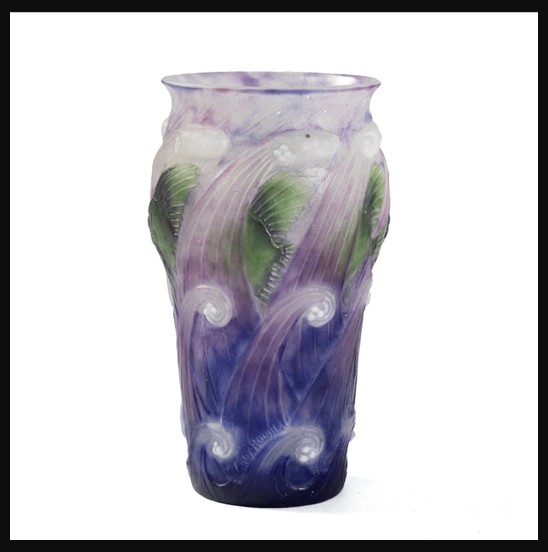
Moissac Vase by René Lalique

René Lalique, French Artist, 1860-1945
Moissac Vase, c. 1930, Opalescent Glass, Height: 13 cm, Private Collection https://hickmet.com/products/rene-lalique-moissac-vase?srsltid=AfmBOopKGBdoz2qgOWYJy5s3FAq5xmPJq2A1jCN-QQW4gMqEHjEXwrhK

Glass is a marvellous material, capable of transforming light, texture, and form into extraordinary works of art. Few creators have harnessed its potential as masterfully as René Lalique, a visionary whose work epitomizes the elegance and innovation of the Art Deco era. Renowned for his ability to merge artistic vision with technical precision, Lalique redefined glassmaking in the early 20th century, crafting pieces that are as functional as they are breathtaking. Moissac Vase by René Lalique stands as a testament to his unparalleled creativity and craftsmanship, embodying the timeless beauty and sophistication that have cemented his legacy as one of history’s most important glassmakers.

The artist’s profound appreciation for glass is evident throughout his career. Originally a master jeweler, Lalique began experimenting with glass in the 1890s, incorporating it into his jewelry designs. By 1910, he had established a glass factory at Combs-la-Ville, France, and in 1918, he acquired a larger factory at Wingen-sur-Moder, France. His innovative use of glass in various forms, from jewelry to architectural elements, underscores his belief in its versatility and beauty.

René Lalique’s foray into glassmaking in the early 20th century marked a transformative and defining moment in his career, elevating him from master jeweler to an iconic and groundbreaking glassmaker. This transition started around 1907 when Lalique began collaborating with perfumer François Coty, designing ornate glass perfume bottles that combined elegance with practicality. Recognizing the artistic and commercial potential of glass, Lalique expanded his focus to creating a wide range of glass objects, including vases, bowls, lighting fixtures, and decorative panels.

The turning point came in 1910 when Lalique established his first glass workshop in Combs-la-Ville, France. By 1918, he had acquired a larger glass factory in Wingen-sur-Moder, Alsace, to meet increasing demand. Lalique’s move to glassmaking was driven by his desire to democratize art, using glass as a medium to create affordable yet exquisitely designed objects accessible to a broader audience. His innovative techniques, such as combining frosted and polished surfaces and using molds for intricate designs, allowed him to produce stunning pieces that were both artistic and functional. This shift cemented his legacy as one of the most influential creators of Art Deco glass.

René Lalique, French Artist, 1860-1945
Moissac Vase, c. 1930, Opalescent Glass, Height: 13 cm, Private Collection https://hickmet.com/products/rene-lalique-moissac-vase?srsltid=AfmBOopKGBdoz2qgOWYJy5s3FAq5xmPJq2A1jCN-QQW4gMqEHjEXwrhK

The Moissac Vase by René Lalique is a stunning example of early 20th-century French decorative art. Crafted in 1927, this glass masterpiece exemplifies Lalique’s ability to seamlessly blend functionality with artistic sophistication. The vase is a cylindrical form with a wider rim, tapered at the bottom, designed to evoke the grandeur and symmetry of Romanesque architectural capitals. Its surface is adorned with a repeating relief pattern of stylized leaves, meticulously rendered to create a sense of organic rhythm. Its opalescent finish, emphasizing the intricate details of the design, enhances its ethereal quality, casting a soft, radiant glow that transforms it into a luminous celebration of nature and form.

From an aesthetic perspective, the Moissac Vase embodies the essence of Art Deco elegance, characterized by its streamlined forms and geometric ornamentation. The motif of ‘leaves’, a timeless symbol of abundance and vitality, is depicted with a balance of naturalism and abstraction, reflecting Lalique’s mastery in synthesizing artistic traditions and modernist trends. The vase’s play of light, achieved through its frosted texture and the sculptural depth of its relief, lends it a dynamic, almost otherworldly glow. This interplay of texture and translucence transforms the vase into not just a decorative object but a celebration of light, form, and nature, showcasing Lalique’s unparalleled ability to harmonize artistry and craftsmanship.

For a PowerPoint Presentation, titled 10 Glass Masterpieces by René Lalique, please… Check HERE!

Bibliography: https://fr.lalique.com/en/pages/story-of-lalique and https://hickmet.com/products/rene-lalique-moissac-vase?srsltid=AfmBOopKGBdoz2qgOWYJy5s3FAq5xmPJq2A1jCN-QQW4gMqEHjEXwrhK

Tomb of the Philosophers

Tomb of Philosophers, c. 300 BC, Fresco Paintings, Pella, Greece
West Wall: Main figural frieze showing a man in a red himation with a wooden rod, pointing at a blue globe. North Wall: On the right side of the photo, a bearded man is depicted, absorbed in reading a papyrus roll. South Wall: On the left side of the photo, another wreathed, bearded ‘philosopher’ is vividly presented.
https://www.palaceofpella.gr/ancient-pella-the-areas-and-the-monuments/?lang=en

Nestled in the heart of ancient Pella, the Tomb of Philosophers stands as one of the most remarkable and enigmatic funerary monuments in Greece, dating back to circa 300 BC. As one of the largest cist-graves ever discovered, its unique decoration sets it apart from any other known ancient tomb. The six figures depicted on its walls, reminiscent of later Roman gatherings of philosophers, provide the earliest known portrayal of an intellectual tradition that links Pella’s vibrant cultural life to the Late Classical period. Among these depictions, a celestial globe suggests the deceased may have been a philosopher with an interest in astronomy or a patron of intellectual pursuits. Above them, scenes of horsemen and grave steles evoke Homeric funeral games, connecting the tomb to the epic, heroic past. The tomb’s intricate design and profound symbolism reflect the high level of cultural and intellectual development that defined ancient Pella, where philosophy and the sciences were integral to a humanist education.

Let’s explore the ‘who’, ‘where”, ‘when’ and ‘what’ of this amazing Hellenistic tomb by posing some questions!

Where is the Tomb of Philosophers located in ancient Pella? The Tomb of Philosophers is located in the ancient city of Pella, which was once the capital of the Macedonian Kingdom in northern Greece. Pella is situated in the region of Central Macedonia, approximately 40 kilometers west of modern-day Thessaloniki. Located in the region of the so-called Eastern Cemetery of Pella, the Tomb is situated just outside the city’s eastern walls. This area, used for burials from the mid-4th century BC until the early 1st century BC, became a principal necropolis following Pella’s major expansion in the late 4th century BC. The Eastern Cemetery is notable for its diverse funerary architecture, with cist graves being a predominant feature. These graves, often arranged in clusters and surrounded by enclosures with sculpted monuments, reflect the wealth and social complexity of the era. The Tomb of Philosophers (the burial chamber is 4.40 m long, 1.95 m wide and 3.00 m high) stands out among these for its exceptional decoration and significance, providing insight into the intellectual and cultural achievements of ancient Pella during its peak.

What is a Cist Tomb? A Cist Tomb is a type of ancient burial structure characterized by its box-like design, typically made of large stone slabs forming the walls, floor, and roof, or sometimes constructed with wood. These tombs were often hewn directly into rock or built within shallow pits and were commonly used for single or multiple burials. Frequently found in ancient cemeteries, cist tombs often contained grave goods such as pottery, jewelry, or personal items meant to accompany the deceased into the afterlife. In Pella’s Eastern Cemetery, Cist Tombs were a prominent feature, reflecting the wealth, social status, and cultural sophistication of the individuals buried within them.

Who was the owner of the Tomb of Philosophers located in ancient Pella? The owner of the Tomb of Philosophers in ancient Pella remains unknown, but the burial context offers intriguing insights. The tomb contained the remains of three individuals: a man in his forties, a woman in her thirties, and an infant. These findings suggest it was a family grave, likely serving as a resting place for multiple generations. The assumption that the family members died at different times aligns with the practice of reusing cist tombs over years, a common custom in ancient burial traditions. The artistic and intellectual significance of the tomb, combined with the presence of elaborate frescoes and symbolic elements such as a celestial globe, suggests the family belonged to the intellectual or social elite of Pella. The man, given the philosophical themes of the tomb, may have been a scholar, astronomer, or patron of knowledge, while the woman and infant reflect the familial connections integral to the tomb’s purpose.

What is depicted in the frescoes decorating the Tomb of Philosophers? The frescoes decorating the Tomb of Philosophers in ancient Pella are a testament to the intellectual and artistic sophistication of Macedonian society during the late Classical and early Hellenistic periods. The walls of the tomb feature a combination of architectural elements, ornamental motifs, and elaborate figurative compositions. These decorations reflect the philosophical and cosmological interests of the time, with the main iconographic theme centered around figures of literati or philosophers. The most striking element is a deep blue sphere depicted on the west wall, symbolizing celestial and cosmological themes, likely influenced by Aristotelian teachings and works like Aratus’s Phaenomena, written in Macedonia during the poet’s time at the court of Antigonus II Gonatas.

Tomb of Philosophers, South Wall, c. 300 BC, Fresco Paintings, Pella, Greece
https://x.com/ancientorigins/status/1585557691497418753

It is interesting to note that the Tomb frescoes illustrate the blending of symbolic and decorative elements to convey both personal identity and cultural values. The use of deep blue tones, floral patterns, and heroic imagery like galloping horsemen suggests a connection to both intellectual and heroic ideals. These visual elements not only commemorate the deceased but also serve as a testament to the vibrant intellectual and artistic achievements of ancient Pella, offering valuable insights into the social, philosophical, and aesthetic priorities of the Macedonian kingdom.

When was the Tomb of Philosophers discovered? The Tomb was unearthed in 2001 by the 17th Ephorate of Prehistoric and Classical Antiquities of Greece, under the leadership of its then-Director, Maria Lilimpaki-Akamati, alongside her team of collaborators.

For a PowerPoint of frescoes preserved in the Tomb of Philosophers in ancient Pella, please… Check HERE!

Bibliography: https://www.palaceofpella.gr/ancient-pella-the-areas-and-the-monuments/?lang=en and https://ejournals.epublishing.ekt.gr/index.php/tekmiria/article/view/36631/27647 and https://www.latsis-foundation.org/content/elib/book_18/pella_gr.pdf pp 185-186

Sofonisba Anguissola of Cremona

Sofonisba Anguissola, c. 1532 – 1625
Self-Portrait at the Easel, 1554, Oil on poplar wood, 19.5 x 12.5 cm, Kunsthistorisches Museum, Vienna, Austria https://smarthistory.org/sofonisba-anguissola/

On International Women’s Day, March 8, we honor the visionary achievements of Sofonisba Anguissola of Cremona, a pioneering female artist of the Renaissance whose brilliance defied societal norms of her time. As Giorgio Vasari eloquently wrote… But Sofonisba of Cremona, the daughter of Messer Amilcaro Anguisciuola, has laboured at the difficulties of design with greater study and better grace than any other woman of our time, and she has not only succeeded in drawing, colouring, and copying from nature, and in making excellent copies of works by other hands, but has also executed by herself alone some very choice and beautiful works of painting. Anguissola’s determination and artistic excellence not only earned her a place among the greats but also paved the way for women in the arts, embodying the spirit of this day dedicated to celebrating the achievements of women across history. https://www.gutenberg.org/files/28421/28421-h/28421-h.htm#Page_121  

Sofonisba Anguissola of Cremona (1532–1625) was a remarkable Italian Renaissance painter whose talent and determination broke barriers for women in the arts. Born into a noble but financially modest family, she received an exceptional education, including training in painting, a rarity for women at the time. Encouraged by her father, Amilcare Anguissola, Sofonisba gained recognition for her skill in portraiture, capturing her subjects with a keen sensitivity and psychological depth. Her talent earned her the favor of Philip II of Spain, who appointed her a court painter, a position she held for many years. In her later life, she married twice, traveled extensively, and continued to mentor younger artists. She lived to the age of 93, an extraordinary lifespan for the period, leaving behind a legacy that inspired generations of women to pursue artistic careers.

Sofonisba Anguissola, c. 1532 – 1625
Self-Portrait of Sofonisba Anguissola, 1556, Oil on Canvas, 66×57 cm, Łańcut Castle, Poland https://smarthistory.org/sofonisba-anguissola/

Displaying a harmonious blend of technical mastery, emotional resonance, and subtle elegance, these artistic aesthetics define her work. Sofonisba’s paintings are characterized by an acute attention to detail, particularly in the rendering of facial expressions and gestures, which convey the inner emotions and individuality of her sitters. Rejecting the grandeur and theatricality typical of the Renaissance, she focused on intimate, humanizing portrayals, making her subjects relatable yet dignified. Her self-portraits, for instance, reveal a quiet confidence and intellectual depth, emphasizing her dual identity as both artist and noblewoman. Sofonisba’s use of soft lighting and refined compositions demonstrates her profound understanding of Renaissance techniques, while her innovative approach to storytelling within portraits influenced subsequent generations of artists, including Anthony van Dyck. Her artistry not only elevated the status of portraiture but also redefined the possibilities for women in the visual arts.

Sofonisba Anguissola, c. 1532 – 1625
The Chess Game (Portrait of the artist’s sisters playing chess), 1555, oil on canvas, 72 x 97 cm, National Museum in Poznań, Poland https://smarthistory.org/sofonisba-anguissola/

Sofonisba Anguissola is a powerful symbol to celebrate on International Women’s Day because she broke through the rigid societal barriers of the Renaissance to excel in a field dominated by men, proving that talent and determination can transcend limitations. As one of the first widely recognized female artists, she demonstrated that women could achieve mastery in the arts, earning respect from contemporaries such as Michelangelo and Vasari. Her work not only showcases technical brilliance but also embodies a unique sensitivity and depth that redefined portraiture, influencing future generations. By excelling in her craft, she opened doors for other women to pursue artistic careers, challenging the gender norms of her time. Anguissola’s legacy reminds us of the importance of advocating for equality and recognizing women’s contributions to culture, making her a bright example of resilience, innovation, and artistic excellence.

The 1556 Self-Portrait at the Easel, housed in Łańcut Castle, Poland, exemplifies her mastery in capturing personal identity and intellectual presence through portraiture. In this work, Anguissola portrays herself as an artist and noblewoman engaged in the act of painting. She is shown with a brush in hand and a palette nearby, gazing outward with a calm yet confident expression, inviting the viewer to recognize her artistic identity and skill. Her attire is modest but elegant, reflecting her noble background while keeping the focus on her profession. The composition draws attention to her hands, tools, and the painting in progress, subtly emphasizing her technical mastery and dedication to her craft. The self-assured presentation, combined with the directness of her gaze, asserts her position not only as a creator but also as an intellectual and innovator in a male-dominated field. This self-portrait is both a declaration of her artistic capability and a rare, introspective glimpse into the life of a Renaissance woman who dared to define herself through her work.

For a PowerPoint Presentation on Portraits of Sofonisba Anguissola, please… Check HERE!

Bibliography: https://smarthistory.org/sofonisba-anguissola/