The myth of the fight between Achelous and Hercules is a captivating tale from Greek mythology. In this legend, Achelous, an ancient Greek river god, transforms into various shapes during his battle with Hercules in an attempt to defeat the hero and win the hand of Deianira, the beautiful Calydonian princess. Despite his shapeshifting abilities, Achelous is ultimately outmatched by Hercules, who manages to break off one of the river god’s horns. This horn becomes the Cornucopia, or the “Horn of Plenty,” symbolizing abundance and nourishment. The myth highlights Hercules’ strength and resourcefulness, as well as the enduring theme of divine contests and transformations in Greek mythology.
Ovid’s narrative in Book 9 of the Metamorphoses provides a detailed account of this myth, including the transformations of Achelous and his fateful battle with Hercules. Who wants to recall the battles he has lost? The great river God tells Theseus, the Athenian hero… But, I will tell it as it happened: since the shame of being beaten is no less than the honour of having fought. It is a great consolation to me that the victor was so famous… Ovid, a prominent Roman poet who lived during the 1st century BC, is known for his retelling of various Greek and Roman myths. He became famous and influential in preserving and popularizing these ancient stories. https://ovid.lib.virginia.edu/trans/Metamorph9.htm#483366540
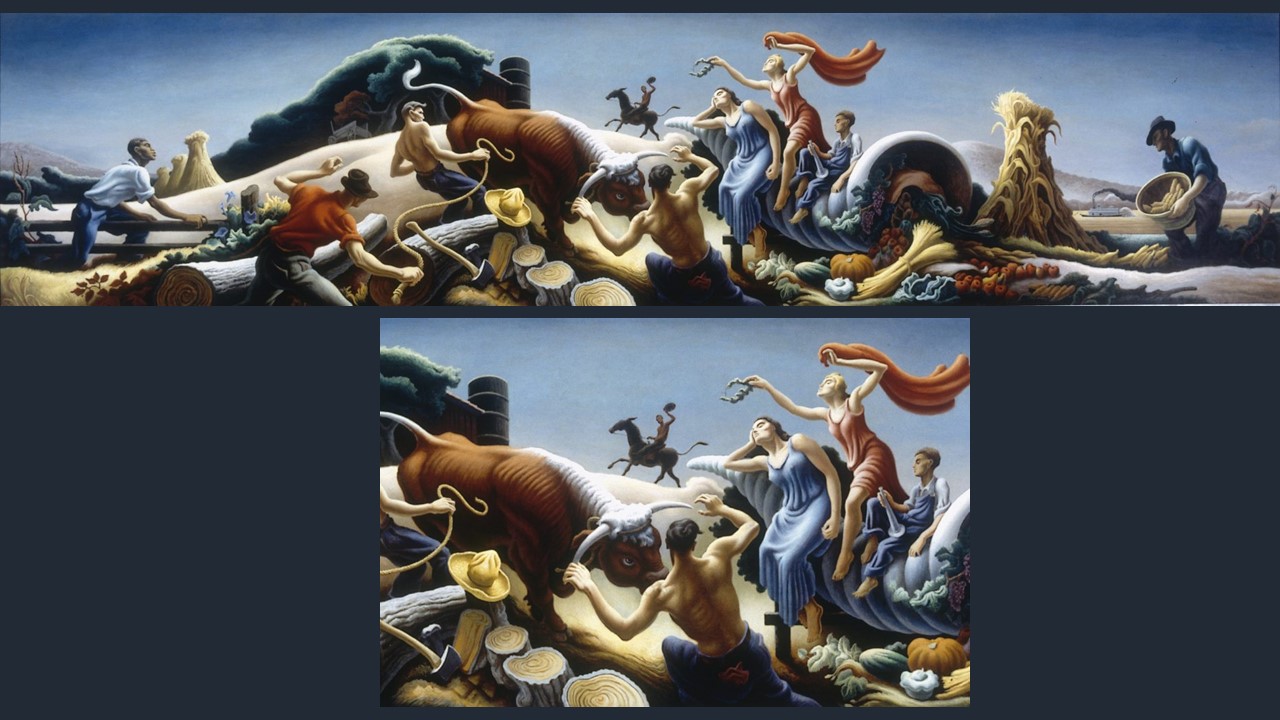
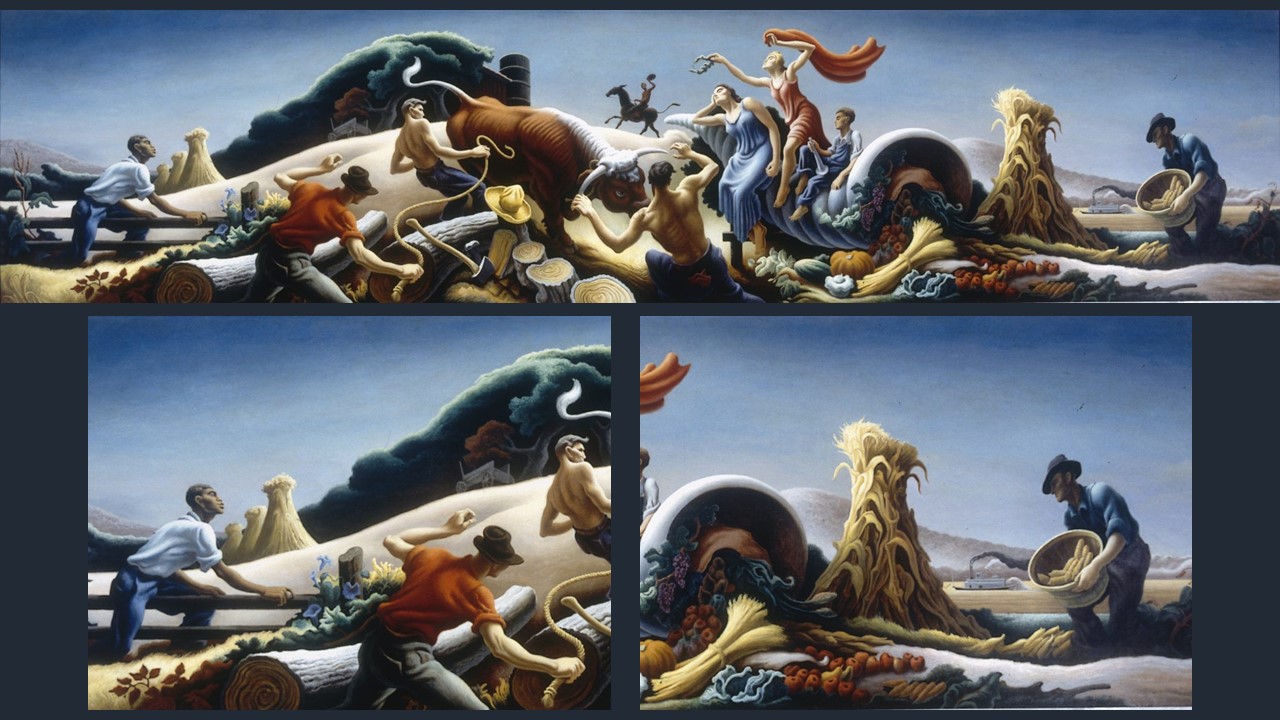
In 1947 American artist Thomas Hart Benton was hired by Lester Siegel Sr., proprietor of Kansas City’s Harzfeld department store, to decorate the wall above the store’s elevator area. Benton settled on a retelling of the Achelous and Hercules myth from ancient Greece, setting it in present-day Missouri. The artist viewed this legend as a parable of his beloved Midwest. The Army Corps of Engineers had begun, at the time, efforts to control the Missouri River, and Benton imagined, and depicted, a future where the waterway was tamed, and the earth swelled with robust harvests. https://ovid.lib.virginia.edu/trans/Metamorph9.htm#483366540 and https://narrativepainting.net/thomas-hart-benton-achelous-and-hercules-1947/
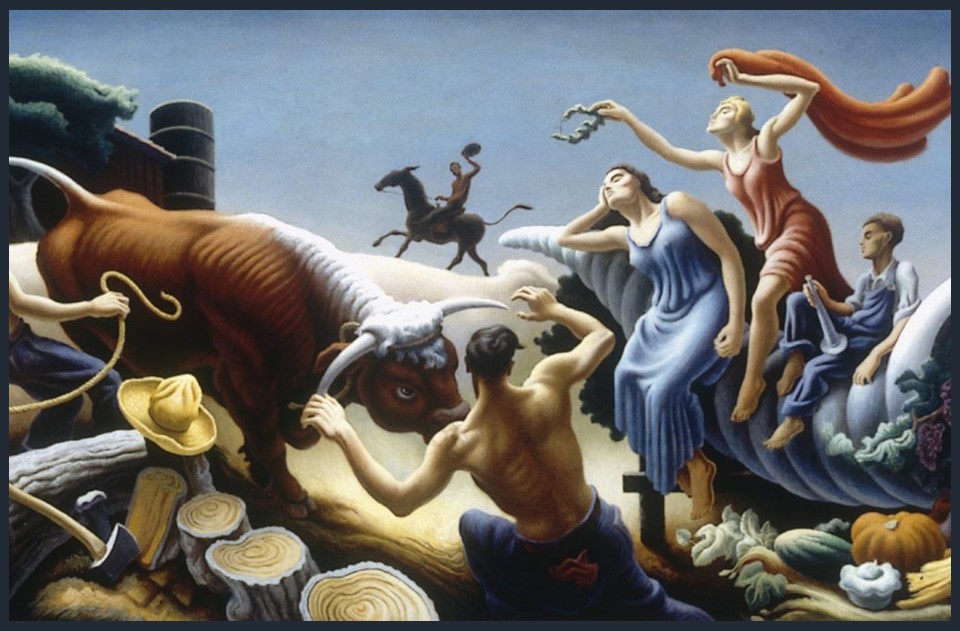
The artwork features a dynamic and muscular Hercules wrestling Achelous, who is depicted as a ferocious bull. Benton’s composition is characterized by bold, exaggerated forms and a strong sense of movement, which is a hallmark of his unique approach to storytelling through art. This painting is a prime example of the artist’s ability to fuse classical themes with the American experience, creating a powerful and visually compelling narrative.
In Achelous and Hercules, Benton not only showcases his technical prowess but also his deep appreciation for the human struggle and the mythological underpinnings that resonate with American themes of strength and determination. The painting stands as a testament to Benton’s skill in merging classical and contemporary elements, and it remains a significant piece in the realm of American art history.
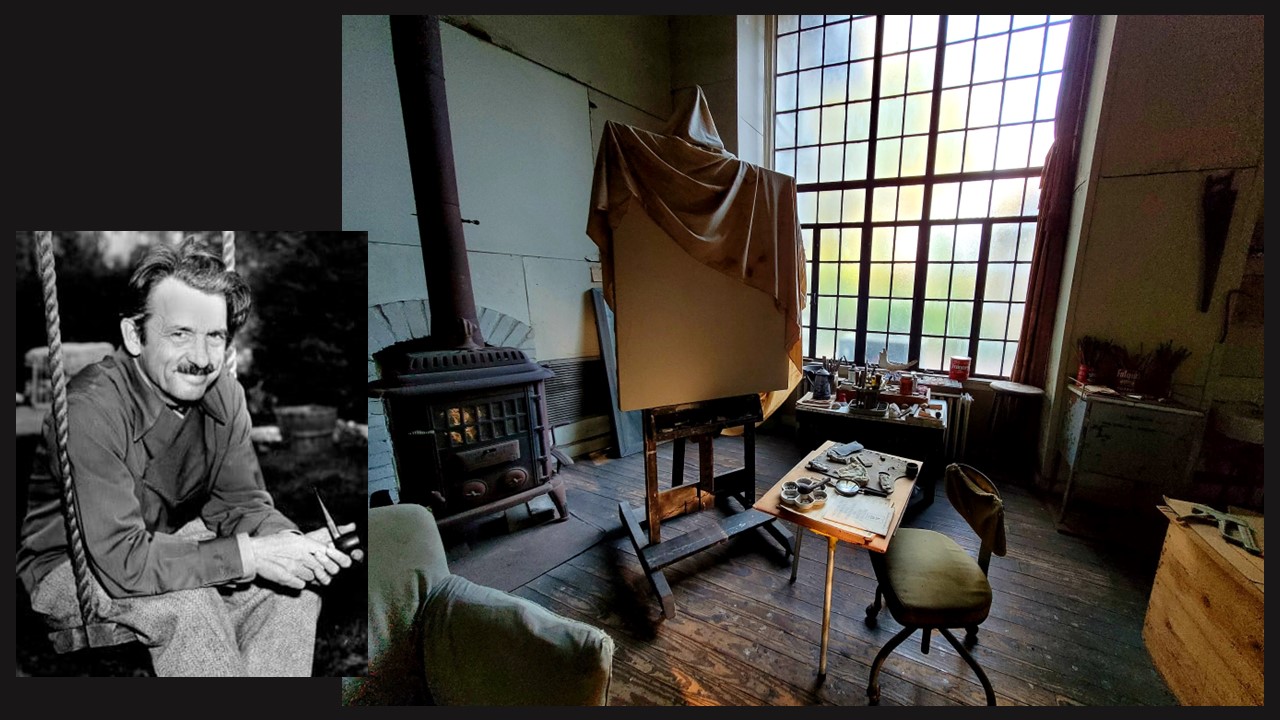
Thomas Hart Benton was a prominent American artist known for his contributions to the American Regionalist movement in the early to mid-20th century. Born in Neosho, Missouri, in 1889, Benton’s work is characterized by its celebration of everyday life in rural America. He was a master of capturing the essence of the American heartland through his vivid and dynamic paintings, often depicting scenes of farmers, laborers, and small-town life. Benton’s art not only showcased his exceptional technical skill but also conveyed a deep sense of patriotism and a connection to the working-class people he portrayed. His distinctive style combined elements of European modernism with a uniquely American perspective. Benton’s legacy lives on as his art continues to be celebrated for its evocative storytelling and its role in shaping the American art landscape.
For a PowerPoint on Thomas Hart Benton’s oeuvre, please… Check HERE!
Once upon a time, in the ancient land of the Franks, there lived a great warrior named Merovech. Merovech was no ordinary man; he had a legendary tale woven into the very fabric of his being. His mother was the Queen of the Franks, An intelligent and powerful woman, who held a mysterious secret… One day, as she wandered along the shores of the great sea, a magnificent sea monster named ‘Quinotaur’ appeared before her. This creature was unlike anything she had ever seen, with shimmering scales and gentle eyes. They spent joyful days together, swimming in the sea, sharing stories and laughter. Their coming together brought forth the child Merovech, a blend of both sea and land, destined for greatness. He became the founder of The MerovingianDynasty of the Francs, strong and wise. His legacy lived on through generations, becoming a testament to the magical love that had once graced the land and the sea. (my own presentation of the Merovingian legend)
So, let’s explore the ‘who,’ ‘how,’ and ‘what’ of the Merovingian Dynasty by answering some questions!
‘Who’ were the Merovingians and ‘What’ defined their dynasty? The Merovingians were a dynasty of Frankish kings that ruled over a significant portion of what is now modern-day France and parts of Germany from the 5th to the 8th centuries. They were named after Merovech, a semi-legendary figure who was thought to be their ancestor.
The dynasty was founded by Merovech’s son, Childeric I, and expanded by his son Clovis I, who is credited with uniting the Franks and converting to Christianity, specifically to Catholicism. Under Clovis I and subsequent Merovingian kings, the dynasty expanded its territory through military conquests, incorporating various Germanic and Gallo-Roman regions. The Merovingian kings were initially strong warriors but later became somewhat figurehead rulers due to a system of decentralization, where local rulers and nobles gained significant autonomy. This led to a weakened central authority. Over time, the dynasty faced internal strife, infighting, and challenges from other Frankish noble families. The decline of the Merovingian Dynasty ultimately paved the way for the rise of the Carolingians, with Charlemagne becoming a central figure in consolidating power and reuniting much of Western Europe.
‘What’ historical and archaeological evidence supports the early history of the Merovingians? The early history of the Merovingians is primarily supported by a combination of historical texts, archaeological findings, numismatic evidence (coinage), and contemporary accounts from neighboring cultures. For instance, works like “Historia Francorum” by Gregory of Tours, a bishop and historian, provide valuable historical accounts of the Merovingian Dynasty, including the reigns of various Merovingian kings and important events during their rule. Additionally, “Fredegar’s Chronicle,” compiled by an anonymous Frankish chronicler known as Fredegar, covers the history of the Franks and the Merovingian Dynasty, offering insights into their early history and political developments.
Diplomatic communications between Merovingian rulers and other contemporary powers, such as Byzantine emperors and popes, provide historical context and shed light on their political relationships, alliances, and conflicts, while Ecclesiastical Documents from the Merovingian period provide information on religious practices, conflicts, and the influence of Christianity on the Merovingian rulers and society. By synthesizing information from these sources, historians construct a comprehensive understanding of the early history of the Merovingians and their contributions to the development of medieval Europe.
Numismatic Evidence, particularly coins minted during the Merovingian era, offers information about their political and economic activities, rulership, and trade relations with neighboring regions. The design, inscriptions, and use of different metals provide insights into their economy and society.
Finally, archaeological excavations of religious sites, graveyards, and tombs associated with the Merovingian period provide valuable insights into their society, beliefs, culture, and burial practices. The discovery of artifacts, grave goods, and the architecture of these tombs helps in understanding their beliefs and social structure. Excavations of royal residences, on the other hand, provide clues about the lifestyle, architecture, and level of sophistication of the Merovingian elite. These sites reveal aspects of governance, art, and material culture.
‘How’ did the arts and culture flourish during the time of the Merovingian Dynasty? During the time of the Merovingian Dynasty, spanning from the 5th to the 8th centuries, arts and culture experienced a distinctive evolution and expression within the Frankish Kingdom. However, it’s important to note that the available historical evidence regarding the arts and culture of this period is relatively limited compared to later medieval periods.
The artistic style during the Merovingian era was influenced by a blend of Germanic, Roman, and early Christian artistic traditions. The Merovingians adopted certain Roman artistic elements, such as architectural designs, while incorporating their own unique styles and themes. For instance, churches and monastic complexes showcased a fusion of Roman architectural features and Germanic influences, often displaying simple designs, rounded arches, and timber construction.
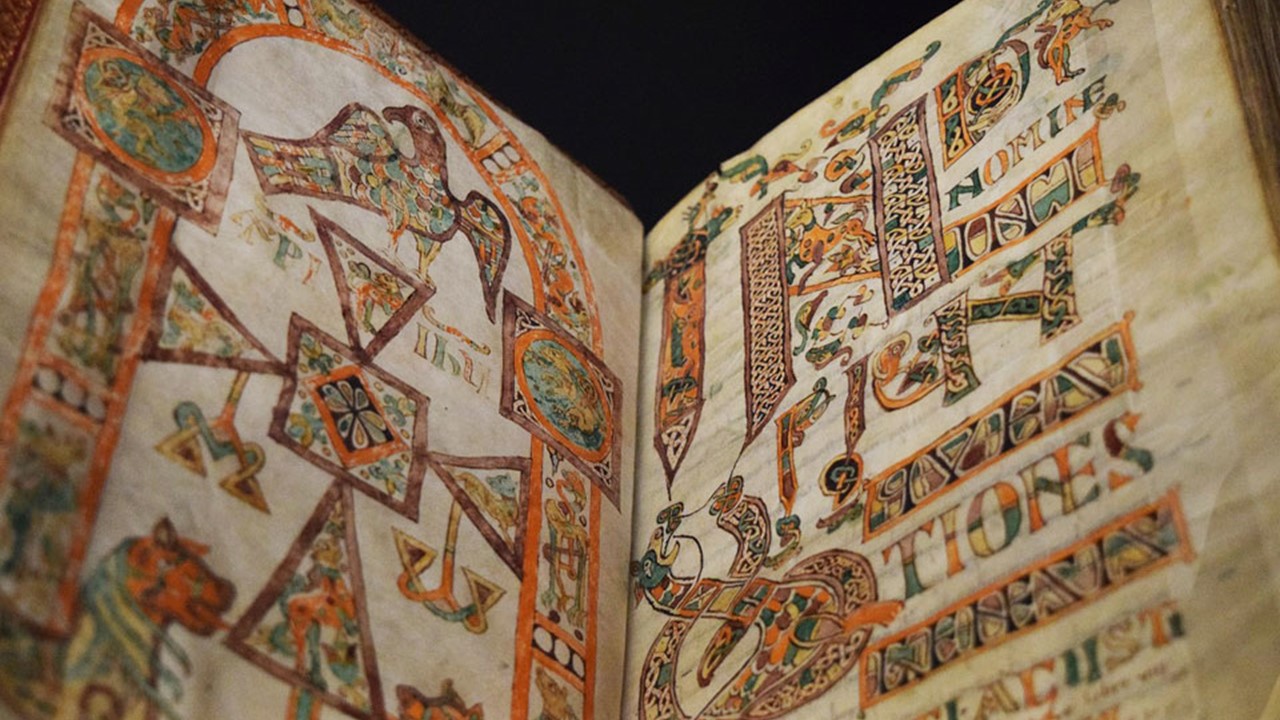
Intricate metalwork, especially in the creation of jewelry like brooches and buckles, held significant artistic value. These pieces often boasted elaborate patterns, filigree work, and the use of gemstones. Additionally, though the number of surviving illuminated manuscripts from this era is limited, some notable examples exist. Manuscripts, typically religious in nature and including Gospel books and psalters, were adorned with colorful illuminations and decorated initials.
In conclusion, the arts and culture flourished during the time of the Merovingian Dynasty, showcasing a unique blend of Germanic, Roman, and early Christian artistic influences. Despite the limitations in available historical evidence, the Merovingians left a lasting legacy through intricate metalwork, expressive jewelry designs, distinctive architectural styles in religious structures, and the production of illuminated manuscripts adorned with vibrant illuminations. These cultural and artistic achievements reflect the dynamic evolution and creative expression within the Frankish Kingdom during the Merovingian era from the 5th to the 8th centuries.
For a PowerPoint on Merovingian Art, please… Check HERE!
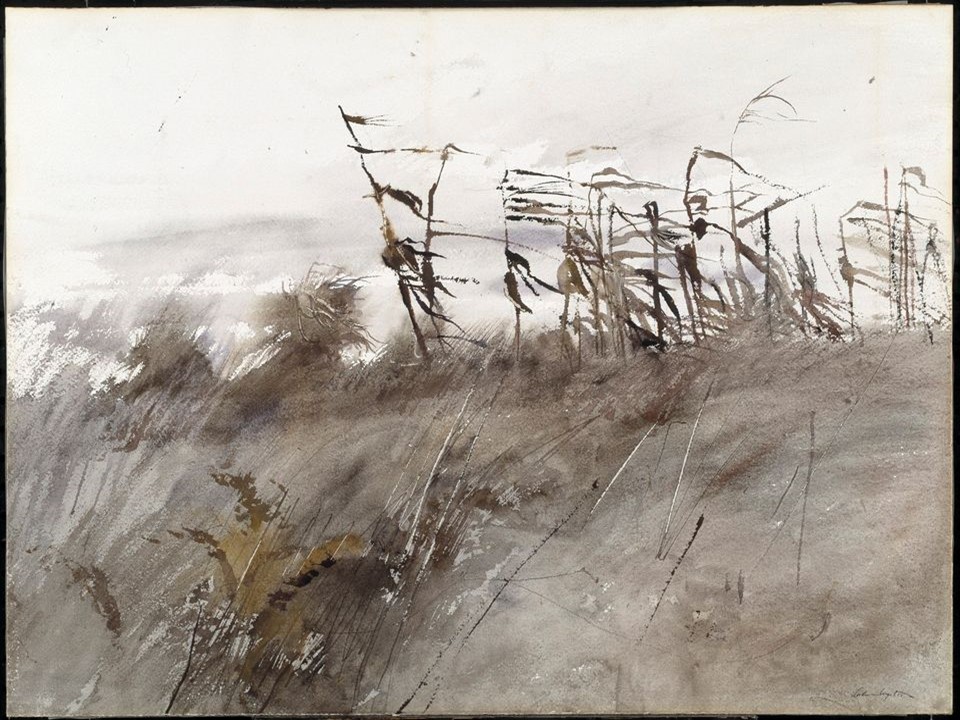
Andrew Wyeth, American Artist, 1917-2009 November First, 1950, Watercolour on Paper mounted on Paperboard, 55.2 x 75.4 cm, Smithsonian American Art Museum, Washington DC, USA https://americanart.si.edu/artwork/november-first-32150
Let me quote Andrew Wyeth… I prefer winter and fall, when you feel the bone structure of the landscape – the loneliness of it, the dead feeling of winter. Something awaits beneath it, the whole story doesn’t show… and introduce to you November First, a landscape of loneliness, decay, and renewal. https://www.theartstory.org/artist/wyeth-andrew/
Andrew Wyeth (1917-2009) was a highly acclaimed American artist known for his realistic and detailed paintings, primarily in a style known as American Realism. He was born in Chadds Ford, Pennsylvania, and was the youngest of the five children of the well-known illustrator and artist N.C. Wyeth. He gained widespread recognition for his works that often depicted the rural landscapes and people of Pennsylvania and Maine. He had a deep connection with the natural world, which was reflected in his art. Some of his most famous works include Christina’s World, a haunting and iconic painting depicting a young woman lying in a field, and the Helga Testorf series, which portrayed a German model and became a subject of much interest and controversy.
The artist masterfully captured for example, textures, surfaces, and subtle variations in light and shadow, creating a sense of hyper-realism in his paintings. His work centered around nature, landscapes, and rural scenes showing a deep appreciation for the natural world and often depicting it with great accuracy and sensitivity. He preferred a subdued and muted colour palette, typically using earth tones, greys, and muted greens. This choice of colours and the interplay of light and shadow in his paintings contributed to the quiet and contemplative mood of his works, evoking a sense of isolation, solitude, and introspection, quiet contemplation, and emotional depth. Depicting scenes and characters from rural America, Wyeth managed to capture the essence of American rural life, and portray its beauty, simplicity, and the passing of time.
Wyeth primarily used two main painting techniques, egg tempera and watercolour. Egg tempera involves mixing pigment with a water-soluble binder made from egg yolk, resulting in a luminous and finely detailed surface. Watercolour, on the other hand, allowed for a more fluid and transparent approach.
Created in 1950, November First is a watercolour painting on paper mounted on paperboard. Part of the Smithsonian American Art Museum, Wyeth’s painting depicts tattered cornstalks in a harvested field, and captures the cold damp of late autumn, portraying the inevitable cycles of decay and renewal… The cornfield shown in this watercolor was located near his studio in Chadds Ford, behind the house of Dr. Margaret Handy, the pediatrician who cared for Wyeth’s two children.https://americanart.si.edu/artwork/november-first-32150
Employing a subdued and muted colour palette that resonates with the November scenery, shades of ochre, gray, muted greens, and hints of blue, dramatic contrasts of light and shadow, and a range of brushwork techniques in watercolour, including washes, and drybrush, Wyeth created a painting that evokes the distinct feelings associated with the month of November. His composition is simple yet elegant, focusing on the beauty and essence of the seasonal landscape, emphasizing a sense of quietude, contemplation, and peacefulness often associated with late autumn and winter.
For a PowerPoint presentation, please… Check HERE!
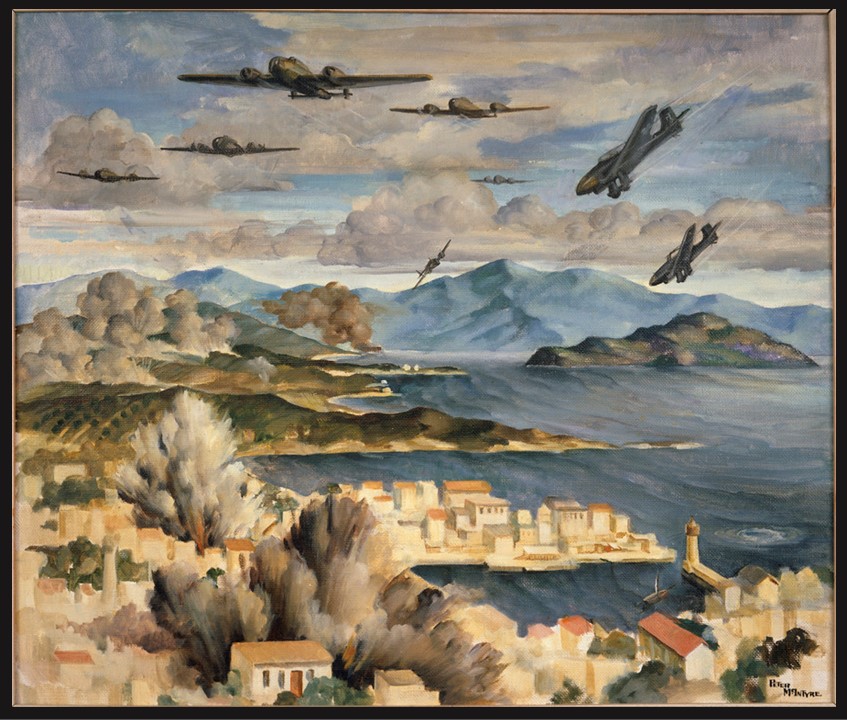
It began just after dawn on 20 May 1941. Many of the 7700 New Zealand soldiers stationed on Crete were finishing breakfast when hundreds of German transport aircraft – some towing gliders – rumbled in over the Mediterranean island. The air above was suddenly filled with parachutes as thousands of elite German paratroops began to descend from the sky. This was the start of what is known as the Battle for Crete. For 12 dramatic days New Zealanders, British, Australian, and Greek troops, assisted by Cretan civilians, tried to repel a huge airborne assault by the Germans. They almost succeeded. Peter McIntyre’s Paintings of the Battle of Crete provide a visual record of the events and scenes during the Battle of Crete. As an official war artist, McIntyre had the unique opportunity to witness the battle firsthand and capture its moments on canvas. These paintings serve as a historical document that helps us better understand the conditions, landscapes, and experiences of those involved in the battle. https://nzhistory.govt.nz/war/the-battle-for-crete/overview
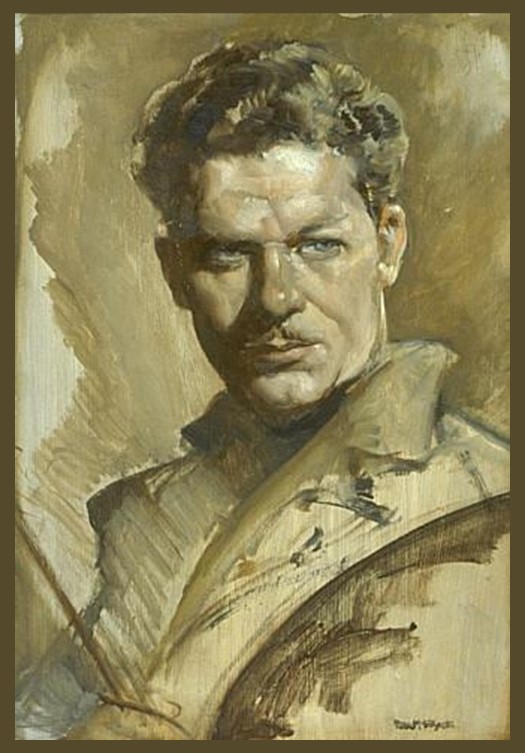
Peter McIntyre (1910–1995) was a notable New Zealand artist known for his landscapes and depictions of rural scenes. He gained recognition for his ability to capture the natural beauty of New Zealand’s landscapes and the unique qualities of its light. McIntyre was born in Dunedin, New Zealand, and he displayed artistic talent from a young age. He attended the Dunedin School of Art and later studied at the Elam School of Fine Arts in Auckland. His early works were influenced by the Regionalist movement, which aimed to capture the essence of New Zealand’s unique landscapes and culture.
One of McIntyre’s significant accomplishments was his role as an official war artist during World War II. He was attached to the New Zealand Expeditionary Force and documented the experiences of New Zealand forces in various theaters of war, including Crete, North Africa, and Italy. McIntyre’s artistic contributions during this time were significant and provided a visual record of the war and its impact on the troops.
In Crete, McIntyre accompanied New Zealand forces during the Battle of Crete in 1941. He witnessed the intense fighting and documented the events through his paintings. McIntyre’s artwork from Crete captured the rugged terrain, the chaos of battle, and the resilience of the soldiers involved. His paintings conveyed the human side of war and reflected the courage, determination, and sacrifices made by the New Zealand forces.
The Blitz, Canea Crete area defended by New Zealanders, May 1941, Oils, 625 x 740mm, Archives New Zealand https://www.archives.govt.nz/images/the-blitz-canea-crete-area-defended-by-nz-ers-new-zealanders-may-1941
McIntyre’s artistic interpretation of the battle brings a unique perspective to the historical narrative. His choices in composition, lighting, and focal points add an artistic layer to the historical record, encouraging viewers to engage with the events on both an intellectual and emotional level.
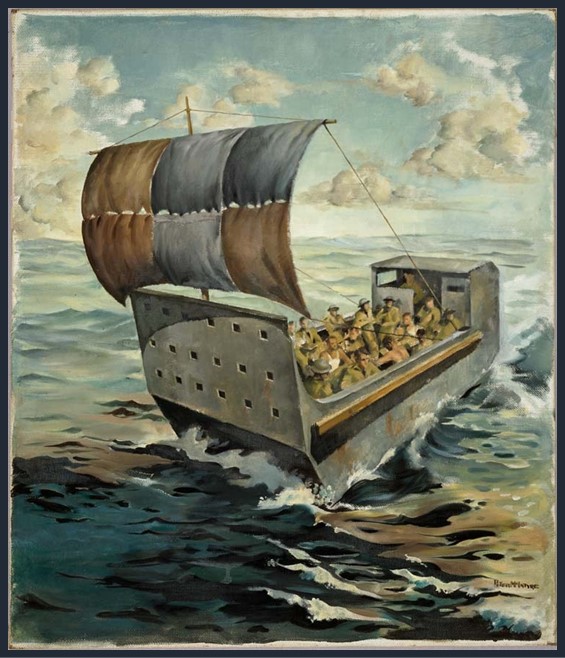
My favorite McIntyre painting of the Battle for Crete is titled The Barge from Crete! It illustrates, according to the New Zealand History Archives experts, the epic journey of a group of escapees who sailed an abandoned landing barge from Crete to Egypt. The 137-strong party, mostly Royal Marines, set out on 1 June. Nine New Zealanders were thought to be among this party, although the only one known by name was Private W.A. Hancox. He had been picked up 3 km offshore, paddling along on a plank of wood.https://nzhistory.govt.nz/media/photo/the-barge-crete-peter-mcintyre
After the barge’s fuel ran out blankets were rigged as sails. To make sure these caught the breeze the men often had to jump into the water and push the nose of the barge in the right direction. Conditions on board were tough. Food supplies were rationed to half a tobacco tin of water and a teaspoon of bully beef per day. During the voyage, one soldier died of exhaustion, and another committed suicide. On 9 June, eight days after leaving Crete, the barge drifted ashore 24 km west of Sidi Barrani in Egypt.https://nzhistory.govt.nz/media/photo/the-barge-crete-peter-mcintyre
Peter McIntyre’s paintings of the Battle of Crete are important as they combine historical documentation, personal perspective, emotional impact, artistic interpretation, and cultural memory. They help us remember, learn from, and emotionally engage with this significant moment in history.
For a PowerPoint of Peter McIntyre’s Paintings of the Battle of Crete, please… Check HERE!
…Constantius and Galerius were made emperors; and the Roman world was divided between them in such a manner, that Constantius had Gaul, Italy, and Africa; Galerius Illyricum, Asia, and the East… Galerius, a man of excellent moral character, and skillful in military affairs, finding that Italy, by Constantius’s permission, was put under his government, created two Caesars, MAXIMIN, whom he appointed over the east, and SEVERUS, to whom he committed Italy. He himself resided in Illyricum… wrote Eutropius in Book X of Abridgement of Roman History about Emperor Gaius Galerius Valerius Maximianus. https://www.forumromanum.org/literature/eutropius/trans10.html
In the Epitome De Caesaribus, a booklet about the Style of Life and the Manners of the Imperatores, sometimes attributed to Sextus Aurelius Victor, Emperor Galerius is described as …possessed of an uncultivated and rustic justice…he was, however, the author continues, praiseworthy enough, physically attractive, a skilled and fortunate warrior, sprung from country parents, a keeper of cattle, whence for him the cognomen Armentarius [“Herdsman”]. 16. He was born and also buried in Dacia Ripensis, a place which he had called Romulianum from the name of his mother, Romula. 17. He insolently dared to affirm that, in the fashion of Olympias, the mother of Alexander the Great, his mother had conceived him after she had been embraced by a serpent.http://roman-emperors.sites.luc.edu/epitome.htm
Living in Thessaloniki, where numerous buildings and structures commissioned by Galerius still grace the cityscape, serving as popular attractions, I find it necessary to introduce you to Emperor Gaius Galerius Valerius Maximianus, commonly referred to as Galerius. He held the position of Roman Emperor within the Tetrarchy system, a governance framework established by Emperor Diocletian, which partitioned the Roman Empire into four co-ruling territories. Galerius, during his rule as Augustus from 305 to 311 AD, gained renown for his multifaceted role within the Tetrarchy, his involvement in the Christian persecutions of the early 4th century, and his military campaigns waged against the Sassanid Empire and hostile Danube frontier tribes.
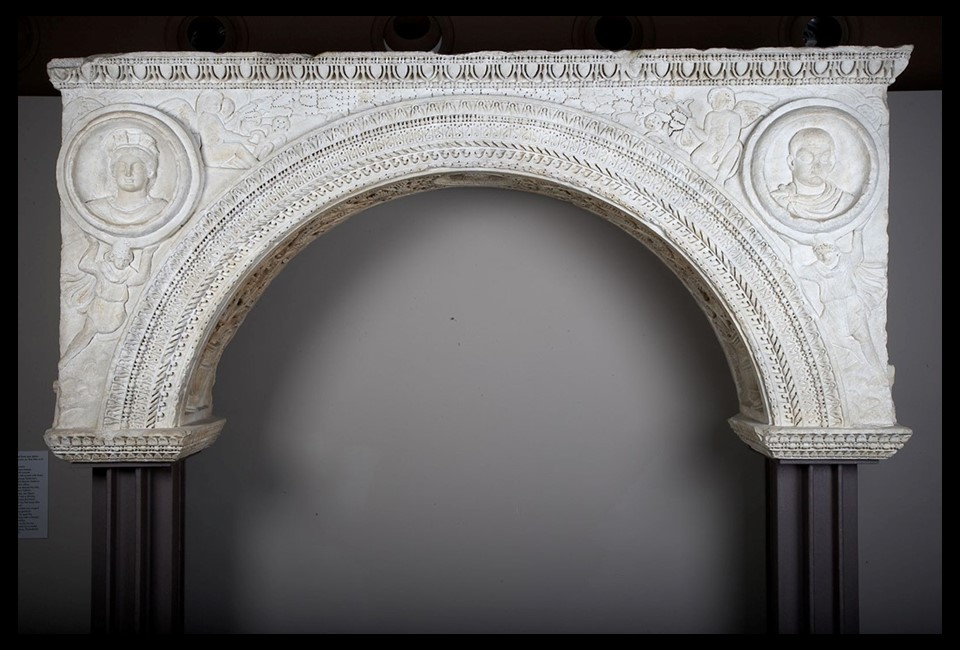
From the Octagon in the Palace of Galerius in Thessaloniki: “The Small Arch of Galerius”, Archaeological Museum of Thessaloniki, Greece https://www.amth.gr/en/exhibitions/highlights
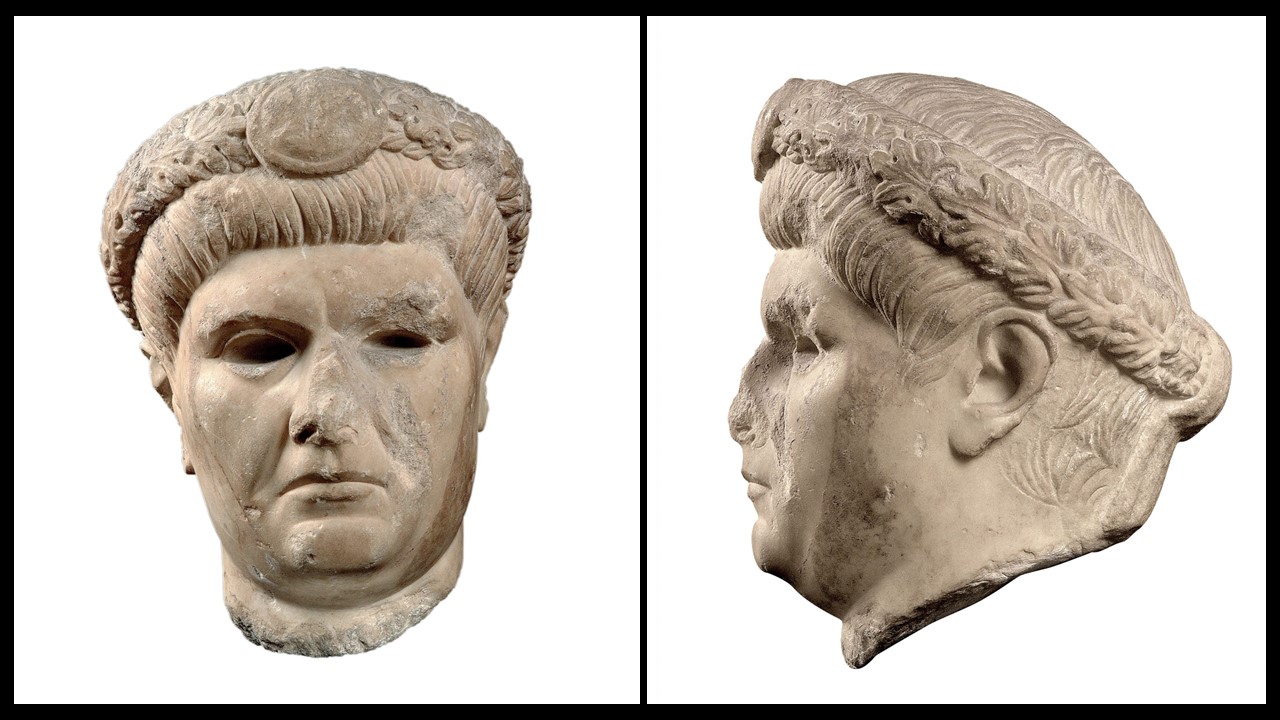
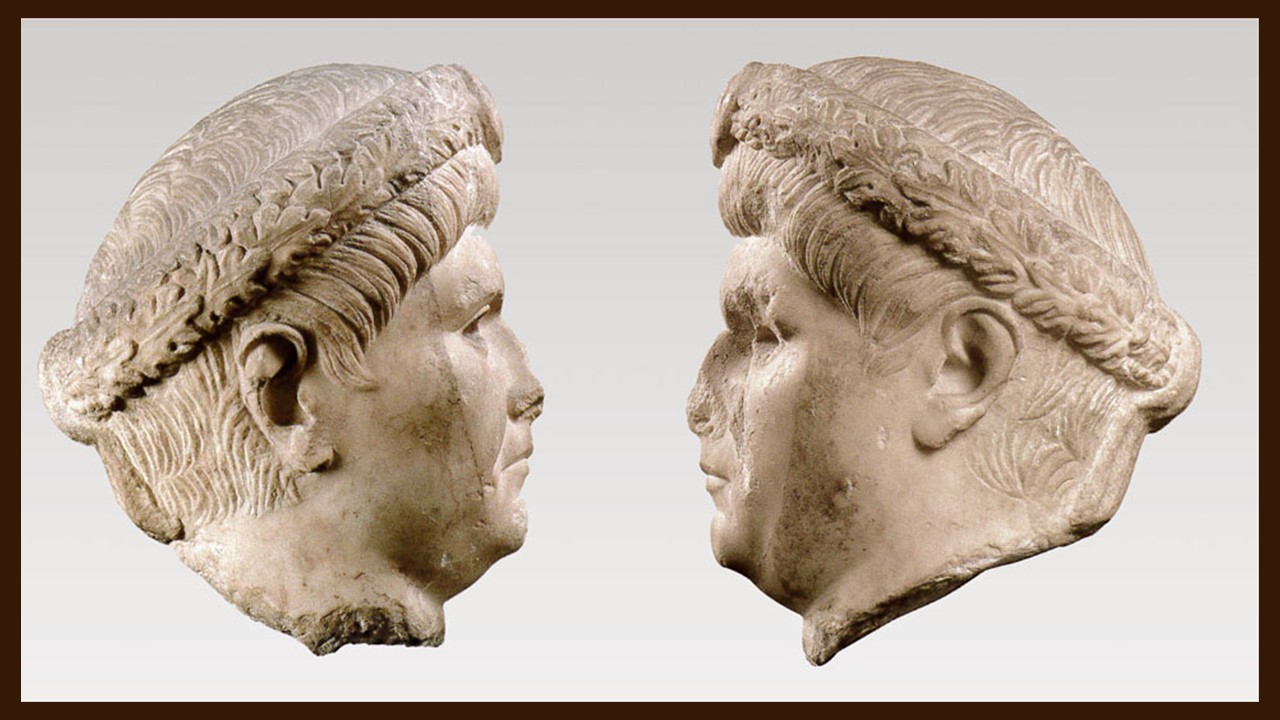
Much like many of his predecessors, Galerius was prominently featured in a multitude of portraits and statues throughout his reign. These artistic representations consistently cast him as a strong and unwavering leader, characterized by stern expression and adorned with intricate military regalia. Beyond their artistic merit, these depictions held profound historical value, serving as windows into the prevailing culture and politics of the Roman Empire during his rule. Moreover, they afford us a glimpse into the nuanced strategies employed by emperors to project their influence and command, shedding light on the perceptions held by their subjects and contemporaries.
Upon encountering his portrait at the Canellopoulos Museum in Athens, I was truly taken aback. Galerius appeared notably advanced in age, likely in the twilight of his life, exuding an aura of austerity, distance, and impassivity. Gazing upon his face, one can vividly sense the gravity of his station. Despite, however, the impression of weariness, detachment, and aloofness, the Emperor unmistakably embodies the quintessential image of an absolute monarch within the Tetrarchy – a power deserving of the most serious consideration!
For a PowerPoint of Portraits depicting Emperor Galerius, please… Check HERE!
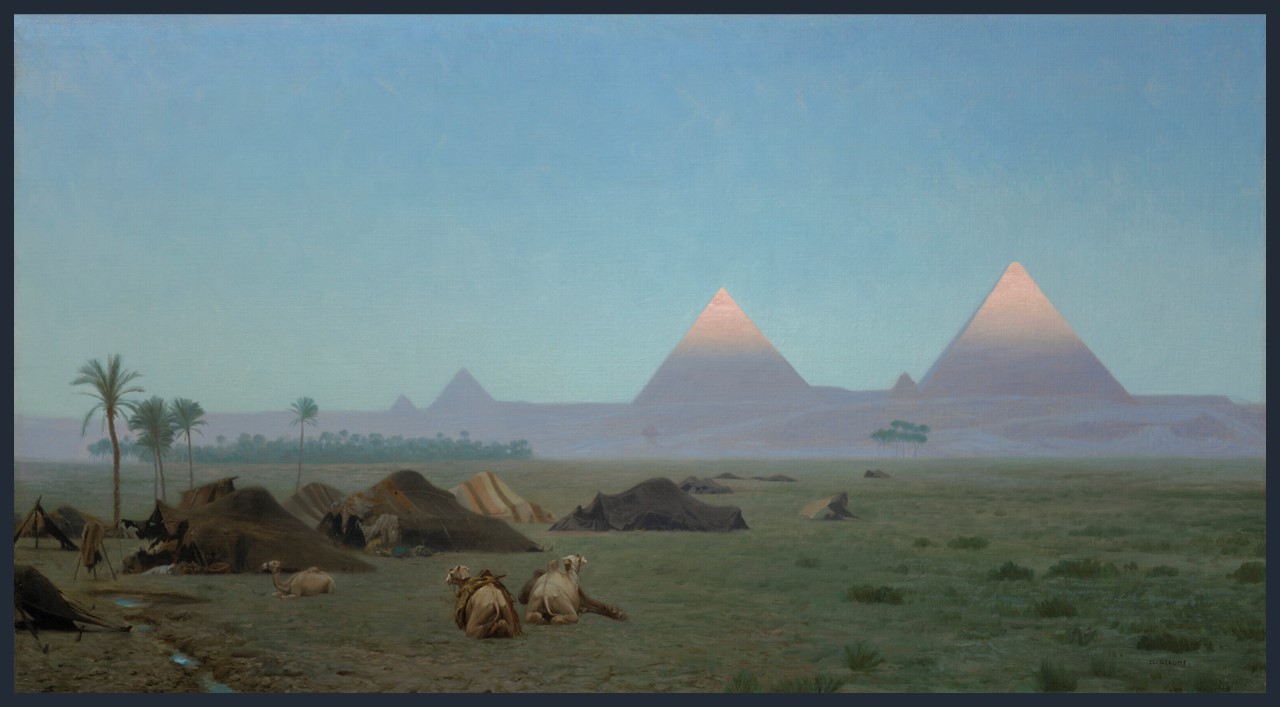
Jean-Léon Gérôme, French Artist, 1824–1904 The First Kiss of the Sun, 1886, Oil on Canvas laid on Board, 54 x 100.4 cm, Private Collection https://www.christies.com/en/lot/lot-6438415
Characterized by Ackerman as “The most beautifully composed and painted of Gérôme‘s landscapes”. The First Kiss of the Sun was painted in 1886, six years after Gérôme‘s last trip to Egypt. https://www.christies.com/en/lot/lot-6438415 (G.M. Ackerman, Jean-Léon Gérome, London, 1986)
So… Who is Jean-Léon Gérôme? Why is his painting The First Kiss of the Sunso beautifully composed and painted? What do we know about his artistic achievements? Let’s explore Jean-Léon Gérôme’s oeuvre … by answering some questions!
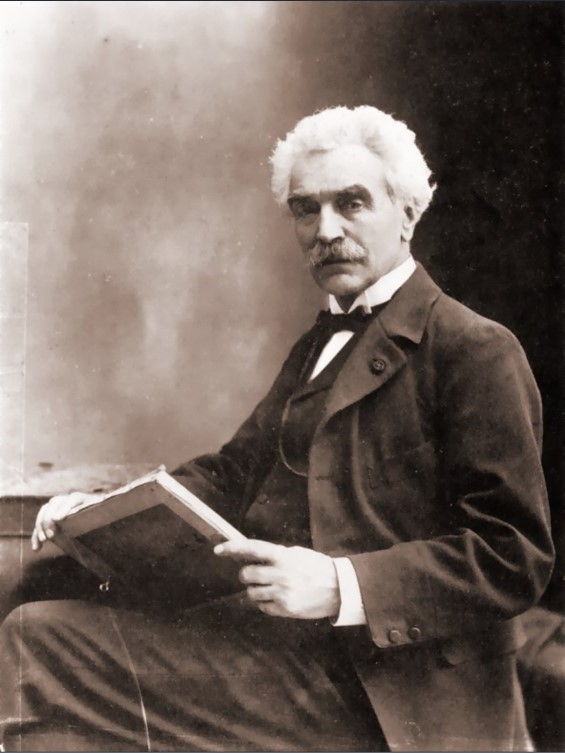
Who is Jean-Léon Gérôme? He is a prominent 19th-century French academic painter, sculptor, and teacher known for his historical and Orientalist works. He was born on May 11, 1824, in Vesoul, France, and passed away on January 10, 1904, in Paris. Gérôme began his artistic training at an early age, studying under Paul Delaroche, a renowned historical painter. He later attended the École des Beaux-Arts in Paris, where he developed a meticulous and highly detailed style that characterized much of his work. His artistry drew heavily from historical and classical themes, often depicting scenes from ancient civilizations and mythology.
How and Why did Gérôme become famous? During the 1850s and 1860s, Gérôme gained widespread recognition and success for his paintings, which often featured archaeological and ethnographic elements. He was particularly acclaimed for his Orientalist pieces, showcasing scenes from the Middle East and North Africa, illustrating the exoticism and culture of these regions. He was a skilled draftsman as well, utilizing precise anatomical and architectural details in his work. His paintings were characterized by their careful composition, vibrant colours, and the depiction of intricate textures. He also explored themes of academic classicism, often depicting heroic or mythological figures.
How is an ‘Orientalist’ artist described? An “Orientalist” artist refers to a Western artist, usually from Europe or North America, who specializes in creating art that focuses on the depiction of the Orient. The Orient, in this context, typically referred to regions of the Middle East, North Africa, and parts of Asia. Orientalist artists were active primarily during the 19th and early 20th centuries, although the influence of Orientalism extends beyond this time frame.
Orientalist artists focused on portraying scenes, landscapes, people, and cultures from the Eastern world. These scenes often included depictions of daily life, historical events, architecture, landscapes, and various customs prevalent in the Orient. They often emphasized the exotic and romantic aspects of the Orient. Artists presented these regions as mysterious, alluring, and different from the Western world. The art was often intended to captivate and fascinate Western audiences.
Why is Gérôme considered to be an Orientalist artist? Gérôme is widely recognized for his artistic focus on depicting scenes, landscapes, and people from the Orient, particularly the Middle East and North Africa. He had, for example, a deep connection to Egypt that greatly influenced his artwork. This connection was primarily through his travels to Egypt, seven times to be precise, and his fascination with its culture, architecture, and history. Gérôme’s interest in Egypt is reflected in a significant portion of his body of work, particularly his Orientalist paintings and sculptures.
How is Gérôme’s painting ‘The First Kiss of the Sun’ best described? According to Christie’s, where The First Kiss of the Sun was auctioned in 2023, the painting dates from 1886, six years after Gérome’s last trip to Egypt. This is probably one of the artist’s most accomplished landscapes. It shows the pyramids of Giza suffused in the golden morning light of the desert sun. This view is from the west, as seen from the rising sun illuminating the summit of each pyramid. The ethereal appearance of the distant pyramids contrasts dramatically with the clearly detailed foreground. Moreover, the haze created by the sand and sunlight lends the picture an air of otherworldliness. The head of the Sphinx is just visible in the middle background.https://www.christies.com/en/lot/lot-6438415
The First Kiss of the Sun Gérôme provides a carefully detailed and beautifully rendered scene of the Giza Plateau, one of Egypt’s most iconic archaeological sites. Interestingly, the painting features the Pharaonic funerary buildings in the background along with a contemporary Bedouin camp in the foreground. The artist captures the soft and ethereal light of the rising sun, which casts a cooler, in my opinion, golden/violet glow on the ancient structures and the surrounding landscape.
How did Gérôme manage to leave a lasting impact on the art world? In addition to his artistic achievements, Gérôme was an influential teacher, serving as a professor at the École des Beaux-Arts in Paris. He mentored many aspiring artists, leaving a lasting impact on the art world through his teachings. Throughout his career, Jean-Léon Gérôme received numerous awards and honours, solidifying his reputation as a leading academic artist of the 19th century. Despite changing artistic trends, his work continues to be appreciated and studied for its historical significance and technical mastery.
For a PowerPoint Presentation of Jean-Léon Gérôme’s Paintings of Egypt, please… Check HERE!
The use of light and shadow accentuates the form and texture of the Pyramids, enhancing the sense of depth and three-dimensionality. Gérôme’s meticulous attention to detail is evident in the accurate rendering of the architectural elements and the presentation of the ‘exotic’ Bedouin campsite. The overall composition conveys a sense of awe and reverence for the historical and cultural significance of the site.
For a PowerPoint on French Academic Art, please… Check HERE!
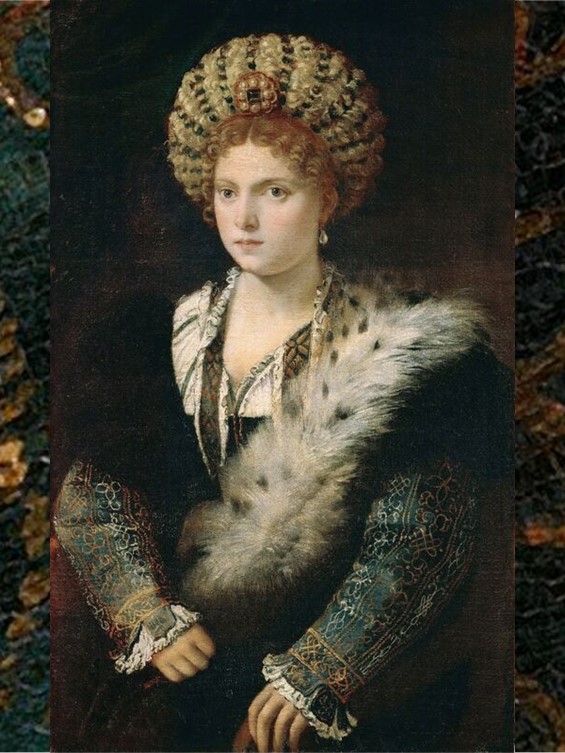
Titian, 1488-1576 Isabella d’Este, Marquise of Mantua (1474–1539), 1534/36 Oil on Canvas, 101.9 × 64 cm, Kunsthistorisches Museum Vienna, Austria https://tiziansfrauenbild.khm.at/en/
In a well-known passage in De pictura, Alberti describes the principal power of portraits,and even painting in general, as follows: Painting possesses a truly divine power in that it does not only make the absent present, as they say of friendship, but it also represents the dead to the living many centuries later […] Through painting, thefaces of the dead go on living for a very long time. Does Titian’s Portrait of Isabella d’Este possess a truly divine power in presenting the true likeness of the Marchioness of Mantua? https://scholarlypublications.universiteitleiden.nl/access/item%3A2889008/view page 125
Titian’s renowned painting of Isabella d’Este, commonly referred to as La Bella (The Beautiful), was created in 1534 when Isabella herself was approximately 60 years old. Notably, the Marchioness of Mantua did not directly sit for Titian’s brush; instead, she dispatched a portrait of herself executed by Francesco Francia (now lost) in 1511 to provide a reference for her likeness. Titian, the accomplished Venetian master, concluded his Portrait in 1536, earning Isabella’s delight with the outcome. In a letter to the Mantuan ambassador in Venice, she acknowledged… The portrait by Titian’s hand captures such a pleasing essence that we are prompted to question whether, during the age he depicts us, we ever possessed the beauty it encapsulates.
Titian’s Portrait of Isabella d’Este is currently housed in the Kunsthistorisches Museum in Vienna. It portrays Isabella as a young and exquisite woman, dressed in elegant attire, with a sophisticated hairstyle and adorned with jewels. The portrait may not be an accurate portrayal of Isabella turning sixty, but it effectively captures the regal poise and demeanor that defined the Marchioness of Mantua.
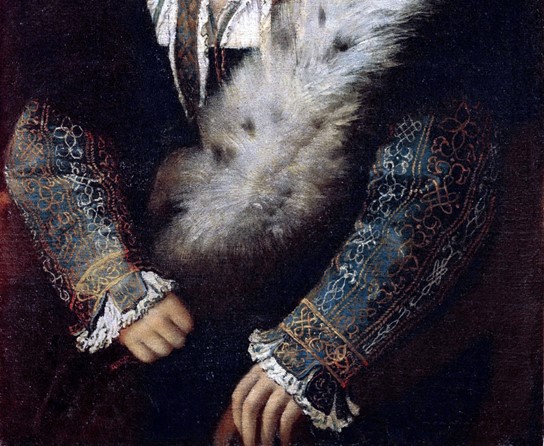
In the painting, Isabella is portrayed in a three-quarter profile, with her gaze slightly averted from the viewer. She is adorned in a sumptuous gown that combines shades of blue and black, intricately embellished with the fantasie dei vinci pattern, which serves as a testament to her position as a prominent noblewoman of her era. The hues of her attire are both dark and vivid, and the fashionable accessories that Isabella wears, pearl earrings and a fur shawl gracefully draped over her shoulder, have been meticulously rendered. These details not only reflect Isabella’s significance but also highlight Titian’s expertise in capturing textures and fabrics. https://scholarlypublications.universiteitleiden.nl/access/item%3A2889008/view pp.22-23
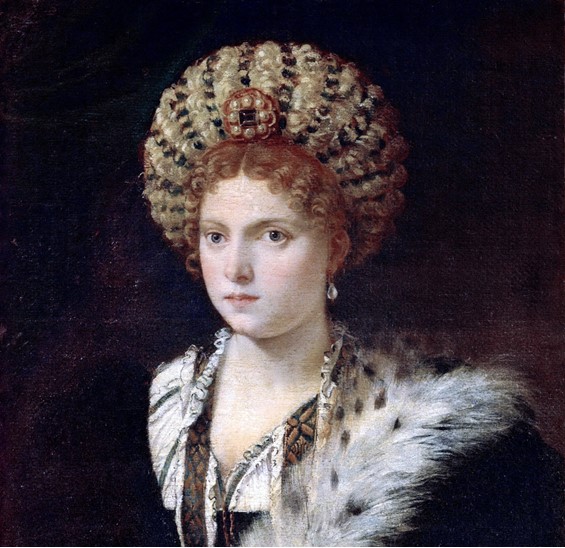
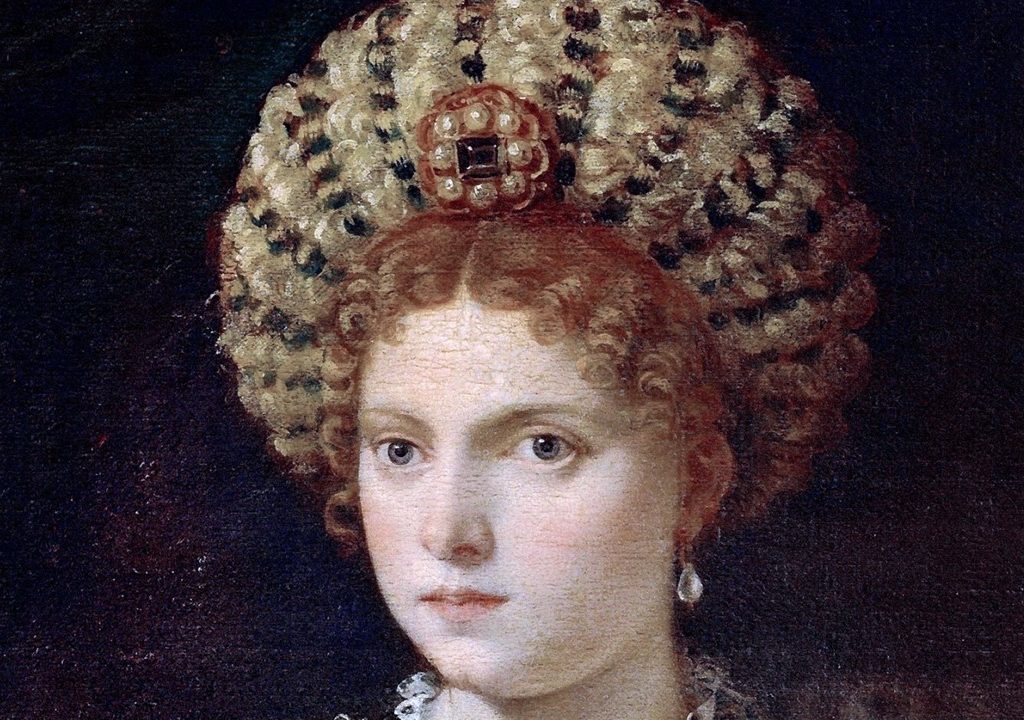
1 am particularly drawn to the elegant arrangement of Isabella’s hair. The Marchioness wears a captivating bulbous headdress featuring a sizable brooch adorned with eight pearls encircling a gem. Isabella was a famous fashionista. The bulbous headdress (known as zazara at the time) was designed by Isabella herself, and the Titian painting served her own trendsetting fashion put on display. What a magnificent way to emphasize her majestic presence!
Isabella’s expression is both serene and confident, befitting her reputation as a powerful and influential figure. Her gaze conveys a sense of introspection and sophistication, while the faint hint of a smile gracing her lips adds an air of subtle allure. The play of light and shadow in the painting adds depth and dimension to Isabella’s features, enhancing the overall realism of the portrait. Titian’s skillful use of chiaroscuro, a technique that contrasts light and dark tones, gives the portrait a lifelike quality and a sense of depth.
The background of the painting is relatively simple, allowing the focus to remain on Isabella’s presence and personality, her elegance, grace, and authority. Through meticulous attention to detail, refined use of color and light, and a keen understanding of portraiture, Titian created a lasting image that captures the essence of Isabella’s character and her place in history.
For a PowerPoint, titled 9 Portraits of Isabella d’Este, please… Check HERE!… Check HERE!
An Interesting Video about Isabella d’Este the Marchioness of Mantua during Early Renaissance Italy by World History Encyclopedia (8:09 min)
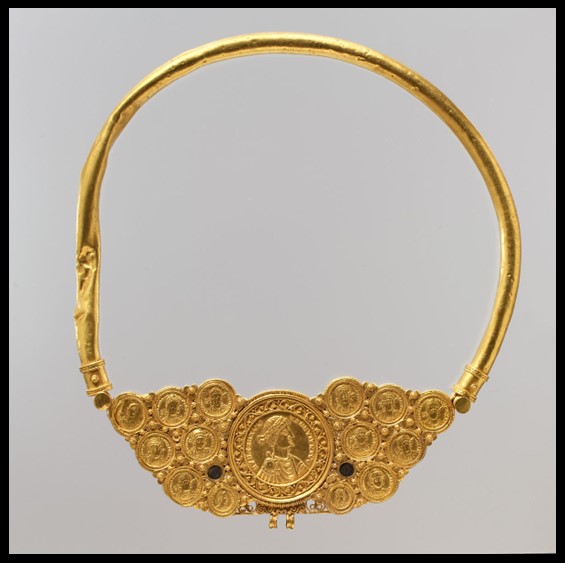
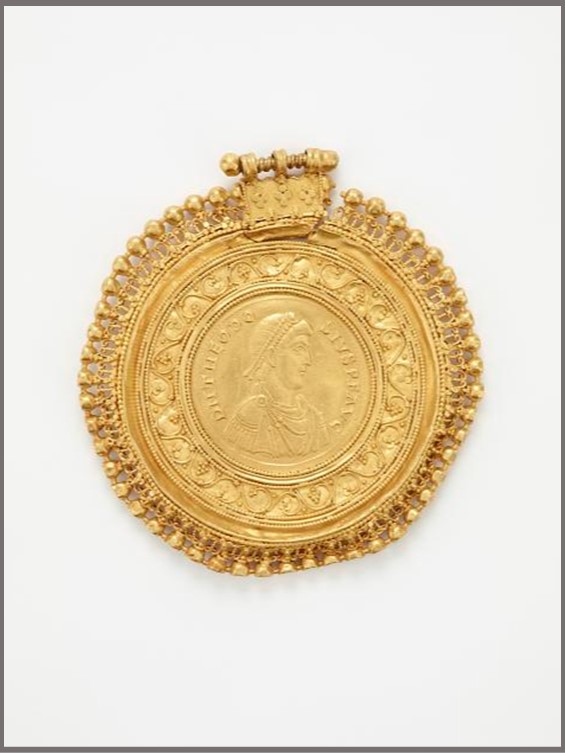
Neck rings, such as the imposing goldPectoral with Coins and Pseudo-Medallion in the Metropolitan Museum in New York City, are cited in early sources as playing a role both in the glorification of military heroes and in coronation ceremonies. They were popular during the Late Roman period and continued well into the Early Byzantine era. Also known as Byzantine Imperial Collars or Byzantine Imperial Torcs, ornate necklaces like the MET example, were worn by members of the Byzantine imperial family and high-ranking officials during the Byzantine Empire (330-1453 AD). These neck rings were made of gold and decorated with medallions, coins, and intricate designs, often featuring Christian symbols. https://www.metmuseum.org/art/collection/search/464070
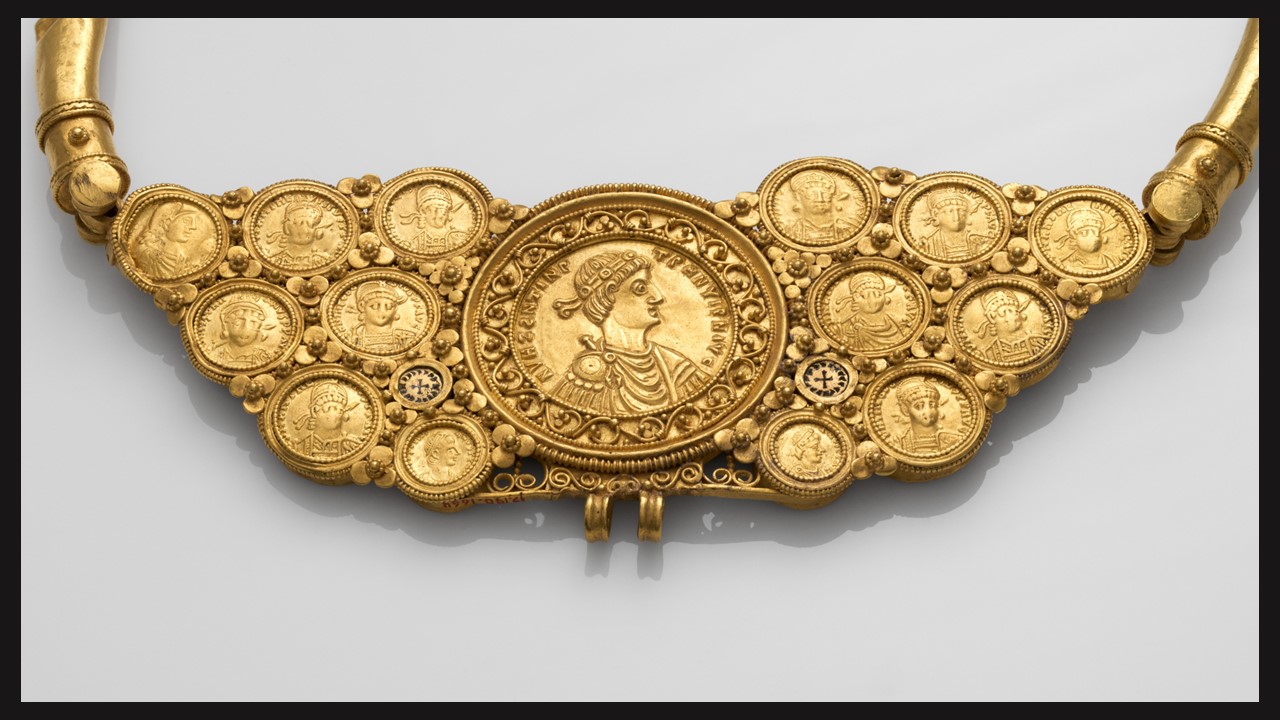
The Metropolitan Museum pectoral necklace is composed of a plain, hollow neck ring attached to a frame set with a large central medallion flanked by coins, and two small decorative disks. The central medallion, encased by beaded wire, presents an unidentified Emperor in military attire on the obverse, and the enthroned personification of Constantinople on the reverse. Fourteen coins of Byzantine Emperors reigning during the fifth to the sixth centuries, are placed symmetrically, left, and right of the central medallion. The coins are surrounded by beaded wire as well. Crosses in niello, an interesting reference to Christianity, decorate the two small disks on either side of the medallion. The space between the coins and the medallion is filled with small rosettes and larger trefoils. The two ribbed rings at the pectoral’s lower edge once held a large medallion of the emperor Theodosius I (in the Collection of the Freer Gallery of Art). https://www.metmuseum.org/art/collection/search/464070 and https://www.metmuseum.org/art/metpublications/Age_of_Spirituality_Late_Antique_and_Early_Christian_Art_Third_to_Seventh_Century Age of Spirituality: Late Antique and Early Christian Art, page 318-319
This amazing necklace was part of a hoard of thirty-four pieces of gold jewelry said to have been found at the turn of the twentieth century, possibly at ancient Lycopolis (modern Assiut) or Antinoöpolis (modern Sheikh Ibada), both in central Egypt. The circumstances of the hoard’s discovery remain obscure as the treasure was illegally excavated. The high quality of each piece links the treasure jewels to the imperial workshops in Constantinople. The hoard is now divided among the Metropolitan Museum; the British Museum, London; the Freer Gallery of Art, Washington, D.C.; and the Staatliche Museen-Preussischer Kulturbesitz, Berlin.Whether the pieces were indeed discovered together or were assembled from different sites, they represent the standard of luxury among the elite in Egypt under Byzantine rule and attest to the close connection between the wealthy province and the capital Constantinople.https://www.metmuseum.org/art/metpublications/The_Arts_of_Byzantium_The_Metropolitan_Museum_of_Art_Bulletin_v_58_no_4_Spring_2001“The Arts of Byzantium”: The Metropolitan Museum of Art Bulletin, v. 58, no. 4 (Spring, 2001), Page 19 and “Into the hands of a well-known antiquary of Cairo”: The Assiut Treasure and the Making of an Archaeological Hoard by Elizabeth Dospěl Williams, West 86th: A Journal of Decorative Arts, Design History, and Material Culture, Vol. 21, No. 2 (Fall-Winter 2014), pp. 251-272 https://www.jstor.org/stable/10.1086/679985?read-now=1#page_scan_tab_contents
The Byzantine Imperial Neck Rings were not just a fashion accessory, they were a symbol of power and authority. The imperial family, for example, wore them on important occasions, such as coronations, to demonstrate their wealth and status. Members of the Byzantine military elite, on the other hand, wore them as trophies of their military distinction. According to Procopius, soldiers were rewarded with money, and honoured with precious necklaces or bracelets. It is interesting to note that during the Early Byzantine period, men and women wore such necklaces alike. https://www.metmuseum.org/art/metpublications/Age_of_Spirituality_Late_Antique_and_Early_Christian_Art_Third_to_Seventh_Century Age of Spirituality: Late Antique and Early Christian Art, Third to Seventh Century, edited by Kurt Weitzmann, 1979, page 318-319
For a PowerPoint on the so-called Assiut Treasure, please… Check HERE!
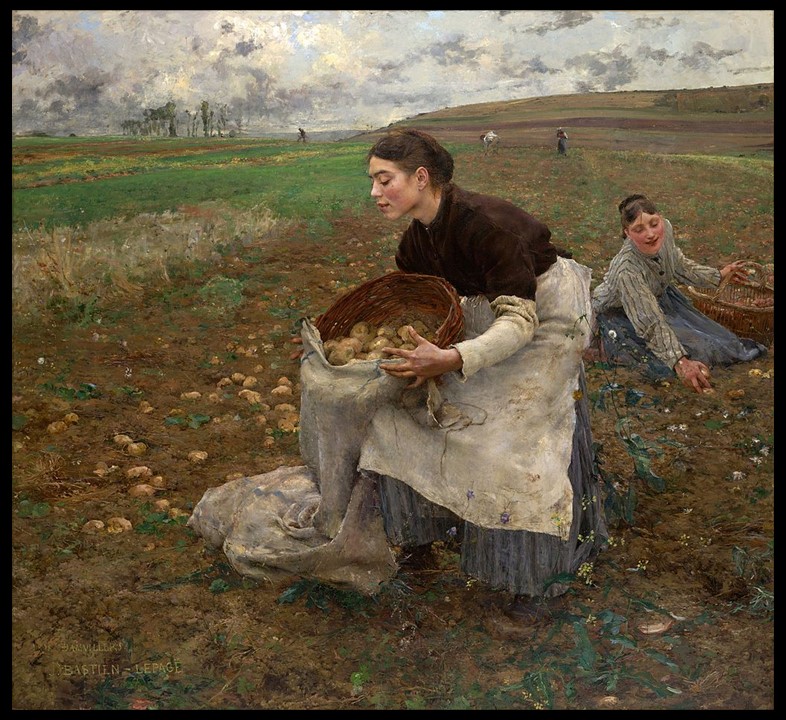
October is the treasurer of the year, / And all the months pay bounty to her store; / The fields and orchards still their tribute bear, / And fill her brimming coffers more and more… The painting October by Jules Bastien-Lepage fills October’s brimming coffers with… ordinary potatoes, and back-breaking labor. Yet, there is such dignity in Bastien-Lepage’s presentation of this unassuming composition, that I would like to explore it more… https://www.poemhunter.com/poem/october-39/comments/
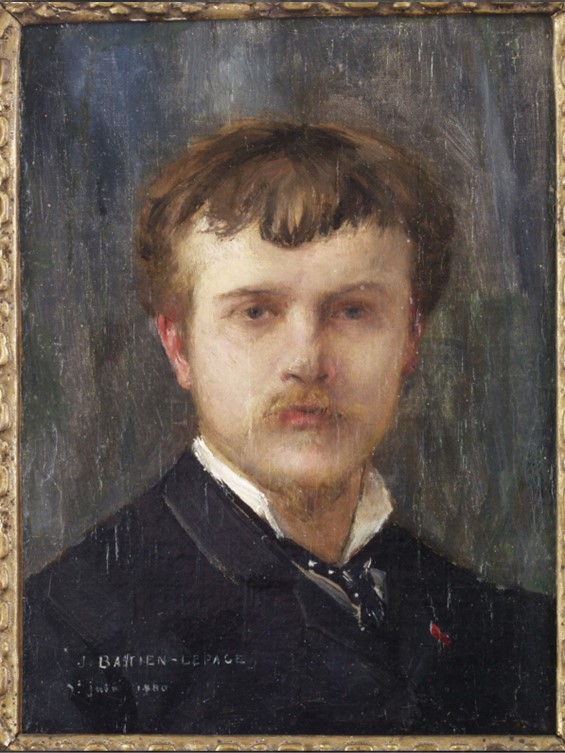
Bastien-Lepage produced a collection of deeply personal artworks, firmly establishing his position within the Naturalism movement’s historical timeline. His oeuvre is focused on three main areas of art, namely, depicting realistic genre themes, creating rural landscapes, and fashioning truthful portraits. The sincerity portrayed in his paintings gained him a loyal following not only in France but also across Europe. Beauty, I am convinced, Jules Bastien-Lepage once said, is the exact truth: neither to the right nor to the left, but in the middle! https://www.theartstory.org/artist/bastien-lepage-jules/
The artist was born (November 1, 1848) in Damvillers, France, and showed an early talent for art. He studied at the École des Beaux-Arts in Paris, where he was influenced by the works of the Barbizon School painters, particularly Jean-Baptiste Corot and Gustave Courbet. Bastien-Lepage’s style combined elements of Realism with a focus on capturing the effects of light and atmosphere. His approach to painting often involved working directly from nature, capturing the effects of light and the nuances of everyday life. His subjects included landscapes, portraits, and genre scenes, all characterized by meticulous attention to detail and a sense of honesty and seriousness.
Unfortunately, Jules Bastien-Lepage’s career was cut short when he died at the age of thirty-six. His work, however, had a significant impact on the development of Naturalism and influenced many artists who followed. Today, regarded as an important figure in the history of 19th-century French art, Bastien-Lepage is respected for the sincerity, and the dignity with which he depicted the Meuse region in which he grew up, and the workers and peasants who his brush rendered! https://www.theartstory.org/artist/bastien-lepage-jules/
For the Paris Salon Bastien-Lepage created and exhibited a pair of Harvest Scenes that marked a new direction in his career as a painter. The earlier of the two works, The Haymakers, (today, in the Musée d’Orsay), exhibited at the Salon in 1878, shows two weary haymakers resting in the summer heat. The second painting, exhibited at the Paris Salon of 1879, and titled October or The Potato Harvest, (today, in the National Gallery of Victoria, Melbourne, Australia) is an account of the bleak autumnal potato harvest, set in a bare, featureless landscape. Both paintings, powerfully rendered, and careful studies of life in the fields, had a considerable influence on the art scene of the time. Both paintings created a new trend in art, and, without intention on Bastien-Lepage’s part, the painter of the Meusian peasants became the head of an Art School. https://www.ngv.vic.gov.au/explore/collection/work/3768/
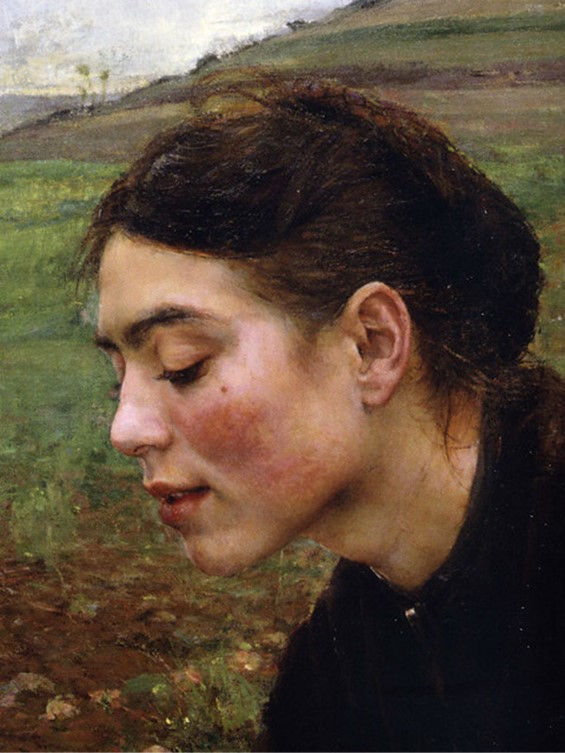
October or The Potato Harvest was an 1879 Salon success. Carried out on a large canvas, the painting indicates Bastien-Lepage’s ambitious artistic program but also bespeaks his confidence in his own technical virtuosity. The artist presents its theme in a solemn key, with warm yet sober colours, and an exquisite understanding of the country in the late summer. It was powerfully executed, full of vigor, serenity, and the ability to combine the high ‘finish’ expected of a conventional academic picture with the looser brushwork associated with the Impressionists.https://www.ngv.vic.gov.au/explore/collection/work/3768/
Jules Bastien-Lepage, French artist, 18480-1884 October (detail), 1878, oil on canvas, 180.7 x 196.0 cm, National Gallery of Victoria, Melbourne, Australia https://www.flickr.com/photos/eoskins/19429557290
The Salon audience noticed the painting’s artistic power, and the Russian painter Vasily Surikov upon seeing it in Paris wrote to his colleague Pavel Chistyakov… I want to talk about those few works that have true dignity. Take Bastien-Lepage’s picture of a Woman Picking Potatoes. The face is both painted and written as living. Everything is written in the air. Reflexes, color, everything is so whole, unbroken, that it is a miracle.https://en.wikipedia.org/wiki/October_(painting)
For a PowerPoint on the artistic oeuvre of Jules Bastien-Lepage, please… Check HERE!
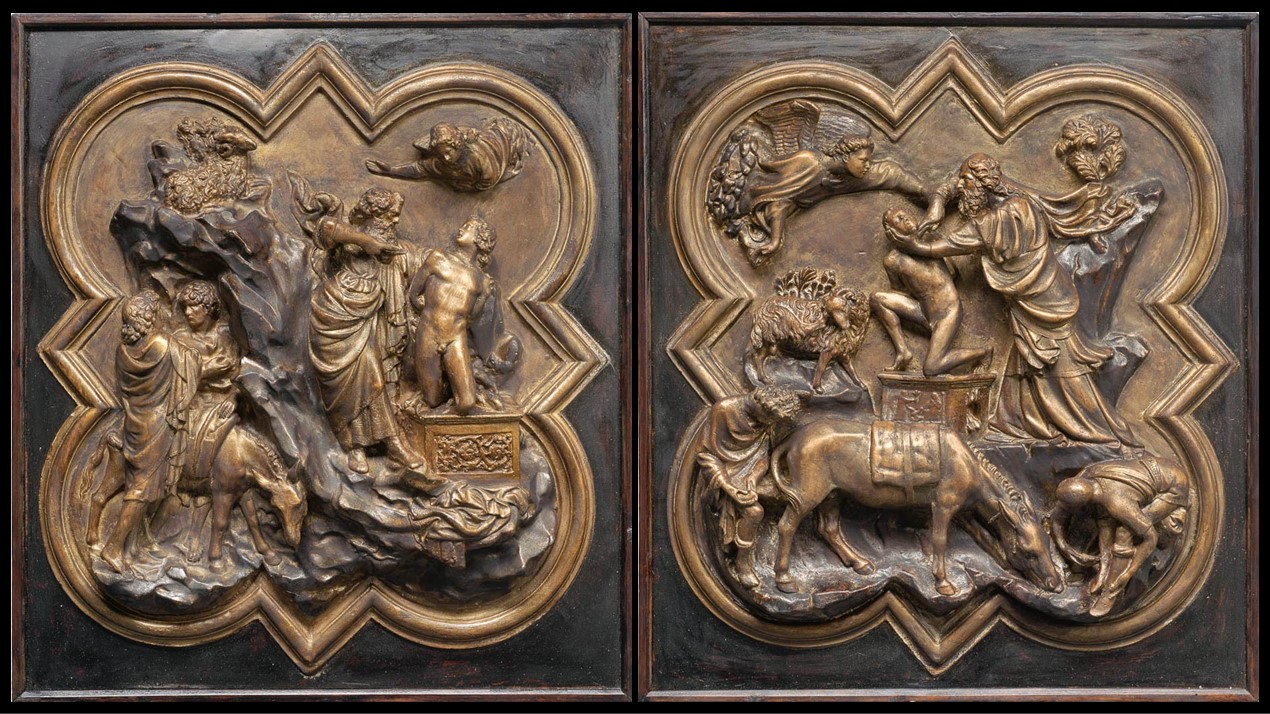
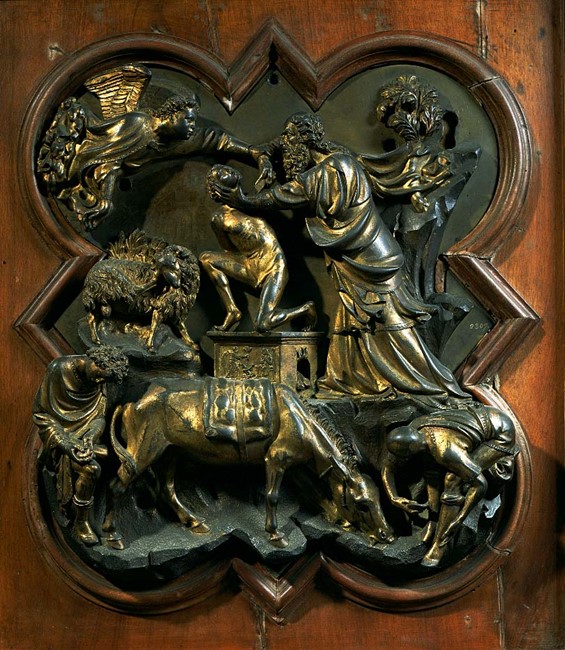
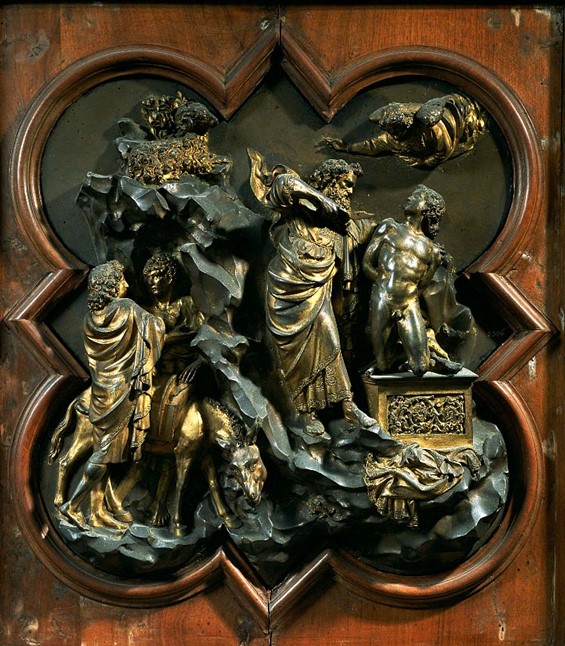
Lorenzo Ghiberti, 1378-1455 Sacrifice of Isaac, 1401, Gilded Bronze, 45 × 38 cm, Museo Nazionale del Bargello, Florence, Italy Filippo Brunelleschi, 1377-1446 Sacrifice of Isaac, 1401, Gilded Bronze, 41 × 36 cm, Museo Nazionale del Bargello, Florence, Italy https://idole-rivalen.khm.at/en/
In 1400, a competition was announced for a bronze double door at the Baptistery in Florence. While such contests were no rarity, this one is considered a classic of its kind. A jury of 34 declared the winner to be Lorenzo Ghiberti, whose composition was regarded as better balanced, not to mention its using around seven kilograms less of the valuable material. Hardly any history of Renaissance art fails to mention this event as a founding moment. The Brunelleschi vs. Ghiberti competition is the best introduction, in my humble opinion, to 15th-century Italian Renaissance Art. https://idole-rivalen.khm.at/en/
Filippo Brunelleschi, 1377-1446 Sacrifice of Isaac, 1401, Gilded Bronze, 41 × 36 cm, Museo Nazionale del Bargello, Florence, Italy https://www.artesvelata.it/concorso-1401/
From the life of Filippo Brunelleschi… in the year 1401, now that sculpture had risen to so great a height, it was determined to reconstruct the two bronze doors of the Church and Baptistery of San Giovanni, since, from the death of Andrea Pisano to that day, they had not had any masters capable of executing them. This intention being, therefore, communicated to those sculptors who were then in Tuscany, they were sent for, and each man was given a provision and the space of a year to make one scene; and among those called upon were Filippo and Donato, each of them being required to make one scene by himself, in competition with Lorenzo Ghiberti, Jacopo della Fonte [Jacopo della Quercia], Simone da Colle, Francesco di Valdambrina, and Niccolo d’ Arezzo. These scenes, being finished in the same year and being brought together for comparison, were all most beautiful and different one from the other; one was well designed and badly wrought, as was that of Donato; another was very well designed and diligently wrought, but the composition of the scene, with the gradual diminution of the figures, was not good, as was the case with that of Jacopo della Quercia; a third was poor in invention and in the figures, which was the manner wherein Francesco di Valdambrina had executed his; and the worst of all were those of Niccolo d’ Arezzo and Simone da Colle. The best was that of Lorenzo di Cione Ghiberti, which had design, diligence, invention, art, and the figures very well wrought. Nor was that of Filippo much inferior, wherein he had represented Abraham sacrificing Isaac; and in that scene a slave who is drawing a thorn from his foot, while he is awaiting Abraham and the ass is browsing, deserves no little praise.
The scenes, then, being exhibited, Filippo and Donato were not satisfied with any save with that of Lorenzo, and they judged him to be better qualified for that work than themselves and the others who had made the other scenes. And so with good reasons they persuaded the Consuls to allot the work to Lorenzo, showing that thus both the public and the private interest would be best served; and this was indeed the true goodness of friendship, excellence without envy, and a sound judgment in the knowledge of their own selves, whereby they deserved more praise than if they had executed the work to perfection. Happy spirits! who, while they were assisting one another, took delight in praising the labors of others. How unhappy are those of our own day, who, not sated with injuring each other, burst with envy while rending others? The Consuls besought Filippo to undertake the work in company with Lorenzo, but he refused, being minded rather to be first in an art of his own than an equal or a second in that work. Wherefore he presented the scene that he had wrought in bronze to Cosimo de’ Medici, who after a time had it placed on the dossal of the altar in the old Sacristy of San Lorenzo, where it is to be found at present; and that of Donato was placed in the Guild of the Exchange.
Lorenzo Ghiberti, 1378-1455 Sacrifice of Isaac, 1401, Gilded Bronze, 45 × 38 cm, Museo Nazionale del Bargello, Florence, Italy https://www.artesvelata.it/concorso-1401/
From the Life of Lorenzo Ghiberti… He had not been long absent from home when the plague ceased, and the Signoria of Florence and the art of the merchants, seeing that there were a number of excellent artists in sculpture at that time, both foreigners and Florentines, thought that it would be a favourable opportunity to make the other two doors of S. Giovanni, the ancient and principal church of the city, a matter which had frequently been discussed. It was arranged by them that all the masters considered to be the best in Italy should be invited to come to Florence to compete in making bronze panels similar to those which Andrea Pisano had done for the first door. Ghiberti was working at Lesare at the time but although offers of higher wages were promised, he availed nothing, for to Lorenzo it seemed worth a thousand years to return to Florence, and he accordingly set out and reached his home in safety. Many foreigners had already arrived and reported themselves to the consuls of the arts. From among them seven masters in all were selected: three Florentines, and the remainder Tuscans. A provision of money was set apart for them, and it was stipulated that within a year each of them should produce, as an example of his skill, a bronze panel of the same size as those of the first door. It was determined that the scene represented should be the sacrifice of Isaac by Abraham, which was considered to be a good subject in which the masters could grapple with the difficulties of the art, because it comprises a landscape, figures both nude and draped, and animals, while the figures in the foreground might be made in full relief, those in the middle distance in half-relief, and those in the background in bas-relief. The competitors for this work were: Filippo di ser Brunellesco, Donato and Lorenzo di Bartoluccio, Florentines, and Jacopo dalla Quercia of Siena, Niccolo d’Arezzo his pupil, Francesco di Vandabrina, 1 and Simone da Colie, sumamed “of the bronzes,” who all promised the consuls to have their panels ready at the appointed time.
They set to work and devoted all their study and diligence, all their strength and knowledge, to surpass each other, keeping what they did close secret, so that they might not light upon the same ideas. Lorenzo alone, who enjoyed the help of Bartoluccio, who made him take great pains and prepare many models before he resolved upon adopting any one of them, continually brought his fellow citizens, and also passing strangers if they understood the trade, to see his work and hear their opinion. By the aid of their criticisms he was enabled to produce a model which was beautifully made and absolutely without a fault. Having shaped his figures and cast the whole in bronze, it proved excellent; and he and his father, Bartoluccio, polished it with such devotion and patience that it was impossible for it to have been better finished. When the time arrived for it to be exhibited in the competition, his panel and those of the other masters were handed over to the art of the merchants to be adjudicated upon. When they came to be examined by the consuls and several other citizens many various opinions were expressed. Numbers of strangers had assembled in Florence, some painters, some sculptors, and some goldsmiths, who were invited by the consuls to come and judge the works in conjunction with others of the same professions who lived in Florence. They numbered thirty-four persons in all, each of them being an adept in his art, and although there were differences of opinion among them, some preferring the style of one and some that of another, yet they were agreed that Filippo di ser Brunellesco and Lorenzo di Bartoluccio had composed and finished a larger number of figures better than Donato had done, although his panel exhibited great powers of design. In that of Jacopo dalla Quercia the figures were good but lacking in delicacy, in spite of the good design and the care bestowed. The work of Francesco di Vandabrina contained good heads and was well finished, but the composition was confused. That of Simone da Colle was a good cast, because he was a founder by profession, but the design was not very good. The production of Niccolo d’Arezzo, showing great skill, was marred by stunted figures and absence of finish. Lorenzo’s alone was perfect in every part, and it may still be seen in the audience chamber of the art of the merchants. The whole scene was well designed and the composition excellent, the figures being slender and graceful, the pose admirable and so beautifully finished that it did not look as if it had been cast and polished, but rather as if it had been created by a breath. Donato and Filippo, when they perceived what diligence Lorenzo had devoted to his work, withdrew to one side and agreed that the work ought to be given to him, for it seemed to them that public and private interests would thus be best served, and as Lorenzo was a young man, not past twenty, he would be able to realize in the production of this work the great promise of his beautiful scene, which; according to their judgment, he had made more excellently than the others: adding that it would be more shameful to dispute his right to preeminence than generous to admit it. Accordingly Lorenzo began on that door opposite the opera of S. Giovanni,’ constructing a large wooden frame for a part of it of the exact size he desired, in the shape of a frame with the ornamentation of heads at the angles about the spaces for containing the scenes and the surrounding friezes. After he had made the mold and dried it with all diligence, he set up a huge furnace, which I remember having seen, and filled the frame with metal. He did this in some premises he had bought opposite S. Maria Nuova, where the hospital of the weavers, known as the Threshing floor, now stands. But realising that all was not going well, he did not lose courage or become distracted, but traced the cause of the disorder and altered his mold with great quickness without anyone knowing it, recasting the world, which came out most successfully. He went on similarly with the rest of the work, casting each scene separately, and then putting them in their appointed places. The division of the scenes was similar to that adopted by Andrea Pisano in the first door designed for him by Giotto.
It is always interesting to go as close as possible to primary sources!
For a PowerPoint on the competition panels, please… Check HERE!
Idols & Rivals, Artists in Competition (September 20, 2022 – January 8, 2023) was an interesting Exhibition in the Kunsthistorischen Museum in Vienna. It showed how in antiquity, the Renaissance, and the Baroque, artists competed with one another and how, in addition, they measured themselves against ancient models. This kind of competition has brought forth some of the best-known works in the history of art. Among the competitors were Brunelleschi and Ghiberti… https://idole-rivalen.khm.at/en/
#/media/File:Jules_Bastien-Lepage_-_October_-_Google_Art_Project.jpg)