Boat Fresco of Orchomenos

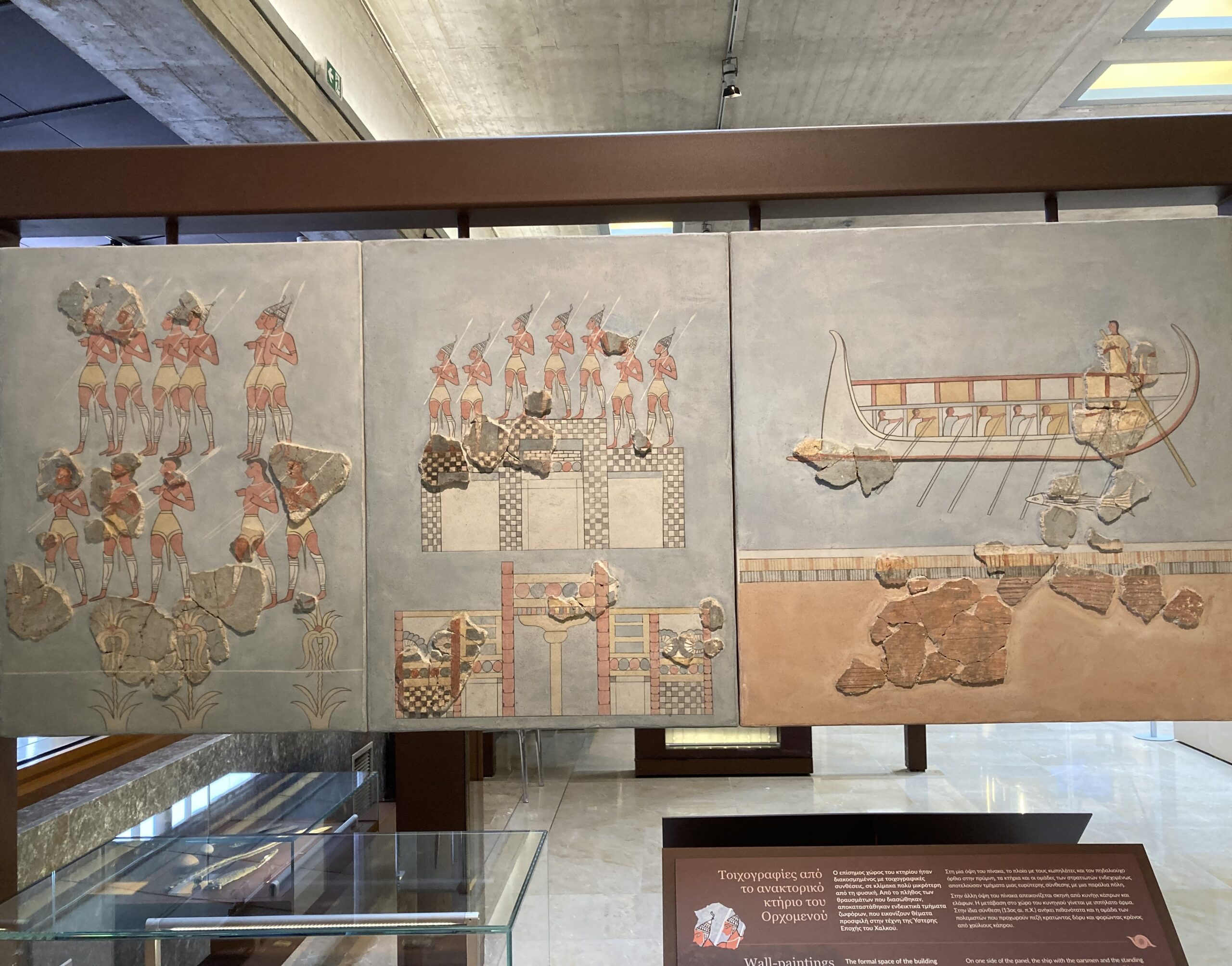
Wall Paintings from the Mycenaean Palace of Boeotian Orchomenos, Late Bronze Age, 13th century BC, Archaeological Museum of Thebes, Greece – Photo credit: Amalia Spiliakou, February 19, 2024

Among the fragmentary remains of the Mycenaean palace at Orchomenos, a wall painting depicting a long, narrow oared vessel offers a rare glimpse into how the rulers of Late Bronze Age Boeotia envisioned their relationship with the sea. Known as the Boat Fresco of Orchomenos, this work, now reconstructed and displayed in the Archaeological Museum of Thebes, dates to the 13th century BC, when the Mycenaean palatial system reached its zenith. Though only scattered plaster fragments survive, they reveal a striking image: a ship manned by seated oarsmen and guided by a standing helmsman at the stern. In its quiet precision and rhythm, this miniature seascape reflects a world where mastery over movement, of ships, people, and power, defined the essence of kingship.

The palace of Orchomenos stood on a low hill overlooking the fertile Boeotian plain. Excavations revealed storerooms, painted architectural façades, and fragments of richly colored wall paintings that once adorned audience halls. According to Th. Spyropoulos’s study in Mycenaean Wall Painting in Context (2015), the ship fragment formed part of a larger scene that may have included city walls and armed figures, a coastal tableau echoing Mycenaean concerns with both defense and seafaring. The linear precision of the hull and the rhythmic placement of the oars evoke balance and order, qualities also prized in palatial architecture and administration.

Wall Painting from the Mycenaean Palace of Boeotian Orchomenos, Late Bronze Age, 13th century BC, Archaeological Museum of Thebes, Greece – Photo credit: Amalia Spiliakou, February 19, 2024

In artistic terms, the Orchomenos fresco belongs to the same tradition as other Mycenaean depictions of ships, most famously the ‘naval scene’ from the Palace of Nestor at Pylos. The Pylos fresco, excavated in Hall 64, portrays a fleet of long, low ships navigating stylized waves filled with fish and dolphins. Both works share conventions such as the gently curving hull, rhythmic oars, and the figure of a helmsman guiding the vessel. Yet their atmosphere differs markedly. The Pylos composition is expansive and dynamic, ships advance across a vivid seascape, perhaps symbolizing a royal expedition or divine voyage, while the Orchomenos image feels more contained, even austere. Its minimal background and measured geometry create a quieter meditation on order and control rather than the celebration of motion.

Reconstruction of the Mycenaean Fresco of Ships from the Palace of Pylos (Rosemary Robertson, 2013)

This contrast may reflect local identity. Pylos, a coastal kingdom deeply tied to the sea, presented maritime power as spectacle, Orchomenos, though inland, still drew wealth from trade routes linking the Gulf of Euboea and central Greece. Its painters adopted the ship motif not as a literal scene but as a symbol of authority, evidence that the imagery of seafaring had become part of a shared Mycenaean visual vocabulary of kingship. The disciplined rowers and steady helmsman thus mirror the palace’s administrative ideals: hierarchy, cooperation, and the mastery of nature through collective labor.

Because the Orchomenos fragments were recovered out of context, interpretation remains cautious. Some scholars propose a decorative register celebrating the Mycenaean “thalassocracy,” others suggest a ritual or mythic voyage. Whatever the intent, the fresco’s survival, though partial, testifies to the integration of marine imagery into the artistic language of mainland Greece. Like other Mycenaean murals, it transforms daily reality into an emblem of order and power. The Orchomenos ship, with its measured rhythm of oars and its commanding helmsman, evokes a civilization that saw itself as both master of the land and heir to the sea.

Seen today in its reconstructed form, the fresco invites reflection on the fragility of artistic memory. What remains are not complete narratives but fragments, strokes of pigment, broken lines, that nonetheless preserve the pulse of the Bronze Age imagination. In those traces, the Mycenaean boat continues its journey across time, carrying with it echoes of labor, leadership, and the enduring allure of the sea.

For a Student Activity inspired by the Orchomenos fresco of a Boat, please… Click HERE!

Bibliography: Spyropoulos, Th. “Wall Paintings from the Mycenaean Palace of Boeotian Orchomenos.” In Mycenaean Wall Painting in Context: New Discoveries, Old Finds Reconsidered, eds. H. Brecoulaki, J. L. Davis & S. R. Stocker. Athens: National Hellenic Research Foundation, 2015, and Archaeological Museum of Thebes, permanent collection panels on wall paintings from Orchomenos (museum text, 2016). https://aristomenismessinios.blogspot.com/2020/04/an-unprecedented-navalscene-from-pylos.html and https://greek-museums.tumblr.com/post/149758810301/archaeological-museum-of-thebes-wall-paintings?utm_source=chatgpt.com and https://bmcr.brynmawr.edu/2016/2016.11.09/?utm_source=chatgpt.com

Funerary Stele of Alexibola

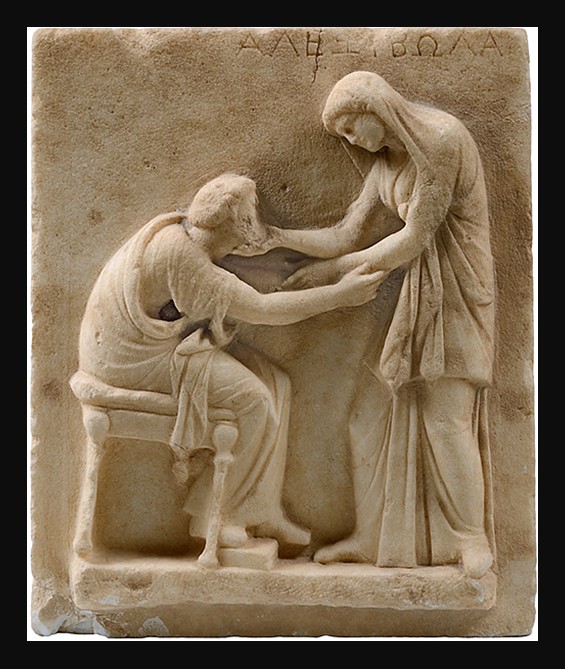
Alexibola: Funerary Stele with Scene of Greeting, early 3rd century BC, Marble, Archaeological Museum of Thera, Greece
https://www.ias.edu/ideas/2017/chaniotis-world-of-emotions

Among the treasures of the Archaeological Museum of Thera, the Funerary Stele of Alexibola stands out as a moving testament to the emotional depth of Classical Greek art. Carved in marble in the early 3rd century BC, the relief depicts Alexibola, the deceased, standing before a seated older man, probably her father, as they exchange a final, tender farewell. The woman’s gesture, gently touching the man’s beard, is met by his reciprocal touch on her arm, creating a moment of quiet intimacy and profound affection. Their calm expressions and composed postures convey sorrow and love without excess, embodying the Greek ideal of dignity even in grief.

Displayed in the acclaimed 2017 exhibition “A World of Emotions: Greece, 700 BC–AD 200” (Onassis Cultural Center, New York; Acropolis Museum, Athens), this stele beautifully illustrates how emotion was central to Greek experience. As curator Angelos Chaniotis observed, emotions shaped Greek culture no less than reason. The stele of Alexibola reveals how artists of the Classical world captured not only the likeness of individuals but also the enduring human capacity for feeling, transforming private loss into timeless art.

Funerary stelae held a vital place in ancient Greek art, serving as both commemorations of the dead and reflections of deeply personal emotion within a public setting. These marble reliefs, often depicting the deceased in moments of quiet interaction with loved ones, reveal how the Greeks balanced restraint and feeling, translating private grief into graceful, idealized form. Rather than dramatic displays of sorrow, they communicate emotion through subtle gestures: a clasped hand, a downward gaze, or a tender touch. The Stele of Alexibola exemplifies this tradition perfectly, its depiction of a final farewell between a daughter and her father transforms the pain of parting into a timeless image of love, respect, and composure. Through such works, Greek artists gave emotional depth to stone, reminding viewers that even in death, the bonds of human affection endure.

The Funerary Stele of Alexibola was discovered on the Cycladic island of Thera, modern Santorini, an island that has long held a significant place in the history of Greek art and culture. Thera was a thriving center of Aegean civilization, strategically located between Crete and mainland Greece, and its artistic legacy reflects this blend of influences. From the vivid frescoes of the prehistoric settlement at Akrotiri, which reveal a sophisticated visual culture rivaling that of Minoan Crete, to later Classical and Hellenistic sculptures such as the stele of Alexibola, Thera demonstrates the island’s continuous engagement with the broader artistic currents of the Greek world. The stele itself embodies the island’s role as both participant in and preserver of Greek aesthetic value, melding technical mastery with emotional subtlety, and reminding us that even on this volcanic outpost, art served as a bridge between personal memory and collective tradition.

Alexibola: Funerary Stele with Scene of Greeting, early 3rd century BC, Marble, Archaeological Museum of Thera, Greece
https://www.greece-is.com/millennia-tour-santorini-ages/

Today, the Funerary Stele of Alexibola continues to speak across millennia, its message as clear and touching as when it was first carved. In its quiet grace, we recognize the timeless human emotions of love, loss, and remembrance, feelings that unite us with those who lived and grieved long ago. The simplicity of the figures, their tender gestures, and the dignified calm of their farewell remind us that art can express what words often cannot. Through Alexibola’s parting moment with her father, we are invited into an intimate world where ancient stone becomes a vessel for enduring emotion, proving that even in silence, the human heart has always sought connection, beauty, and meaning.

For a PowerPoint Presentation of important ancient Greek Funerary Stele, please… Check HERE!

Bibliography: https://www.ias.edu/ideas/2017/chaniotis-world-of-emotions

More Posts on ancient Greek Funerary Stele by Teacher Curator… https://www.teachercurator.com/art/hegeso-daughter-of-proxenos/ and https://www.teachercurator.com/ancient-greek-art/telling-us-goodbye/ and https://www.teachercurator.com/ancient-greek-art/grave-stele-of-a-youth-and-a-little-girl/

Poliochne on Lemnos

Poliochne on Lemnos, one of the earliest European settlements (Early Bronze Age, c. 3200–2100 BCE), with its maze-like houses and public squares revealing the social organization and daily life of its inhabitants. – Photo Credit: Amalia Spiliakou, July 2025

Visiting the ancient settlement of Poliochne on Lemnos offered a rare opportunity to step directly into the early stages of European urban history. Walking among the remains of its carefully planned streets and multi-roomed houses, I was struck by how vividly the site conveys the ingenuity and social organization of its Bronze Age inhabitants. Poliochne, often regarded as one of Europe’s earliest towns, reveals a level of architectural and cultural sophistication that challenges modern assumptions about prehistoric life. Through the photographs I captured on-site, I hope to share both the tangible traces of this remarkable settlement and the sense of awe that comes from encountering a place where history feels immediately present.

Poliochne, on the eastern coast of Lemnos, flourished as a major urban center of the Early Bronze Age. Established around the mid-fifth millennium BC and occupied until the end of the second millennium BC, it prospered thanks to its strategic location between Asia Minor and the Aegean, with safe anchorage, fertile land, and abundant freshwater. Archaeological evidence reveals a sophisticated settlement with strong fortifications, public squares, paved streets with drains, wells, and both modest houses and large mansions, reflecting a complex social and civic structure. Its development unfolded through successive cultural phases, marked by advances in architecture, pottery, metallurgy, and trade, while its decline in the late third millennium was likely triggered by a devastating earthquake. Closely connected to Troy, Thermi on Lesbos, and other centers of the Northeast Aegean, Poliochne was a hub of commerce and innovation, leaving a lasting imprint on early urban life in the wider region.

Opened in the west side of the settlement at Poliochne is the main gate, terminus also of the central thoroughfare 102. Both the street and the gateway appear to have been part of the first urban plan of the settlement, which is dated to the Blue period, and were kept unchanged throughout almost its entire existence, with some additions and local interventions. 
Photo Credit: Amalia Spiliakou, July 2025

Poliochne, first established during the Final Neolithic period, developed through successive architectural phases that archaeologists have identified by color. In the earliest Black Period (3700–3200 BC), a modest cluster of oval huts built of wood and straw stood at the hill’s center. The following Blue Period (3200–2700 BC) saw dramatic growth: the settlement expanded, a fortification wall was erected on the mainland side, and the urban plan became more organized. Oval huts gave way to apsidal and oblong houses, and public buildings began to appear, including the so-called Bouleuterion, likely a meeting hall for civic leaders, and a large communal granary capable of storing vast quantities of food. By the Green Period (2700–2400 BC), the city expanded further northward with new retaining walls, extended defenses, redesigned gates, and a carefully laid-out road system with squares and wells, reflecting a thriving and increasingly complex urban society.

One of the most intriguing aspects of Poliochni is the evidence of democratic structures within its society. Central to this is the “Bouleuterion,” a communal meeting space that points to the practice of collective decision-making, It served as a gathering place for the city’s inhabitants to discuss and decide on matters of common interest, reflecting an early form of democratic governance.
https://www.thearchaeologist.org/blog/poliochni-of-lemnos-the-oldest-city-in-europe-and-a-cradle-of-democracy and Photo Credit: Amalia Spiliakou, July 2025

In the Red and Yellow Periods (2400–2100 BC), Poliochne contracted in size but reached a peak in monumental architecture. This was the era of the first megarons, rectangular halls that may have served as proto-palatial residences or civic buildings, such as Megaron 832 and Megaron 317. The city’s centerpiece in the Yellow Period was Megaron 605, a grand structure with storerooms situated on a central square, thought to have been the seat of a ruler or elite household. The discovery nearby of a golden hoard, comparable to treasures unearthed at Troy, underscores Poliochne’s wealth and regional importance. A well-preserved network of streets, including a main north–south thoroughfare, demonstrates advanced urban planning. Yet, around 2100 BC, a devastating earthquake destroyed much of the settlement, leading to its gradual decline. Later phases, the Brown and Purple Periods (2100–1200 BC), saw only sparse occupation without the monumental scale of earlier centuries, marking the fading of one of Europe’s earliest urban centers.

Archaeological excavations at Poliochne began in the 1930s under the direction of the Italian School of Archaeology at Athens, led by Alessandro Della Seta, who uncovered nearly two-thirds of the site between 1931 and 1936. These pioneering investigations revealed the multi-phased settlement and established Poliochne as one of the earliest urban centers in Europe. Further campaigns were carried out between 1951 and 1956 by Luigi Bernabò Brea, whose detailed publications systematized the site’s stratigraphy and architectural sequence. Renewed work in the late 20th century, under Sandro Tiné, combined excavation with architectural restoration and conservation, re-examining earlier findings with modern methods. Today, the site remains an exemplary case of early Aegean archaeology, where stratigraphic precision and long-term international collaboration have illuminated the development of urban life in the prehistoric Aegean.

For a PowerPoint Presentation of the Bronze Age Seplement of Poliochne, please… Check HERE!

Bibliography: http://odysseus.culture.gr/h/3/eh351.jsp?obj_id=2534 and https://www.greeknewsagenda.gr/poliochne-on-the-island-of-lemnos-the-earliest-evidence-of-social-and-civic-structure-in-europe/ and https://sites.dartmouth.edu/aegean-prehistory/lessons/lesson-7-narrative/

Head of Aphrodite of the Aspremont-Lynden/Arles type 

Head of Aphrodite of the Aspremont-Lynden/Arles type, 1st c. AD copy of an original 4th century BC work by Praxiteles, Marble, possibly Parian (Marathi), Height: 32 cm, National Archaeological Museum, Athens, Greece
https://blogs.getty.edu/iris/the-christian-empire-that-grew-from-classical-roots/

The Head of Aphrodite of the Aspremont-Lynden/Arles type, housed in the National Archaeological Museum in Athens, offers a compelling glimpse into the classical ideals of beauty and divinity shaped by the legacy of Praxiteles. As a copy of a lost 4th-century BC original, possibly the first known depiction of Aphrodite with a nude upper body, this sculptural type reflects the evolving representation of the goddess, bridging the serene sensuality of the Aphrodite of Knidos with the more voluptuous forms of later works like the Aphrodite of Melos. The surviving head, now divorced from its torso, carries echoes of a refined, yet idealized femininity that would influence Roman and Renaissance aesthetics alike. Its later restoration by François Girardon, under the patronage of Louis XIV, introduced symbolic elements like the mirror and apple, both deeply charged with mythological meaning, underscoring not just Aphrodite’s divine allure, but also the enduring power of classical art to adapt to new cultural narratives. An incised cross on her forehead, likely added in the early Christian era, marks a moment when pagan imagery was recontextualized within a new religious worldview.

Carved from Parian marble, the Head of Aphrodite once belonged to an over-life-size statue of a clothed Aphrodite, though some scholars have suggested it may instead portray the famed courtesan Phryne due to its individualized features. The face, turned slightly to the right, is serene and harmonious, with soft, fleshy contours and delicately incised features: a smooth triangular forehead framed by parted curls, a broad nose (now broken), full lips, and a rounded chin. A thick bun gathers the hair at the nape, secured by a wide band. The eyes, beneath gently curved brows, show signs of deliberate Christian-era defacement, likely part of an effort to “close” the eyes and “silence” the mouth. A small, incised cross on the forehead reinforces this reinterpretation of pagan art within a Christian context, suggesting the statue may have been reused as a sacred image. Despite the damage, most notably to the nose and facial extremities, the head remains in relatively good condition and serves as a compelling testament to both the endurance of classical ideals and their transformation in later religious and cultural landscapes.

Head of Aphrodite of the Aspremont-Lynden/Arles type, 1st c. AD copy of an original 4th century BC work by Praxiteles, Marble, possibly Parian (Marathi), Height: 32 cm, National Archaeological Museum, Athens, Greece
https://x.com/ArysPan/status/1513155769000247301/photo/1

The statue’s discovery near the Clock of Andronikos Kyrrhestes in the Roman Agora of Athens further grounds it in the layered urban fabric of ancient Athens, where temples, markets, and later churches coexisted and often repurposed one another’s remains. This setting, close to the sanctuary of Aphrodite and Eros on the north slope of the Acropolis, reinforces the likelihood that the statue originally served a votive or cultic function. The artistic style—marked by its naturalistic modeling, graceful asymmetry, and subtle anatomical details like the “Venus rings” on the neck—embodies the Praxitelian ideal of ethereal beauty softened by human warmth. In this way, the head is not only a remnant of a once-complete devotional image but also a rare survivor of artistic transitions: from Classical to Hellenistic, pagan to Christian, and ultimately, from sacred object to museum artifact.

For a Student Activity, please… Check HERE

Bibliography: https://blogs.getty.edu/iris/the-christian-empire-that-grew-from-classical-roots/ and https://collections.louvre.fr/en/ark:/53355/cl010277986

Hephaistia on the island of Lemnos

Ancient Theater of Hephaistia, late 5th to early 4th century BC, Lemnos Island, Greece
One of the most important monuments of Lemnos, this theater reflects the transition from the Classical to the Hellenistic world, later remodeled during the Roman period.
Photo Credit: Amalia Spiliakou, July 2025

When I visited the ancient city of Hephaistia on the island of Lemnos in July 2025, the quiet hills and open sea breeze made it easy to imagine how myth and daily life once blended here. Named after Hephaestus, the god of fire and metallurgy who, according to legend, fell to Lemnos after being cast from Olympus, the city was the island’s principal center of power and worship. Today its ruins still speak volumes: the stone outlines of sanctuaries and houses, the tombs that reveal centuries of life, and the well-preserved theater that once echoed with civic gatherings and performances. To walk through Hephaistia is not only to step into a serene landscape but also to encounter a city that thrived from the Late Bronze Age through the Byzantine era, balancing myth, religion, and community in a way that remains profoundly compelling.

Hephaistia was once the most important city of Lemnos, rivaling the nearby settlement of Myrina. Its strategic position overlooking the northern Aegean not only provided natural protection but also allowed it to thrive as a gateway for trade, culture, and religious influence. It became both a political hub, where decisions shaping the island were made, and a sacred site intimately tied to the cult of Hephaestus, whose fiery craft was thought to resonate with the island’s volcanic landscape. Archaeological discoveries confirm continuous habitation for centuries, revealing a layered history of prosperity and resilience. The diversity of remains — from private homes and storerooms to public baths, temples, and meeting spaces — paints a picture of a bustling, interconnected community. Hephaistia was not merely a seat of power but also a place where religious rituals, artistic performances, and everyday exchanges intertwined, embodying the rhythms of civic life in antiquity.

The site’s most striking feature is its ancient theater, an elegant structure carefully restored and still able to convey the sense of grandeur it must have radiated in antiquity. Standing there today, it is easy to imagine the rows filled with citizens gathering for performances, debates, and rituals that reinforced the city’s identity. The theater’s semicircular form, perfectly attuned to the surrounding landscape, frames a view toward the sea, giving performances a backdrop as dramatic as the plays themselves. From its stone tiers, one can almost hear the echoes of voices that once rose into the open air, carrying words of tragedy, comedy, and civic discourse. Around this centerpiece lie the ruins of temples, altars, and burial sites, which together provide a vivid window into the spiritual and social fabric of the city. Excavations have also uncovered ceramics, inscriptions, and structural remains, each artifact adding detail to Hephaistia’s long history, from its Bronze Age foundations to its significance under Roman rule. For today’s visitors, these ruins are more than silent stones; they are a tangible bridge between myth and history, where ancient legend is grounded in the enduring presence of place.

What impressed me most was the atmosphere of the place: quiet, open, and touched by the Aegean winds. Unlike busier archaeological sites in Greece, Hephaistia retains a sense of tranquility that invites reflection. Standing in the theater, looking out toward the sea, I felt connected not just to the myths of Hephaestus but also to the generations of people who once called this city home. It is a site that combines scholarly richness with an emotional pull, offering both education and inspiration to those who walk its paths.

The ancient city of Hephaistia is more than a collection of ruins, it is a living reminder of how mythology, community, and history intertwine. For travelers interested in both the educational depth of archaeology and the personal resonance of travel, the city offers a unique and rewarding experience. My walk among its stones left me with a profound sense of connection, to myth, to history, and to the enduring spirit of Lemnos.

For a PowerPoint Presentation, please… Check HERE!

Bibliography: https://greekreporter.com/2025/08/01/hephaistia-ancient-greek-city-limnos/ and https://en.wikipedia.org/wiki/Hephaestia and https://efales-lem.gr/en/ancient_site/%CE%B7%CF%86%CE%B1%CE%B9%CF%83%CF%84%CE%AF%CE%B1/

Kylix with a School Boy

Terracotta kylix (drinking cup), Attributed to the Painter of Munich 2660, ca. 460 BC, Terracotta, Red Figure, 7×20 cm, the MET, NY, USA https://www.metmuseum.org/art/collection/search/250548

On September 11, as Greek students step into classrooms to begin the 2025–26 academic year, it feels fitting to look back, far back, to what might have been another ‘first day of school’ in antiquity. The Kylix with a School Boy, attributed to the Painter of Munich 2660 and now housed at The Metropolitan Museum of Art in New York, portrays a young boy carrying his writing tablet. More than two millennia later, his composed walk to class still speaks to a timeless truth: the anticipation, curiosity, and quiet rituals of learning are as old as civilization itself.

The Terracotta Kylix with Schoolboys, attributed to the Painter of Munich 2660 by Beazley, an unknown Greek red-figure painter of the early Classical period, offers a vivid glimpse into the routines and playfulness of ancient education. On the interior, a single schoolboy walks purposefully, carrying a hinged writing tablet by its handle, the tying string carefully rendered by the artist. Dressed in a himation and crowned with a wreath, he embodies the dignity of the student role, yet also the ritualized formality of Athenian youth. The precision in depicting the tablet’s details reminds us of the centrality of writing and record-keeping in Greek learning, even in the mid-5th century BC.

The exterior scenes expand the narrative into small, lively vignettes. On one side, two boys, one holding a manuscript roll, the other a tablet, approach a seated “teacher” grasping a stick, who appears identical in age and attire to his pupils, hinting that this may be a game of role reversal. On the other, a standing ‘teacher’ offers a short branch, perhaps a symbolic prize, to the head of the class, while another boy waits patiently with his walking stick. Mantles and wreaths adorn all the figures, blurring distinctions between play and instruction. In both scenes, the kylix captures not only the tools and gestures of ancient schooling but also the social interplay, imitation, and camaraderie that have always been part of the learning experience.

The Metropolitan Museum Kylix with Schoolboys reflects an aesthetic of modest charm rather than meticulous precision. Its scenes, while simply composed, convey a quiet narrative warmth: the boys, neatly draped in their himatia and crowned with wreaths, are rendered as polite, attentive pupils, slightly awed by their teacher. The painter, a successor to the tradition of Douris, specialized in cups showing boys and youths in calm, restrained poses, pleasing works that may lack distinction but exude an approachable grace. Characteristic details mark his hand: the small dot of the iris that often touches neither eyelid, the gentle downward curve of the mouth, the short, rhythmic strokes shaping the hair around face and neck, the continuous line defining the fingertips, and the single sweeping curve for the ankle. Though not executed with the highest refinement, the kylix’s aesthetic lies in its unpretentious storytelling, making it a quietly endearing example of early Classical vase painting.

For a Student Activity inspired by the Metropolitan Museum of Art Kylix, please… Check HERE!

Bibliography: Red-Figured Athenian Vases in the Metropolitan Museum of Art, Vol. 1 and 2, by Gisela M. A. Richter, Pages: 136-137 https://books.google.gr/books?id=M85NBgAAQBAJ&printsec=frontcover&source=gbs_ge_summary_r&redir_esc=y#v=onepage&q&f=false and https://www.metmuseum.org/art/collection/search/250548

The Spinario

Spinario Estense, Roman Republican Art (attributed), 509 BC 509 BC / 27 BC, Marble, Height: 92 cm, Galleria Estense, Modena, Italy Photo Credit: Amalia Spiliakou, April 1, 2025

The Spinario, also known as Boy with Thorn, is a celebrated bronze statue that likely dates to the Hellenistic period (323–31 BC), though the most famous version is a Roman copy from the 1st century BC. The original Greek artist remains unknown, but the sculpture exemplifies the Hellenistic interest in naturalism and the depiction of everyday, intimate moments. It shows a young boy seated, intently pulling a thorn from his foot—a simple yet evocative scene that contrasts with the heroic or divine themes common in earlier classical art. The statue gained fame during the Renaissance, admired for its realistic portrayal of youth and emotion, and was among the first ancient sculptures to be displayed publicly in Rome, influencing artists for centuries.

Spinario, 1st century BC, Bronze, Height: 73 cm, Museii Capitolini, Rome, Italy
https://www.museicapitolini.org/en/opera/spinario

Its presence in Rome during the Renaissance elevated the Spinario to iconic status, as artists and scholars alike celebrated it as a paragon of classical antiquity, drawn to its technical mastery and expressive naturalism. Its prominent display made it a touchstone for artists seeking to reconnect with the aesthetics and values of antiquity. Housed in the Palazzo dei Conservatori on the Capitoline Hill, it was admired not just for its aesthetic beauty but also for its embodiment of classical ideals, such as contemplation and youthful grace. Renaissance humanists and artists saw the Spinario as a direct link to the artistic genius of antiquity, inspiring works that emphasized anatomical accuracy, emotional depth, and classical themes. Its presence helped revive a deep respect for Greco-Roman art and shaped the artistic ambitions of the period.

Severo Da Ravenna (workshop of),
The Spinario, 1510-1530, Bronze, Height: 18.8 cm, V&A Museum, London, UK https://collections.vam.ac.uk/item/O158405/the-spinario-statuette-severo-da-ravenna/
Antico (Pier Jacopo Alari Bonacolsi), ca. 1460–1528
Spinario, modeled ca. 1496, cast ca. 1501, Bronze, Height:19.7 cm, the MET, NY, USA https://www.metmuseum.org/perspectives/spinario-facing-pain

During the Renaissance, the Spinario captivated artists who sought to emulate classical antiquity’s grace and realism. Notably, it was copied by artists such as Severo da Ravenna and Jacopo Buonaccolsi (also known as “L’Antico”), both of whom created bronze replicas in the early 16th century. These Renaissance versions were often smaller in scale and displayed the same refined attention to anatomical detail and natural posture. Some of these copies were commissioned by powerful patrons and collectors across Europe, eager to possess echoes of classical antiquity. Today, examples of these Renaissance copies can be found in major collections such as the Louvre Museum in Paris, the Victoria and Albert Museum in London, and the Kunsthistorisches Museum in Vienna, reflecting the enduring influence of the Spinario on European art and collecting traditions.

Spinario Estense, Roman Republican Art (attributed), 509 BC 509 BC / 27 BC, Marble, Height: 92 cm, Galleria Estense, Modena, Italy Photo Credit: Amalia Spiliakou, April 1, 2025

The Spinario Estense, now housed in the Galleria Estense in Modena, is a sculpture that reflects deep admiration for classical antiquity. Its form is based on the celebrated ancient statue of a boy removing a thorn from his foot, which was once located in the Lateran area of Rome before being transferred to the Capitoline Hill in 1471 by Pope Sixtus IV. The Modena version was restored between 1598 and 1599 by the sculptor Francesco Casella, as noted in a letter to Giovan Battista Laderchi, secretary to Duke Cesare d’Este. It arrived in Modena between 1629 and 1630, becoming part of the Este collection, where it remains a key example of how Renaissance patrons sought to preserve and celebrate the artistic legacy of antiquity.

The statue in Modena is now widely regarded as an eclectic work that blends stylistic elements from different periods of antiquity. Scholars believe it was originally conceived in the Hellenistic period, with a naturalistic body inspired by Greek prototypes, while the head reflects the more rigid, idealized forms of the earlier Severe Style. This fusion suggests the statue, in its present form, was produced in the 1st century BC, during the proto-Augustan age. Recent interpretations propose that rather than representing a generic shepherd boy, the figure may embody a more significant character tied to Rome’s foundational mythology. In the cultural and political climate of the Augustan period, the shepherd par excellence of Greek origin was Ascanio, also known as Iulo—the mythological son of Aeneas and legendary ancestor of the gens Iulia—lending the statue a symbolic dimension connected to Roman identity and imperial lineage.

Spinario Estense, Roman Republican Art (attributed), 509 BC 509 BC / 27 BC, Marble, Height: 92 cm, Galleria Estense, Modena, Italy Photo Credit: Amalia Spiliakou, April 1, 2025

Seeing the Spinario Estense in person on April 1st, 2026, was a striking and memorable experience. Standing before it in the Galleria Estense, I was captivated by the quiet intensity of the boy’s gesture, so focused, so human. Knowing its long journey through time, from Hellenistic inspiration to Roman reinterpretation and Renaissance reverence, added a powerful sense of continuity to the moment. What struck me most was how this single figure holds within its layers of history, mythology, and artistic devotion. It reminded me that classical art isn’t just something we study, it’s something we feel, and seeing the Spinario in Modena made that connection deeply personal.

For a Sudent Activity, titled If the Spinario Could Speak…, please… Check HERE!

Bibliography: https://catalogo.beniculturali.it/detail/HistoricOrArtisticProperty/0800675924

Ancient Greek Gold Phiale

Libation Bowl (phiale mesomphalos), Greek, Late Orientalizing Period, about 625 BC, Gold, Diameter: 15 cm, MFA Boston, USA https://collections.mfa.org/objects/238352/libation-bowl-phiale-mesomphalos?ctx=7a1910d2-cc14-430a-99b9-d503c1d5b7f3&idx=6

Radiant and evocative, the Ancient Greek Gold Phiale housed at MFA Boston stands as a striking emblem of ancient ritual and artistry. Crafted for sacred libations, this exquisite artifact invites us to step into a world where art and myth intertwine, much like the stirring verse of Homer: ‘Thither, prince, do thou draw nigh, as I bid thee, and dig a pit of a cubit’s length this way and that, and around it pour a libation to all the dead, first with milk and honey, thereafter with sweet wine, and in the third place with water, and sprinkle thereon white barley meal’ (Homer 10.520). This resonant call to ceremony not only reflects the spiritual significance of ritual offerings in ancient Greece but also enhances our understanding of the Phiale’s role as both a functional vessel and a work of art. Discover more about this captivating piece in MFA Boston’s collection by posing questions beginning with ‘who,’ ‘what,’ ‘when,” and “where” and uncover the artwork’s historical background, artistic significance, and the narrative behind its creation.  https://anastrophe.uchicago.edu/cgi-bin/perseus/citequery3.pl?dbname=GreekNov21&query=Hom.%20Od.%2010.496&getid=2

The gold Libation Bowl, known as ‘Mesomphalos Phiale’ at MFA Boston, is an exquisite example of ancient Greek ritual art. Crafted entirely in gold, this libation bowl boasts a gracefully curved form and simple decorative details that highlight both its functional and ceremonial roles. According to MFA experts, this is ‘one of the earliest surviving vessels of precious metal in this form and a rare example in gold this phiale is simply decorated, segmented into nine lobes and embellished with bands of beading on parts of the interior. The surface has been left mostly plain, highlighting the intrinsic splendor of the lustrous material. On the exterior, just below the rim, an incised inscription in archaic Corinthian dialect reveals the donors. Its refined design and meticulous craftsmanship not only reflect the technical prowess of Archaic Greek metalworkers but also serve as a tangible reminder of the spiritual and cultural traditions that once permeated everyday life. https://collections.mfa.org/objects/238352/libation-bowl-phiale-mesomphalos?ctx=7a1910d2-cc14-430a-99b9-d503c1d5b7f3&idx=6

Who were the sponsors of the Greek MFA Phiale, and What can we infer about their historical and social significance? Based on an inscription, just below the rim of the phiale, the sponsors of the Gold ancient Greek bowl, are the sons of Kypselos, a prominent figure in ancient Greece, known for his role as the first tyrant of Corinth during the 7th century BC. He took control of the city-state from its king by a coup in 657 BC and was succeeded thirty years later by his son, Periander, who was considered one of the Seven Sages of Greece. His second son, Gorgus became the first tyrant of the Corinthian colony Ambracia on the Ionian Sea coast. The patronage of Kypselos and his sons emphasizes  their social and political influence in Corinthian society, underscoring their prominence and role in religious and civic Greek life during the time. Their sponsorship not only highlights their influential status in ancient Greek society but also reflects the importance of religious and civic dedications during that period.

What is the significance of the inscription on the exterior side of the MFA Gold Phiale? On the exterior side of the phiale, just below the rim, an incised inscription in Archaic Corinthian dialect reads: ‘Ϙυψελίδαι ἀνέθεν ἐξ Ἐρακλείας’ in translation to English, ‘The sons of Kypselos dedicated [this bowl] from Heraklea.’ The inscription noting that it was dedicated by the sons of Kypselos from Heraklea links the artifact to a historically significant family, thereby providing further insight into the social and political context of its time. It was probably made at Corinth, and was financed, according to the inscription, by the spoils of a battle fought at a place called Heraklea. This combination of artistic excellence and cultural symbolism makes the phiale a compelling object of study within the MFA Boston collection.

What is an ancient Greek Mesomphalos Phiale? In ancient Greece, pouring libations of wine or oil onto hallowed ground was a profound act of offering to the gods, a ritual that spurred the development of specialized ceremonial vessels. One notable example is the Mesomphalos Phiale—a handless, footless bowl defined by a central, swollen “navel-like” feature that not only enhances its aesthetic appeal but also imbues the vessel with symbolic significance. Its design, echoing the sacred centrality of the Omphalos at Delphi, underscores themes of cosmic balance and serves as a focal point in religious ceremonies. Adorned with intricate decorative motifs, the phiale was both a functional tool for the libation ritual and an embodiment of the ancient Greek ideals of harmony and proportion.

How does the design and craftsmanship of the ancient Greek Gold Mesomphalos Phiale at the MFA Boston embody the ancient Greek ideals of harmony and balance? The ancient Greek Gold Mesomphalos Phiale at the MFA Boston is a remarkable fusion of artistry and craftsmanship, showcasing the high level of skill achieved by ancient artisans. Made from finely hammered gold, this shallow, wide bowl is simply decorated, segmented into nine lobes and embellished with delicate beading adorning some sections of its interior. The smooth, flat surface accentuates its clean lines and symmetrical form. Its well-preserved condition allows viewers to appreciate the intricate detailing, which reflects both the technical expertise and the aesthetic sensibilities of the time, epitomizing the elegance and sophistication of ancient Greek art. The object’s simplicity and symmetrical form also convey a sense of harmony and balance, hallmarks of Greek artistic ideals.

How was the Mesomphalos Phiale handled and used during ancient Greek libation rituals? During ancient Greek ceremonies, the Mesomphalos Phiale was treated with great reverence and care, reflecting its dual role as both a functional libation bowl and a sacred symbol. For a more detailed exploration of its ritual use and embodied significance, please refer to “The Greek Libation Bowl as Embodied Object” by Milette Gaifman. chrome-extension://efaidnbmnnnibpcajpcglclefindmkaj/https://classics.osu.edu/sites/default/files/2022-09/Gaifman_Libation%20Bowl%20as%20Embodied%20Object.pdf

Where was the discussed MFA Gold Phiale discovered, and how did it come to be acquired by the MFA Boston? The Gold Phiale at the MFA Boston is believed to have originated in 1010Olympia, discovered around 1916 near the ancient sanctuary. Records indicate it was found east of the Altis—between the stadium and the river Alpheios—in an area where winter rains had formed a small torrent. The artifact came into the possession of Mr. D. K. Tseklenis and Mr. Stratos of 34 Bromfield Street, Boston, and was subsequently purchased by the MFA on September 1, 1921, for $8,000. While additional details on its complete provenance remain limited, its discovery in Olympia underscores its importance as a significant piece of ancient Greek art and religious practice.

For a PowerPoint Presentation of the Mesompalos Phiale in Ancient Greece, please… Check HERE!

Tomb of the Philosophers

Tomb of Philosophers, c. 300 BC, Fresco Paintings, Pella, Greece
West Wall: Main figural frieze showing a man in a red himation with a wooden rod, pointing at a blue globe. North Wall: On the right side of the photo, a bearded man is depicted, absorbed in reading a papyrus roll. South Wall: On the left side of the photo, another wreathed, bearded ‘philosopher’ is vividly presented.
https://www.palaceofpella.gr/ancient-pella-the-areas-and-the-monuments/?lang=en

Nestled in the heart of ancient Pella, the Tomb of Philosophers stands as one of the most remarkable and enigmatic funerary monuments in Greece, dating back to circa 300 BC. As one of the largest cist-graves ever discovered, its unique decoration sets it apart from any other known ancient tomb. The six figures depicted on its walls, reminiscent of later Roman gatherings of philosophers, provide the earliest known portrayal of an intellectual tradition that links Pella’s vibrant cultural life to the Late Classical period. Among these depictions, a celestial globe suggests the deceased may have been a philosopher with an interest in astronomy or a patron of intellectual pursuits. Above them, scenes of horsemen and grave steles evoke Homeric funeral games, connecting the tomb to the epic, heroic past. The tomb’s intricate design and profound symbolism reflect the high level of cultural and intellectual development that defined ancient Pella, where philosophy and the sciences were integral to a humanist education.

Let’s explore the ‘who’, ‘where”, ‘when’ and ‘what’ of this amazing Hellenistic tomb by posing some questions!

Where is the Tomb of Philosophers located in ancient Pella? The Tomb of Philosophers is located in the ancient city of Pella, which was once the capital of the Macedonian Kingdom in northern Greece. Pella is situated in the region of Central Macedonia, approximately 40 kilometers west of modern-day Thessaloniki. Located in the region of the so-called Eastern Cemetery of Pella, the Tomb is situated just outside the city’s eastern walls. This area, used for burials from the mid-4th century BC until the early 1st century BC, became a principal necropolis following Pella’s major expansion in the late 4th century BC. The Eastern Cemetery is notable for its diverse funerary architecture, with cist graves being a predominant feature. These graves, often arranged in clusters and surrounded by enclosures with sculpted monuments, reflect the wealth and social complexity of the era. The Tomb of Philosophers (the burial chamber is 4.40 m long, 1.95 m wide and 3.00 m high) stands out among these for its exceptional decoration and significance, providing insight into the intellectual and cultural achievements of ancient Pella during its peak.

What is a Cist Tomb? A Cist Tomb is a type of ancient burial structure characterized by its box-like design, typically made of large stone slabs forming the walls, floor, and roof, or sometimes constructed with wood. These tombs were often hewn directly into rock or built within shallow pits and were commonly used for single or multiple burials. Frequently found in ancient cemeteries, cist tombs often contained grave goods such as pottery, jewelry, or personal items meant to accompany the deceased into the afterlife. In Pella’s Eastern Cemetery, Cist Tombs were a prominent feature, reflecting the wealth, social status, and cultural sophistication of the individuals buried within them.

Who was the owner of the Tomb of Philosophers located in ancient Pella? The owner of the Tomb of Philosophers in ancient Pella remains unknown, but the burial context offers intriguing insights. The tomb contained the remains of three individuals: a man in his forties, a woman in her thirties, and an infant. These findings suggest it was a family grave, likely serving as a resting place for multiple generations. The assumption that the family members died at different times aligns with the practice of reusing cist tombs over years, a common custom in ancient burial traditions. The artistic and intellectual significance of the tomb, combined with the presence of elaborate frescoes and symbolic elements such as a celestial globe, suggests the family belonged to the intellectual or social elite of Pella. The man, given the philosophical themes of the tomb, may have been a scholar, astronomer, or patron of knowledge, while the woman and infant reflect the familial connections integral to the tomb’s purpose.

What is depicted in the frescoes decorating the Tomb of Philosophers? The frescoes decorating the Tomb of Philosophers in ancient Pella are a testament to the intellectual and artistic sophistication of Macedonian society during the late Classical and early Hellenistic periods. The walls of the tomb feature a combination of architectural elements, ornamental motifs, and elaborate figurative compositions. These decorations reflect the philosophical and cosmological interests of the time, with the main iconographic theme centered around figures of literati or philosophers. The most striking element is a deep blue sphere depicted on the west wall, symbolizing celestial and cosmological themes, likely influenced by Aristotelian teachings and works like Aratus’s Phaenomena, written in Macedonia during the poet’s time at the court of Antigonus II Gonatas.

Tomb of Philosophers, South Wall, c. 300 BC, Fresco Paintings, Pella, Greece
https://x.com/ancientorigins/status/1585557691497418753

It is interesting to note that the Tomb frescoes illustrate the blending of symbolic and decorative elements to convey both personal identity and cultural values. The use of deep blue tones, floral patterns, and heroic imagery like galloping horsemen suggests a connection to both intellectual and heroic ideals. These visual elements not only commemorate the deceased but also serve as a testament to the vibrant intellectual and artistic achievements of ancient Pella, offering valuable insights into the social, philosophical, and aesthetic priorities of the Macedonian kingdom.

When was the Tomb of Philosophers discovered? The Tomb was unearthed in 2001 by the 17th Ephorate of Prehistoric and Classical Antiquities of Greece, under the leadership of its then-Director, Maria Lilimpaki-Akamati, alongside her team of collaborators.

For a PowerPoint of frescoes preserved in the Tomb of Philosophers in ancient Pella, please… Check HERE!

Bibliography: https://www.palaceofpella.gr/ancient-pella-the-areas-and-the-monuments/?lang=en and https://ejournals.epublishing.ekt.gr/index.php/tekmiria/article/view/36631/27647 and https://www.latsis-foundation.org/content/elib/book_18/pella_gr.pdf pp 185-186

The Figure of Eight Shield

Wall painting depicting the Figure of Eight Shield,
Fresco from the Cult Center of the Acropolis
of Mycenae, 1250-1180 BC, National Archaeological Museum
of Athens, Greece https://commons.wikimedia.org/wiki/File:Mycenaean_mural_
depicting_a_shield_at_the_National_Archaeological_Museum_of_Athens_on_October_26,_2021.jpg

The Figure of Eight Shield is a distinctive type of shield originating in the Aegean region, particularly prominent during the Late Bronze Age. Its unique design, resembling the number ‘8’, featured a curving outline that provided comprehensive protection while allowing for ease of movement. Typically constructed from a wooden frame, it was reinforced with layers of leather or metal to enhance durability and resistance in combat. This shield is closely associated with the warrior culture of Mycenaean Greece and is frequently depicted in frescoes and artifacts from that period, symbolizing both practicality and status in the martial practices of the time.

Let me present you with ’10 Facts’ about the amazing Figure of Eight Mycenaean Shields!

Unique Shape: The ‘Figure of Eight’ shield was shaped like two large, connected ovals, creating a narrow waist-like middle. This design not only made it visually distinctive but also allowed for a balance between size and ease of handling.

Large Size: These shields were massive, often covering a soldier from head to toe, providing extensive body protection. Their size was advantageous in phalanx formations or defensive stances but made them cumbersome in fast, mobile combat.

Construction Materials: The construction of the ‘Figure of Eight’ shields reflects the technological ingenuity of the Mycenaeans. The core of the shield was typically a wooden frame, chosen for its balance of strength and lightness, allowing the shield to remain functional despite its large size. The wooden frame was then covered with multiple layers of tightly stretched cowhide, often up to several layers thick, which added durability and the ability to absorb impact from weapons like spears and arrows. To further enhance their strength, some shields were reinforced with bronze fittings or edging. These metal elements made the shields more resistant to slashing or piercing blows, ensuring they could withstand the demands of battle. Additionally, the cowhide was sometimes treated with oils or other substances to make it more durable and less susceptible to wear from environmental factors like moisture. These materials worked in harmony to produce a shield that was both protective and flexible, suited for the needs of Mycenaean warriors in close combat or defensive formations.

Mycenaean warrior, complete with Boar’s Tusk Helmet and the Figure of Eight Shield, ca. 13th Century BC, Ivory, Archaeological Museum, Delos, Greece https://twitter.com/DocCrom/status/1264518112386396160
Mycenaean Dagger Blade with Hunters attacking Lions, c. 1,600-1,500 BC, inlaid in gold, silver and niello, National Archaeological Museum of Athens, Greece https://archeology.dalatcamping.net/the-bronze-legacy-unveiling-the-artistry-of-mycenaean-daggers/

Artistic Depictions: Artistic depictions of the ‘Figure of Eight’ shields are found in various media, including frescoes, pottery, and engraved seals, offering valuable insights into their role in Mycenaean and Minoan societies. Frescoes from palatial sites like Knossos and Tiryns often show warriors wielding these shields, emphasizing their importance in both warfare and ceremonial contexts. Seal engravings, frequently detailed and symbolic, also depict the shields, suggesting their association with elite status or divine protection. Such representations indicate that the shields were not just practical tools for defense but also symbols of power, prestige, and cultural identity in the Late Bronze Age.

Use in Warfare: The shield was designed for full-body protection, particularly in close combat or during sieges. Its large size made it especially effective against projectile weapons, though it required significant strength to wield.

Ceremonial and Symbolic Roles: These shields were likely used in rituals or as symbols of power, as seen in artistic representations. Their association with elite warriors or deities underscores their importance beyond mere battlefield use.

Origins and Chronology: The ‘Figure of Eight’ shield originated in the Late Bronze Age, around 1600 BCE, and was likely influenced by earlier Minoan designs. It fell out of use by the end of the Bronze Age as combat tactics evolved.

Flexibility and Mobility: The narrow middle of the shield allowed soldiers to maneuver it more easily despite its large size. This feature improved mobility in combat, making it versatile for both offense and defense.

Decline in Use: By the 12th century BCE, the ‘Figure of Eight’ shield was replaced by smaller, lighter designs like circular or tower shields. This change reflected the increasing importance of agility and individual mobility in warfare.

Connection to Homeric Epics: Homer’s descriptions of large shields, though generally round, may have been inspired by earlier designs like the ‘Figure of Eight.’ These shields serve as a link between Mycenaean warfare and later Greek military traditions.

For a PowerPoint on Student Activities inspired by the Mycenaean Shields, please… Check HERE!