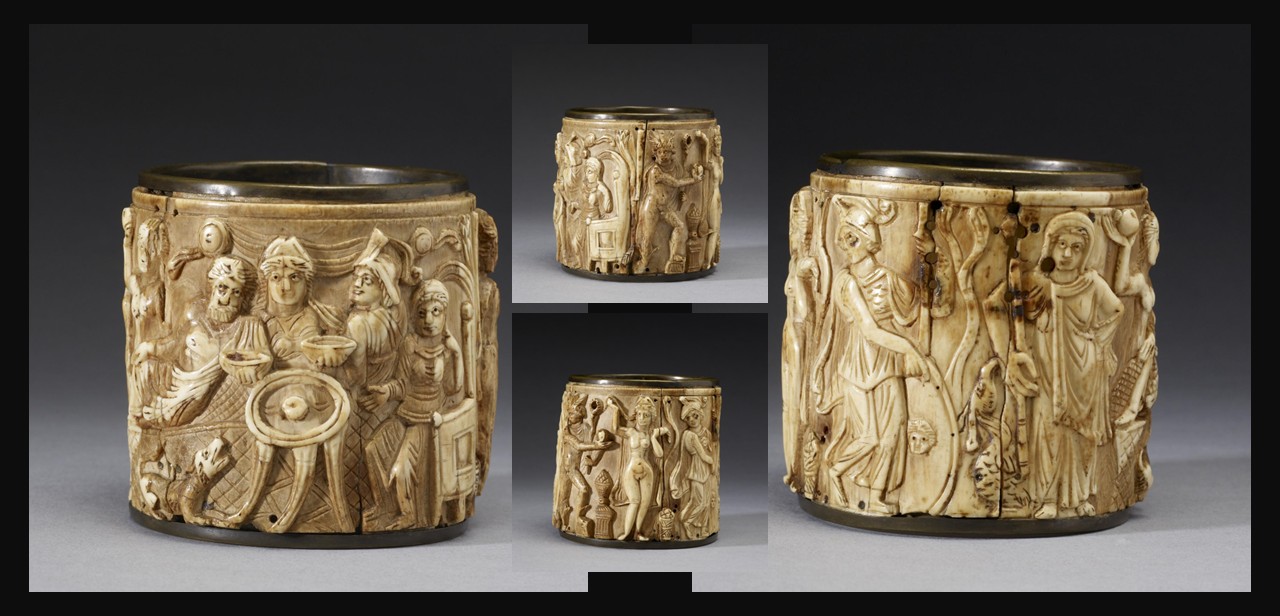
Circular Pyxis with Mythological scenes, 5th-6th century, from Egypt, Ivory, 8.5 x 9.1 cm, The Walters Art Gallery, Baltimore, USA https://art.thewalters.org/object/71.64/
Nestled in the collection of The Walters Art Museum in Baltimore is a remarkable Ivory Vessel known as the Circular Pyxis, carved in Egypt during the 5th or the 6th century AD. This delicately worked object may be small in size, but it opens a rich window into the artistic and cultural world of Late Antiquity, a period of transition, imagination, and blending traditions. This exquisite Late Antique Ivory Pyxis not only captivates with its carved mythological scenes but also carries a rich history of ownership that reflects the changing tides of art collecting over the centuries. Originally circulating in European collections in the 19th century, the pyxis was first recorded in the possession of Count Girolamo Possenti of Fabriano before being sold in Florence in 1880 and again in Cologne in 1886. It entered the collection of American collector Henry Walters in 1926, and upon his bequest in 1931 became part of the permanent holdings of The Walters Art Museum in Baltimore, where it continues to be studied and admired today.
What Is a Pyxis? Meaning, Function, and Materials: The term pyxis derives from the Greek word for “box” and in antiquity referred to a small, lidded container used to store personal items such as jewelry, cosmetics, or incense. Characterized by its simple form, a body with a fitted lid, the pyxis offered artists a compact surface for both functional design and decorative refinement. Although the type is most familiar from Classical and later Greek pottery, archaeological evidence indicates that luxury containers, including examples carved from ivory, were already produced in the Aegean during the Minoan and Mycenaean periods. By the Roman and Late Antique eras, the pyxis had become firmly established as a prestigious object, increasingly fashioned from precious materials such as ivory, metal, and stone. Ivory in particular, valued across the Mediterranean for its rarity and suitability for fine carving, endowed these objects with an elegance that signaled both elite status and a long tradition of personal adornment.
Mythological Imagery on the Circular Pyxis: What makes the Baltimore pyxis truly exceptional is its carved decoration. Around its circumference, the artist has rendered two mythological episodes from Greek lore in fine relief. One scene depicts the Olympian gods feasting, gathered around a tripod and holding the famed golden Apple of the Hesperides. In the next, Hermes presents this golden fruit to Aphrodite, chosen over Hera and Athena as the most beautiful goddess, a story connected to the Judgment of Paris.
Late Antique Context: Pagan Myth in a Christian Age: This pyxis was carved in Late Antique/Early Christian period, a time when classical Greek mythological themes were still popular even as the Roman Empire embraced Christianity. Many luxury ivories from the 4th through 7th centuries blend pagan and Christian imagery or appear in elite contexts where older stories of pagan mythology remained aesthetically or intellectually significant. The survival of this mythological subject matter on an object likely owned by a sophisticated patron suggests that ancient narratives continued to resonate even amid changing beliefs.
Why the Late Antique Ivory Pyxis Still Matters Today: Today, the Circular Pyxis invites us not only to admire the technical skill of its anonymous craftsman but also to reflect on the layered cultural world it came from. Its intricate carvings make it both a work of art and a storytelling medium, bridging classical mythology with Late Antique tastes. Objects like this remind us that art can transcend time, connecting the ancient past to modern viewers in unexpected ways.
For a related PowerPoint presentation on Ivory Pyxides from the Greco-Roman world, please, Check… HERE!
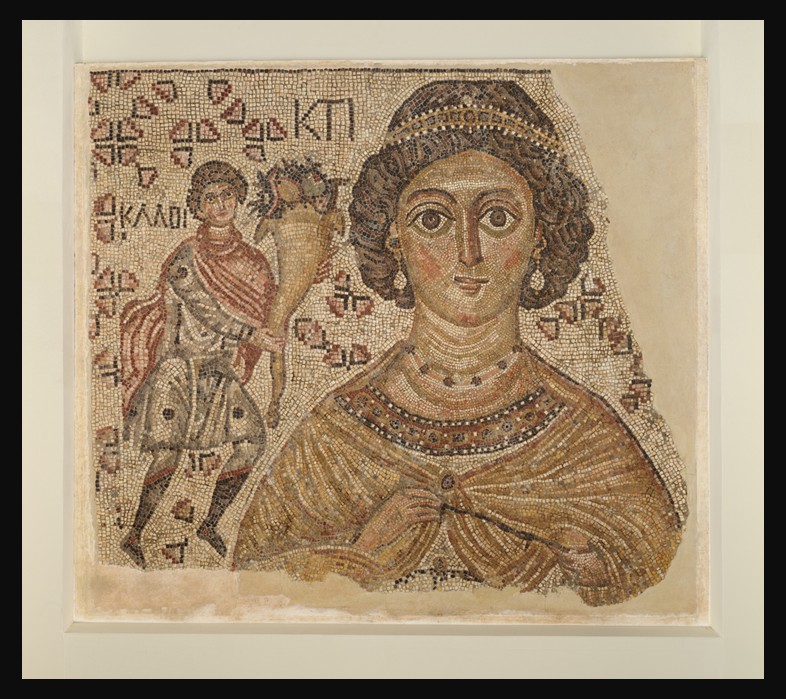
Step into the symbolic world of Late Antiquity through this remarkable mosaic fragment portraying Ktisis, the ancient personification of creation, foundation, and civic generosity. With her richly ornamented garments, expressive gaze, and accompanying figure holding a cornucopia, she embodies the ideals of prosperity and well-ordered society. Once part of an elegant floor, this mosaic invites us to reflect on how art, mythology, and civic identity were woven seamlessly into daily life in the ancient Mediterranean.
At the center of the composition appears the personification of Ktisis, depicted frontally with large, expressive eyes that engage the viewer directly and lend the figure a commanding, almost iconic presence. Her softly modeled face is framed by carefully arranged curls and crowned with a jeweled headband, details that underscore refinement and elevated status. She wears a richly patterned garment fastened with an ornate necklace, the dense ornamentation and shimmering tesserae emphasizing dignity, wealth, and abundance. In her hand she holds a Roman copper tool called a foot ruler, a clear visual sign of engineering closely tied to her symbolic role. The Greek inscription naming Ktisis identifies her unambiguously, guiding the viewer’s interpretation of the scene. To the left, a smaller standing male figure advances toward her holding a cornucopia, the classical emblem of plenty; an inscription beside him identifies his role and further clarifies the allegorical program of the mosaic. Scholars have suggested that Ktisis was originally flanked symmetrically by a second small male figure on her right, now lost, which would have created a more balanced composition emphasizing abundance and benefaction on both sides. Even in its fragmentary state, the surviving figure establishes a subtle narrative exchange that reinforces themes of prosperity, order, and civic well-being while enlivening the scene.
In late antiquity, Ktisis embodied the concepts of foundation, creation, and benefaction. She was closely associated with the act of building and with the generosity of patrons who endowed structures for private or communal use. Her presence in a floor mosaic would have communicated prosperity, stability, and divine or civic favor, transforming the architectural space into a visual statement of success and legitimacy.
Stylistically, the mosaic reflects a transitional moment between classical naturalism and the emerging Byzantine aesthetic. Subtle modeling of the face coexists with an increasingly abstracted body and decorative emphasis on surface pattern. The shimmering marble and glass tesserae enhance the figure’s presence, while the frontal pose and enlarged eyes anticipate later Byzantine iconography.
As a floor mosaic, this image would have been encountered from above and at close range, integrated into the rhythm of daily movement. Walking across the figure of Ktisis reinforced her symbolic role: prosperity and benefaction quite literally underfoot, embedded in the fabric of the building itself. The mosaic thus functioned not only as decoration but as a constant visual assertion of order and well-being.
Seen today as a fragment and displayed vertically, the mosaic invites a different kind of engagement. Removed from its architectural setting, it becomes an object of focused contemplation rather than lived experience. Yet even in isolation, the figure of Ktisis continues to speak eloquently about late antique values, patronage, and the evolving language of Byzantine art.
For a Student Activity inspired by the Roman Foot Ruler, please… Check HERE!
For a PowerPoint Presentation of Activities created by my students, please… Check HERE!
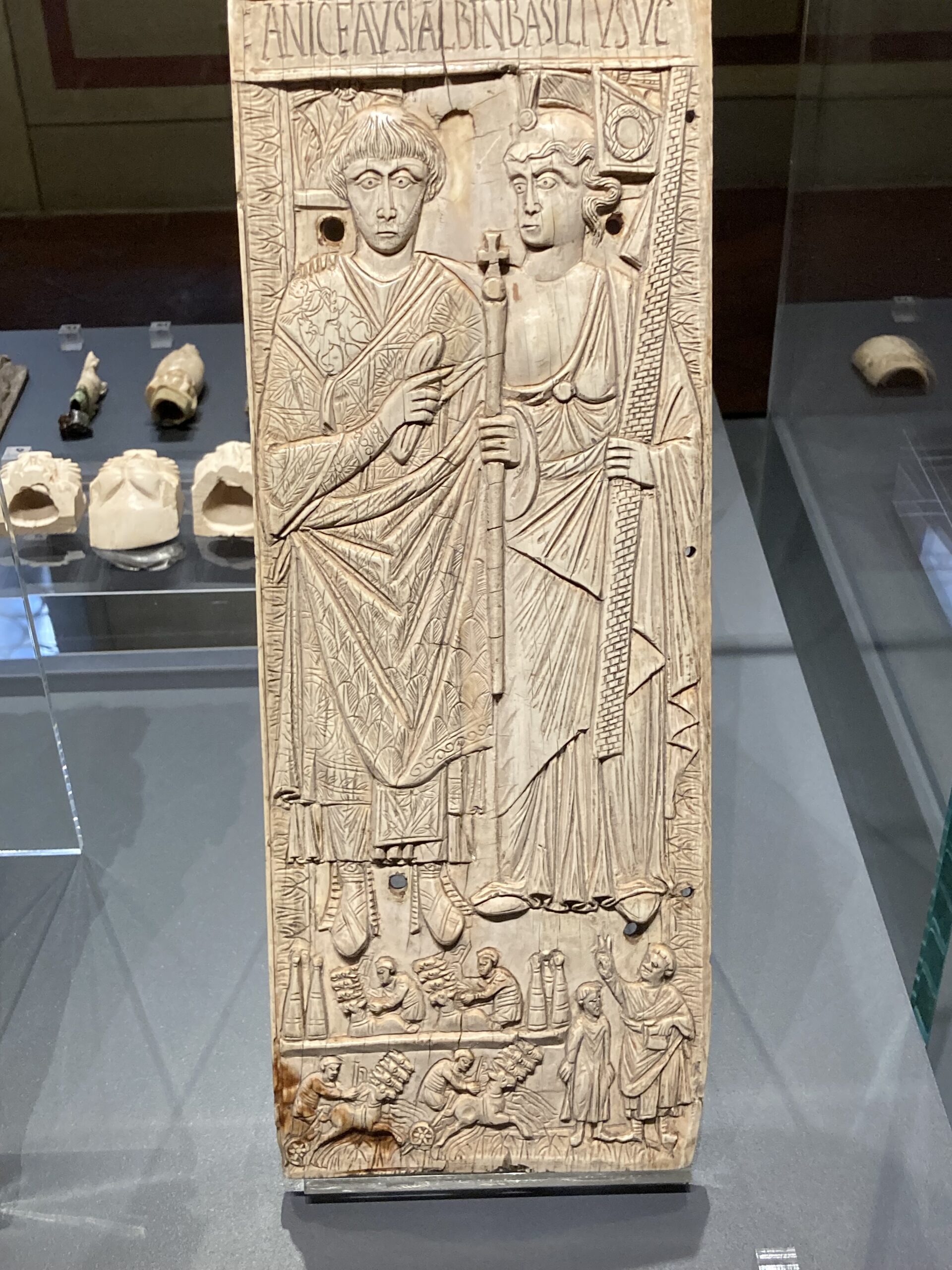
The Bargello panel of The Consular Diptych ofAnicius Faustus Albinus Basilius (consul in 541 AD) offers a vivid glimpse into the ceremonial splendor and political symbolism of late antiquity. Carved in fine ivory, the plaque depicts the Consul Basilio standing frontally beside the personification of Rome, who crowns him with a laurel wreath, a timeless emblem of civic and military virtue. Below unfolds a chariot race, a rare and dynamic motif symbolizing the public games that marked the consul’s inauguration. The consul holds both the scipio topped with a cross and the mappa circensis, the cloth used to signal the start of the races, fusing Christian and traditional Roman imagery in a moment of political theater.
Once hinged to a now-separated companion leaf, the Milan panel (Avori 10, Castello Sforzesco), the Bargello relief would have formed one side of a luxurious diptych presented to commemorate Basilius’s consulship. The Milan fragment, showing Victory presenting the consul’s portrait within a clipeus, completes the scene’s message of divine favor and public virtue. Together, these ivories capture the final flowering of the consular tradition, bridging Roman civic ideals and Byzantine court aesthetics, and reflecting a world where art served both as devotion and as declaration of power.
Consular diptychs were luxurious paired ivory panels created in the late Roman and early Byzantine periods to commemorate the inauguration of a consul, one of the highest offices in the empire. Traditionally carved on the inside to hold wax for writing, these diptychs evolved by the 4th and 5th centuries into richly decorated ceremonial gifts rather than practical objects. Newly appointed consuls commissioned them to celebrate their accession and distributed them to friends, allies, and dignitaries as tokens of prestige and gratitude. The front surfaces were elaborately carved with scenes of the consul’s investiture, imperial imagery, or allegorical figures such as Victory or Rome, while inscriptions proclaimed the consul’s name and titles. Their iconography—often showing the consul presiding over games, dispensing largesse, or associated with divine favor—served to reaffirm the continuity of Roman civic traditions even as imperial power shifted eastward to Constantinople.
Anicius Faustus Albinus Basilius, consul in 541 CE, was a distinguished member of the ancient and influential Anicii family, one of the last great senatorial lineages of Rome. His career unfolded during a turbulent period in the Gothic War and the final years of the Western Roman aristocracy. Before attaining the consulship, Basilius held prominent administrative posts, including comes domesticorum (commander of the imperial household guard) and patricius, titles that reflected both his rank and his proximity to the imperial court. Appointed consul by Emperor Justinian I, he was the last man to hold the title in the Western tradition. After his term, the consulship ceased to exist as an independent civic office and became an imperial prerogative. His consular games, commemorated by the magnificent ivory diptych now divided between Florence and Milan, symbolized both the enduring prestige of Rome’s senatorial elite and the transformation of Roman political culture under Byzantine rule. Basilius’s life thus marks a poignant historical threshold: he stood at the end of Rome’s ancient civic offices and the dawn of a new, imperial order dominated by Constantinople.
The Consular Diptych of Anicius Faustus Albinus Basilius, divided today between the Bargello Museum in Florence and the Museo delle Arti Decorative in Milan, stands as one of the most compelling survivals of sixth-century ivory art. Created in 541 CE to commemorate Basilius’s consulship—the last in the Western Roman tradition—the two panels once formed a hinged pair, uniting political ceremony, imperial iconography, and refined craftsmanship. The Bargello panel represents the consul’s public and civic identity, while the Milan plaque embodies the divine and honorific aspects of his role, creating a complete visual narrative of authority and virtue.
Consul Basilio with personification of Rome and chariot race, 541 – 541, Plaque of an Ivory Consular Diptych, 34.5×12.9 cm, National Museum of Bargello, Florence, Italy – Photo Credit: Amalia Spiliakou, April 2025
The Bargello panel presents Basilius standing frontally in full consular regalia beside the personification of Rome, who crowns him with a laurel wreath, a symbol of victory and civic honor. In his hands, the consul holds the scipio topped with a cross and the mappa circensis, signaling the opening of the chariot races carved below in vivid relief, where teams of four-horse chariots turn around the spina of the circus. This combination of Christian and traditional Roman imagery reflects the fusion of old civic ritual with new imperial faith. The Milan plaque, by contrast, depicts a winged Victory seated on a globe, her feet resting on an eagle’s outstretched wings as she presents a clipeus containing Basilius’s portrait. Around it runs the inscription BONO REI PVBLICAE ET ITERVM (For the good of the Republic, and again), proclaiming the consul’s service to the state. Together, these compositions balance earthly power and celestial sanction, merging public ceremony with divine endorsement.
Aesthetically, the two panels reveal both unity and distinction. The Bargello panel is dense and narrative, crowded with human figures and architectural motifs that emphasize movement and civic spectacle. The Milan panel, in contrast, is more restrained and idealized, its composition centered, symmetrical, and imbued with spiritual calm. The Milanese Victory, delicately modeled and classically poised, recalls earlier Roman traditions of divine personification, while the Bargello figures are more rigid, their proportions elongated, their gestures formalized in the emerging Byzantine style. The difference in tone, public versus celestial, active versus contemplative, suggests that the two leaves were designed as complementary expressions of the same ideology: the earthly authority of the consul validated by divine and imperial favor.
Viewed together, the two ivories encapsulate the final synthesis of Roman civic art and Byzantine symbolism. They celebrate the consulship not merely as an office but as a sacred performance of continuity between past and present, Rome and Constantinople, man and empire. Their divided survival, one in Florence, one in Milan, mirrors the historical fragmentation of the world that produced them, yet their shared message endures: that power, piety, and artistic excellence could still converge in the twilight of antiquity. As such, the diptych of Basilius stands not only as a testament to individual glory but as a poignant farewell to the visual language of Roman public life.
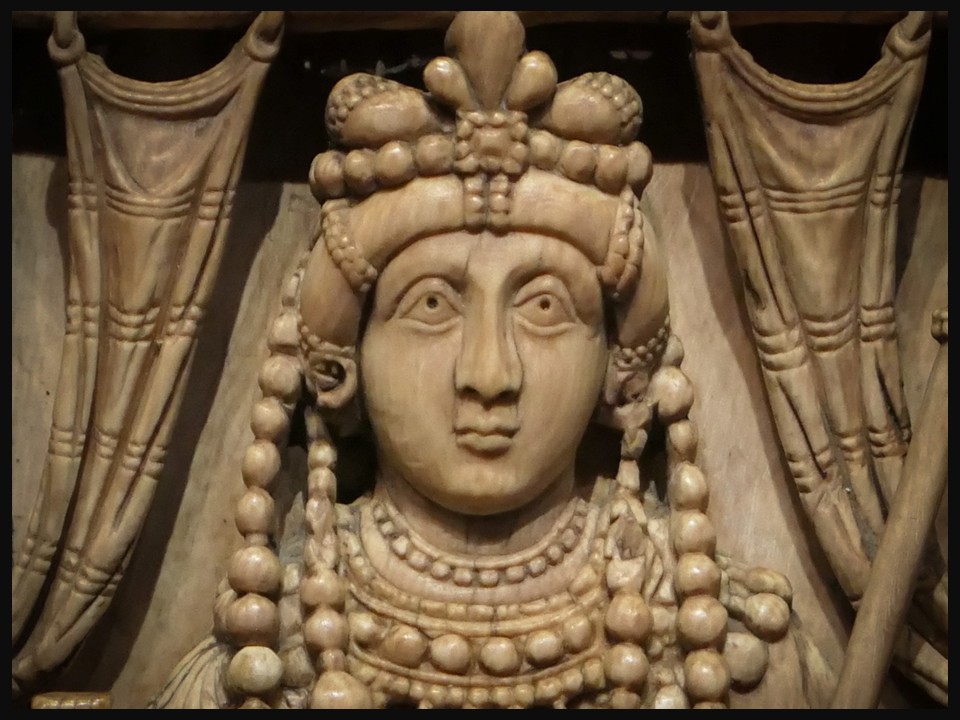
In the heart of Late Antique Constantinople, luxury art served not only as decoration but as a statement of power and identity. Among these treasures are two exquisite ivory plaques, generally attributed to portray Empress Ariadne (r. 474–515), now housed in the Bargello Museum in Florence and the Kunsthistorisches Museum in Vienna. While scholars debate their exact identification, these delicate carvings offer a rare glimpse into the artistry and political symbolism of the early Christian Byzantine court.
Empress Ariadne, around 500 AD, Ivory, Height: 36,5 cm,The Bargello Museum, Florence, Italy – Photo Credit: Marya Stamatiadi April 2025 Empress Ariadne, around 500 AD, Ivory, Height: 26,5 cm,Kunsthistorisches Museum, Vienna, Austria https://www.khm.at/en/artworks/kaiserin-ariadne-71782-1
The late 5th and early 6th centuries were a period of significant political and religious transformation. Ariadne, the daughter of Emperor Leo I and Empress Verina, became central to dynastic succession at a time when no male heir was available. Married first to Emperor Zeno, she played a mediating role during his often turbulent reign. After his death, Ariadne married Anastasios, a palace official (silentiarius) whom she helped elevate to the throne, securing imperial stability. If the ivory plaques do depict her, they present not only an image of an empress consort but also of a figure who embodied dynastic continuity and wielded real political influence in Constantinople.
The Bargello plaque, cataloged as part of a larger pentittico (five-panel composition), presents a standing female figure dressed in imperial robes and facing frontally. Executed in carved and incised ivory with traces of paint, it has been compared to major works such as the Barberini Ivory, and scholars have proposed that it may once have formed part of the same ensemble as the Vienna plaque. Stylistic affinities with consular diptychs, such as those of Aerobindus and Anastasius, suggest a date around 500 AD. While rival identifications have been proposed, the attribution to Ariadne remains the most recurrent. The ivory entered the Bargello in the 19th century through an exchange, further adding to its layered history as both a Byzantine and a modern collectible.
Empress Ariadne, around 500 AD, Ivory, Height: 36,5 cm,The Bargello Museum, Florence, Italy – Photo Credit: Marya Stamatiadi April 2025 Empress Ariadne, around 500 AD, Ivory, Height: 26,5 cm,Kunsthistorisches Museum, Vienna, Austria https://www.khm.at/en/artworks/kaiserin-ariadne-71782-1
By contrast, the Vienna plaque shows the empress enthroned beneath a shell-shaped baldachin, flanked by eagles, symbols of imperial authority. Dated to around 500 AD, the ivory portrays the ruler richly adorned, holding a sphaira topped with a cross in her left hand while raising her right in a gesture of blessing. The throne, the globe and cross, and the orant-like pose emphasize divine sanction and ceremonial majesty over individual portraiture. Classified as Early Byzantine, the plaque passed from the Riccardi collection in Florence into the Kunsthistorisches Museum, where it remains a centerpiece of the Antikensammlung.
Empress Ariadne, around 500 AD, Ivory, Height: 36,5 cm,The Bargello Museum, Florence, Italy – Photo Credit: Marya Stamatiadi April 2025 Empress Ariadne, around 500 AD, Ivory, Height: 26,5 cm,Kunsthistorisches Museum, Vienna, Austria https://www.khm.at/en/artworks/kaiserin-ariadne-71782-1
Taken together, the two plaques, one depicting the empress standing in ceremonial presence, the other enthroned in majesty, illustrate complementary aspects of imperial power. They exemplify the Constantinopolitan fusion of classical forms with emerging Christian symbolism, and, if indeed they represent Ariadne, they also illuminate the ways in which an empress could embody both dynastic continuity and divine legitimacy during a pivotal moment in Byzantine history.
Early Christian Ivory Treasures in The Bargello Museum, Florence, Italy – Photo Credit: Marya Stamatiadi April 2025
Today, the Bargello and Vienna ivory plaques continue to captivate scholars and visitors alike, not only for their exquisite craftsmanship but also for the historical questions they raise. Whether or not they truly portray Ariadne, they stand as rare survivals of Constantinopolitan ivory carving, embodying the fusion of imperial image-making and Christian symbolism. Through them, we glimpse both the artistry of a vibrant court and the enduring allure of an empress whose legacy shaped the transition of power at a crucial moment in Byzantine history.
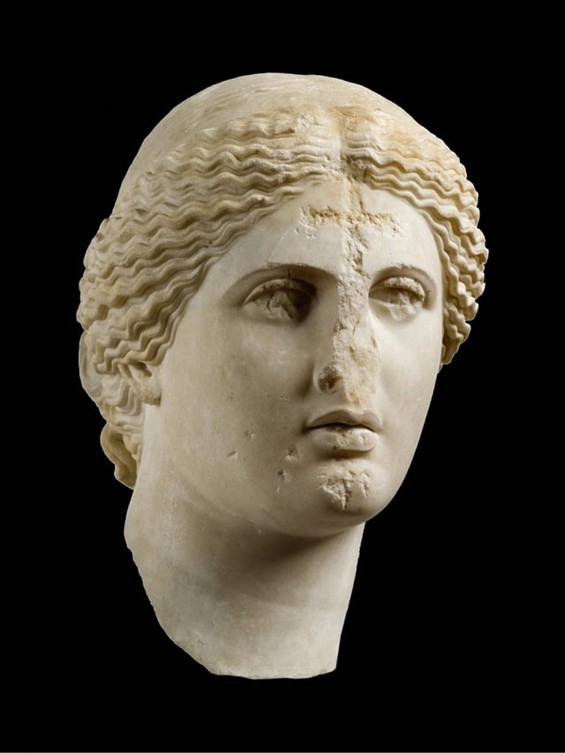
The Head of Aphrodite of the Aspremont-Lynden/Arles type, housed in the National Archaeological Museum in Athens, offers a compelling glimpse into the classical ideals of beauty and divinity shaped by the legacy of Praxiteles. As a copy of a lost 4th-century BC original, possibly the first known depiction of Aphrodite with a nude upper body, this sculptural type reflects the evolving representation of the goddess, bridging the serene sensuality of the Aphrodite of Knidos with the more voluptuous forms of later works like the Aphrodite of Melos. The surviving head, now divorced from its torso, carries echoes of a refined, yet idealized femininity that would influence Roman and Renaissance aesthetics alike. Its later restoration by François Girardon, under the patronage of Louis XIV, introduced symbolic elements like the mirror and apple, both deeply charged with mythological meaning, underscoring not just Aphrodite’s divine allure, but also the enduring power of classical art to adapt to new cultural narratives. An incised cross on her forehead, likely added in the early Christian era, marks a moment when pagan imagery was recontextualized within a new religious worldview.
Carved from Parian marble, the Head of Aphrodite once belonged to an over-life-size statue of a clothed Aphrodite, though some scholars have suggested it may instead portray the famed courtesan Phryne due to its individualized features. The face, turned slightly to the right, is serene and harmonious, with soft, fleshy contours and delicately incised features: a smooth triangular forehead framed by parted curls, a broad nose (now broken), full lips, and a rounded chin. A thick bun gathers the hair at the nape, secured by a wide band. The eyes, beneath gently curved brows, show signs of deliberate Christian-era defacement, likely part of an effort to “close” the eyes and “silence” the mouth. A small, incised cross on the forehead reinforces this reinterpretation of pagan art within a Christian context, suggesting the statue may have been reused as a sacred image. Despite the damage, most notably to the nose and facial extremities, the head remains in relatively good condition and serves as a compelling testament to both the endurance of classical ideals and their transformation in later religious and cultural landscapes.
Head of Aphrodite of the Aspremont-Lynden/Arles type, 1st c. AD copy of an original 4th century BC work by Praxiteles, Marble, possibly Parian (Marathi), Height: 32 cm, National Archaeological Museum, Athens, Greece https://x.com/ArysPan/status/1513155769000247301/photo/1
The statue’s discovery near the Clock of Andronikos Kyrrhestes in the Roman Agora of Athens further grounds it in the layered urban fabric of ancient Athens, where temples, markets, and later churches coexisted and often repurposed one another’s remains. This setting, close to the sanctuary of Aphrodite and Eros on the north slope of the Acropolis, reinforces the likelihood that the statue originally served a votive or cultic function. The artistic style—marked by its naturalistic modeling, graceful asymmetry, and subtle anatomical details like the “Venus rings” on the neck—embodies the Praxitelian ideal of ethereal beauty softened by human warmth. In this way, the head is not only a remnant of a once-complete devotional image but also a rare survivor of artistic transitions: from Classical to Hellenistic, pagan to Christian, and ultimately, from sacred object to museum artifact.
Bust of a Lady, circa 410 AD, from an Asia Minor workshop, possibly in Aphrodisias, circa 410, white Phrygian (Dokimion) Marble, Height: 56 cm, Archaeological Museum of Chania, Greece
In the Archaeological Museum of Chania on the island of Crete, the Bust of a Lady offers a rare window into the shifting artistic and cultural values of the Late Roman and Early Christian period through the medium of female portraiture. During this era, women’s portraits began to diverge from classical Roman realism and overt displays of status, embracing a more stylized, introspective aesthetic aligned with emerging Christian ideals. Features such as large, contemplative eyes and serene expressions came to symbolize inner virtue and spiritual depth. While hairstyles and clothing still hinted at social rank, they also reflected increasing modesty, mirroring broader societal transformations.
This particular bust depicts a woman of aristocratic beauty in the prime of her life, aged approximately 25 to 30. She is shown frontally, with her neck gently turned to the right, lending the portrait a poised and lifelike presence. Her oval face is framed by a tall forehead, almond-shaped eyes once inlaid with rose-colored glass, small full lips, and a strong chin—features that convey both grace and inner fortitude. A decorative band of twenty-two stylized curls runs across her forehead and temples, while four braids crown her head, testifying to her refined appearance.
She is draped in a heavy himation falling in deep, classical folds over a lighter chiton, a detail that evokes the sculptural traditions of earlier periods and enhances the portrait’s intellectual elegance. Although her left shoulder is only partially modeled, the form suggests the bust was designed for a niche setting, likely within a private villa, where such an omission would remain unseen. The combination of fine craftsmanship, classical references, and material opulence speaks to both her high status and the enduring artistry of late Roman Crete.
Although initially dated between the 2nd and 4th centuries, recent scholarship proposes a more precise date in the early 5th century, during the reign of Theodosios II (c. 410 AD). This dating is based on strong stylistic parallels with imperial portraits of Valentinian II and Theodosios II, and the bust is thought to have originated in an Asia Minor workshop, likely Aphrodisias. If correct, this attribution provides rare evidence of continued cultural and artistic exchange between Crete and Constantinople following the catastrophic earthquake of 365 AD.
This striking portrait, crafted from fine-grained marble was unearthed in 1982 in Nea Chora, a neighborhood of modern Chania that once formed the western sector of ancient Kydonia. Found in unstratified fill, it lacks a secure archaeological context. Nonetheless, the area was continuously inhabited from the Roman to early Byzantine periods, and the sculpture’s discovery in a historically wealthy district known for luxurious homes supports the notion that it belonged to an elite and culturally vibrant community.
While Crete is most famously celebrated for its Bronze Age Minoan civilization, the island also enjoyed a remarkable cultural resurgence under Roman rule, a period that produced refined works of art like the Bust of a Lady in the Archaeological Museum of Chania. In a region often viewed through the lens of its ancient past, the portrait from Kydonia invites us to appreciate the island’s lesser-known legacy: a vibrant late antique society that continued to engage with the broader currents of imperial art, identity, and belief.
For a Student Activity inspired by the Bust of a Lady in the Archaeological Museum of Chania, please… Check HERE!
In the quiet hush of a walled garden, Sosannah, a woman of rare beauty and deeper virtue, sought solitude beneath the sun. But hidden behind aged branches and envy-clouded eyes, two elders — judges of the people — watched with corrupted hearts. When the moment came and she was alone, they emerged, casting off the mask of piety to reveal their lust. They cornered her with a cruel choice: submit to their desire or face a false accusation that would cost her life. But Sosannah, steadfast and unshaken, chose honor over life, her silence a cry to the heavens. Dragged before the assembly and condemned by perjury, her fate seemed sealed — until Daniel, youthful and divinely stirred, rose with clarity and courage. Separating the liars, he unraveled their tale with the sharp blade of truth, exposing their deceit. Justice turned its gaze, and the elders, once revered, fell by the very law they had twisted. And Sosannah, radiant in her innocence, stood free — a testament to the power of virtue and the triumph of truth… https://bible.usccb.org/bible/daniel/13
The story of Sosannah stands as a powerful symbol for the Christian Church — a portrait of moral courage, spiritual integrity, and trust in divine justice. She embodies the faithful soul, or even the Church itself, called to remain pure amid a world of temptation, false judgment, and the abuse of authority. Her unwavering stance reflects the Church’s vocation: to uphold truth and righteousness, even when isolated or under threat. In a culture that often rewards compromise, Sosannah’s quiet strength challenges believers to hold fast to virtue, trusting in God’s unseen hand.
The figures surrounding her — the corrupt elders and the righteous Daniel — deepen the symbolism. They represent, respectively, the danger of distorted power within religious institutions and the hope of divine intervention through the voice of the just. For the Church today, Sosannah’s story is less about the drama of her trial and more about the enduring truth it reveals: that God sees the heart, hears the cry of the innocent, and will ultimately vindicate the faithful. In this, Sosannah becomes not just a heroine of the past, but a guide for the present — a reminder that holiness is resilient, and truth, though buried for a time, will rise.
The Biblical story has inspired countless artists across centuries, drawn to its rich emotional tension and symbolic depth. In Renaissance and Baroque art especially, painters such as Rembrandt, Artemisia Gentileschi, and Tintoretto depicted the moment of confrontation in Sosannah’s garden — a scene ripe with psychological complexity. While some early depictions emphasized her beauty and vulnerability, later interpretations, particularly by women artists like Gentileschi, focused on Sosannah’s distress, resistance, and the moral corruption of the elders. These artworks often served as visual meditations on virtue under siege, the misuse of authority, and the strength of conscience. Through gestures, gazes, and the contrast of light and shadow, artists explored not only a biblical narrative but a timeless human drama — inviting viewers to contemplate justice, dignity, and divine vindication.
My favourite rendition of Sosannah’s story lies within the Museum of Byzantine Culture in Thessaloniki. It is a remarkable early Christian fresco on the west wall of a barrel-vaulted grave, presenting the biblical story of Sosannah and the Elders with both symbolic power and refined artistry. There’s something deeply moving about how this familiar biblical story comes to life through the quiet beauty of early Christian art. The composition is split into two parts: the lower register features a delicate thorakion slab with small pillars topped by pinecones — a soft, almost architectural whisper — while the upper zone bursts with meaning. There stands Sosannah, praying with solemn grace, flanked by two men whose agitation betrays their guilt. She’s framed by tall cypress trees that bend inward, as if the natural world itself leans in to witness this moment of trial and courage. Her footsteps slightly beyond the slab, reaching toward the viewer, as if inviting us to stand with her.
This fresco, dating to the fifth century, is not only a masterful example of early Christian funerary art but also a theological statement. The theme of Sosannah’s unjust accusation and divine vindication was especially resonant during a time when the Christian Church was defining its identity against the backdrop of intense doctrinal disputes and heresies. In this context, Sosannah becomes an allegory for the Church itself—pure, persecuted, and ultimately defended by divine truth. The expressive detail, naturalistic rendering of garments and foliage, and vibrant use of colour distinguish this fresco as one of the finest examples of its kind, blending artistic grace with profound spiritual symbolism.
For a PowerPoint Presentation, titled Sosannah in Painting, please… Check HERE!
Christos Laskaris captures the essence of Spring in his evocative poem: ‘Διάβαζα ένα ποίημα για την άνοιξη / όταν την είδα / να έρχεται από μακριά: / μισή γυναίκα, / μισή όνειρο. / Κατέβαινε το μονοπάτι κάτω / στεφανωμένη / με άνθη κερασιάς. / Τότε κατάλαβα τι δύναμη έχουν τα ποιήματα. (I was reading a poem about Spring / when I saw her from afar: / half woman, / half dream. / She was going down the path / wreathed / with cherry blossoms. / That was when I understood the power poems hold.). These lines illustrate the transformative power of poetry, where words bloom into vivid imagery, evoking the ephemeral beauty and vitality of the season. As I reflected on Laskaris’s portrayal of Spring as ‘half woman, half dream,’ I was reminded of a small textile piece in the MET collection, a decorative artwork depicting the Personification of Spring. This intricate piece, adorned with motifs of blossoming flowers and a graceful figure, parallels the poem’s vision, embodying renewal and beauty in a tangible form. Together, the poem and the artwork highlight, I humbly believe, Spring’s timeless allure and its ability to inspire across art forms, reminding us of the season’s power to awaken imagination and connect us to the essence of life. https://e-keimena.gr/index.php?option=com_content&view=article&id=510:poihmata-gia-thn-anoiksh&catid=149:poihmata-anoiksh&Itemid=54
Searching for information on Early Christian Textiles, I came across two booklets I would like to share… and acting more like a Curator rather than a Teacher, I present you Textiles of Late Antiquity, a 1995 Metropolitan Museum of Art Publication, and Woven Interiors: Furnishing Early Medieval Egypt, an Exhibition Catalogue of 2020, organized by the George Washington University Museum, The Textile Museum, and Dumbarton Oaks Research Library and Collection. https://www.metmuseum.org/art/metpublications/Textiles_of_Late_Antiquity and https://museum.gwu.edu/woven-interiors-furnishing-early-medieval-egypt
This small tapestry panel from Egypt in the Metropolitan Museum in New York City, identified as: Tabula (Square) with the Head of Spring. is a remarkable example of Coptic textile art from the Early Christian period. It was originally an appliqué on a larger textile, likely part of a set adorning a garment. Woven from linen and wool, the piece measures just a few centimeters across but is rich in detail and vibrant in colour. The central figure is a personification of Spring, adorned with a wreath of pink blossoms that symbolize the season’s renewal and fertility. The figure is depicted in a frontal pose, dressed in flowing robes with intricate floral patterns that demonstrate Spring’s association with nature’s abundance, and the skill of the weaver. The panel’s relatively well-preserved state is a testament to Egypt’s hot, dry climate, which has safeguarded textiles that would have otherwise been lost to time.
Aesthetically, the panel is a harmonious blend of naturalistic detail and stylized design, characteristic of Coptic art. The vibrant colour palette, dominated by earthy tones and soft pinks, reflects the organic materials used in its creation and emphasizes the figure’s connection to nature. The composition is balanced, with the central figure drawing the viewer’s eye while the centrally placed floral elements create a sense of movement and vitality. The weaving technique, combining fine detail with bold forms, showcases the artistic and technical sophistication of the Coptic weavers. Symbolically, the personification of Spring embodies themes of renewal, prosperity, and the cycle of life, which held deep significance in both pagan and early Christian contexts. This small yet exquisite piece thus serves as both a functional decorative element and a meaningful cultural artifact, bridging artistic tradition and symbolic expression.
For a Student Activity inspired by the MET textile with the Personification of Spring, please… Check HERE!
Sweet Violet, Vienna Dioscurides, Folio 148v, about 515 AD, Byzantine Greek Illuminated Manuscript of De Materia Medica by Pedanius Dioscurides, vellum folios measure 37 by 30 cm, Österreichischen Nationalbibliothek, Vienna https://jenikirbyhistory.getarchive.net/topics/vienna+dioscurides?page=2
“The Vienna Dioscurides is a Byzantine Greek illuminated manuscript copy of “Medical Material” by Dioscorides, which was created in 515 AD. It is a rare surviving example of an illustrated ancient scientific and medical text… The original “De Materia Medica” or “On Medical Material” was first written between 50 and 70 CE by Pedanius Dioscorides. It is a pharmacopeia of medicinal plants and was widely read and used for more than 1,500 years… This specific manuscript copy was created in the Byzantine Empire’s capital, Constantinople, for the byzantine imperial princess, Anicia Juliana. She was the daughter of Anicius Olybrius, who had been one of the last Western Roman Emperors… The manuscript was presented to the princess in gratitude for her funding the construction of a church… The dedication miniature portrait of Anicia Juliana is the oldest surviving dedication portrait in a book…” I find it hard to encapsulate the manuscript’s significance more effectively. The Manuscript’s Folio 148 verso presenting Sweet Violet is my favourite!https://joyofmuseums.com/ancient-manuscripts-and-historically-influential-books/vienna-dioscurides/
This manuscript serves as one of my chosen ‘canvases’ for celebrating the arrival of each month. My goal for 2025 is to present twelve artworks—one for each month of the year—featuring exquisite depictions of flowers that beautifully convey their essence, symbolism, and historical importance. This initiative is more than just a tribute to flowers; it serves as a personal invitation to pause each month and appreciate the harmonious relationship between nature and art. Join us as we uncover how artists have woven the language of flowers into their work, using them to convey themes of love, purity, resilience, and more, allowing us to experience the beauty of each month in a fresh and vibrant way.
With a rich history spanning over two millennia, Sweet Violet is imbued with deep meaning and symbolism, making it a cherished choice for various occasions. As the flower of the month for February, its delicate fragrance and subtle beauty captivate the senses, while its association with love, modesty, and remembrance ensures that Sweet Violet remain a timeless floral favorite.
Sweet Violets (Viola odorata), known for their delicate fragrance and dainty blooms, have a storied history in botany that spans thousands of years. Originating in Europe and parts of Asia, they were among the earliest flowers to be cultivated for both medicinal and ornamental purposes. The ancient Greeks and Romans revered the Sweet Violet, using it in herbal remedies, perfumes, and even as a symbol of love and modesty. In medieval times, its medicinal properties were documented in early botanical texts, where it was praised for its ability to soothe headaches, respiratory issues, and inflammation. Renowned botanists, including Pedanius Dioscorides, highlighted the violet’s therapeutic virtues in works like De Materia Medica. Over the centuries, the Sweet Violet has maintained its place in botanical studies as a plant of both scientific and cultural significance, admired for its beauty, fragrance, and enduring symbolism.
The name Sweet Violet derives from its botanical classification, Viola odorata, which highlights both its genus and its defining characteristic—its fragrance. The genus name Viola is rooted in Latin, adopted from the ancient Greek word ion, which referred to violets and was associated with myths and poetic traditions. The epithet odorata translates to ‘fragrant’ or ‘sweet-smelling’ in Latin, emphasizing the flower’s delicate and appealing scent. In Greek mythology, violets were linked to figures like Io, a mortal transformed into a heifer by Zeus, for whom the gods caused violets to bloom as a food source. Over time, the name sweet violet became synonymous with modesty, purity, and love, encapsulating the flower’s gentle beauty and enduring fragrance.
Folio 148 verso of the Vienna Dioscurides features a stunning depiction of the Sweet Violet (Viola odorata), a testament to the manuscript’s masterful blend of scientific accuracy and artistic beauty. The page showcases the violet’s delicate blossoms, rendered in soft shades of purple and violet, with meticulous attention to the gentle curvature of the petals and the fine detail of the green leaves. The naturalistic portrayal reflects the Byzantine artists’ commitment to capturing the essence of the plant, both as a botanical specimen and as an object of aesthetic admiration. The composition is harmonious and balanced, with the violets depicted in their natural form, seemingly alive on the page. Beyond its visual appeal, the illustration exemplifies the manuscript’s role as both a practical pharmacopeia and a work of art, celebrating the beauty of nature through precise lines, subtle color palettes, and elegant simplicity. This folio, like many others in the Vienna Dioscurides, elevates the scientific depiction of plants to a level of timeless artistic achievement.
For a PowerPoint Presentation on the Vienna Dioscuridis, please… Check HERE!
In the realm of Byzantine devotion, Enkolpia (plural of enkolpion) were cherished devotional objects, worn around the neck by early Christian believers. These items often depict religious icons, acting as both a personal expression of faith and a protective amulet. An enkolpion with the Enthroned Virginwould emphasize the veneration of Mary, the Nativity, Adoration, and Baptism scenes would highlight central narratives of the Christian story, underscoring the divinity of Christ from birth to baptism. The Dumbarton Oaks Enkolpion with Nativity, the Enthroned Virgin, Adoration and Baptism is more than an object, it’s a narrative of divine love and protection. This piece captures the Byzantine reverence for Mary and Christ’s life events, merging intricate craftsmanship with theological depth—a fascinating window into Byzantine religious artistry and belief.
The Enkolpion in the Dumbarton Oaks was once part of the collection of Josef Strzygowski, a prominent Austrian art historian known for his studies on Byzantine and Islamic art. Strzygowski’s collection included rare and unique devotional pieces, with the enkolpion being notable for its intricate scenes. The enkolpion changed hands in October 1955 when Walter Strzygowski sold it to Dumbarton Oaks Research Library and Collection in Washington, DC, where it now stands as a key artifact reflecting Byzantine religious art and devotion.
Tracing its provenance, we go back to June 22, 1906, at Graz, in Austria, where a Cypriot Greek sold it to the Austrian scholar. According to Marvin C. Ross (Art historian, curator and member of WWII Monuments Men), the same Cypriot states in a letter that ‘his treasure’ had been found in Cyprus (the small town of Karavas, near Lambousa), along with other Byzantine jewelry which was sold to the elder J. Pierpont Morgan, and which was later given, by his son, to the Metropolitan Museum of Art in New York.’ It is believed that the Dumbarton Oaks enkolpio was part of a much larger find, which has come to be called the Lambousa treasure. Today, in the Cyprus Museum in Nicosia, there is a gold hinge that perfectly fits the two rings at the top of the frame on the Strzygowski/Dambarton Oaks medallion, providing valuable evidence on the artwork’s provenance. https://www.jstor.org/stable/1291110?read-now=1&seq=1
The Byzantine Enkolpion, a type of devotional object worn around the neck, served as both a spiritual safeguard and a personal emblem of faith. These small, portable items, often featuring crosses, medallions, or reliquaries, were deeply intertwined with the daily lives and social practices of their owners, extending beyond mere religious devotion to function as symbols of protection, connection, and exchange. The Strzygowski/Dambarton Oaks Emkolpion consists of a Medallion, cast, not struck, 6.5 cm in diameter, and 109 grs of gold in weight, adorned with a braidlike inner border, and a broad, flat frame.
The Enkolpion of the Enthroned Mary at Dumbarton Oaks features intricate religious imagery that underscores its devotional purpose. On one side, the Virgin Mary is depicted seated on a throne, holding the Christ Child, flanked by two angels. Below this central scene are smaller panels illustrating key moments from Christ’s early life: the Nativity, with the Christ Child in a manger surrounded by the ox, the ass, and a contemplative Joseph; two shepherds pointing toward a guiding star; and the Visit of the Magi, who approach the Virgin and Child while a star shines above them. An inscription along the edge reads, “Christ, our God, help us.”
The reverse side of the Byzantine Enkolpion of the Enthroned Mary at Dumbarton Oaks depicts the Baptism of Christ, a scene rich with symbolic elements. On the left, St. John baptizes a nude Christ in the waters of the Jordan, while the Hand of God and the Dove of the Holy Spirit appear from above, signifying divine approval. To the right, two angels stand with their hands respectfully covered, witnessing the sacred event. Below, the river Jordan is personified, and two river nymphs swim, adding a sense of movement to the scene. Encircling the medallion is an inscription quoting Matthew 3:17: “This is my beloved Son, in whom I am well pleased.”