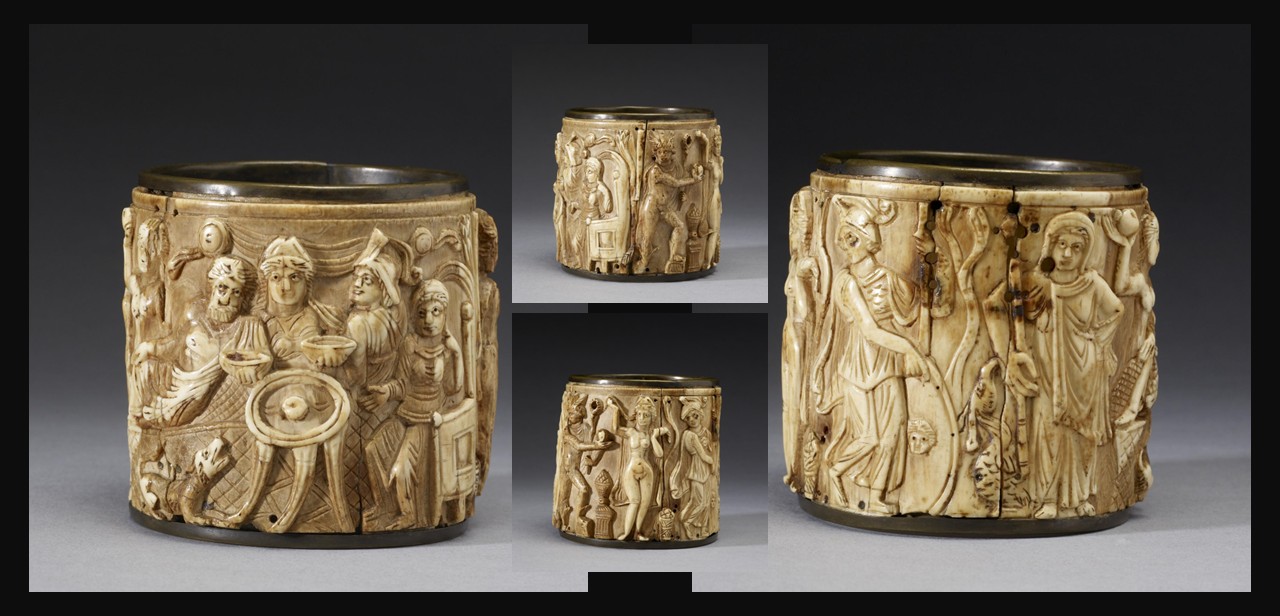
Circular Pyxis with Mythological scenes, 5th-6th century, from Egypt, Ivory, 8.5 x 9.1 cm, The Walters Art Gallery, Baltimore, USA https://art.thewalters.org/object/71.64/
Nestled in the collection of The Walters Art Museum in Baltimore is a remarkable Ivory Vessel known as the Circular Pyxis, carved in Egypt during the 5th or the 6th century AD. This delicately worked object may be small in size, but it opens a rich window into the artistic and cultural world of Late Antiquity, a period of transition, imagination, and blending traditions. This exquisite Late Antique Ivory Pyxis not only captivates with its carved mythological scenes but also carries a rich history of ownership that reflects the changing tides of art collecting over the centuries. Originally circulating in European collections in the 19th century, the pyxis was first recorded in the possession of Count Girolamo Possenti of Fabriano before being sold in Florence in 1880 and again in Cologne in 1886. It entered the collection of American collector Henry Walters in 1926, and upon his bequest in 1931 became part of the permanent holdings of The Walters Art Museum in Baltimore, where it continues to be studied and admired today.
What Is a Pyxis? Meaning, Function, and Materials: The term pyxis derives from the Greek word for “box” and in antiquity referred to a small, lidded container used to store personal items such as jewelry, cosmetics, or incense. Characterized by its simple form, a body with a fitted lid, the pyxis offered artists a compact surface for both functional design and decorative refinement. Although the type is most familiar from Classical and later Greek pottery, archaeological evidence indicates that luxury containers, including examples carved from ivory, were already produced in the Aegean during the Minoan and Mycenaean periods. By the Roman and Late Antique eras, the pyxis had become firmly established as a prestigious object, increasingly fashioned from precious materials such as ivory, metal, and stone. Ivory in particular, valued across the Mediterranean for its rarity and suitability for fine carving, endowed these objects with an elegance that signaled both elite status and a long tradition of personal adornment.
Mythological Imagery on the Circular Pyxis: What makes the Baltimore pyxis truly exceptional is its carved decoration. Around its circumference, the artist has rendered two mythological episodes from Greek lore in fine relief. One scene depicts the Olympian gods feasting, gathered around a tripod and holding the famed golden Apple of the Hesperides. In the next, Hermes presents this golden fruit to Aphrodite, chosen over Hera and Athena as the most beautiful goddess, a story connected to the Judgment of Paris.
Late Antique Context: Pagan Myth in a Christian Age: This pyxis was carved in Late Antique/Early Christian period, a time when classical Greek mythological themes were still popular even as the Roman Empire embraced Christianity. Many luxury ivories from the 4th through 7th centuries blend pagan and Christian imagery or appear in elite contexts where older stories of pagan mythology remained aesthetically or intellectually significant. The survival of this mythological subject matter on an object likely owned by a sophisticated patron suggests that ancient narratives continued to resonate even amid changing beliefs.
Why the Late Antique Ivory Pyxis Still Matters Today: Today, the Circular Pyxis invites us not only to admire the technical skill of its anonymous craftsman but also to reflect on the layered cultural world it came from. Its intricate carvings make it both a work of art and a storytelling medium, bridging classical mythology with Late Antique tastes. Objects like this remind us that art can transcend time, connecting the ancient past to modern viewers in unexpected ways.
For a related PowerPoint presentation on Ivory Pyxides from the Greco-Roman world, please, Check… HERE!
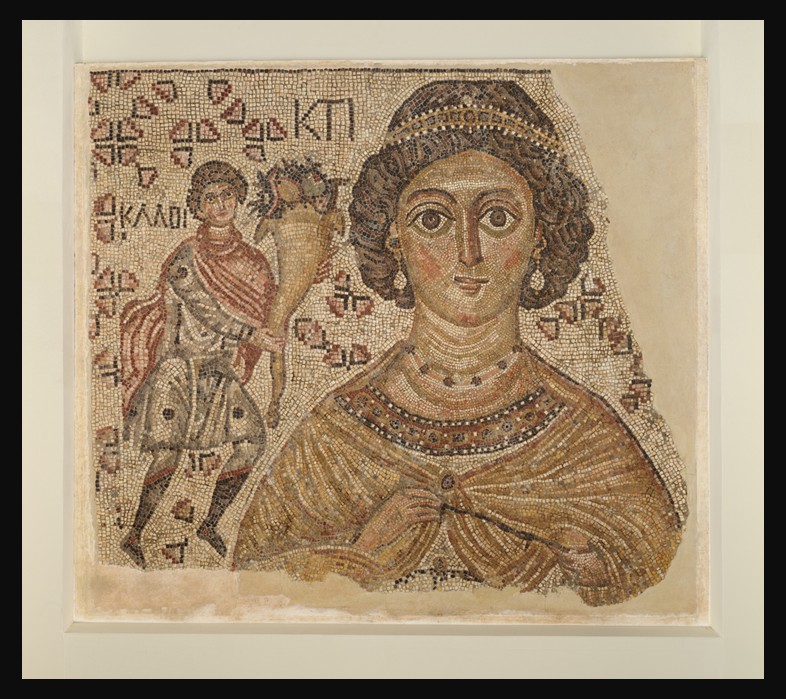
Step into the symbolic world of Late Antiquity through this remarkable mosaic fragment portraying Ktisis, the ancient personification of creation, foundation, and civic generosity. With her richly ornamented garments, expressive gaze, and accompanying figure holding a cornucopia, she embodies the ideals of prosperity and well-ordered society. Once part of an elegant floor, this mosaic invites us to reflect on how art, mythology, and civic identity were woven seamlessly into daily life in the ancient Mediterranean.
At the center of the composition appears the personification of Ktisis, depicted frontally with large, expressive eyes that engage the viewer directly and lend the figure a commanding, almost iconic presence. Her softly modeled face is framed by carefully arranged curls and crowned with a jeweled headband, details that underscore refinement and elevated status. She wears a richly patterned garment fastened with an ornate necklace, the dense ornamentation and shimmering tesserae emphasizing dignity, wealth, and abundance. In her hand she holds a Roman copper tool called a foot ruler, a clear visual sign of engineering closely tied to her symbolic role. The Greek inscription naming Ktisis identifies her unambiguously, guiding the viewer’s interpretation of the scene. To the left, a smaller standing male figure advances toward her holding a cornucopia, the classical emblem of plenty; an inscription beside him identifies his role and further clarifies the allegorical program of the mosaic. Scholars have suggested that Ktisis was originally flanked symmetrically by a second small male figure on her right, now lost, which would have created a more balanced composition emphasizing abundance and benefaction on both sides. Even in its fragmentary state, the surviving figure establishes a subtle narrative exchange that reinforces themes of prosperity, order, and civic well-being while enlivening the scene.
In late antiquity, Ktisis embodied the concepts of foundation, creation, and benefaction. She was closely associated with the act of building and with the generosity of patrons who endowed structures for private or communal use. Her presence in a floor mosaic would have communicated prosperity, stability, and divine or civic favor, transforming the architectural space into a visual statement of success and legitimacy.
Stylistically, the mosaic reflects a transitional moment between classical naturalism and the emerging Byzantine aesthetic. Subtle modeling of the face coexists with an increasingly abstracted body and decorative emphasis on surface pattern. The shimmering marble and glass tesserae enhance the figure’s presence, while the frontal pose and enlarged eyes anticipate later Byzantine iconography.
As a floor mosaic, this image would have been encountered from above and at close range, integrated into the rhythm of daily movement. Walking across the figure of Ktisis reinforced her symbolic role: prosperity and benefaction quite literally underfoot, embedded in the fabric of the building itself. The mosaic thus functioned not only as decoration but as a constant visual assertion of order and well-being.
Seen today as a fragment and displayed vertically, the mosaic invites a different kind of engagement. Removed from its architectural setting, it becomes an object of focused contemplation rather than lived experience. Yet even in isolation, the figure of Ktisis continues to speak eloquently about late antique values, patronage, and the evolving language of Byzantine art.
For a Student Activity inspired by the Roman Foot Ruler, please… Check HERE!
For a PowerPoint Presentation of Activities created by my students, please… Check HERE!
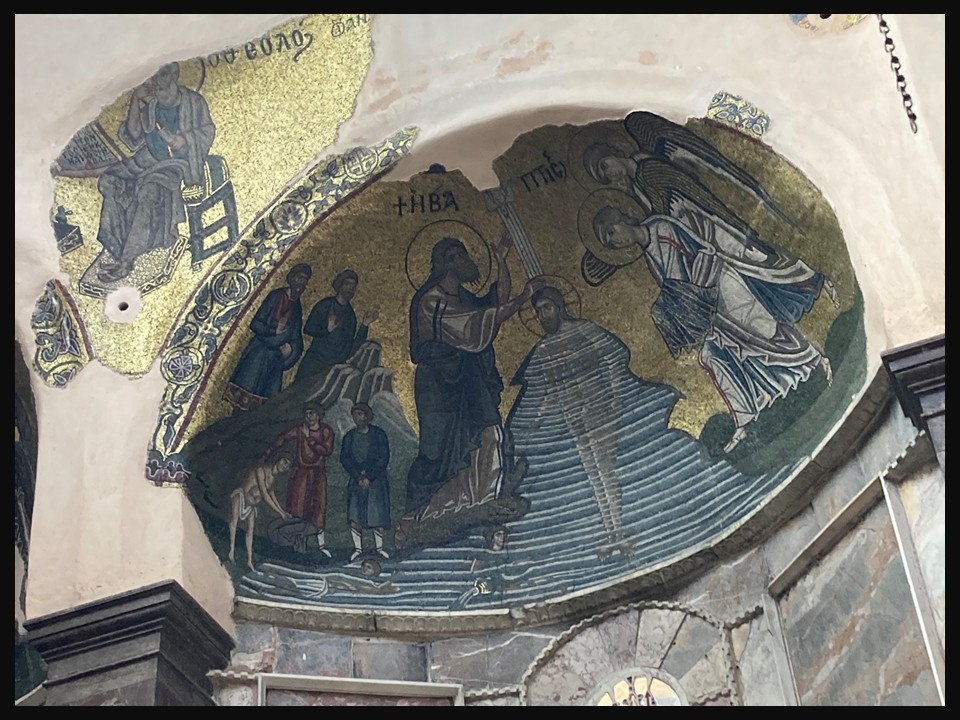
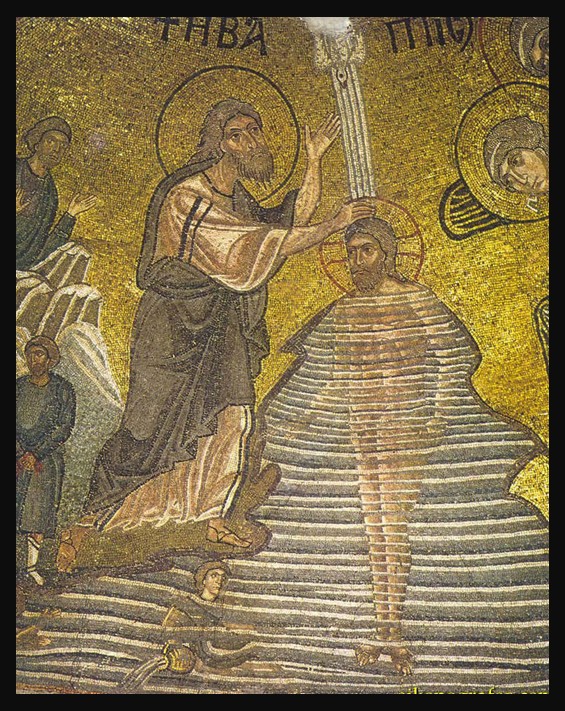
The Baptism of Christ, Nea Moni, Chios, 11th century, Mosaic, Chios Island, Greece – Photo Credit: Amalia Spiliakou, 2025
Every year on January 7, the Orthodox Church celebrates the Feast of Saint John the Forerunner, the prophet who prepared the way for Christ and baptized Him in the Jordan River. On the island of Chios, this commemoration finds a particularly resonant setting in Nea Moni, the 11th-century monastic foundation distinguished for its architectural integrity and exceptional mosaic decoration. In the Katholiko, the mosaic of the Baptism of Christ stands out for its refined handling of the sacred narrative: the descending waters of the Jordan, the presence of attendant angels, and the hieratic figure of Christ are rendered in luminous gold and saturated blues typical of Middle Byzantine aesthetics. The composition not only conveys a key episode of Christian theology but also reflects the spiritual and artistic ambitions of the monastery’s patrons and craftsmen.
Nea Moni, 11th century, Chios Island, Greece Photo Credit: Amalia Spiliakou, 2025
Perched on the slopes of Mount Provateftis, Nea Moni’s founding is closely tied to a local legend involving three hermits who discovered a miraculous icon of the Virgin beneath a myrtle tree. Each attempt to relocate the icon resulted in its return to the original site, a phenomenon interpreted as divine intervention. Reports of the miracle reached Empress Zoe and the future Emperor Constantine IX Monomachos, whose visions of the Virgin prompted them to grant imperial patronage between 1049 and 1055. Their involvement enabled the construction of a monumental complex that united imperial ideology, theological symbolism, and monastic devotion. Over subsequent centuries, Nea Moni flourished as a center of worship, pilgrimage, and artistic production, even as it later endured phases of decline, particularly under Ottoman rule.
Middle Byzantine Mosaics and the Macedonian Renaissance
The monastery’s historical and artistic significance is encapsulated in its mid-11th-century mosaics, among the finest surviving ensembles of Middle Byzantine art. Although the dome mosaic of the Katholiko has perished, likely once depicting Christ Pantocrator with attendant angelic powers, substantial portions of the original decoration survive. In the pendentives, mosaics of the Cherubim and Seraphim remain, along with two Evangelists, John (despite heavy damage) and Mark. In the apse, the Virgin Platytera is preserved headless. Below these, the octagonal wall surfaces retain important scenes from the Dodekaorton, continuing also into the narthex. The Baptism, Crucifixion, and Anastasis form what is often regarded as the ensemble’s most accomplished triad, characterized by subtle modeling, expressive gestures, and a refined chromatic palette, while additional scenes include the Transfiguration and Deposition. The narthex once displayed a now-lost mosaic of the Virgin Orans in its small dome, surrounded by full-length military saints set within arched frames, and its vaults presented six Christological compositions, some of which survive only fragmentarily.
These works collectively reveal multiple stylistic currents of the late Macedonian period: classicizing figures with volumetric bodies and balanced stances appear alongside more linear, expressive compositions that anticipate later developments in Byzantine art. The extensive use of gold ground and deliberate reduction of spatial depth contribute to an ethereal, otherworldly atmosphere, while sophisticated optical adjustments on curved surfaces demonstrate the technical skill and theoretical awareness of artists likely trained in the imperial workshops of Constantinople.
When compared with contemporaneous mosaic cycles at Osios Loukas and Daphni on the Greek mainland, Nea Moni demonstrates both adherence to shared Byzantine conventions and distinctive regional features. All three complexes employ similar hierarchical structures, with Christ Pantocrator originally presiding from the dome and a surrounding ensemble of heavenly and apostolic figures reinforcing Middle Byzantine theological ideals. Yet while Osios Loukas and Daphni tend toward more monumental proportions and sculptural modeling, Nea Moni is marked by a lighter chromatic range, subtler facial expression, and delicate rendering of form. These distinctions highlight the diversity of artistic production across the Byzantine world and underscore Nea Moni’s significance as a particularly refined example of 11th-century Aegean mosaic art. Together, these monuments attest to a period of exceptional creativity in Middle Byzantine ecclesiastical decoration and affirm the enduring cultural and spiritual importance of Nea Moni.
For a PowerPoint Presentation, inspired by the ‘Feast Day of Saint John the Forerunner’ Blog Post and the Mosaics in the Nea Mony, in Chios, please… Click HERE!
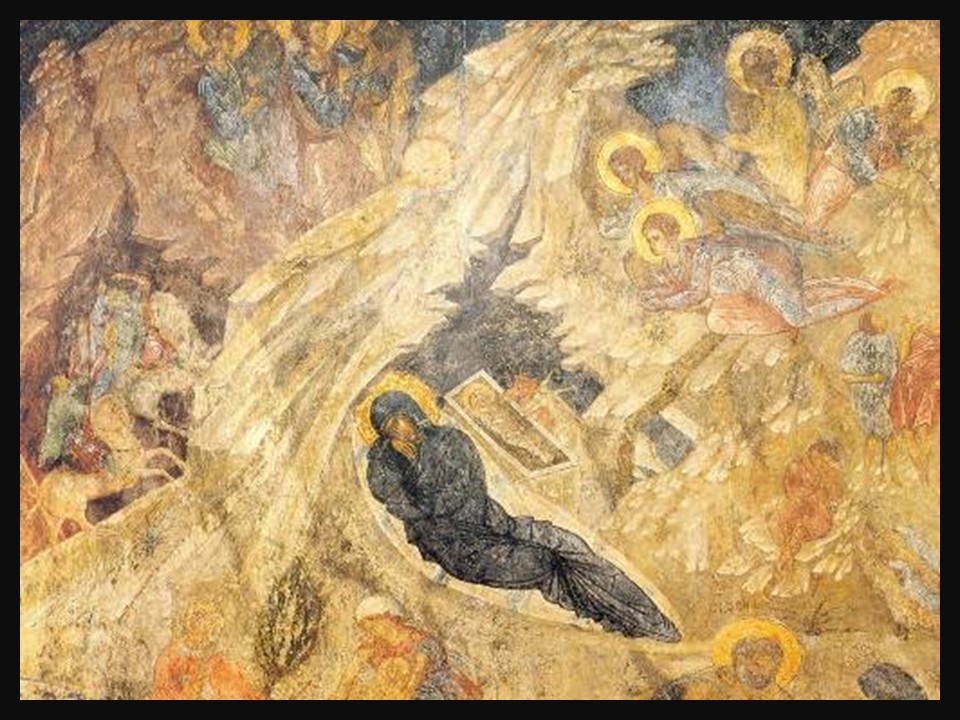
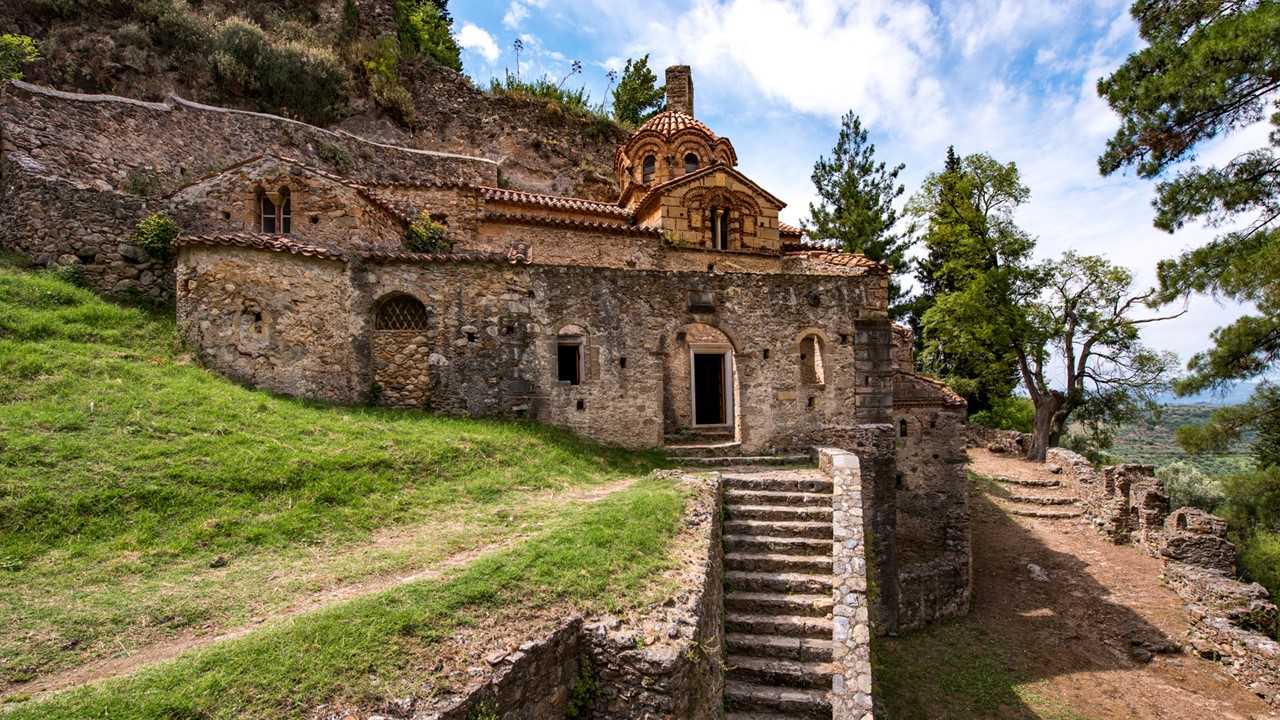
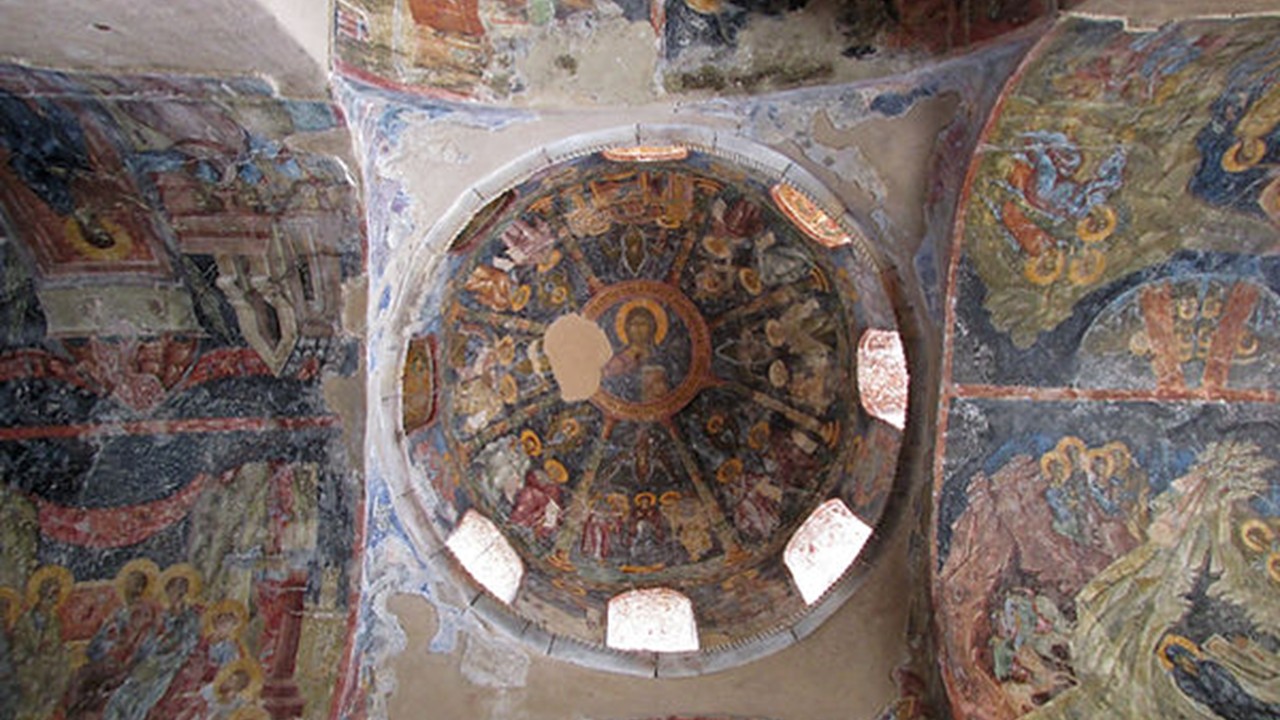
The Nativity Fresco of Peribleptos Monastery in Mystras captures the spiritual heart of the season through the radiant artistry of Byzantine devotion. High on the slopes of Mistra, within the Monastery of Perivleptos, the Nativity scene painted across its frescoed walls unfolds as a vivid testament to Byzantine spirituality and artistic mastery. Created in the 14th century, this depiction of Christ’s birth captures both the human tenderness and divine mystery central to Orthodox faith. Beneath the soft light filtering through the dome windows, figures of Mary, Joseph, angels, and shepherds converge around the newborn Christ, embodying a theology of incarnation rendered through luminous color and sacred geometry. As we celebrate Christmas Day 2025, this fresco invites reflection on how art can transform stone and pigment into a living proclamation of hope and transcendence.
Mystras and the Late Byzantine World
Mystras, located near ancient Sparta in the Peloponnese, was one of the most significant centers of the late Byzantine Empire, flourishing between the 13th and 15th centuries. Established by the Franks in 1249 and later reclaimed by the Byzantines, it became the capital of the Despotate of the Morea, a major political, intellectual, and artistic hub during Byzantium’s final centuries. The city’s fortified acropolis, palaces, monasteries, and churches, including the Peribleptos, Pantanassa, and Hodegetria to mention just three, reveal a remarkable synthesis of political power and cultural refinement. Mystras nurtured a vibrant artistic school known for its refined frescoes and architecture, which combined classical Byzantine traditions with new stylistic developments that prefigured aspects of the Renaissance. Today, Mystras stands as a UNESCO World Heritage Site, representing the last brilliant flowering of Byzantine art and spirituality before the empire’s fall.
Among its most notable monuments, the Katholikon (main church) of thePeribleptos (Perivleptos) Monastery was founded in the mid-14th century, most scholars attribute its patronage to the first Despot of the Morea, Manuel Kantakouzenos, and his wife Isabella (Isabelle) de Lusignan. Built into the southeast slope of the town and partly supported by a cave, the church is a two-column cross-in-square plan that exemplifies the local “Mystras style,” with squared stone and inlaid tilework that give the exterior a fortress-like appearance. Its dating is commonly placed around the 1350s–1370s, when Mystras was a lively cultural and political center of the late Byzantine Peloponnese.
The interior is celebrated for an extensive and unusually well-preserved cycle of late Byzantine frescoes (mid-14th century) that focus especially on the life of the Virgin and key Gospel scenes, paintings that art historians link stylistically to Cretan and Macedonian workshops and that show Palaeologan-era innovations in space and movement. Because these frescoes survive largely in situ, the Peribleptos Katholikon is considered crucial for understanding late Byzantine painting and the artistic renaissance in the Morea; the whole site of Mystras is protected for its outstanding medieval ensembles.
The Nativity scene in the Peribleptos Monastery at Mystra stands as one of the most evocative frescoes of the late Byzantine period, part of the church’s rich Christological cycle. Depicted with serene grace and otherworldly poise, the Virgin reclines beside the Christ Child in a rocky grotto, encircled by Joseph, the Magi, shepherds, and angels—each slender figure animated by elegant gestures and expressive faces. The artist achieves a vivid harmony of color and form, combining traditional Byzantine iconography with a confident, freer sense of spatial rhythm. The layered landscape, luminous tones, and effortless authority of each depiction reveal the maturity of the Mystras school, whose refinement would profoundly influence the later Cretan School of icon painters.
Aesthetically, the Nativity fresco exemplifies the serene elegance and emotional subtlety of late Byzantine art at its height. The soft modulation of color—from deep blues and warm ochres to pale rose and gold—infuses the composition with both tenderness and transcendence. Figures are modeled with a supple handling of light and shadow that departs from earlier rigidity, achieving a lyrical balance between solemnity and grace. This confident, almost Renaissance sensibility anticipates the stylistic currents that would flow from Mystras to Crete and, ultimately, to Venice. Through this luminous synthesis of theology and beauty, the Peribleptos Nativity becomes not merely a devotional image but a harbinger of artistic renewal across the Mediterranean world.
As we celebrate Christmas Day 2025, the Nativity fresco at Peribleptos reminds us that the story of Christ’s birth continues to inspire wonder, devotion, and artistic creation across the centuries. Just as the figures in the fresco gather around the newborn Savior, we too are invited to pause, reflect, and share in the warmth, hope, and light that this holy day brings. In the quiet glow of candlelight or the brilliance of a winter sunrise, the spirit of Mystra endures, connecting past and present in a timeless celebration of faith and beauty.
Explore further: Download our PowerPoint Presentation on the Byzantine Monuments of Mystras for educators, students, and art lovers… HERE!
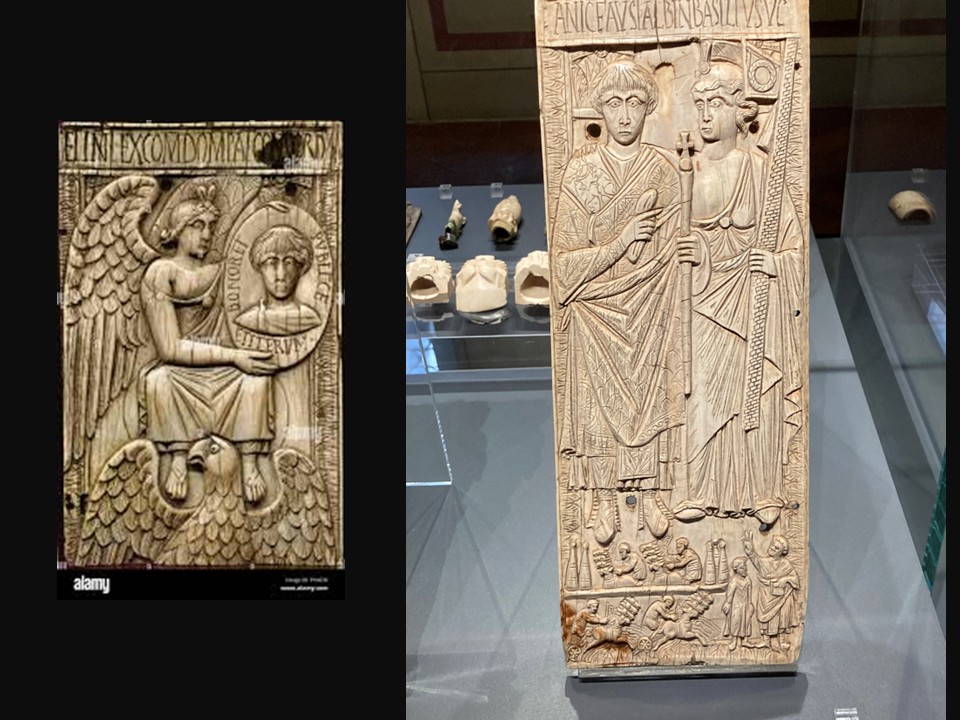
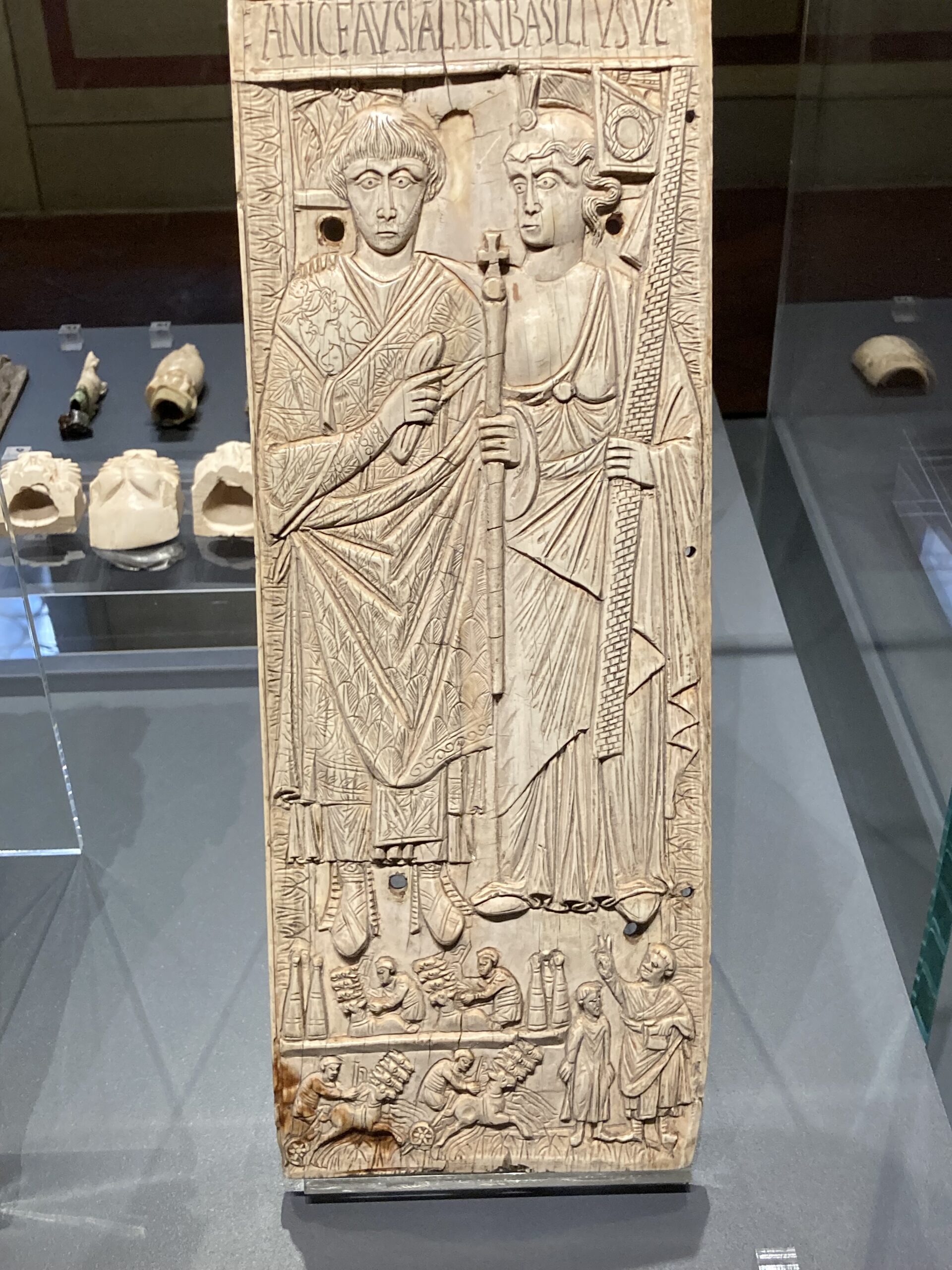
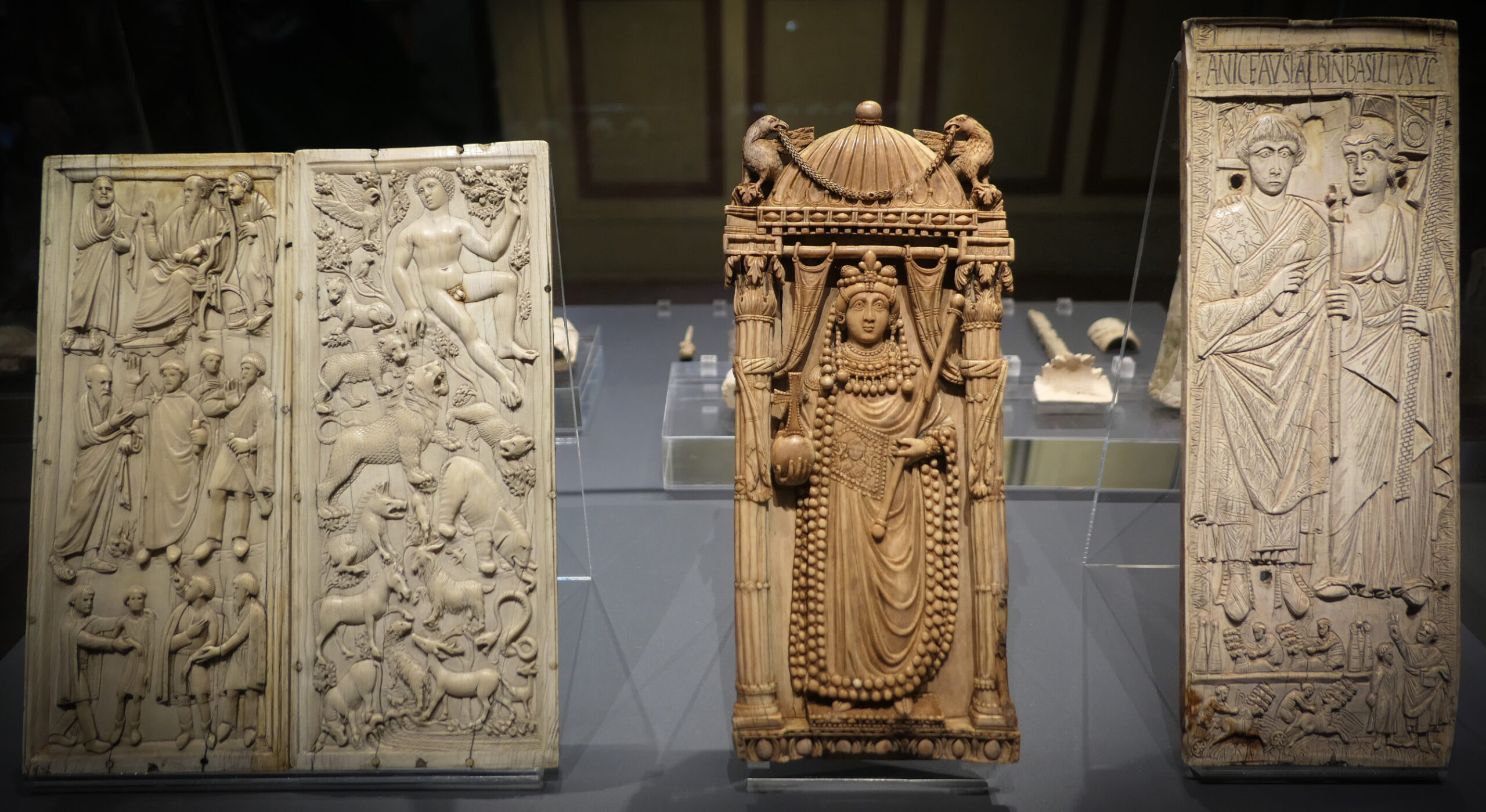
The Bargello panel of The Consular Diptych ofAnicius Faustus Albinus Basilius (consul in 541 AD) offers a vivid glimpse into the ceremonial splendor and political symbolism of late antiquity. Carved in fine ivory, the plaque depicts the Consul Basilio standing frontally beside the personification of Rome, who crowns him with a laurel wreath, a timeless emblem of civic and military virtue. Below unfolds a chariot race, a rare and dynamic motif symbolizing the public games that marked the consul’s inauguration. The consul holds both the scipio topped with a cross and the mappa circensis, the cloth used to signal the start of the races, fusing Christian and traditional Roman imagery in a moment of political theater.
Once hinged to a now-separated companion leaf, the Milan panel (Avori 10, Castello Sforzesco), the Bargello relief would have formed one side of a luxurious diptych presented to commemorate Basilius’s consulship. The Milan fragment, showing Victory presenting the consul’s portrait within a clipeus, completes the scene’s message of divine favor and public virtue. Together, these ivories capture the final flowering of the consular tradition, bridging Roman civic ideals and Byzantine court aesthetics, and reflecting a world where art served both as devotion and as declaration of power.
Consular diptychs were luxurious paired ivory panels created in the late Roman and early Byzantine periods to commemorate the inauguration of a consul, one of the highest offices in the empire. Traditionally carved on the inside to hold wax for writing, these diptychs evolved by the 4th and 5th centuries into richly decorated ceremonial gifts rather than practical objects. Newly appointed consuls commissioned them to celebrate their accession and distributed them to friends, allies, and dignitaries as tokens of prestige and gratitude. The front surfaces were elaborately carved with scenes of the consul’s investiture, imperial imagery, or allegorical figures such as Victory or Rome, while inscriptions proclaimed the consul’s name and titles. Their iconography—often showing the consul presiding over games, dispensing largesse, or associated with divine favor—served to reaffirm the continuity of Roman civic traditions even as imperial power shifted eastward to Constantinople.
Anicius Faustus Albinus Basilius, consul in 541 CE, was a distinguished member of the ancient and influential Anicii family, one of the last great senatorial lineages of Rome. His career unfolded during a turbulent period in the Gothic War and the final years of the Western Roman aristocracy. Before attaining the consulship, Basilius held prominent administrative posts, including comes domesticorum (commander of the imperial household guard) and patricius, titles that reflected both his rank and his proximity to the imperial court. Appointed consul by Emperor Justinian I, he was the last man to hold the title in the Western tradition. After his term, the consulship ceased to exist as an independent civic office and became an imperial prerogative. His consular games, commemorated by the magnificent ivory diptych now divided between Florence and Milan, symbolized both the enduring prestige of Rome’s senatorial elite and the transformation of Roman political culture under Byzantine rule. Basilius’s life thus marks a poignant historical threshold: he stood at the end of Rome’s ancient civic offices and the dawn of a new, imperial order dominated by Constantinople.
The Consular Diptych of Anicius Faustus Albinus Basilius, divided today between the Bargello Museum in Florence and the Museo delle Arti Decorative in Milan, stands as one of the most compelling survivals of sixth-century ivory art. Created in 541 CE to commemorate Basilius’s consulship—the last in the Western Roman tradition—the two panels once formed a hinged pair, uniting political ceremony, imperial iconography, and refined craftsmanship. The Bargello panel represents the consul’s public and civic identity, while the Milan plaque embodies the divine and honorific aspects of his role, creating a complete visual narrative of authority and virtue.
Consul Basilio with personification of Rome and chariot race, 541 – 541, Plaque of an Ivory Consular Diptych, 34.5×12.9 cm, National Museum of Bargello, Florence, Italy – Photo Credit: Amalia Spiliakou, April 2025
The Bargello panel presents Basilius standing frontally in full consular regalia beside the personification of Rome, who crowns him with a laurel wreath, a symbol of victory and civic honor. In his hands, the consul holds the scipio topped with a cross and the mappa circensis, signaling the opening of the chariot races carved below in vivid relief, where teams of four-horse chariots turn around the spina of the circus. This combination of Christian and traditional Roman imagery reflects the fusion of old civic ritual with new imperial faith. The Milan plaque, by contrast, depicts a winged Victory seated on a globe, her feet resting on an eagle’s outstretched wings as she presents a clipeus containing Basilius’s portrait. Around it runs the inscription BONO REI PVBLICAE ET ITERVM (For the good of the Republic, and again), proclaiming the consul’s service to the state. Together, these compositions balance earthly power and celestial sanction, merging public ceremony with divine endorsement.
Aesthetically, the two panels reveal both unity and distinction. The Bargello panel is dense and narrative, crowded with human figures and architectural motifs that emphasize movement and civic spectacle. The Milan panel, in contrast, is more restrained and idealized, its composition centered, symmetrical, and imbued with spiritual calm. The Milanese Victory, delicately modeled and classically poised, recalls earlier Roman traditions of divine personification, while the Bargello figures are more rigid, their proportions elongated, their gestures formalized in the emerging Byzantine style. The difference in tone, public versus celestial, active versus contemplative, suggests that the two leaves were designed as complementary expressions of the same ideology: the earthly authority of the consul validated by divine and imperial favor.
Viewed together, the two ivories encapsulate the final synthesis of Roman civic art and Byzantine symbolism. They celebrate the consulship not merely as an office but as a sacred performance of continuity between past and present, Rome and Constantinople, man and empire. Their divided survival, one in Florence, one in Milan, mirrors the historical fragmentation of the world that produced them, yet their shared message endures: that power, piety, and artistic excellence could still converge in the twilight of antiquity. As such, the diptych of Basilius stands not only as a testament to individual glory but as a poignant farewell to the visual language of Roman public life.
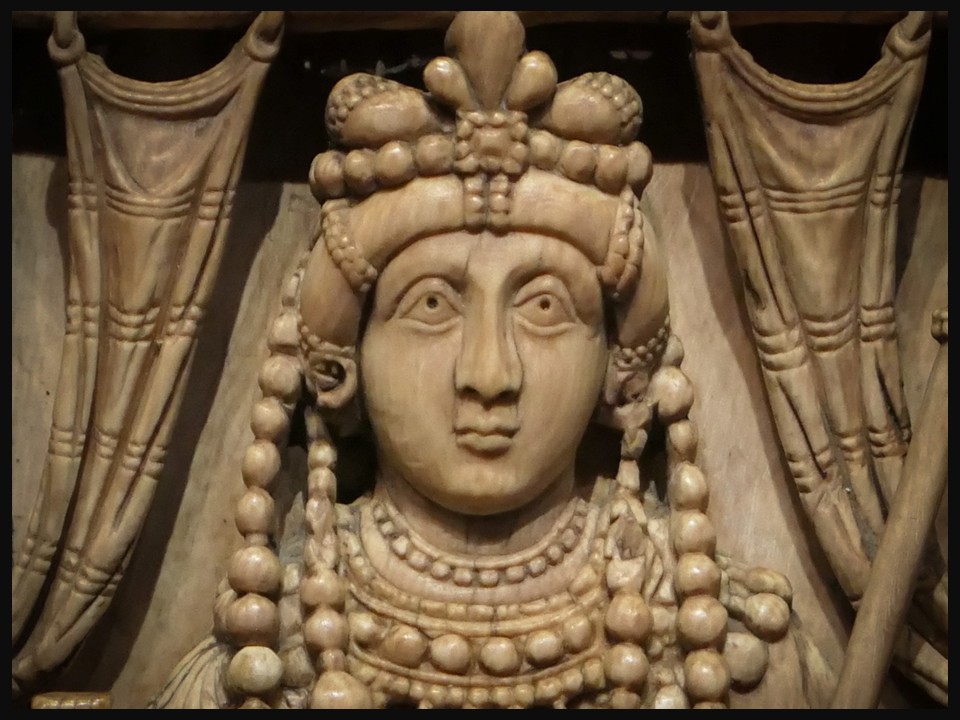
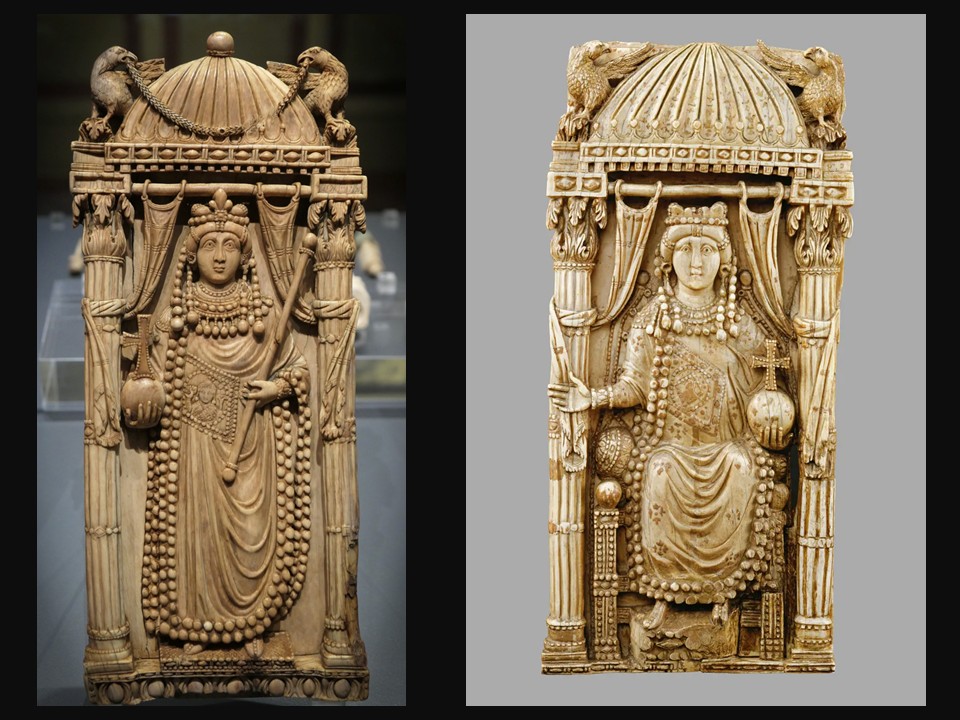
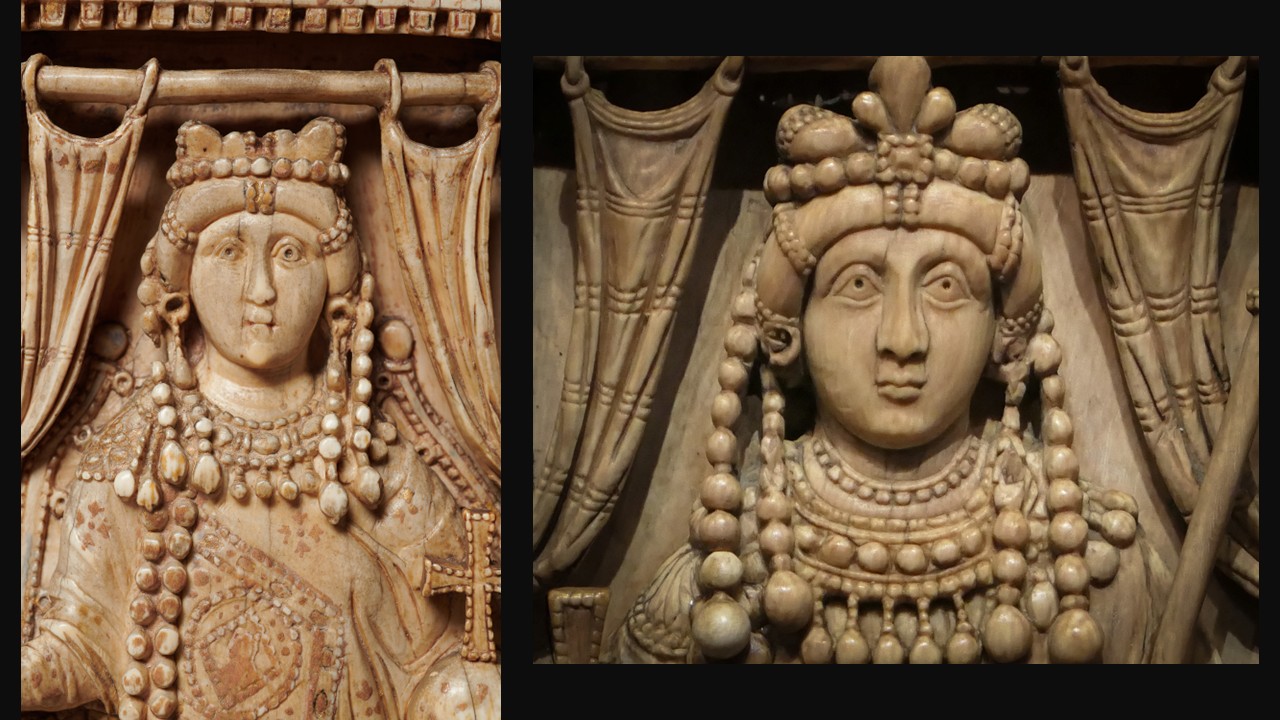
In the heart of Late Antique Constantinople, luxury art served not only as decoration but as a statement of power and identity. Among these treasures are two exquisite ivory plaques, generally attributed to portray Empress Ariadne (r. 474–515), now housed in the Bargello Museum in Florence and the Kunsthistorisches Museum in Vienna. While scholars debate their exact identification, these delicate carvings offer a rare glimpse into the artistry and political symbolism of the early Christian Byzantine court.
Empress Ariadne, around 500 AD, Ivory, Height: 36,5 cm,The Bargello Museum, Florence, Italy – Photo Credit: Marya Stamatiadi April 2025 Empress Ariadne, around 500 AD, Ivory, Height: 26,5 cm,Kunsthistorisches Museum, Vienna, Austria https://www.khm.at/en/artworks/kaiserin-ariadne-71782-1
The late 5th and early 6th centuries were a period of significant political and religious transformation. Ariadne, the daughter of Emperor Leo I and Empress Verina, became central to dynastic succession at a time when no male heir was available. Married first to Emperor Zeno, she played a mediating role during his often turbulent reign. After his death, Ariadne married Anastasios, a palace official (silentiarius) whom she helped elevate to the throne, securing imperial stability. If the ivory plaques do depict her, they present not only an image of an empress consort but also of a figure who embodied dynastic continuity and wielded real political influence in Constantinople.
The Bargello plaque, cataloged as part of a larger pentittico (five-panel composition), presents a standing female figure dressed in imperial robes and facing frontally. Executed in carved and incised ivory with traces of paint, it has been compared to major works such as the Barberini Ivory, and scholars have proposed that it may once have formed part of the same ensemble as the Vienna plaque. Stylistic affinities with consular diptychs, such as those of Aerobindus and Anastasius, suggest a date around 500 AD. While rival identifications have been proposed, the attribution to Ariadne remains the most recurrent. The ivory entered the Bargello in the 19th century through an exchange, further adding to its layered history as both a Byzantine and a modern collectible.
Empress Ariadne, around 500 AD, Ivory, Height: 36,5 cm,The Bargello Museum, Florence, Italy – Photo Credit: Marya Stamatiadi April 2025 Empress Ariadne, around 500 AD, Ivory, Height: 26,5 cm,Kunsthistorisches Museum, Vienna, Austria https://www.khm.at/en/artworks/kaiserin-ariadne-71782-1
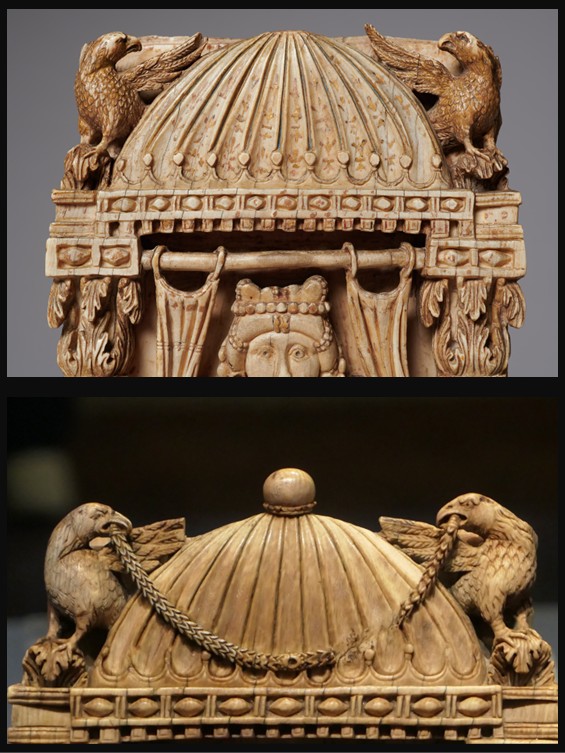
By contrast, the Vienna plaque shows the empress enthroned beneath a shell-shaped baldachin, flanked by eagles, symbols of imperial authority. Dated to around 500 AD, the ivory portrays the ruler richly adorned, holding a sphaira topped with a cross in her left hand while raising her right in a gesture of blessing. The throne, the globe and cross, and the orant-like pose emphasize divine sanction and ceremonial majesty over individual portraiture. Classified as Early Byzantine, the plaque passed from the Riccardi collection in Florence into the Kunsthistorisches Museum, where it remains a centerpiece of the Antikensammlung.
Empress Ariadne, around 500 AD, Ivory, Height: 36,5 cm,The Bargello Museum, Florence, Italy – Photo Credit: Marya Stamatiadi April 2025 Empress Ariadne, around 500 AD, Ivory, Height: 26,5 cm,Kunsthistorisches Museum, Vienna, Austria https://www.khm.at/en/artworks/kaiserin-ariadne-71782-1
Taken together, the two plaques, one depicting the empress standing in ceremonial presence, the other enthroned in majesty, illustrate complementary aspects of imperial power. They exemplify the Constantinopolitan fusion of classical forms with emerging Christian symbolism, and, if indeed they represent Ariadne, they also illuminate the ways in which an empress could embody both dynastic continuity and divine legitimacy during a pivotal moment in Byzantine history.
Early Christian Ivory Treasures in The Bargello Museum, Florence, Italy – Photo Credit: Marya Stamatiadi April 2025
Today, the Bargello and Vienna ivory plaques continue to captivate scholars and visitors alike, not only for their exquisite craftsmanship but also for the historical questions they raise. Whether or not they truly portray Ariadne, they stand as rare survivals of Constantinopolitan ivory carving, embodying the fusion of imperial image-making and Christian symbolism. Through them, we glimpse both the artistry of a vibrant court and the enduring allure of an empress whose legacy shaped the transition of power at a crucial moment in Byzantine history.
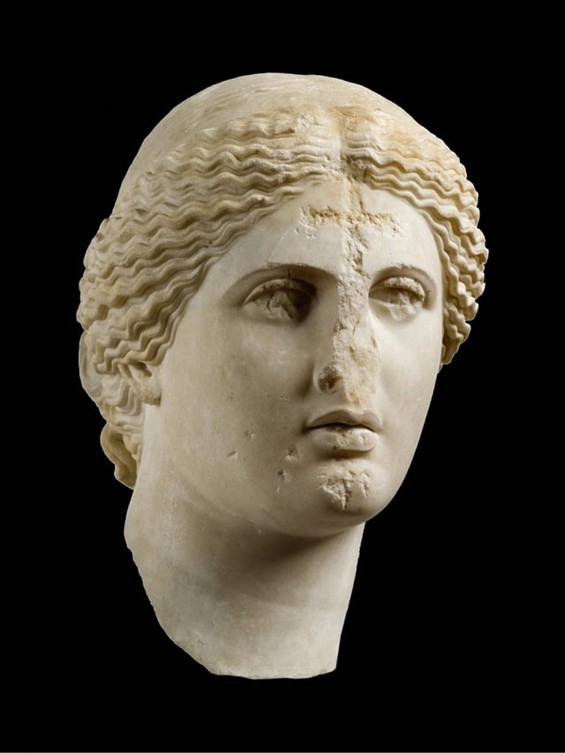
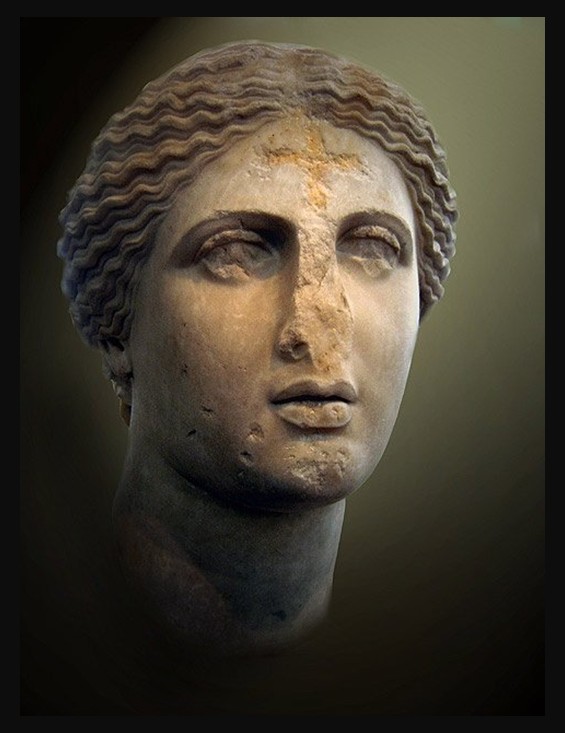
The Head of Aphrodite of the Aspremont-Lynden/Arles type, housed in the National Archaeological Museum in Athens, offers a compelling glimpse into the classical ideals of beauty and divinity shaped by the legacy of Praxiteles. As a copy of a lost 4th-century BC original, possibly the first known depiction of Aphrodite with a nude upper body, this sculptural type reflects the evolving representation of the goddess, bridging the serene sensuality of the Aphrodite of Knidos with the more voluptuous forms of later works like the Aphrodite of Melos. The surviving head, now divorced from its torso, carries echoes of a refined, yet idealized femininity that would influence Roman and Renaissance aesthetics alike. Its later restoration by François Girardon, under the patronage of Louis XIV, introduced symbolic elements like the mirror and apple, both deeply charged with mythological meaning, underscoring not just Aphrodite’s divine allure, but also the enduring power of classical art to adapt to new cultural narratives. An incised cross on her forehead, likely added in the early Christian era, marks a moment when pagan imagery was recontextualized within a new religious worldview.
Carved from Parian marble, the Head of Aphrodite once belonged to an over-life-size statue of a clothed Aphrodite, though some scholars have suggested it may instead portray the famed courtesan Phryne due to its individualized features. The face, turned slightly to the right, is serene and harmonious, with soft, fleshy contours and delicately incised features: a smooth triangular forehead framed by parted curls, a broad nose (now broken), full lips, and a rounded chin. A thick bun gathers the hair at the nape, secured by a wide band. The eyes, beneath gently curved brows, show signs of deliberate Christian-era defacement, likely part of an effort to “close” the eyes and “silence” the mouth. A small, incised cross on the forehead reinforces this reinterpretation of pagan art within a Christian context, suggesting the statue may have been reused as a sacred image. Despite the damage, most notably to the nose and facial extremities, the head remains in relatively good condition and serves as a compelling testament to both the endurance of classical ideals and their transformation in later religious and cultural landscapes.
Head of Aphrodite of the Aspremont-Lynden/Arles type, 1st c. AD copy of an original 4th century BC work by Praxiteles, Marble, possibly Parian (Marathi), Height: 32 cm, National Archaeological Museum, Athens, Greece https://x.com/ArysPan/status/1513155769000247301/photo/1
The statue’s discovery near the Clock of Andronikos Kyrrhestes in the Roman Agora of Athens further grounds it in the layered urban fabric of ancient Athens, where temples, markets, and later churches coexisted and often repurposed one another’s remains. This setting, close to the sanctuary of Aphrodite and Eros on the north slope of the Acropolis, reinforces the likelihood that the statue originally served a votive or cultic function. The artistic style—marked by its naturalistic modeling, graceful asymmetry, and subtle anatomical details like the “Venus rings” on the neck—embodies the Praxitelian ideal of ethereal beauty softened by human warmth. In this way, the head is not only a remnant of a once-complete devotional image but also a rare survivor of artistic transitions: from Classical to Hellenistic, pagan to Christian, and ultimately, from sacred object to museum artifact.
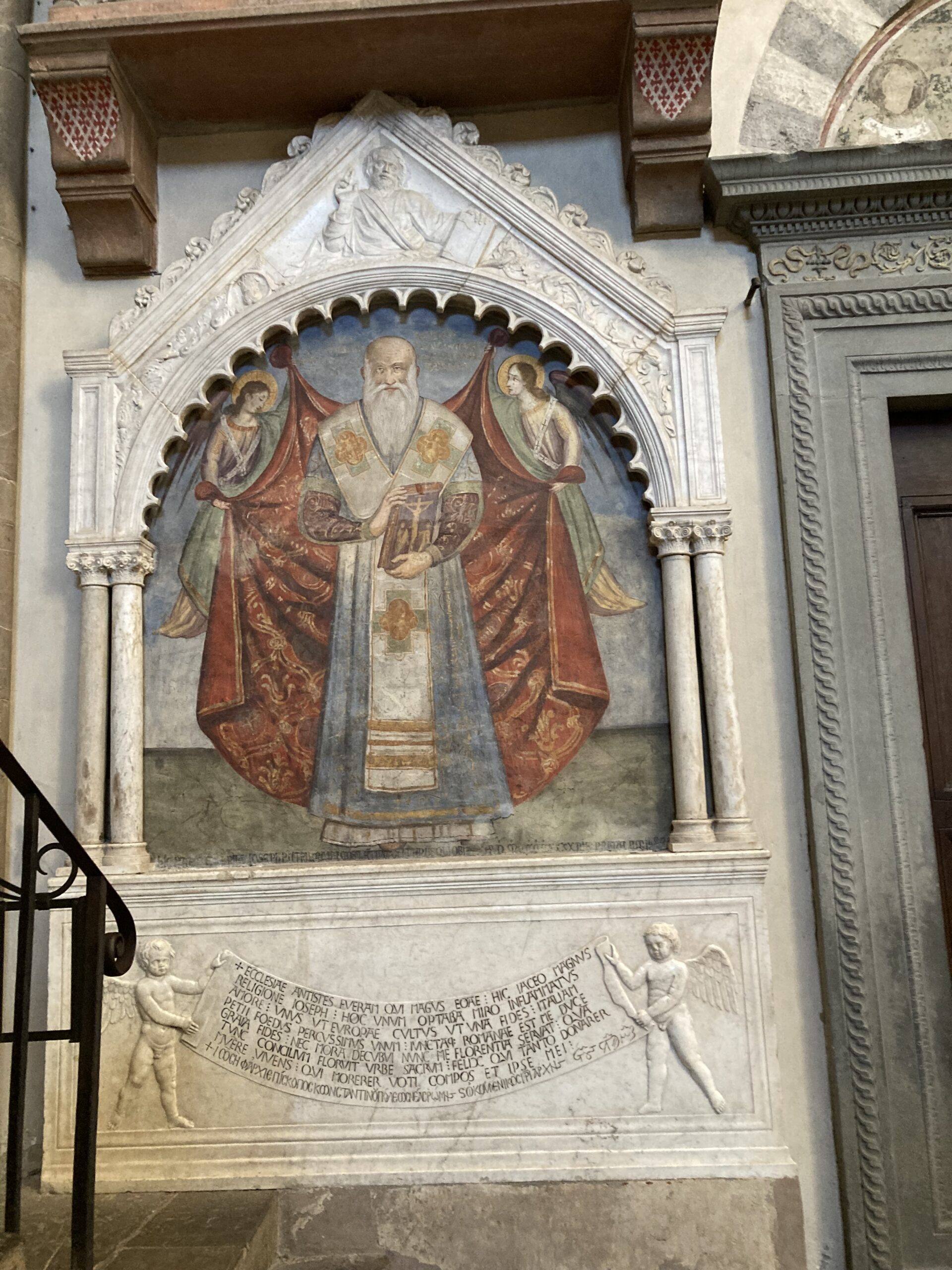
Tomb of Joseph II Patriarch of Constantinople, Florentine sculptor, 1440, Santa Maria Novella, Florence Painted Portrait of Patriarch Joseph II of Constantinople, 1590-92, Santa Maria Novella, Florence, Italy Photo credit: Amalia Spiliakou, April 2025
Patriarch Joseph II of Constantinople was a pivotal figure in the history of the Eastern Orthodox Church, most notably for his participation in the Council of Ferrara-Florence (1438–1439), a major attempt to reconcile the long-standing schism between the Eastern and Western Christian churches. As the spiritual leader of the Eastern delegation, he played a crucial role in the theological dialogues aimed at achieving ecclesiastical unity. Though the union was short-lived, his involvement marked a significant moment of engagement between East and West. Patriarch Joseph II passed away during the council in Florence in 1439, and fittingly, his tomb remains in the Dominican church of Santa Maria Novella, an enduring symbol of his commitment to bridging divided faiths.
Born around 1360, likely in Constantinople, he was of noble origin and possibly related, on his father’s side, to the Bulgarian royal family. Before rising to the patriarchate, Joseph became a monk on Mount Athos and later served as the Metropolitan of Ephesus. In 1416, he was elected Ecumenical Patriarch of Constantinople, leading the Orthodox Church during a time of both spiritual and geopolitical crisis as the Byzantine Empire faced increasing pressure from the advancing Ottoman Turks.
A staunch supporter of church unity, Joseph II was a central participant in the Council of Ferrara-Florence (1438–1445), convened to heal the East-West Schism between the Orthodox and Roman Catholic Churches. His delegation sought Western military aid in exchange for theological concessions, a strategy driven by the empire’s desperate political situation. Despite his ill health, Joseph played a vital role in the negotiations, advocating dialogue and reconciliation. He died in Florence on June 10, 1439, before the council concluded, and was buried with honor in the church of Santa Maria Novella. His tomb remains there today, a rare and poignant symbol of his commitment to Christian unity and the enduring legacy of his leadership in a time of upheaval.
Although no literary or theological works by Patriarch Joseph II of Constantinople are known to have survived, his contemporaries spoke highly of his intellect and character. Ambrogio Traversari, in a letter dated February 20, 1438, praised him as venerable, so refined, with common sense, experience in life, and added, in my judgment, I think that today one could not find his like in all of Greece [Byzantium], noting that their conversation and the patriarch’s demeanor arouses respect. In Personalities of the Council of Florence, and Other Essays, Joseph Gill echoes this view, portraying Joseph II as a spiritually and intellectually vibrant leader despite his old age and deteriorating health. Nearly eight years old and suffering from heart disease, the Patriarch nonetheless demonstrated keen insight, prudent judgment, and steadfast dedication to the cause of church union until his death in Florence, shortly before the council concluded.
The Tomb of Patriarch Joseph II of Constantinople in the church of Santa Maria Novella, Florence, is a striking monument that reflects both historical reverence and artistic devotion. Created by a Florentine sculptor around 1440, the tomb commemorates the Eastern Patriarch who died in Florence during the Council of Florence, a major attempt at reunifying the Eastern and Western Churches. A later painted portrait (1590–92) complements the sculptural work, offering a vivid image of the patriarch. Ambrogio Traversari, a key figure in the council and admirer of Joseph II, described him with deep respect… The father is old, and, like his age, his grey hair, long beard and face make him a venerable figure to all who see him. This description is poignantly echoed in both the tomb and the painting, which together convey the spiritual dignity and serene wisdom of a man who symbolized unity and holiness at a crucial moment in church history. https://www.scribd.com/document/688389117/GILL-J-Personalities-of-the-Council-of-Florence-Joseph-II
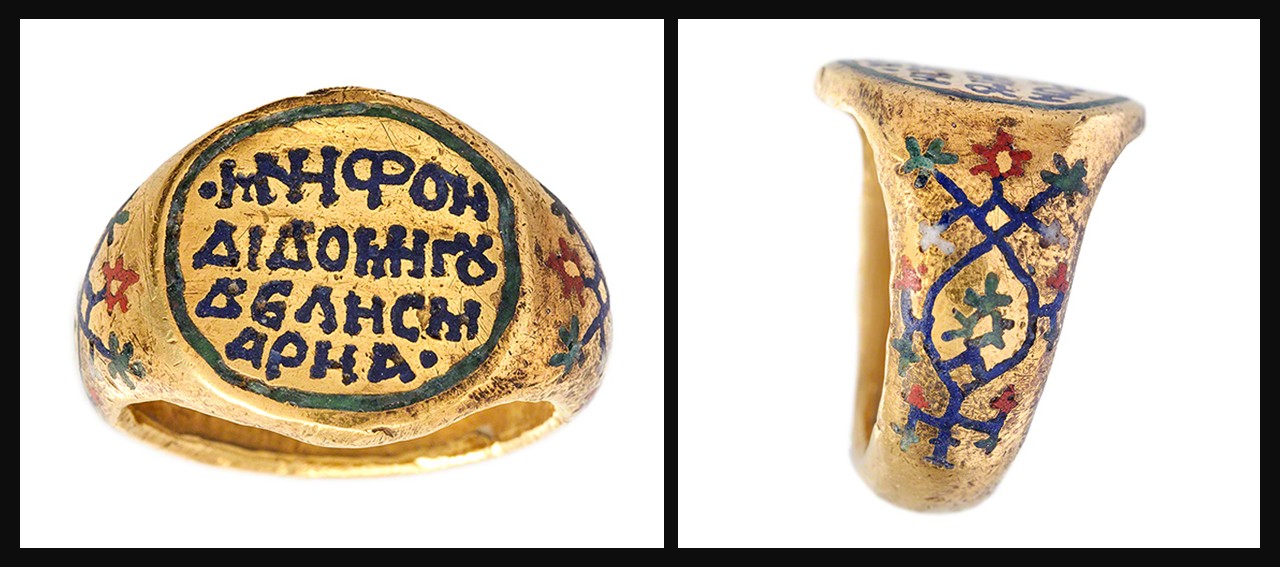
Engagement Ring with a Greek Inscription, about 1175–1300 AD, Gold and enamel, Diameter: 2.1 x 2.3 cm, National Archaeological Museum, Athens, Greece Image courtesy of the National Archaeological Museum, Athens https://blogs.getty.edu/iris/put-a-ring-on-it/
In the shimmering glow of Byzantium’s golden age, love and faith were often sealed in objects of exquisite craftsmanship and deep symbolic meaning. Among these treasures, Byzantine Engagement Rings stand as powerful tokens of devotion, not only between husband and wife but also to God. One such remarkable example is the Byzantine Engagement Ring in the Stathatos Collection, adorned with intricate enamel decoration, reflecting the era’s profound intertwining of romance and spirituality. This ring, much like the art and culture of its time, serves as a testament to a society where marriage was both a sacred bond and a reflection of divine harmony. Let us explore the beauty, symbolism, and historical significance of this extraordinary artifact.
Ashley Hilton’s Getty IRIS blog post, “Put a Ring On It,” sparked my curiosity about the deep personal and historical narratives embedded in Byzantine jewelry, particularly the Byzantine gold ring of Goudeles from the Stathatos Collection. This ring, inscribed with a dedication to a lady named Maria, serves as a tangible testament to love, devotion, and identity in the Byzantine world. Hilton’s discussion of the ring inspired me to delve deeper into its historical and social context, as well as the role of the Goudeles family in Byzantine society.
So, let’s explore the ‘who’, ‘how’ and ‘what’ of this amazing Byzantine Engagement Ring by posing some questions!
Who was Goudeles and who was Maria, and what do we know about their identity or social status in Byzantine society? The name “Goudeles” is associated with a prominent Byzantine family active from the 11th to the 15th centuries. Members of this family held various significant positions within the Byzantine Empire. The gold engagement ring from the Stathatos Collection bears an inscription (on bezel): MNHCTΡΟΝ |ΔΙΔΟΜΗΓΟΥ | ΔΕΛΗC M | AΡHA (I, Goudeles, give this engagement ring to Maria). While the exact identity of Goudeles and Maria remains uncertain, the ring’s craftsmanship and materials suggest that both the bride and the groom lived during the late 12th early 13th centuries, and belonged to wealthy and possibly influential families. For the groom, given the family’s historical prominence, it’s plausible that the Goudeles who commissioned this ring was a member of this distinguished lineage, reflecting the family’s sustained status within Byzantine society.
What was the historical significance of the Goudeles family in the Byzantine Empire? The Goudeles family was a prominent Byzantine lineage, contributing significantly to both the military and administrative sectors of the empire over several centuries. The earliest known reference to the family appears on a 10th-century lead seal, which mentions a member of the Goudeles family who held the titles of imperial protospatharios and strategos, signifying his high-ranking military status. However, the exact details of his service and the specific region he governed remain uncertain.
During the Komnenian period, one of the most notable figures was Basil Tzykandeles Goudeles, who married Eudokia Angelina, the daughter of Theodora Komnene and Constantine Angelos. This alliance linked the Goudeles family to the ruling Komnenian and Angelos dynasties, which produced emperors such as Isaac II Angelos and Alexios III Angelos.
In the late 14th and early 15th centuries, the Goudeles family strengthened its ties with the Palaiologan Dynasty through marriage. Among its distinguished members were Georgios Goudelis and Nicholas Goudelis. Georgios, in his testament, referred to himself as Ego Georgius Gudeles, servus prepotentis et sancti imperatoris et regis nostri (“I, George Gudeles, servant of our powerful and holy emperor and king”), reflecting his position within the Byzantine aristocracy. He served as mesazon (a chief ministerial role) under Emperors John V Palaiologos and Manuel II Palaiologos, assisting in governance and administration. Nicholas Goudeles, a diplomat in imperial service, was at one point considered for a high advisory position. During the final siege of Constantinople in 1453, he was among the defenders of the city’s Land Walls, and his fate after the city’s fall remains unknown. After the fall of Constantinople, members of the Goudeles family migrated to Italy, where they remained active in international commerce, particularly through cooperation with the maritime republic of Genoa.
Overall, the Goudeles family played a crucial role in Byzantine history, with members serving in high military, diplomatic, and administrative capacities. Their strategic alliances with ruling dynasties and their contributions to the empire’s governance reflect their lasting historical significance.
How does the design, decoration, and inscription of the Goudeles Engagement Ring in the Stathatos Collection showcase Byzantine artistry and symbolism? The Goudeles engagement ring in the Stathatos Collection is a fine example of inscribed Byzantine engagement jewelry, reflecting both artistic craftsmanship and social status. The ring’s band gradually widens to form an almost circular bezel. It is flat on the interior and slightly convex on the exterior, featuring an elaborate stylized vegetal decoration with intersecting blue spirals and green, red, and white flowers on its sides. The bezel is flat and contains a four-line inscription in blue enamel, framed within a green border. The intricate detailing, the use of precious materials, and the weight of the ring indicate that it likely belonged to a wealthy individual.
In Byzantine tradition, engagement rings (annuli pronubi), like wedding rings, were worn on the fourth digit (ring finger) of the left hand, as it was believed to have a direct connection to the heart, symbolizing eternal love and commitment. This ring exemplifies the fusion of Byzantine artistry, social hierarchy, and symbolic marital customs.
In the quiet hush of a walled garden, Sosannah, a woman of rare beauty and deeper virtue, sought solitude beneath the sun. But hidden behind aged branches and envy-clouded eyes, two elders — judges of the people — watched with corrupted hearts. When the moment came and she was alone, they emerged, casting off the mask of piety to reveal their lust. They cornered her with a cruel choice: submit to their desire or face a false accusation that would cost her life. But Sosannah, steadfast and unshaken, chose honor over life, her silence a cry to the heavens. Dragged before the assembly and condemned by perjury, her fate seemed sealed — until Daniel, youthful and divinely stirred, rose with clarity and courage. Separating the liars, he unraveled their tale with the sharp blade of truth, exposing their deceit. Justice turned its gaze, and the elders, once revered, fell by the very law they had twisted. And Sosannah, radiant in her innocence, stood free — a testament to the power of virtue and the triumph of truth… https://bible.usccb.org/bible/daniel/13
The story of Sosannah stands as a powerful symbol for the Christian Church — a portrait of moral courage, spiritual integrity, and trust in divine justice. She embodies the faithful soul, or even the Church itself, called to remain pure amid a world of temptation, false judgment, and the abuse of authority. Her unwavering stance reflects the Church’s vocation: to uphold truth and righteousness, even when isolated or under threat. In a culture that often rewards compromise, Sosannah’s quiet strength challenges believers to hold fast to virtue, trusting in God’s unseen hand.
The figures surrounding her — the corrupt elders and the righteous Daniel — deepen the symbolism. They represent, respectively, the danger of distorted power within religious institutions and the hope of divine intervention through the voice of the just. For the Church today, Sosannah’s story is less about the drama of her trial and more about the enduring truth it reveals: that God sees the heart, hears the cry of the innocent, and will ultimately vindicate the faithful. In this, Sosannah becomes not just a heroine of the past, but a guide for the present — a reminder that holiness is resilient, and truth, though buried for a time, will rise.
The Biblical story has inspired countless artists across centuries, drawn to its rich emotional tension and symbolic depth. In Renaissance and Baroque art especially, painters such as Rembrandt, Artemisia Gentileschi, and Tintoretto depicted the moment of confrontation in Sosannah’s garden — a scene ripe with psychological complexity. While some early depictions emphasized her beauty and vulnerability, later interpretations, particularly by women artists like Gentileschi, focused on Sosannah’s distress, resistance, and the moral corruption of the elders. These artworks often served as visual meditations on virtue under siege, the misuse of authority, and the strength of conscience. Through gestures, gazes, and the contrast of light and shadow, artists explored not only a biblical narrative but a timeless human drama — inviting viewers to contemplate justice, dignity, and divine vindication.
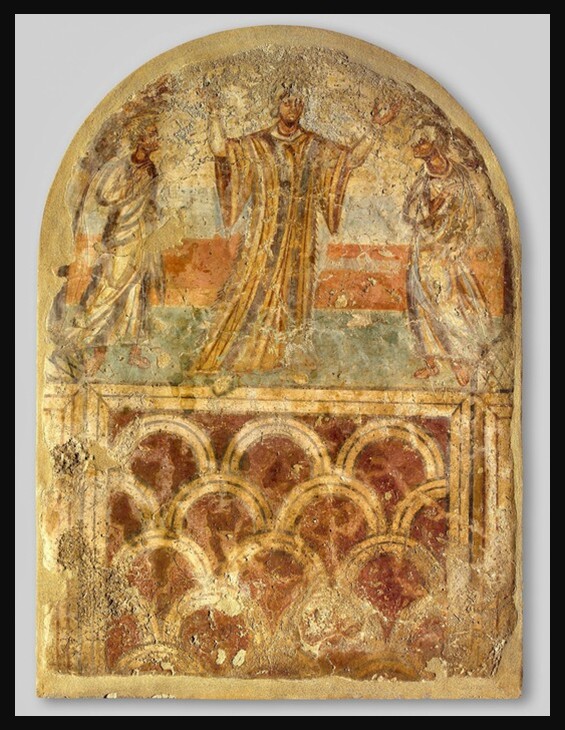
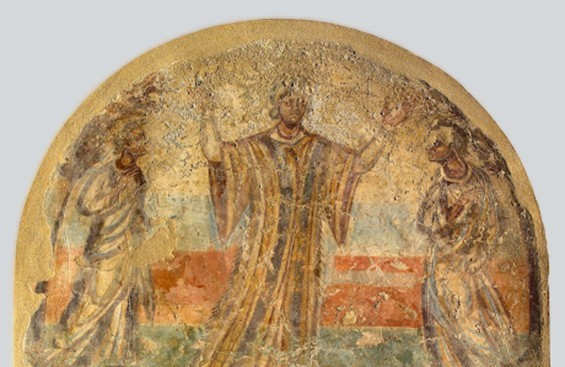
My favourite rendition of Sosannah’s story lies within the Museum of Byzantine Culture in Thessaloniki. It is a remarkable early Christian fresco on the west wall of a barrel-vaulted grave, presenting the biblical story of Sosannah and the Elders with both symbolic power and refined artistry. There’s something deeply moving about how this familiar biblical story comes to life through the quiet beauty of early Christian art. The composition is split into two parts: the lower register features a delicate thorakion slab with small pillars topped by pinecones — a soft, almost architectural whisper — while the upper zone bursts with meaning. There stands Sosannah, praying with solemn grace, flanked by two men whose agitation betrays their guilt. She’s framed by tall cypress trees that bend inward, as if the natural world itself leans in to witness this moment of trial and courage. Her footsteps slightly beyond the slab, reaching toward the viewer, as if inviting us to stand with her.
This fresco, dating to the fifth century, is not only a masterful example of early Christian funerary art but also a theological statement. The theme of Sosannah’s unjust accusation and divine vindication was especially resonant during a time when the Christian Church was defining its identity against the backdrop of intense doctrinal disputes and heresies. In this context, Sosannah becomes an allegory for the Church itself—pure, persecuted, and ultimately defended by divine truth. The expressive detail, naturalistic rendering of garments and foliage, and vibrant use of colour distinguish this fresco as one of the finest examples of its kind, blending artistic grace with profound spiritual symbolism.
For a PowerPoint Presentation, titled Sosannah in Painting, please… Check HERE!