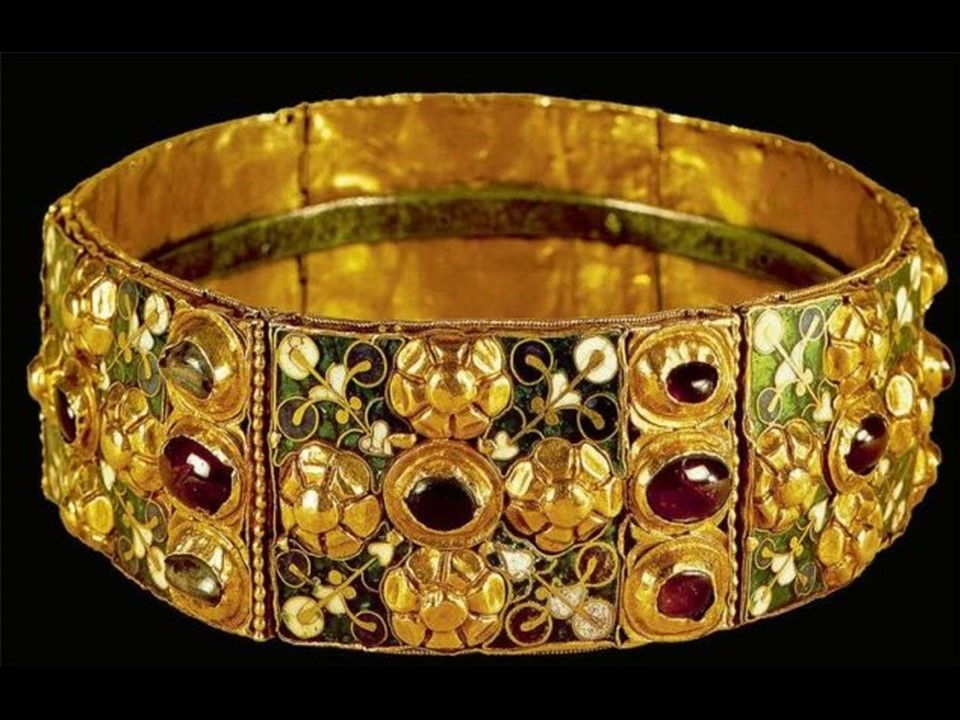
The Iron Crown

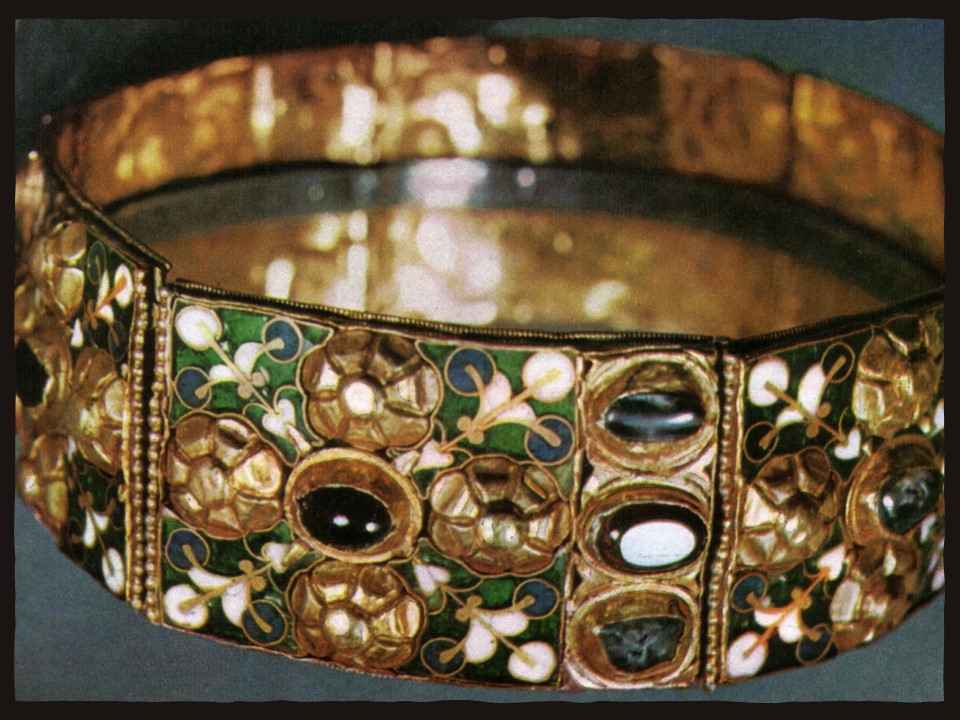
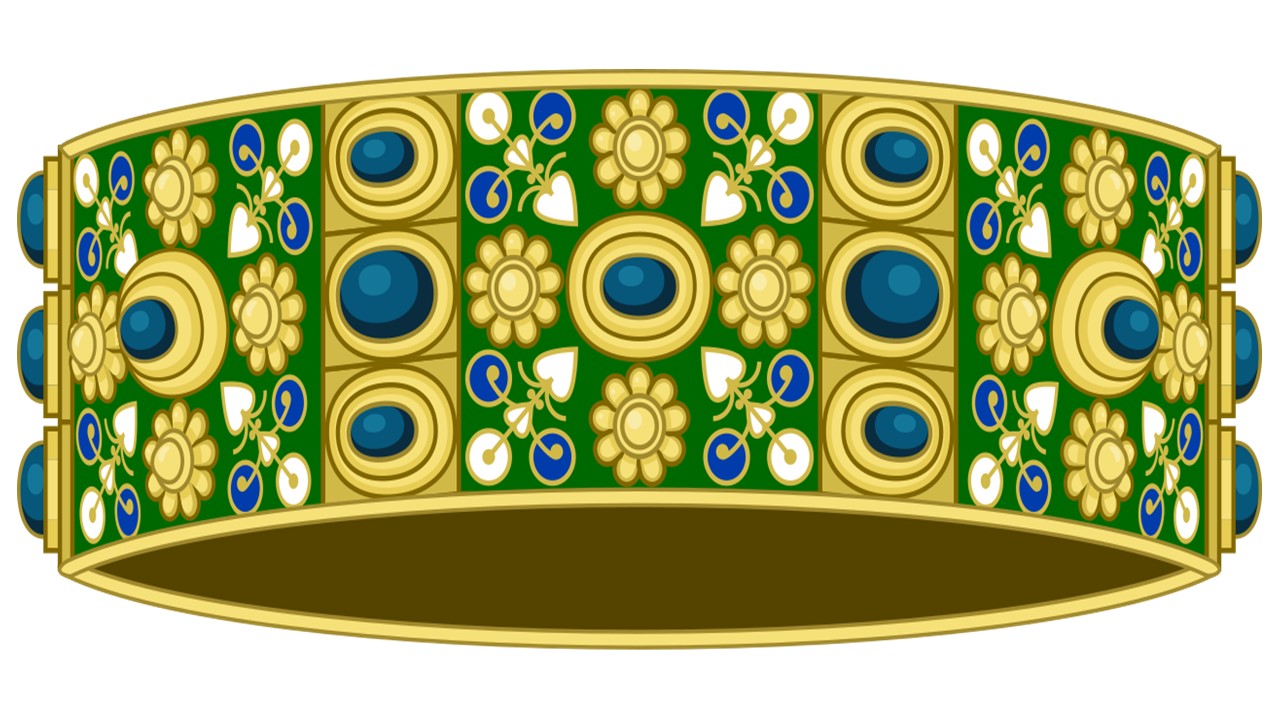
The Iron Crown, dated between the IV-V and IX centuries, gold, silver, enamel and cabochons with garnets, blue corundum, amethysts, Teodolinda’s Chapel, Monza Cathedral

“…And so I left her to her prayers, and went    To gaze upon the pride of Monza’s shrine    Where in the sacristy the light still falls    Upon the Iron Crown of Italy    On whose crowned heads the day has closed, not yet    The daybreak gilds another head to crown…” by Dante Gabriel Rossetti, A Last Confession

Once upon a time… there was a Bavarian princess named Teodolinda (570 – 627) whose fate was to prudently rule over Lombardy, and bequeath the people of Italy, a great treasure… the Iron Crown of Monza! She was the wife of two Lombard kings, Authari (c. 540 – 590) and Agilulf, (c. 555 – 616) and mother, and regent of king, Adaloaldo (603-629).
She is described as a beautiful and intelligent woman, a follower of the Nicene Creed (the First Council of Nicaea, 325 – adopted to resolve the Arian controversy) and a devoted friend of Pope Gregory the Great (c. 540 – 604). She is also described as a great patroness of the arts, providing Monza, the Lombard summer capital, with its Cathedral, a spectacular basilica dedicated to St. John the Baptist. A local legend describes how Queen Teodolinda while riding alongside the Lambro River in the area of Monza met with a dove which instructed her to build a church in the area…and how, dutifully, she did! Today, gazing upon the Monza Cathedral one can only think of the truth behind the legend!

Queen Teodolinda and Pope Gregory the Great are responsible for bringing to Monza some astonishing Early Christian works of art and relics. The Iron Crown is one such extraordinary relic, an item of veneration and great mastery of Early Christian goldsmithery.

The Crown consists of six golden, rectangular plates beautifully embellished with enamelwork and cabochon gems… garnets, amethysts and blue corundum. Each plate is divided into two uneven in size, parts. The right part is narrow and consists of a vertical row of three cabochon gems, one under the other. The other one is three times bigger in size and rectangular in shape. It is decorated with a central cabochon gem, four gold rosettes, and four amazing enamelled floral motifs. The combination of shining gold, opaque and translucent enamels add to the grace and beauty of the Crown, making it an alluring artefact of the Early Christian period.
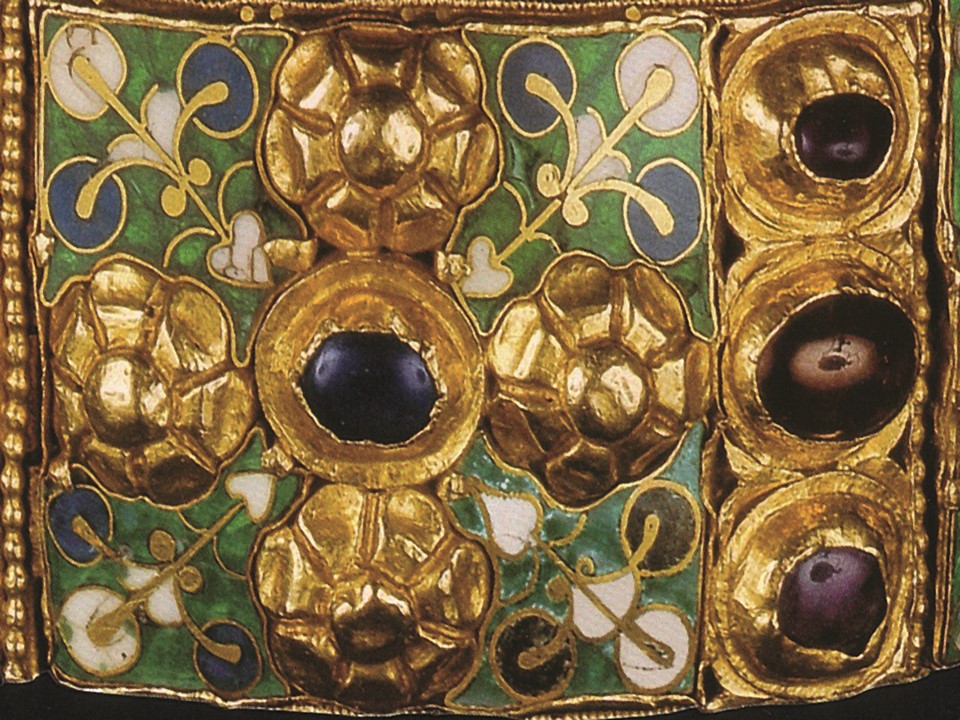
The Iron Crown of Monza is one of the most venerated relics in Italy as tradition and legend ties it up with the Passion of Christ and the first Christian emperor, Constantine. According to Ambrose, Archbishop of Milan,  Saint Helena while visiting Palestine in 326, found the nails used for Christ’s martyrdom. One of these nails was inserted as an inner circle in the creation of the Iron Crown that was first worn by no other than Emperor Constantine himself! That Crown, always according to Ambrose, was brought to Milan by Emperor Theodosius, and after many interesting adventures passed to Queen Teodolinda and finally, the Cathedral of Monza. Historically, the Iron Crown was used for the Coronation of all Italian Kings since the Carolingian Period.
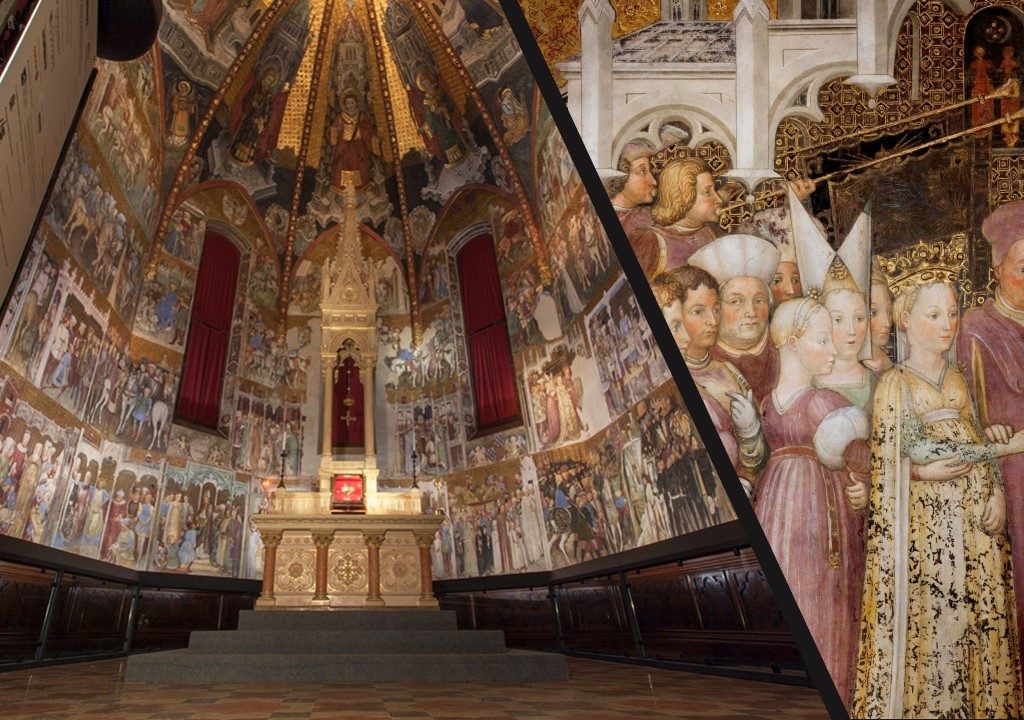
Ambrogio (active 1441 – 1481) and Gregorio (active 1453 al 1481) Zavattari
Teodolinda, queen of the Lombards, marries Agilulf, duke of Turin (detail), 1444, fresco, Chapel of Queen Teodolinda, Monza Cathedral

The original Monza oraculum (chapel) built on the Greek Cross plan Teodolinda commissioned back in 595, is long gone… only some walls exist today. On the exact site, however, starting from the 13th century, the Monza Cathedral was built,  a Basilica church in the Latin Cross plan with an octagonal tiburium. The famous Teodolinda chapel was built at the same time. Today, the Chapel is famous for the mid-15th century wall paintings, painted by Milanese artists from the Zavattari workshop, that recount 45 episodes from Queen Teodolinda’s life and a consecrated altar, built by Luca Beltrami in 1895-96, that holds this most important of Italy’s relics… the Iron Crown of Monza.  https://www.wmf.org/project/duomo-theodelindas-chapel

For a Student Activity, please check HERE!
Theodoros Ralli

Theodoros Ralli, 1852-1909
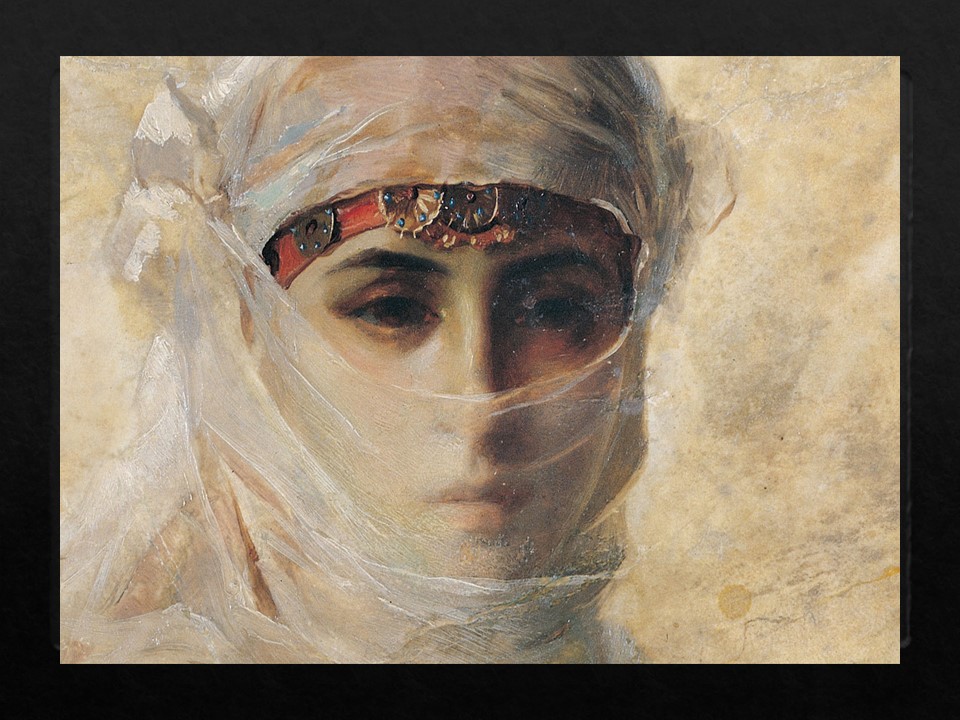
Veiled Woman, 1889, oil on vellum, diameter 22 cm, ALPHA Bank Collection

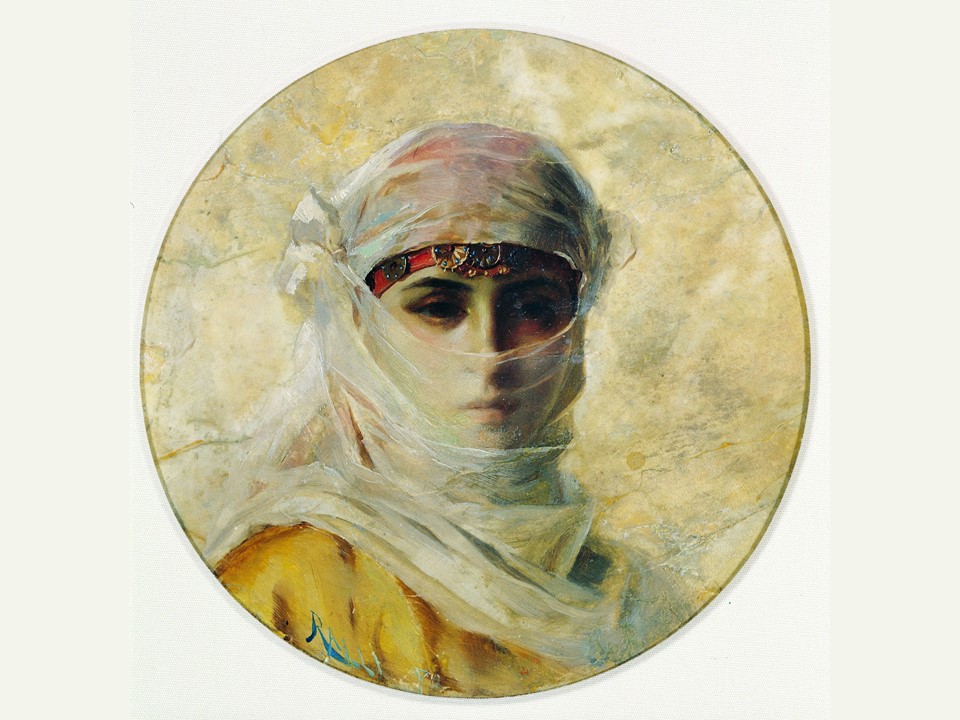
“Art is ANYTHING you can get away with” Andy Warhol once said… How true is he when we consider the artistic oeuvre of Theodoros Ralli and his amazing Orientalism! A wealthy Greek ex-patriate artist, living between the West, mostly in Paris, and the East, Cairo during the cold month of winter, Theodoros Ralli is a true cosmopolitan of the late 19th century Gilded Age.

“A perfect Parisian type, wearing a beret à la Hermonville and a light brown vest with gold trim buttoned to the neck, still very youthful and of an open, jovial character, Mr. Ralli is a delightful conversationalist and very gallant.”

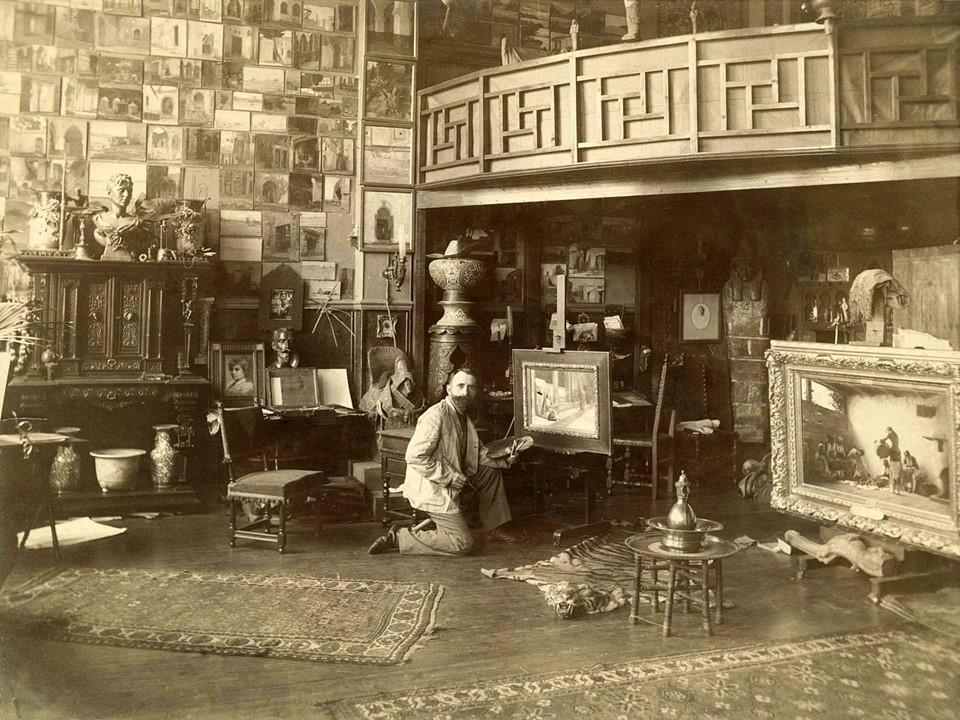
Not just so… Theodoros Ralli, born in Constantinople, at the crossroads of East and West, the mythical capital of the Byzantine Empire and the alluring EAST, was destined to become the most representative of the Greek, Orientalist painters. He was “the offspring of a wealthy family from the island of Chios, active in commerce in England and around the world.” Theodoros Ralli had no financial problems to pursue, unobstructed, his passion for the Arts. The photographs of his Parisian Studio that still survive today preserve his appearance and way of living. Documents of the period present him as a personality, and discuss “his courtesy, gentility, humour, patience, tenacity, smoking habit, love of Wagnerian opera, a weakness for watercolourists, aversion to long-term relationships, industriousness and his love for the fair sex, in Parisian Studios he had the nickname of Don Juan.”  All documents “reinforce the picture of a man who despite his genteel and fragile appearance, disposed of enormous psychic reserves, had an iron will and the perseverance to become what he had dreamed of becoming: a painter.”

The Artist’s Studio in Paris

Theodoros Ralli studied painting under the academic teacher and Orientalist painter Jean-Leon Gerome until approximately 1880, sharing his teacher’s aversion towards Impressionism and the avant-garde movements of the later 19th century. He exhibited, uninterruptedly, in the official French Salons, the World Exhibitions of Paris, as well as many other exhibitions both inside and outside France, winning medals and establishing international recognition. He travelled extensively to Greece and many Middle Eastern countries, drawing inspiration for his paintings. He kept two Studios, one in Paris and another in Cairo, where he kept warm and stimulated during wintertime.

Theodoros Ralli, 1852-1909
Veiled Woman, 1889, oil on vellum, diameter 22 cm, ALPHA Bank Collection

Orientalism in later 19th century Art is a tantalizing, multi-faceted, genre much loved by Europeans of the time. We can trace it back to the merchants of the Silk Road, the few adventurous Northern European travellers of the “Grand Tour,” or the Venetian Renaissance fiestas painted by Veronese, the Dutch Curiosity Cabinets, Rococo eroticism or to the many Odalisques that inspired both Ingres and Delacroix. Then we have to consider Napoleon, his Egyptian Campaign of 1798-1801, and the gradual European desire for… political involvement and colonialism. Whatever the cause of European curiosity and pathos for the East, it lingered for a long time, inspiring and creating great works of art. https://www.metmuseum.org/toah/hd/euor/hd_euor.htm    and    https://www.artuk.org/discover/stories/inspired-by-the-east-thoughts-about-orientalism

For a Student Activity on Orientalism inspired by Theodoros Ralli, please… Click HERE!

Written both in Greek and English, this is a valuable source of information for the Artist: Theodoros Ralli, Looking East – The catalogue was first published on the occasion of the exhibition “Theodoros Ralli. Looking East” Benaki Museum, Museum of Islamic Art, 11th December 2014 – 22nd February 2015 https://www.benaki.org/images/publications/pdf/rallis.pdf

For Browsing through a collection of paintings by Theodoros Ralli, go to https://paletaart.wordpress.com/2012/07/09/%CF%81%CE%AC%CE%BB%CE%BB%CE%B7%CF%82-%CE%B8%CE%B5%CF%8C%CE%B4%CF%89%CF%81%CE%BF%CF%82-rallis-theodoros-1852-1909/

The Philadelphia Crucifixion

Rogier van der Weyden, 1399 or 1400 – 1464
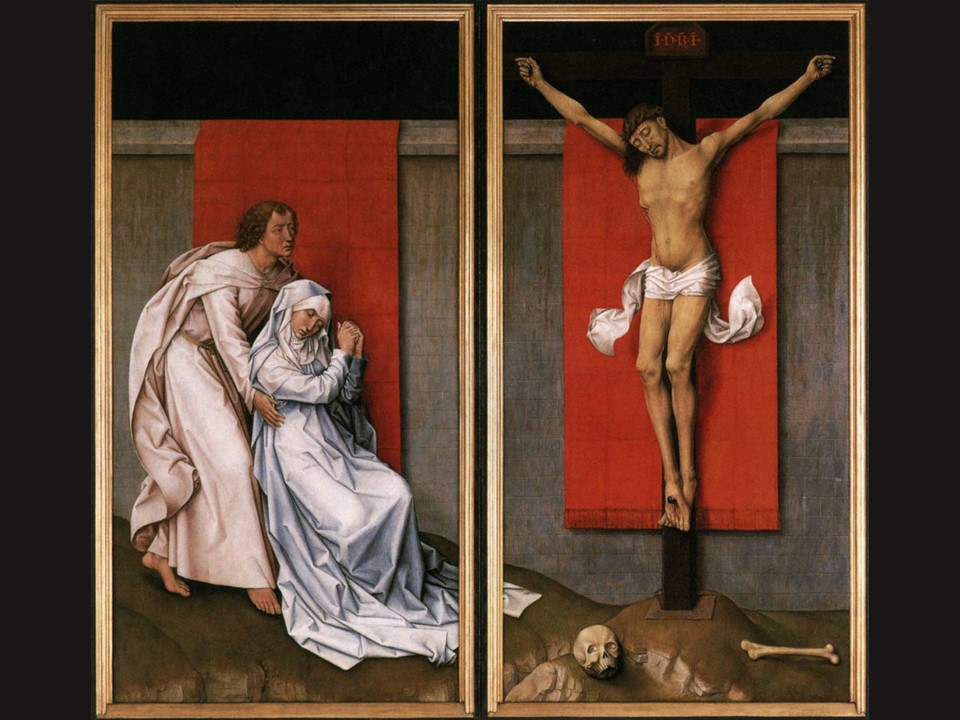
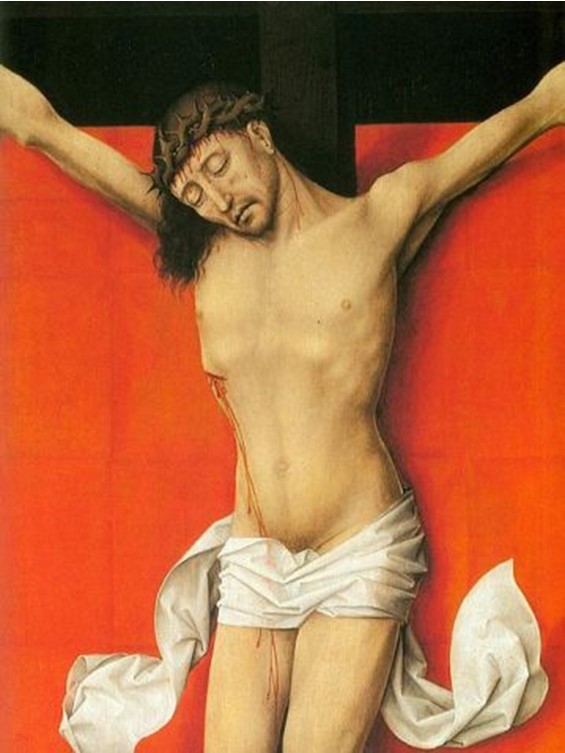
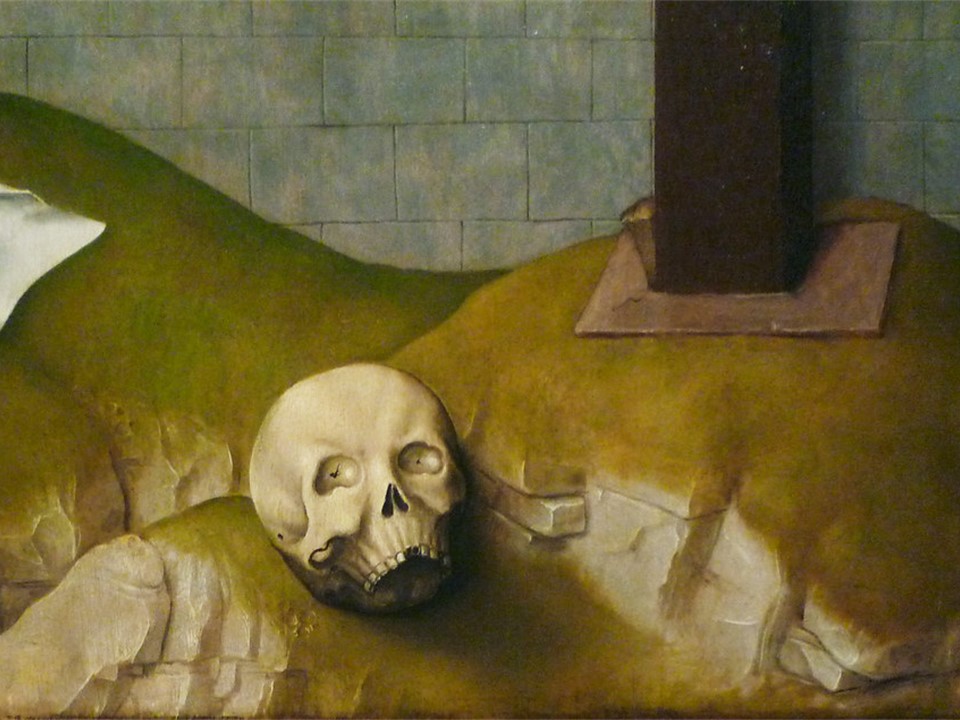
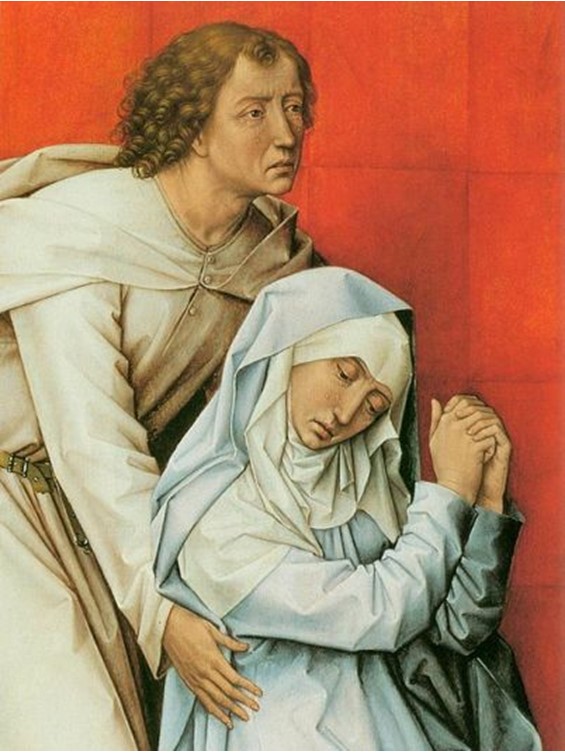
Crucifixion Diptych, c. 1460, oil on oak panels. Left panel: 180.3 × 93.8 cm – Right panel: 180.3 × 92.6 cm, Philadelphia Museum of Art

“My God, My God, why have you forsaken me?” the first thing that comes to my mind when I see Rogier van der Weyden’s Philadelphia Crucifixion!

Spiritual, innovative, intense, unique, sophisticated… here are some adjectives I can use to describe this very special Diptych, the great master of Northern Renaissance, Rogier van der Weyden, created back in 1460. Painted with vibrant colours, warm and engaging in some parts, but equally cool and standing apart, in others, Rogier’s colours create an atmosphere of poise, composure and utter sorrow. The two panels are quite distinct, as the right one, heavenly and unearthly, is dedicated to Christ’s greatest moment of Sacrifice, and the left, depicting Saint John the Evangelist supporting a devastated Mary, grounds us to human reality. Yet, the two panels unite through homogeneity in the background, and Mary’s tunic that trails from left to right, creating together, a unique composition.

Not only so… as the Philadelphia Crucifixion, his finest, in my humble opinion, masterpiece, proves Rogier to be the master conductor of a symphony in lines, shapes and glorious colours.

Just observe how masterfully he uses straight, vertical and curved lines… Bold straight lines mark the cornice of the background wall and highlight the face of Christ. The vertical lines of the cross and Christ’s body enhance the necessary need for monumentality and stability, while the outstretched and crossed hands add to Christ’s Pathos. Curved lines observe the postures of both figures on the left panel, John and Mary, adding emotional warmth and humanity. Finally, an imaginary diagonal line, pulls us towards the lower part of the right, Crucifixion panel, emphasizing the meaning of Christ’s Sacrifice on the Cross with the depiction of “Adam’s” Skull on the hill of Golgotha.

Equally important to consider are the shapes Rogier incorporates in his composition and the colours of his palette. The highlight, similarly important in both panels, is undoubtedly the use of two vivid red rectangular pieces of cloth hanging over the background wall, creating the ideal setting for the three protagonists of this amazing Crucifixion. While the hanging cloth is painted a vivid red, the garments the three figures in the composition wear, bathed in stark light, are the palest, crispiest tints the artist could use.

The meaning of this composition is complex. The way these amazing panels were used is equally perplexing… The following Bibliography might help…

Mark S. Tucker, from the Philadelphia Museum of Art: Handbook. Philadelphia: Philadelphia Museum of Art, 2014, pp. 98–99. http://www.philamuseum.org/collections/permanent/102845.html    and    https://www.facebook.com/rvdweyden/posts/crucifixion-diptych-the-crucifixion-with-the-virgin-and-saint-john-the-evangelis/10162026910315231/

Dr. Christopher D.M. Atkins and Dr. Beth Harris, “Rogier van der Weyden, The Crucifixion, with the Virgin and Saint John the Evangelist Mourning,” in Smarthistory, June 20, 2018, accessed April 15, 2020… https://smarthistory.org/rogier-van-der-weyden-the-crucifixion-with-the-virgin-and-saint-john-the-evangelist-mourning/

The Wikipedia site on Rogier’s PhiladelphiaCrucifixion is interesting and rich… https://en.wikipedia.org/wiki/Crucifixion_Diptych_(van_der_Weyden)

For a Student Activity on the discussed Diptych, please… click HERE!

The Month of April

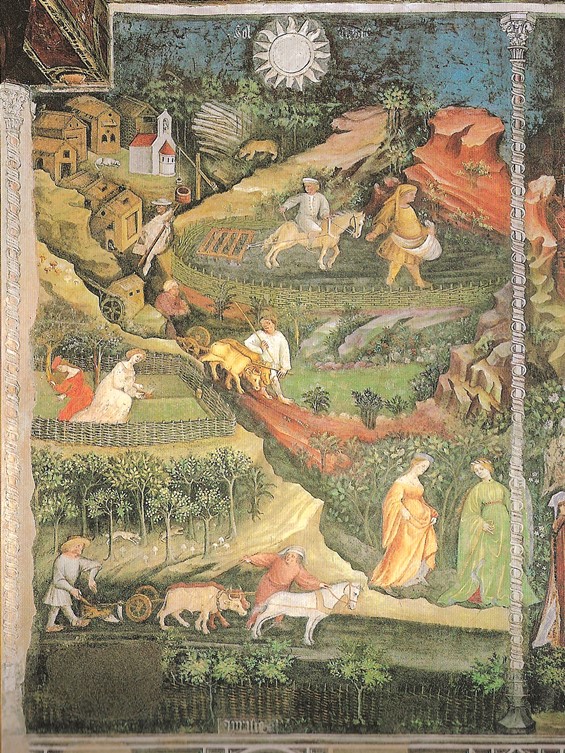
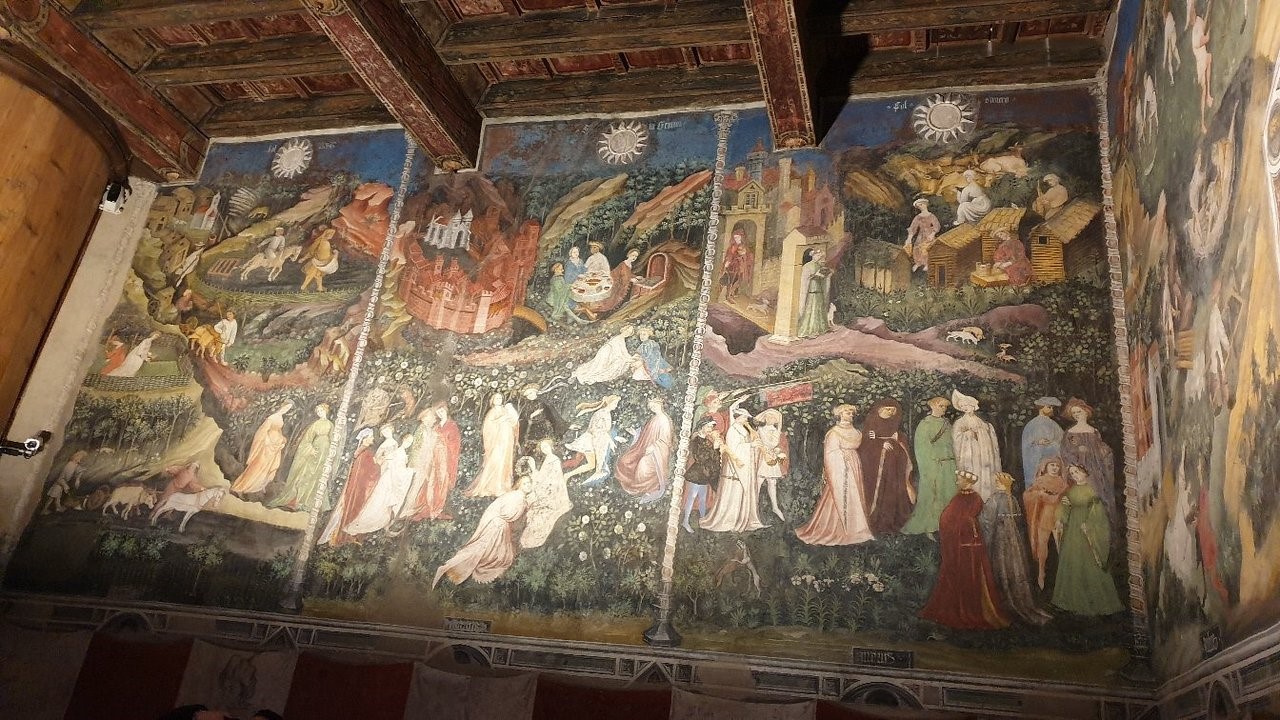
The Month of April, 1407, possibly by Maestro Venceslao, Fresco, Torre Aquila, Castello del Buonconsiglio in Trento, Italy

The Italian proverb “Aprile dolce dormire” certainly does not suit the fourth scene of the calendar of the Cycle of Months of Torre Aquila in Trento. Here, under the great April sun, one does not sleep, nor is one idle, but it is all a fervour of activity. http://senzadedica.blogspot.com/2013/04/il-ciclo-dei-mesi-aprile.html

The Month of April fresco comes from Torre Aquila in the Castello del Buonconsiglio, in Trento, Italy. It is part of an amazing fresco Cycle of the Twelve Months painted on the walls of the tower’s 2nd-floor main room. It was commissioned by Prince-Bishop George of Liechtenstein, who wanted to show how well-governed his territories were and how his labourers thrived. The painter of these remarkable paintings, Master Wenceslas, understood well what he was asked to do, created the best 15th-century advertising brochure for Trento, and for the Month of April fashioned a dazzling spring scene, crowded with a well-dressed crowd who, in the lush local countryside, serenely performed their necessary everyday chores. 

Master Wenceslas, a Bohemian painter active in Trento since 1397, creates a rich April scene, full of natural beauty and pastoral activities. Nature awakens and the citizens of Trento are busy. The farmers catch up with their activities and the Ladies of the Court and enjoy a stroll in the woods. The scene is rich, dense and joyful… inspired by real-life but immensely beautified. The commissioner of this fresco, Prince-Bishop George of Liechtenstein, wants to give the idea that his territories flourish under his good governance. and prudent guidance. The painter, Master Wenceslas, understood this very well, and created a verdant scene of dazzling colours, the winter greys have disappeared, crowded with well-dressed farmers and elegant ladies.  https://it.wikipedia.org/wiki/Ciclo_dei_mesi

…the month of April, Many and June

Wenceslas’s countryside is fertile and well organized. The fields are separated in an orderly manner and protected, like precious gardens, by braided willow fences. Everything is represented with such precision… the land, the buildings, the farmers’ chores. The April fresco looks as if it is the page of a textbook for a young farmer to study and learn! https://www.ilmiraggio.com/ciclo-dei-mesi-torre-aquila/

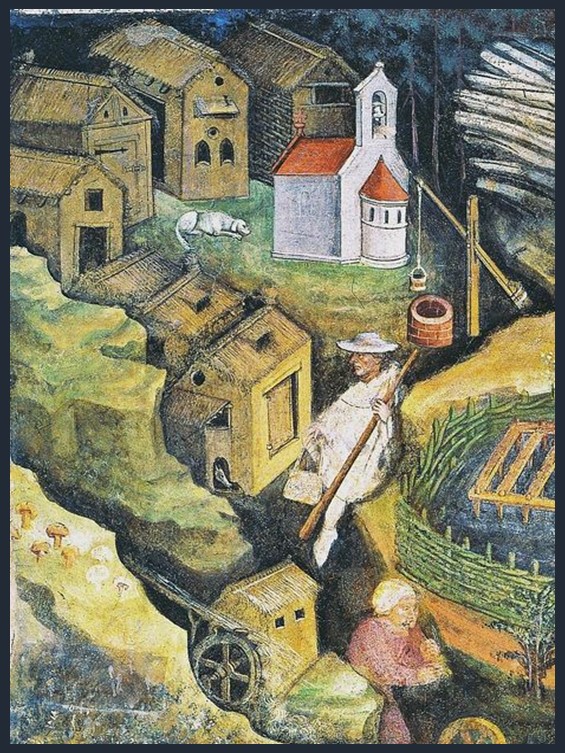
At the top of the composition, a lush fir forest offers refuge to one of those bears that populated the Alps at the time. Further down, a pilgrim, fully dressed in white with a hat and a cane, walks through a borough of thatched-roof houses arranged around a small church, empty of villagers… silent. Even the dogs in this village keep silent, as they are both dozing.

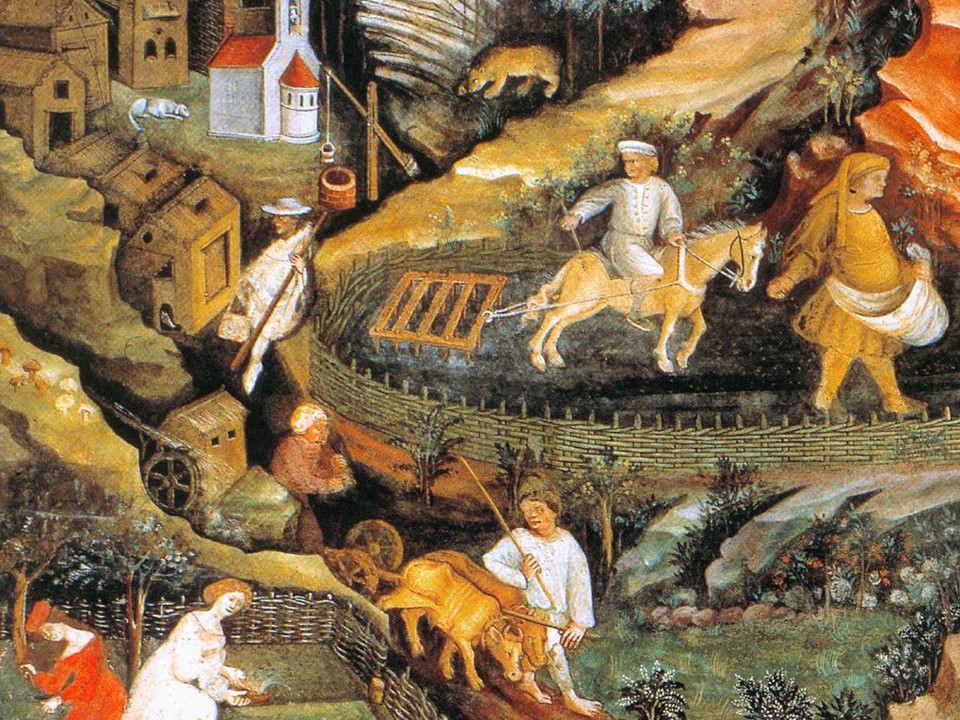
The farmers are busy with their pastoral duties. In a fenced and already ploughed field a farmer sows, while another farmer works the land with a harrow pulled by a horse. Further down to the left, two men, probably coming from a water-mill, carry sacks of flour on a cart driven by oxen. In the foreground, two other farmers plough the land with a heavy wheeled plough pulled by a pair of oxen and a horse. Women do not remain idle. Two of them, taking advantage of the beautiful weather, participate in the fervour of spring activities, gardening their well-fenced plot! Their precious land is on the border of a small forest where, among immense mushrooms, a dog chases a hare!

The month of April fresco is not only about hard work. The presence of two aristocratic young ladies, in the lower, right part of the composition, can not be missed. Depicted on the edge of the painted scene, the elegant ladies seem to walk towards the festive procession depicted in the following month of May. One of them, wearing an elegant green gown with long sleeves, crosses the thin, pillar-like, frame that divides the two months, and effortlessly, just as the succession of seasons is constant and uninterrupted, guides us to the next composition… that of May!

Until Next Month… check HERE! for a student Activity!
Still Life à la cafetière

Vincent van Gogh, 1853 – 1890
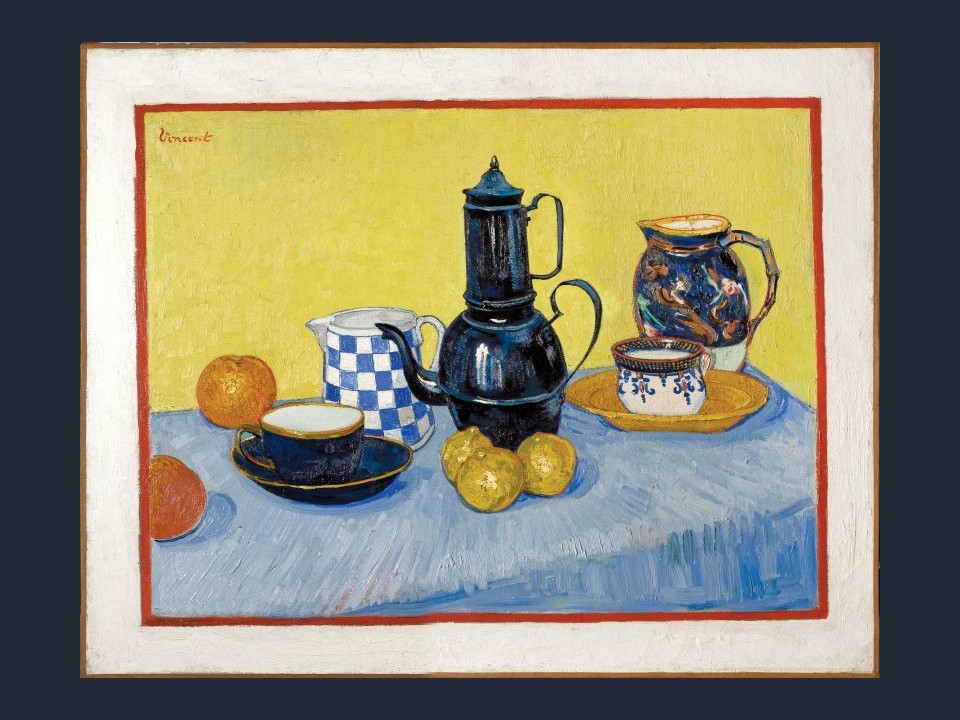
Still Life à la cafetière, Still Life with Coffee Pot, May 1888, Oil on Canvas, 65 × 81 cm, Basil and Elise Goulandris Foundation, Athens

The three primary colours, red, blue yellow, a touch of orange… and how you can create a masterpiece! Still Life à la cafetière in the Basil and Elise Goulandris Foundation, at Athens, is a case to study!!!

“Painting Still Lifes is the beginning of everything,” Van Gogh said back in the winter of 1884/85, and as Dutch in origin, he was so right! Let’s not forget the Netherlandish attachment to this genre. During his prolific career that did not last more than a decade, from 1881 until his death in 1890, Van Gogh painted more than 170 Still Lifes! https://www.museum-barberini.com/en/van-gogh/

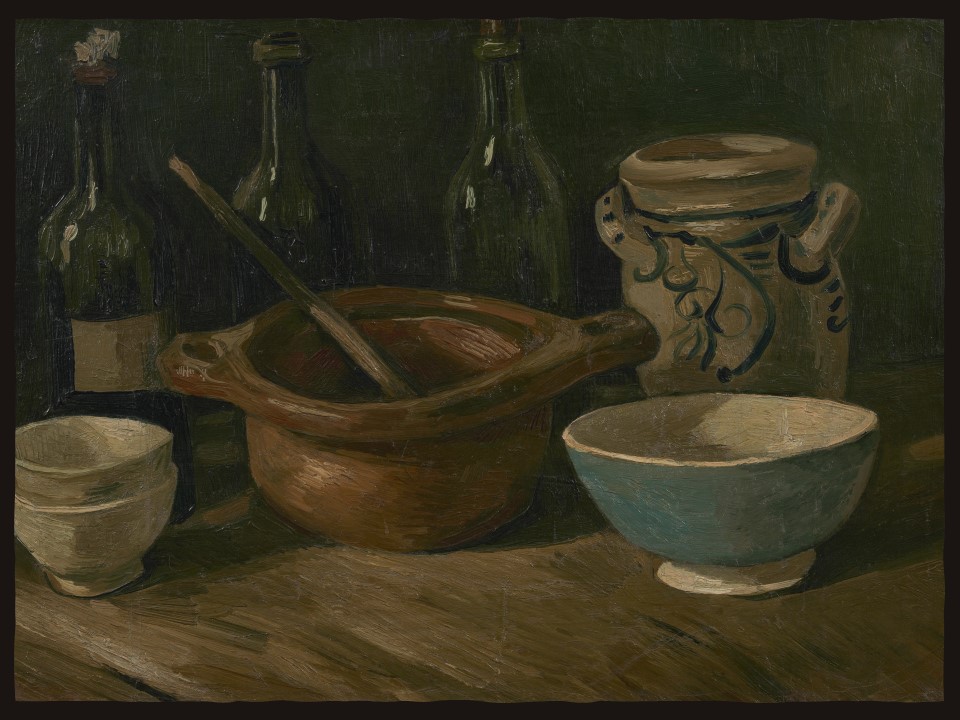
He started by “paying tribute” to his Dutch, 17th-century tradition of painting Still Lifes with sombre, melancholy, earthy tones. We can describe these early Still Life paintings as experiments in colour! Direct, powerful, and sincere, these early Still Life studies were created while living with his parents in Nuenen. Across a dark background, he used humble everyday objects that were probably used by his family for their everyday meals. By mixing primary colours himself, his palette was dark, brown and greyish, and the objects he was presenting were brought to life with touches of white paint. His painting, titled Still life with three bottles and earthenware, is a perfect example. https://www.vangoghmuseum.nl/en/collection/s0138V1962?v=1

Vincent van Gogh, 1853 – 1890
Still Life with three bottles and earthenware, 1884/5, oil on canvas, 39,5 x 56 cm, Van Gogh Museum, Amsterdam

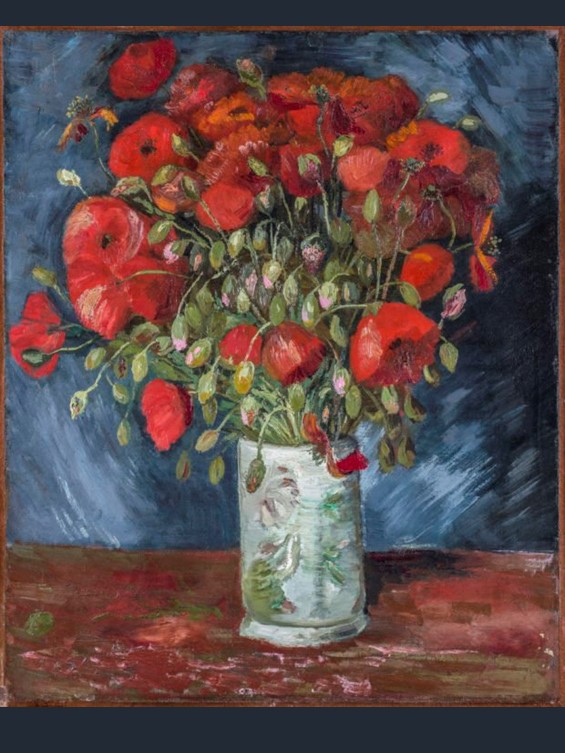
That was not enough for Van Gogh! He felt the need to develop and evolve, to practice and struggle in getting better… and so, he travels to Paris, gets in touch with Impressionism, and his Still Life paintings gradually acquire the bright Mediterranean colours of Southern France, which he so loved. Painting Still Lifes during the Paris period is very important for him. He studies every book he can get on the fundamentals of “Colour Theory” and experiments until his colour palette dramatically changes. He doesn’t mix colours any more, he uses them separately, he combines complementary colours and gets rid of the use of browns. In Paris, painting flowers fascinates him, changing his technique intrigues him, communicating his feelings as well as what he sees becomes his objective. The newly authenticated Vase with Poppies at the Wadsworth Atheneum is such a representative example of his efforts at the time. https://www.theartnewspaper.com/blog/two-van-gogh-exhibitions-in-a-single-week

Vincent van Gogh, 1853 – 1890
Vase with Poppies, ca. 1886, oil on canvas, Wadsworth Atheneum, 56.0 cm × 46.5 cm, Hartford, Connecticut

Vincent van Gogh moved to Arles in early 1888, and his palette positively explodes with colour and vibrant brushstrokes. The Basil and Elise Goulandris Foundation painting Still Life à la cafetière is an amazing example of his final period. Quoting a description of the painting in a Van Gogh letter to his brother Theo, we read… “A coffee pot in blue enamel, a cup (on the left) royal blue and gold, a milk jug checkered light blue and white, a cup (on the right) white with blue and orange patterns on a plate of earthenware yellow-grey, a pot of barbotine or majolica blue with red, green, brown patterns, finally two oranges and three lemons; the table is covered with a blue cloth, the background yellow-green, thus six different blues and four of five yellows and oranges.” The art of simplicity at it’s best. Once more, dispassionate items of his everyday life, search for immediacy and turn into a moving painting of extraordinary vitality. The three primary colours, lots of blues and greens, an amazing red borderline that encloses the painting, juxtapose to “touches” of complementary oranges. A diagonal composition with crossed lines animates the composition. Incredible brushstrokes forcefully convene in the enamel coffee pot, creating a sense of perspective. He works like a man in a frenzy and creates a world, his world, that feels ALIVE! Color, Space, and Creativity: Art and Ontology in Five British Writers, by Jack Stewart, 2008, Rosemont Publishing & Printing Corp., page 224, and https://goulandris.gr/en/artwork/vincent-van-gogh-still-life-coffee-pot

For a Student Activity, please… check HERE!
Celebrating the Greek War of Independence

K. G. Papagiannaki,
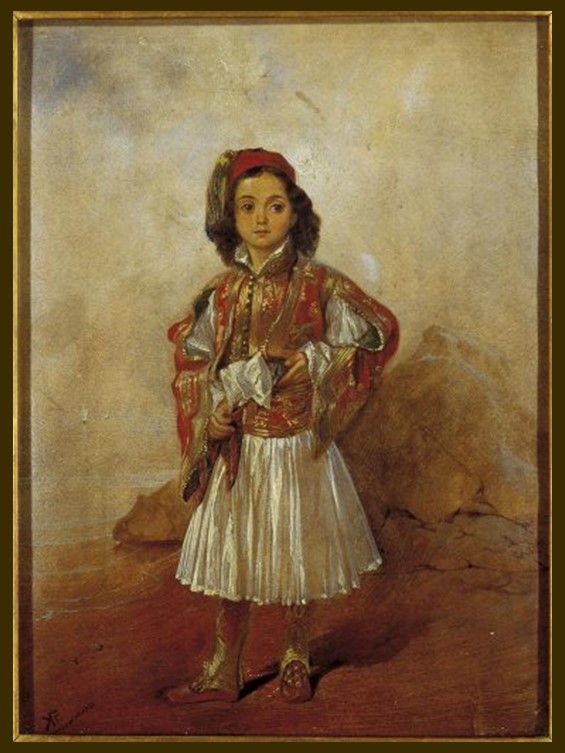
The Greek Boy, 1837, oil on canvas, 0,28×0,21 cm, Benaki Museum, Athens

It was for these children that we fought… Celebrating the Greek War of Independence …paraphrasing the words of Yanni Makrigianni, 1794-1864, Greek Revolutionary Fighter of 1821!

If you wish to learn more about the Greek War of Independence and the preparation for the Bicentennial Celebration in 2021, please VISIT the official Greece 1821-2021 Bicentennial site: https://www.greece2021.gr/en/ and/or https://www.greece2021.gr/

For our Youngsters…

For celebratory mood and quality time with your youngster, you can VISIT the National Historical Museum site http://www.nhmuseum.gr/en and then go to http://www.nhmuseum.gr/el/ekpaideysi/ekpaideytiko-yliko/.

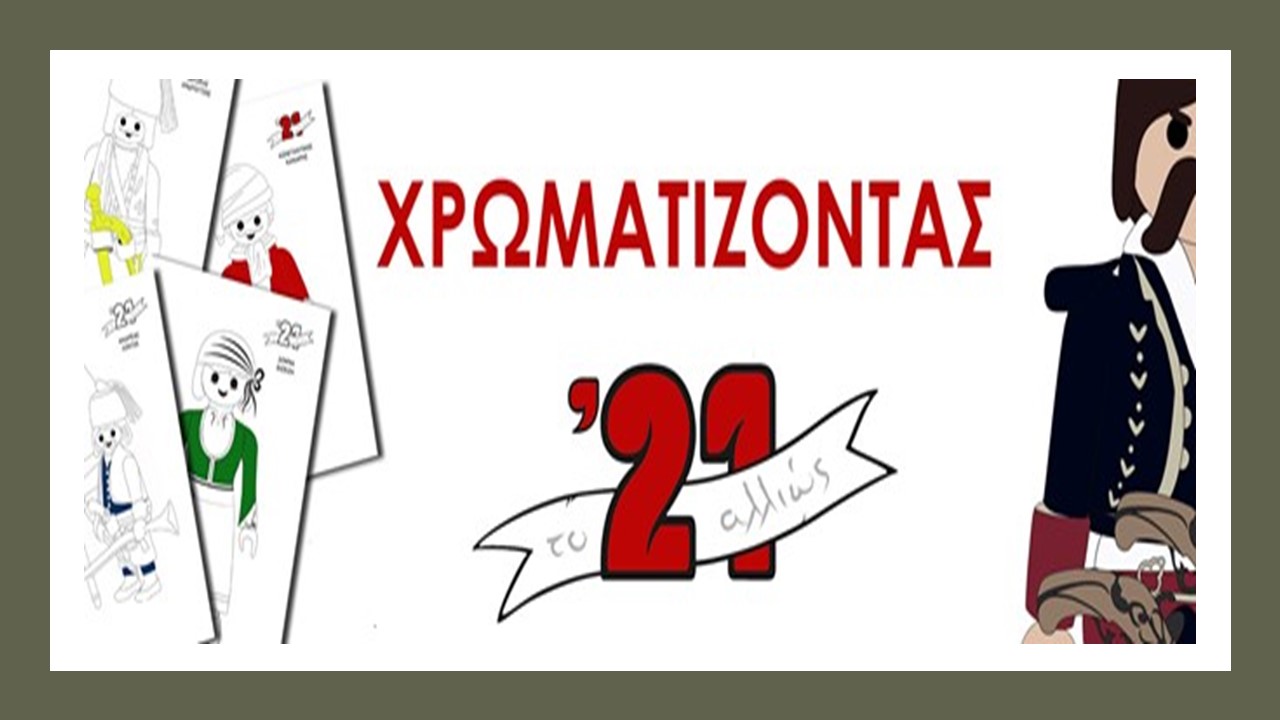
This a Colouring Page Activity (in Greek BUT easy to understand and DO) on famous figures of the Greek War of Independence. It was inspired by the Exhibition The 1821 Greek War of Independence Retold in… Playmobil! Activity is very EASY! http://www.nhmuseum.gr/el/ekpaideysi/ekpaideytiko-yliko/

To do the Colouring Activity Press on each picture you wish your child to colour – download it – print it – DONE! You can choose between heroes and heroines of the Greek War of Independence and celebrate an important moment in Greek History.

From top to bottom the Colouring Page Figures are: Theodoros Kolokotronis, Odysseas Androutsos, Laskarina Bouboulina, Konstantinos Kanaris, Manto Mavrogenous, Germanos, Metropolitan Paleon Patron, Andreas Lontos, Asimo Goura, Ioannis Makrigiannis, Domna Visvizi, Christos Kapsalis, Andreas Pipinos, Dimitrios Papanikolis

Colouring 1821-Greek War of Independence

For an easy to print Celebrating the Greek War of Independence Worksheet, please… check HERE!
Panagia Kosmosotira in Feres

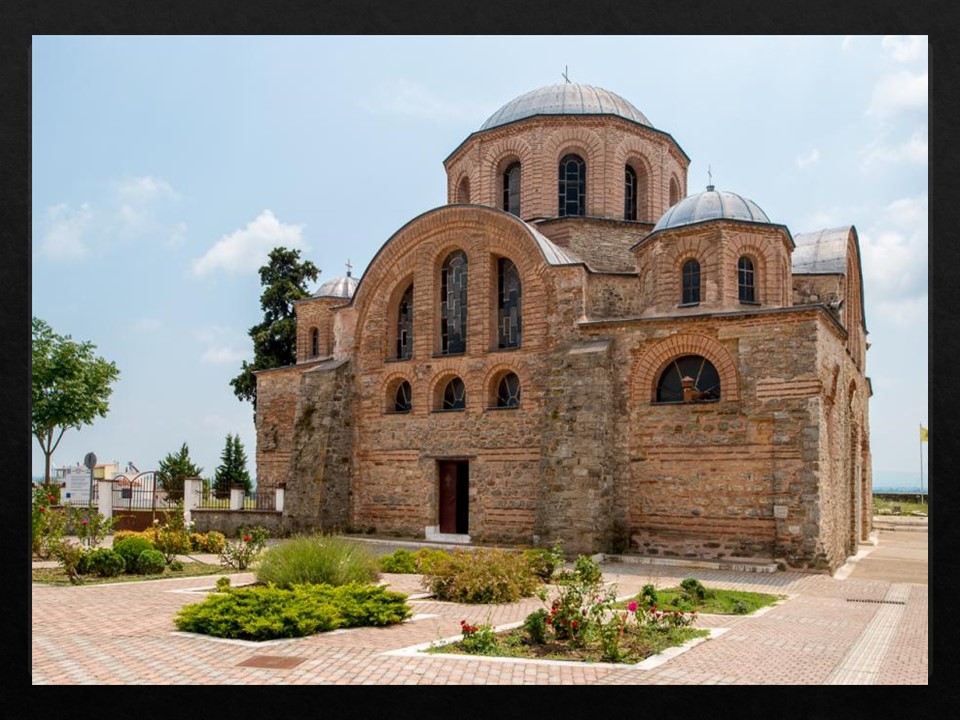
The imposing, the 12th century Panagia Kosmosotira in Feres

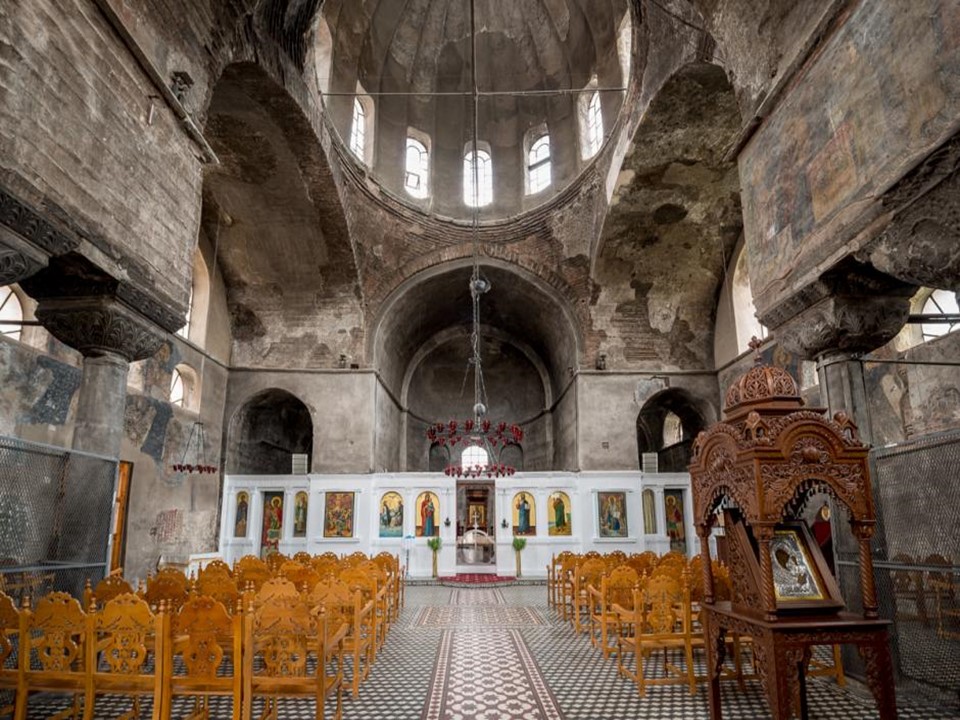
A church of the utmost quality, unpretentious, beautiful and imposing, the 12th century Panagia Kosmosotira in Feres, is the Katholikon of a grand Monastery, in the Byzantine type of the cross-in-square church with two columns and five domes. The Monastery is built in a magnificent location, the Byzantine city of Bera, modern-day Feres, next to the Delta of Evros River.

Panagia Kosmosotira, the Monastery, and its Katholikon were founded by Sevastokrator Isaakios Komnenos, the third son of Alexios I Komnenos (c. 1048 – 15 August 1118), founder of the Komnenian dynasty. Isaakios was a Porphyrogennetos (born in the purple) prince, a title he was granted as he was born during the reign of his parents. Although the origin of the title Prorphyrogennetos is not clear, it is widely accepted that a special Chamber known as “Porphyra” in the Great Palace of Constantinople was used for the delivery of the imperial newborns. Anna Komnene, a Porphyrogennete herself, describes this special room as “set apart long ago for an Empress’s confinement” located “where the stone oxen and the lions stand” (the Boukoleon Palace), and was in the form of a perfect square from floor to ceiling, with the latter ending in a pyramid. Its walls, floor and ceiling were completely veneered with imperial porphyry, which was “generally of a purple colour throughout, but with white spots like sand sprinkled over it.” https://www.doaks.org/resources/online-exhibits/gods-regents-on-earth-a-thousand-years-of-byzantine-imperial-seals/imperial-titulature/porphyrogennitos and https://en.wikipedia.org/wiki/Born_in_the_purple

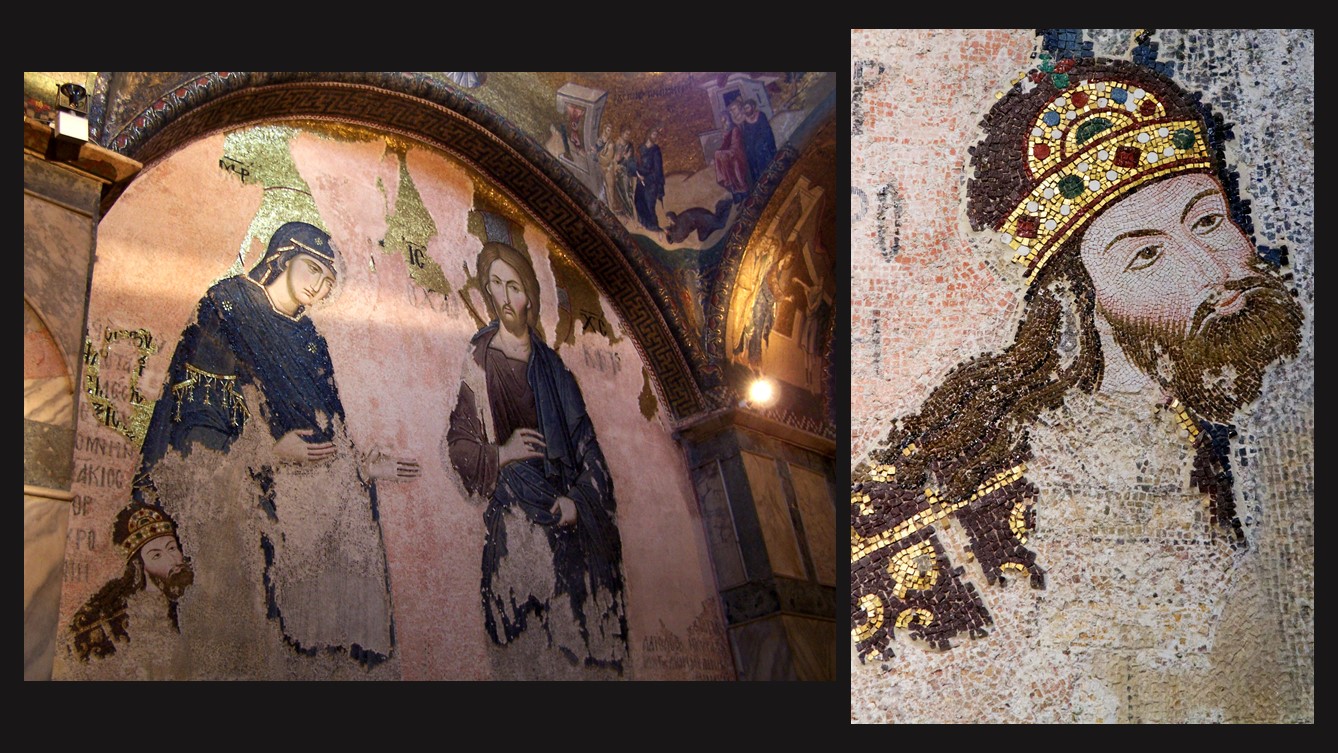
Isaakios Komnenos had the title of Sevestokrator as well, granted to him by his brother, Emperor Ioannis II Komnenos (1087 – 1143) with whom he was in constant dispute and rivalry over the Byzantine Throne. He is also known as the author of several treatises and poems, a cultured man of learning and a great patron of the arts. Isaakios is responsible for rebuilding the Chora Church in Constantinople, where on the lower right side of the grand Deesis mosaic, his donor portrait survives to this day.

The Katholikon of Panagia Kosmosotira was Isaakios’s final resting place. A bit after 1150 he was forced to retire to his estate in Thrace, where in 1151/52, he founded the cenobitic monastery of Kosmosoteira (“Theotokos the World-Saviour”) in Bera (modern Feres). “The construction of the monastery, which was meant as his residence and final resting place, was of great emotional importance to Isaac, who invested considerable time and effort in it: although heavily ill at the time, he still went and supervised the monastery’s construction almost daily, and personally authored its typikon (charter) in 1152, making meticulous provisions about its governance and assigning extensive grants to it, including his own estates at Ainos. Possibly in imitation of his brother’s foundation of the Pantokrator Monastery, he also ordered the erection of a hospital outside the monastery walls.”

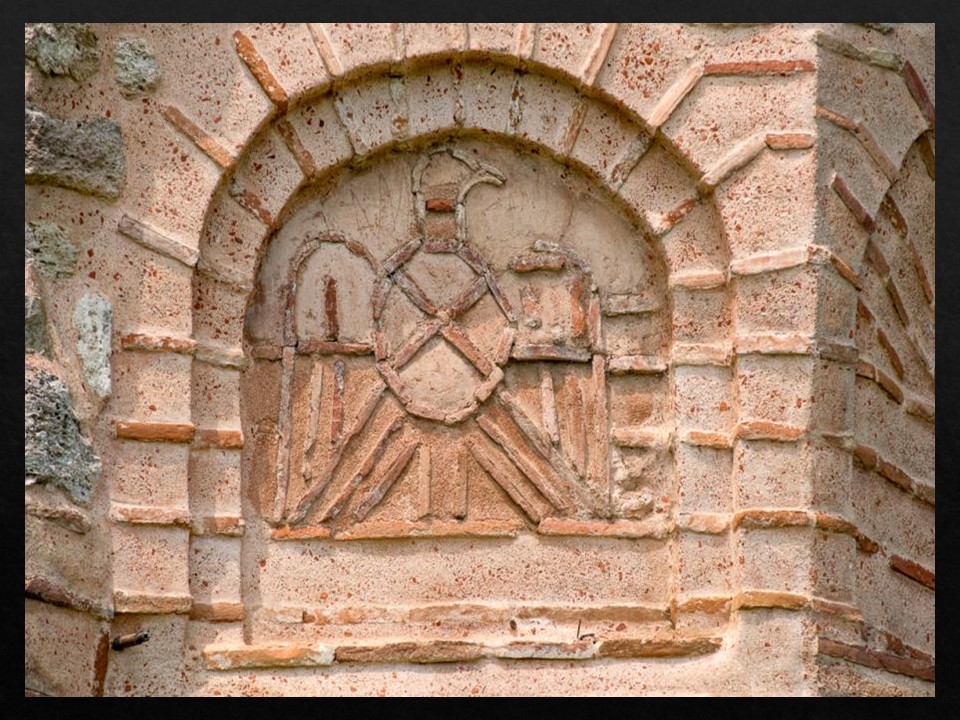
When visiting Panagia Kosmosotira, please note 1. The “monumental simplicity” of its architecture 2. The curved “contour” lines that characterize the structure of the church 3. The interplay of stone and brick in the construction 4. The interior fresco decoration dates back to the 12th century, an exquisite example of the Constantinopolitan style 5. The four painted military saints depicted between the arched windows of the northern and southern aisles (portraits of members of the Komnenos family?), and 6. the walled-in ceramic depiction of the single-headed eagle, a symbol of the dynasty of the Komnenos family in Trebizond.

For a WAC (stands for Writing Across the Curriculum) Student Activity, please… check HERE!
Correggio’s Jupiter and Io

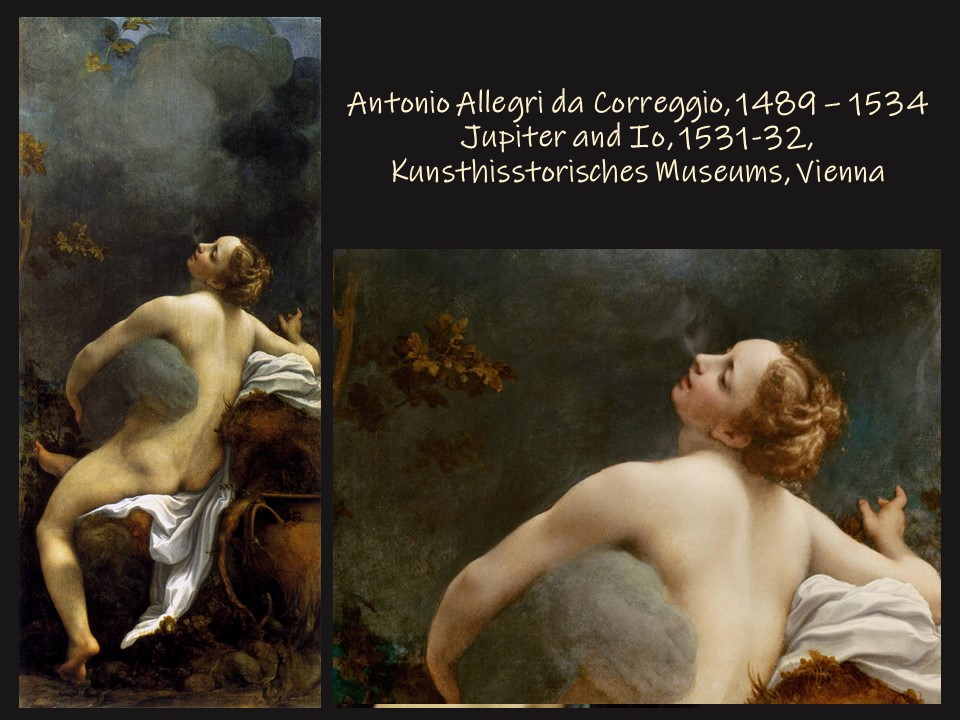
Antonio Allegri da Correggio, 1489 – 1534
Jupiter and Io, 1531-32, oil on canvas, 163.5 × 70.5 cm, Kunsthisstorisches Museums, Vienna
Photo credited to https://da.khanacademy.org/humanities/renaissance-reformation/high-ren-florence-rome/late-renaissance-venice/v/correggio-jupiter-and-io

According to Kelly Richman-Abdou “Mannerism is the Style That Put an Elaborate Twist on Renaissance Art.” I like her comment, and how it applies to our Mannerist painting in focus, Correggio’s Jupiter and Io! MY MODERN MET, October 21, 2018, https://mymodernmet.com/what-is-mannerism/

My question is how can order, harmony, and balance, ideals of Classical Art and the Renaissance be “turned/twisted” into something fresh and exciting? Is Mannerism to Renaissance what Hellenistic Art was to 5th century BC Classicism? This is not an easy question to answer. Is Correggio’s mythological painting of Jupiter and Io a good example to start… better so, scratch the mere surface?

Antonio Allegri da Correggio is an interesting artist to consider. Famous today for his illusionistic, grand domed ceilings, Correggio is a protagonist of Mannerism! Giorgio Vasari wrote, “…everything that is to be seen by his [Correggio’s] hand is admired as something divine.” He is so right! Correggio’s paintings were appreciated by generations of fervent art patrons and artists… from Dukes to Emperors and from Rubens to Boucher. Vasari was also the first to write about Corregggio’s handling of colours, chiaroscuro, and textures, as well. “It may, at least, be held for certain that no one ever handled colors better than he and that no craftsman ever painted with greater delicacy or with more relief, such was the softness of his flesh-painting and such the grace with which he finished his works…” Today, describing the unique “softness” of his painting technique, we use the term “morbidezza,” meaning extreme softness, delicacy, and fuzziness. https://www.oxfordreference.com/noresults;jsessionid=58804597E272C2C21C9F375C6CEFC612?btog=chap&noresults=true&pageSize=20&q=morbid+ezza&sort=relevance

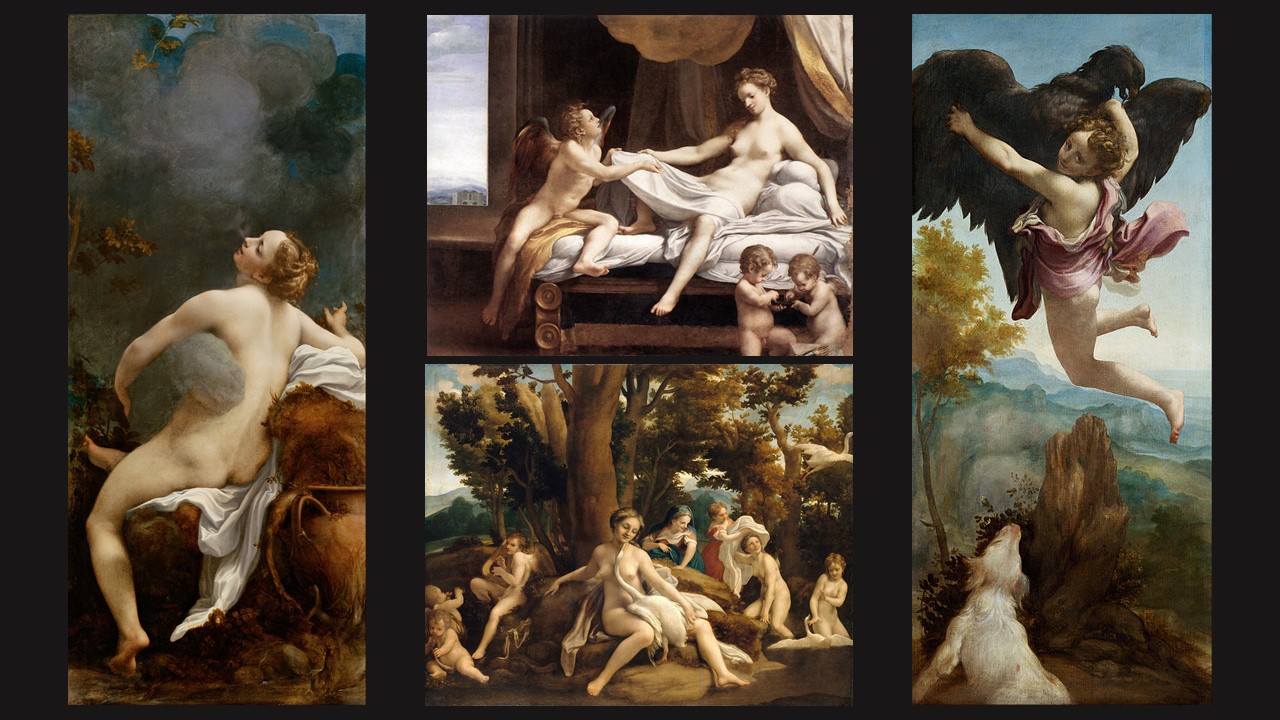
Correggio’s Jupiter and Io was most probably, one of four mythological paintings representing the Loves of Zeus, or Jupiter for the Romans, commissioned by the Duke of Mantua, Federico Il Gonzaga, for the decoration of his private Studiolo. These paintings render the myths of, 1. Jupiter and Io, 1531-32, oil on canvas, 163.5 × 70.5 cm, Kunsthisstorisches Museums, Vienna 2. Danaë, 1531, oil on canvas, 161 x 193 cm, Galleria Borghese, Rome 3. Leda and the Swan, 1532, oil on canvas, 156.2 x 195.3 cm, Gemäldegalerie, Berlin 4. Ganymede Abducted by the Eagle, 1531-1532, oil on canvas, 163.5 × 70.5 cm, Kunsthistorisches Museum, Vienna

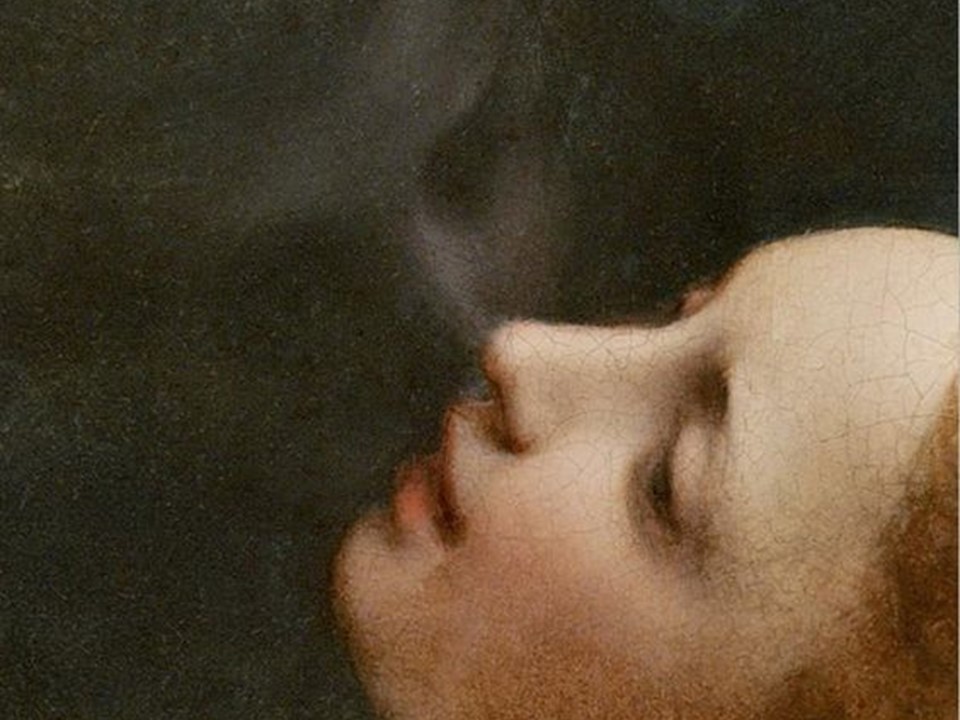
The myth of Jupiter and Io, depicted in one of the two Vienna paintings by Correggio, is popular and well-liked since antiquity. Lust, deceit, jealousy, revenge and suffering, interwind, creating a fascinating story to render in art. Correggio did an amazing job! I love his Mannerist “twisted” use of posture, movement, and texture. Using a narrow upright format he creates a stable, vertical composition, but Io’s body turns, curls and entwines, so unnaturally, around the charcoal grey cloud of Zeus, it is impossible not to notice. Her firm naked body shimmers in the light and contrasts with the thick, dark, fuzzy cloud that envelops her. What a magnificent contrast of colours and textures. The faces of Zeus and Io make you wonder… what is he whispering to her ear that makes her look so “abandoned”?

For a Student RWAP (Research-Writing-Art-Project), please… check HERE!
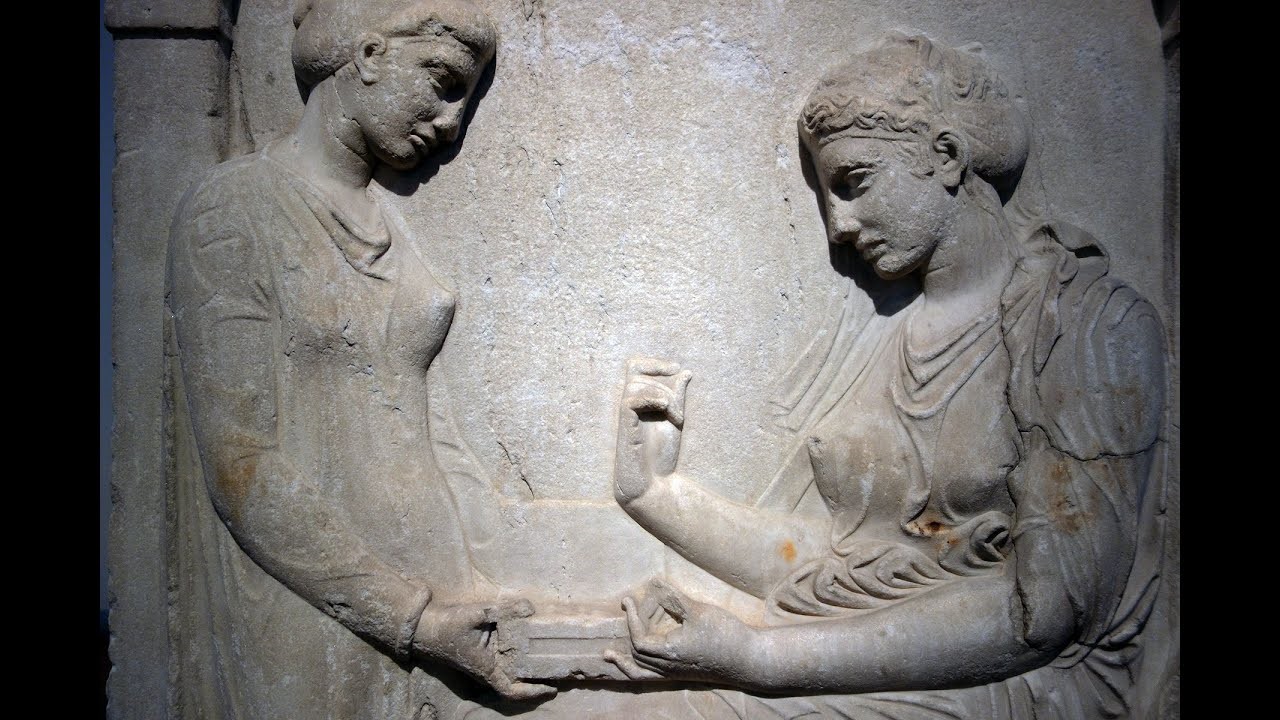
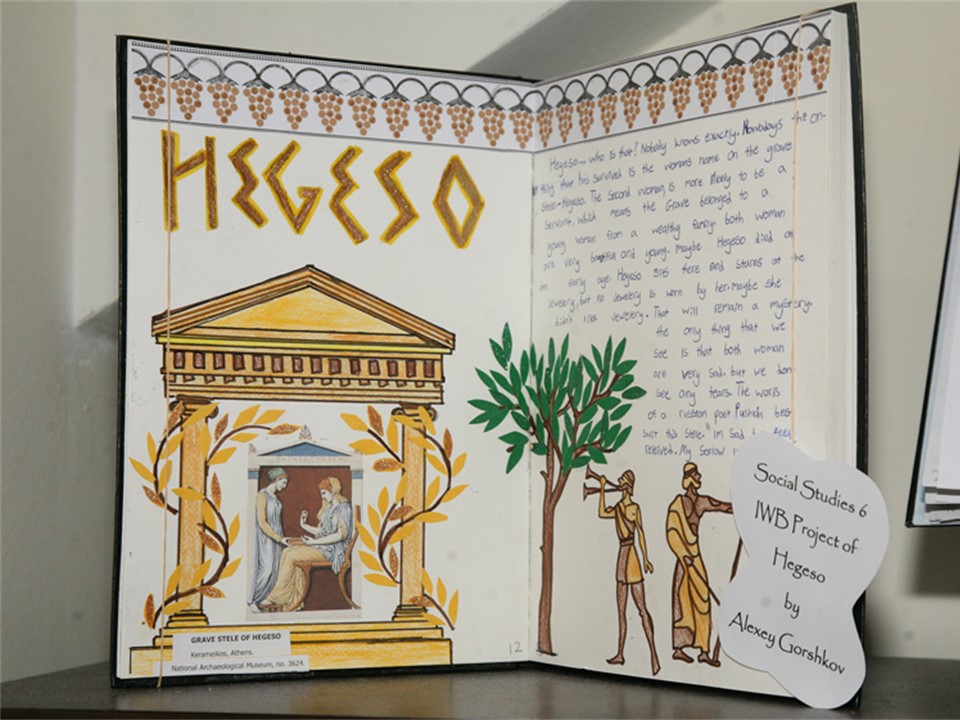
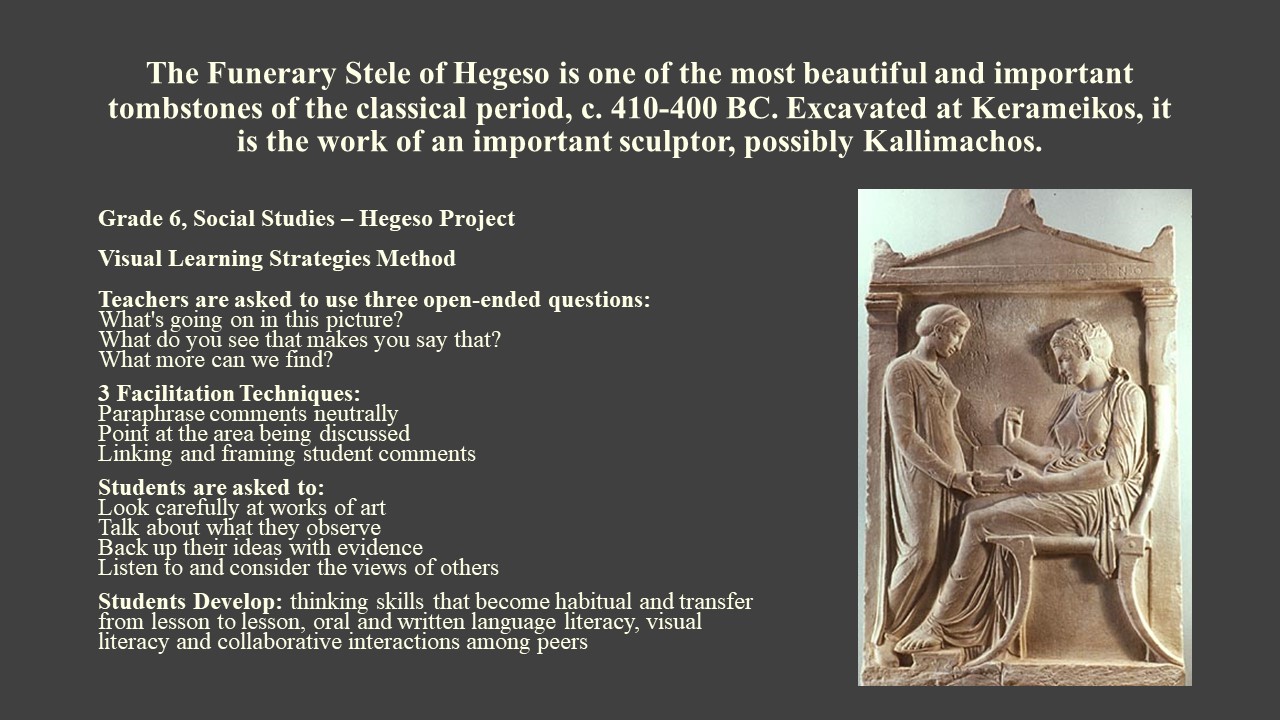
Hegeso, daughter of Proxenos

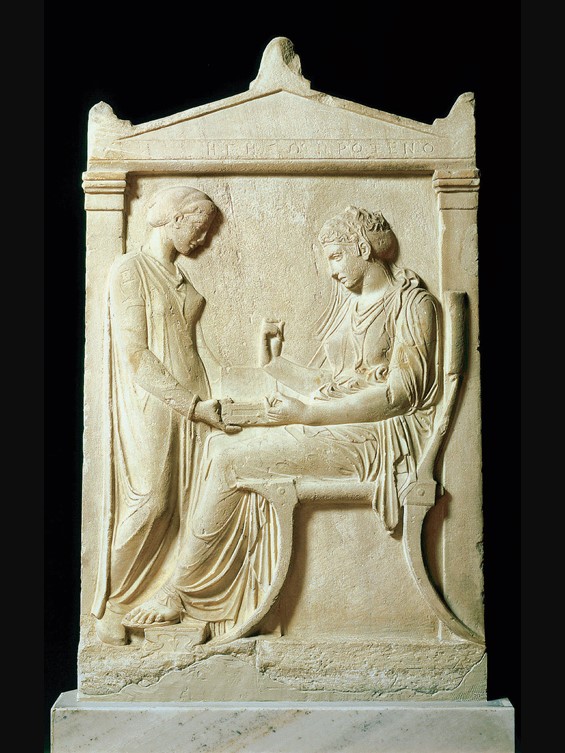
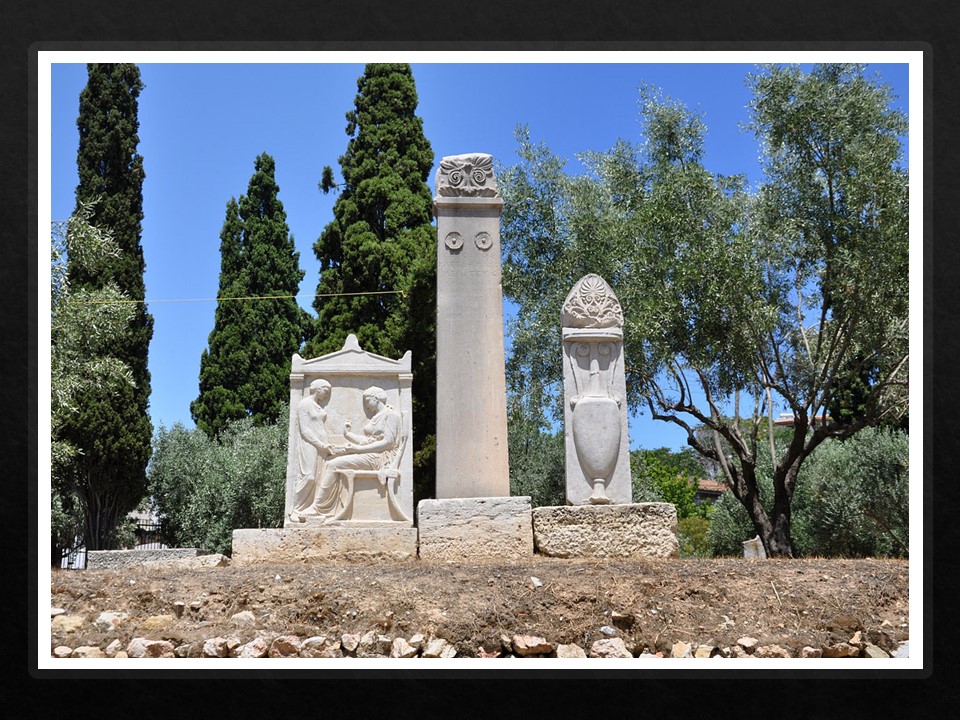
Attributed to Kallimachos architect and sculptor working in the second half of the 5th century BC, Funerary Grave Stelae of Hegeso, c. 410-400 BC, found in Kerameikos, Pentelic Marble, 1,56  x 0,97 m, National Archaeological Museum of Athens

“Sometimes, staring at Hegeso. I am thinking that through tears the best smiles grow up.” The smile and the tears of Hegeso, daughter of Proxenos by Katerina Samara

Kerameikos Cemetery of ancient Athens

The amazing Funerary Stelae of Hegeso, daughter of Proxenos, is one of the many masterpieces exhibited in the National Archaeological Museum in Athens. Found during the 1870 archaeological excavation period at the ancient Athenian Cemetery of Kerameikos, Hegeso’s Stelae was made of Pentelic marble and has been attributed to the sculptor and architect Kallimachos. She was a cherished member of a prominent Athenian family, as the magnificence of the relief sculptural Stelae and the family grave plot to which the Stelae was paced, indicate. https://www.namuseum.gr/en/collection/klasiki-periodos-2/

Hegeso’s Stelae is an exquisite example of the so-called “Rich” style that dates to the end of the 5th century and its main characteristics are the artists’ interest in the human body, on garments with elaborate pleats and on airy figures that move gracefully in space. Hegeso is depicted seated on a smart seat (klismos), her feet resting on a footstall. She wears a chiton, a himation, and a transparent veil on her head. With her right hand, she takes a jewel (originally painted) from a pyxis (jewel box) handed to her by a young servant girl, who solemnly stands before her. The servant wears a “barbarian” (not Greek) garment, with long sleeves, and a net on her hair. What a simple, and unpretentious composition the artist achieved! At the same time elegance, grace, class, and sophistication prevail.

The relief sculpture of Hegeso, daughter of Proxenos, according to the epigram on the top of the stele which kept alive the Lady’s name for 25 centuries, is probably the work of a skillful artist called Kallimachos. Little is known about the artist, not even if he was Athenian or Corinthian. He is, however, reputed to have worked in the building of the Athenian Acropolis, and for designing the first Corinthian Capital at the Temple of Apollo Epicurius at Bassae, after observing acanthus leaves growing out of a basket placed on top of a young girl’s tomb. Kallimachos, according to Pausanias, is described as clever, innovative, and “catatexitechnus,” meaning he was an extreme perfectionist. https://en.wikipedia.org/wiki/Callimachus_(sculptor)

The Theban poet Pindar wrote that “We are things of a day… When brightness comes, and the gods give it, there is shining light on man, and his life is sweet.” Let me quote Gabriela Chartier and her comments on how “People should not strive only to be remembered after death, but instead to enjoy the sweetness of life…” and how “Hegeso’s stele seems to coincide with Pindar’s idea. Hegeso is not doing anything heroic; the image does not refer to myths or to the epic past. Instead, she is shown in an event of everyday life: a moment in democratic Athens when the light was shining on her. The fact that this image is on a grave stele reinforces Pindar’s message. Placing such scenes along the main road in the Kerameikos would have offered a constant reminder: human life is passing. We are things of a day.” https://archaeologystudentsspeak.wordpress.com/2016/05/02/gabriela-chartier-on-the-grave-stele-of-hegeso/

Hegeso, daughter of Proxenos RWAP (stands for Research-Writing-Art-Project) is… HERE!

Examples of student RWAP (stands for Research-Writing-Art-Project) Sketchbooks… HERE!

The Forty Martyrs of Sebaste

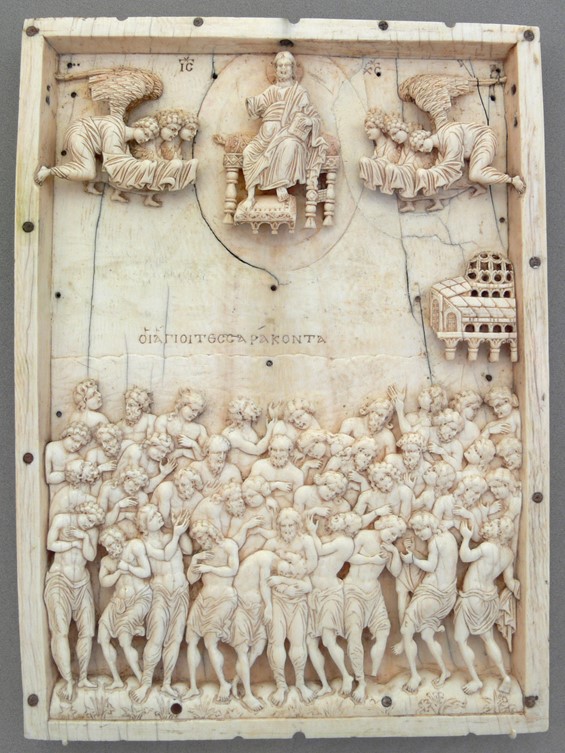
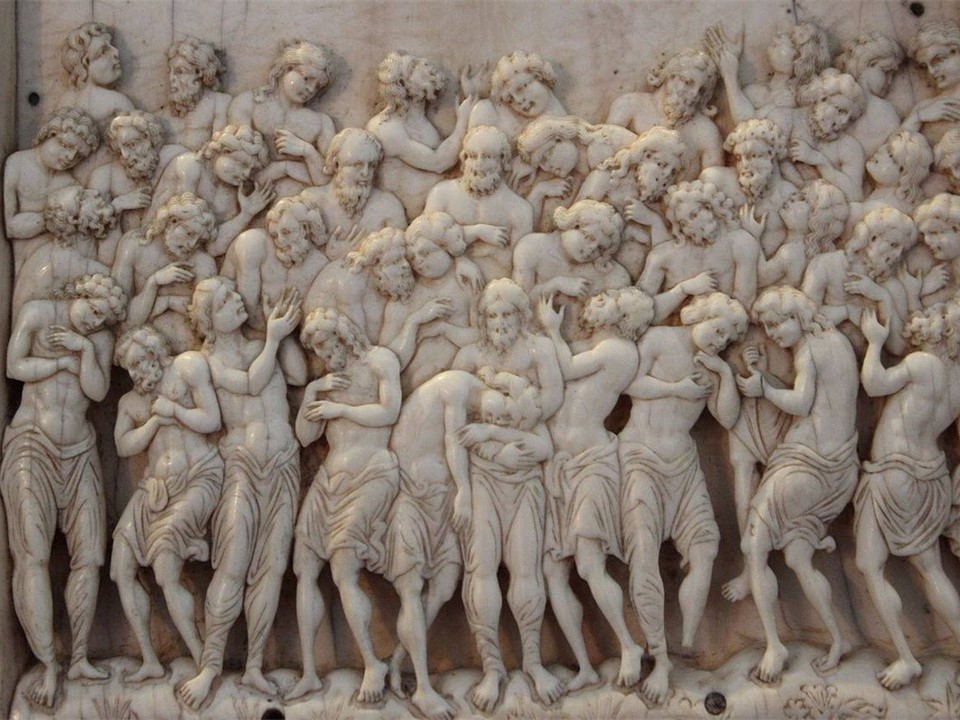
The Forty Martyrs of Sebaste, 10th century AD,  ivory relief panel from Constantinople, Museum für Byzantinische Kunst, BODE Museum, Berlin
https://history2701.fandom.com/wiki/The_Forty_Martyrs_of_Sebaste

The Forty Martyrs of Sebaste Ivory Icon at the BODE Museum in Berlin is a favorite of mine for making me think, reflect and compare.

First of all, I like the story of these 40 tough Roman soldiers, devoted to their faith, suffering… in the city of Sevaste, in Armenia, during the reign of Emperor Licinius, and under the presidency of Agricolaus, in the year 320 AD. Their story is beautifully told by MATHEW in http://dignareme.blogspot.com/2017/03/the-40-martyrs-of-sebaste.html

Then, I like Byzantine Ivory Carving! What a magnificent medium in… small-scale. Byzantine Art is not only about monumental, awe-inspiring mosaics and frescoes. The aficionados of Byzantium find equal pleasure even more! in artifacts of smaller scale, like luxurious ivories, silverware, glassware, and jewelry, even humble pottery and woodwork.

I am fascinated by Ivory itself. One only has to imagine the caravans or the galleys bringing to Constantinople African elephant tasks, the anticipation of the artisans ready to put their expertise into practice, and the eagerness of the buyers as they consider one more coveted possession. During the 10th and the 11th centuries, Byzantine Ivories were popular among the City’s aristocrats and highly prized as Imperial gifts to foreign dignitaries.

Meticulously carved, ivory icons, consular diptychs, or pyxides, enchant us today with their beauty. “The allure of this substance is easily understood: its smooth, tactile quality and creamy color made it ideal for the creation of” amazing works of art, just like the Icon of the Forty Martyrs of Sevaste in the BODE Museum.

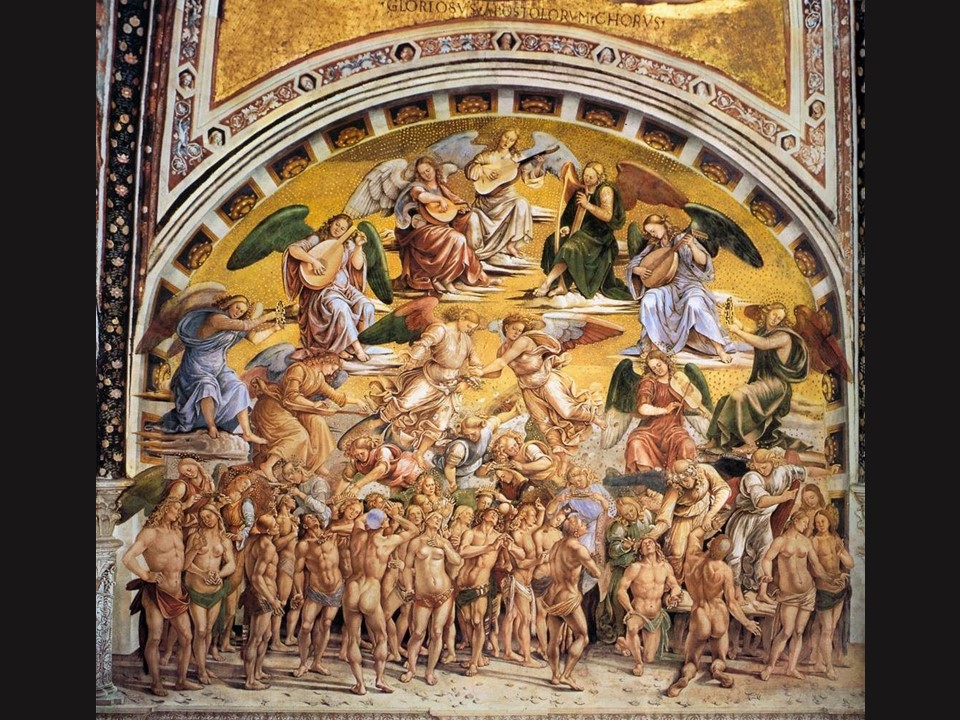
Fresco painting by Luca Signorelli (1499) of Paradise, Orvieto Cathedral, Orvieto, Umbria
The Forty Martyrs of Sebaste, 10th century AD,  ivory relief panel from Constantinople, Museum für Byzantinische Kunst, BODE Museum, Berlin

Is this amazing carving a case of Byzantine Renascence? The depiction of forty agonizing bodies, winding and twisting, reminds me of Signorelli’s fantasia of Paradise and Hell in Orvioto’s Cathedral, in the Capella of San Brizio.  Are there missing links connecting these two masterpieces I don’t know about? Whatever the answer is, the BODE Ivory Icon is a strategic player in the equation. https://www.metmuseum.org/toah/hd/ivor/hd_ivor.htm and http://www.travelingintuscany.com/art/lucasignorelli/sanbriziochapel.htm

For a “Similarities and Differences” Student Activity, please… check HERE!
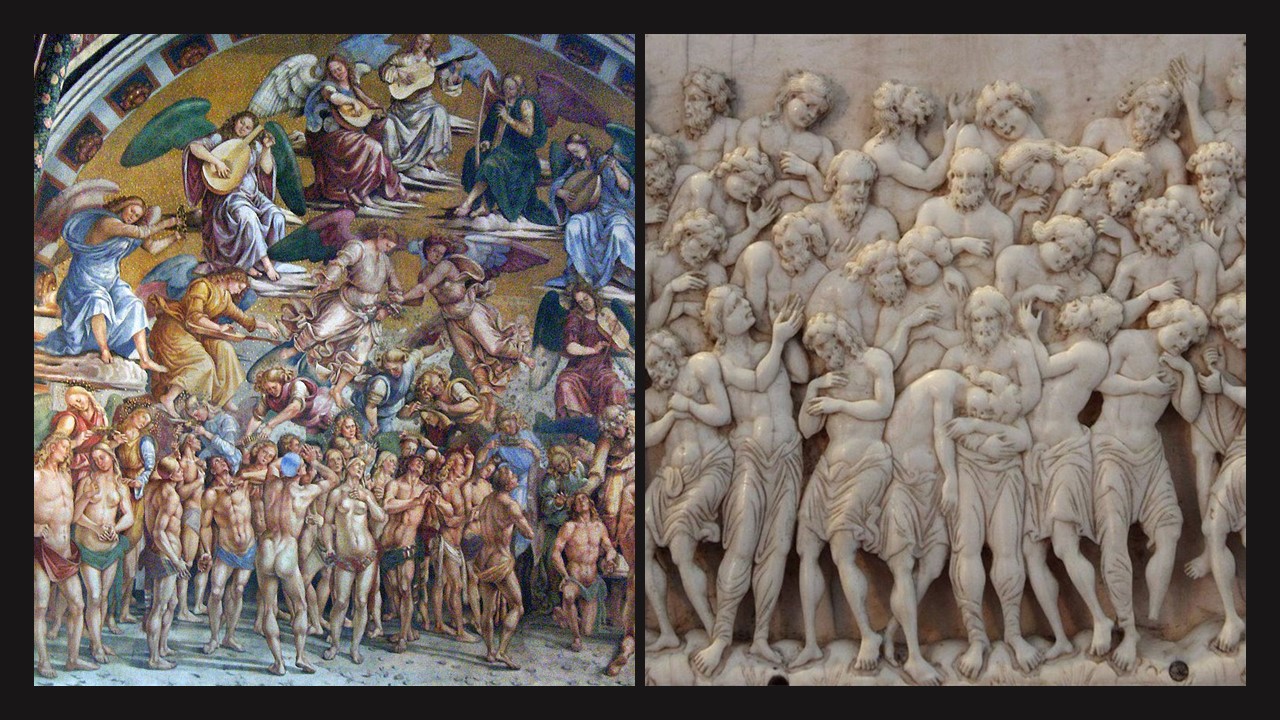
Fresco painting by Luca Signorelli (1499) of Paradise, Orvieto Cathedral, Orvieto, Umbria