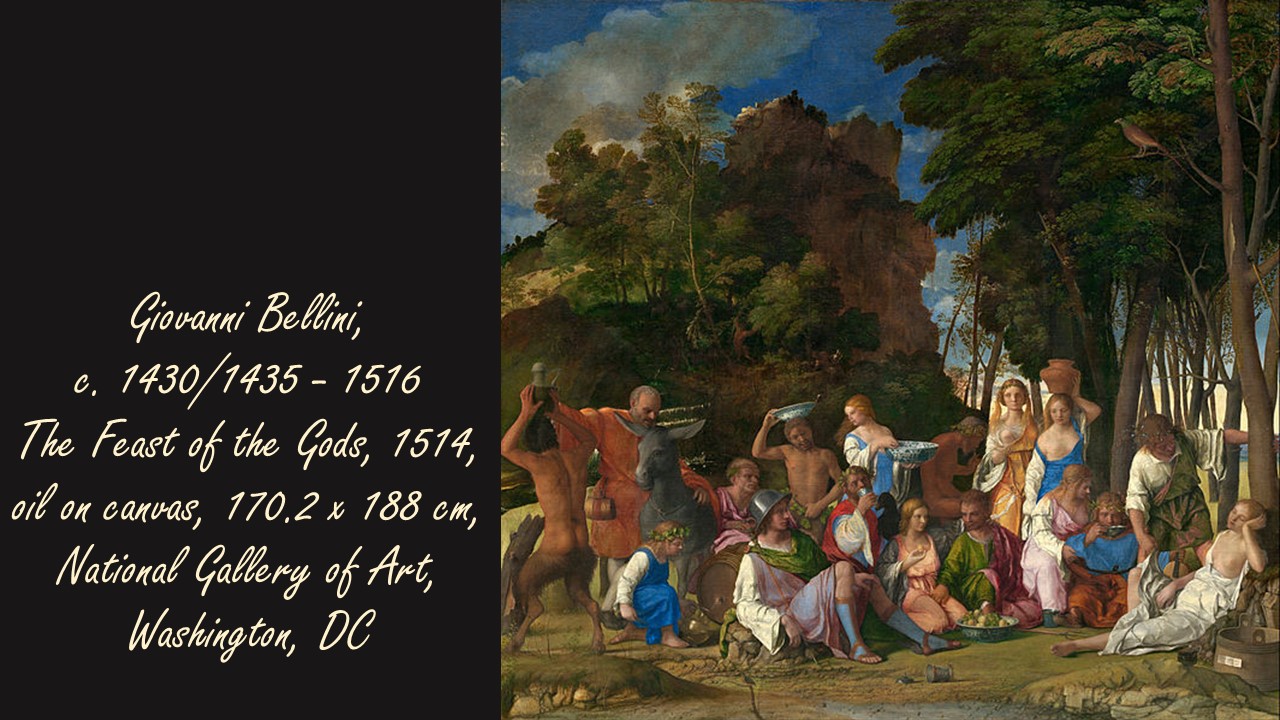
The Feast of the Gods is the story of a Renaissance Patron of the Arts, three Master Painters and a… very special Room, the camerino d’alabastro (alabaster study) of the Ferrara Castle.
The story starts with the desire of Duke Alfonso d’Este to decorate his studiolo, the camerino d’alabastro, with a series of bacchanals, mythological paintings that celebrate Bacchus and Venus, the gods of wine and love. Alfonso’s private studiolo in Ferrara was his retreat, where he would collect, exhibit and admire his collection of ancient medals, antique statuettes, and mythological paintings, celebrating the delights of nature and love. It was a very private place, only a handful of people ever saw while the Duke was still alive. Soon after he died, the room was disassembled, the paintings were taken to Rome, ending up in Washington DC, London, and Madrid.
For his first bacchanal, Alfonso turned to Giovanni Bellini, the Venetian master, who “very old, but still the best there is” as Albrecht Dürer said in one of his letters, was famous at the time for his “luminous color that would be the glory of Venetian painting for centuries to come.” The Feast of the Gods, Bellini’s creation, turned to be a very unique painting. Bellini, reluctant at first, accepted the Duke’s invitation and drawing inspiration from Ovid’s Poems, created “a wooded pastoral setting, in which the gods, with Jupiter, Neptune, and Apollo among them, revel eating and drinking, attended by nymphs and satyrs.” The painting has all the characteristics of Bellini’s excellence: brilliant colors, lush pastoral setting, an engaging story and an ambiance of sensuality.
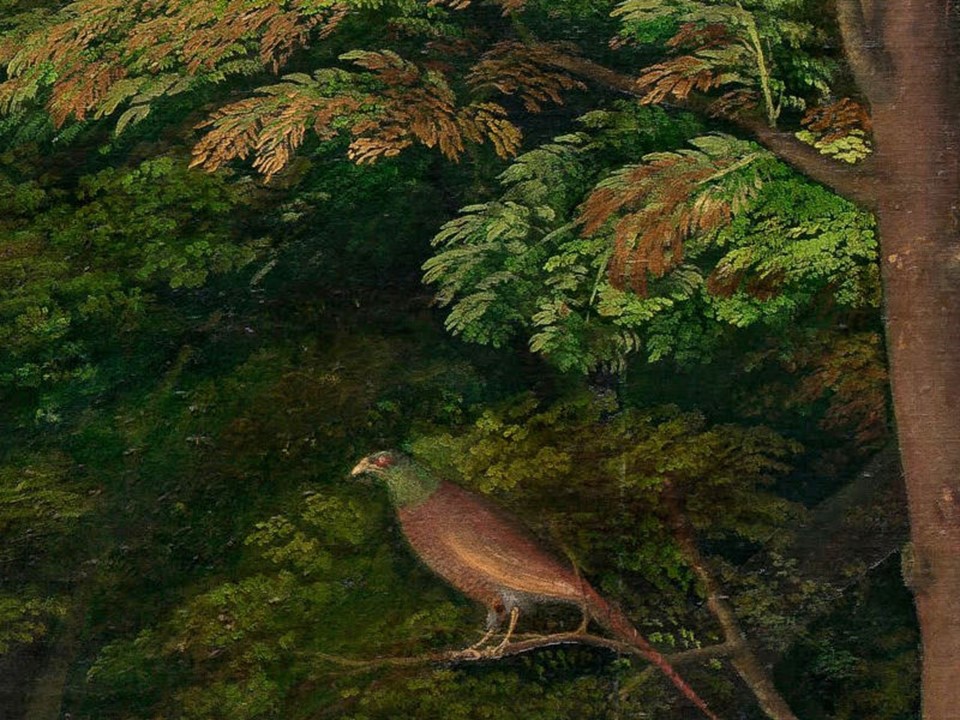
The painting was completed in 1514 but a few years later Alfonso commissioned two artists, Dosso Dossi and Titian, to rework parts of the painting’s landscape background. Dosso Dossi changed parts of the landscape on the left side and added a pheasant resting on bright foliage at the upper right part of the painting. Then, Bellini’s student, Titian, added his own alterations. He reworked Dosso’s alterations adding the dramatic, mountainous backdrop that can be seen now, leaving only Dosso’s pheasant intact. The painted figures and decorative elements of the painting were untouched and remain Bellini’s own. There is, however, an enigma and further questions! “Did Alfonso, an amateur painter who was reported to fancy pheasants, paint the bird himself? Did Alfonso “picture” himself in another way as well? Some evidence suggests that Feast of the Gods contains cryptic references to the duke’s marriage to Lucrezia Borgia, perhaps even portraits of the couple.” https://www.nga.gov/collection/highlights/bellini-titian-the-feast-of-the-gods.html and https://www.nga.gov/collection/art-object-page.1138.html
Many scholars believe that Alfonso’s studiolo was the finest of its kind, a shining jewel box! The first commission went to the elderly Giovanni Bellini and the Feast of the Gods (NGA Washingon DC) was the result. Michelangelo and Raphael were also commissioned to create works of art for the Duke’s studiolo but their commissions never materialized. With Bellini’s death in 1514, Titian, and the Duke’s court artist, Dosso Dossi, stepped in to complete this ambitious project. Dosso Dossi’s painting was destroyed centuries ago, but Titian’s Bacchus and Ariadne (National Gallery, London) The Worship of Venus (Museo del Prado, Madrid) and the Bacchanal of the Andrians (Museo del Prado, Madrid) still survive to tell us their story. https://www.theguardian.com/uk/2003/feb/08/artsandhumanities.arts1
For Student Activity, please… check HERE!