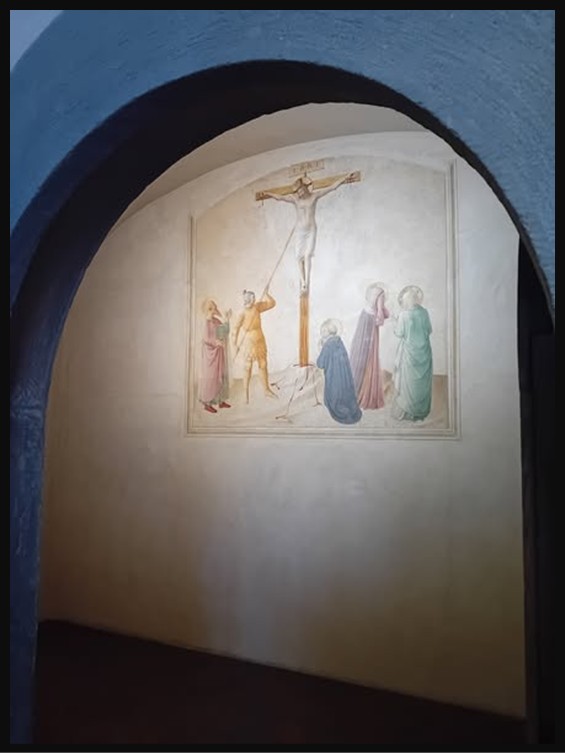
Fresco by Fra Beato Angelico (1395–1455) titled “Crucifixion with the Virgin Mary, Martha, and Saints Mark, Dominic, and Longino” (1440–1442). The figures are set against a serene, gold-hued background typical of Angelico’s early Renaissance style, located in Cell 42 of the Convent of San Marco, Florence, Italy.

Fra Angelico’s story of the Passion

Fresco by Fra Beato Angelico (1395–1455) titled “Crucifixion with the Virgin Mary, Martha, and Saints Mark, Dominic, and Longino” (1440–1442). The figures are set against a serene, gold-hued background typical of Angelico’s early Renaissance style, located in Cell 42 of the Convent of San Marco, Florence, Italy.
Fra Beato Angelico, 1395-1455
Crucifixion with the Virgin Mary with Martha, and Saints Mark, Dominic and Longino, 1440-1442, Fresco, Convent of San Marco, Cell 42, Florence, Tuscany, Italy
Photo Credit – Petros Dimitrakopoulos, 2025

At the Convent of San Marco in Florence, behind the plain door of a small monastic cell, Fra Angelico painted a Crucifixion that speaks in a whisper rather than a shout. Created in the early 1440s for the private room of a young Dominican friar, this fresco was never meant for crowds or ceremony, but for the quiet rhythm of daily prayer. Its stillness, simplicity, and emotional clarity draw the viewer into close, personal reflection on Christ’s suffering, an approach that feels especially resonant at Easter, when Fra Angelico’s story of the Passion invites not only remembrance, but inward contemplation.

Who was Fra Angelico, and how did a humble friar become one of the defining painters of the Renaissance? Fra Angelico, born Guido di Pietro around 1395, was a Dominican friar as well as one of the most gifted painters of the early Renaissance. He entered the Dominican Order at Fiesole and later lived in Florence, where his artistic life unfolded alongside his religious vocation. For him, painting was not simply a profession but a form of devotion — a way to teach, inspire, and deepen prayer. His contemporaries admired not only his skill but also his character; Giorgio Vasari later wrote that he could not take up his brush without first praying.

Artistically, Fra Angelico stood at a turning point in European art. He embraced the new Renaissance interest in natural light, believable space, and human emotion, yet he used these innovations in the service of spiritual clarity rather than dramatic display. His frescoes at San Marco, painted for the private meditation of Dominican friars, show how profoundly he understood the purpose of sacred images: not to impress the eye, but to move the soul. In this way, the “humble friar” became one of the defining painters of the Renaissance, an artist whose greatness lies as much in quiet intensity as in technical brilliance.

Where was this Crucifixion meant to be seen, and by whom? That purpose becomes especially clear in the setting of one of his most moving works. The Crucifixion discussed here is found not in a public church but in Cell 42 at the Convent of San Marco in Florence, a small room once used by a young Dominican novice. Painted around 1440–1442, during the Medici-sponsored renovation of the convent, the fresco was intended as a daily companion for prayer. These walls were not galleries but spiritual training grounds, where friars learned to contemplate Christ’s suffering in silence and solitude. In such a space, Fra Angelico’s art fulfilled its deepest aim: to draw the viewer inward, turning a simple room into a place of profound encounter.
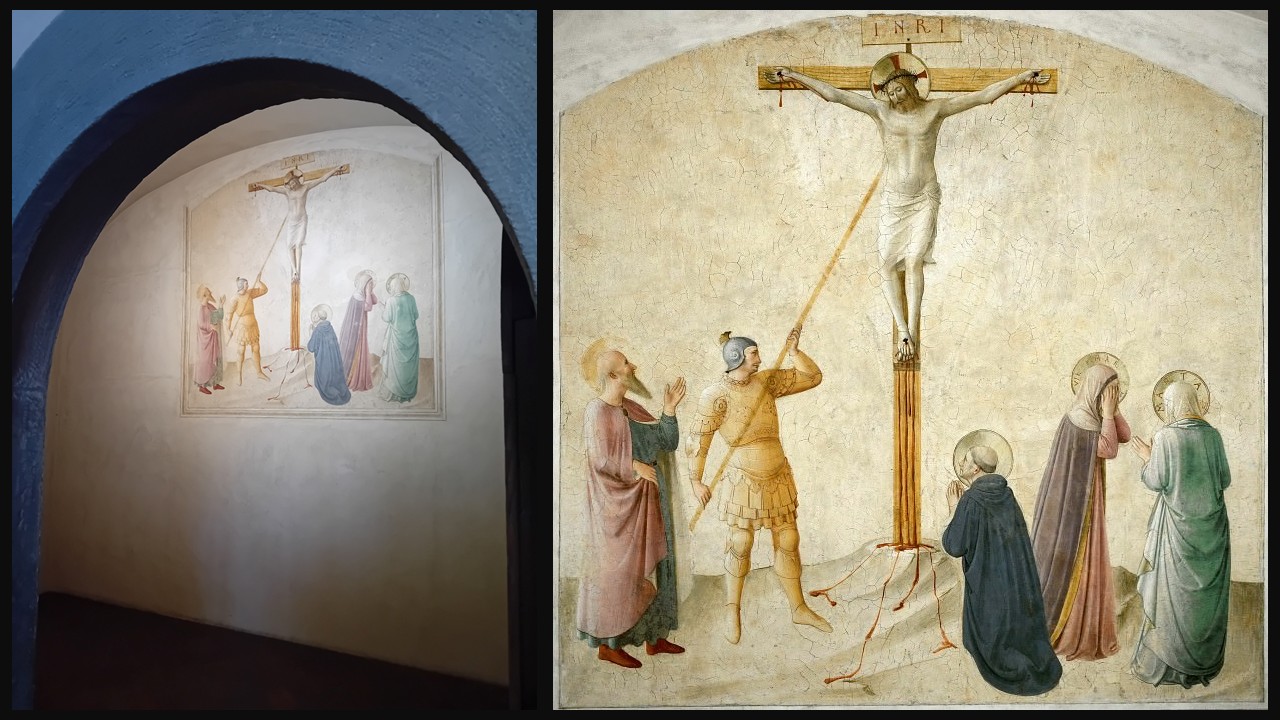
Fresco by Fra Beato Angelico (1395–1455) titled “Crucifixion with the Virgin Mary, Martha, and Saints Mark, Dominic, and Longino”, depicting Christ on the cross at the center, flanked by the Virgin Mary and Saint Martha in mourning. Saints Mark, Dominic, and Longino standing nearby in reverent poses.
Fra Beato Angelico, 1395-1455
Crucifixion with the Virgin Mary with Martha, and Saints Mark, Dominic and Longino, 1440-1442, Fresco, Convent of San Marco, Cell 42, Florence, Tuscany, Italy
Photo Credits – Left: Petros Dimitrakopoulos, 2025, Right: https://gallerix.org/storeroom/217683978/N/8229/

How does Fra Angelico tell the story of the Crucifixion within this quiet, pared-down scene? Fra Angelico tells the story of the Crucifixion with remarkable restraint, using clarity rather than complexity to convey its emotional and spiritual depth. Christ hangs at the center of the composition, isolated against a pale, almost empty background that removes any distraction of landscape or crowd. This stillness focuses attention entirely on his body and sacrifice. The vertical flow of blood from his wounds, running down the wood of the Cross to the ground below, forms a stark visual path that connects heaven and earth — a quiet but powerful sign of suffering offered for humanity.

Beneath the Cross, a small group of figures models different ways of responding to this moment. The Virgin Mary stands in sorrowful composure, her grief inward and dignified. Nearby are St. Mark, St. Dominic, and St. Martha, saints connected to preaching, contemplation, and service. The Roman soldier Longinus pierces Christ’s side, a moment of violence that becomes, in Christian thought, a moment of revelation. Through these restrained gestures and balanced spacing, Fra Angelico transforms the wall into a visual meditation, where silence, posture, and gaze speak as powerfully as dramatic movement.

Standing before Fra Angelico’s story of the Passion fresco, or even imagining it from afar, we are invited into the same kind of attentive stillness that shaped the prayer of the young friar who once slept in Cell 42. Fra Angelico’s Crucifixion does not overwhelm us with drama or spectacle; instead, it asks us to slow down, to remain, and to look with compassion. At Easter, when the story of suffering and hope stands at the heart of the Christian calendar, this quiet wall painting reminds us that transformation often begins in silence. In the simplicity of a monastic cell, the Passion becomes not only an event to remember, but a mystery to contemplate, one that continues to speak softly across the centuries.

For a Student Activity of Fra Ageico’s story of the Passion frescoin Cell 42 at the Convent of San Marco in Florence, please… check HERE!

Bibliography: from Art in Tuscany   http://www.travelingintuscany.com/art/fraangelico/conventodisanmarco.htm and from the Lives of the Artists by Giorgio Vasari in http://www.travelingintuscany.com/art/giorgiovasari/lives/fragiovannidafiesole.htm
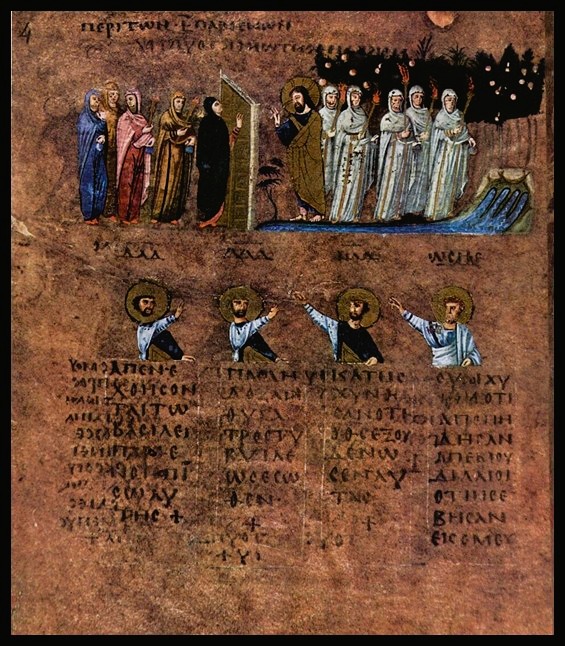
The 6th-century illuminated Gospel Book Codex Purpureus Rossanensis (Rossano Gospels) page showing the Parable of the Ten Virgins in purple-dyed parchment with gold and silver inks, held at the Diocesan Museum, Rossano, Italy.

Codex Purpureus Rossanensis

The 6th-century illuminated Gospel Book Codex Purpureus Rossanensis (Rossano Gospels) page showing the Parable of the Ten Virgins in purple-dyed parchment with gold and silver inks, held at the Diocesan Museum, Rossano, Italy.
Rossano Gospels or Codex Purpureus Rossanensis, The parable of the ten virgins, 6th-century, Illuminated manuscript Gospel Book, Diocesan Museum, Rossano, Italy
https://commons.wikimedia.org/wiki/File:Meister_des_Evangeliars_von_Rossano_002.jpg

Few works of early Christian art capture the interplay of narrative, symbolism, and material splendor as vividly as the sixth-century Codex Purpureus Rossanensis, known as the Rossano Gospels. Its purple-dyed parchment, inscribed in silver and gold, sets the stage for a series of luminous miniatures, among which the depiction of the Parable of the Ten Virgins stands out. The miniature demonstrates a sophisticated use of spatial composition, color, and gesture to convey the contrast between the wise and foolish virgins, transforming a biblical parable into a visually compelling meditation on vigilance and readiness. Waiting with Lamps Aflame reflects this synthesis of artistry and theology, offering viewers both aesthetic and spiritual insight as they contemplate Easter 2026.

A Royal Gospel in Purple and Gold

Created in the 6th century, probably in the eastern Mediterranean world, the Codex Purpureus Rossanensis is one of the oldest surviving illuminated manuscripts of the New Testament. Its pages are dyed a deep imperial purple, a colour reserved in antiquity for royalty, and its sacred text is written in silver and gold ink. Containing the Gospels of Matthew and Mark, the manuscript is both a theological treasure and a masterpiece of early Christian art. Today it is preserved in the Cathedral Museum of Rossano in southern Italy and is recognized by UNESCO as part of the Memory of the World Register. Yet beyond its historical prestige, the codex speaks in images that remain spiritually urgent.

The Parable of Watchfulness

The Parable of the Ten Virgins tells of ten young women waiting for the arrival of the bridegroom. Five are wise, bringing extra oil for their lamps. Five are ‘foolish’, unprepared for delay. When the bridegroom finally arrives at midnight, only the prepared enter the wedding feast. The door is shut. The parable concludes with a solemn warning: “Watch therefore, for you know neither the day nor the hour.” In the liturgical tradition of Holy Week, especially in the Orthodox services of Holy Tuesday, this parable is read as a call to spiritual vigilance. Christ is the Bridegroom. Humanity waits. The question is not whether He will come, but whether we will be ready.

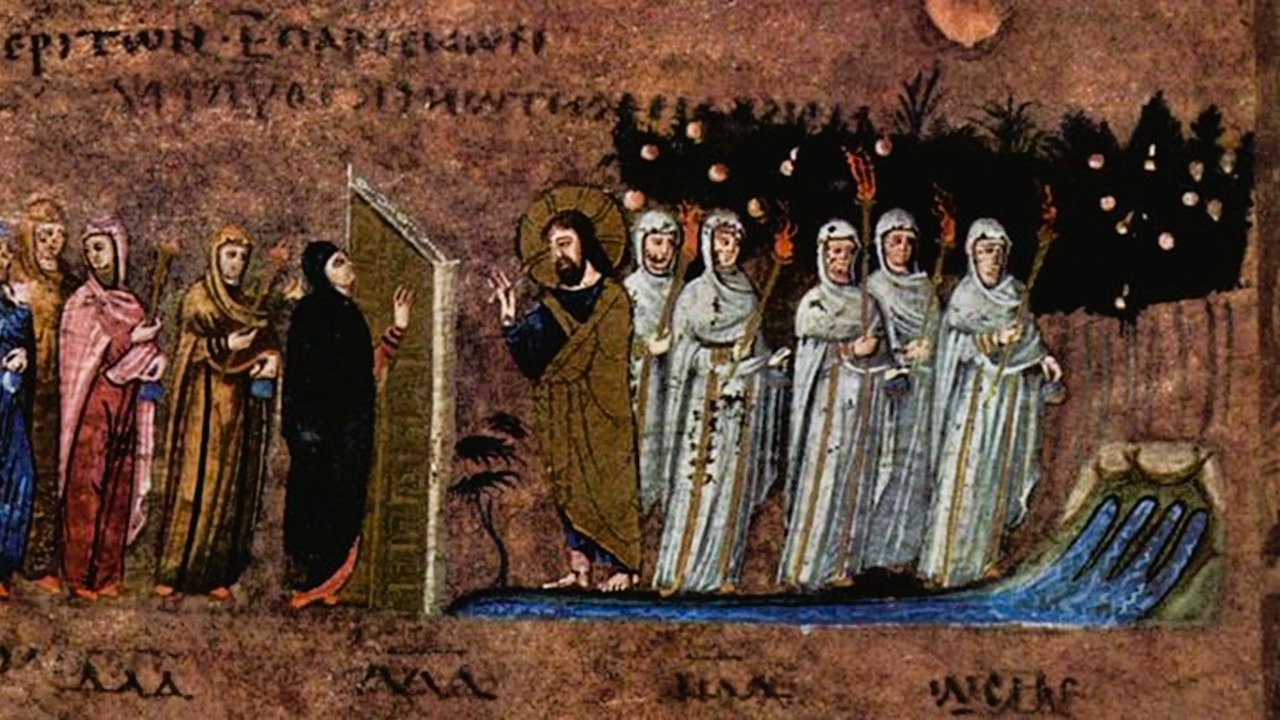
Detail of the 6th-century illuminated Gospel Book Codex Purpureus Rossanensis (Rossano Gospels) page showing the Parable of the Ten Virgins in Rossano, Italy.
Rossano Gospels or Codex Purpureus Rossanensis, The parable of the ten virgins (detail), 6th-century, Illuminated manuscript Gospel Book, Diocesan Museum, Rossano, Italy
https://grace.allpurposeguru.com/2024/03/the-parable-of-the-wise-and-foolish-virgins-a-warning/

Light and Division in the Rossano Miniature

In the Rossano Gospels, this parable unfolds across a richly coloured miniature structured around a central architectural door. On one side stand the five unprudent ladies. Their garments are vibrant, yet their lamps are dark. Their gestures suggest movement and urgency, but they approach a closed door, too late. The absence of flame is striking: the torches they carry are extinguished, visually reinforcing their lack of preparation. On the other side stand the five wise ladies. Clad in luminous white, they hold torches crowned with flame. Their posture is composed, serene. Light radiates from their lamps, visually echoing Christ’s own identity as the Light of the World. The door near them is not a barrier but a threshold. The artist uses contrast, dark and light, colour and white, stillness and anxiety, not simply to illustrate the Gospel story, but to interpret it. The painting becomes theology in colour.

An Image for Our Own Vigil

What makes the Rossano Gospels so powerful is that they do not merely preserve Scripture, they invite contemplation. The purple pages, once associated with imperial authority, now proclaim a different kingship: that of the risen Christ. The silver and gold letters shimmer like reflected candlelight, drawing the reader into sacred time.

In this Easter season, the miniature of the Ten Virgins offers more than historical beauty. It offers a spiritual mirror. To live as a Christian is to live in hopeful expectation, not anxious waiting, but watchful trust. The oil in the lamp becomes a symbol of prayer, mercy, faithfulness, love, all that sustains the flame.

As we celebrate the Resurrection in 2026, we might pause before this sixth-century image and ask ourselves: Are we merely standing at the door, or are we ready to enter the feast?

For a PowerPoint Presentation of the Codex Purpureus Rossanensis, please… check HERE!

Sources
Archdiocese of Rossano–Cariati, Codex Purpureus Rossanensis, available at: https://www.artesacrarossano.it/eng/details_works.php?IDo=36
Google Arts & Culture, Admire the Rossano Gospels’ Miniatures of the New Testament, available at: https://artsandculture.google.com/story/admire-the-rossano-gospels%E2%80%99-miniatures-of-the-new-testament-unesco-memory-of-the-world/9wXBYc45V5WHdA?hl=en

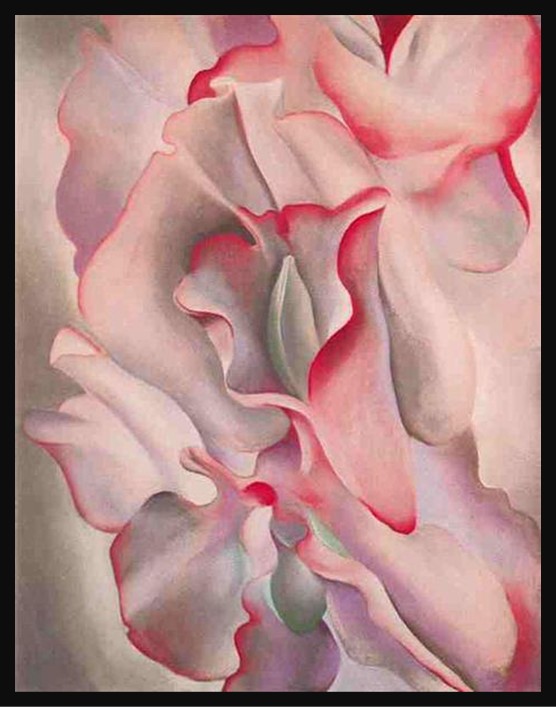
Georgia O’Keeffe, Pink Sweet Peas II: Close-up view of enlarged pink sweet pea blossoms filling the vertical composition, their velvety petals unfolding in soft gradations of rose against a muted background.

Pink Sweet Peas II

Georgia O’Keeffe, Pink Sweet Peas II: Close-up view of enlarged pink sweet pea blossoms filling the vertical composition, their velvety petals unfolding in soft gradations of rose against a muted background.
Georgia O’Keeffe, American, 1887-1986
Pink sweet peas II, 1940, Oil on Canvas; 101.6×76.3 cm, Private collection
https://www.facebook.com/photo/?fbid=10162953797243474&set=g.5907271979

In 1940, Georgia O’Keeffe painted Pink Sweet Peas II, a luminous oil on canvas that transforms a modest garden flower into a commanding, almost immersive presence. By enlarging the blossoms to fill the vertical format, O’Keeffe dissolves the boundary between botanical study and abstraction. The petals curve and fold across the surface in soft gradations of pink, their velvety forms emerging from a subdued ground. What might have been a simple still life becomes instead an encounter, intimate, contemplative, and quietly monumental.

Born in 1887 in Sun Prairie, Wisconsin, O’Keeffe emerged as one of the most distinctive voices in twentieth-century American art. After studying at the Art Institute of Chicago and later in New York, she developed an independent visual language rooted in clarity of form and emotional intensity. Her early abstractions attracted the attention of photographer and gallerist Alfred Stieglitz, who became both her advocate and husband. Over the decades, O’Keeffe divided her time between New York and New Mexico, where the vast desert landscape profoundly shaped her artistic vision. Today, she is widely recognized as a central figure in American modernism, celebrated for her radical close-up flowers, stark landscapes, and enduring commitment to seeing the world on her own terms.

O’Keeffe’s flower paintings have long occupied a central place in discussions of American modernism. Working against the conventions of traditional floral still life, she magnified her subjects to such a scale that they verge on landscape. The viewer no longer observes the flower from a polite distance; we are drawn into its interior rhythms. In Pink Sweet Peas II, the gentle chromatic transitions—blush pinks, pale whites, subtle greens—suggest fragility, yet the composition itself feels structurally assured. The sweeping arcs of the petals create a dynamic movement that anchors the painting firmly within modernist concerns for form, color, and spatial tension.

Sweet peas, known for their delicate fragrance and climbing tendrils, carry symbolic associations of blissful pleasure, gratitude, and departure. Their ephemeral bloom makes them a poignant emblem of spring’s brief splendor. That this painting resonates especially in April—often celebrated as Sweet Pea month—adds another layer of meaning. April marks a seasonal threshold: the reawakening of gardens, the return of light, the quiet promise of renewal. O’Keeffe’s magnified blossoms capture that moment of emergence, when growth feels both tender and inevitable.

Yet beyond symbolism, Pink Sweet Peas II speaks to O’Keeffe’s sustained investigation of perception itself. By isolating and enlarging the flower, she compels us to look slowly and attentively. The painting asks what happens when we truly see something ordinarily overlooked. In this way, the work embodies a distinctly modern sensibility, one that values direct experience over inherited convention.

As we celebrate sweet peas in April, O’Keeffe’s canvas offers a reminder that even the most delicate forms can hold immense visual power. Through her brush, a fleeting bloom becomes enduring, and the quiet poetry of spring is translated into color, curve, and light.

For a PowerPoint Presentation, titled ‘2026 – 12 Months – 12 Flowers’, please… Click HERE!

Bibliography: the Georgia O’Keeffe Museum https://www.okeeffemuseum.org/ and https://www.artchive.com/artwork/pink-sweet-peas-2-georgia-o-keeffe/?utm_source=chatgpt.com

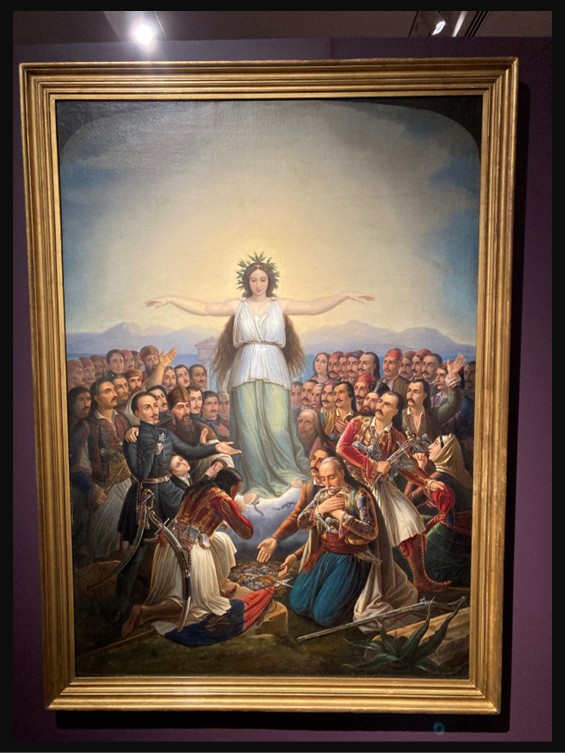
Allegorical figure of Greece in classical dress with outstretched arms above a crowd of Greek independence fighters, symbolizing national defense and unity.

The Defense of the Homeland above All Else

Allegorical figure of Greece in classical dress with outstretched arms above a crowd of Greek independence fighters, symbolizing national defense and unity.
Theodoros Vryzakis, Greek, 1814-1878
The Defense of the Homeland above All Else, 1858, Oil on Canvas, 183 x 132 cm, National Gallery – Alexandros Soutsos Museum, Athens, Greece – Photo Credit: Amalia Spiliakou, February 18, 2024, ‘Meanings’. Personifications and Allegories from Antiquity to Today Exhibition, Acropolis Museum, Athens, Greece

Each year on March 25, Greece commemorates the struggle for independence that reshaped its destiny and gave birth to the modern Greek state. It is a day of remembrance, pride, and reflection, a moment to honor not only the events of the Revolution, but also the people whose courage and vision made freedom possible. Fittingly, one of the most powerful visual tributes to this shared history comes from the brush of Theodoros Vryzakis (1814–1878). His 1858 painting, The Defense of the Homeland above All Else (Υπέρ πατρίδος το παν), now in the National Gallery in Athens, transforms history into allegory, memory, and national gratitude.

At first glance, the painting appears to depict a gathering of figures from the Greek War of Independence. Yet this is not a scene from a specific historical moment. Instead, Vryzakis presents an imaginary assembly, a symbolic coming together of all those who prepared for, fought in, and spiritually supported the Revolution. Military leaders, clergy, intellectuals, and patriots stand side by side, united not in battle but in triumph, after the long-sought dream of independence has been realized. The scene is less about action and more about remembrance, honor, and collective identity.

At the heart of the composition stands a powerful allegorical figure: Greece personified. She appears as a serene, dignified woman, adorned with classical references that connect modern Greece to its ancient heritage. Freed from her shackles and crowned with laurel, she inclines her head and gently extends her arms toward the gathered figures. Her gesture is not one of command, but of gratitude and blessing. In Vryzakis’s vision, the nation itself acknowledges the sacrifices of its “natural and spiritual children,” honoring them with calm solemnity rather than dramatic exaltation.

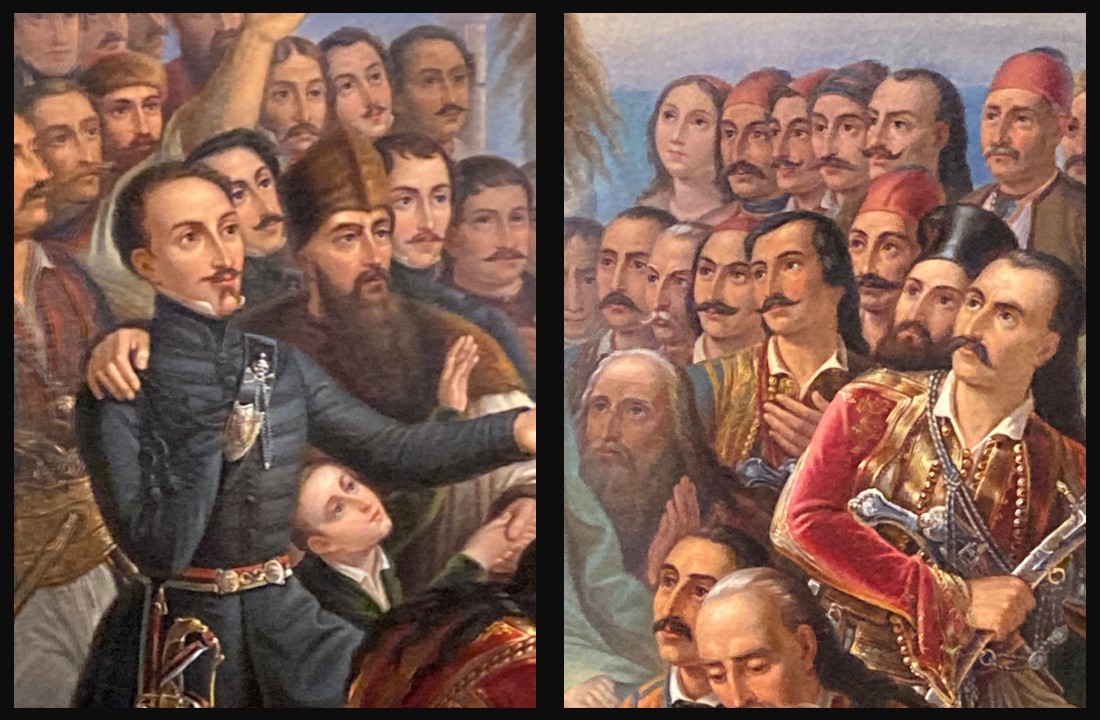
Allegorical painting by Theodoros Vryzakis depicting heroes of the 1821 Greek War of Independence..
Theodoros Vryzakis, Greek, 1814-1878
The Defense of the Homeland above All Else (details), 1858, Oil on Canvas, 183 x 132 cm, National Gallery – Alexandros Soutsos Museum, Athens, Greece – Photo Credit: Amalia Spiliakou, February 18, 2024, ‘Meanings’. Personifications and Allegories from Antiquity to Today Exhibition, Acropolis Museum, Athens, Greece

One of the most compelling aspects of the painting is the invitation it extends to the viewer: Can you recognize the heroes? Vryzakis brings together individuals who, in reality, lived in different regions and moments of the struggle, creating a shared symbolic space where they stand as equals. The painting includes those who prepared the intellectual ground for revolution, those who led and fought in key battles, and those who offered spiritual guidance and moral strength. In doing so, Vryzakis emphasizes that independence was not the achievement of a single figure, but the result of a collective national effort.

As the leading Greek painter of historical subjects in the 19th century, Vryzakis played a vital role in shaping how the Revolution would be remembered. His works helped form a visual language of national identity, blending realism with idealization to create images that were both emotionally powerful and deeply symbolic. At a time when the young Greek state was still defining itself, such paintings helped transform historical events into shared cultural memory, offering citizens a heroic yet human narrative of their recent past.

Today, on Greek Independence Day, The Defense of the Homeland above All Else continues to resonate. It reminds us that freedom was won through the dedication of many, known and unknown, and that the story of a nation is built not only on battlefields, but also in remembrance, gratitude, and unity. In Vryzakis’s vision, Greece does not stand alone. She stands surrounded by those who gave everything for her, and through art, their presence remains part of the living memory of the nation.

For a List of Student Activities on the Greek Revolution of 1821 prepared by Greek Museums and Foundations… check HERE!

Bibliography: from the Greek National Gallery of Art https://www.nationalgallery.gr/artwork/yper-patridos-to-pan/

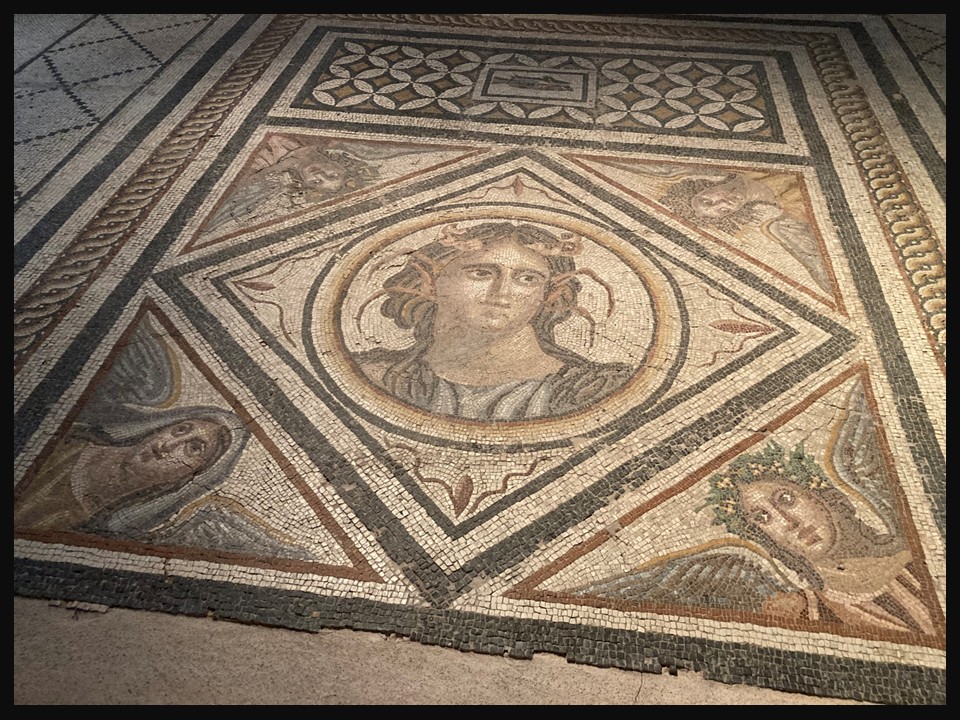
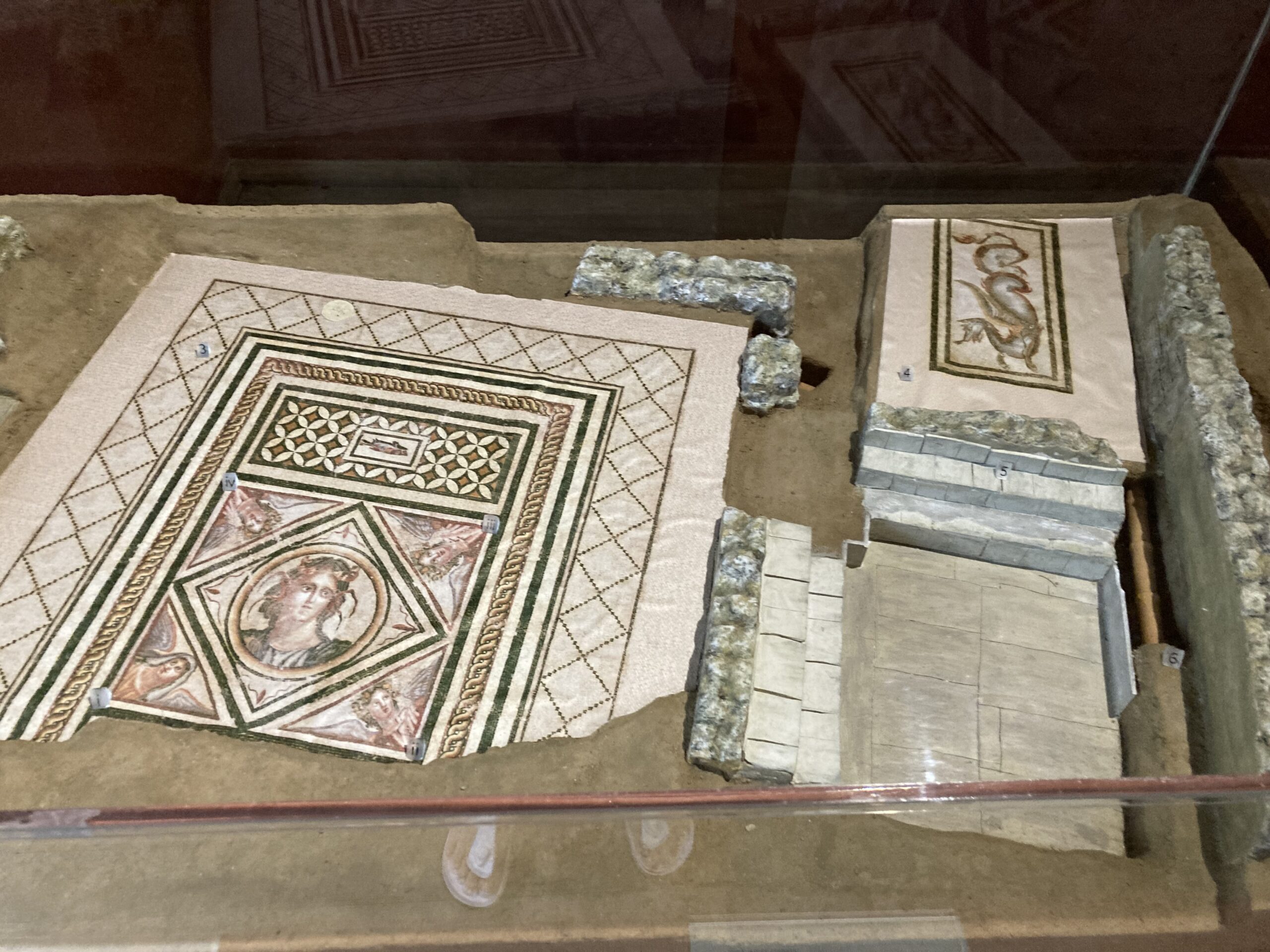
Floor mosaic from the House of Euripos (2nd–3rd century AD), showing a central youthful sea spirit surrounded by personifications of the Four Seasons, Archaeological Museum of Mytilene, Greece.

Roman Mosaic from the House of Euripos

Floor mosaic from the House of Euripos (2nd–3rd century AD), showing a central youthful sea spirit surrounded by personifications of the Four Seasons, Archaeological Museum of Mytilene, Greece.
House of Euripos, Floor Mosaic of the Four Seasons, 2nd-3rd century AD, Archaeological Museum of Mytilene, Greece – Photo Credit: Amalia Spiliakou, 2025

The first day of spring, March 20, 2026, arrives as it always has — quietly, persistently, with light lingering a little longer and the earth stirring back to life. Across cultures and centuries, this moment has marked renewal, balance, and the return of growth. Fittingly, an ancient work of art from the island of Lesvos captures this same eternal rhythm: the remarkable Roman mosaic from the House of Euripos, now displayed in the Archaeological Museum of Mytilene, Greece.

Created in the 2nd–3rd century AD, this mosaic once decorated the atrium of a grand Roman house on the hill of Agia Kyriaki. Like other elite homes of its time, the structure was likely organized around a sun-lit courtyard with rooms opening onto it,  spaces for welcoming guests, sharing meals, and everyday family life, all designed to make the most of light and air. Interestingly, the natural slope of the land made space for an underground stone cistern with an arched roof, neatly built into the structure. But it’s the Roman mosaic floor that truly steals the show, turning the setting from simply elegant into something memorable, with imagery that reflects the powerful forces shaping both nature and everyday human life.

The Mosaic of the Four Seasons

At its center appears a striking figure: a young, beardless sea spirit, framed within a medallion set inside a diamond shape. His identity is closely tied to the waters that sustained ancient Mytilene. Scholars interpret him as Euripos, representing either a key waterway near the city or the Pyrrhaean Euripos, today’s Gulf of Kalloni, famed since antiquity for its rich fisheries. His marine nature is unmistakable: dolphins and lobster claws woven into his hair signal his dominion over the sea. He is not merely decorative; he embodies abundance, movement, and the life-giving power of water, a reminder that prosperity in island communities has always depended on the rhythms of the natural world.

House of Euripos representation of the triclinium floor mosaic of the four Seasons with a sea divinity in the center and the 'Dragon' passageway floor mosaic.
House of Euripos (museum representation of the triclinium floor mosaic and the ‘Dragon’ passageway mosaic), 2nd-3rd century AD, Archaeological Museum of Mytilene, Greece – Photo Credit: Amalia Spiliakou, 2025

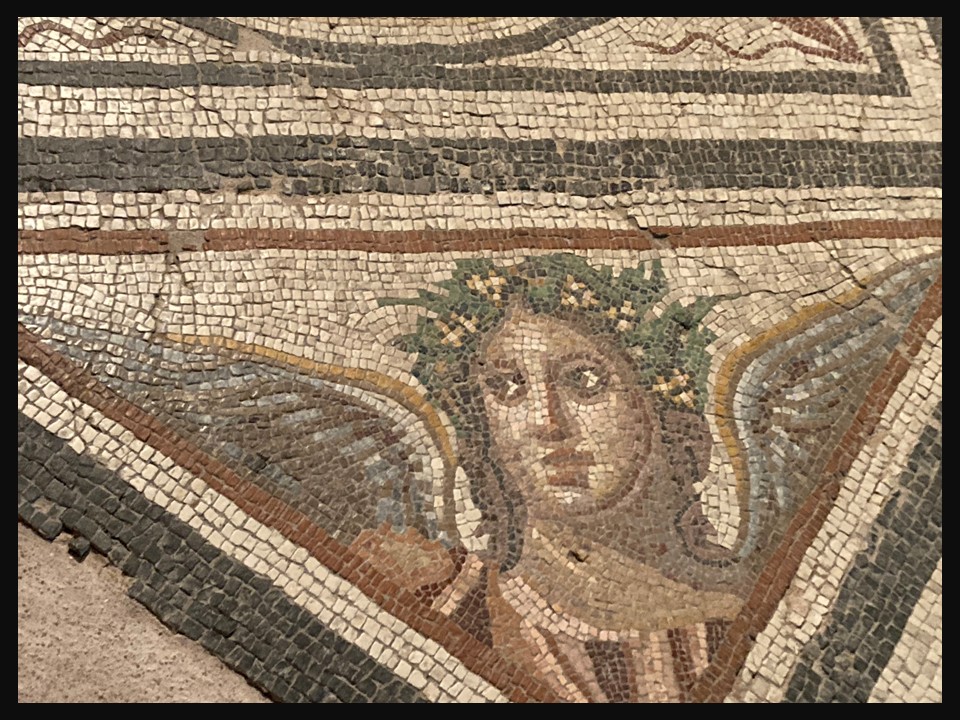
Surrounding this central sea being, at the four corners of the diamond, are the Four Seasons, shown as winged figures, both male and female, each with distinct attributes. Together they form a complete cycle of the year, a cosmic calendar in stone. Spring, the season we celebrate today, is depicted with flowers and fresh green leaves, symbols of rebirth and vitality. Her presence radiates softness and promise, much like the first blossoms that now dot fields and gardens. Summer holds sheaves of grain, a sign of harvest to come and the sun’s nurturing strength. Autumn bears fruits, representing maturity, fulfillment, and the rewards of the earth. Winter, in contrast, appears with a somber expression and wrapped in heavy drapery, embodying cold, stillness, and the dormancy from which life will soon re-emerge.

Mosaic detail from the House of Euripos depicting Spring.
House of Euripos (detail of ‘Spring’), 2nd-3rd century AD, Floor Mosaic, Archaeological Museum of Mytilene, Greece – Photo Credit: Amalia Spiliakou, 2025

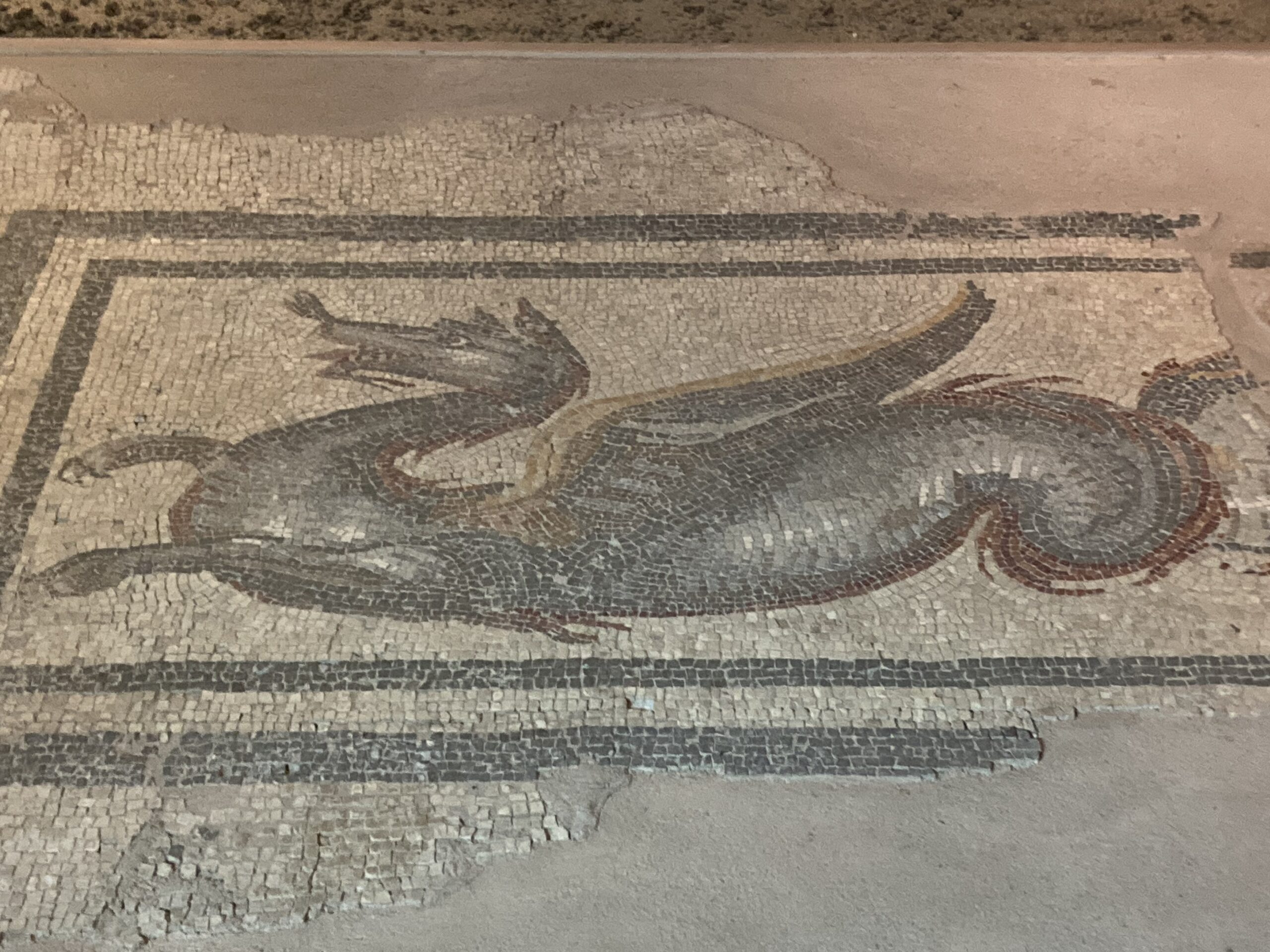
Together, these figures do more than decorate a floor, they express an ancient understanding of time as a cycle rather than a straight line. The people who walked across this mosaic nearly two thousand years ago lived in close awareness of seasonal change. Agriculture, fishing, travel, and daily routines all depended on nature’s shifting moods. By placing the Seasons around a sea divinity, the mosaic’s artist wove land, water, and time into a unified vision of existence. Even the guardian dragon once positioned at the entrance of the house fits within this worldview. Fierce and protective, it symbolically stood watch over the household, guarding the harmony between the human domain and the powerful natural and supernatural forces represented inside.

Detail of the passageway 'Dragon' floor mosaic from the House of Euripos in Mytilene, 2nd-3rd century AD.
House of Euripos (detail of the passageway ‘Dragon’ floor mosaic), 2nd-3rd century AD, Floor Mosaic, Archaeological Museum of Mytilene, Greece – Photo Credit: Amalia Spiliakou, 2025

Artistically, the mosaic from the House of Euripus is a masterpiece of subtlety. The creator employed delicate shades of gray, pink, green, and yellow, achieving depth and liveliness with remarkable sensitivity. Though made in the Roman period, the style reflects the enduring influence of the rich Hellenistic artistic tradition, a blend of technical skill and emotional nuance that gives the figures both grace and presence. On this first day of spring, the mosaic feels especially resonant. Spring’s figure in the composition does not stand alone; she exists as part of a greater cycle that includes growth, abundance, decline, and rest. The message is timeless: renewal is meaningful because it follows dormancy. Light returns because darkness had its turn.

As we step into longer days and warmer air, the Roman Mosaic from the House of Euripos reminds us that the changing seasons have always shaped human imagination. Nearly two millennia ago, an artist in Mytilene, Greece captured the same sense of wonder we feel today when the first flowers open. Stone and tesserae preserve that moment for us, a quiet but enduring celebration of nature’s rhythms and the promise carried in every new spring.

For a PowerPoint presentation of the Roman Mosaic from the House of Euripos mosaic in Mytilene, please, check… HERE!

The House of Euripos is not an isolated example. Roman Mytilene was home to a number of richly decorated villas, including the House of Menander, whose extraordinary mosaics, featuring theatrical scenes, philosophers, and mythological imagery, offer a fascinating parallel to the artistic and cultural world reflected here. Together, these residences reveal the prosperity and refined tastes of the island during the Roman period. Read more about the House of Menander

Bibliography: from the Lesvos News https://www.lesvosnews.net/articles/news-categories/afieromata/ti-na-deite-sto-arhaiologiko-moyseio-mytilinis-grafei-o and the site of the new Archaeological Museum of Mytilene https://archaeologicalmuseums.gr/en/museum/5df34af3deca5e2d79e8c122/new-archaeological-museum-of-mytilini

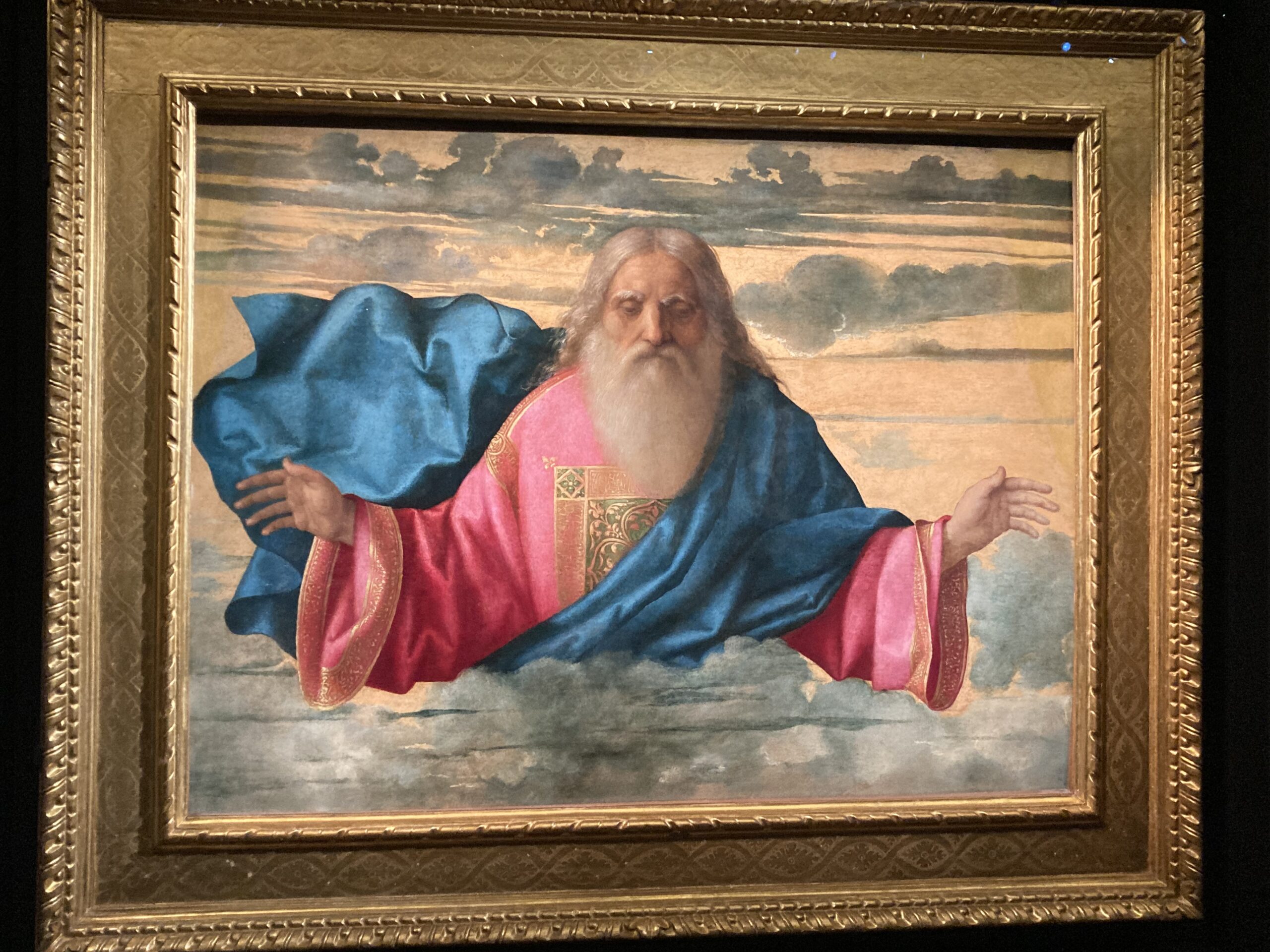
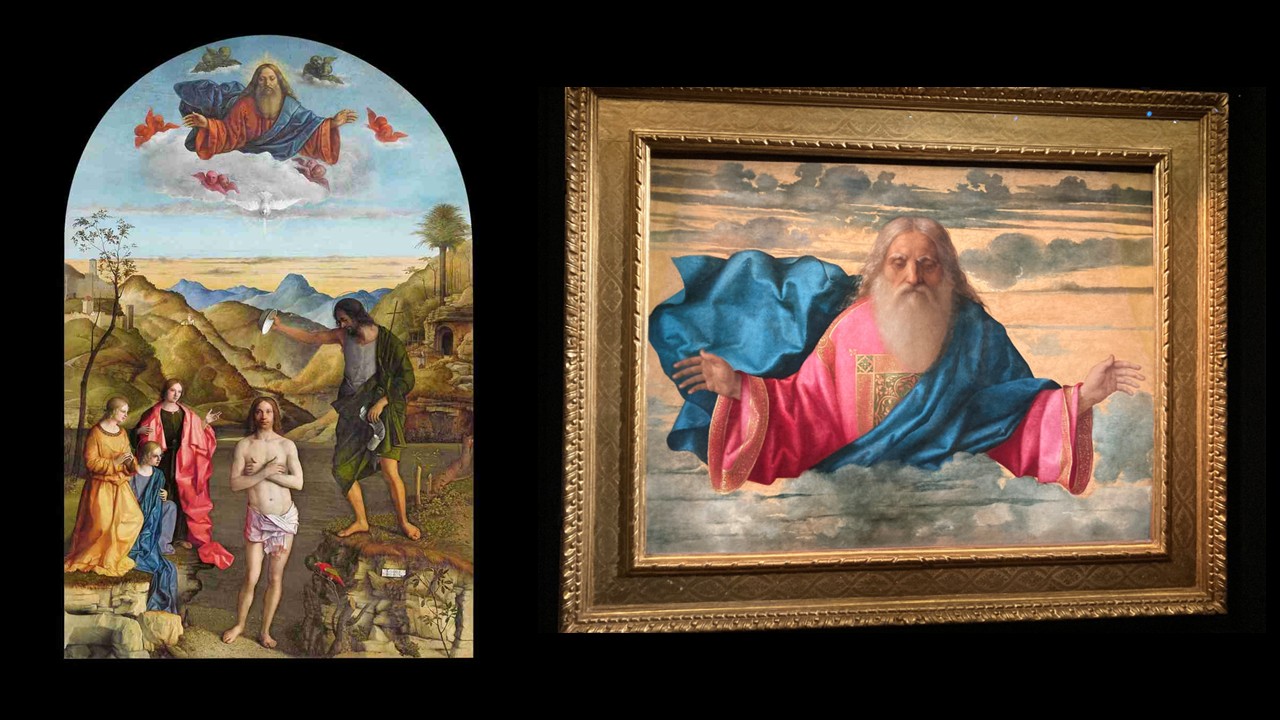
God the Father appears as an elderly, white-bearded man in red and blue robes, shown against glowing clouds and raising his hand in blessing.

Giovanni Bellini’s God the Father

God the Father appears as an elderly, white-bearded man in red and blue robes, shown against glowing clouds and raising his hand in blessing.
Giovanni Bellini, 1434-1516
God the Father, 1505-1510, Oil on Wood, 102×132 cm, Palazzo Mosca-Musei Civici, Pesaro, Italy – Photo Credit: Amalia Spiliakou, March 2023, (Exhibition: GIOVANNI BELLINI Influences Croisées at Jacquemart-André Museum, Paris)

In Giovanni Bellini’s God the Father, the viewer encounters a quiet yet profound vision of the divine. Emerging gently from a bank of clouds, God appears not in thunder or spectacle, but in stillness, with arms extended in a gesture that seems at once welcoming, blessing, and encompassing. His presence fills the pictorial space with solemn calm, suspended between heaven and earth. The encounter feels intimate rather than overwhelming, inviting contemplation rather than awe. Bellini’s restrained vision draws us into a moment of spiritual reflection, where divine authority is expressed through serenity and light.

By the early sixteenth century, Bellini stood as the most revered painter in Venice, a master whose career bridged the poetic sensibility of the Early Renaissance and the luminous innovations of the High Renaissance. In his later years, his painting achieved an exceptional refinement of color, atmosphere, and emotional restraint. This work belongs to that mature phase, when technical mastery had become inseparable from spiritual depth. Rather than striving for dramatic invention, Bellini turns toward quiet revelation, offering an image shaped by decades of observation, devotion, and artistic wisdom.

The panel is widely considered to be the upper fragment of a now-lost altarpiece, a hypothesis supported by both its format and compositional logic. Bellini had previously employed an almost identical solution in the figure of the Eternal Father crowning the altarpiece of the Baptism of Christ, painted between 1500 and 1502 for the Garzadori altar in the church of Santa Corona in Vicenza. In both cases, God the Father appears above the principal sacred scene, emerging from clouds and presiding over the mystery below. The Pesaro panel thus preserves what was once the theological and visual apex of a larger devotional structure.

Garzadori Altar – The Baptism of Christ by Giovanni Bellini in the Chiesa di Santa Corona, Vicenza, Italy, and God the Father by Giovanni Bellini in the Palazzo Mosca-Musei Civici, Pesaro, Italy.
Giovanni Bellini, 1434-1516
Garzadori Altar with The Baptism of Christ, 1500-1502, Tempera on board, 400cm x 263cm, Chiesa di Santa Corona, Vicenza, Italy https://www.facebook.com/groups/162243897516549/posts/1715539035520353/
God the Father, 1505-1510, Oil on Wood, 102×132 cm, Palazzo Mosca-Musei Civici, Pesaro, Italy – Photo Credit: Amalia Spiliakou, March 2023

While the compositional idea recalls the Vicenza altarpiece, the more mature stylistic language of the Pesaro painting suggests a slightly later date, around 1505. The handling of light is softer, the transitions more atmospheric, and the emotional tone more restrained. Bellini’s God no longer asserts authority through formal symmetry alone, but through a quiet sense of presence. The frontal pose, open arms, and direct gaze establish a relationship with the viewer, transforming the image into a silent dialogue between heaven and earth.

Much of the painting’s expressive power lies in Bellini’s mastery of color and light. The deep blue mantle envelops the figure in celestial gravity, while the rose-red garment introduces warmth and humanity. Light dissolves hard contours, softening the boundaries between flesh, fabric, and cloud, as though the divine presence permeates the surrounding space. The composition remains balanced and still, resisting narrative movement. Transcendence is communicated here not through drama, but through harmony, clarity, and luminous calm.

In God the Father, Bellini offers a vision of the divine shaped by contemplation rather than spectacle. Even as a fragment, the panel retains its devotional intensity, inviting sustained looking and inward reflection. The painting encapsulates Bellini’s late artistic philosophy, in which faith is expressed through light, color, and human presence. Suspended in clouds yet emotionally accessible, Bellini’s God is neither distant nor overwhelming but gently revealed, an enduring testament to the painter’s quiet theology of grace.

For a Student Activity, please… Check HERE!

Bibliography: from the Italian General catalogue of Cultural Heritage  https://catalogo.beniculturali.it/detail/HistoricOrArtisticProperty/1100131504

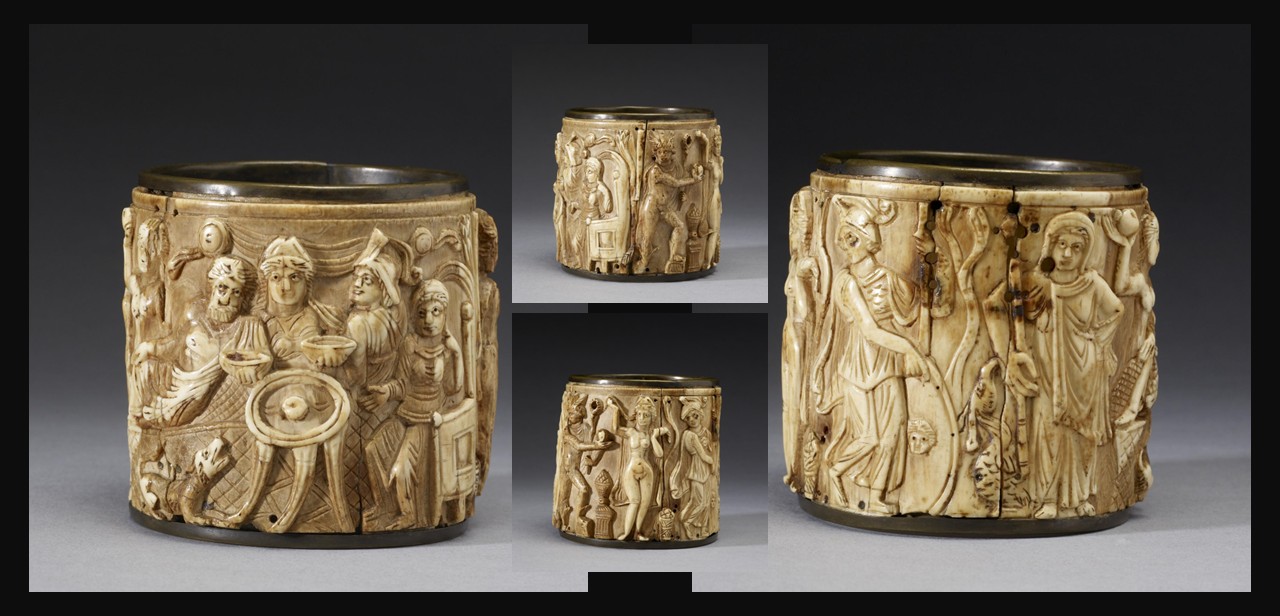
Circular ivory pyxis carved with Greek mythological scenes, made in Egypt in the 5th–6th century AD, in the collection of the Walters Art Museum, Baltimore.

Late Antique Ivory Pyxis

Circular ivory pyxis carved with Greek mythological scenes, made in Egypt in the 5th–6th century AD, in the collection of the Walters Art Museum, Baltimore.
Circular Pyxis with Mythological scenes, 5th-6th century, from Egypt, Ivory, 8.5 x 9.1 cm, The Walters Art Gallery, Baltimore, USA
https://art.thewalters.org/object/71.64/

Nestled in the collection of The Walters Art Museum in Baltimore is a remarkable Ivory Vessel known as the Circular Pyxis, carved in Egypt during the 5th or the 6th  century AD. This delicately worked object may be small in size, but it opens a rich window into the artistic and cultural world of Late Antiquity, a period of transition, imagination, and blending traditions. This exquisite Late Antique Ivory Pyxis not only captivates with its carved mythological scenes but also carries a rich history of ownership that reflects the changing tides of art collecting over the centuries. Originally circulating in European collections in the 19th century, the pyxis was first recorded in the possession of Count Girolamo Possenti of Fabriano before being sold in Florence in 1880 and again in Cologne in 1886. It entered the collection of American collector Henry Walters in 1926, and upon his bequest in 1931 became part of the permanent holdings of The Walters Art Museum in Baltimore, where it continues to be studied and admired today.

What Is a Pyxis? Meaning, Function, and Materials: The term pyxis derives from the Greek word for “box” and in antiquity referred to a small, lidded container used to store personal items such as jewelry, cosmetics, or incense. Characterized by its simple form, a body with a fitted lid, the pyxis offered artists a compact surface for both functional design and decorative refinement. Although the type is most familiar from Classical and later Greek pottery, archaeological evidence indicates that luxury containers, including examples carved from ivory, were already produced in the Aegean during the Minoan and Mycenaean periods. By the Roman and Late Antique eras, the pyxis had become firmly established as a prestigious object, increasingly fashioned from precious materials such as ivory, metal, and stone. Ivory in particular, valued across the Mediterranean for its rarity and suitability for fine carving, endowed these objects with an elegance that signaled both elite status and a long tradition of personal adornment.

Mythological Imagery on the Circular Pyxis: What makes the Baltimore pyxis truly exceptional is its carved decoration. Around its circumference, the artist has rendered two mythological episodes from Greek lore in fine relief. One scene depicts the Olympian gods feasting, gathered around a tripod and holding the famed golden Apple of the Hesperides. In the next, Hermes presents this golden fruit to Aphrodite, chosen over Hera and Athena as the most beautiful goddess, a story connected to the Judgment of Paris.

Late Antique Context: Pagan Myth in a Christian Age: This pyxis was carved in Late Antique/Early Christian period, a time when classical Greek mythological themes were still popular even as the Roman Empire embraced Christianity. Many luxury ivories from the 4th through 7th centuries blend pagan and Christian imagery or appear in elite contexts where older stories of pagan mythology remained aesthetically or intellectually significant. The survival of this mythological subject matter on an object likely owned by a sophisticated patron suggests that ancient narratives continued to resonate even amid changing beliefs.

Why the Late Antique Ivory Pyxis Still Matters Today: Today, the Circular Pyxis invites us not only to admire the technical skill of its anonymous craftsman but also to reflect on the layered cultural world it came from. Its intricate carvings make it both a work of art and a storytelling medium, bridging classical mythology with Late Antique tastes. Objects like this remind us that art can transcend time, connecting the ancient past to modern viewers in unexpected ways.

For a related PowerPoint presentation on Ivory Pyxides from the Greco-Roman world, please, Check… HERE!

Bibliography: From the Walters Art Galleryhttps://art.thewalters.org/object/71.64/

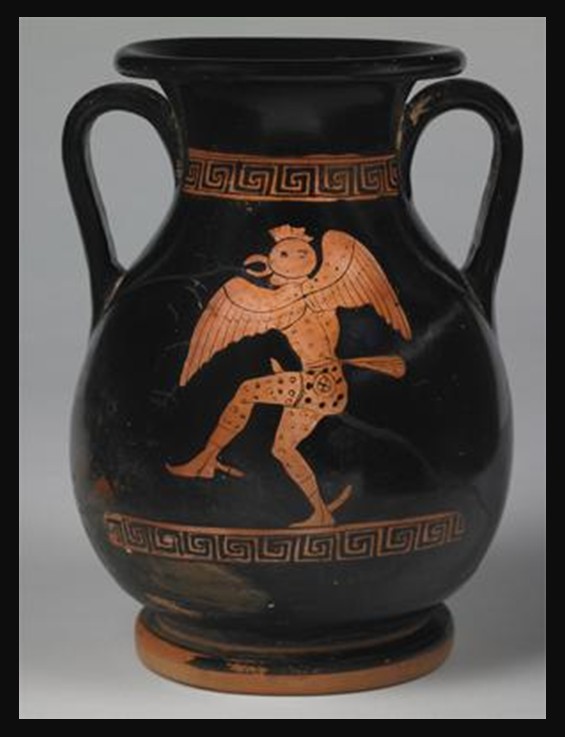
Attic red-figure ceramic pelike showing a lively scene from Greek comedy: a costumed actor in a bird (rooster) outfit with wings, tail, and a raised leg.

Pelike with an Actor Dressed as a Bird

Attic red-figure ceramic pelike showing a lively scene from Greek comedy: a costumed actor in a bird (rooster) outfit with wings, tail, and a raised leg.
Red Figure Pelike with an Actor Dressed as a Bird, 430-420 BC, Attic red-figured Pelike, Hight: 20.3 cm, , Michael C. Carlos Museum of Emory University, GA, USA https://en.wikipedia.org/wiki/Red_Figure_Pelike_with_an_Actor_Dressed_as_a_Bird

At first glance, this small Attic pelike seems playful, an oddly dressed figure, half-human and half-bird, frozen in mid-performance. Yet, the Red Figure Pelike with an Actor Dressed as a Bird (430–420 BC) offers far more than whimsy. Preserved today in the Michael C. Carlos Museum, the vase captures a moment from the theatrical world of classical Athens, where comedy, costume, and visual spectacle merged into a powerful cultural language. Read through the lens of Aristophanes’ The Birds, this modest ceramic vessel becomes a rare window into how ancient Greeks imagined performance and how costume transformed actors into living symbols on the stage.

What is the Red Figure Pelike with an Actor Dressed as a Bird? This object is a small Attic red-figure pelike, dated to around 430–420 BC, a vessel type typically used for storing liquids such as oil or wine. On its surface, however, it bears a highly unusual image: a costumed actor dressed as a bird, complete with wings, tail, and mask. Rather than depicting myth or daily life, the vase represents the world of theatrical performance, making it one of the clearest surviving visual records of ancient Greek comedy in action.

Who is depicted and why is it notable? The central figure is an actor wearing a full bird costume, most likely a rooster, while a musician on the reverse plays the double aulos. This pairing signals that we are witnessing a staged performance, not a symbolic or mythical scene. What makes the image remarkable is its specificity: it does not simply suggest theater, but shows the physical mechanics of costume, mask, and performance. The exaggerated body, feathered attachments, and theatrical posture reveal how comedy relied on visual transformation to communicate character and humor instantly.

Where and when was it made, and where is it now? The pelike was produced in Attica during the late fifth century BC, at the height of Athens’ cultural and theatrical innovation. Today, it is housed in the Michael C. Carlos Museum of Emory University in Georgia, where it stands as one of the most important visual documents of ancient Greek theater. Its survival allows us to connect literary descriptions of drama with tangible artistic evidence.

Why would a vase depict a theatrical performance? In classical Athens, theater was not merely entertainment, it was a civic and religious experience tied to festivals honoring Dionysus, the god of wine and performance. Vases used in symposia often featured Dionysian or theatrical imagery, reinforcing the link between wine, celebration, and drama. This pelike therefore functioned both as a utilitarian object and as a visual reminder of one of the most defining cultural practices of Athenian life.

How does this image connect to Aristophanes’ The Birds? Although the pelike predates Aristophanes’ The Birds (first performed in 414 BC), it reflects the same comic tradition that made such a play possible. Aristophanes famously populated his stage with costumed birds who formed a chorus and enacted a fantastical political satire. The pelike demonstrates that bird costumes were already part of the theatrical vocabulary, helping audiences recognize characters immediately and heightening the visual humor. Rather than illustrating a specific scene, the vase reveals the performative world from which The Birds emerged.

What does this tell us about ancient Greek theatrical costume? Greek comedy relied on exaggerated dress, masks, and bodily transformation. Costumes were not decorative but communicative: they defined identity, role, and tone at a glance. The bird costume on the pelike shows how actors used artificial wings, tails, masks, and footwear to create hybrid beings that were simultaneously humorous, symbolic, and instantly legible to spectators. Such visual coding was essential in large open-air theaters, where meaning had to be seen as well as heard.

Why is this pelike important for understanding ancient performance? Literary texts tell us what was said on stage; this vase shows us how performance looked. It preserves details of costume construction, posture, and stage presence that no script can convey. As a result, the pelike bridges material culture and dramatic literature, allowing us to reconstruct how comedy was embodied before an audience. It is one of the few surviving artifacts that captures the physical reality of ancient theatrical illusion.

What broader themes does this object illuminate? Beyond theater, the pelike speaks to themes of transformation, identity, and the power of visual storytelling in Greek culture. Birds, creatures that cross the boundary between earth and sky, become tools for satire and social commentary, much as they do in Aristophanes’ play. The vase also reminds us that art and performance were deeply interconnected in Athens: pottery did not merely decorate daily life, it recorded and reflected the spectacles that defined communal experience.

For a PowerPoint Presentation, titled Aristophanes, Staging Ornithes (The Birds): Art, Costume, and Performance from Antiquity to Today, please… Check HERE!

Bibliography: from the Michael C. Carlos Museum of Emory University in Atlanta https://collections.carlos.emory.edu/objects/24341/redfigure-pelike-with-actor-dressed-as-bird and Wikipedia https://en.wikipedia.org/wiki/Red_Figure_Pelike_with_an_Actor_Dressed_as_a_Bird

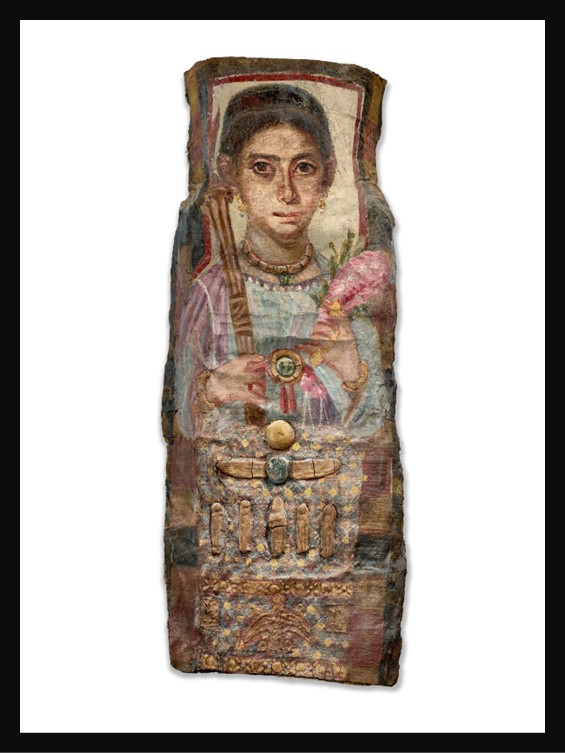
A Roman-period Fayum Mummy portrait of a young woman, painted in encaustic with gilded stucco motifs on linen. She is shown front-facing, with large dark eyes framed by heavy brows, and wears rich gold jewelry including a broad neck torque and rings.

Fayum Mummy Portraits

A Roman-period Fayum Mummy portrait of a young woman, painted in encaustic with gilded stucco motifs on linen. She is shown front-facing, with large dark eyes framed by heavy brows, and wears rich gold jewelry including a broad neck torque and rings.
Mummy Portrait of a Lady, c. 225-250 AD, Encaustic painting on linen and motifs with gilded stucco, Height: 95.8 cm, Private Collection
https://www.christies.com/en/lot/lot-6552510?ldp_breadcrumb=back

Fayum Mummy Portraits stand among the most haunting and intimate survivals of the ancient world, faces painted nearly two millennia ago that still meet our gaze with striking immediacy. Created in Roman Egypt between the 1st and 3rd centuries AD, these portraits were composed on wooden panels or linen shrouds using encaustic (hot wax) or tempera techniques. They were placed over the faces of mummified bodies, merging Egyptian funerary tradition with Roman artistic naturalism. The result is a genre unlike anything else from antiquity: individualized likenesses rendered with soft modeling, luminous skin tones, and expressive eyes that seem to bridge the divide between life and death. Their preservation owes much to Egypt’s dry climate, allowing modern viewers to experience a rare continuity with people of the distant past.

The Painted Linen and Stucco Mummy Portrait of a Woman dated to circa 225–250 A.D., offered through Christie’s, illustrates the sophistication of the tradition at its height. The figure is richly adorned, holding symbolic objects and framed by an intricate blend of painting and molded stucco work that elevates the shroud from a simple funerary covering to a deeply personal memorial. Details such as jewelry, garments, and ritual motifs reflect both the sitter’s status and the multicultural world of Roman-period Egypt. As archaeological evidence and scientific study continue to expand our understanding of these portraits, each example adds to the compelling story of identity, memory, and artistry in an era where cultures converged along the Nile.

The Meaning and Symbolism of Fayum Mummy Portraits

It is within this broader cultural and artistic landscape that Antinoöpolis, founded by Emperor Hadrian around 130 AD, emerges as a particularly important center of production. Situated on the east bank of the Nile, the city became renowned for its distinctive mummy portraits, many of which were uncovered during Albert Gayet’s excavations between 1896 and 1911. These shrouds share a recognizable aesthetic: expressive eyes, refined brushwork, and a fusion of Roman naturalism with Egyptian funerary tradition. The portrait discussed here aligns closely with this Antinoöpolitan style, leading art historian D. L. Thompson to attribute it to the hand of “Painter L,” a talented artist, or workshop, active in the city during the 2nd and 3rd centuries AD. Thompson identified hallmark traits such as large, dark, almond-shaped eyes and strong arched brows, features also seen in works now housed in the Louvre and the Benaki Museum. This connection situates the Christie’s portrait firmly within one of the most accomplished artistic traditions of Roman Egypt.

The refined style associated with Antinoöpolis is matched by the remarkable richness of the portrait’s iconography, which conveys the high social status of the woman depicted. Her gold jewelry is rendered with particular care: a heavy torque set with what may be a beryl stone, a prominent round brooch or buckle, and multiple rings that shimmer against her fingers. Gilding highlights additional decorative elements on the lower body, including applied stucco figures such as a winged sun-disk and standing deities interpreted as the four sons of Horus, underscoring the fusion of wealth, protection, and sacred symbolism. Even more striking is the object held in her right hand, interpreted by Ortiz-García as a torch linked to the underworld’s darkness, suggesting a possible identification of the deceased with Isis-Demeter, and by extension with the Pharaonic harvest deity Renenutet. In her left hand, a vivid pink funerary wreath provides a more conventional attribute for this category of shrouds. Together with the Osirian elements surrounding her, an implied chapel setting, gilded uraei once crowning the composition, and a bead-net motif recalling ancient faience networks, the portrait presents a powerful, multilayered vision of the deceased as both an elite woman of Roman Egypt and a figure ritually transformed for eternal life.

For a PowerPoint Presentation on Fayum Mummy Portraits, please… Click HERE!

Bibliography: From the Christie’s site https://www.christies.com/en/lot/lot-6552510?ldp_breadcrumb=back and from the J. Paul Getty Museum chrome-extension://efaidnbmnnnibpcajpcglclefindmkaj/https://www.getty.edu/publications/resources/virtuallibrary/0892360380.pdf