Bridges of Light

James Abbott McNeill Whistler, American, 1834-1903
Nocturne in Blue and Gold: Old Battersea Bridge,
1872, Oil on canvas, 66,6×50,2 cm, TATE Gallery, UK
https://www.tate.org.uk/art/artworks/whistler-nocturne-blue-and-gold-old-battersea-bridge-n01959
Utagawa Hiroshige, Japanese,1797-1858
Bamboo Yards, Kyōbashi Bridge (12th Month, 1857), from the series One Hundred Famous Views of Edo, ca. 1856–58, Color woodblock print, 36×24.1 cm, The Art Institute, Chicago, USA
https://www.artic.edu/artworks/26522/fireworks-at-ry%C5%8Dgoku-ry%C5%8Dgoku-hanabi-from-the-series-one-hundred-famous-views-of-edo-meisho-edo-hyakkei

Bridges of Light – they often symbolize connection between places, people, or moments in time. In art, they also link the visible world to the realm of mood and imagination. Two works from opposite sides of the globe, James McNeill Whistler’s Nocturne in Blue and Gold: Old Battersea Bridge (1872–75) and Utagawa Hiroshige’s Bamboo Yards, Kyōbashi Bridge (1857), both turn the humble bridge into something poetic and transcendent. Though separated by culture, medium, and intention, they share an atmospheric stillness that invites reflection on light, water, and the human gaze.

James McNeill Whistler’s Nocturne in Blue and Gold: Old Battersea Bridge captures London at night as a mysterious symphony of blue and shadow. Painted around 1872, this oil on canvas is part of Whistler’s celebrated “Nocturne” series, works that sought to translate the visual world into the language of music.

The scene is minimal: a great wooden bridge looms above the Thames, faint figures hover on its span, fireworks flicker faintly in the distance. Yet what dominates is not the structure, but the atmosphere, a veil of misty blue punctuated by golden glimmers. Whistler strips away narrative detail, emphasizing mood over subject. His soft brushwork and tonal harmony evoke a world on the edge of visibility, where city lights dissolve into the haze.

At the time, such abstraction was revolutionary. Critics like John Ruskin accused Whistler of “flinging a pot of paint in the public’s face,” prompting a famous libel trial. Yet today, this painting stands as a precursor to modernism, an early exploration of how color and composition can convey emotion without storytelling. Whistler’s bridge is not merely an urban landmark, it’s a threshold between reality and reverie.

Two decades earlier and half a world away, Utagawa Hiroshige portrayed another bridge, Kyōbashi, in the bustling city of Edo (modern Tokyo). His Bamboo Yards, Kyōbashi Bridge (12th Month, 1857) is one print from the masterful series One Hundred Famous Views of Edo, now in the Brooklyn Museum’s collection.

In this woodblock print, Hiroshige depicts a tranquil night scene: a full moon floats above a canal, wooden boats drift silently, and stacked bamboo poles line the riverbank. The bridge arches gently across the upper plane, connecting neighborhoods as the water reflects the glow of the winter sky. The composition is crisp and balanced, geometric lines meet fluid curves, and the print’s limited palette of cool blues and pale whites creates a luminous serenity.

Unlike Whistler’s subjective haze, Hiroshige’s clarity celebrates the harmony between city and nature. His mastery of linear perspective and color gradation (bokashi) guides the viewer’s eye into the depth of Edo’s nocturnal calm. The work belongs to the ukiyo-e (“pictures of the floating world”) tradition, art that captured fleeting, beautiful moments of everyday life. Yet even here, amid bamboo yards and bridges, Hiroshige evokes something timeless: the poetry of stillness.

Though born of different worlds, Meiji-era Japan and industrial London, both works share an extraordinary sensitivity to atmosphere and light. Whistler’s oil painting and Hiroshige’s woodblock print each transform an urban bridge into a site of contemplation.

Whistler’s Nocturne immerses us in ambiguity and mood. His blues blur edges and forms, inviting emotion over clarity. Hiroshige’s Kyōbashi Bridge, by contrast, sharpens detail within calm order. Yet both convey the quiet beauty of the city at rest, a pause between day and night, motion and stillness.

There is also an intriguing link between the two artists. Western painters like Whistler were profoundly influenced by Japanese art during the late 19th century, a movement known as Japonisme. Whistler himself admired Hiroshige’s prints and adopted their compositional daring: asymmetry, flattened perspective, and the focus on atmospheric tone. In a sense, Whistler’s London nocturne owes a debt to the poetic precision of Edo’s floating world.

In both images, light and water serve as mirrors, literal and symbolic. Hiroshige’s canal reflects the moon’s glow, while Whistler’s Thames glimmers with distant sparks. Each artist invites us to linger in that reflection, to sense the beauty that lies between visibility and suggestion.

The choice of medium also shapes the experience. Hiroshige’s woodblock print, with its clean contours and delicate color transitions, feels crafted, meditative, and reproducible, designed for an audience that cherished everyday beauty. Whistler’s oil painting, on the other hand, is singular and subjective, the result of layered pigment and a painter’s improvisation. Both reveal how material and method can express different kinds of intimacy with the world.

Bridges are not only physical crossings but metaphors for transition, between places, cultures, or even states of mind. In Nocturne in Blue and Gold, Whistler transforms London’s industrial river into a space of mood and mystery. In Bamboo Yards, Kyōbashi Bridge, Hiroshige turns Edo’s night into a vision of harmony and calm.

Viewed together, these two works form a quiet dialogue across continents. One whispers through mist, the other gleams under moonlight, yet both remind us that art’s greatest power lies in its ability to make the familiar shimmer anew.

For a PowerPoint Presentation on James McNeill Whistler’s art and Ukiyo-e Japanese Prints, please… Check HERE!

Bibliography: https://www.tate.org.uk/art/artworks/whistler-nocturne-blue-and-gold-old-battersea-bridge-n01959 and https://www.brooklynmuseum.org/objects/121690

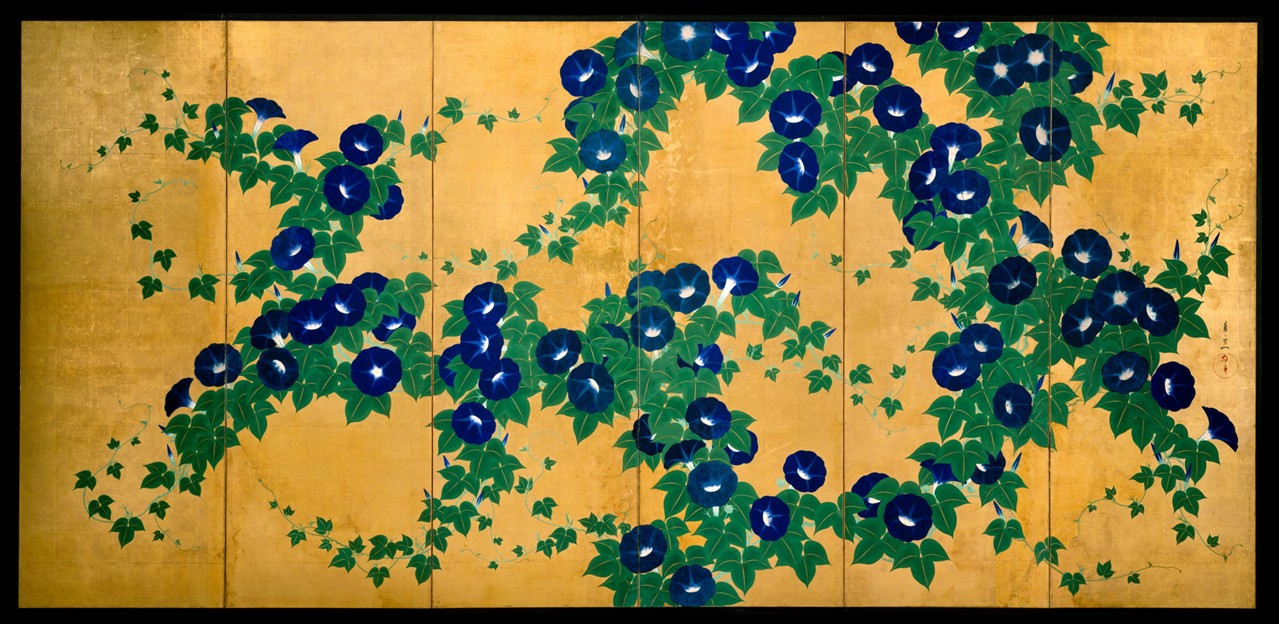
Morning Glories by Suzuki Kiitsu

Morning Glories by Suzuki Kiitsu, Japanese Edo period artist (1796–1858), six-panel folding screens with ink, color, and gold leaf on paper, The Met Museum, New York, USA
https://www.metmuseum.org/art/collection/search/48982

Morning Glories by Suzuki Kiitsu, a stunning pair of early 19th-century six-panel folding screens housed in The Met, exemplifies the lyrical elegance of the Rinpa school. Against a backdrop of luminous gold leaf, the Morning Glory vines unfurl in rhythmic cascades, their delicate blooms appearing both vibrant and contemplative. Kiitsu’s masterful use of space, color, and pattern invites a meditative gaze, blurring the boundary between nature and design. The screens evoke a quiet moment suspended in time, one that inspired the haiku: Bound in gilded calm, / the morning glories whisper / secrets to the sun. Through this intricate dialogue between natural form and artistic restraint, Kiitsu offers more than decorative beauty, he captures the ephemeral grace of a single September morning made eternal.

Suzuki Kiitsu was a prominent Japanese painter of the Edo period and a leading figure of the Rinpa school of painting. Born in Edo, modern-day Tokyo, Kiitsu was a devoted student of Sakai Hōitsu, who revived and expanded the decorative Rinpa tradition established by artists like Ogata Kōrin and Tawaraya Sōtatsu. After Hōitsu’s death, Kiitsu continued his teacher’s legacy while developing a distinct personal style. He became known for his screen paintings and nature studies that combined bold design with subtle naturalism. Despite being less internationally known than his predecessors, Kiitsu is celebrated in Japan for refining the Rinpa aesthetic with a fresh sensitivity and technical finesse.

Kiitsu’s work is characterized by luminous color, rhythmic composition, and a heightened attention to seasonal motifs such as flowers, birds, and flowing water. His celebrated screen paintings, including Morning Glories, demonstrate his skill in transforming natural subjects into elegant, almost abstract patterns while maintaining a sense of stillness and harmony. He often employed gold or silver leaf backgrounds, setting ephemeral flora against timeless, radiant fields, a hallmark of Rinpa visual poetry. Kiitsu’s legacy rests in his ability to balance reverence for tradition with individual innovation, securing his place as a master of Japanese decorative painting.

The Rinpa school of art, sometimes spelled Rimpa, originated in early 17th-century Kyoto and is one of the most influential styles in traditional Japanese painting. It began with Tawaraya Sōtatsu, who was known for his elegant, stylized depictions of classical literature and nature, often painted on folding screens and fans. A century later, Ogata Kōrin revitalized the style, blending Sōtatsu’s decorative sensibility with a more dramatic use of color, form, and rhythm. Rinpa artists were not part of a formal lineage but were connected by shared aesthetic values, including the use of gold or silver leaf backgrounds, flattened perspective, and an emphasis on seasonal or poetic themes drawn from classical Japanese literature and waka poetry.

The term “Rinpa” itself combines “Rin” from Kōrin and “pa”, meaning “school”, coined much later to describe this loosely associated group of artists. Rinpa works often merge painting, calligraphy, and design, revealing a sophisticated balance between abstraction and representation. While the style was deeply rooted in Japanese tradition, it also showed openness to Chinese and Korean influences in brushwork and composition. Suzuki Kiitsu, working two centuries later, was part of a later Edo-period revival of Rinpa led by Sakai Hōitsu. Though removed in time, Kiitsu embraced and expanded Rinpa’s visual language, ensuring its continued vitality and influence into the modern era.

Morning Glories is a monumental pair of six‑panel folding screens, a byōbu, crafted with ink, color, and gold leaf on paper. The work creates a vivid, expansive field in which rich blues and greens of Morning Glory blossoms emerge from a radiant gold-leaf ground. Kiitsu omits any spatial context or background elements, concentrating instead on the lush proliferation of flowers and leaves. The blossoms on the right screen rise upward from the ground, while those on the left cascade down, as if held by an invisible trellis, a composition that balances exuberance with careful orchestration.

This screen set reflects Kiitsu’s dual influences: trained as a textile dyer and a pupil of Sakai Hōitsu, he skillfully merges decorative pattern sensibility with naturalistic rendering. The thick, mineral pigments against the gold leaf evoke the luxurious surface of textiles, while subtle attention to botanical form ensures each petal and vine feels believable and dynamic. The tension between decorative abstraction and natural realism is characteristic of Rinpa aesthetics, yet in this work Kiitsu brings a fresh vision, his Morning Glories are botanical yet stylized, rhythmic yet alive. As a signature masterpiece of the Edo‑period Rinpa revival, these screens embody both opulent décor and quiet botanical poetry.

As a fitting close to this meditation on Suzuki Kiitsu’s Morning Glories, it is worth noting that the morning glory is the traditional birth flower of October, a symbol of fleeting beauty, affection, and renewal. In Kiitsu’s masterful screens, this humble bloom becomes a grand subject, elevated through shimmering gold and rhythmic composition into something timeless. The flower’s delicate form and brief bloom are captured in suspended motion, embodying both the transience of nature and the elegance of Edo-period design. In this radiant work, Kiitsu not only honors the spirit of the Rinpa school but also transforms a seasonal motif into a lasting celebration of life’s quiet, impermanent grace.

For a Student Activity, inspired by the MET folding screen titled Morning Glories by Suzuki Kiitsu, please… Check HERE!

Bibliography: https://www.metmuseum.org/art/collection/search/48982

Teika’s Poems for the Twelve Months presented by Tosa Mitsunari

Tosa Mitsunari, Japanese Artist, 1646-1710
Teika’s Poems for the Twelve Months, Edo period (1603-1868), 1646-1710, ink, color and gold leaf on paper, six-fold screen, 170.18x 61.92 cm (each panel), Indianapolis Museum of Art, USA
https://commons.wikimedia.org/wiki/File:Tosa_Mitsunari_-_Teika%27s_Poems_for_the_Twelve_Months_-_2000.9_-_Indianapolis_Museum_of_Art.jpg

Before my eyes / the snowflakes fall upon the icy pond / piling up like the years gone by / like the layered feather coats of the oshi… wrote Fujiwara Teika back in 1214. Many years later Fujiwara Teika’s Poems for the Twelve Months presented by Tosa Mitsunari delight us with their elegance and beauty! http://collection.imamuseum.org/artwork/55793/

Who is Fujiwara Teika? Fujiwara Sadaie, also called Teika, or Fujiwara Teika, (born 1162, Japan—died Sept. 26, 1241, Kyōto), is one of the greatest poets of his age and Japan’s most influential poetic theorists and critics until modern times. The son of a great poet, Shunzei (or Toshinari, 1114–1204), Teika surpassed his father’s literary legacy and raised his family in political importance. His literary talent attracted the attention of retired emperor Go-Toba (1180–1239), who appointed him, in 1205, one of the compilers of the eighth Imperial anthology Shin kokinshū (c. 1205, “New Collection of Ancient and Modern Times”), and in 1232, sole compiler of the ninth anthology, Shin chokusenshū (1235; “New Imperial Collection”). This is a great accomplishment and honour. https://www.britannica.com/biography/Fujiwara-Sadaie

Who is Tosa Mitsunari? Tosa Mitsusuke (1675–1710) was a Japanese artist of the Edo era. In 1696, as the 18th head of the Tosa school of painting, Mitshunari was appointed  Official Court Painter with duties to serve the Emperor. He worked for the Imperial Official Bureau of Painting and managed to revive his family’s political and economic fortunes. In 1709, he did paintings of room partitions in the royal palace and in the Sento palace with Kano Tsunenobu. Mitsuoki was known for reintroducing the Yamato-e style and reviving the Tosa school of painting. He painted delicate bird-and-flower (kacho) paintings in the Chinese court manner and was especially noted for his precise depictions of quail. https://prabook.com/web/tosa.mitsuoki/3742785 and https://en.wikipedia.org/wiki/Tosa_Mitsusuke

Tosa Mitsunari, Japanese Artist, 1646-1710
Teika’s Poems for the Twelve Months, Edo period (1603-1868), 1646-1710, ink, color and gold leaf on paper, six-fold screen, 170.18x 61.92 cm (each panel), Indianapolis Museum of Art,
https://www.artsy.net/artwork/tosa-mitsunari-teikas-poems-for-the-twelve-months

How are a poet and a painter connected in art? Japanese secular painting and poetry walk side by side. Poets composed verses about images in paintings and painters made works based on poems and inscribed them with erudite calligraphy, or pasted a poem in elegant characters onto the painting. The resulting synthesis exceeded the sum of the parts, creating many layers of meaning. http://collection.imamuseum.org/artwork/55793/

Tosa Mitsunari, Japanese Artist, 1646-1710
Teika’s Poems for the Twelve Months, Edo period (1603-1868), 1646-1710, ink, color and gold leaf on paper, six-fold screen, 170.18x 61.92 cm (each panel), Indianapolis Museum of Art,
https://commons.wikimedia.org/wiki/File:Tosa_Mitsunari_-_Teika%27s_Poems_for_the_Twelve_Months_-_2000.10_-_Indianapolis_Museum_of_Art.jpg

Are Fujiwara Teika’s Poems for the Twelve Months painted by Tosa Mitsunari in the Indianapolis Museum of Art Screen an example of artistic collaboration? Yes, the Indianapolis Screen is a perfect example. The pair of six-fold screens in the Indianapolis Museum masterfully combines landscape painting and poetic texts. The texts, poems by Fujiwara Teika, subtly express emotions through metaphors of nature. The imagery, a typical landscape by Tosa Mitsunari, celebrates the changing aspect of nature. The depicted months are numbered according to the lunar calendar, and the first month, presented in the first panel, roughly corresponds to February. http://collection.imamuseum.org/artwork/55793/

For a Student Activity inspired by the Indianapolis Museum Japanese Screens, please… Check, HERE!