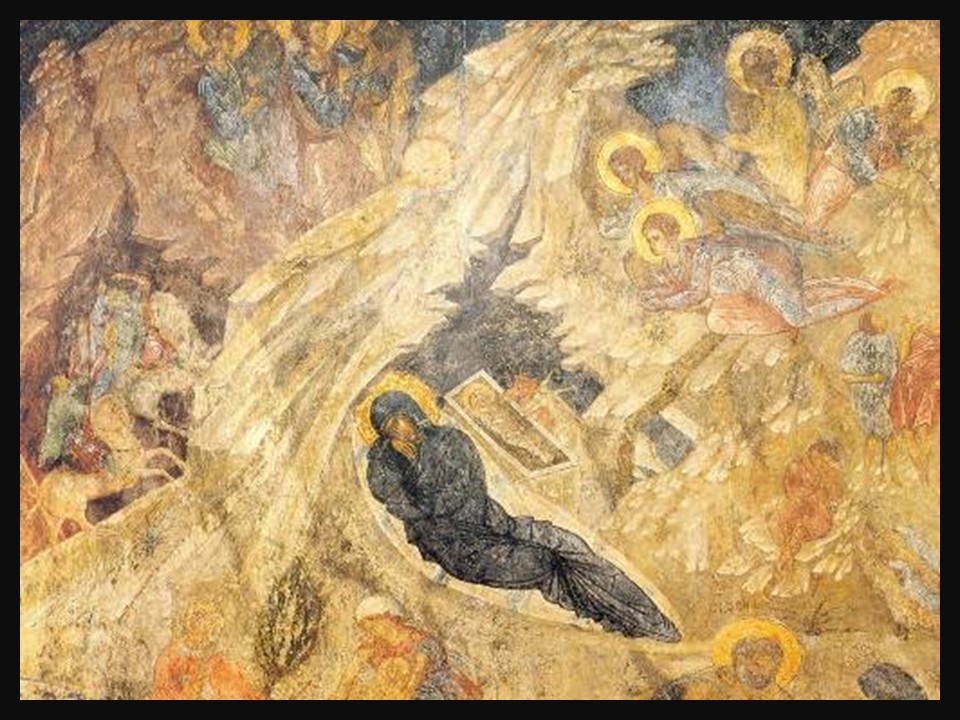
Byzantine fresco of the Nativity in the Perivleptos Monastery Katholikon at Mystra, showing the Virgin Mary reclining and the infant Jesus in a cave-like setting, surrounded by haloed figures and a rocky landscape rendered in rich, earth-toned pigments typical of 14th-century Orthodox iconography.

The Nativity Fresco of Peribleptos Monastery in Mystra

Byzantine fresco of the Nativity in the Perivleptos Monastery Katholikon at Mystra, showing the Virgin Mary reclining and the infant Jesus in a cave-like setting, surrounded by haloed figures and a rocky landscape rendered in rich, earth-toned pigments typical of 14th-century Orthodox iconography.
Nativity Scene, Peribleptos Monastery, circa 1348/80, Mystras, Greece
https://eclass.uoa.gr/modules/document/file.php/ARCH396/Didaktiko%20yliko/PanKal997.htm

The Nativity Fresco of Peribleptos Monastery in Mystras captures the spiritual heart of the season through the radiant artistry of Byzantine devotion. High on the slopes of Mistra, within the Monastery of Perivleptos, the Nativity scene painted across its frescoed walls unfolds as a vivid testament to Byzantine spirituality and artistic mastery. Created in the 14th century, this depiction of Christ’s birth captures both the human tenderness and divine mystery central to Orthodox faith. Beneath the soft light filtering through the dome windows, figures of Mary, Joseph, angels, and shepherds converge around the newborn Christ, embodying a theology of incarnation rendered through luminous color and sacred geometry. As we celebrate Christmas Day 2025, this fresco invites reflection on how art can transform stone and pigment into a living proclamation of hope and transcendence.

Mystras and the Late Byzantine World

Mystras, located near ancient Sparta in the Peloponnese, was one of the most significant centers of the late Byzantine Empire, flourishing between the 13th and 15th centuries. Established by the Franks in 1249 and later reclaimed by the Byzantines, it became the capital of the Despotate of the Morea, a major political, intellectual, and artistic hub during Byzantium’s final centuries. The city’s fortified acropolis, palaces, monasteries, and churches, including the Peribleptos, Pantanassa, and Hodegetria to mention just three, reveal a remarkable synthesis of political power and cultural refinement. Mystras nurtured a vibrant artistic school known for its refined frescoes and architecture, which combined classical Byzantine traditions with new stylistic developments that prefigured aspects of the Renaissance. Today, Mystras stands as a UNESCO World Heritage Site, representing the last brilliant flowering of Byzantine art and spirituality before the empire’s fall.
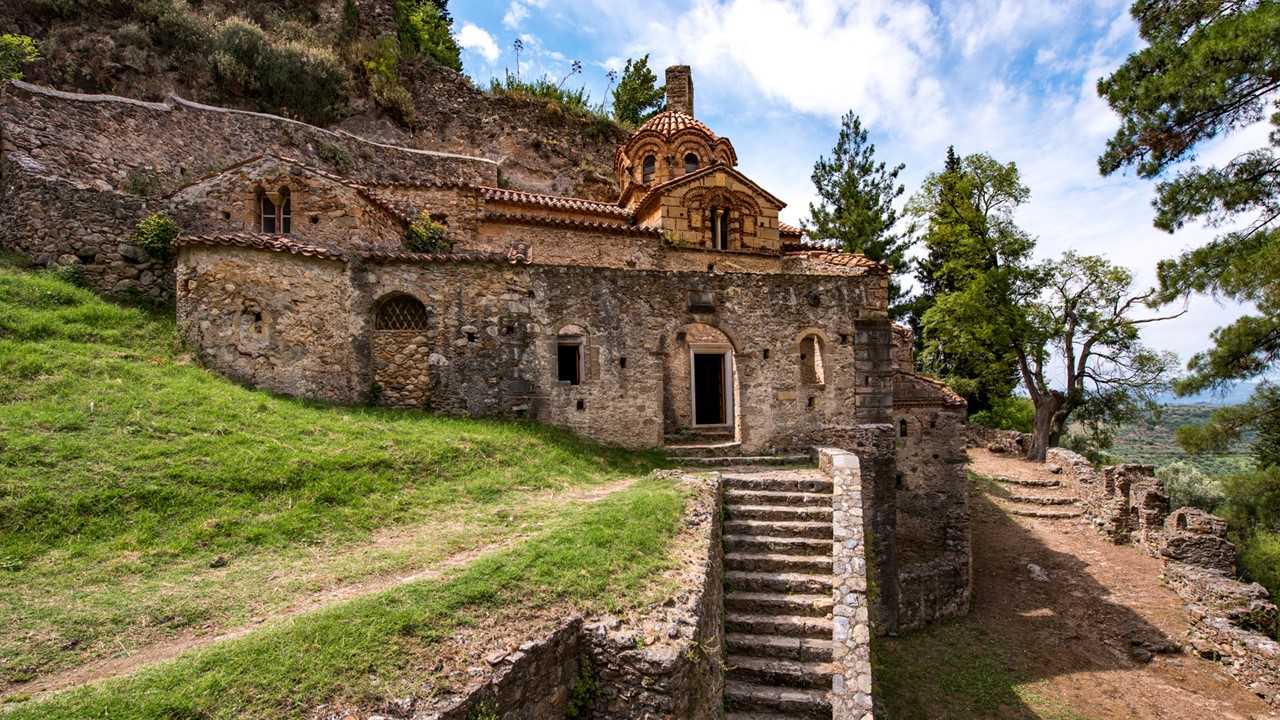
Exterior view of the Perivleptos Monastery Katholikon in Mystras, showing the late Byzantine stone and brick church built into the side of a cliff with its rugged masonry walls, traditional pitched roof, and adjacent tower and monastic buildings under a clear sky, reflecting its 14th-century Mystras architectural style and historic setting on the hillside.
Peribleptos Monastery, circa 1348/80, Mystras, Greece
https://www.religiousgreece.gr/en/attractions/monastery-perivleptos

Late Byzantine Frescoes of Peribleptos

Among its most notable monuments, the Katholikon (main church) of the Peribleptos (Perivleptos) Monastery was founded in the mid-14th century, most scholars attribute its patronage to the first Despot of the Morea, Manuel Kantakouzenos, and his wife Isabella (Isabelle) de Lusignan. Built into the southeast slope of the town and partly supported by a cave, the church is a two-column cross-in-square plan that exemplifies the local “Mystras style,” with squared stone and inlaid tilework that give the exterior a fortress-like appearance. Its dating is commonly placed around the 1350s–1370s, when Mystras was a lively cultural and political center of the late Byzantine Peloponnese.

The interior is celebrated for an extensive and unusually well-preserved cycle of late Byzantine frescoes (mid-14th century) that focus especially on the life of the Virgin and key Gospel scenes, paintings that art historians link stylistically to Cretan and Macedonian workshops and that show Palaeologan-era innovations in space and movement. Because these frescoes survive largely in situ, the Peribleptos Katholikon is considered crucial for understanding late Byzantine painting and the artistic renaissance in the Morea; the whole site of Mystras is protected for its outstanding medieval ensembles.
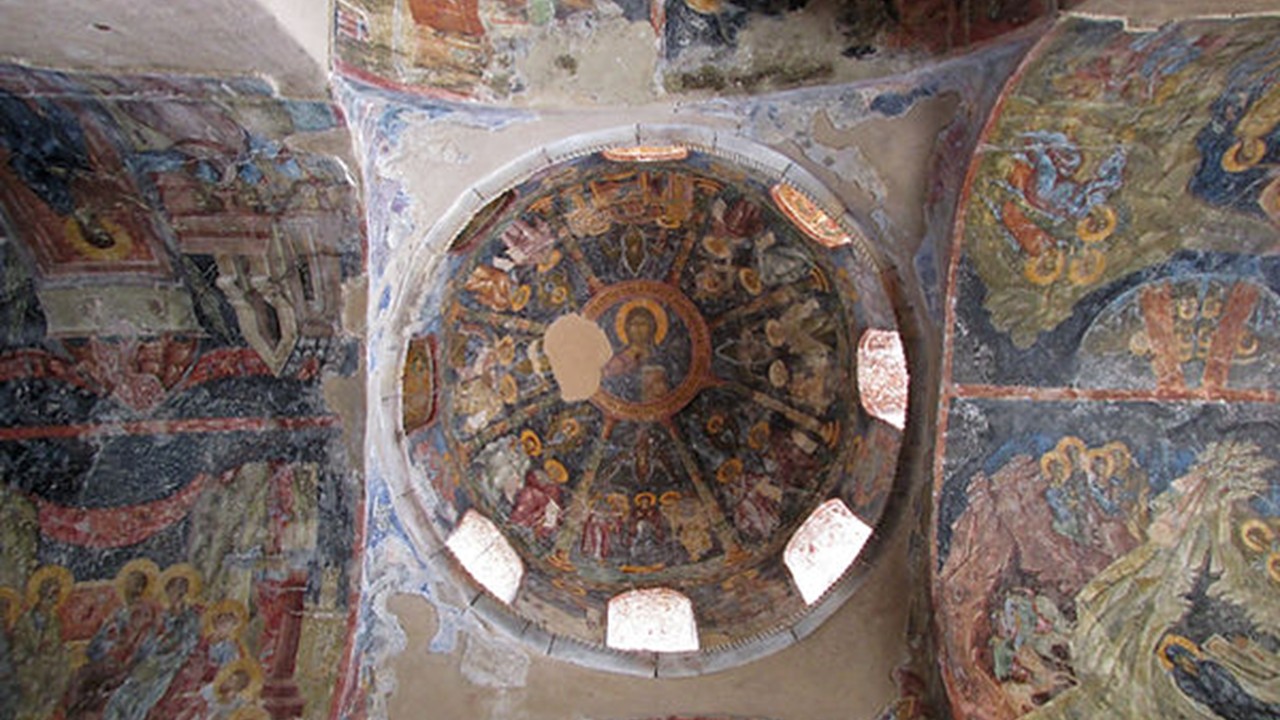
Interior view of the frescoed roof (dome) of the Katholikon at Perivléptos Monastery, showing the large central image of Christ Pantokrator (Christ as ruler of all) within the dome, painted in vivid colors on the curved vaults of this 14th-century church interior.
Peribleptos Monastery frescoes, circa 1348/80, Mystras, Greece
https://www.thebyzantinelegacy.com/peribleptos-mystras

The Nativity Fresco at Peribleptos

The Nativity scene in the Peribleptos Monastery at Mystra stands as one of the most evocative frescoes of the late Byzantine period, part of the church’s rich Christological cycle. Depicted with serene grace and otherworldly poise, the Virgin reclines beside the Christ Child in a rocky grotto, encircled by Joseph, the Magi, shepherds, and angels—each slender figure animated by elegant gestures and expressive faces. The artist achieves a vivid harmony of color and form, combining traditional Byzantine iconography with a confident, freer sense of spatial rhythm. The layered landscape, luminous tones, and effortless authority of each depiction reveal the maturity of the Mystras school, whose refinement would profoundly influence the later Cretan School of icon painters.

Aesthetically, the Nativity fresco exemplifies the serene elegance and emotional subtlety of late Byzantine art at its height. The soft modulation of color—from deep blues and warm ochres to pale rose and gold—infuses the composition with both tenderness and transcendence. Figures are modeled with a supple handling of light and shadow that departs from earlier rigidity, achieving a lyrical balance between solemnity and grace. This confident, almost Renaissance sensibility anticipates the stylistic currents that would flow from Mystras to Crete and, ultimately, to Venice. Through this luminous synthesis of theology and beauty, the Peribleptos Nativity becomes not merely a devotional image but a harbinger of artistic renewal across the Mediterranean world.

As we celebrate Christmas Day 2025, the Nativity fresco at Peribleptos reminds us that the story of Christ’s birth continues to inspire wonder, devotion, and artistic creation across the centuries. Just as the figures in the fresco gather around the newborn Savior, we too are invited to pause, reflect, and share in the warmth, hope, and light that this holy day brings. In the quiet glow of candlelight or the brilliance of a winter sunrise, the spirit of Mystra endures, connecting past and present in a timeless celebration of faith and beauty.

Explore further: Download our PowerPoint Presentation on the Byzantine Monuments of Mystras for educators, students, and art lovers… HERE!

Bibliography: analysed in detail by The Byzantine Legacy: https://churchesingreece.blogspot.com/2014/07/mystras-peribleptos.html and in Greek https://www.ime.gr/choros/mystras/gr/E/14E/14E12.html
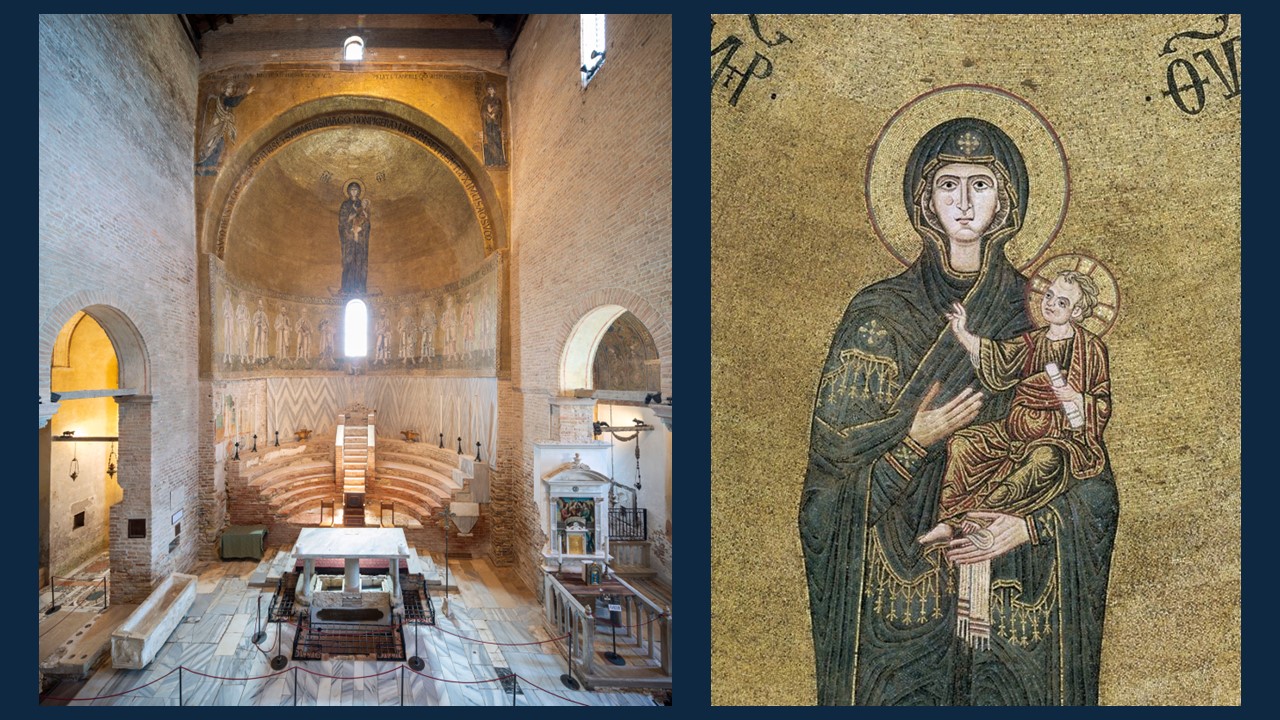
The Torcello Hodegetria

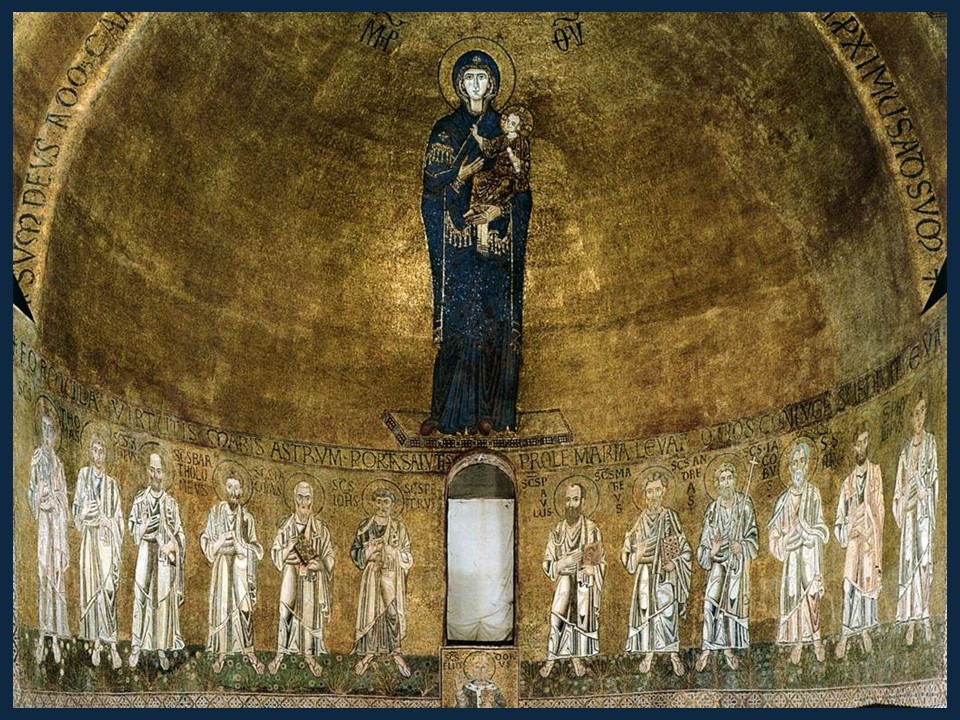
Cathedral of Santa Maria Assunta in Torcello, View of the Apse with the Mosaics of the Annunciation at the very top, the Hodegetria, and the Apostles, 11th century, Torcello, Italy http://www.thehistoryblog.com/archives/date/2020/10/06 and https://gr.pinterest.com/pin/642677809300738057/

Torcello was the mother-city of Venice, and she lies there now, a mere mouldering vestige, like a group of weather-bleached parental bones left impiously unburied. […] The church, admirably primitive and curious… is rich in grimly mystical mosaics of the twelfth century and the patchwork of precious fragments in the pavement not inferior to that of St. Mark’s… Torcello, like the Lido, has been improved; the deeply interesting little cathedral of the eighth century, which stood there on the edge of the sea, as touching in its ruin, with its grassy threshold and its primitive mosaics, as the bleached bones of a human skeleton washed ashore by the tide, has now been restored and made cheerful, and the charm of the place, its strange and suggestive desolation, has well-nigh departed… wrote Henry James in Italian Hours. Fifteen years back when I first visited Torcello, the deeply interesting little cathedra was restored and cheerful and the mosaic of The Torcello Hodegetria… a sight I will never forget! https://www.online-literature.com/henry_james/italian-hours/1/ and https://www.museodelcamminare.org/progetti/re_iter/james/james_en.html

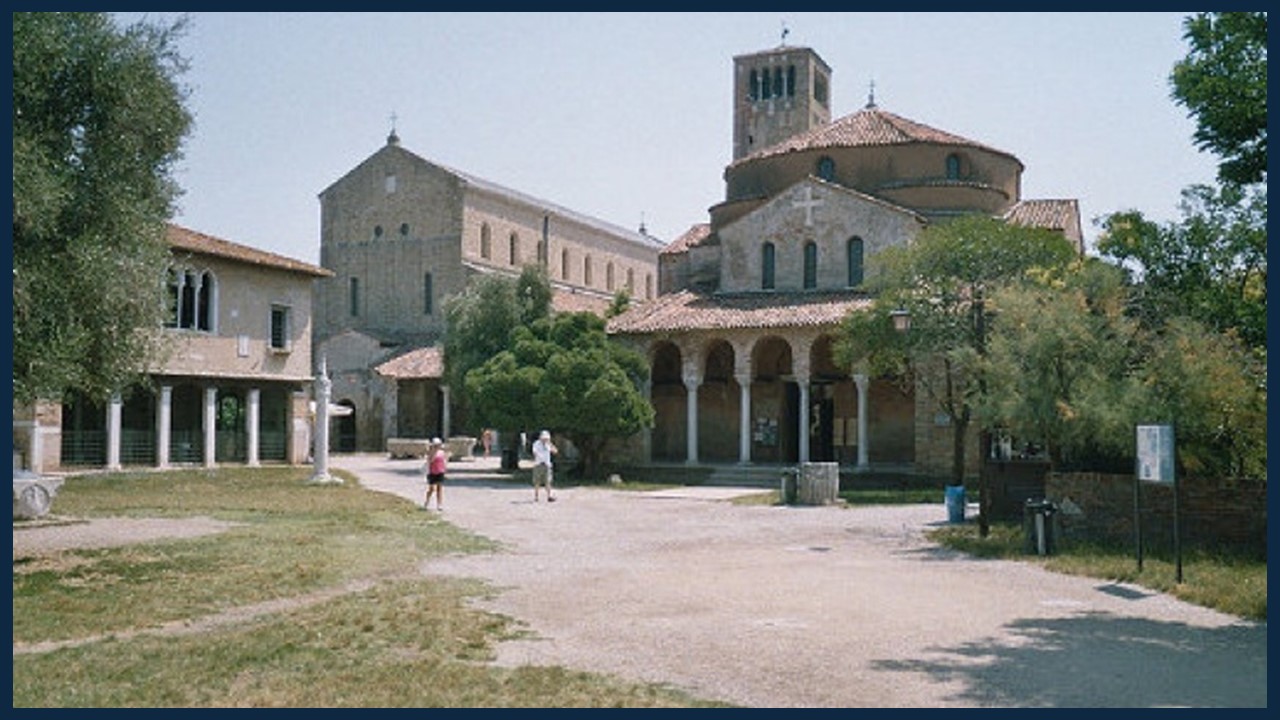
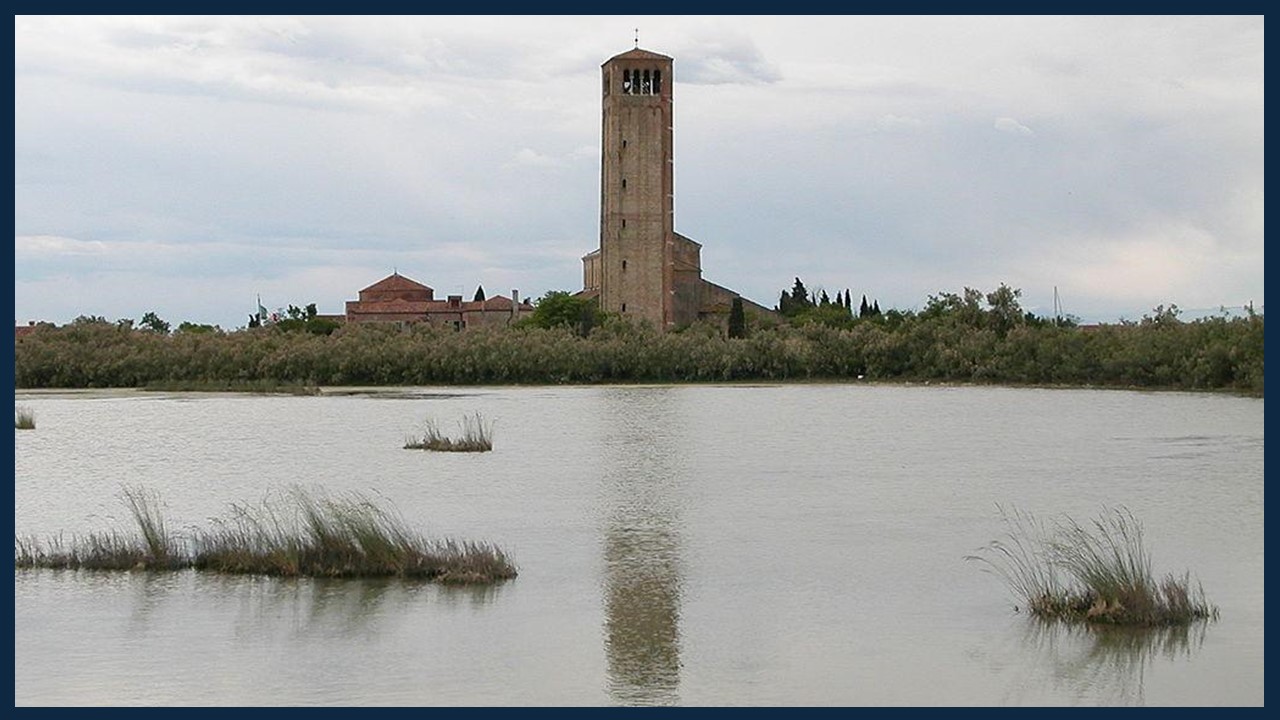
Torcello Island, View of the Cathedral of Santa Maria Assunta, the Church of Santa Fosca, and the Torcello Museum, Italy https://events.veneziaunica.it/content/basilica-santa-maria-assunta

The island of Torcello, situated in the northern part of the Venetian Lagoon, holds a significant place in the history of Venice. Established around the 5th century, Torcello is one of the earliest lagoon islands to be populated, serving as a refuge for people fleeing barbarian invasions on the mainland. During its peak in the early Middle Ages, it was a thriving center of commerce and culture, surpassing Venice in both size and influence. The island is renowned for its historic landmarks, particularly the Cathedral of Santa Maria Assunta, which dates back to 639 AD and houses some of the finest Byzantine mosaics in Italy. Despite its decline in later centuries due to malaria and the silting up of its canals, Torcello remains a captivating testament to the early development and artistic heritage of the Venetian Lagoon.

The island boasts several remarkable monuments that reflect its rich history and cultural heritage. The centerpiece is the Cathedral of Santa Maria Assunta, founded in 639 AD, and renowned for its stunning Byzantine mosaics. Adjacent to the Cathedral is the Church of Santa Fosca, a beautiful example of Byzantine-Romanesque architecture, built in the 11th century. Another notable structure is the Torcello Museum, housed in two historic buildings, the Palazzo dell’Archivio and the Palazzo del Consiglio, which display a fascinating collection of archaeological finds and medieval artefacts. The iconic Attila’s Throne, a stone chair of uncertain origin traditionally linked to the legendary Hun leader, and the ancient Devil’s Bridge, known for its distinctive shape and mysterious legends, further enrich Torcello’s historical landscape, making the island a captivating destination for history enthusiasts and travellers alike.

The Cathedral of Santa Maria Assunta, founded in 639 AD, and renovated in 1008 by its bishop, Orseolo, whose father was the Doge of Venice, stands as a magnificent testament to early Venetian history and Byzantine artistry. As the oldest cathedral in the Venetian Lagoon, it embodies a rich blend of architectural and cultural influences. The cathedral is particularly renowned for its exquisite mosaics, which date back to the 11th century. These mosaics include an imposing depiction of the Last Judgment and a majestic image of the Virgin Hodegetria. The cathedral’s ancient structure, with its elegant apse, Iconostasis, marble columns, incredible mosaic floor, and serene ambience, offers a glimpse into the early Christian art and architecture that once flourished in the region. Over the centuries, the Cathedral of Santa Maria Assunta has remained a vital link to the past, drawing visitors who seek to experience its historical and spiritual significance.

Virgin holding the Christ-Child with eleven of the apostles and St Paul, 11th century, Mosaic, Cathedral of Santa Maria Assunta, Cathedral of Santa Maria Assunta, Torcello, Italy https://www.walksinrome.com/italy-venice-torcello-santa-maria-assunta.html

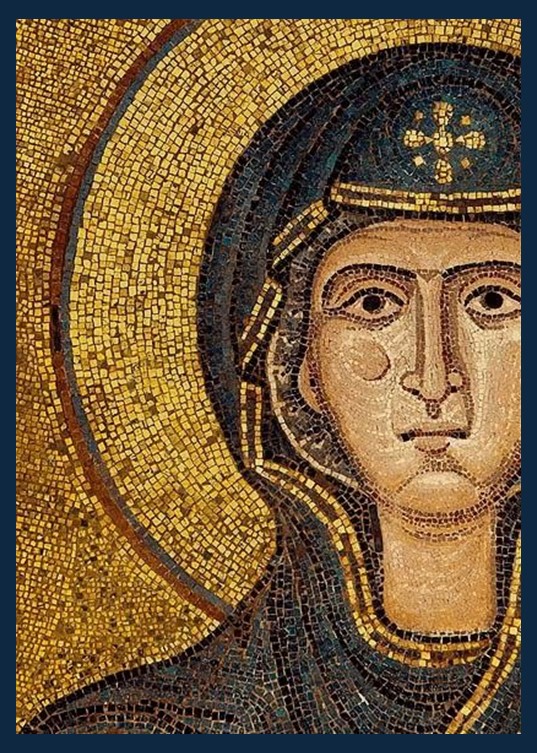
The apse mosaic in the Cathedral of Santa Maria Assunta on Torcello island is a stunning masterpiece of Byzantine art, featuring the Hodegetria and the Apostles. The central figure of the Virgin Mary, depicted as the Hodegetria, stands with the Christ Child on her arm against a shimmering gold background, guiding the faithful with her serene yet commanding presence. The Hodegetria, wrapped in precious garments, and labelled in Greek, emphasises both the universal and local significance of the imagery. Below this scene, are the twelve Apostles including Saint Paul, each rendered with distinctive expressions and postures, symbolizing the foundation of the Christian Church. The Triumphal arch above showcases the Annunciation, with Gabriel and Mary on opposite sides.

Virgin holding the Christ-Child with eleven of the apostles and St Paul, 11th century, Mosaic, Cathedral of Santa Maria Assunta, Cathedral of Santa Maria Assunta, Torcello, Italy https://gr.pinterest.com/pin/305822630944977788/

The mosaic, with its intricate gold background and detailed iconography, radiates a profound sense of divine authority and spiritual tranquillity. Created in the 11th century, this artwork exemplifies the exquisite craftsmanship and deep religious devotion characteristic of Byzantine mosaics, making it one of the most revered and admired features of the Cathedral.

For a Student Activity, please… Check HERE!

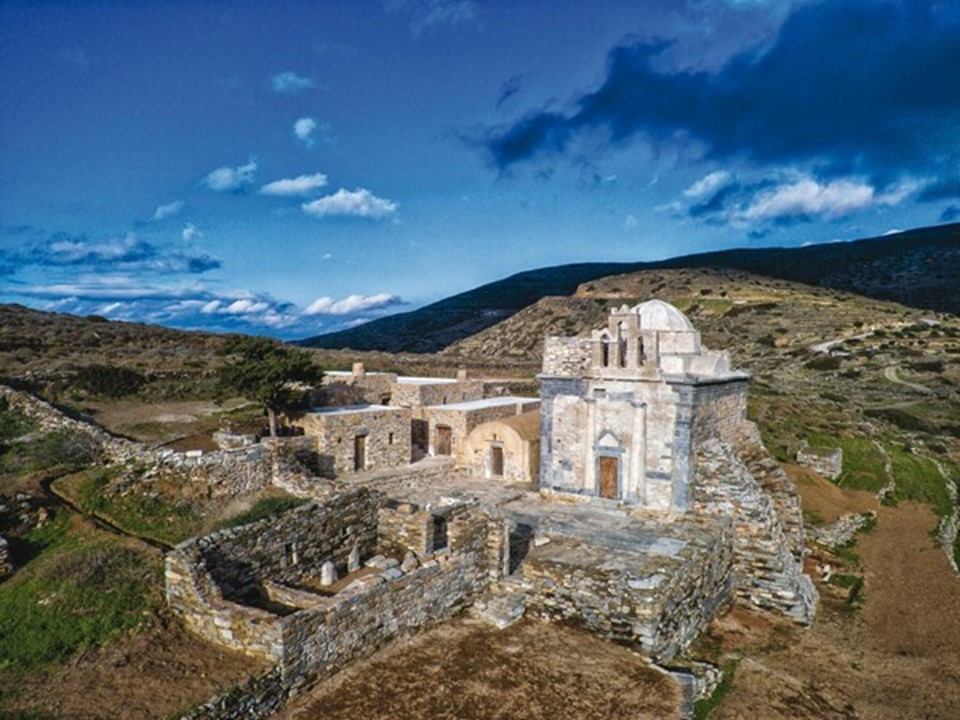
The Monument of Episkopi on Sikinos

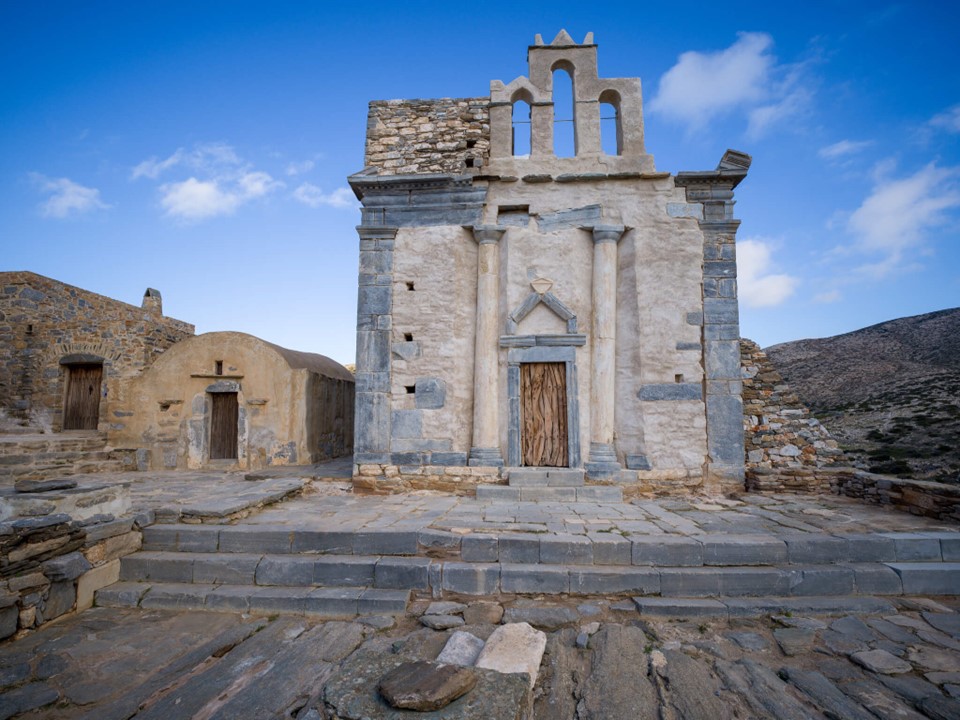
The Monument of Episkopi on Sikinos, one of the smallest Cycladic islands, is a Roman mausoleum dating back to the 3rd century. Because of its conversion to a Byzantine church, it was continuously used and has therefore survived nearly intact. Its ancient structure, combined with interventions from several historical periods, offers an incomparable palimpsest of archaeological periods that is rarely preserved in ancient monuments. Severely affected by destructive earthquakes and human interventions throughout the centuries, the monument was abandoned in the 20th century. The Ephorate of Antiquities of the Cyclades decided to restore the building in 2016. In 2022 the monument, fully restored and fully studied by the scientific personnel of the Cyclades Ephorate of Antiquities, reopened to the public. https://www.europeanheritageawards.eu/winners/monument-of-episkopi/

How can we introduce the Island of Sikinos? Sikinos is a tiny and rocky island with few permanent inhabitants, located in the Cyclades, between the islands of Ios and Folegandros. It has an area of approximately 42 square kilometers and a population of around 300 people. It is a quiet and peaceful island with a traditional way of life. The main village, called Chora, is built on a hill and has narrow streets, white-washed houses, and stunning views of the Aegean Sea. Other villages on the island include Alopronia, a small fishing village with a sandy beach, and Episkopi, where the historic Episkopi Church is located.

Is the Island of Sikinos related to any Greek Myth? According to Greek Mythology, the island of Sikinos is named after the son of Thoas, King of Lemnos, and son of God Dionysos and Princess Ariadne. Ypsipyli, Thoa’s daughter, trying to save her father from the Lemnian women who were killing the male inhabitants of the island, hid him in a wooden box and threw him into the sea. The waves of the sea led Thoa’s box to the island of Oinoe, where the king married the nymph Niida, who gave birth to a boy called Sikinos. It was Thoa’s son and grandson of Dionysos and Ariadne, who gave his name to the island during his reign.

The History of the Island: The island has a long and fascinating history, dating back to ancient times when the island was known for its vineyards and wine production. The island was also known as an important religious center, with a temple dedicated to Apollo the Pythian located on the island’s highest peak. Sikinos’s history parallels that of the other Cyclades islands, passing from Roman to Byzantine rule, and then falling to the Venetians and the Ottomans.

In the 13th century AD, Sikinos was conquered by the Venetians, who built a fortress on the island to protect it from pirates and other invaders. During this time, the island became an important center for trade and commerce, and its wine was exported throughout the Mediterranean. In the 16th century, Sikinos was occupied by the Ottoman Turks, who ruled the island for nearly 300 years. During this time, the island’s population declined, and many Sikinians migrated to other parts of Greece and to other countries. In the early 19th century, Sikinos became part of the newly formed Greek state, and the island began to experience a period of growth and prosperity. The island’s vineyards were revived, and Sikinos once again became an important center for wine production. https://sikinostravel.com/sikinos-island/history/

Which is the most important monument on the Island of Sikinos? Undauntedly Episkopi, or the monument of the Diocese of Sikinos. According to Dr Dimitrios Athanasoulis, Director of the Ephorate of Antiquities of the Cyclades… The monument of the Diocese of Sikinos, one of the smaller islands of the Cyclades, was, originally, a Roman period mausoleum, built during the 3rd century AD. The mausoleum became a Byzantine church, and subsequently, an important landmark of cultural heritage for the island community throughout the centuries. https://www.lifo.gr/now/entertainment/episkopi-sikinoy-ena-monadiko-mnimeio-apodidetai-simera-sto-koino

What new archaeological information did the restoration of Episkopi bring to light? The archaeological research that took place during the restoration of the monument, Dr Dimitrios Athanasoulis said, enriched our knowledge of the funerary monuments of the Roman period in the Eastern Mediterranean region, as well as of Byzantine church building in the Cyclades. During the restoration work of Episkopi, valuable evidence of the past was revealed, such as inscriptions and fragments of Roman and Byzantine frescoes, for the preservation of which a microclimate monitoring system was installed. The most important find was the hermetically sealed, undisturbed burial of a woman of the upper class, named “Neiko”, with findings that betrayed superstitions and necrophobic notions. https://www.lifo.gr/now/entertainment/episkopi-sikinoy-ena-monadiko-mnimeio-apodidetai-simera-sto-koino

Why was the monument of Episkopi on Sikinos bestowed the Europa Nostra Award in 2022? The monument of Episkopi is a cultural landmark and a source of pride for this small island community. Building materials were reused as much as possible and new masonry was incorporated using locally collected stones. The combination of architectural elements of a Roman mausoleum in a Byzantine church forms a unique monument that is simply striking… emphasized by the Awards’ Jury. https://www.europeanheritageawards.eu/winners/monument-of-episkopi/

For a Student Activity, please, Check… HERE!

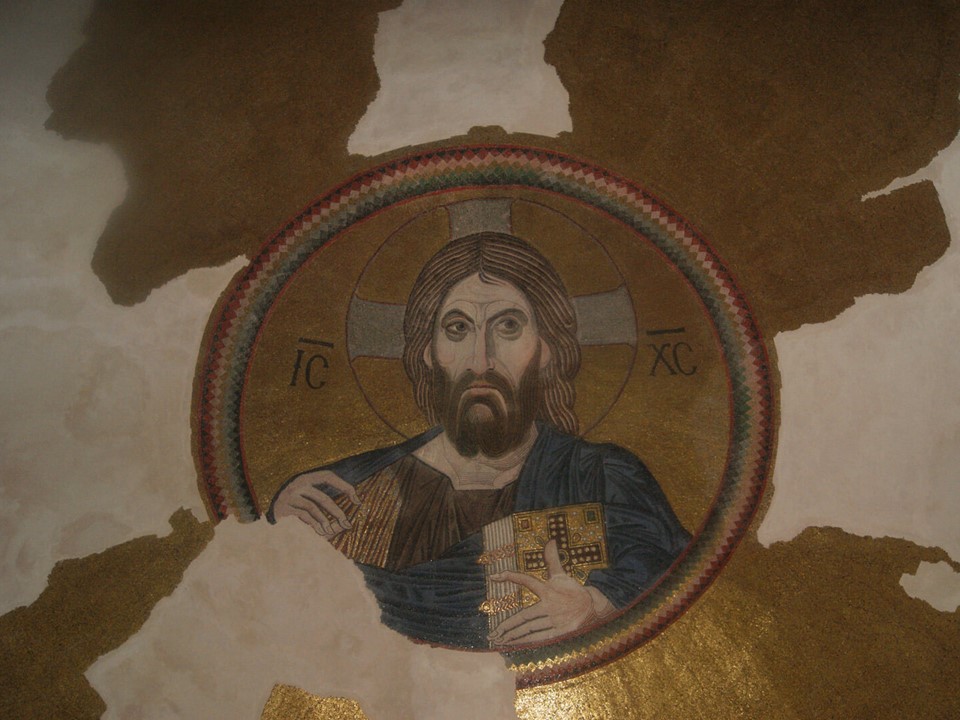
Christ Pantocrator in the Byzantine Monastery of Daphni

Christ Pantocrator in the Byzantine Monastery of Daphni… whose great eyes, dark and exorbitant and cast almost furtively over one shoulder, at total variance with His right hand’s serene gesture of blessing and admonition, spell not only pain but fear, anguish and guilt, as though He were in flight from an appalling doom. The only fit setting for such an expression is the Garden of ! Gethsemane; but this is a Christ-God in His glory, the All-Powerful One. It is tremendous, tragic, mysterious and shattering… writes Patrick Leigh Fermor in his travel book Mani. Travels in the Southern Peloponnese of 1958. https://patrickleighfermor.org/tag/mani/ and https://www.biblio.com/mani-by-fermor-patrick-leigh/work/20200

The sight of the Pantocrator image at Daphni is indeed breathtaking, and I particularly like Fermor’s use of adjectives… tremendous, tragic, mysterious, and shattering! Whether Fermor was right or not in his description… whether the Daphni Pantocrator survives today exactly as it was created by the anonymous 11th century Byzantine master… is not easy to answer, but was expertly addressed by Robin Cormack in his 2009 article Rediscovering the Christ Pantocrator at Daphni. Professor Cormack takes his reader on a wonderful journey as he “deciphers” the secrets of this amazing mosaic and the wondrous ways of mosaic restoration. Journal of the Warburg and Courtauld Institutes, Vol. 71 (2008), pp. 55-74 (20 pages) Published By: The University of Chicago Press https://www.jstor.org/stable/20462776?read-now=1&refreqid=excelsior%3Aefe48f19a158ab3c7526e9941fbf2d9f&seq=20

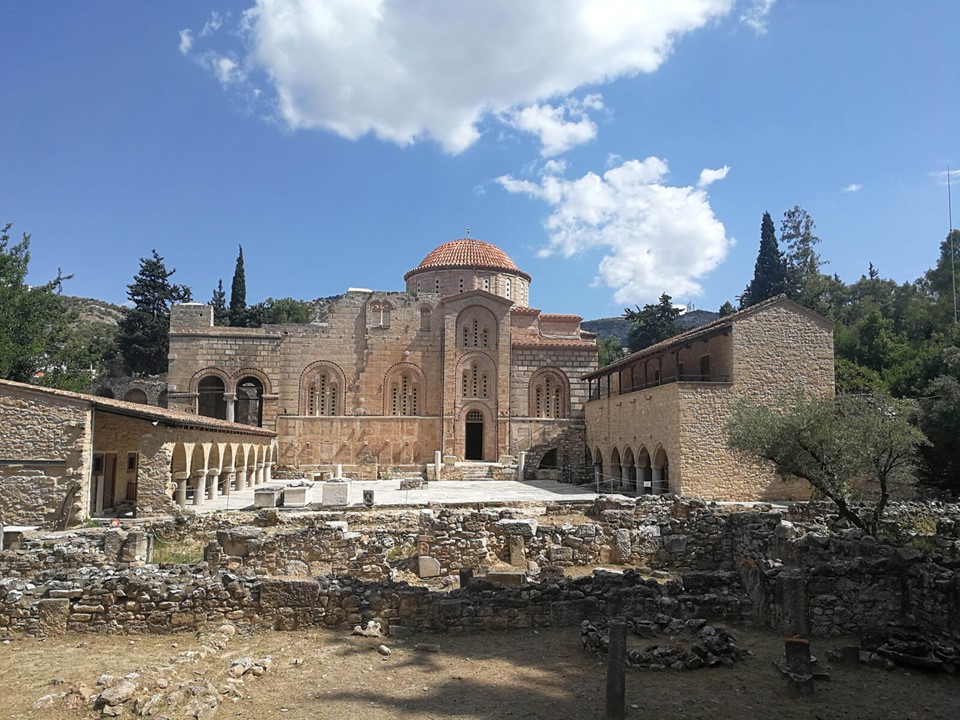
Visiting the Daphni Monastery has always been a wonderful experience! Built on the slopes of Mount Egaleo in the grove of Haidari, next to the ancient Athenian Ιερά Οδό (Sacred Road) that connected Athens with Eleusis, the site of the eponymous Eleusinian Mysteries, lies the Byzantine Monastery of Daphni. It is only interesting that the Monastery was built on the location of the ancient sanctuary of Apollo Daphnaios, destroyed during the invasion of the Goths in 395 AD. Unfortunately, of the old temple only one Ionic column still remains in the colonnade of the narthex, while the rest were removed by Lord Elgin in the 19th century. http://odysseus.culture.gr/h/2/eh251.jsp?obj_id=1514

According to the Greek Ministry of Culture (ΟΔΥΣΣΕΥΣ site), the first monastic community at Daphni was organized during the 6th century AD and was enclosed by strong defensive walls, almost square in plan. The catholicon was a three-aisled basilica which stood in the center of the courtyard. Along the inner NE side of the walls, two-storied buildings were constructed, containing the cells of the monks. A reception hall and a second block of cells were attached on the north wall of the enclosure. http://odysseus.culture.gr/h/2/eh251.jsp?obj_id=1514

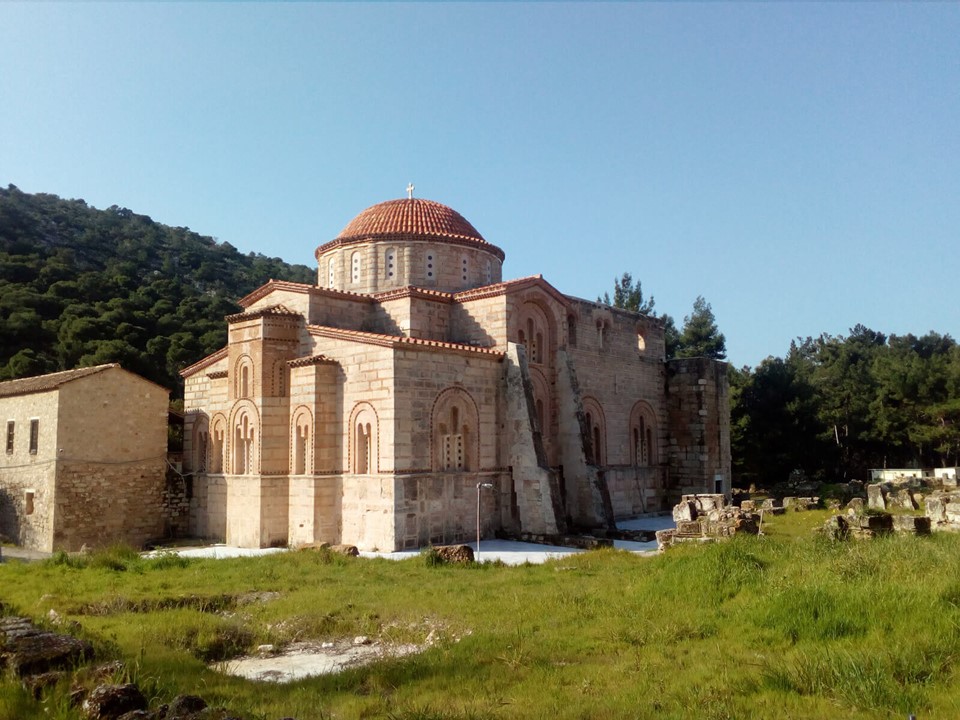
What we see today is the 2nd phase of development and construction, dating from the 11th century (around 1080). The Monastery’s Katholikon is a cross-in-square church of the octagonal type, surmounted by a broad and high dome. It has a narthex, formed as an open portico… The exonarthex was constructed a little later, in the early 12th century and the chapel to the west was added in the 18th century… The porch with the three pointed arches in the west facade of the narthex was added in the 13th century by the Frankish monks and certainly points to western influence… The walls of the church are built in the simple cloisonne masonry with poor brick decoration, restricted on the windows… The monastery is protected by a square enclosure fortified with towers and ramparts, with two entrance gates on its east and west sides. http://odysseus.culture.gr/h/2/eh251.jsp?obj_id=1514

For a Student Activity, please… Check HERE!

For an interesting Video on the Daphni Monastery, please Check… https://www.archaeology.wiki/blog/video/daphni-monastery/

Church of the Parigoritissa in Arta

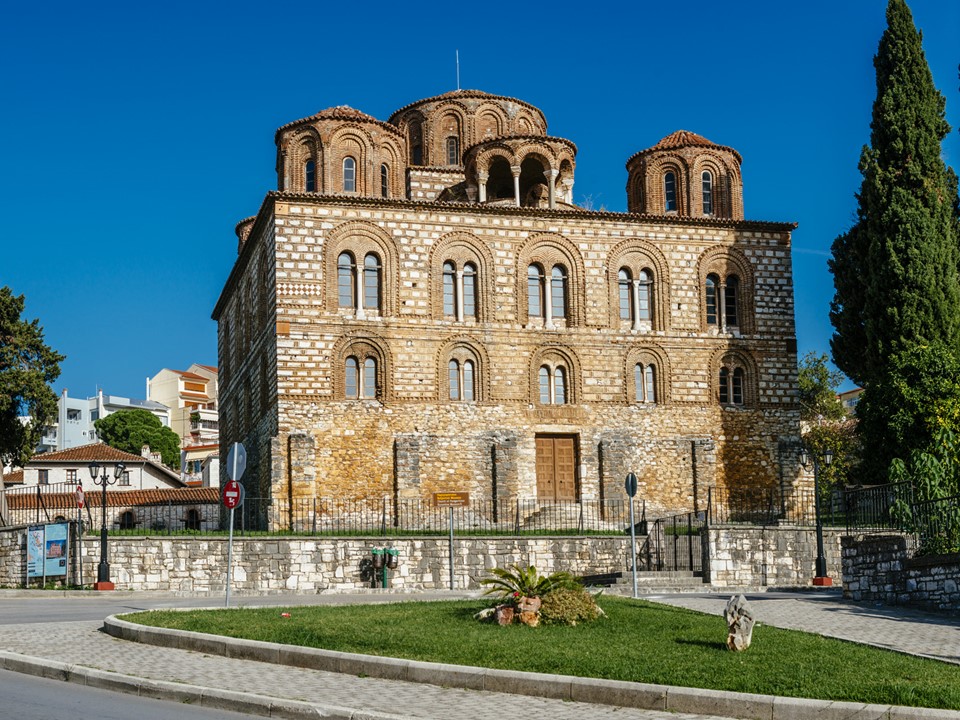
Church of the Parigoritissa in Arta, 1294-1296, Arta, Greece
https://efaart.gr/portfolio/panagia-parigoritisa/

According to a popular Epirote legend… the anonymous “πρωτομάστορας” (master architect), commissioned to build the Church of the Parigoritissa in Arta was accomplished, famous, and much in demand! Hired to design plans for another church, while still working in Arta, the “πρωτομάστορας” was obliged to travel away, leaving his assistant in charge. The assistant, anonymous as well, was young, ambitious, innovative, and highly creative. He decided to change the original plans… implement a novel architectural proposal, and, in the process, created an original Church design we still admire today! Upon his return, the “πρωτομάστορας” was stunned, envious and… vengeful! He wanted revenge and he planned carefully… He tricked his unsuspecting assistant into climbing to the roof under the pretext that he was going to show him a mistake he made and then… the plan was, to push him over. But the plan did not materialize as wished! As the young assistant was falling, he grabbed the master-builder dragging him along to their death. The mother of the young assistant was devastated… but one night the Virgin Mary appeared to her dream and “την παρηγόρησε,” consoled her for her unjust loss. Mary’s consolation was considered a miracle and thus… the Church in Arta was called “Παναγία η Παρηγορήτισσα,” the Church of the Virgin Mary of Consolation. https://www.mixanitouxronou.gr/o-thrilos-tou-protomastora-pou-zilepse-to-epitevgma-tou-voithou-tou-ke-ton-dolofonise-panagia-i-parigoritissa-i-vizantini-ekklisia-tis-artas-me-ton-protoporiako-troulo-pou-eorite/

Ιn Arta the Parigoritissa Church is considered the city’s Αρχόντισσα… most Aristocratic edifice! Built on the western slope of Peranthis hill, the church is associated with the Komnenos Doukas ruling family of the Despotate of Epiros. Archaeologists discern 2 construction phases. The older 1st phase dates to the middle of the 13th century and is associated with Michael II Komnenos Doukas (1230 until his death in 1266/68 ruler of the Despotate of Epirus) and his wife Theodora Petraliphaina (canonized as Saint Theodora of Arta, ca. 1225 – after 1270). Recent archaeological discoveries show that large parts of its original masonry were preserved to a sufficient height and incorporated via various modifications for the construction of the church’s 2nd phase which materialized under the sponsorship of Nikiphoros I Komnenos Doukas (c. 1240-1297) and his wife Anna Palaiologina Kantakouzene (d. 1313). On the western wall of the main church, over the entrance, an inscription verifies the fact that the Parogoritissa church was founded in the period 1294-1296 by the despot of Epirus Nikephoros I Komnenos Doukas, his wife Anna Palaiologina Kantakouzene, and their son Thomas. The aspiration of the princely couple was to create a Metropolitan Church worthy of a Byzantine Capital, impressive and original in design, luxurious and imposing on its exterior and interior decoration!  http://www.peartas.gov.gr/index.php?option=com_content&view=article&id=66:2011-06-15-08-30-45&catid=23:2011-06-10-06-28-51&Itemid=26

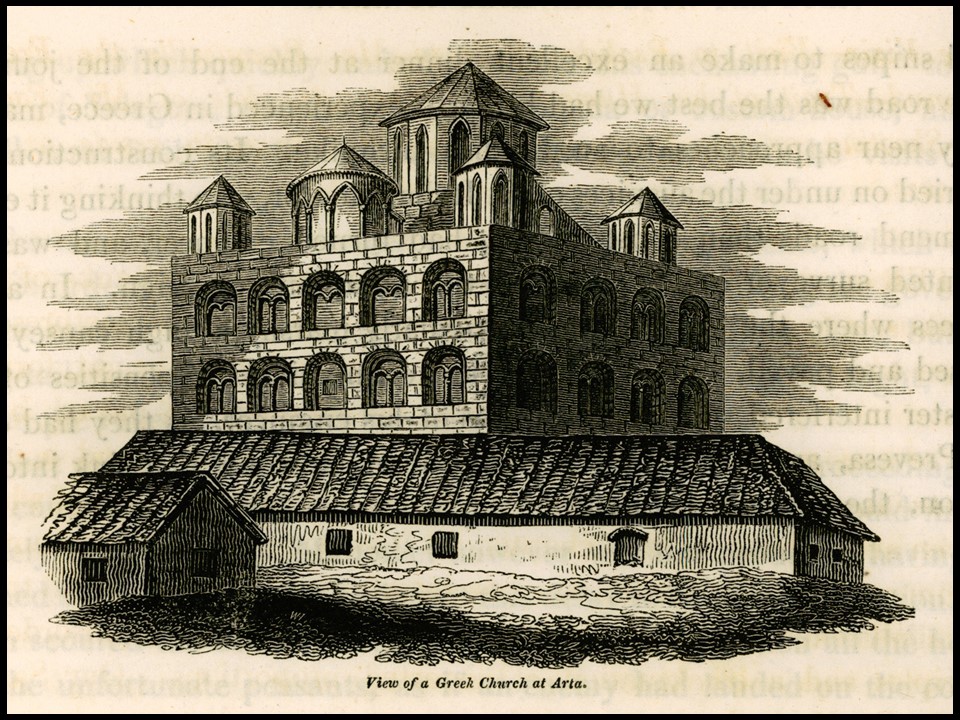
Thomas Smart Hughes, Travels in Sicily Greece, and Albania… Illustrated with engravings of maps scenery plans &c., vol. Ι, London, J. Mawman, 1820, Collection: Hellenic Library – Alexander S. Onassis Public Benefit Foundation
https://eng.travelogues.gr/item.php?view=44972

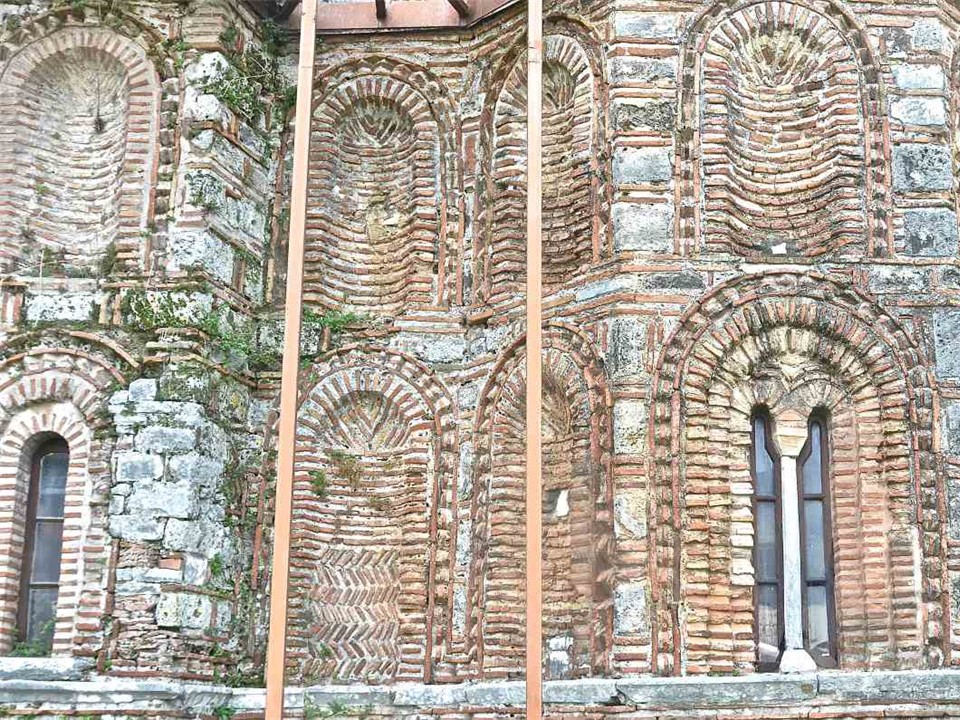
The church of Parigoritissa was dedicated to the Annunciation of the Virgin Mary and was formerly the Katholikon of a large Monastery, of which 16 cells and the Refectory are also preserved. It is one monumental, voluminous, cubic in essence (has dimensions of 20,30×22 m) building, which external masonry and design “elusively” resemble the Italian mansions of the Early Renaissance period. The exterior façade of the church is divided into three zones: The lowest one is irregularly built and unadorned because until 1865 it was covered by a portico, as evidenced by the existence of 12 pilasters on the three sides of the temple to support its roof. The two upper zones of the church are meticulously built according to the isodomic “cloisonne” system, adorned with a large number of double (dilova) windows with a colonnette in between, and further embellished with elaborate brick decorations. The Parigoritissa like many other churches in Arta, uses bricks and clay tiles in a variety of colours and designs, to decorate their walls with designs like meanders, concentric rhombuses, and toothed strips to name just a few. Finally, the church is crowned by five domes, from which the central one is larger and taller. Among the two western domes, there is a smaller, open dome, which gives the impression of a ciborium. http://www.peartas.gov.gr/index.php?option=com_content&view=article&id=66:2011-06-15-08-30-45&catid=23:2011-06-10-06-28-51&Itemid=26 and https://issuu.com/efaartas/docs/parigotitissa_arta_fylladio_32sel

Church of the Parigoritissa in Arta (Keramoplastika), 1294-1296, Arta, Greece
https://www.greekgastronomyguide.gr/ena-24oro-stin-arta/

For an interesting 3D Video on the Byzantine city of Arta and its Monuments created by the Greek Ephorate of Antiquities of Art, go to: https://www.youtube.com/watch?v=5vZ6fVBDzj0

For interesting Photographs, go to… https://www.thebyzantinelegacy.com/parigoritissa

For a Student Activity, please… Check HERE!

My thoughts on the interior architectural plan and decoration of the Parigoritissa Church will be presented in another BLOG POST…

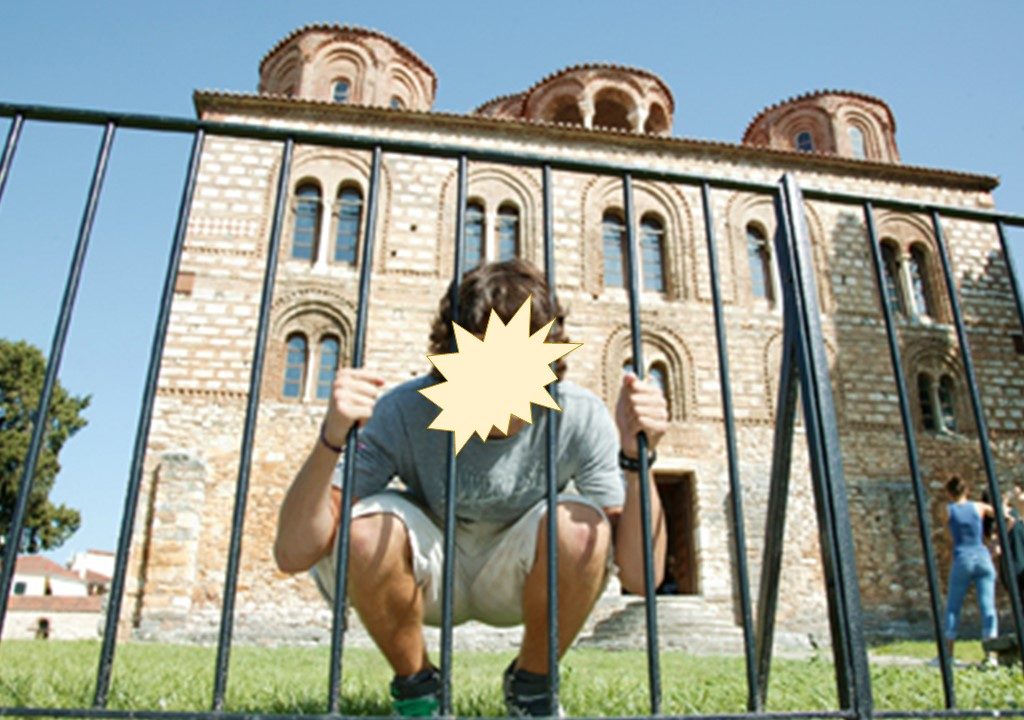
Visiting the Parogoritissa with my students…
Photo Credit: Kostas Papantoniou