In ancient times, the landscape west of the Euripos river, opposite the island-city of Mytilene, underwent a remarkable transformation. What began in the Archaic period as an extensive cemetery gradually evolved into a thriving residential district as the city expanded beyond its original fortified island in the early Hellenistic era. By the Roman period, this southeastern area near the hill of Agia Kyriaki had become a prestigious neighbourhood, home to affluent residents whose villas reflected the economic prosperity and cultural vitality of the island of Lesvos. Among these residences, the so-called House of Menander stands out as one of the most impressive discoveries.
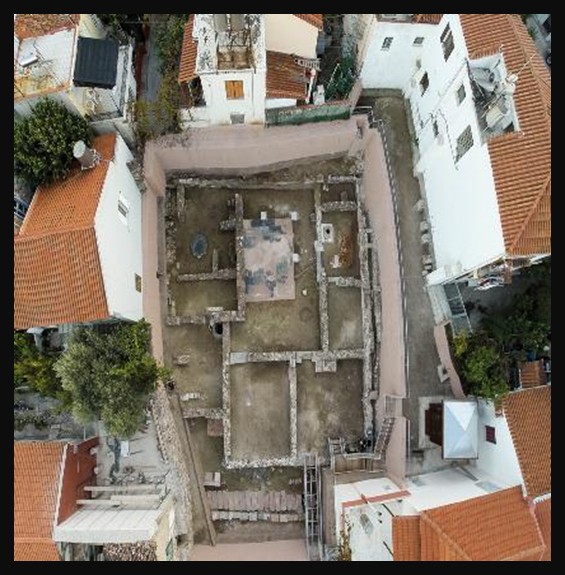
Although parts of its mosaic floors had surfaced as early as 1930, the House of Menander was properly excavated in stages between 1961–63, 1973–75, and again between 2010–15 through the ‘Unification of the Archaeological Sites of Mytilene’ project. The excavations revealed continuous use of the site from the Late Classical/Hellenistic period into the Early Byzantine era, including a long-lived east–west road equipped with a stone culvert, clay pipes, and later a monumental colonnade. The villa itself, built after the 2nd century AD atop earlier Hellenistic remains, went through at least two major building phases before it was ultimately destroyed by fire in the late 3rd century.
Architecturally, the House of Menander represents the late Roman peristyle house at its finest. At its center lay a marble-paved courtyard framed by three columns on each side and surrounded by covered stoae that led to the wings of the house. Much of the north and west wings survive today, including representative rooms used for meetings, dining, and entertainment, while other parts were lost to later Early Byzantine construction and the 20th-century refugee housing built after the Asia Minor Catastrophe. Even in its fragmentary state, the villa conveys a sense of refinement, wealth, and a strong commitment to artistic expression.
The Mosaics in the House of Menander
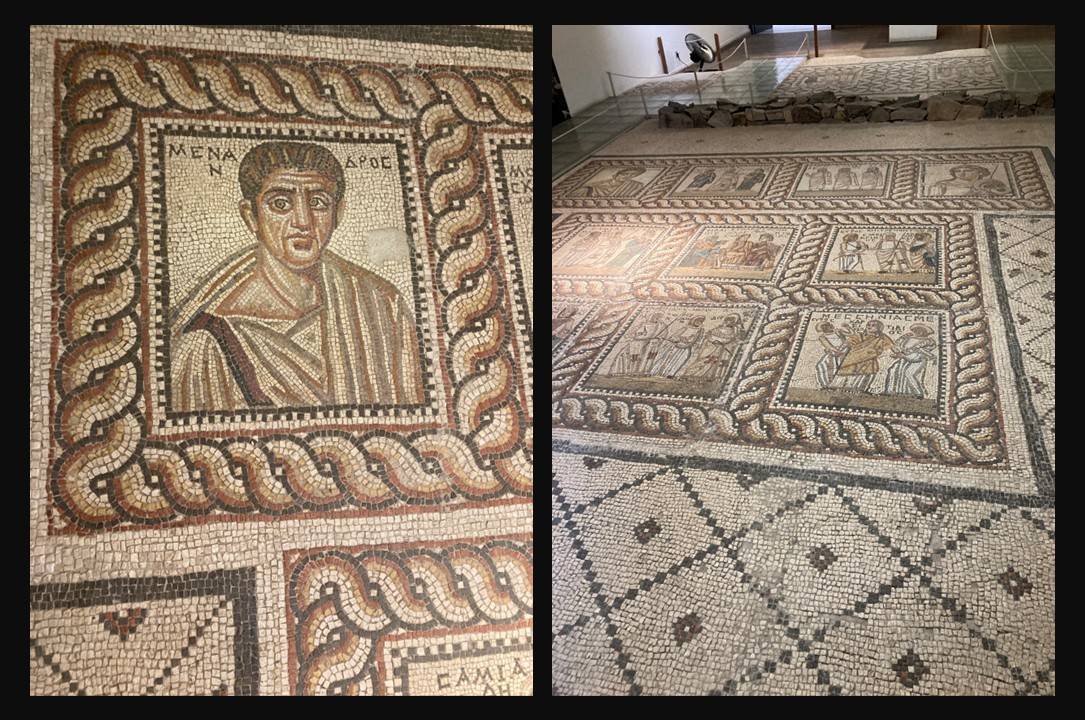
This artistic identity is best revealed in the villa’s extraordinary mosaics. The northern stoa features intersecting geometric patterns framing metopes inspired by the comedies of Menander, the great Athenian playwright of the New Comedy, whose name has been symbolically attached to the house. The western stoa continues the theme with more geometric motifs, theatrical masks, and a charming fishing scene. Inside the north wing, the hall (oecus) contains a magnificent Orpheus mosaic: the legendary poet-musician sits playing his lyre, enchanting animals and even the nearby tree whose branches bend towards him. The neighbouring triclinium presents an even richer narrative tapestry, with ten mosaic panels depicting Menander’s portraits, scenes from his comedies, Socrates with his disciples, and the muse Thalia. Inscriptions identify the plays, scenes, and actors, underscoring the cultural literacy and theatrical tastes of the villa’s occupants.
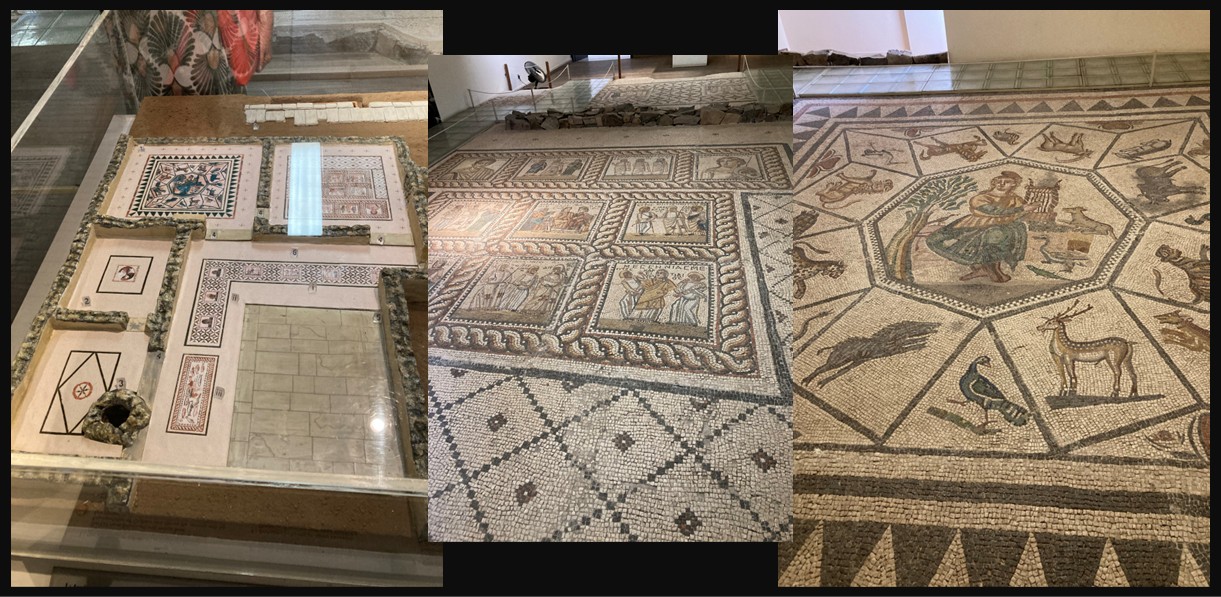
Beyond their beauty, these mosaics offer compelling insights into the household’s identity. The built altar and marble-lined offering table in the hall, as well as the burnt cesspit near the triclinium, point to domestic ritual practices. Combined with the overwhelming theatrical and philosophical themes of the mosaics, they suggest two possibilities: either the villa belonged to a wealthy citizen deeply engaged with drama, music, and intellectual life, or it served as the seat of a Dionysiac actors’ association, a guild dedicated to the god of theatre. In either case, the House of Menander stands as a celebration of performance, artistry, and cultural memory within a domestic setting.
After the villa’s discovery, its mosaics were painstakingly detached, conserved, and restored throughout the mid-20th century. Since 1998, they have been the star attraction of the New Archaeological Museum of Mytilene, where visitors can admire their detail up close. Meanwhile, the remains of the house itself, still embedded in the quiet neighborhood of Krinagoras Street, are accessible to the public, offering a rare opportunity to walk through a Roman residence where poetry, philosophy, and theatre once animated the floors beneath its inhabitants’ feet.
For a downloadable PowerPoint Presentation on the House of Menander and its mosaics, please… Click HERE!
Another remarkable example of mosaic decoration from Roman Mytilene can be seen in the House of Euripos, where the Four Seasons are arranged around a central marine divinity, reflecting a different but equally symbolic approach to domestic art… https://www.teachercurator.com/uncategorized/roman-mosaic-house-of-euripos-four-seasons-mytilene/
Bibliography: from the Archaeological Routes of Lesvos https://www.efales-ar.gr/en/ancient_site/the-house-of-menander-in-mytilene/ and the Greek Ministry of Culture http://odysseus.culture.gr/h/2/eh2560.jsp?obj_id=19976