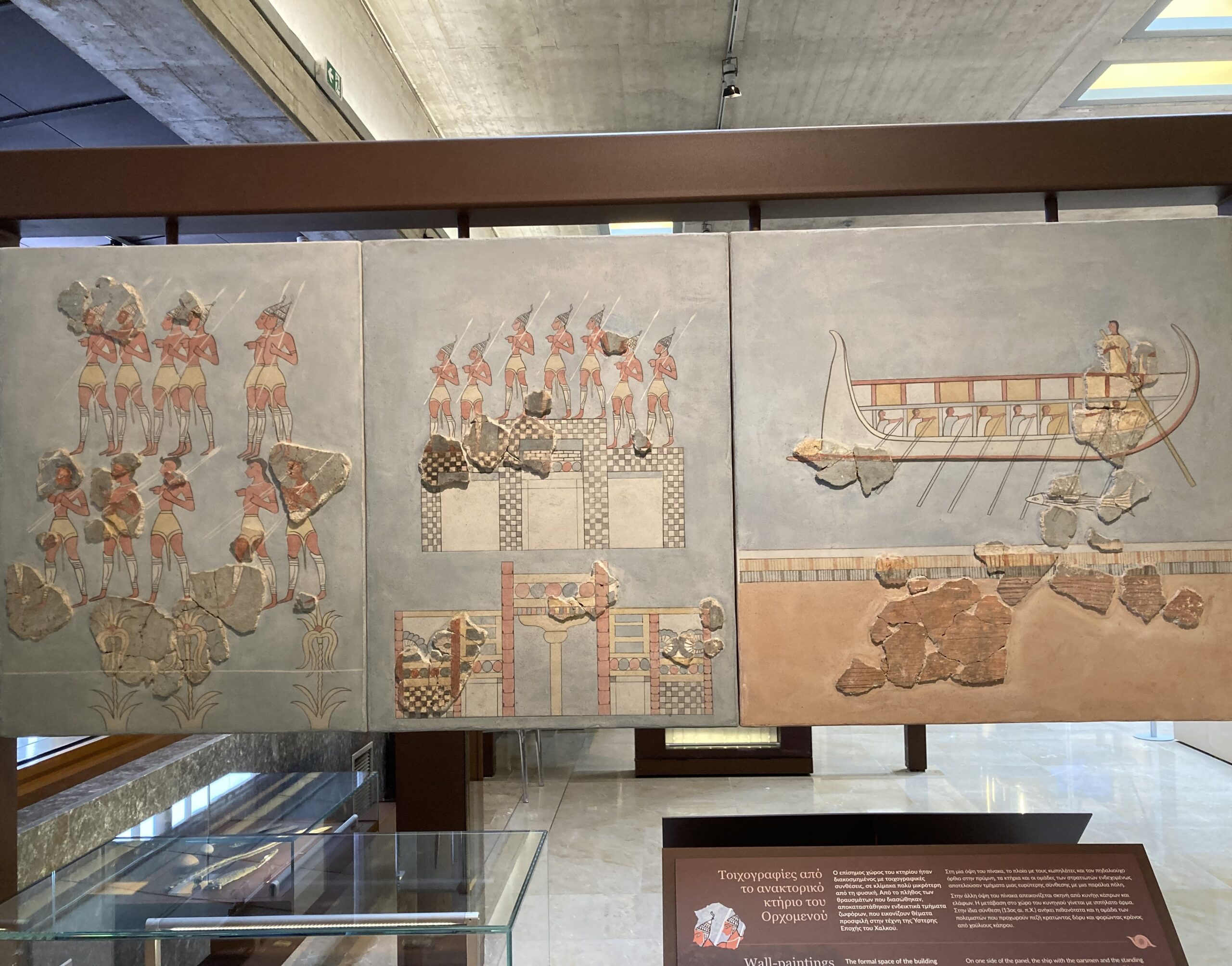
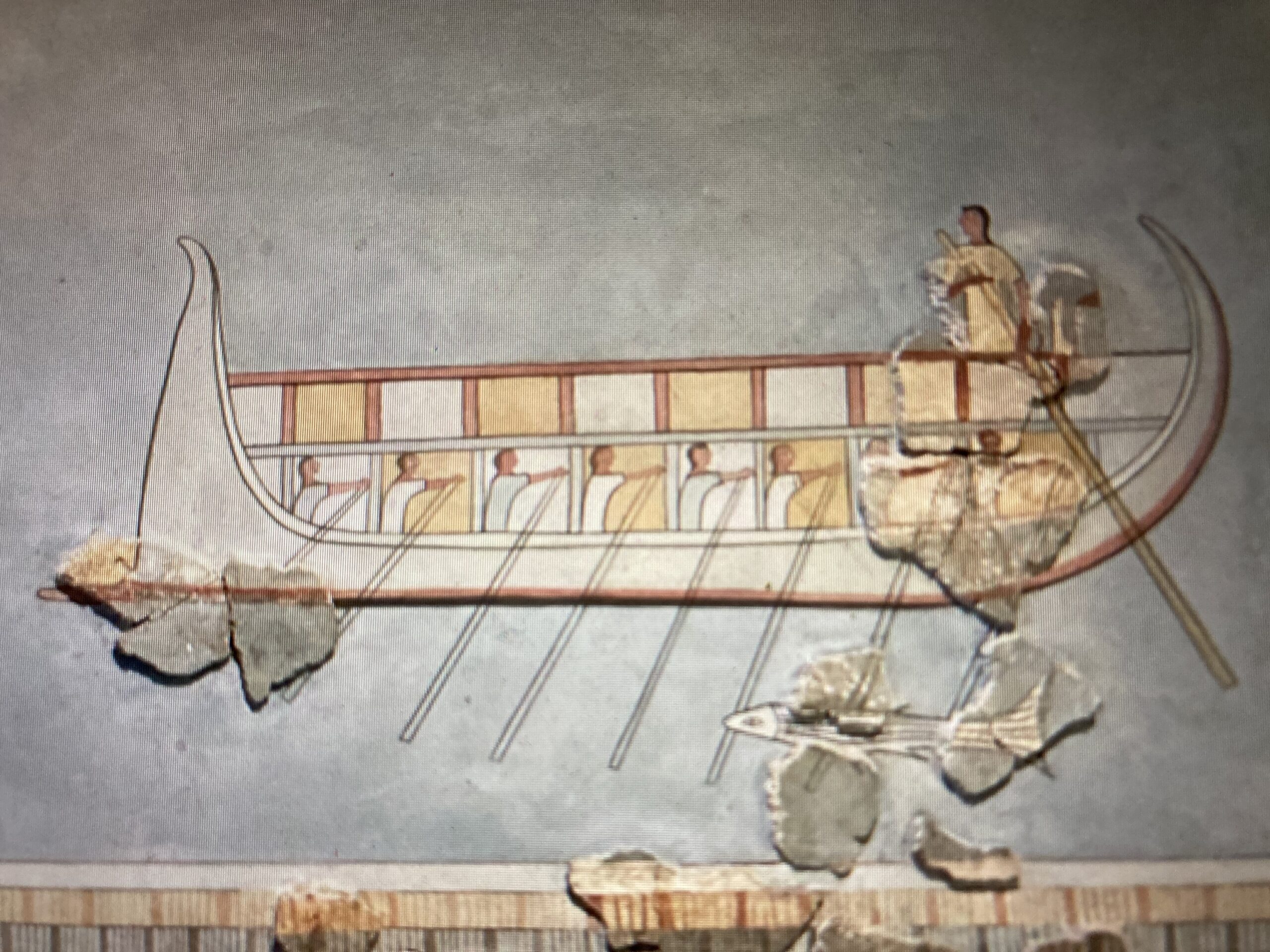
Among the fragmentary remains of the Mycenaean palace at Orchomenos, a wall painting depicting a long, narrow oared vessel offers a rare glimpse into how the rulers of Late Bronze Age Boeotia envisioned their relationship with the sea. Known as the Boat Fresco of Orchomenos, this work, now reconstructed and displayed in the Archaeological Museum of Thebes, dates to the 13th century BC, when the Mycenaean palatial system reached its zenith. Though only scattered plaster fragments survive, they reveal a striking image: a ship manned by seated oarsmen and guided by a standing helmsman at the stern. In its quiet precision and rhythm, this miniature seascape reflects a world where mastery over movement, of ships, people, and power, defined the essence of kingship.
The palace of Orchomenos stood on a low hill overlooking the fertile Boeotian plain. Excavations revealed storerooms, painted architectural façades, and fragments of richly colored wall paintings that once adorned audience halls. According to Th. Spyropoulos’s study in Mycenaean Wall Painting in Context (2015), the ship fragment formed part of a larger scene that may have included city walls and armed figures, a coastal tableau echoing Mycenaean concerns with both defense and seafaring. The linear precision of the hull and the rhythmic placement of the oars evoke balance and order, qualities also prized in palatial architecture and administration.
In artistic terms, the Orchomenos fresco belongs to the same tradition as other Mycenaean depictions of ships, most famously the ‘naval scene’ from the Palace of Nestor at Pylos. The Pylos fresco, excavated in Hall 64, portrays a fleet of long, low ships navigating stylized waves filled with fish and dolphins. Both works share conventions such as the gently curving hull, rhythmic oars, and the figure of a helmsman guiding the vessel. Yet their atmosphere differs markedly. The Pylos composition is expansive and dynamic, ships advance across a vivid seascape, perhaps symbolizing a royal expedition or divine voyage, while the Orchomenos image feels more contained, even austere. Its minimal background and measured geometry create a quieter meditation on order and control rather than the celebration of motion.
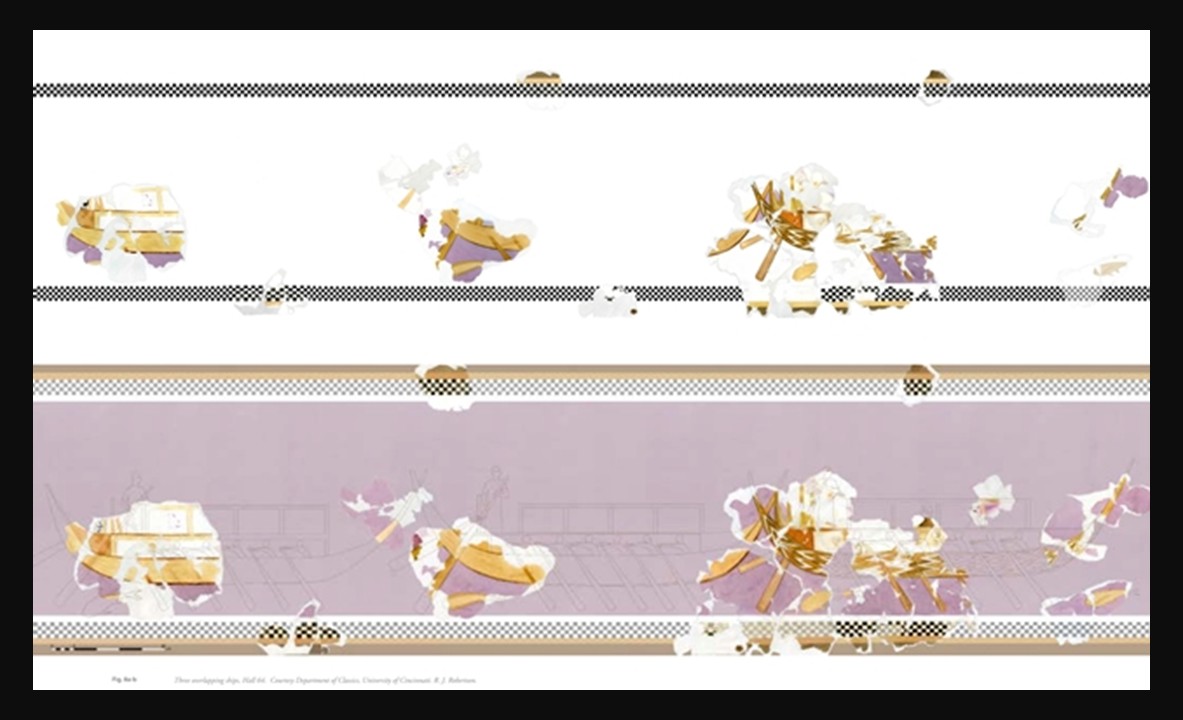
This contrast may reflect local identity. Pylos, a coastal kingdom deeply tied to the sea, presented maritime power as spectacle, Orchomenos, though inland, still drew wealth from trade routes linking the Gulf of Euboea and central Greece. Its painters adopted the ship motif not as a literal scene but as a symbol of authority, evidence that the imagery of seafaring had become part of a shared Mycenaean visual vocabulary of kingship. The disciplined rowers and steady helmsman thus mirror the palace’s administrative ideals: hierarchy, cooperation, and the mastery of nature through collective labor.
Because the Orchomenos fragments were recovered out of context, interpretation remains cautious. Some scholars propose a decorative register celebrating the Mycenaean “thalassocracy,” others suggest a ritual or mythic voyage. Whatever the intent, the fresco’s survival, though partial, testifies to the integration of marine imagery into the artistic language of mainland Greece. Like other Mycenaean murals, it transforms daily reality into an emblem of order and power. The Orchomenos ship, with its measured rhythm of oars and its commanding helmsman, evokes a civilization that saw itself as both master of the land and heir to the sea.
Seen today in its reconstructed form, the fresco invites reflection on the fragility of artistic memory. What remains are not complete narratives but fragments, strokes of pigment, broken lines, that nonetheless preserve the pulse of the Bronze Age imagination. In those traces, the Mycenaean boat continues its journey across time, carrying with it echoes of labor, leadership, and the enduring allure of the sea.
For a Student Activity inspired by the Orchomenos fresco of a Boat, please… Click HERE!
Bibliography: Spyropoulos, Th. “Wall Paintings from the Mycenaean Palace of Boeotian Orchomenos.” In Mycenaean Wall Painting in Context: New Discoveries, Old Finds Reconsidered, eds. H. Brecoulaki, J. L. Davis & S. R. Stocker. Athens: National Hellenic Research Foundation, 2015, and Archaeological Museum of Thebes, permanent collection panels on wall paintings from Orchomenos (museum text, 2016). https://aristomenismessinios.blogspot.com/2020/04/an-unprecedented-navalscene-from-pylos.html and https://greek-museums.tumblr.com/post/149758810301/archaeological-museum-of-thebes-wall-paintings?utm_source=chatgpt.com and https://bmcr.brynmawr.edu/2016/2016.11.09/?utm_source=chatgpt.com