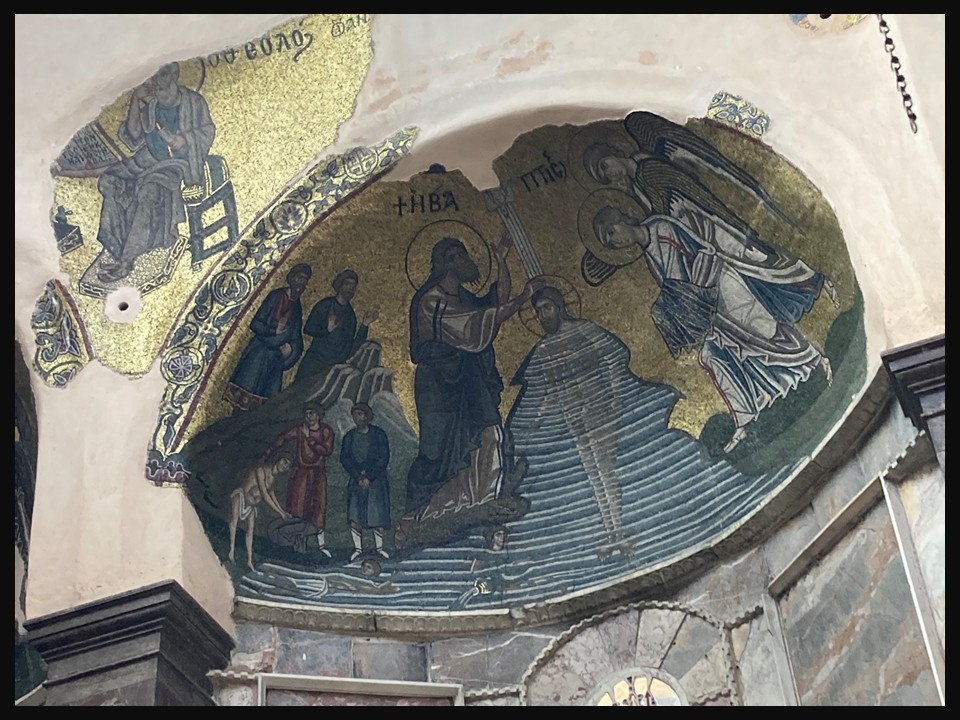
The Baptism of Christ mosaic at Nea Moni monastery, Chios, 11th century, depicting Christ in the Jordan with John the Forerunner and attendant angels.

Feast Day of Saint John the Forerunner

The Baptism of Christ mosaic at Nea Moni monastery, Chios, 11th century, depicting Christ in the Jordan with John the Forerunner and attendant angels.
The Baptism of Christ, Nea Moni, Chios, 11th century, Mosaic, Chios Island, Greece – Photo Credit: Amalia Spiliakou, 2025

Every year on January 7, the Orthodox Church celebrates the Feast of Saint John the Forerunner, the prophet who prepared the way for Christ and baptized Him in the Jordan River. On the island of Chios, this commemoration finds a particularly resonant setting in Nea Moni, the 11th-century monastic foundation distinguished for its architectural integrity and exceptional mosaic decoration. In the Katholiko, the mosaic of the Baptism of Christ stands out for its refined handling of the sacred narrative: the descending waters of the Jordan, the presence of attendant angels, and the hieratic figure of Christ are rendered in luminous gold and saturated blues typical of Middle Byzantine aesthetics. The composition not only conveys a key episode of Christian theology but also reflects the spiritual and artistic ambitions of the monastery’s patrons and craftsmen.

Exterior view of the Nea Moni monastery on Chios Island, Greece, a Byzantine complex set in a wooded hillside, with stone buildings and red-tiled roofs surrounding the central church.
Nea Moni, 11th century, Chios Island, Greece
Photo Credit: Amalia Spiliakou, 2025

Perched on the slopes of Mount Provateftis, Nea Moni’s founding is closely tied to a local legend involving three hermits who discovered a miraculous icon of the Virgin beneath a myrtle tree. Each attempt to relocate the icon resulted in its return to the original site, a phenomenon interpreted as divine intervention. Reports of the miracle reached Empress Zoe and the future Emperor Constantine IX Monomachos, whose visions of the Virgin prompted them to grant imperial patronage between 1049 and 1055. Their involvement enabled the construction of a monumental complex that united imperial ideology, theological symbolism, and monastic devotion. Over subsequent centuries, Nea Moni flourished as a center of worship, pilgrimage, and artistic production, even as it later endured phases of decline, particularly under Ottoman rule.

Middle Byzantine Mosaics and the Macedonian Renaissance

The monastery’s historical and artistic significance is encapsulated in its mid-11th-century mosaics, among the finest surviving ensembles of Middle Byzantine art. Although the dome mosaic of the Katholiko has perished, likely once depicting Christ Pantocrator with attendant angelic powers, substantial portions of the original decoration survive. In the pendentives, mosaics of the Cherubim and Seraphim remain, along with two Evangelists, John (despite heavy damage) and Mark. In the apse, the Virgin Platytera is preserved headless. Below these, the octagonal wall surfaces retain important scenes from the Dodekaorton, continuing also into the narthex. The Baptism, Crucifixion, and Anastasis form what is often regarded as the ensemble’s most accomplished triad, characterized by subtle modeling, expressive gestures, and a refined chromatic palette, while additional scenes include the Transfiguration and Deposition. The narthex once displayed a now-lost mosaic of the Virgin Orans in its small dome, surrounded by full-length military saints set within arched frames, and its vaults presented six Christological compositions, some of which survive only fragmentarily.
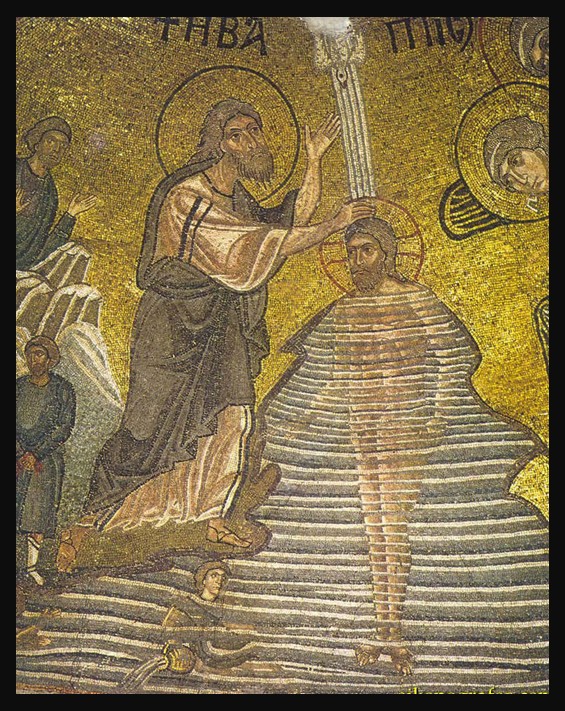
The Baptism of Christ mosaic (detail view) at Nea Moni monastery, Chios, 11th century, depicting Christ in the Jordan with John the Forerunner and attendant angels.
The Baptism of Christ (detail), Nea Moni, Chios, 11th century
https://www.pallasweb.com/deesis/byzantine-mosaics-of-nea-moni-on-chios.html

These works collectively reveal multiple stylistic currents of the late Macedonian period: classicizing figures with volumetric bodies and balanced stances appear alongside more linear, expressive compositions that anticipate later developments in Byzantine art. The extensive use of gold ground and deliberate reduction of spatial depth contribute to an ethereal, otherworldly atmosphere, while sophisticated optical adjustments on curved surfaces demonstrate the technical skill and theoretical awareness of artists likely trained in the imperial workshops of Constantinople.

When compared with contemporaneous mosaic cycles at Osios Loukas and Daphni on the Greek mainland, Nea Moni demonstrates both adherence to shared Byzantine conventions and distinctive regional features. All three complexes employ similar hierarchical structures, with Christ Pantocrator originally presiding from the dome and a surrounding ensemble of heavenly and apostolic figures reinforcing Middle Byzantine theological ideals. Yet while Osios Loukas and Daphni tend toward more monumental proportions and sculptural modeling, Nea Moni is marked by a lighter chromatic range, subtler facial expression, and delicate rendering of form. These distinctions highlight the diversity of artistic production across the Byzantine world and underscore Nea Moni’s significance as a particularly refined example of 11th-century Aegean mosaic art. Together, these monuments attest to a period of exceptional creativity in Middle Byzantine ecclesiastical decoration and affirm the enduring cultural and spiritual importance of Nea Moni.

For a PowerPoint Presentation, inspired by the ‘Feast Day of Saint John the Forerunner’ Blog Post and the Mosaics in the Nea Mony, in Chios, please… Click HERE!

Bibliography: https://smarthistory.org/mosaics-and-microcosm/ and from’My World of Byzantium’ https://www.pallasweb.com/deesis/byzantine-mosaics-of-nea-moni-on-chios.html
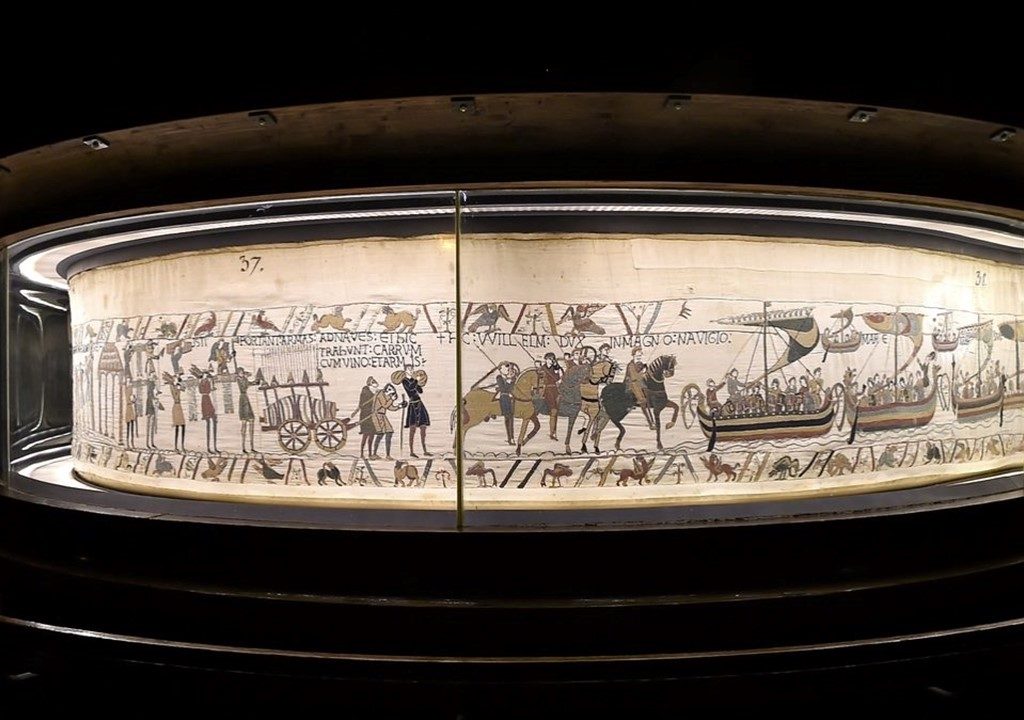
A Unique Tapestry in Bayeux

Bayeux Tapestry, c. 1070, Εmbroidered Wool on Linen, about 68.3 metres long and about 70cm wide , Bayeux Tapestry Museum, France
https://www.bayeuxmuseum.com/en/the-bayeux-tapestry/

Auspiciously a comet hangs / in the tabby linen / above King Harold    /    the way the Hale-Bopp / once in 1997 / blipped above the funeral parlor    /    the night before we buried / my cousin / You’ll never live to see this again    /    the aunties sighed the air thick / with peepers / while thirty-nine of    /    Heaven’s Gate Away Team / attempted to reach / the spaceship trailing    /    the comet’s wake / by swallowing / phenobarbital    /    mixed with applesauce— / that star-smear / across the sky no doubt    /    scrawling some sentence / from some holy book / no doubt signaling    /    another turn toward war / & further down / the tapestry ghost ships    /    cross a corrugated sea / horses midgallop / trample the woven acres    /    between king & king— / because all art once / was about conquest    /    history will remember / those horses  / even as time robs    /    the yarn of its dye / even as I place /  my hand to the glass… writes Jacques J. Rancourt, and I question…Is a Unique Tapestry in Bayeux true to Rancourt’s phrase… all art once / was about conquest…https://www.cincinnatireview.com/samples/a-detail-from-the-bayeux-tapestry-11th-c-by-jacques-j-rancourt/

Let’s answer some questions starting with Who, Where, When, What and Why…

What is the Bayeux Tapestry? The Bayeux Tapestry is in fact an embroidered linen cloth that is nearly 70 meters long and about 50 centimeters tall. It is embroidered with woolen yarns in various colors and depicts the events leading up to the Norman Conquest of England in 1066, as well as the Battle of Hastings itself. The Bayeux Tapestry is remarkable for its size, the detail of its embroidery, and its historical significance, and it has been studied and admired by scholars, historians, and art enthusiasts for centuries.

When was the Bayeux Tapestry created? The exact date of the creation of the Bayeux Tapestry is not known, but it is believed to have been created in the 1070s or 1080s, within a few years of the Norman Conquest of England in 1066.

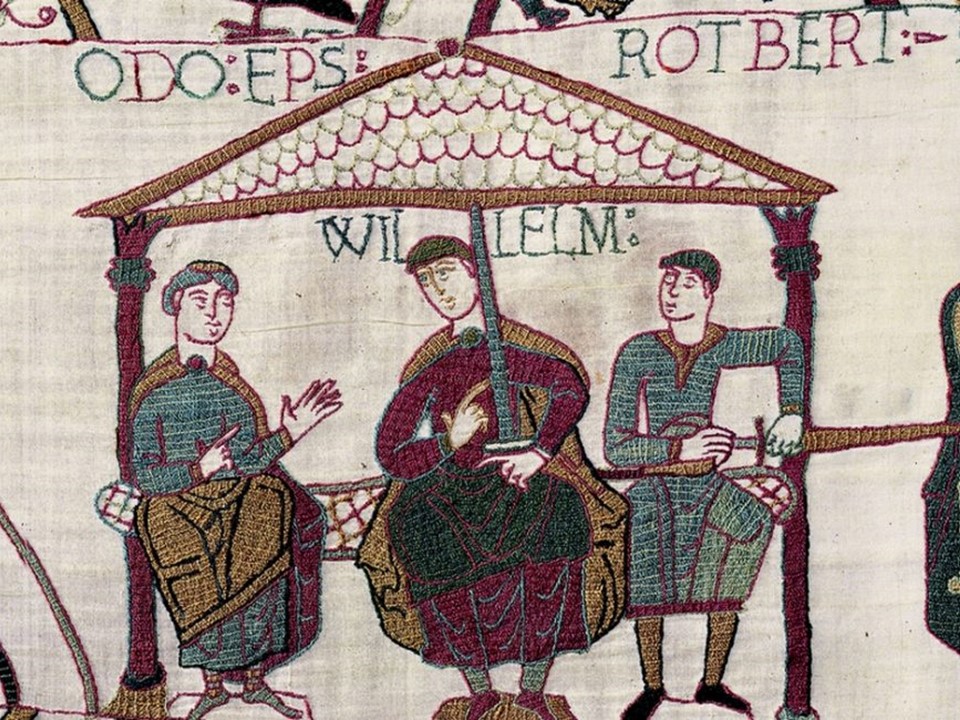
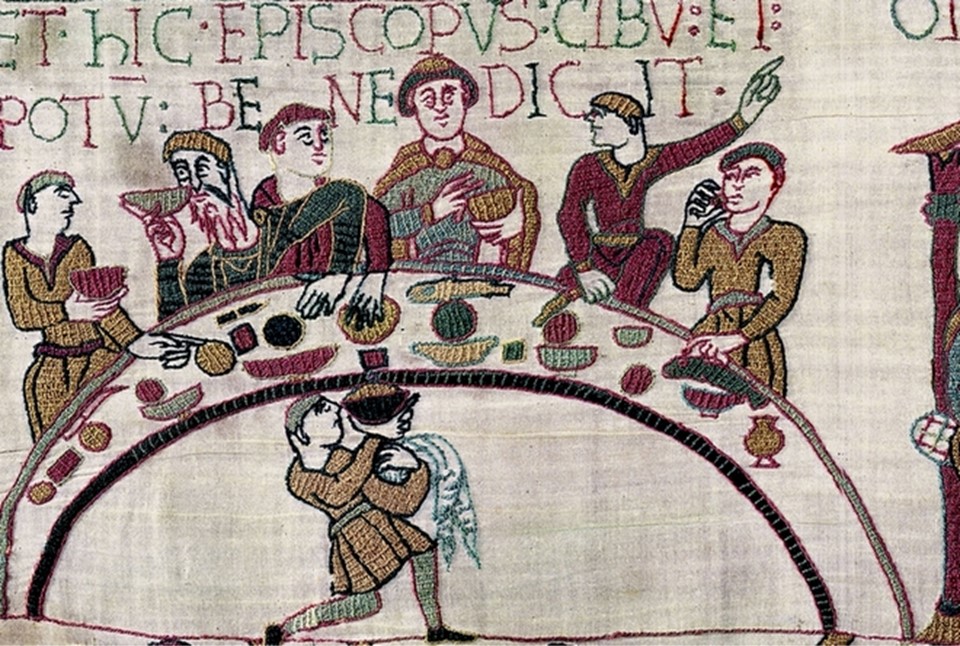
Who created the Bayeux Tapestry? The creator of the Bayeux Tapestry is not definitively known, and the identity of the artist or artists who created it remains a mystery. However, it is believed that the tapestry was commissioned by Bishop Odo, the half-brother of William the Conqueror, and was probably created by skilled embroiderers and weavers in England or in the Normandy region of France, where Odo held significant power. The style of the embroidery and the subjects depicted in the tapestry suggest that it was likely created by artists who were familiar with the Anglo-Saxon and Norman artistic traditions of the time.

Bayeux Tapestry (detail with Odo, Bishop of Bayeux), c. 1070, Εmbroidered Wool on Linen, about 68.3 metres long and about 70cm wide , Bayeux Tapestry Museum, France
https://www.bayeuxmuseum.com/en/the-bayeux-tapestry/discover-the-bayeux-tapestry/the-characters/

Why was the Bayeux Tapestry created? The exact reason for the creation of the Bayeux Tapestry is not known, but it is believed to have been created as a commemoration of the Norman Conquest of England in 1066. The tapestry tells the story of the events leading up to the Battle of Hastings and the Norman victory over the Anglo-Saxon army led by King Harold Godwinson. The tapestry may have also been created as a form of propaganda, to promote the legitimacy of William’s claim to the English throne and to portray the Anglo-Saxons in a negative light. Additionally, the tapestry may have served as a historical record of the events depicted, providing a visual account of the Norman Conquest for future generations.

Who are the main characters depicted in the Bayeux Tapestry? The Bayeux Tapestry depicts several main characters who played important roles in the events leading up to the Norman Conquest and the Battle of Hastings. Some of the main characters depicted in the tapestry include 1. Harold Godwinson, the Anglo-Saxon king, who was defeated by William the Conqueror at the Battle of Hastings. 2. William the Conqueror, the Norman leader who invaded England and defeated Harold Godwinson. 2. Edward the Confessor, the Anglo-Saxon king who died in 1066, triggering the succession crisis that led to the Norman Conquest. 3. Duke William’s Norman army, including his knights and soldiers. Anglo-Saxon soldiers, including Harold’s army. 4. Odo, Bishop of Bayeux, who is believed to have commissioned the tapestry and is depicted leading troops into battle. Other important figures, such as King Harold’s brothers, Earl Tostig and Earl Gyrth, and William’s half-brother, Bishop Odo. The tapestry also depicts various animals, scenes of battle and everyday life, and several Latin inscriptions that provide additional information about the events depicted.

Bayeux Tapestry (detail with William the Conqueror), c. 1070, Εmbroidered Wool on Linen, about 68.3 metres long and about 70cm wide , Bayeux Tapestry Museum, France https://www.bayeuxmuseum.com/en/the-bayeux-tapestry/discover-the-bayeux-tapestry/

Where did the events depicted in the Bayeux Tapestry take place? The events depicted in the Bayeux Tapestry primarily took place in England and Normandy, which are located in present-day France and England. The tapestry depicts the events leading up to the Norman Conquest of England in 1066, including the death of King Edward the Confessor, the coronation of Harold Godwinson as king, and the invasion of England by William the Conqueror and his Norman army. The tapestry also depicts the Battle of Hastings, which took place on October 14, 1066, in a location that is now known as Battle, East Sussex, England. Some scenes in the tapestry also show everyday life in England and Normandy, including scenes of hunting, feasting, and other activities.

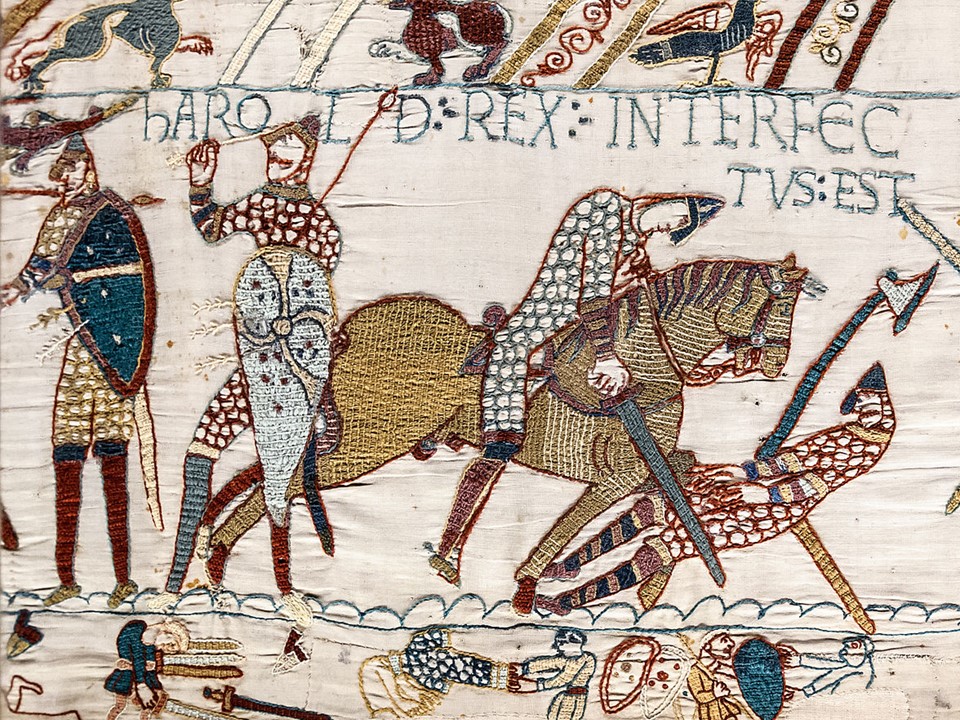
Which events from the Norman Conquest are depicted in the Bayeux Tapestry? The Bayeux Tapestry depicts the events leading up to the Norman Conquest of England in 1066, as well as the Battle of Hastings itself. Some of the specific events and scenes depicted in the tapestry include: 1. The death of Edward the Confessor, the king of England, and the subsequent succession crisis that led to the Norman Conquest. 2. The journey of Harold Godwinson, the Anglo-Saxon king of England, to Normandy to meet with Duke William of Normandy and the subsequent oath of allegiance that Harold took to William. 3. The Norman invasion of England, including the landing of the Norman fleet at Pevensey and the building of a castle at Hastings. 4. The Battle of Hastings, including the preparations of the Norman and Anglo-Saxon armies, the events leading up to the battle, and the battle itself, including the death of Harold and the Norman victory. 5. The coronation of William the Conqueror as the king of England and his subsequent reign, including the building of castles and the suppression of rebellions. Overall, the Bayeux Tapestry provides a detailed visual record of the Norman Conquest, including the key players, events, and battles of the period, and has served as an important historical and cultural artifact for over 900 years.

Bayeux Tapestry, Harold’s, the Anglo-Saxon Earl of Wessex and King of England, Death at the Battle of Hastings, c. 1070, Εmbroidered Wool on Linen, about 68.3 meters long and about 70cm wide, Bayeux Tapestry Museum, France https://commons.wikimedia.org/wiki/File:Bayeux_Tapestry_scene57_Harold_death.jpg

Why is the Bayeux Tapestry considered an important work of art? The Bayeux Tapestry is considered an important art historical artifact for several reasons. Firstly, the tapestry is an outstanding example of the art of embroidery and was created using a combination of techniques, including stem stitch, outline stitch, laid work, and couching. The embroidery is executed in a range of colors, including various shades of red, blue, green, yellow, and brown, and uses different types of thread, including silk, wool, and linen. Secondly, the Bayeux Tapestry is a unique example of the fusion of Anglo-Saxon and Norman artistic traditions, which were combined to create a distinctive style. The tapestry features both Anglo-Saxon and Norman figures and incorporates elements of Anglo-Saxon and Norman art, such as the interlacing patterns and spirals of Anglo-Saxon art, and the use of naturalistic forms in Norman art. Thirdly, the Tapestry is an important example of narrative art, as it tells a coherent story through a series of scenes and images that captures the viewer’s imagination. Finally, this is an important cultural artifact that has had a significant influence on the development of art and design over the centuries

Where did the Bayeux Tapestry get its name from? / Who owns the Bayeux Tapestry today? The Bayeux Tapestry is named after the town of Bayeux in Normandy, France, where it has been kept for most of its history. The tapestry is believed to have been commissioned by Bishop Odo of Bayeux, who was the half-brother of William the Conqueror and a powerful figure in Normandy. It is thought that the tapestry was probably displayed in Bayeux Cathedral in the 11th century. The Bayeux Tapestry is currently owned by the Centre Guillaume le Conquérant in Bayeux, France, where it is on display in a museum called the Musée de la Tapisserie de Bayeux. This is considered a treasured cultural and historical artifact. The tapestry is protected by French law and is considered a national treasure of France. The tapestry is sometimes also referred to as the Bayeux Embroidery, as it is embroidered rather than woven like a traditional tapestry.

For a PowerPoint, on a unique Tapestry in Bayeux, please… Check HERE!