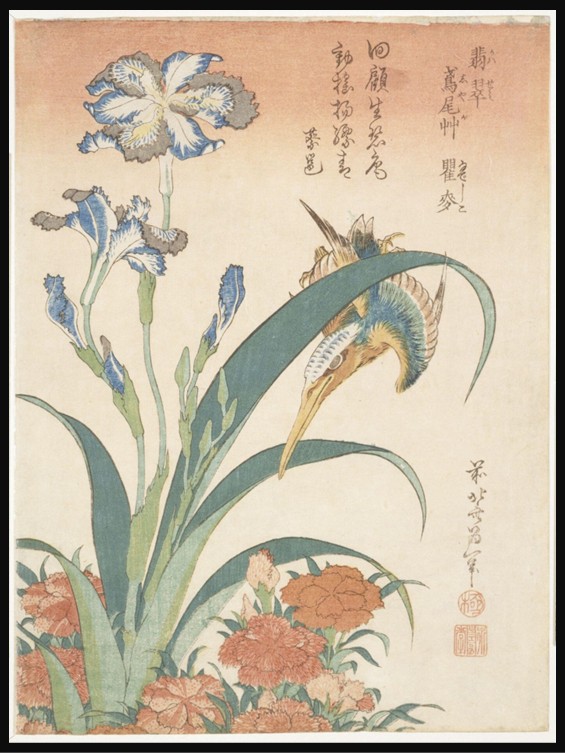
Kingfisher, Irises and Wild Pinks, ca. 1834, Woodblock Print, 22.9×16.5cm, Victoria&Albert Museum, London, UK
https://collections.vam.ac.uk/item/O71685/kingfisher-irises-and-wild-pinks-woodblock-print-katsushika-hokusai/
Katsushika Hokusai is best known for iconic landscapes like The Great Wave, yet some of his most enchanting works are found in the quieter world of kacho-ga, his bird-and-flower prints. In this article, Facts You Didn’t Know About Hokusai’s Kingfisher, Irises, Wild Pinks, we look closely at a print that blends poetry, nature, and craftsmanship. This elegant composition captures a kingfisher mid-dive among irises and wild pinks — a scene rich with seasonal symbolism and Edo-period artistry. And with the Iris celebrated as the flower of February, it becomes the perfect artwork to explore at this time of year.
Fact 1 — It Belongs to Hokusai’s Celebrated Kacho-ga Tradition
Hokusai’s kacho-ga (“bird and flower pictures”) reveal his sensitivity to nature and his mastery of balance, rhythm, and line. During the Edo period, these prints were extremely popular, decorating homes, shops, and teahouses. They were typically designed in chuban or horizontal oban format, compact sizes that suited domestic interiors.
In Kingfisher, Irises and Wild Pinks, Hokusai combines delicate floral forms with the dynamic motion of a kingfisher swooping toward unseen water below. The serene composition, paired with luminous color, highlights Hokusai’s talent for capturing both the emotional and symbolic qualities of the natural world.
Fact 2 — The Iris Connects the Print to the Month of February
Seasonal references were deeply embedded in Japanese art, literature, and daily life. Flowers signaled not only the time of year but also moods, festivals, and poetic associations. In this print, the Iris, with its upright stance and sword-like leaves, serves as a visual cue for February, a month linked to purification and the transition toward spring. For Edo-period viewers, this seasonal symbolism would have been instantly recognizable. The inclusion of a poem, placed alongside the image, further enriches the association by weaving nature, emotion, and time together in a single frame. Through such details, Hokusai invites viewers to read the artwork as both a botanical study and a meditation on seasonal harmony.
Fact 3 — It Was Created through a highly Collaborative Process
While we often imagine the artist as a solitary genius, Edo woodblock prints were the result of a sophisticated system of collaboration.
- Hokusai, the designer, created the initial drawing.
- Block cutters carved the artist’s lines into cherry wood blocks, one for each color.
- Printers skillfully applied pigments and pressure to produce crisp impressions.
- Specialist publishers managed the entire operation — financing the work, coordinating artisans, ensuring censorship approval, and distributing the finished prints.
This print bears Hokusai’s signature and includes both the official censor’s seal and the publisher’s mark, confirming its place within a well-regulated marketplace. Far from being unique, each impression was part of a larger production run, making these prints accessible and affordable to a growing urban audience.
Fact 4 — It Was Mass-Produced Yet Considered Highly Refined Art
In the 18th and 19th centuries, prints like this were widely purchased by merchants and artisans who sought beautiful yet affordable decoration. Bird-and-flower prints, in particular, appealed to the tastes of the urban middle class, offering vibrant color and intimate natural imagery. When these prints began arriving in Europe in the mid-to-late 19th century, they were initially seen as inexpensive curios. That changed quickly. Western artists, from the Impressionists to the Arts and Crafts designers, were captivated by the clarity of line, asymmetrical compositions, and expressive patterning. Prices rose dramatically, and Hokusai emerged as the most admired Japanese printmaker in the West. Thus, although Kingfisher, Irises and Wild Pinks was once an accessible decorative print, it is now recognized as a work of remarkable aesthetic refinement.
Fact 5 — Its Influence Reached Victorian Britain and Beyond
Hokusai’s natural imagery had a profound impact on 19th-century British visual culture. Designers and artists were drawn to the flattened perspectives, bold contours, and poetic pairing of flora and fauna. Japanese prints influenced wallpaper design, textile patterns, book illustration, and even garden aesthetics. A print like Kingfisher, Irises and Wild Pinks — combining botanical elegance with calligraphic fluidity — exemplified the qualities Western artists admired most. Through the movement known as Japonisme, Hokusai’s vision helped reshape how Europeans understood nature, composition, and decoration. His influence remains visible today in everything from contemporary illustration to modern graphic design.
Conclusion
Hokusai’s Kingfisher, Irises and Wild Pinks is far more than a charming nature scene. It is a window into the cultural rhythms of Edo Japan, a record of artistic collaboration, and a powerful example of how Japanese aesthetics transformed Western art. With its February irises, dynamic kingfisher, and subtle poetic layers, the print continues to speak across cultures and centuries, proof of Hokusai’s extraordinary ability to turn a moment in nature into a timeless work of art.
For a PowerPoint Presentation of Hokusai’s ‘Masterpieces of Flowers and Birds’, please… Check HERE!
Bibliography: from the Victoria and Albert Museum https://collections.vam.ac.uk/item/O71685/kingfisher-irises-and-wild-pinks-woodblock-print-katsushika-hokusai/