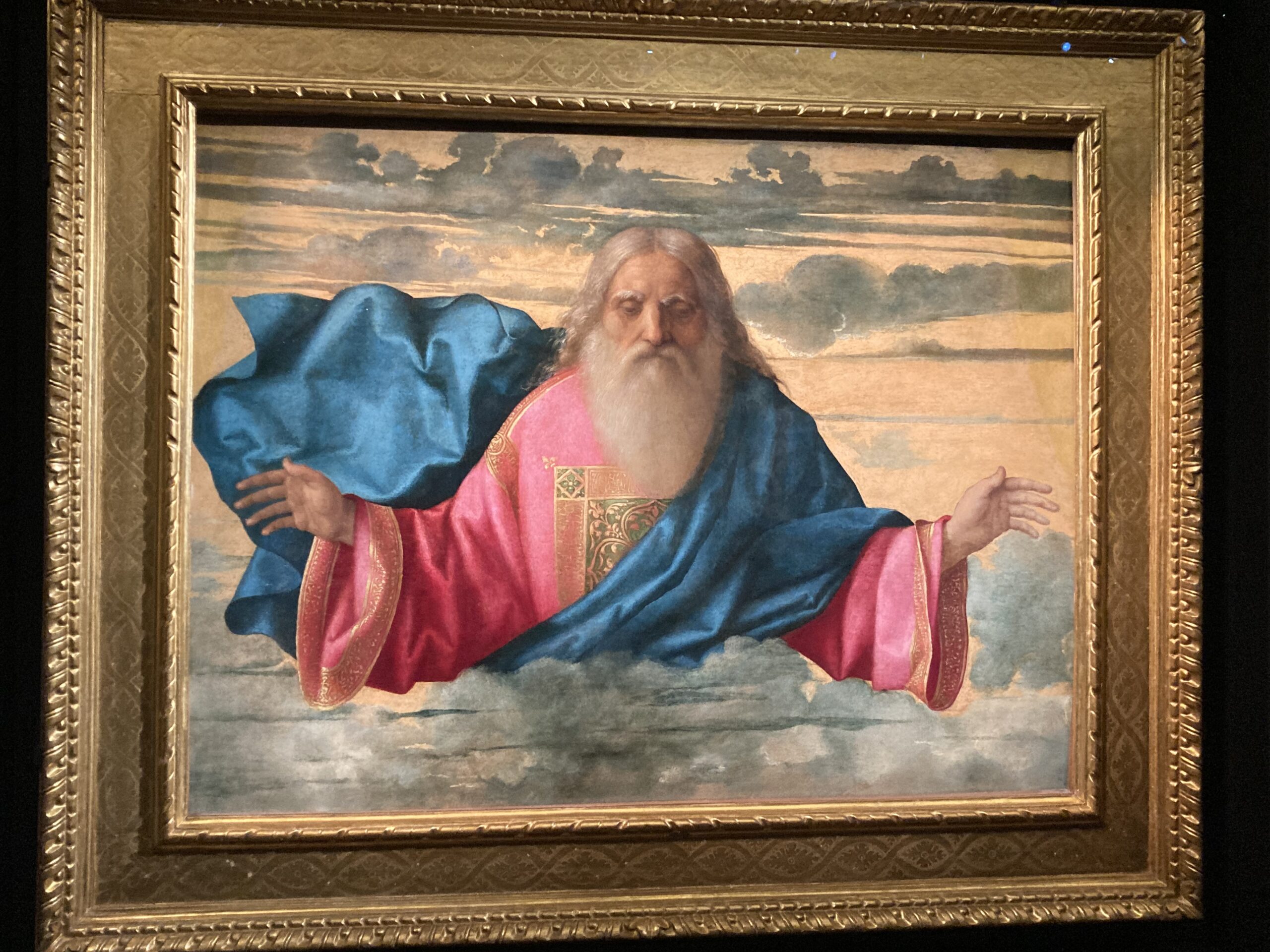
God the Father, 1505-1510, Oil on Wood, 102×132 cm, Palazzo Mosca-Musei Civici, Pesaro, Italy – Photo Credit: Amalia Spiliakou, March 2023, (Exhibition: GIOVANNI BELLINI Influences Croisées at Jacquemart-André Museum, Paris)
In Giovanni Bellini’s God the Father, the viewer encounters a quiet yet profound vision of the divine. Emerging gently from a bank of clouds, God appears not in thunder or spectacle, but in stillness, with arms extended in a gesture that seems at once welcoming, blessing, and encompassing. His presence fills the pictorial space with solemn calm, suspended between heaven and earth. The encounter feels intimate rather than overwhelming, inviting contemplation rather than awe. Bellini’s restrained vision draws us into a moment of spiritual reflection, where divine authority is expressed through serenity and light.
By the early sixteenth century, Bellini stood as the most revered painter in Venice, a master whose career bridged the poetic sensibility of the Early Renaissance and the luminous innovations of the High Renaissance. In his later years, his painting achieved an exceptional refinement of color, atmosphere, and emotional restraint. This work belongs to that mature phase, when technical mastery had become inseparable from spiritual depth. Rather than striving for dramatic invention, Bellini turns toward quiet revelation, offering an image shaped by decades of observation, devotion, and artistic wisdom.
The panel is widely considered to be the upper fragment of a now-lost altarpiece, a hypothesis supported by both its format and compositional logic. Bellini had previously employed an almost identical solution in the figure of the Eternal Father crowning the altarpiece of the Baptism of Christ, painted between 1500 and 1502 for the Garzadori altar in the church of Santa Corona in Vicenza. In both cases, God the Father appears above the principal sacred scene, emerging from clouds and presiding over the mystery below. The Pesaro panel thus preserves what was once the theological and visual apex of a larger devotional structure.
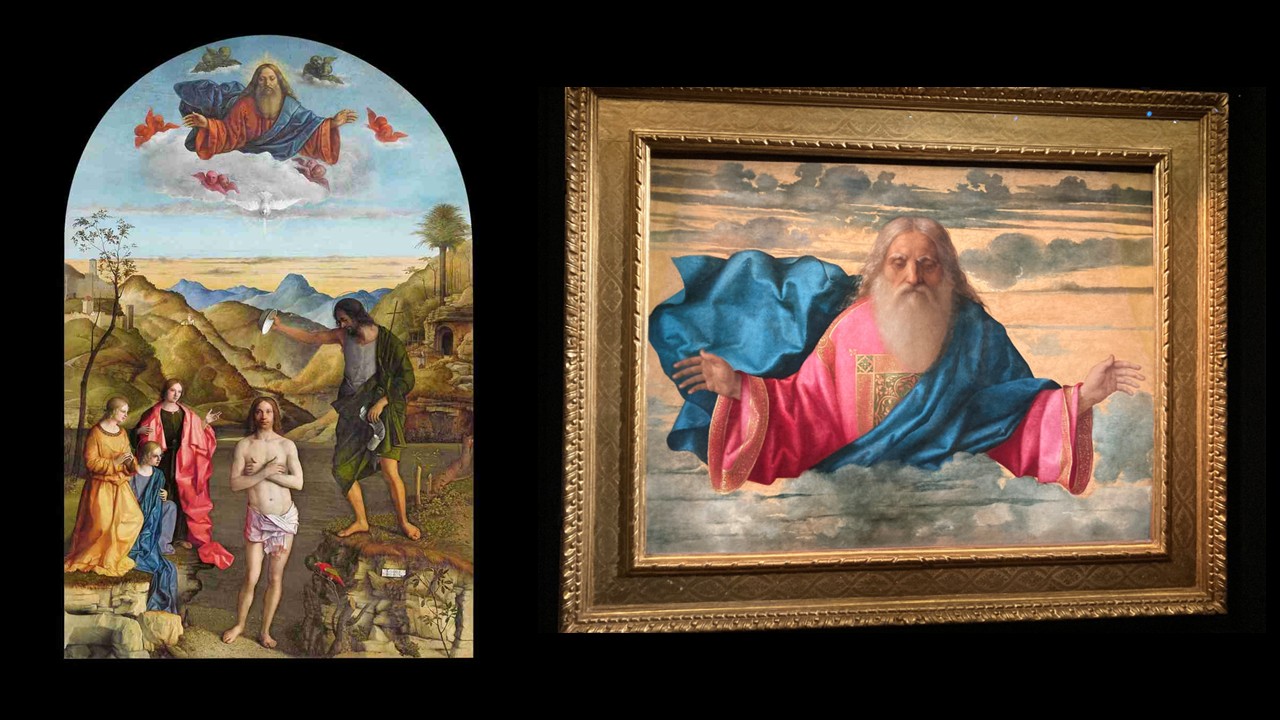
Garzadori Altar with The Baptism of Christ, 1500-1502, Tempera on board, 400cm x 263cm, Chiesa di Santa Corona, Vicenza, Italy https://www.facebook.com/groups/162243897516549/posts/1715539035520353/
God the Father, 1505-1510, Oil on Wood, 102×132 cm, Palazzo Mosca-Musei Civici, Pesaro, Italy – Photo Credit: Amalia Spiliakou, March 2023
While the compositional idea recalls the Vicenza altarpiece, the more mature stylistic language of the Pesaro painting suggests a slightly later date, around 1505. The handling of light is softer, the transitions more atmospheric, and the emotional tone more restrained. Bellini’s God no longer asserts authority through formal symmetry alone, but through a quiet sense of presence. The frontal pose, open arms, and direct gaze establish a relationship with the viewer, transforming the image into a silent dialogue between heaven and earth.
Much of the painting’s expressive power lies in Bellini’s mastery of color and light. The deep blue mantle envelops the figure in celestial gravity, while the rose-red garment introduces warmth and humanity. Light dissolves hard contours, softening the boundaries between flesh, fabric, and cloud, as though the divine presence permeates the surrounding space. The composition remains balanced and still, resisting narrative movement. Transcendence is communicated here not through drama, but through harmony, clarity, and luminous calm.
In God the Father, Bellini offers a vision of the divine shaped by contemplation rather than spectacle. Even as a fragment, the panel retains its devotional intensity, inviting sustained looking and inward reflection. The painting encapsulates Bellini’s late artistic philosophy, in which faith is expressed through light, color, and human presence. Suspended in clouds yet emotionally accessible, Bellini’s God is neither distant nor overwhelming but gently revealed, an enduring testament to the painter’s quiet theology of grace.
For a Student Activity, please… Check HERE!
Bibliography: from the Italian General catalogue of Cultural Heritage https://catalogo.beniculturali.it/detail/HistoricOrArtisticProperty/1100131504