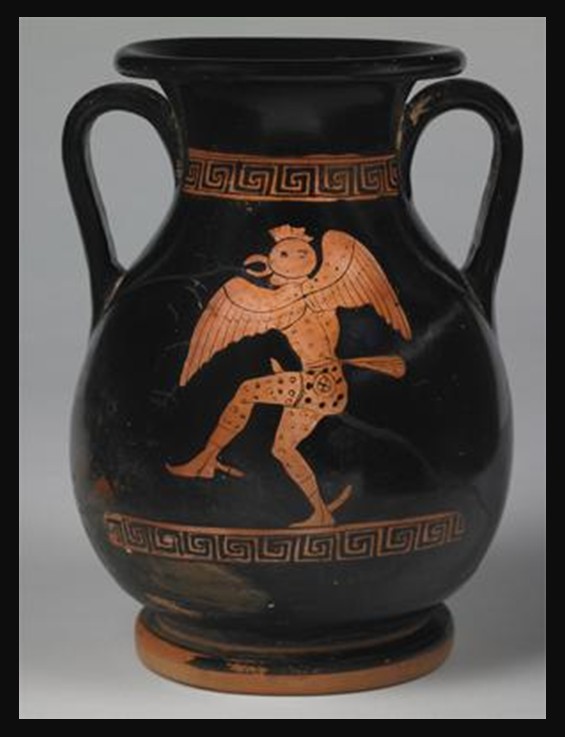
At first glance, this small Attic pelike seems playful, an oddly dressed figure, half-human and half-bird, frozen in mid-performance. Yet, the Red Figure Pelike with an Actor Dressed as a Bird (430–420 BC) offers far more than whimsy. Preserved today in the Michael C. Carlos Museum, the vase captures a moment from the theatrical world of classical Athens, where comedy, costume, and visual spectacle merged into a powerful cultural language. Read through the lens of Aristophanes’ The Birds, this modest ceramic vessel becomes a rare window into how ancient Greeks imagined performance and how costume transformed actors into living symbols on the stage.
What is the Red Figure Pelike with an Actor Dressed as a Bird? This object is a small Attic red-figure pelike, dated to around 430–420 BC, a vessel type typically used for storing liquids such as oil or wine. On its surface, however, it bears a highly unusual image: a costumed actor dressed as a bird, complete with wings, tail, and mask. Rather than depicting myth or daily life, the vase represents the world of theatrical performance, making it one of the clearest surviving visual records of ancient Greek comedy in action.
Who is depicted and why is it notable? The central figure is an actor wearing a full bird costume, most likely a rooster, while a musician on the reverse plays the double aulos. This pairing signals that we are witnessing a staged performance, not a symbolic or mythical scene. What makes the image remarkable is its specificity: it does not simply suggest theater, but shows the physical mechanics of costume, mask, and performance. The exaggerated body, feathered attachments, and theatrical posture reveal how comedy relied on visual transformation to communicate character and humor instantly.
Where and when was it made, and where is it now? The pelike was produced in Attica during the late fifth century BC, at the height of Athens’ cultural and theatrical innovation. Today, it is housed in the Michael C. Carlos Museum of Emory University in Georgia, where it stands as one of the most important visual documents of ancient Greek theater. Its survival allows us to connect literary descriptions of drama with tangible artistic evidence.
Why would a vase depict a theatrical performance? In classical Athens, theater was not merely entertainment, it was a civic and religious experience tied to festivals honoring Dionysus, the god of wine and performance. Vases used in symposia often featured Dionysian or theatrical imagery, reinforcing the link between wine, celebration, and drama. This pelike therefore functioned both as a utilitarian object and as a visual reminder of one of the most defining cultural practices of Athenian life.
How does this image connect to Aristophanes’ The Birds? Although the pelike predates Aristophanes’ The Birds (first performed in 414 BC), it reflects the same comic tradition that made such a play possible. Aristophanes famously populated his stage with costumed birds who formed a chorus and enacted a fantastical political satire. The pelike demonstrates that bird costumes were already part of the theatrical vocabulary, helping audiences recognize characters immediately and heightening the visual humor. Rather than illustrating a specific scene, the vase reveals the performative world from which The Birds emerged.
What does this tell us about ancient Greek theatrical costume? Greek comedy relied on exaggerated dress, masks, and bodily transformation. Costumes were not decorative but communicative: they defined identity, role, and tone at a glance. The bird costume on the pelike shows how actors used artificial wings, tails, masks, and footwear to create hybrid beings that were simultaneously humorous, symbolic, and instantly legible to spectators. Such visual coding was essential in large open-air theaters, where meaning had to be seen as well as heard.
Why is this pelike important for understanding ancient performance? Literary texts tell us what was said on stage; this vase shows us how performance looked. It preserves details of costume construction, posture, and stage presence that no script can convey. As a result, the pelike bridges material culture and dramatic literature, allowing us to reconstruct how comedy was embodied before an audience. It is one of the few surviving artifacts that captures the physical reality of ancient theatrical illusion.
What broader themes does this object illuminate? Beyond theater, the pelike speaks to themes of transformation, identity, and the power of visual storytelling in Greek culture. Birds, creatures that cross the boundary between earth and sky, become tools for satire and social commentary, much as they do in Aristophanes’ play. The vase also reminds us that art and performance were deeply interconnected in Athens: pottery did not merely decorate daily life, it recorded and reflected the spectacles that defined communal experience.
For a PowerPoint Presentation, titled Aristophanes, Staging Ornithes (The Birds): Art, Costume, and Performance from Antiquity to Today, please… Check HERE!
Bibliography: from the Michael C. Carlos Museum of Emory University in Atlanta https://collections.carlos.emory.edu/objects/24341/redfigure-pelike-with-actor-dressed-as-bird and Wikipedia https://en.wikipedia.org/wiki/Red_Figure_Pelike_with_an_Actor_Dressed_as_a_Bird