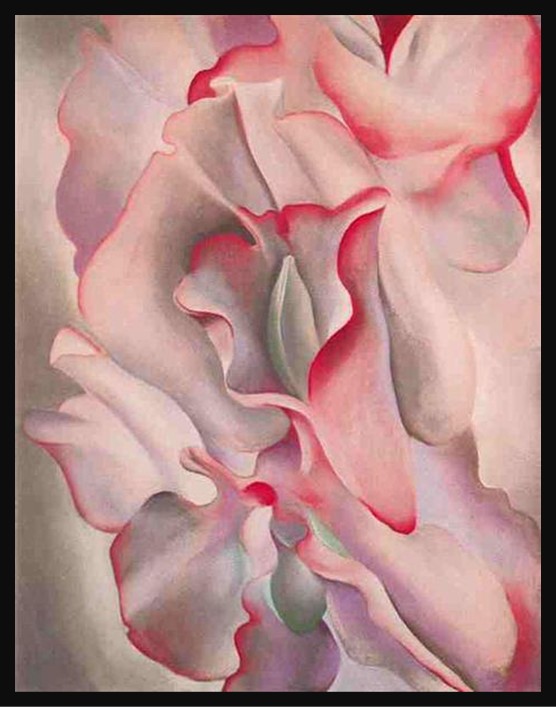
Pink sweet peas II, 1940, Oil on Canvas; 101.6×76.3 cm, Private collection
https://www.facebook.com/photo/?fbid=10162953797243474&set=g.5907271979
In 1940, Georgia O’Keeffe painted Pink Sweet Peas II, a luminous oil on canvas that transforms a modest garden flower into a commanding, almost immersive presence. By enlarging the blossoms to fill the vertical format, O’Keeffe dissolves the boundary between botanical study and abstraction. The petals curve and fold across the surface in soft gradations of pink, their velvety forms emerging from a subdued ground. What might have been a simple still life becomes instead an encounter, intimate, contemplative, and quietly monumental.
Born in 1887 in Sun Prairie, Wisconsin, O’Keeffe emerged as one of the most distinctive voices in twentieth-century American art. After studying at the Art Institute of Chicago and later in New York, she developed an independent visual language rooted in clarity of form and emotional intensity. Her early abstractions attracted the attention of photographer and gallerist Alfred Stieglitz, who became both her advocate and husband. Over the decades, O’Keeffe divided her time between New York and New Mexico, where the vast desert landscape profoundly shaped her artistic vision. Today, she is widely recognized as a central figure in American modernism, celebrated for her radical close-up flowers, stark landscapes, and enduring commitment to seeing the world on her own terms.
O’Keeffe’s flower paintings have long occupied a central place in discussions of American modernism. Working against the conventions of traditional floral still life, she magnified her subjects to such a scale that they verge on landscape. The viewer no longer observes the flower from a polite distance; we are drawn into its interior rhythms. In Pink Sweet Peas II, the gentle chromatic transitions—blush pinks, pale whites, subtle greens—suggest fragility, yet the composition itself feels structurally assured. The sweeping arcs of the petals create a dynamic movement that anchors the painting firmly within modernist concerns for form, color, and spatial tension.
Sweet peas, known for their delicate fragrance and climbing tendrils, carry symbolic associations of blissful pleasure, gratitude, and departure. Their ephemeral bloom makes them a poignant emblem of spring’s brief splendor. That this painting resonates especially in April—often celebrated as Sweet Pea month—adds another layer of meaning. April marks a seasonal threshold: the reawakening of gardens, the return of light, the quiet promise of renewal. O’Keeffe’s magnified blossoms capture that moment of emergence, when growth feels both tender and inevitable.
Yet beyond symbolism, Pink Sweet Peas II speaks to O’Keeffe’s sustained investigation of perception itself. By isolating and enlarging the flower, she compels us to look slowly and attentively. The painting asks what happens when we truly see something ordinarily overlooked. In this way, the work embodies a distinctly modern sensibility, one that values direct experience over inherited convention.
As we celebrate sweet peas in April, O’Keeffe’s canvas offers a reminder that even the most delicate forms can hold immense visual power. Through her brush, a fleeting bloom becomes enduring, and the quiet poetry of spring is translated into color, curve, and light.
For a PowerPoint Presentation, titled ‘2026 – 12 Months – 12 Flowers’, please… Click HERE!
Bibliography: the Georgia O’Keeffe Museum https://www.okeeffemuseum.org/ and https://www.artchive.com/artwork/pink-sweet-peas-2-georgia-o-keeffe/?utm_source=chatgpt.com