https://www.christies.com/en/lot/lot-6552510?ldp_breadcrumb=back
Fayum Mummy Portraits stand among the most haunting and intimate survivals of the ancient world, faces painted nearly two millennia ago that still meet our gaze with striking immediacy. Created in Roman Egypt between the 1st and 3rd centuries AD, these portraits were composed on wooden panels or linen shrouds using encaustic (hot wax) or tempera techniques. They were placed over the faces of mummified bodies, merging Egyptian funerary tradition with Roman artistic naturalism. The result is a genre unlike anything else from antiquity: individualized likenesses rendered with soft modeling, luminous skin tones, and expressive eyes that seem to bridge the divide between life and death. Their preservation owes much to Egypt’s dry climate, allowing modern viewers to experience a rare continuity with people of the distant past.
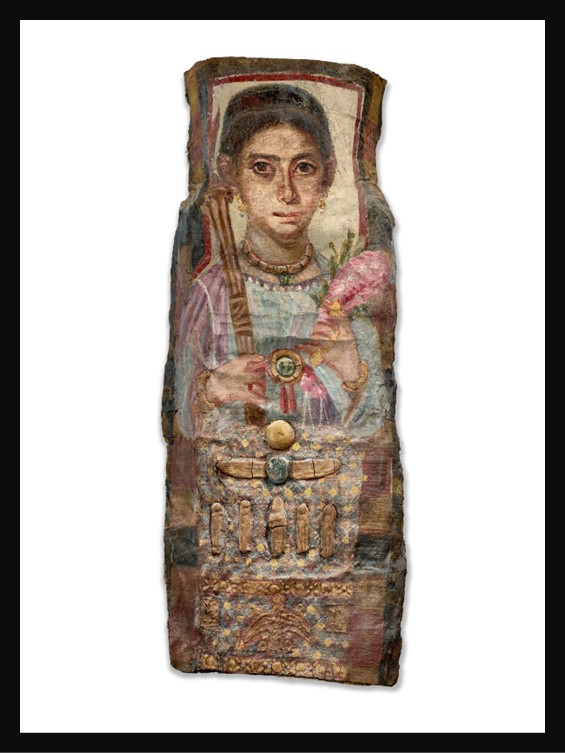
The Painted Linen and Stucco Mummy Portrait of a Woman dated to circa 225–250 A.D., offered through Christie’s, illustrates the sophistication of the tradition at its height. The figure is richly adorned, holding symbolic objects and framed by an intricate blend of painting and molded stucco work that elevates the shroud from a simple funerary covering to a deeply personal memorial. Details such as jewelry, garments, and ritual motifs reflect both the sitter’s status and the multicultural world of Roman-period Egypt. As archaeological evidence and scientific study continue to expand our understanding of these portraits, each example adds to the compelling story of identity, memory, and artistry in an era where cultures converged along the Nile.
The Meaning and Symbolism of Fayum Mummy Portraits
It is within this broader cultural and artistic landscape that Antinoöpolis, founded by Emperor Hadrian around 130 AD, emerges as a particularly important center of production. Situated on the east bank of the Nile, the city became renowned for its distinctive mummy portraits, many of which were uncovered during Albert Gayet’s excavations between 1896 and 1911. These shrouds share a recognizable aesthetic: expressive eyes, refined brushwork, and a fusion of Roman naturalism with Egyptian funerary tradition. The portrait discussed here aligns closely with this Antinoöpolitan style, leading art historian D. L. Thompson to attribute it to the hand of “Painter L,” a talented artist, or workshop, active in the city during the 2nd and 3rd centuries AD. Thompson identified hallmark traits such as large, dark, almond-shaped eyes and strong arched brows, features also seen in works now housed in the Louvre and the Benaki Museum. This connection situates the Christie’s portrait firmly within one of the most accomplished artistic traditions of Roman Egypt.
The refined style associated with Antinoöpolis is matched by the remarkable richness of the portrait’s iconography, which conveys the high social status of the woman depicted. Her gold jewelry is rendered with particular care: a heavy torque set with what may be a beryl stone, a prominent round brooch or buckle, and multiple rings that shimmer against her fingers. Gilding highlights additional decorative elements on the lower body, including applied stucco figures such as a winged sun-disk and standing deities interpreted as the four sons of Horus, underscoring the fusion of wealth, protection, and sacred symbolism. Even more striking is the object held in her right hand, interpreted by Ortiz-García as a torch linked to the underworld’s darkness, suggesting a possible identification of the deceased with Isis-Demeter, and by extension with the Pharaonic harvest deity Renenutet. In her left hand, a vivid pink funerary wreath provides a more conventional attribute for this category of shrouds. Together with the Osirian elements surrounding her, an implied chapel setting, gilded uraei once crowning the composition, and a bead-net motif recalling ancient faience networks, the portrait presents a powerful, multilayered vision of the deceased as both an elite woman of Roman Egypt and a figure ritually transformed for eternal life.
For a PowerPoint Presentation on Fayum Mummy Portraits, please… Click HERE!
Bibliography: From the Christie’s site https://www.christies.com/en/lot/lot-6552510?ldp_breadcrumb=back and from the J. Paul Getty Museum chrome-extension://efaidnbmnnnibpcajpcglclefindmkaj/https://www.getty.edu/publications/resources/virtuallibrary/0892360380.pdf