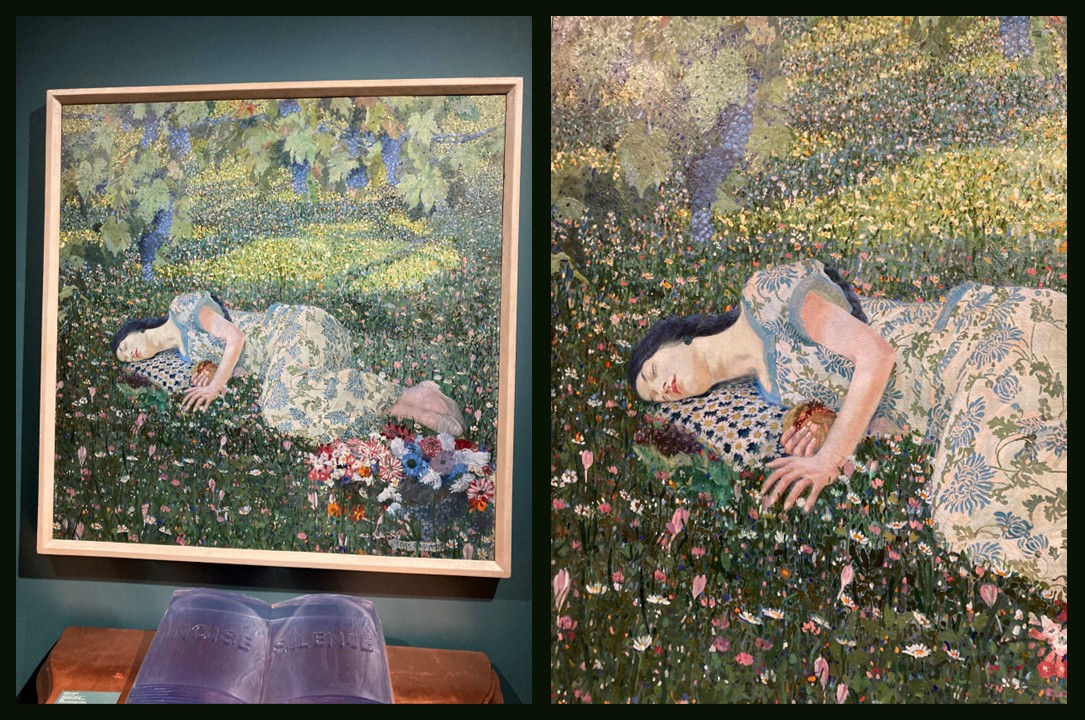
The Dream of the Pomegranate, 1913, Oil on Canvas, Palazzo Maffei, Verona Italy – Photo Credit: Amalia Spiliakou, September 2025
At first glance, The Dream of the Pomegranate feels hushed, almost suspended in time. A young woman sleeps in a meadow dense with wildflowers, her body gently folded into the grass beneath a canopy of heavy grape leaves. Nothing disturbs her rest; there is no breeze, no narrative action, only an enveloping stillness. Felice Casorati invites us into a private, interior space, one shaped not by events, but by dreams. Painted in 1913, on the eve of World War I, the work belongs to the artist’s early Symbolist phase, when mood, psychology, and poetic suggestion mattered more than realism or story.
Casorati renders the figure with deliberate calm. Her pose is natural yet carefully arranged, her patterned dress echoing the decorative rhythms of the surrounding flowers. The meadow is not a landscape to be entered but a surface to be contemplated: flattened, densely patterned, and quietly immersive. This emphasis on decoration and harmony reveals Casorati’s dialogue with European Secessionist painting, particularly Gustav Klimt, while retaining a distinctly Italian sensitivity to structure and balance. The dreamlike quality is heightened by the painting’s silence; even abundance here feels restrained, held in equilibrium.
The pomegranate, cradled near the sleeper’s hand, anchors the painting’s symbolic dimension. Traditionally associated with fertility, rebirth, and the cyclical nature of life, it also carries darker associations with sleep, death, and the unconscious. In this context, the fruit functions less as an attribute than as a threshold, marking the passage between waking life and inner vision. Casorati does not illustrate a specific myth or allegory, instead, he offers a state of being, where nature and body merge into a single, contemplative rhythm.
This work is especially significant within Casorati’s career because it represents a moment of transition. In the years following World War I, he would abandon the decorative richness and Symbolist reverie seen here, moving toward a more austere, classical style defined by geometric clarity, emotional restraint, and metaphysical quiet. Yet the core of his artistic identity is already present in The Dream of the Pomegranate: the fascination with stillness, the tension between intimacy and distance, and the conviction that silence can be profoundly expressive.
Viewed today, the painting feels uncannily contemporary. In a world saturated with speed and noise, Casorati’s sleeping figure offers an alternative mode of attention—slow, inward, and reflective. The Dream of the Pomegranate does not ask to be decoded so much as experienced. Like a dream remembered upon waking, it lingers softly, reminding us that rest, introspection, and quiet beauty are not escapes from reality, but essential ways of understanding it.
Finally, the setting in which The Dream of the Pomegranate is encountered today adds a further layer of meaning. The painting is housed at Palazzo Maffei – Casa Museo in Verona, an historic palace overlooking Piazza delle Erbe that brings modern and contemporary art into dialogue with architecture, antiquity, and lived space. Displayed within this intimate, carefully curated environment, Casorati’s work feels less like a museum object and more like a quiet presence, something discovered rather than announced. Palazzo Maffei’s emphasis on contemplation, domestic scale, and visual dialogue perfectly complements Casorati’s poetics of silence, allowing the painting’s dreamlike stillness to unfold slowly and personally for each viewer.
For a PowerPoint Presentation of Felice Casorati oeuvre, please… Check HERE!
Bibliography: from the Palazzo Maffei site https://palazzomaffeiverona.com/evento/felice-casorati-incontro/, from an Instagram post https://www.instagram.com/p/CpGKc78rniR/