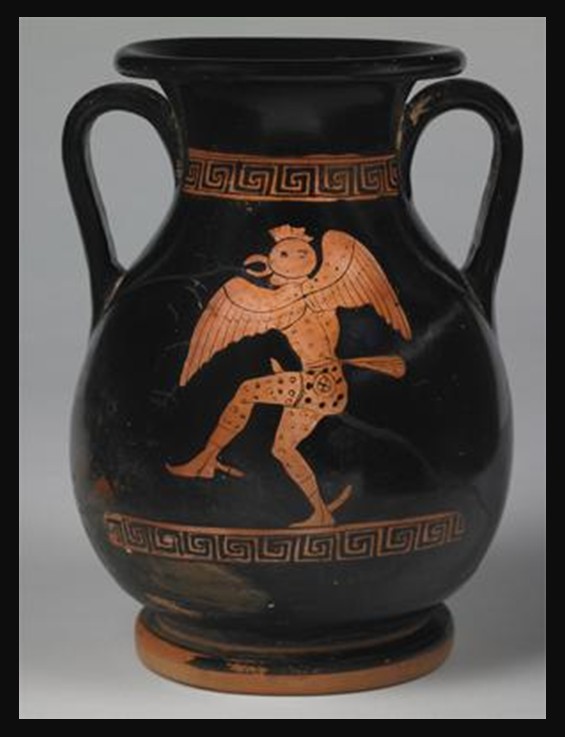
Attic red-figure ceramic pelike showing a lively scene from Greek comedy: a costumed actor in a bird (rooster) outfit with wings, tail, and a raised leg.

Pelike with an Actor Dressed as a Bird

Attic red-figure ceramic pelike showing a lively scene from Greek comedy: a costumed actor in a bird (rooster) outfit with wings, tail, and a raised leg.
Red Figure Pelike with an Actor Dressed as a Bird, 430-420 BC, Attic red-figured Pelike, Hight: 20.3 cm, , Michael C. Carlos Museum of Emory University, GA, USA https://en.wikipedia.org/wiki/Red_Figure_Pelike_with_an_Actor_Dressed_as_a_Bird

At first glance, this small Attic pelike seems playful, an oddly dressed figure, half-human and half-bird, frozen in mid-performance. Yet, the Red Figure Pelike with an Actor Dressed as a Bird (430–420 BC) offers far more than whimsy. Preserved today in the Michael C. Carlos Museum, the vase captures a moment from the theatrical world of classical Athens, where comedy, costume, and visual spectacle merged into a powerful cultural language. Read through the lens of Aristophanes’ The Birds, this modest ceramic vessel becomes a rare window into how ancient Greeks imagined performance and how costume transformed actors into living symbols on the stage.

What is the Red Figure Pelike with an Actor Dressed as a Bird? This object is a small Attic red-figure pelike, dated to around 430–420 BC, a vessel type typically used for storing liquids such as oil or wine. On its surface, however, it bears a highly unusual image: a costumed actor dressed as a bird, complete with wings, tail, and mask. Rather than depicting myth or daily life, the vase represents the world of theatrical performance, making it one of the clearest surviving visual records of ancient Greek comedy in action.

Who is depicted and why is it notable? The central figure is an actor wearing a full bird costume, most likely a rooster, while a musician on the reverse plays the double aulos. This pairing signals that we are witnessing a staged performance, not a symbolic or mythical scene. What makes the image remarkable is its specificity: it does not simply suggest theater, but shows the physical mechanics of costume, mask, and performance. The exaggerated body, feathered attachments, and theatrical posture reveal how comedy relied on visual transformation to communicate character and humor instantly.

Where and when was it made, and where is it now? The pelike was produced in Attica during the late fifth century BC, at the height of Athens’ cultural and theatrical innovation. Today, it is housed in the Michael C. Carlos Museum of Emory University in Georgia, where it stands as one of the most important visual documents of ancient Greek theater. Its survival allows us to connect literary descriptions of drama with tangible artistic evidence.

Why would a vase depict a theatrical performance? In classical Athens, theater was not merely entertainment, it was a civic and religious experience tied to festivals honoring Dionysus, the god of wine and performance. Vases used in symposia often featured Dionysian or theatrical imagery, reinforcing the link between wine, celebration, and drama. This pelike therefore functioned both as a utilitarian object and as a visual reminder of one of the most defining cultural practices of Athenian life.

How does this image connect to Aristophanes’ The Birds? Although the pelike predates Aristophanes’ The Birds (first performed in 414 BC), it reflects the same comic tradition that made such a play possible. Aristophanes famously populated his stage with costumed birds who formed a chorus and enacted a fantastical political satire. The pelike demonstrates that bird costumes were already part of the theatrical vocabulary, helping audiences recognize characters immediately and heightening the visual humor. Rather than illustrating a specific scene, the vase reveals the performative world from which The Birds emerged.

What does this tell us about ancient Greek theatrical costume? Greek comedy relied on exaggerated dress, masks, and bodily transformation. Costumes were not decorative but communicative: they defined identity, role, and tone at a glance. The bird costume on the pelike shows how actors used artificial wings, tails, masks, and footwear to create hybrid beings that were simultaneously humorous, symbolic, and instantly legible to spectators. Such visual coding was essential in large open-air theaters, where meaning had to be seen as well as heard.

Why is this pelike important for understanding ancient performance? Literary texts tell us what was said on stage; this vase shows us how performance looked. It preserves details of costume construction, posture, and stage presence that no script can convey. As a result, the pelike bridges material culture and dramatic literature, allowing us to reconstruct how comedy was embodied before an audience. It is one of the few surviving artifacts that captures the physical reality of ancient theatrical illusion.

What broader themes does this object illuminate? Beyond theater, the pelike speaks to themes of transformation, identity, and the power of visual storytelling in Greek culture. Birds, creatures that cross the boundary between earth and sky, become tools for satire and social commentary, much as they do in Aristophanes’ play. The vase also reminds us that art and performance were deeply interconnected in Athens: pottery did not merely decorate daily life, it recorded and reflected the spectacles that defined communal experience.

For a PowerPoint Presentation, titled Aristophanes, Staging Ornithes (The Birds): Art, Costume, and Performance from Antiquity to Today, please… Check HERE!

Bibliography: from the Michael C. Carlos Museum of Emory University in Atlanta https://collections.carlos.emory.edu/objects/24341/redfigure-pelike-with-actor-dressed-as-bird and Wikipedia https://en.wikipedia.org/wiki/Red_Figure_Pelike_with_an_Actor_Dressed_as_a_Bird
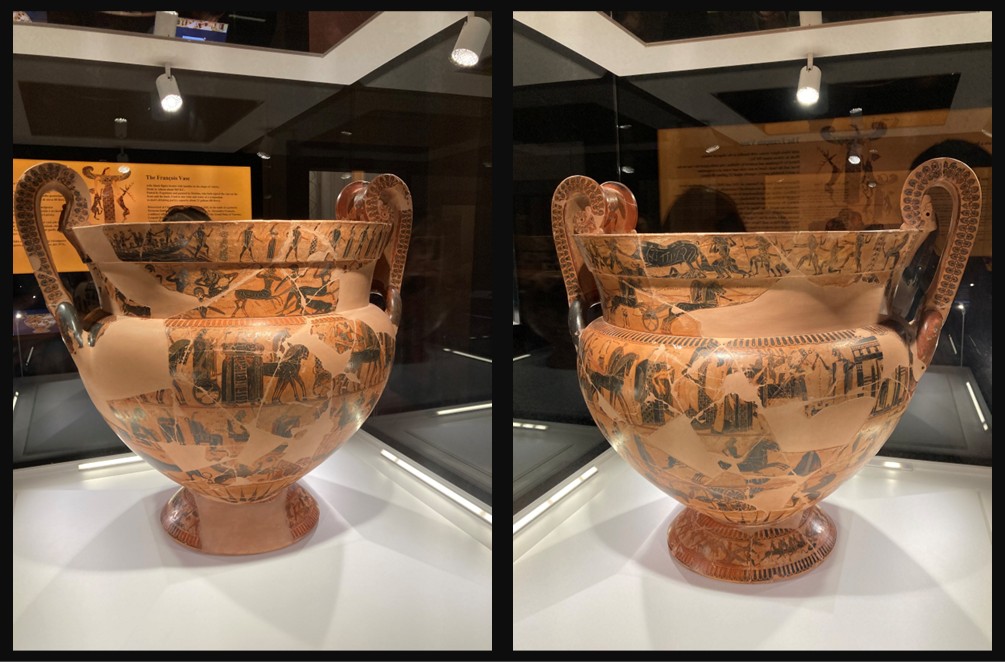
Attic black-figure volute krater known as the François Vase showing multiple mythological scenes in horizontal friezes, by Kleitias and Ergotimos, c. 570–565 BC.

François Vase

Attic black-figure volute krater known as the François Vase showing multiple mythological scenes in horizontal friezes, by Kleitias and Ergotimos, c. 570–565 BC.
Kleitias(painter) and Ergotimos(potter)
François Vase, Side A (right) and Side B (left), large Attic volute krater decorated in the black-figure style, c. 570-565 BC, Height: 66 cm, National Archaeological Museum, Florence, Italy – Photo Credit: Amalia Spiliakou, April 2025

Discover one of the greatest masterpieces of ancient Greek ceramics, the François Vase, a magnificent black-figure krater signed by the potter Ergotimos and the painter Kleitias. Covered with more than two hundred finely drawn figures, it unfolds a vibrant panorama of myth: weddings, hunts, battles, heroes, and gods, all rendered with exquisite narrative clarity. This monumental vessel invites us to marvel at the artistry and storytelling brilliance that flourished in Athens during the 6th century BC, where every detail contributes to a world alive with legend and ceremony.

4 Unique Facts About the François Vase

1. A Collaboration of Masters
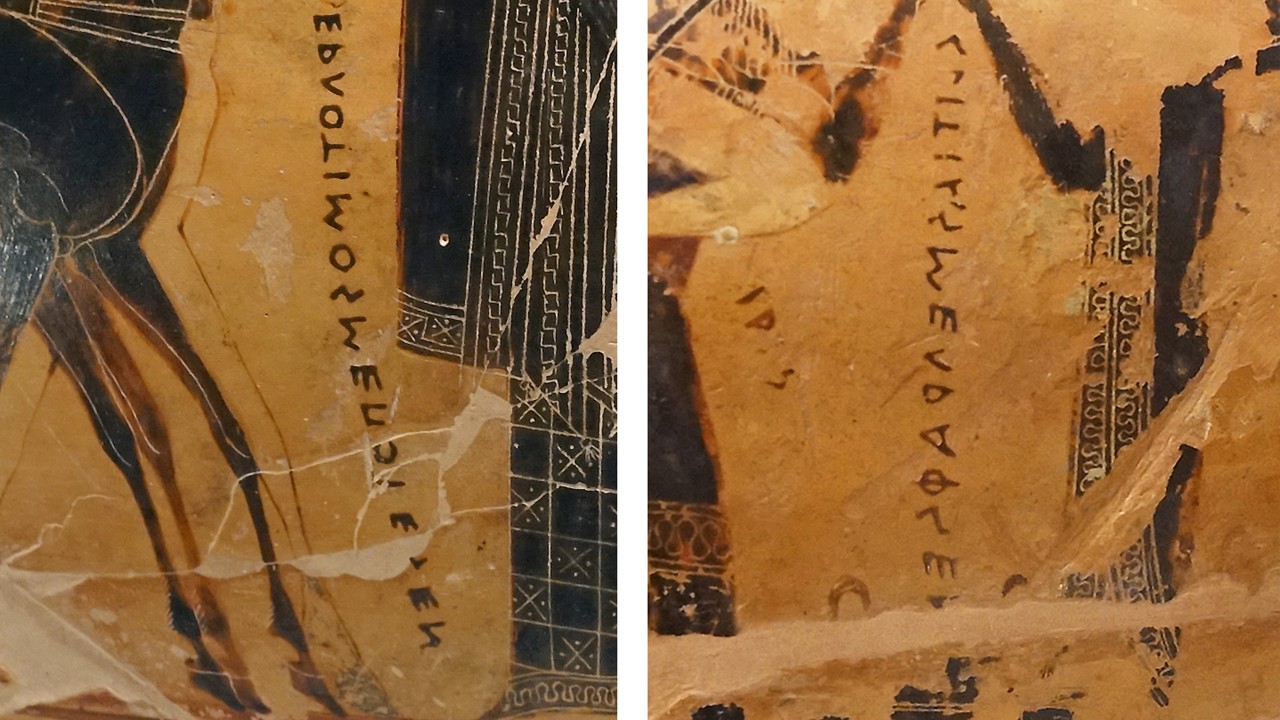
The François Vase is signed by both its creators, Ergotimos, the potter, and Kleitias, the painter—an exceptional practice in early 6th-century BCE Athens that underscores the prestige of their collaboration. Their signatures appear proudly on the vase in Greek—ΕΡΓΟΤΙΜΟΣ ΜΕΠΟΙΕΣΕΝ (“Ergotimos made me”) and ΚΛΕΙΤΙΑΣ ΜΕΓΡΑΦΣΕΝ (“Kleitias painted me”)—asserting authorship at a moment when most artisans remained anonymous.

Painted inscriptions on the François Vase explicitly name its makers: Ergotimos as potter and Kleitias as painter.
Kleitias(painter) and Ergotimos(potter)
François Vase, Detail with painted label (left) identifies Ergotimos as the potter; painted label (right) identifies Kleitias as the painter, large Attic volute krater decorated in the black-figure style, c. 570-565 BC, Height: 66 cm, National Archaeological Museum, Florence, Italy https://smarthistory.org/francois-vase/
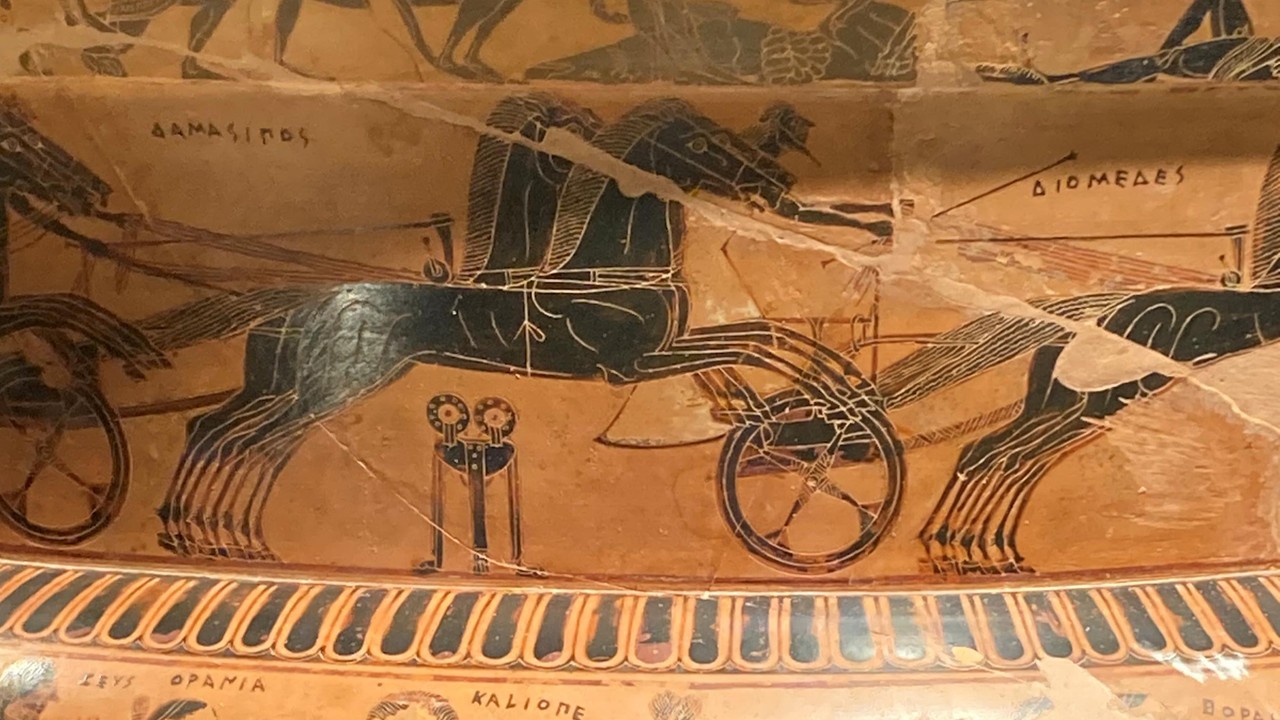
This François Vase detail depicts the chariot race organized by Achilles in honor of the fallen Patroklos, a key episode from Homer’s Iliad.
Kleitias(painter) and Ergotimos(potter)
François Vase, Detail chariot race organized by Achilles in honor of Patroklos, large Attic volute krater decorated in the black-figure style, c. 570-565 BC, Height: 66 cm, National Archaeological Museum, Florence, Italy – Photo Credit: Amalia Spiliakou, April 2025

Ergotimos was renowned for his technical mastery, creating a large and perfectly balanced volute krater whose complex shape was articulated into seven carefully organized friezes or bands, providing an ambitious and orderly framework for visual storytelling. Kleitias, working in the Attic black-figure technique, was among the most innovative painters of his generation, populating the surface with an astonishing 270 humans, 121 of which are identified by inscriptions. His meticulous incision, use of added red and white, and deployment of boustrophedon writing, in which the direction of the text alternates from left to right and right to left, guide the viewer through densely packed mythological narratives, transforming the vase into a systematic and encyclopedic compendium of myth.

2. A Mythological Encyclopedia in Bands
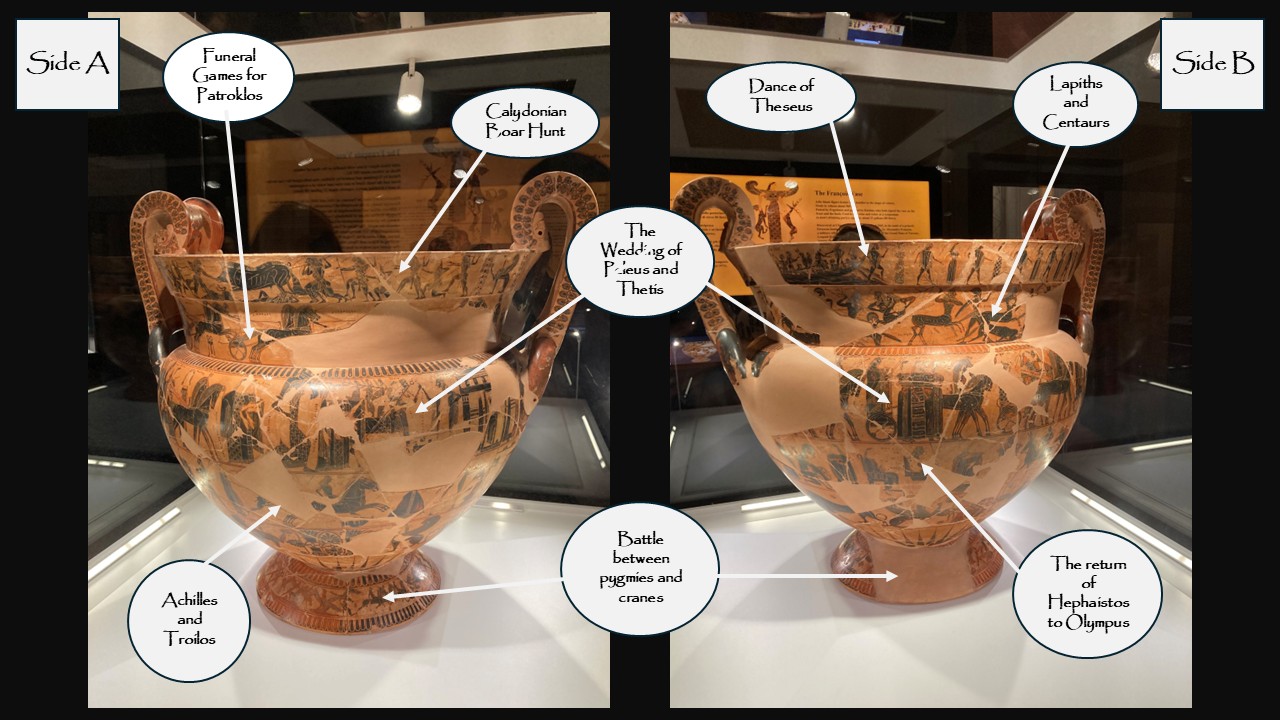
The François Vase functions as a comprehensive visual encyclopedia of Greek mythology, its narratives meticulously organised into horizontal friezes or bands that allow the viewer to “read” the stories in a structured sequence from neck to foot (see image). On the neck, two friezes unfold: above, the Calydonian Boar Hunt on Side A and the dance of Theseus and the Athenian youths celebrating their escape from Crete on Side B; below, the chariot race from the funeral games for Patroklos (A) faces the battle between Lapiths and Centaurs (B). Encircling the shoulder of the vase is a continuous frieze of the wedding of Peleus and Thetis, attended by a solemn procession of Olympian gods, uniting both sides in a single mythic event.

François Vase: The mythological scenes arranged in horizontal friezes; Attic black-figure volute krater by Kleitias and Ergotimos, c. 570–565 BC.

On the lower body, Side A shows Achilles in pursuit of Troilos, while Side B depicts the return of Hephaistos to Olympus, carried by Dionysos. Beneath these scenes, a lower register of sphinxes, animal combats, and palmette ornament anchors the narrative world in decorative rhythm. Even the vessel’s structural elements carry myth: the foot presents the comic yet symbolic battle between pygmies and cranes, while the handles feature Ajax bearing the body of Achilles and Artemis, the Mistress of Beasts, extending the storytelling to every surface of the krater.

3. Mastery of Black-Figure Technique
The François Vase is a prime example of the black-figure technique, in which figures are painted in black slip, with added white and purple used to distinguish female flesh and details of drapery. Details were then incised through the black slip to reveal the clay beneath, allowing for intricate depictions of anatomy, expression, and movement—bringing mythological scenes vividly to life.

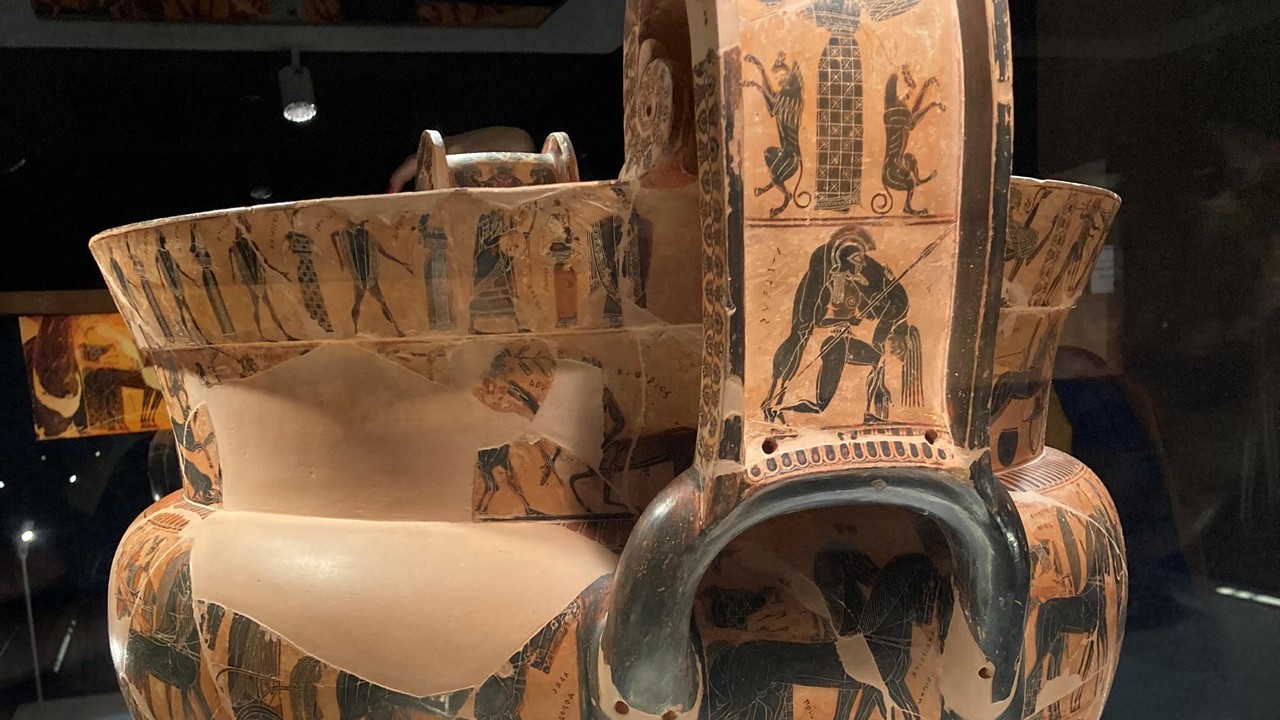
 Ajax carries the fallen body of Achilles from the battlefield, a poignant moment drawn from the Trojan War cycle.
Kleitias(painter) and Ergotimos(potter)
François Vase, Detail with Ajax carrying the body of Achilles on the handle of the vase, large Attic volute krater decorated in the black-figure style, c. 570-565 BC, Height: 66 cm, National Archaeological Museum, Florence, Italy – Photo Credit: Amalia Spiliakou, April 2025

 Alongside this technical virtuosity, the vase preserves key features of the Orientalizing period, including mythological creatures such as gryphons and sphinxes, as well as exotic vegetal motifs—notably the lotus and palmette—which appear in subsidiary registers and decorative zones. These Near Eastern–inspired elements enrich the narrative imagery and reflect the cosmopolitan visual language shaping Athenian art in the early sixth century BC. Beyond gods and heroes, the vase offers glimpses of contemporary Greek society. Scenes of warriors, chariots, and domestic life reveal clothing, armor, and social customs, making it a rich historical resource as well as an artistic masterpiece.

4. A Journey Through Time
Unearthed in 1844 in an Etruscan tomb near Chiusi, the François Vase bears witness to the far-reaching cultural exchanges between Archaic Athens and Etruria, where Attic pottery was highly prized from as early as the seventh century BCE. Produced in Athens and exported to Italy—likely through major Etruscan centers such as Vulci—the vase was discovered fragmented in a chamber tomb at Fonte Rotella, already looted in antiquity, underscoring its long and complex biography even before modern times.

Following its discovery, the surviving fragments were sent to Florence and first reassembled in 1845 by the restorer Vincenzo Manni, who reconstructed the krater’s original form despite missing pieces. The vase’s modern history has been equally dramatic: in 1900, it was shattered into more than 600 fragments after a museum incident, yet painstakingly restored by Pietro Zei, who achieved an almost complete reconstruction and incorporated newly identified fragments. Further conservation followed in 1902, and again in 1973, after the devastating 1966 Florence flood caused additional damage. Today, preserved in the Archaeological Museum of Florence, the François Vase stands not only as a masterpiece of Archaic Greek art but also as a rare survivor shaped by centuries of loss, recovery, and restoration—linking the ancient Mediterranean world with modern scholarship.

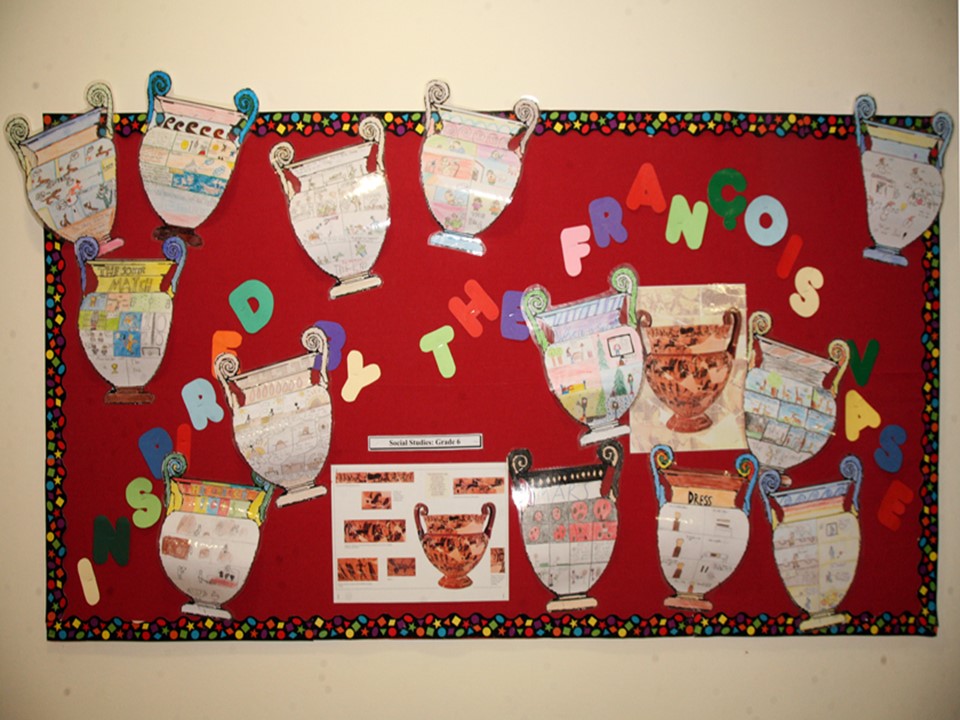
François Vase: Student bulletin board exhibition for Grade 6 Social Studies at Pinewood, The American International School of Thessaloniki.
François Vase Student Activity for Social Studies Grade 6, Bullet Board Exhibition, Pinewood, The American International School of Thessaloniki – Photo Credit: Amalia Spiliakou https://www.teachercurator.com/ancient-greek-art/inspired-by-the-francois-vase/

The François Vase isn’t just a ceramic vessel, it’s a window into the imagination, artistry, and daily life of ancient Greece. Each figure, frieze, and inscription invites us to step into a world where myths lived vividly and storytelling was a celebrated art. Whether admired for its technical brilliance or its epic narratives, the vase continues to captivate visitors at the Archaeological Museum of Florence, reminding us that the stories of heroes and gods are as enduring as the artistry that preserves them.

For a PowerPoint Presentation of the François Vase, please… Click HERE!

If interested, explore my Blog Post titled Inspired by the François Vase… https://www.teachercurator.com/ancient-greek-art/inspired-by-the-francois-vase/

Bibliography: University of California Press E-Books: The François Vase https://publishing.cdlib.org/ucpressebooks/view?docId=ft1f59n77b&chunk.id=d0e2374&toc.depth=1&toc.id=&brand=ucpress and Florence Inferno: The François Vase https://www.florenceinferno.com/the-francois-vase/ and smarthistory: The François Vase: story book of Greek mythology https://smarthistory.org/francois-vase/