IVLIA BELLA

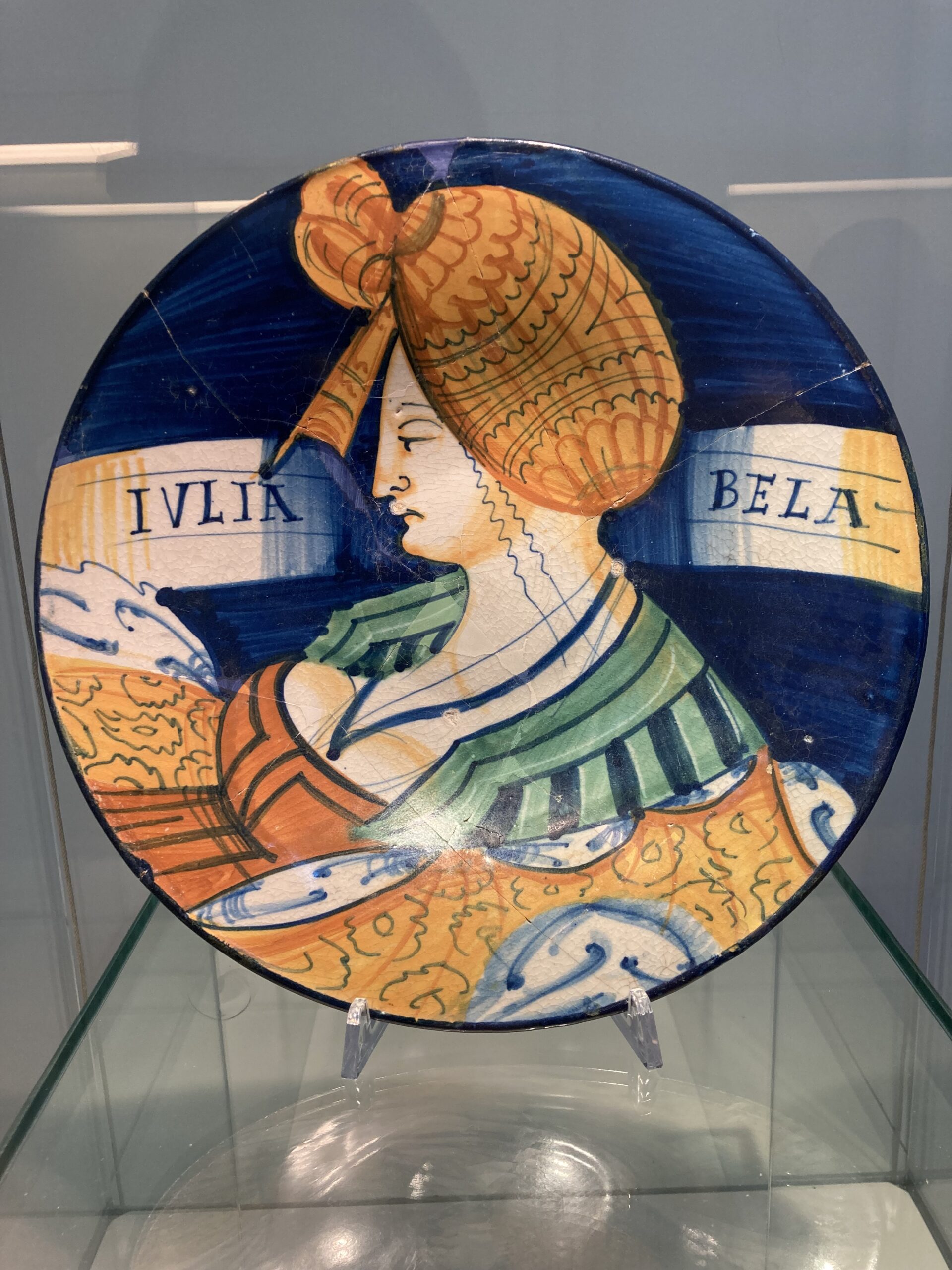
Iulia Bella plate, Faenza, end of 15th – beginning of 16th cent., Maiolica, Diameter: 28.2 cm, International Ceramics Museum in Faenza, Italy – Photo Credit: Amalia Spiliakou, April 2025

The IVLIA BELLA plate, housed at the Museo Internazionale delle Ceramiche in Faenza, stands as a luminous example of early Renaissance maiolica and the city’s mastery of ceramic portraiture. Crafted in the late 15th or early 16th century, the plate portrays the bust of a refined young woman in profile—her name, “Iulia Bella,” inscribed gracefully on a scroll behind her. This delicate work reflects a pivotal cultural shift in Faenza’s ceramic tradition, as artists moved away from Gothic and Oriental motifs toward the celebration of human beauty and individuality. With its elegant design and rich symbolism of love and virtue, the IVLIA BELLA plate captures both the artistry and humanism that defined the Italian Renaissance.

Let’s explore the ‘who’, ‘where’, when’, ‘why’ and ‘what’ of the amazing Majolica Plate of IVLIA BELLA in theInternational Museum of Ceramics in Faenzaby posing some questions!

Who was Iulia Bella? While her exact identity remains unknown, “Iulia Bella” likely represents a young bride or an idealized figure of feminine beauty. The name inscription personalizes the plate, suggesting it may have been commissioned to celebrate marriage, virtue, or social status, reflecting Renaissance ideals of elegance and moral refinement.

What artistic techniques make this plate stand out? The plate exemplifies Faenza maiolica through its tin-glazed surface, vibrant enamel colors, and finely painted portrait in profile. The careful rendering of her hairstyle, damask dress, and the inscribed scroll demonstrates a mastery of detail and the shift from decorative patterns to human-centered imagery.

When and in what cultural context was it created? Created in the late 15th or early 16th century, the plate emerges during the Italian Renaissance, when Faenza workshops transitioned from Gothic and Oriental motifs toward portraits and figurative art. This period emphasized humanism, individuality, and the celebration of beauty in daily life.

Where would the plate have been displayed? Such plates were likely display items rather than functional tableware, placed in domestic interiors or marriage chambers to be admired. Their role was both decorative and symbolic, showcasing refinement, wealth, and cultural sophistication.

Why were ceramics chosen for commemorative or amatory portraits? Ceramics offered a durable, portable, and visually striking medium for personal or commemorative imagery. A painted plate like IVLIA BELLA combined practical elegance with social signaling, allowing patrons to celebrate beauty, virtue, and status within the home in a tangible, everyday object.

Why is the International Museum of Ceramics in Faenza considered an important institution in the world of ceramic art and history? The International Museum of Ceramics in Faenza is considered one of the most important institutions in the world of ceramic art and history due to its vast and diverse collection, its historical significance, and its role in preserving and promoting ceramic heritage. Founded in 1908, the museum houses work from ancient civilizations to contemporary ceramic art, representing cultures from across the globe. It is especially renowned for its comprehensive display of Italian Majolica, with masterpieces from key production centers like Faenza, Deruta, and Urbino. The museum also serves as a vital center for research, education, and innovation in ceramics, hosting exhibitions, workshops, and scholarly initiatives. Its presence in Faenza, a city with centuries-old ceramic traditions, further cements its role as a guardian of both local craftsmanship and international ceramic excellence.

For a Student Activity inspired by the Faenza Plate of Iulia Bella, please… Click HERE!

Bibliography: https://www.micfaenza.org/en/opera/iulia-bella-plate/ and https://lauramorelli.com/ceramics-faenza/  
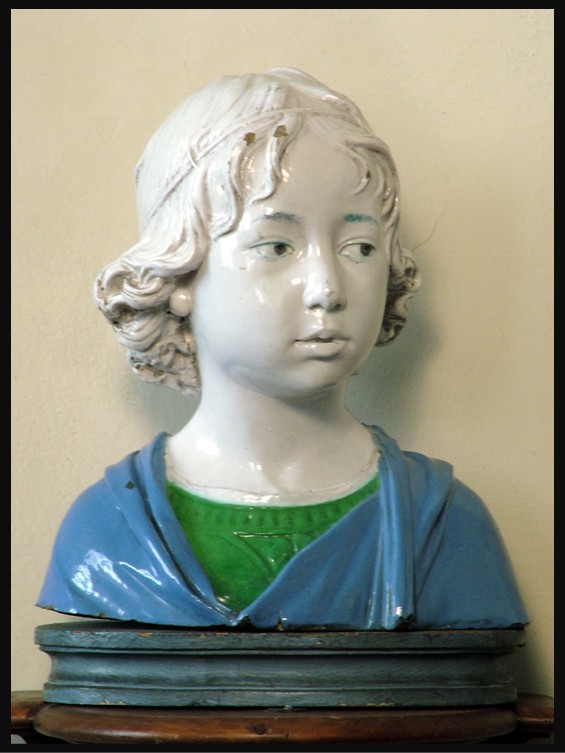
Andrea della Robbia’s tender Portrait of a Child

Andrea Della Robbia, 1435-1525
Portrait of a Child, ca 1475 – ca 1480, Glazed Terracotta, Height: 34 cm, National Museum of Bargello, Florence, Italy – Photo Credit: Amalia Spiliakou, April 2025

To mark UN World Children’s Day on November 20, a celebration of children’s rights and their place at the heart of our shared humanity, it feels fitting to turn our attention to Andrea della Robbia’s tender Portrait of a Child, housed in Florence’s Bargello Museum. Crafted in the late 15th century, this glazed terracotta bust captures the purity and quiet dignity of childhood with remarkable grace. Della Robbia’s mastery of the terracotta invetriata technique lends the work its luminous surface and soft, lifelike expression, qualities that make the child’s gentle gaze as moving today as it was five centuries ago. This piece serves as both an artistic treasure and a timeless reminder of innocence, compassion, and the enduring importance of nurturing the young. https://www.un.org/en/observances/world-childrens-day

Andrea della Robbia (1435–1525) was a prominent Florentine sculptor and a key figure in the celebrated Della Robbia family workshop, renowned for its innovative glazed terracotta sculptures. The nephew of Luca della Robbia, who first perfected the family’s distinctive enamel technique, Andrea inherited both the workshop and his uncle’s passion for combining sculpture with color. Working in Renaissance Florence during a period of extraordinary artistic flourishing, he produced devotional works, portraits, and architectural reliefs that blended religious feeling with human warmth. His works adorned churches, hospitals, and cloisters throughout Tuscany, where his serene Madonnas and angelic figures became beloved symbols of faith and tenderness.

Andrea della Robbia’s artistic legacy lies in his refinement of the terracotta invetriata technique, a process that coated clay sculptures with brightly colored, tin-based glazes to achieve both durability and visual brilliance. This innovation, first pioneered by his uncle Luca, was transformed under Andrea’s hand into a sophisticated artistic language that united practicality, beauty, and devotion. His mastery of color and form allowed him to create works that combined the sculptural depth of relief with the vibrancy of painting, resulting in pieces that glowed with a sense of divine light. The luminous surfaces of his sculptures not only protected them from weathering but also made them accessible to a broader audience, adorning churches, hospitals, and civic spaces across Tuscany. Beyond technical achievement, Andrea infused his figures with spiritual purity and emotional tenderness, particularly visible in his serene Madonnas and the famous swaddled infants of the Ospedale degli Innocenti. Through his craftsmanship and sensitivity, he elevated glazed terracotta into one of the Renaissance’s most distinctive and enduring expressions of faith, compassion, and artistic innovation.

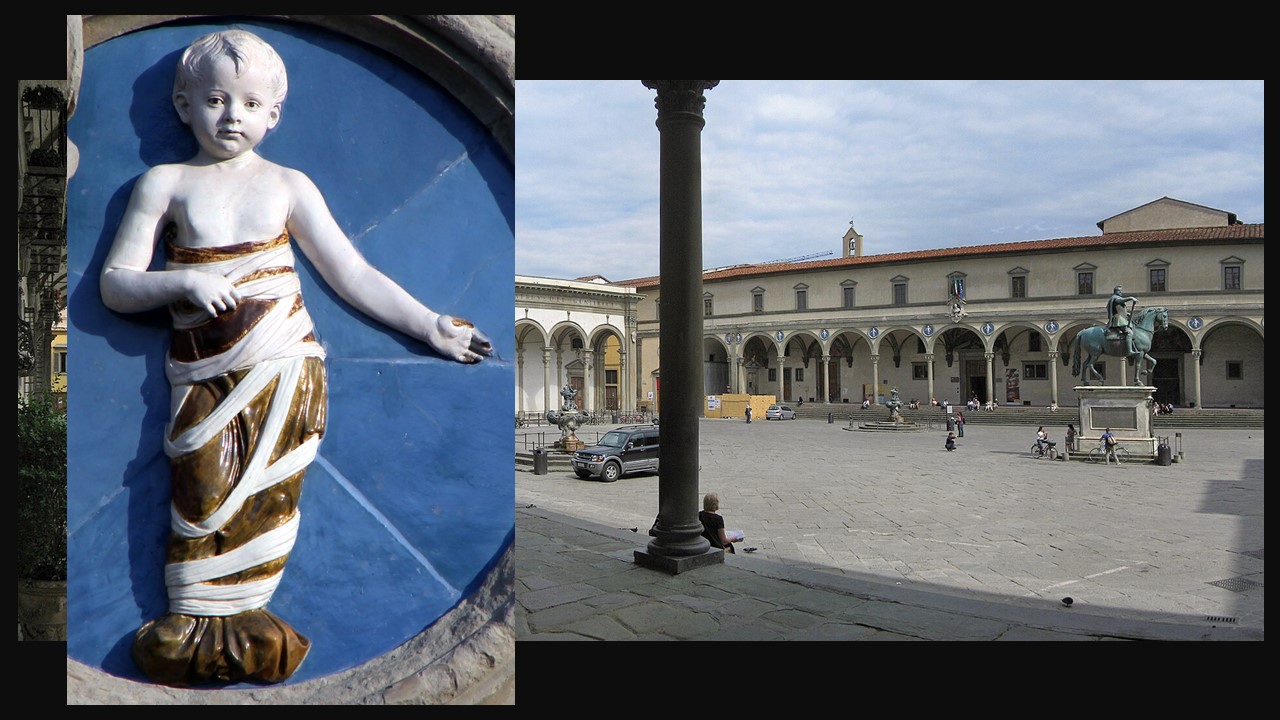
Designed by Filippo Brunelleschi, 1377-1446
Spedale degli Innocenti, Construction: 1417-1436 – Inauguration: 1445, Piazza della Santissima Annunziata, Florence, Italy https://it.wikipedia.org/wiki/Spedale_degli_Innocenti
Andrea della Robbia, 1435-1525
Infant in Swaddling Clothes, 1487, Glazed Terracotta, Diameter about 100 cm, Ospedale degli Innocenti, Piazza della Santissima Annunziata, Florence, Italy https://smarthistory.org/andrea-della-robbia-bambini-ospedale-degli-innocenti/

Andrea della Robbia’s Head of a Boy, housed in the Bargello Museum in Florence, is a finely modeled glazed terracotta bust that captures the quiet grace and innocence of childhood. The sculpture portrays a young boy with softly curling hair, serene features, and a gentle, introspective expression. His head is slightly turned, lending the figure a sense of naturalism and presence, while the delicate modeling of the lips and eyes reflects Andrea’s remarkable sensitivity to human emotion. The figure’s clothing, rendered in vivid blue and green glazes, contrasts beautifully with the pure white of the face, emphasizing both the luminosity and purity that the invetriata technique made possible. This harmony of color and form, combined with the lifelike modeling, embodies the Renaissance ideal of blending spiritual serenity with human warmth. The piece radiates quiet dignity and emotional restraint, standing as a testament to Andrea della Robbia’s gift for transforming humble terracotta into art of transcendent beauty.

For a PowerPoint Presentation of Andrea della Robbia’s oeuvre, please… Check HERE!

For more information on Andrea della Robbia’s contribution to the Florentine Ospedale degli Innocenti, please visit the Teacher Curator’s Blog Post… https://www.teachercurator.com/art/spedale-degli-innocenti-in-florence/

Bibliography: https://catalogo.beniculturali.it/detail/HistoricOrArtisticProperty/0900383750 and https://wahooart.com/en/artists/andrea-della-robbia-en/ and chrome-extension://efaidnbmnnnibpcajpcglclefindmkaj/https://www.nga.gov/sites/default/files/2025-06/exhibition-della-robbia.pdf

The Medici in Faenza

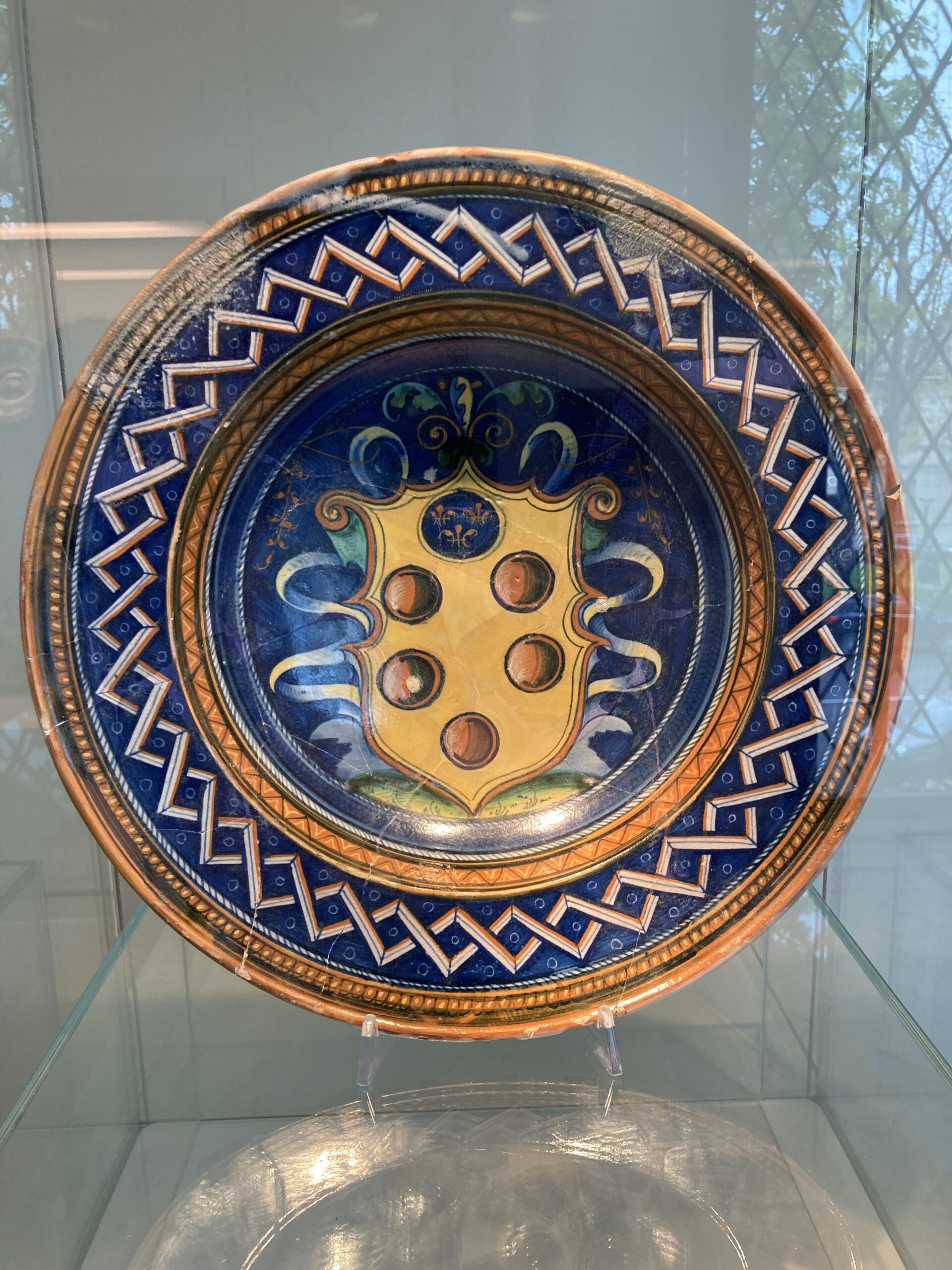
Majolica Plate decorated with the coat of arms of the Medici of Florence, 16th century (1525 – 1530), Diameter: 12.3 cm, International Museum of Ceramics in Faenza, Italy – Photo Credit: Amalia Spiliakou, April 2025

Visiting the International Museum of Ceramics in Faenza was an unforgettable experience, an inspiring journey through centuries of ceramic artistry. As someone with a deep appreciation for both history and design, I was truly impressed by the museum’s extraordinary collection, which showcases the global and cultural significance of ceramics in such a thoughtfully curated way. Among the many treasures, one piece that especially captivated me was a modest yet elegant Majolica plate from the 16th century, skillfully adorned with the coat of arms of the Medici of Florence. Despite its small size, just 12.3 cm in diameter, its refined craftsmanship and understated beauty spoke volumes. It offered a glimpse into The Medici in Faenza, a subtle yet powerful reminder of how far their influence reached, and how even the simplest objects can carry the weight of history with quiet grace. https://www.micfaenza.org/en/

Let’s explore the ‘how’, ‘’, ‘why’, and ‘what’ of the amazing ‘Majolica Plate decorated with the coat of arms of the Medici of Florence’ in theInternational Museum of Ceramics in Faenzaby posing some questions!

What is Majolica, and why was it significant in Renaissance Italy? A Majolica plate is a type of tin-glazed earthenware that became highly popular in Renaissance Italy for its vibrant colors and intricate designs. Made from clay and coated with a white tin glaze, the surface served as a canvas for hand-painted decoration using metallic oxide pigments, which became brilliantly glossy after firing. These plates often featured historical, mythological, or heraldic imagery—like the Medici coat of arms—and were prized for both their beauty and craftsmanship. More than just functional objects, Majolica plates were symbols of wealth, status, and artistic refinement, reflecting the cultural and political identity of their time.

What is the origin of the term “Majolica,” and how has its meaning and use evolved over time? The term “Majolica” originates from the Spanish island of Mallorca (Majorca), which was a key trading hub for ceramics between the Islamic world and Italy during the Middle Ages. Italian potters believed that the brightly colored, tin-glazed pottery imported through Mallorca came from there, and the name “Maiolica” (the Italian form) became associated with this style of earthenware. Initially, it referred specifically to the luxurious, vividly painted ceramics produced in Renaissance Italy, especially in centers like Faenza, Deruta, and Urbino. Over time, particularly in the 19th century, the term “Majolica” began to be used more broadly—and sometimes confusingly—to describe other types of colorful ceramics, including English Victorian ware with entirely different techniques. Despite this evolution, in its original sense, Majolica remains a celebrated hallmark of Italian Renaissance artistry and innovation in ceramics.

What role did the city of Faenza play in the development and prominence of Majolica earthenware? Faenza played a central role in the development and prominence of Majolica earthenware during the Renaissance, becoming one of the most important ceramic production centers in Italy. The city’s artisans were renowned for their technical skill and artistic innovation, helping to refine the tin-glazing technique that gave Majolica its brilliant, glossy surface. Faenza’s strategic location along trade routes and its strong guild traditions fostered an environment where ceramic craftsmanship could flourish. So influential was its production that the French term for fine tin-glazed pottery—faïence—derives from the name of the city. Faenza’s legacy in ceramics continues today, celebrated through institutions like the International Museum of Ceramics, which honors its rich contribution to the art form.

Why is the International Museum of Ceramics in Faenza considered an important institution in the world of ceramic art and history? The International Museum of Ceramics in Faenza is considered one of the most important institutions in the world of ceramic art and history due to its vast and diverse collection, its historical significance, and its role in preserving and promoting ceramic heritage. Founded in 1908, the museum houses work from ancient civilizations to contemporary ceramic art, representing cultures from across the globe. It is especially renowned for its comprehensive display of Italian Majolica, with masterpieces from key production centers like Faenza, Deruta, and Urbino. The museum also serves as a vital center for research, education, and innovation in ceramics, hosting exhibitions, workshops, and scholarly initiatives. Its presence in Faenza—a city with centuries-old ceramic traditions—further cements its role as a guardian of both local craftsmanship and international ceramic excellence.

How would you describe the ‘Majolica Plate decorated with the coat of arms of the Medici of Florence,’ in the International Museum of Ceramics in Faenza, Italy? When I visited the International Museum of Ceramics in Faenza on the 1st of April 2025, one piece that left a lasting impression on me was the Majolica Plate decorated with the coat of arms of the Medici of Florence. Though modest in size—just 12.3 cm in diameter—it stood out as a refined and powerful example of Renaissance ceramic artistry. Created between 1525 and 1530, the plate features the iconic Medici heraldry, beautifully rendered in vibrant tin-glaze colors that still hold their brilliance centuries later. What struck me most was the balance between its elegant simplicity and the rich symbolism it carried. The clean lines and careful proportions reflect the technical mastery of the Renaissance ceramic tradition, while the Medici emblem speaks volumes about the political and cultural reach of this powerful Florentine family. Standing before it, I felt a quiet awe—this small object encapsulated so much history, beauty, and meaning in such a graceful form.

For a Student Activity, please… Check HERE!

Bibliography: https://www.metmuseum.org/met-publications/maiolica-italian-renaissance-ceramics-in-the-metropolitan-museum-of-art