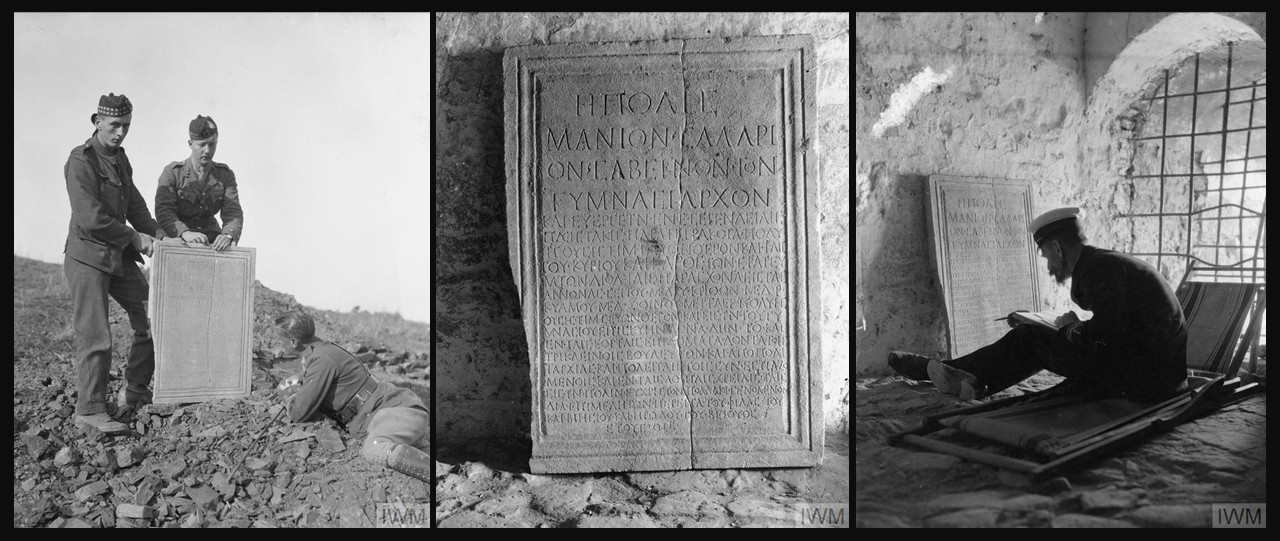
Discovery of the ancient marble memorial plaque praising the virtues of Manius Salarius Sabinus for his benefactions by the 8th Battalion, Royal Scots Fusiliers whilst digging trenches on part of the Birdcage Line defences between the villages of Aivatli and Laina (ancient Lete),April 1916, (in the Collection of the Archaeological Museum of Thessaloniki), Photo date: 1916– Photo Credit: Imperial War Museums, UK https://www.iwm.org.uk/collections/item/object/205297459
The ancient marble memorial plaque praising the virtues of Manius Salarius Sabinus for his benefactions (in the Collection of the Archaeological Museum of Thessaloniki), Photo date: 1916– Photo Credit: Imperial War Museums, UK https://www.iwm.org.uk/collections/item/object/205297460
Photographer: Ariel Lowe Varges, American, 1890–1972
Lieutenant Commander Ernest Gardiner R.N.V.R. working on the ancient marble memorial plaque praising the virtues of Manius Salarius Sabinus for his benefactions, Photo date: 1916 – Photo Credit: Imperial War Museums, UK https://www.iwm.org.uk/collections/item/object/205265524
In the context of the WWI Salonika campaign (1915–1918), Ariel Lowe Varges’s lens captured more than just Allied operations, it also glimpsed the buried threads of the classical past emerging within the conflict zone. This dual resonance is movingly preserved in three photographs now held by the Imperial War Museums: one records the 1916 discovery of an ancient marble memorial plaque praising the virtues of Manius Salarius Sabinus for his benefactions, another depicts the plaque itself, and a third shows Lieutenant Commander Ernest Gardiner, R.N.V.R., carefully examining its inscription. Together, these images form a unique bridge between Martial Reportage and Archaeological Revelation, testifying to how the upheaval of war could uncover, preserve, and even reframe fragments of history long concealed beneath the surface.
The photographs gain further significance when placed against the wider backdrop of the British Salonica Force’s archaeological work. Under the supervision of Gardiner, a professor at the University of London, systematic excavations were carried out at Karabournaki in Thessaloniki and at Tsaousitsa in Kilkis, revealing tombs and ancient artifacts. Initially stored in the White Tower, where one floor was converted into a “Museum of the British Force”, these finds were later transferred in 1918 to the army headquarters housed in the Papafio Orphanage. In 1919, the collection was shipped to the British Museum, where much of it remains today, though part of it was retained in Thessaloniki and is now held by the Archaeological Museum. Through Varges’s camera, the entanglement of military occupation, archaeological discovery, and cultural heritage are given rare visual form.
Among the finds made during this extraordinary phase of wartime archaeology was the marble memorial plaque of Manius Salarius Sabinus (Μάνιος Σαλάριος Σαβεῖνος), unearthed by the Royal Scottish Fusiliers near Liti in April 1916 while digging defensive trenches of the Birdcage Line. The inscription, dated to AD 121/122 under Hadrian, honors Sabinus, a wealthy landowner of Lete, possibly also a citizen of Thessaloniki, for his repeated generosity during times of famine, when he sold grain to both the local populace and the emperor’s troops at exceptionally low prices. The text itself preserves this civic gratitude in clear terms:
ἡ πόλις Μάνιον Σαλάριον Σαβεῖνον τὸν γυμνασίαρχον καὶ εὐεργέτην
ἐν [σι]-τηνδείαις πλειστάκις παραπεπρακότα τὰ σιτία
τοῖς στρατοῖς τοῦ κυρίου Καίσαρος ἐπ’ εὐτελεστάτοις τιμαῖς …
“The city [honors] Manius Salarius Sabinus, gymnasiarch and benefactor, who many times in times of grain-shortage sold grain to the armies of our lord Caesar at the very lowest prices …”
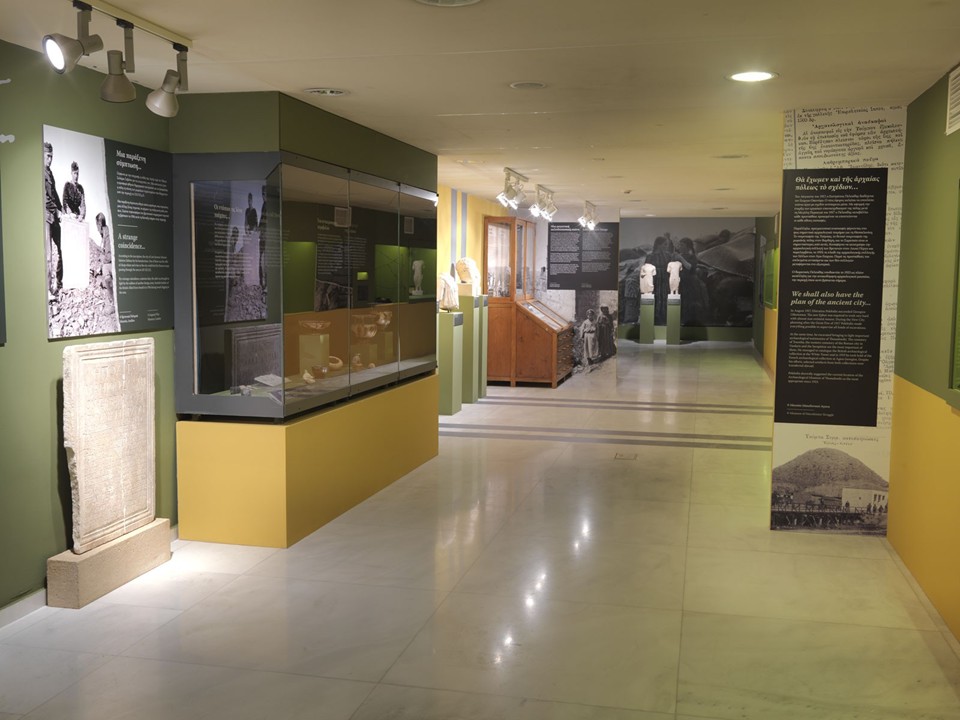
Praised as gymnasiarch and benefactor, he emerges from the inscription as a civic leader whose actions linked local welfare with imperial military needs. Initially stored in the improvised wartime museum of the White Tower, the plaque was fortunately retained in Greece after the dispersal of the British Salonica Force collection. Today it resides in the Archaeological Museum of Thessaloniki, illustrating how wartime excavations brought to light evidence of past shortages and civic benefaction, resonant with the conditions of Macedonia in the First World War.
Ariel Lowe Varges (1890–1972) was a pioneering American photographer and newsreel cameraman whose career spanned some of the most turbulent events of the early 20th century. Born in Chicago on June 11, 1890, he began as a photographer for the Chicago Examiner before joining William Randolph Hearst’s newspaper empire in New York around 1911. Among the first American still photographers to embrace motion picture cameras, Varges made his mark in 1914 when he filmed the Mexican War and soon after became the first foreign cameraman permitted to cover the war in Serbia, thanks to a connection with Sir Thomas Lipton.
During World War I, Varges served as an official cinematographer with the British Army, documenting campaigns in Salonika, the Middle East, and Mesopotamia. His vivid depictions of frontline conditions were instrumental in shaping how the war was seen by the public. For his contributions, he was made an honorary Member of the Order of the British Empire. After the war, he continued his globe-spanning career, becoming the first foreign cameraman to film Leon Trotsky and later covering conflicts in China and Ethiopia for Hearst newsreels. His adventurous assignments even included aerial cinematography over the pyramids with the Cairo–Baghdad Squadron.
By the 1950s, Varges had transitioned into a leadership role as head of the photographic laboratory for Hearst’s News of the Day newsreel program, retiring in 1952. He died on December 27, 1972, in Norwich, Connecticut, and was buried in Preston Cemetery. Remembered as a trailblazer in war cinematography and newsreel journalism, Varges helped shape modern visual reporting by bringing audiences closer than ever before to world events.
For a Student Activity, inspired by Ariel Lowe Varges’s photographs of the ancient marble memorial plaque praising the virtues of Manius Salarius Sabinus for his benefactions, please… check HERE!
Bibliography: chrome-extension://efaidnbmnnnibpcajpcglclefindmkaj/https://ikee.lib.auth.gr/record/286234/files/Xydopoulos%20Euergetes%20AWE.pdf?utm_source=chatgpt.com and https://shootingthegreatwar.blogspot.com/search?q=Ariel+Varges&fbclid=IwY2xjawL7xP1leHRuA2FlbQIxMABicmlkETEyS2dKa2lvV0dTbGFITmc4AR7QWbi9QnOpTIhSeUIPyCnh1r83OdC4VnOGI-z6re858Ge4s2B6A71idjyk1g_aem_z-xs-iAmzHAZK5lxukZcjw