Impressionist oil painting of Venice by Childe Hassam, showing sunlit canal buildings reflected in water.

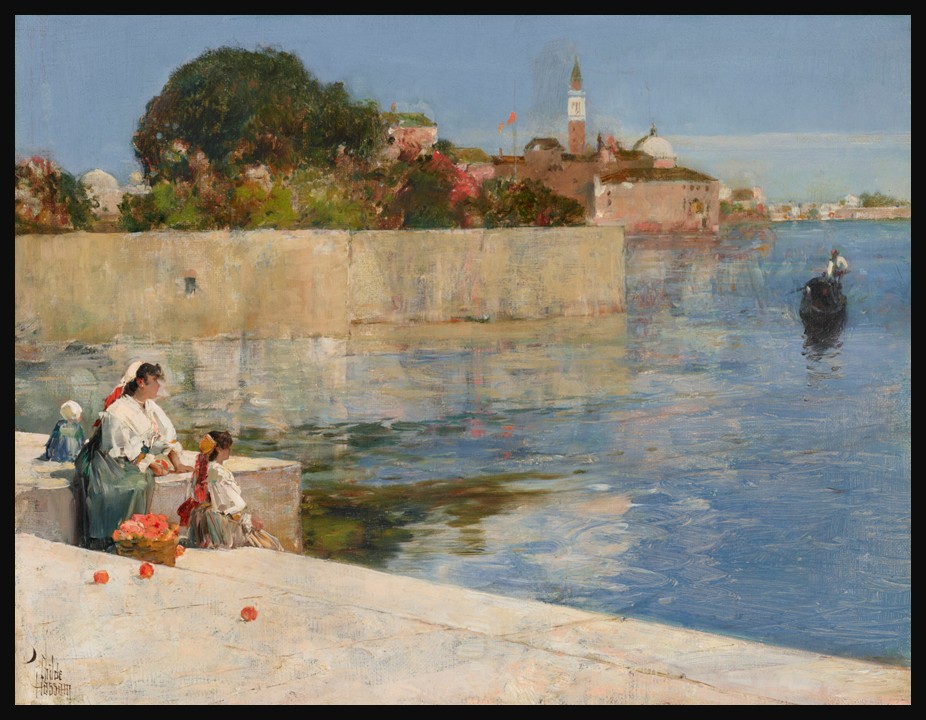
View of Venice

Impressionist oil painting of Venice by Childe Hassam, showing sunlit canal buildings reflected in water.
Childe Hassam, American, 1859-1935
View of Venice, c. 1883, Oil on Canvas, 32.4 x 40.6 cm, Private Collection
https://www.christies.com/en/lot/lot-6519611?ldp_breadcrumb=back

When Childe Hassam set out on his first extended European journey in the summer of 1883, he was still a young Boston-based illustrator searching for his artistic voice. Accompanied by fellow painter Edmund H. Garrett, he traveled through Great Britain, France, Spain, the Netherlands, and Italy, absorbing everything from atmospheric city scenes to masterworks in museums. Venice was among the places that captivated him most deeply. Shimmering light, reflected architecture, and a city arranged on water offered a visual language he had not yet encountered in America. Looking back on this formative trip, Hassam later wrote: “I made my sketches from nature in watercolor and I used no white. It was this method which led me into the paths of pure color… When I turned to oils, I endeavored to keep my color as vibrant.” This reflection offers a perfect lens through which to enjoy View of Venice, painted around that pivotal moment in his early career.

View of Venice and the Emergence of American Impressionism

View of Venice is a small but luminous work that captures the essence of the floating city with youthful immediacy. A gondola glides across the lagoon, fruit sellers animate the foreground, and a soaring campanile anchors the horizon, not as a monumental landmark, but as part of a living environment. Hassam’s brushwork dispenses with tight detail and instead pursues fleeting effects of atmosphere. Reflections tremble on the water’s surface; sunlight flickers across sails, stones, and faces. This sensitivity to shimmering light and transient impressions would soon become hallmarks of his mature style, but here we see it in its early, exploratory form.

Although Hassam would later refine his Impressionist language during his Paris years (1886–1889), View of Venice already reveals his fundamental shift from illustration to a modern painterly vision. His interest lies not in the grand, theatrical Venice of Canaletto, but in the lived-in Venice of ordinary people, canal traffic, and the play of natural light. It reflects the emerging belief, one he often articulated, that the modern artist should paint the world as it appears in the moment, with spontaneity and personal perception guiding the hand.

The painting’s recent appearance at Christie’s reaffirms its significance within Hassam’s development. Far from being a minor travel sketch, View of Venice represents one of the earliest surviving examples of his European awakening, a moment when he began to shed the conventions of American illustration in favor of the freer, color-driven vocabulary that would later define his career. Its provenance, stretching from early Boston collections to a Pennsylvania private estate, adds a layer of continuity: View of Venice has long been cherished as a document of transformation.

Venice itself continued to echo through Hassam’s later works. Whether painting urban New York, New England harbors, or quiet coastal views, he repeatedly explored the interplay of water, sky, architecture, and modern life. The atmospheric sensibility first awakened in the Venetian lagoon never left him. Seen in this light, View of Venice is more than an early experiment, it is a seed from which much of his later brilliance grew.

Today, this painting invites us to see Venice not as a fragile relic or tourist symbol, but as a vibrant, ever-changing stage for color and life. Through Hassam’s eyes, we experience the city with the wonder of a young artist standing at the threshold of discovery. View of Venice remains a testament to the transformative power of travel, observation, and the courage to embrace a new artistic path, a message as resonant now as it was in 1883.

For a PowerPoint Presentation of Childe Hassam’s oeuvre, please… Check HERE!

Childe Hassam remains one of the most important figures in American Impressionism. In this former Teacher Curator post, I examine another of his paintings, situating it within his broader artistic development and exploring how light, atmosphere, and everyday life define his style. Please… Check HERE!

Bibliography: According to Christie’s catalogue entry https://www.christies.com/en/lot/lot-6519611?ldp_breadcrumb=back
Bridges of Light

James Abbott McNeill Whistler, American, 1834-1903
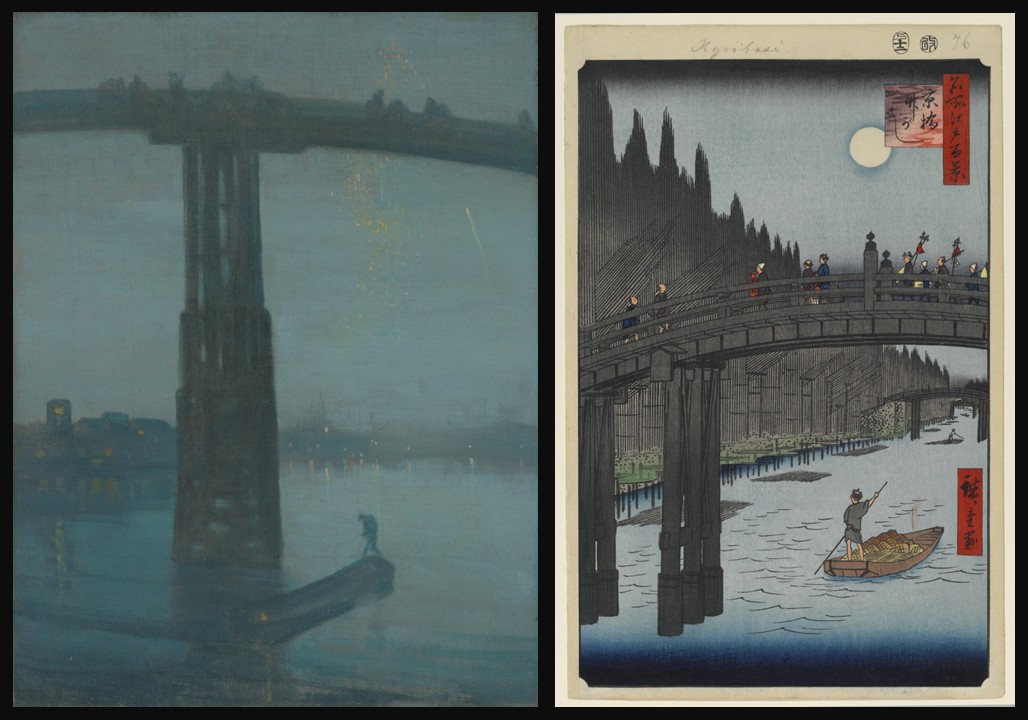
Nocturne in Blue and Gold: Old Battersea Bridge,
1872, Oil on canvas, 66,6×50,2 cm, TATE Gallery, UK
https://www.tate.org.uk/art/artworks/whistler-nocturne-blue-and-gold-old-battersea-bridge-n01959
Utagawa Hiroshige, Japanese,1797-1858
Bamboo Yards, Kyōbashi Bridge (12th Month, 1857), from the series One Hundred Famous Views of Edo, ca. 1856–58, Color woodblock print, 36×24.1 cm, The Art Institute, Chicago, USA
https://www.artic.edu/artworks/26522/fireworks-at-ry%C5%8Dgoku-ry%C5%8Dgoku-hanabi-from-the-series-one-hundred-famous-views-of-edo-meisho-edo-hyakkei

Bridges of Light – they often symbolize connection between places, people, or moments in time. In art, they also link the visible world to the realm of mood and imagination. Two works from opposite sides of the globe, James McNeill Whistler’s Nocturne in Blue and Gold: Old Battersea Bridge (1872–75) and Utagawa Hiroshige’s Bamboo Yards, Kyōbashi Bridge (1857), both turn the humble bridge into something poetic and transcendent. Though separated by culture, medium, and intention, they share an atmospheric stillness that invites reflection on light, water, and the human gaze.

James McNeill Whistler’s Nocturne in Blue and Gold: Old Battersea Bridge captures London at night as a mysterious symphony of blue and shadow. Painted around 1872, this oil on canvas is part of Whistler’s celebrated “Nocturne” series, works that sought to translate the visual world into the language of music.

The scene is minimal: a great wooden bridge looms above the Thames, faint figures hover on its span, fireworks flicker faintly in the distance. Yet what dominates is not the structure, but the atmosphere, a veil of misty blue punctuated by golden glimmers. Whistler strips away narrative detail, emphasizing mood over subject. His soft brushwork and tonal harmony evoke a world on the edge of visibility, where city lights dissolve into the haze.

At the time, such abstraction was revolutionary. Critics like John Ruskin accused Whistler of “flinging a pot of paint in the public’s face,” prompting a famous libel trial. Yet today, this painting stands as a precursor to modernism, an early exploration of how color and composition can convey emotion without storytelling. Whistler’s bridge is not merely an urban landmark, it’s a threshold between reality and reverie.

Two decades earlier and half a world away, Utagawa Hiroshige portrayed another bridge, Kyōbashi, in the bustling city of Edo (modern Tokyo). His Bamboo Yards, Kyōbashi Bridge (12th Month, 1857) is one print from the masterful series One Hundred Famous Views of Edo, now in the Brooklyn Museum’s collection.

In this woodblock print, Hiroshige depicts a tranquil night scene: a full moon floats above a canal, wooden boats drift silently, and stacked bamboo poles line the riverbank. The bridge arches gently across the upper plane, connecting neighborhoods as the water reflects the glow of the winter sky. The composition is crisp and balanced, geometric lines meet fluid curves, and the print’s limited palette of cool blues and pale whites creates a luminous serenity.

Unlike Whistler’s subjective haze, Hiroshige’s clarity celebrates the harmony between city and nature. His mastery of linear perspective and color gradation (bokashi) guides the viewer’s eye into the depth of Edo’s nocturnal calm. The work belongs to the ukiyo-e (“pictures of the floating world”) tradition, art that captured fleeting, beautiful moments of everyday life. Yet even here, amid bamboo yards and bridges, Hiroshige evokes something timeless: the poetry of stillness.

Though born of different worlds, Meiji-era Japan and industrial London, both works share an extraordinary sensitivity to atmosphere and light. Whistler’s oil painting and Hiroshige’s woodblock print each transform an urban bridge into a site of contemplation.

Whistler’s Nocturne immerses us in ambiguity and mood. His blues blur edges and forms, inviting emotion over clarity. Hiroshige’s Kyōbashi Bridge, by contrast, sharpens detail within calm order. Yet both convey the quiet beauty of the city at rest, a pause between day and night, motion and stillness.

There is also an intriguing link between the two artists. Western painters like Whistler were profoundly influenced by Japanese art during the late 19th century, a movement known as Japonisme. Whistler himself admired Hiroshige’s prints and adopted their compositional daring: asymmetry, flattened perspective, and the focus on atmospheric tone. In a sense, Whistler’s London nocturne owes a debt to the poetic precision of Edo’s floating world.

In both images, light and water serve as mirrors, literal and symbolic. Hiroshige’s canal reflects the moon’s glow, while Whistler’s Thames glimmers with distant sparks. Each artist invites us to linger in that reflection, to sense the beauty that lies between visibility and suggestion.

The choice of medium also shapes the experience. Hiroshige’s woodblock print, with its clean contours and delicate color transitions, feels crafted, meditative, and reproducible, designed for an audience that cherished everyday beauty. Whistler’s oil painting, on the other hand, is singular and subjective, the result of layered pigment and a painter’s improvisation. Both reveal how material and method can express different kinds of intimacy with the world.

Bridges are not only physical crossings but metaphors for transition, between places, cultures, or even states of mind. In Nocturne in Blue and Gold, Whistler transforms London’s industrial river into a space of mood and mystery. In Bamboo Yards, Kyōbashi Bridge, Hiroshige turns Edo’s night into a vision of harmony and calm.

Viewed together, these two works form a quiet dialogue across continents. One whispers through mist, the other gleams under moonlight, yet both remind us that art’s greatest power lies in its ability to make the familiar shimmer anew.

For a PowerPoint Presentation on James McNeill Whistler’s art and Ukiyo-e Japanese Prints, please… Check HERE!

Bibliography: https://www.tate.org.uk/art/artworks/whistler-nocturne-blue-and-gold-old-battersea-bridge-n01959 and https://www.brooklynmuseum.org/objects/121690

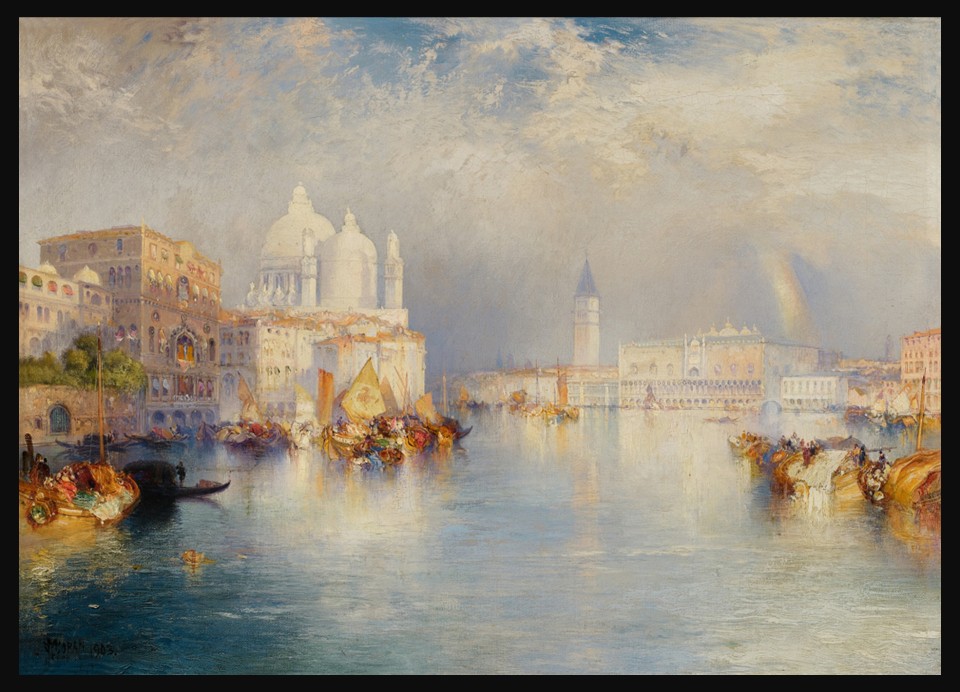
Grand Canal Venice

Thomas Moran, American Artist, 1837 – 1926
Grand Canal, Venice, 1903, Oil on Canvas, 35.6×51.4 cm, Private Collection https://www.sothebys.com/en/buy/auction/2025/art-of-the-americas-featuring-the-american-west/grand-canal-venice

Since my arrival I have done nothing but wander about the streets & I have done no work as yet. Venice is all, & more, than the travelers have reported of it. It is wonderful. I shall make no attempt at description but will tell you all when I get back… wrote Thomas Moran to his wife Mary from the Grand Hotel in Venice in May 1886. These words capture the sense of awe that the city inspired in the American artist, and they resonate deeply in his 1903 painting Grand Canal, Venice. Now held in a private collection, the work distills Moran’s wonder into luminous color and atmospheric depth, offering not a literal depiction, but a poetic impression shaped by memory and reverence. This blog post explores how Moran’s Venetian experience, as conveyed in both word and image, invites us into a vision where travel, beauty, and art converge.

Thomas Moran (1837–1926) was a British-born American painter and printmaker celebrated, primarily, for his dramatic landscapes of the American West. Emigrating with his family to the United States as a child, Moran began his artistic career in Philadelphia, where he trained as a wood engraver and painter. His early exposure to the Hudson River School deeply influenced his style, particularly its emphasis on sublime natural beauty. Moran gained national fame in the 1870s after joining the Hayden Geological Survey to Yellowstone, where his sketches helped convince Congress to designate the area as the first national park. Over his career, Moran traveled widely, capturing not only the grandeur of the American frontier but also the romantic scenery of Europe, including Venice, which became a recurring subject in his later work.

Aesthetically, Moran’s paintings blend realism with a luminous romanticism, using bold color, atmospheric effects, and sweeping compositions to evoke both the physical majesty and emotional power of the landscape. Influenced by British artist J.M.W. Turner, Moran often used light and shadow to create a sense of transcendence, turning natural scenes into visual poetry. His works are less concerned with topographical accuracy than with capturing an idealized vision of nature—vast, untamed, and awe-inspiring. In his Venetian subjects, such as Grand Canal, Venice (1903), Moran translated this approach to an urban setting, bathing the architecture and waterways in golden light and shimmering detail, imbuing the city with the same sense of wonder he found in the American wilderness.

Thomas Moran’s relationship with Venice was rooted in his broader passion for travel and the romantic allure of historic European cities. He first visited Venice in the 1880s, a period when many American artists sought inspiration abroad. In May 1886, writing to his wife Mary from the Grand Hotel, Moran expressed a profound sense of wonder, admitting he had done no work, only wandered the streets, overwhelmed by the city’s beauty. Venice captivated him with its interplay of light, water, and architecture, elements perfectly suited to his painterly style. The city became a recurring subject in his work, not for documentary precision but for its atmospheric potential. Moran returned to Venice multiple times, translating his impressions into luminous compositions like Grand Canal, Venice (1903), where the city’s grandeur is filtered through a lens of memory, mood, and artistic reverence.

For a PowerPoint Presentation on Thomas Moran and Venice, please… Check HERE!

Bibliography: https://americanart.si.edu/blog/sargent-whistler-venice and https://thomas-moran.org/

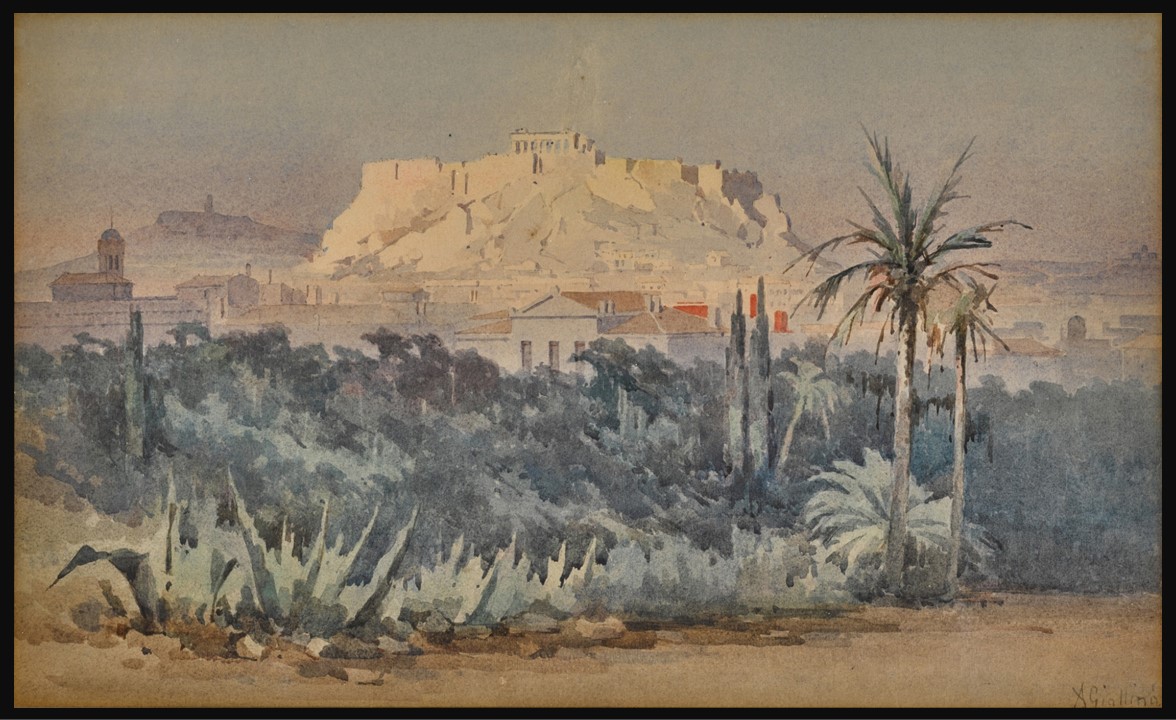
Angelos Giallinas

Angelos Giallina, Greek Artist, 1857 – 1939
The Parthenon, Watercolour over Pencil, 273 by 455 mm, Private Collection
https://www.sothebys.com/en/buy/auction/2024/royal-noble/the-parthenon?locale=en

In his approach to the Parthenon, Angelos Giallinas (1857–1939), a prominent Greek watercolorist of the late 19th and early 20th centuries, not only portrayed the monument as an architectural subject but elevated it to a lyrical symbol of Greek heritage. His work, deeply connected to the theme of Light, Memory, and Reverence, reflects a profound sensitivity to the interplay between the ancient ruins and the surrounding natural environment. Born in Corfu, Giallinas studied at the local School of Fine Arts before continuing his education in Venice, Naples, and Rome. There, he absorbed the refined tonalities of the Italian landscape tradition, which he later fused with a uniquely Greek sensibility rooted in poetic realism and national pride.

Giallinas’s depictions of the Parthenon are marked by a restrained yet evocative use of watercolor. He did not aim for archaeological precision but instead emphasized the atmospheric qualities of the scene, the golden hues of Attic sunlight, the gradations of the Athenian sky, and the quiet dialogue between the ruins and the surrounding landscape. This impressionistic approach aligned with European aesthetic movements of his time while remaining deeply connected to the emotional resonance of place and memory in Greek culture.

Throughout his career, Giallinas gained significant recognition both at home and abroad. He held successful exhibitions across Europe, including in London, where his work attracted the attention of collectors and critics. In 1902, he was commissioned by the British royal family to create a series of Greek landscapes, further elevating his international profile. He played a pivotal role in legitimizing watercolor as a medium for serious artistic expression within Greek art, moving beyond its traditional role as a preparatory tool.

Technically, Giallinas mastered watercolor’s fluidity and transparency with exceptional subtlety. His brushwork was controlled yet expressive, employing translucent washes to create depth without sacrificing luminosity. He avoided harsh contrasts, favoring gradations of color that conveyed a meditative stillness. In his hands, watercolor became a means not just of depiction, but of evocation—his skies, seas, and stones imbued with feeling as much as form.

Crucially, Giallinas’s art reflects the broader cultural currents of post-independence Greece, where landscape painting became a vehicle for expressing national identity. His serene views of the Parthenon and other iconic sites participated in the 19th-century project of reconnecting modern Greece to its classical past. Yet his interpretation was not triumphant or didactic; instead, it was introspective and elegiac. By rendering these monuments with atmospheric sensitivity rather than monumental grandeur, Giallinas offered a vision of Greece that was rooted in continuity, memory, and quiet resilience—qualities that resonated deeply in a society still defining itself between antiquity and modernity.

When I look at Giallinas’s paintings of the Parthenon, I’m struck by their quiet power. There’s no theatrical drama, no exaggerated gesture—just a deep, contemplative calm. He treats the monument not as a tourist spectacle but as something intimate: a memory held in light and stone. The watercolor bleeds gently around the contours of the ruins, dissolving into the pale Athenian sky, as if he’s painting not only what he sees but what he feels. The Parthenon appears suspended in time, drifting between history and the present. Giallinas’s brush whispers rather than declares—and in that quietness, he captures something enduring, something essentially Greek.

For a Student Activity, inspired by Angelos Giallinas’s interpretation of the Parthenon, please… Check HERE!

You can view a former Teacher-Curator BLOG POST titled ‘Garden in Corfu by Angelos Giallinas’… https://www.teachercurator.com/art/garden-in-corfu-by-angelos-giallinas/?fbclid=IwY2xjawKIGElleHRuA2FlbQIxMABicmlkETF5ZWtES1JYMDBPQVY5c055AR7-a8br2Ukq3ahJuUCSU0eESsf5WwODDQtNdgSK0kYgNnSS856uiARVWSentw_aem_T8IM2xzIAGQQEC4qcWajdQ

Bibliography: https://corfuguidedtours.com/a-renowned-painters-historic-mansion/?utm_source=chatgpt.com and https://haaa.gr/news/en_30.php?utm_source=chatgpt.com