Cimabue’s Maestà di Assisi

Cimabue, 1240-1302
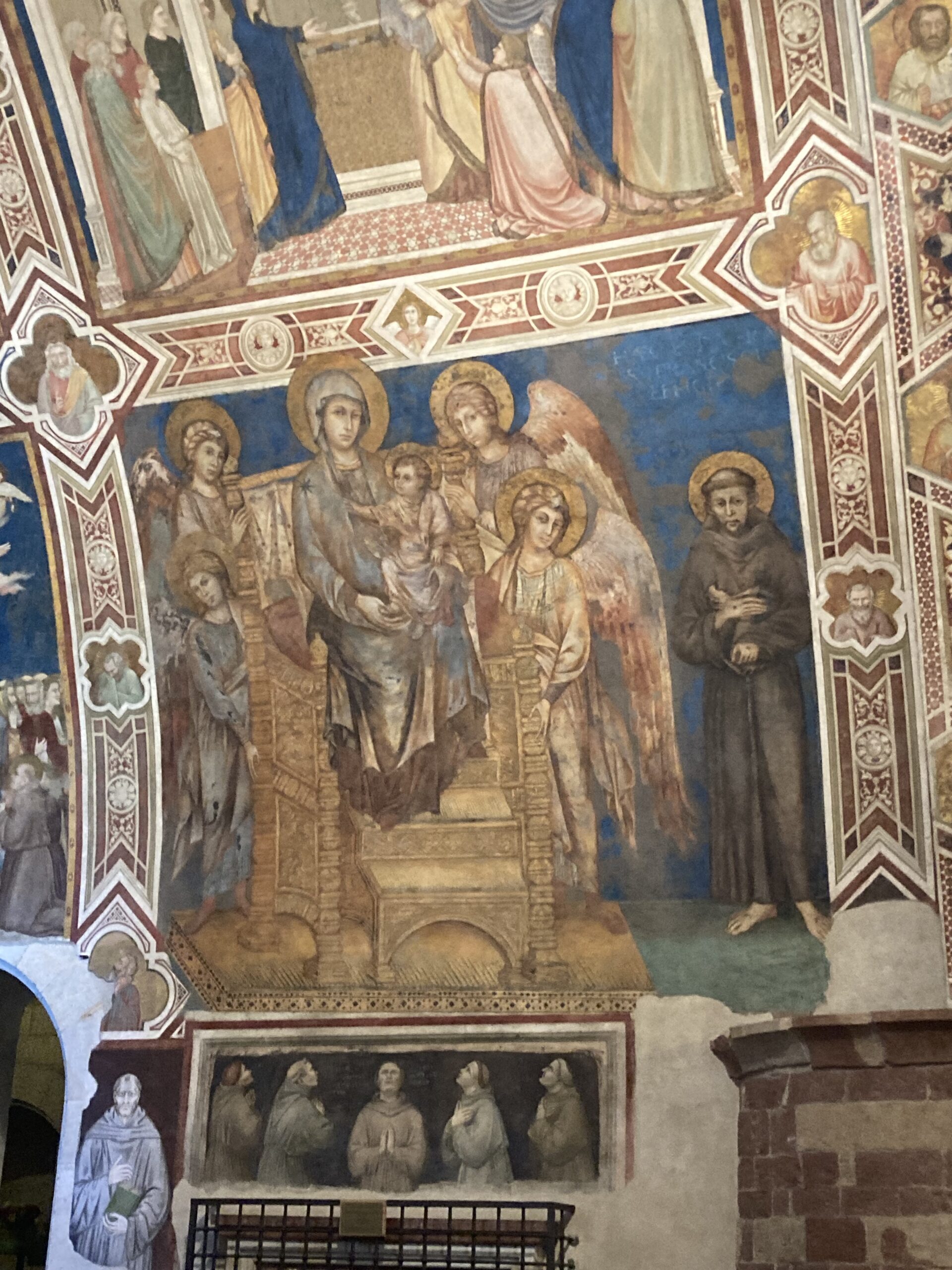
Maestà di Assisi, 1285-1288, fresco, 320×340 cm, Basilica of San Francesco in Assisi, Italy – Photo Credit: Amalia Spiliakou, April 2025

When I visited the Lower Church of San Francesco in Assisi in April 2025, I was struck by the quiet majesty of Cimabue’s Maestà di Assisi. Tucked into the dimly lit transept, this fresco radiates a sense of reverence and timelessness that photographs simply can’t capture. Seeing the Virgin Mary enthroned with the Christ Child, surrounded by a chorus of angels, I was moved by how Cimabue bridged the distance between the divine and the human. Painted around 1285, this work marks a crucial shift from the rigid, symbolic forms of Byzantine tradition toward a more naturalistic and emotionally resonant style. The delicate modeling of faces, the subtle sense of depth, and the quiet dignity of the figures all hinted at the artistic revolution that would soon follow. In this post, I’ll reflect on how Cimabue’s Maestà not only embodies the spiritual vision of its time but also left a lasting impression on me as a viewer, and on the course of Western art.

Cimabue’s Maestà di Assisi is in the south transept of the Lower Church of the Basilica of San Francesco in Assisi, a site of profound spiritual and artistic significance. The Basilica, constructed in the 13th century to honor Saint Francis, consists of two levels: the soaring Gothic Upper Church and the more intimate, Romanesque Lower Church. Within this dim, contemplative space, the Maestà forms part of a rich fresco program that includes scenes from the lives of the Virgin and Saint Francis, as well as works by other major artists of the period, including Giotto, Pietro Cavallini, and Simone Martini. Together, these masterpieces transform the Lower Church into a visual pilgrimage through the early stages of Italian art, where Cimabue’s contributions mark a critical bridge between the Byzantine tradition and the emerging naturalism of the Renaissance.
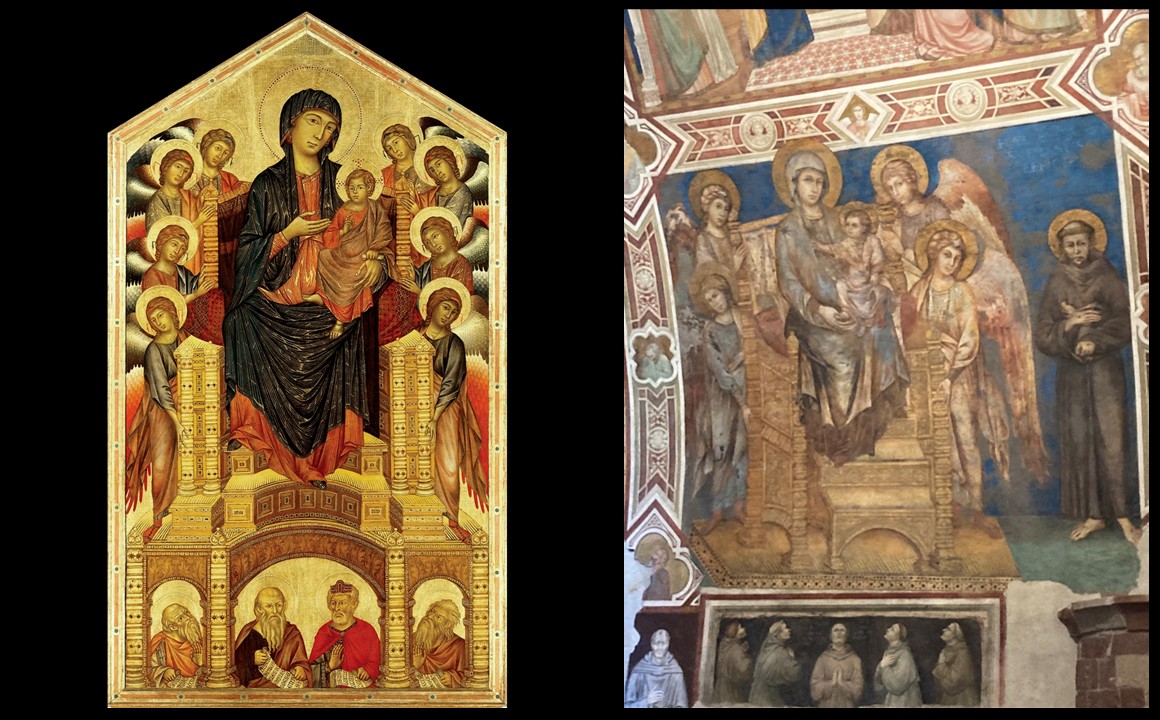
Cimabue, ca. 1240-ca. 1302
The Madonna in Majesty,
1285-86, tempera on panel, 385 x 223 cm, Uffizi Gallery, Florence, Italy
Maestà di Assisi, 1285-1288, fresco, 320×340 cm, Basilica of San Francesco in Assisi, Italy – Photo Credit: Amalia Spiliakou, April 2025

Cimabue, born Cenni di Pepo around 1240 in Florence, is widely regarded as one of the pivotal figures in the evolution of Western art. He was trained in the Byzantine tradition, which dominated Italian painting in the 13th century with its stylized forms and gold backgrounds, but Cimabue began to break from these conventions in subtle yet significant ways. Active mainly in Florence and later in Assisi, he worked on both panel paintings and large-scale fresco cycles. His most famous surviving works include the Santa Trinita Maestà (Uffizi Gallery), the Crucifix at Santa Croce, and his contributions to the decoration of the Basilica of San Francesco in Assisi. Cimabue was also the teacher of Giotto, whose revolutionary approach to realism would carry forward and amplify the artistic shift that Cimabue had initiated. Although his style remained rooted in medieval spirituality, Cimabue laid the groundwork for the expressive potential and spatial complexity that would define early Renaissance art.

Cimabue’s work is characterized by a remarkable tension between Byzantine rigidity and the early stirrings of naturalism. In his Assisi frescoes, particularly the Maestà in the Lower Church, he introduces a greater sense of depth and volume through delicate shading and a more thoughtful use of space. The figures, while still hieratic and front-facing, possess a dignity and gravitas that suggest a growing concern with human presence and emotional resonance. The Maestà di Assisi exemplifies this transition: the Virgin sits enthroned in a symmetrical, richly colored composition that respects traditional iconography, but the softened contours of her face and the more varied, overlapping arrangement of the angels begin to imply a spatial realism that was new for its time. Cimabue’s aesthetic choices reflect both reverence for sacred themes and a quiet but revolutionary move toward a more lifelike visual language—one that would deeply influence the course of Italian art.
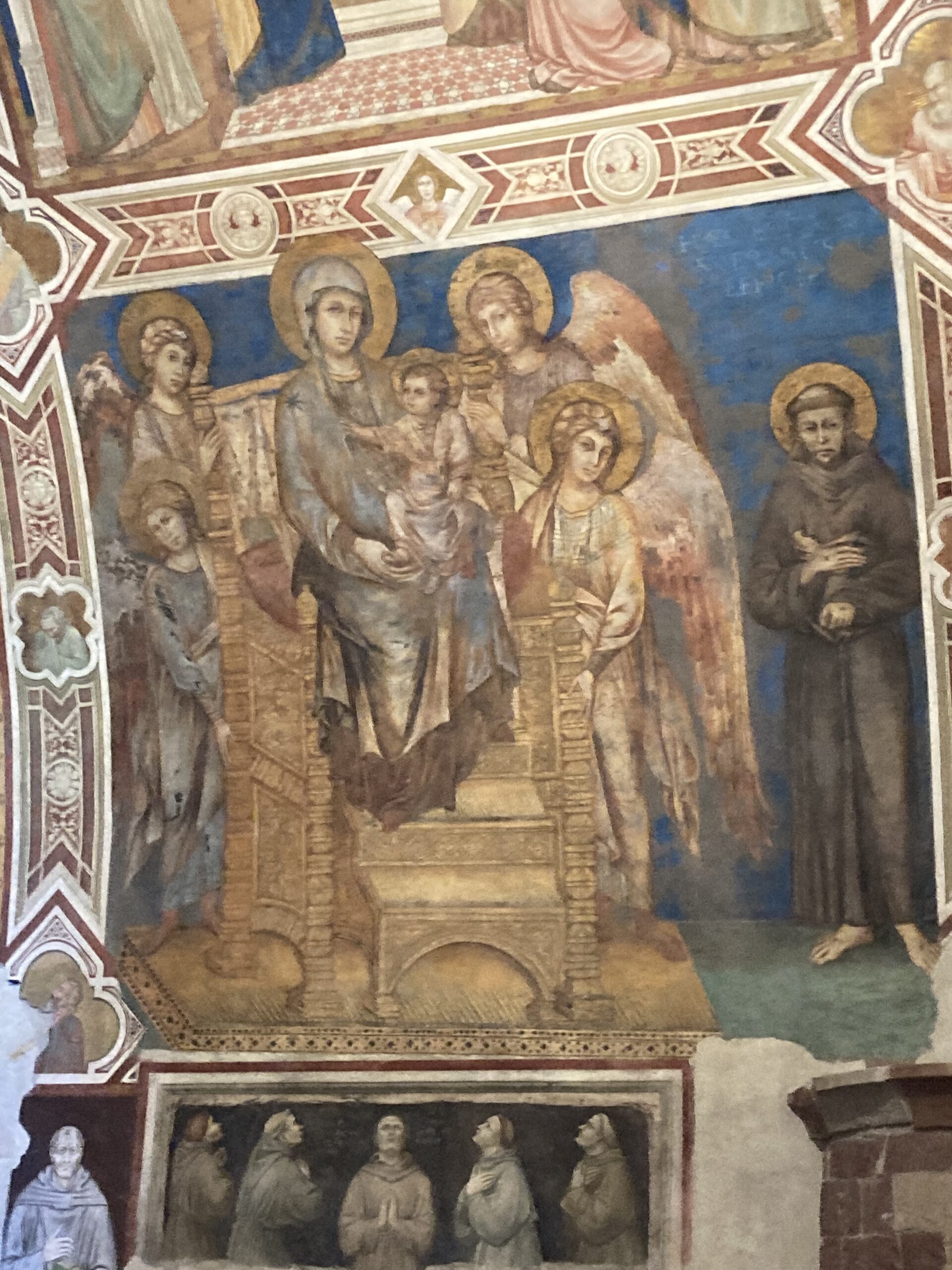
Cimabue, ca. 1240-ca. 1302
Maestà di Assisi,
1285-1288, fresco, 320×340 cm, Basilica of San Francesco in Assisi, Italy – Photo Credit: Amalia Spiliakou, April 2025

In Cimabue’s Maestà di Assisi, Saint Francis is represented standing to the right of the throne, distinguishable by his simple friar’s habit, bare feet, and the visible stigmata on his hands, feet, and chest—a gesture of his deep union with Christ’s suffering. According to tradition the image of the saint is based on eyewitness descriptions by those who knew him personally and is considered one of the earliest and most authentic portrayals of Francis. The fresco originally included other figures, possibly Saint Anthony of Padua, on the left side, but that section is now lost, suggesting that the original composition once conveyed a broader devotional context. The contrast between the elevated, richly dressed figures of the Virgin and Child and the humble, sober figure of Francis reinforces the spiritual ideals of Franciscan humility and poverty. The recent restoration, completed in early 2024, which removed centuries of overpainting and yellowed protective layers, has revived the sharpness of Francis’s face and refined features, attributes described in medieval sources, allowing viewers today to reconnect more directly with Cimabue’s original vision and the powerful symbolism of the Poverello himself.

For a Student Activity titled Compare and Contrast Activity: Cimabue’s Two Maestà, please… Check HERE!

Bibliography: https://www.lavoce.it/assisi-presentato-il-restauro-che-svela-il-vero-volto-di-san-francesco/?utm_source=chatgpt.com and https://en.wikipedia.org/wiki/Cimabue?utm_source=chatgpt.com and https://www.assisinews.it/speciali/svelata-la-maesta-di-assisi-restituita-allaffresco-la-vera-materia-del-cimabue-foto/?utm_source=chatgpt.com and https://www.lanazione.it/cosa-fare/il-capolavoro-di-cimabue-gloria-alla-maesta-di-assisi-sublime-luce-al-restauro-8aaee18e?utm_source=chatgpt.com
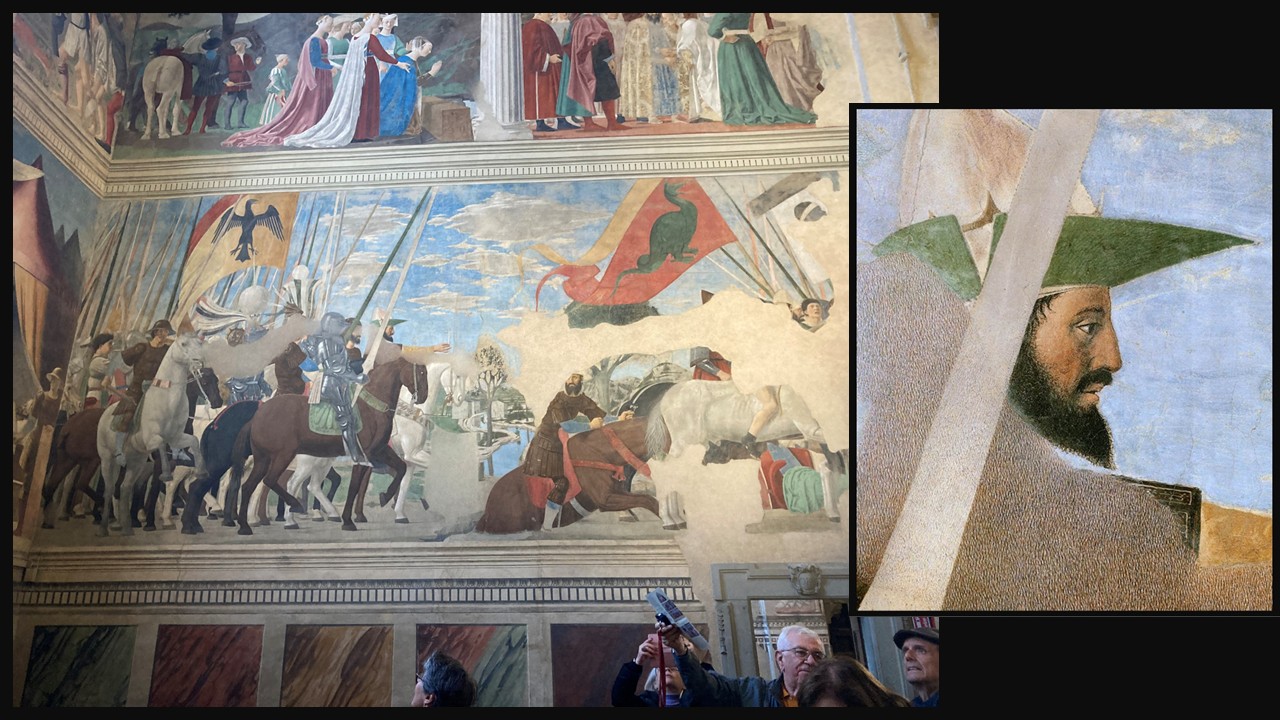
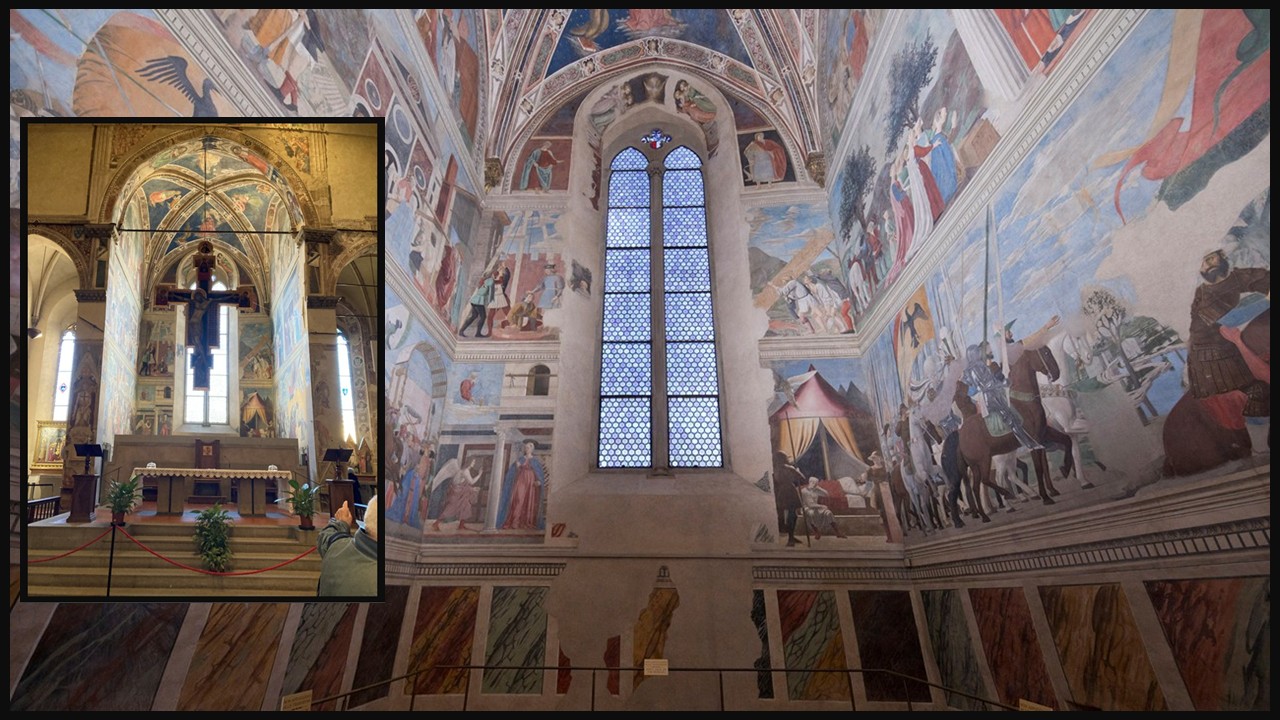
Saint Constantine in Arezzo

Piero della Francesca, 1416-1492
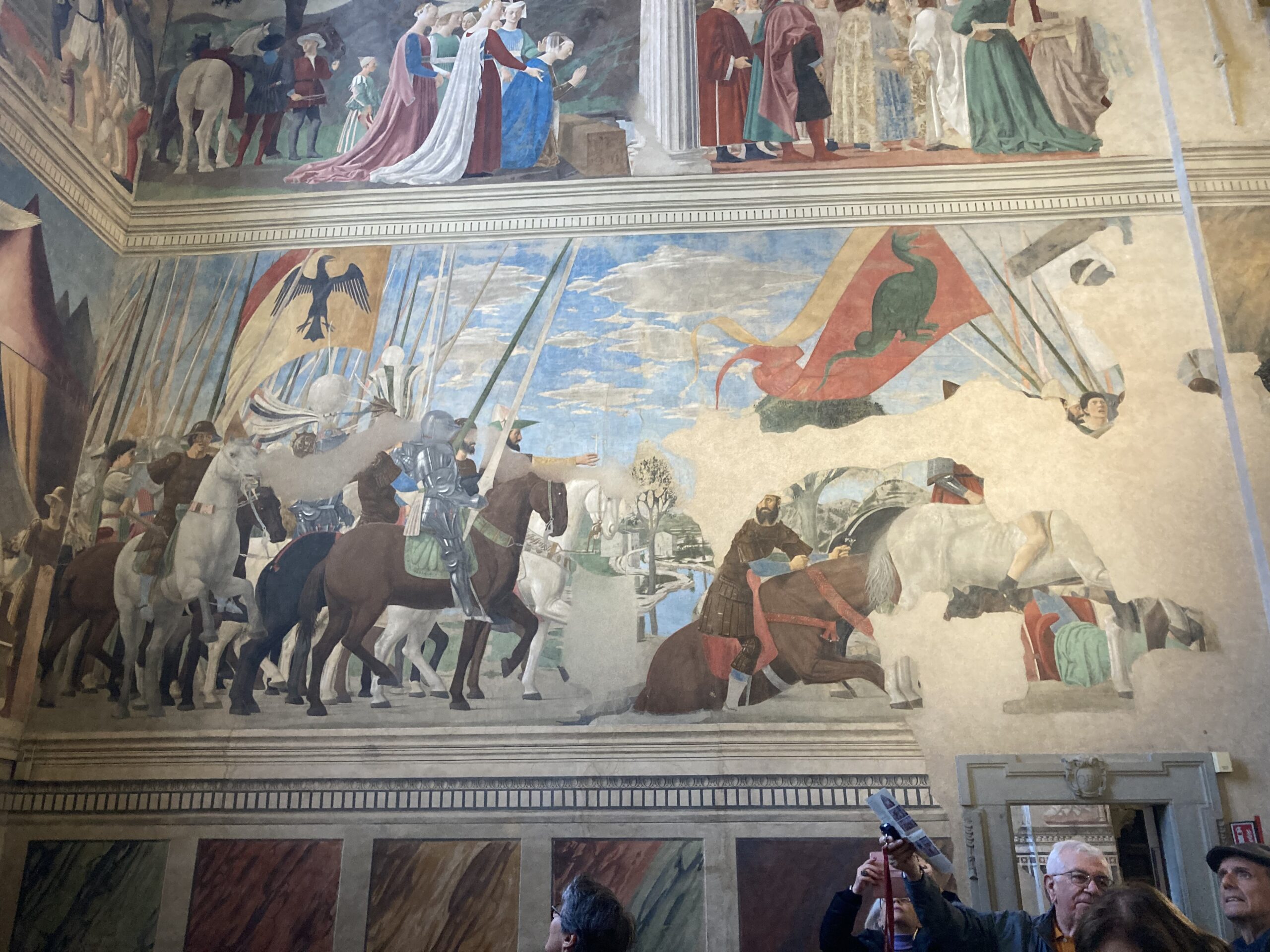
View of the Cappella Maggiore, 1452-66, Fresco, San Francesco, Arezzo, Italy – Photo Credit: Amalia Spiliakou, Spring 2025
Constantine’s face: https://www.wga.hu/frames-e.html?/html/p/piero/index.html

On the occasion of Saint Constantine’s name day, we turn our gaze to Piero della Francesca’s majestic fresco cycle, The Legend of the True Cross, in Arezzo. Painted in the mid-15th century on the walls of the Basilica of San Francesco, this monumental series draws from Jacopo da Varagine’s Legenda Aurea, a medieval text brought to life through della Francesca’s luminous palette, serene figures, and masterful use of perspective. Set against the familiar landscapes of Arezzo and Sansepolcro, the ten scenes trace the mythical journey of the wood of the Cross, from Eden to Jerusalem. Saint Constantine in Arezzo plays a pivotal role, both visionary and imperial. He is rendered with the calm authority and timeless grace that define della Francesca’s style—making this cycle not only a meditation on faith and history, but also a fitting tribute to the saint’s enduring legacy.

Piero della Francesca (c. 1412–1492) was born in the Tuscan town of Sansepolcro, where he would later return and spend much of his life. He likely received his early training in local workshops before working in Florence, where he encountered the innovations of artists such as Masaccio and Fra Angelico. By the 1440s, he had established himself as an independent master, receiving important commissions across central Italy. He painted for the courts of Ferrara, Rimini, and Urbino—centers of Renaissance humanism—most famously executing the fresco cycle The Legend of the True Cross in Arezzo between the 1450s and 1460s. His patrons included powerful figures like Sigismondo Malatesta and Federico da Montefeltro, the latter of whom he portrayed in one of his best-known portraits. In his later years, Piero devoted himself increasingly to writing treatises on mathematics and perspective, including De Prospectiva Pingendi and Libellus de Quinque Corporibus Regularibus. His eyesight deteriorated in old age, likely leading to the end of his painting career, and he died in his hometown in 1492. Giorgio Vasari praised him in his Lives of the Artists, calling him ‘a man so devoted to geometry and to the mathematical sciences, and so excellent in them, that he has left in writing many treatises which are no less useful than delightful.’ https://it.wikisource.org/wiki/Le_vite_de%27_pi%C3%B9_eccellenti_pittori,_scultori_e_architettori_(1568)/Piero_della_Francesca

Piero della Francesca, 1416-1492
View of the Cappella Maggiore, 1452-66, Fresco, San Francesco, Arezzo, Italy https://www.iguzzini.com/de/news/neues-licht-fur-piero-della-francesca/
View of the Cappella Maggiore, Photo Credit: Amalia Spiliakou, Spring 2025

The artist’s fresco cycle The Legend of the True Cross, is one of the masterpieces of Renaissance art. The cycle narrates the legendary history of the wood of the Cross, from the time of Adam to its rediscovery by Saint Helena. Executed with remarkable clarity, balance, and use of perspective, the frescoes reflect Piero’s intellectual engagement with geometry and humanist ideals. Among the most striking scenes is The Victory of Constantine over Maxentius, where Piero stages the miraculous triumph of Constantine, guided by a vision of the Cross in the sky. Bathed in soft, ethereal light, the battle scene showcases Piero’s mastery of atmosphere and foreshadows the spiritual power attributed to the relic, underscoring themes of divine intervention and the legitimacy of Christian rule.

Piero della Francesca, 1416-1492
View of the Cappella Maggiore, 1452-66, Fresco, San Francesco, Arezzo, Italy – Photo Credit: Amalia Spiliakou, Spring 2025

Giorgio Vasari, writing in the Lives of the Artists, offers a vivid and admiring account of Piero della Francesca’s depiction of the fresco at San Francesco in Arezzo. Vasari highlights Piero’s extraordinary ability to convey the psychological and physical intensity of battle, writing: “In this same story he effectively expressed in a battle the fear, the animosity, the dexterity, the strength and all the other emotions that can be considered in those who fight, and the accidents likewise, with an almost incredible slaughter of wounded, fallen and dead. In which, for having counterfeited in fresco the arms that shine, Peter deserves the greatest praise, no less than for having made on the other side, where there is the flight and submersion of Maxentius, a group of cavalry in foreshortening, so marvelously executed, that compared to those times they can be called too beautiful and too excellent.” Vasari is particularly struck by Piero’s anatomical precision, noting a “half-naked and half-dressed Saracen on a dry horse, very well discovered in anatomy, little known in his time.” The praise concludes with recognition of Piero’s impact on the city of Arezzo and his patrons: “For this work he deserved to be richly rewarded by Luigi Bacci… and to be, as he was afterwards, always loved and revered in that city, which had so illustrious his works.” Vasari’s words underscore the technical brilliance and emotional depth of Piero’s art, as well as its lasting cultural significance. https://it.wikisource.org/wiki/Le_vite_de%27_pi%C3%B9_eccellenti_pittori,_scultori_e_architettori_(1568)/Piero_della_Francesca

Piero della Francesca, 1416-1492
View of the Cappella Maggiore, 1452-66, Fresco, San Francesco, Arezzo, Italy – Photo Credit: Amalia Spiliakou, Spring 2025
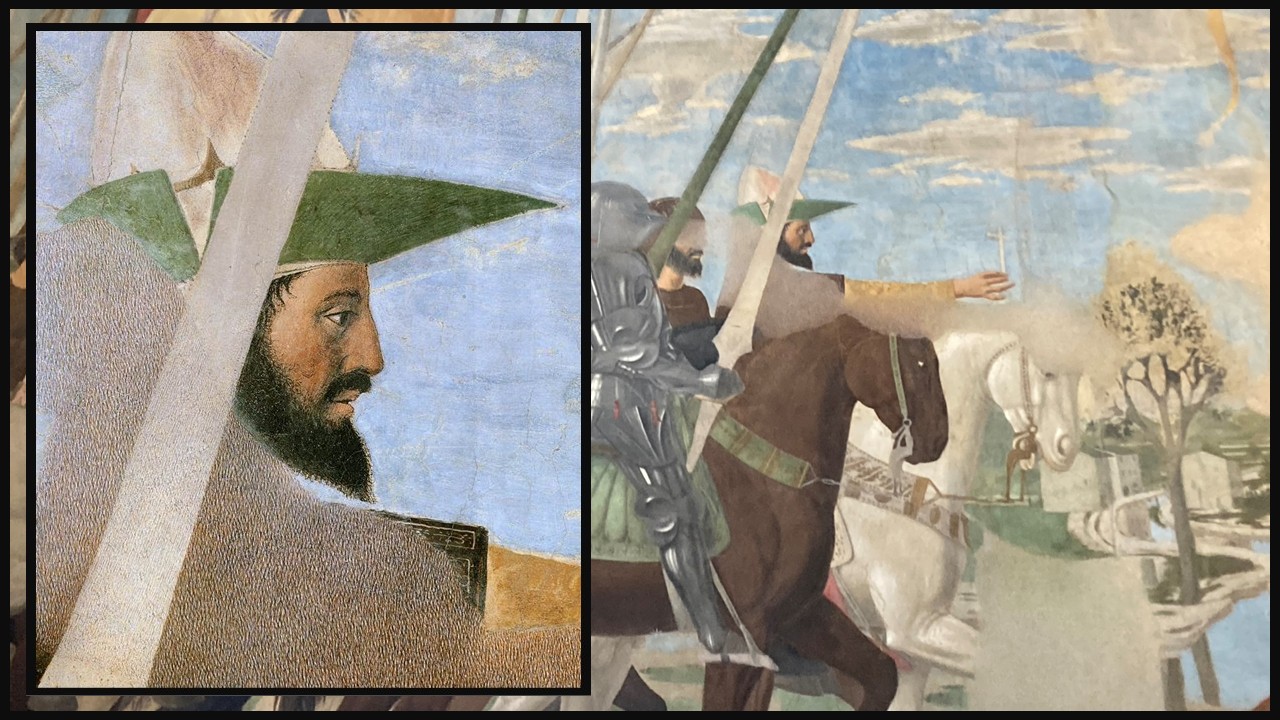
Constantine’s face: https://www.wga.hu/frames-e.html?/html/p/piero/index.html
Piero della Francesca, 1416-1492
Constantine’s Victory over Maxentius, 1452-66, Fresco, San Francesco, Cappella Maggiore,Arezzo, Italy https://gr.pinterest.com/pin/736127501580922200/
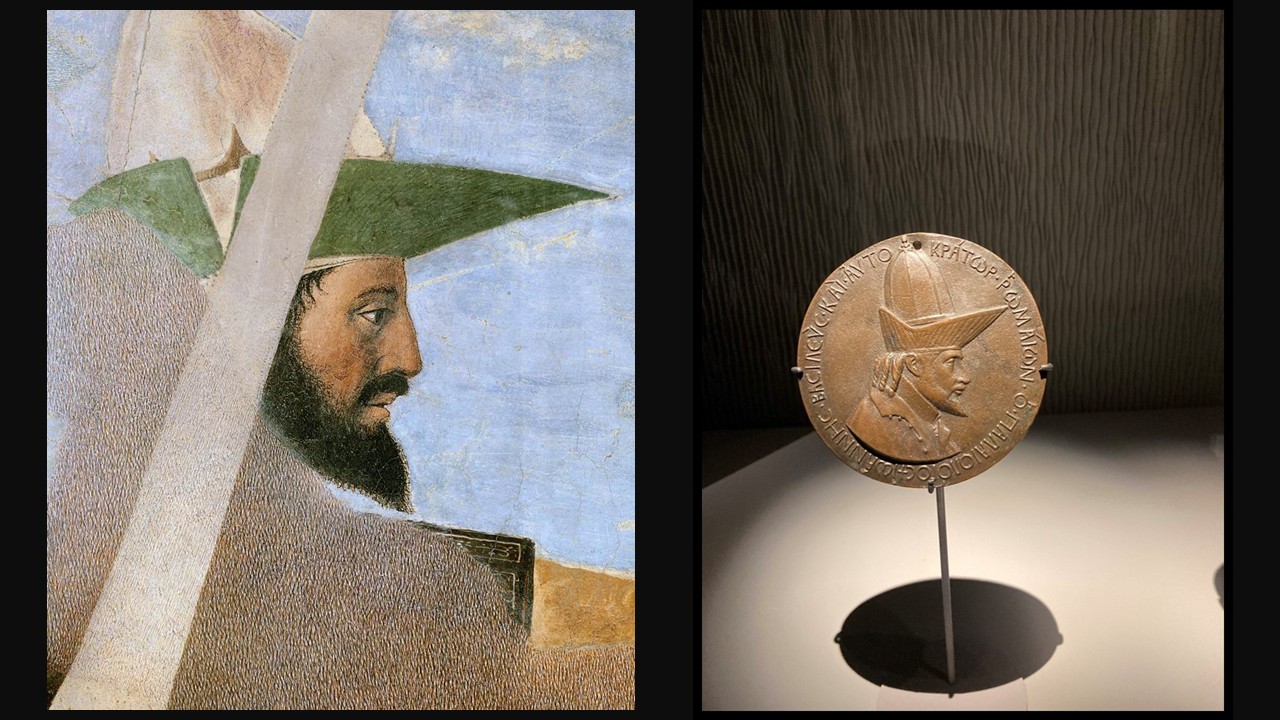
Pisanello’s Medallion of Ioannis VIII Palaiologos, a loan from the Galleria Giorgio Franchetti at the Ca’ d’Oro, Venice, as exhibited in the Hôtel de la Marine, in Paris, France – Photo Credit: Amalia Spiliakou, March 2023

One of the most intriguing details in Piero della Francesca’s depiction of Emperor Constantine in The Victory over Maxentius is how closely the Roman leader resembles the Byzantine Emperor Ioannis VIII Palaiologos. Dressed in an ornate, exotic hat that echoes the imperial skaranikon worn by Palaiologos, Constantine seems less like a Roman general and more like a figure from the fading Byzantine court. The resemblance is especially striking when compared to Pisanello’s famous medallion of the Byzantine emperor, created during Ioannis’s visit to Italy in the 1430s. That historic journey, which brought the emperor to Florence in 1439 for the Council of Florence, a major attempt to reconcile the Eastern and Western Churches, had a profound impact on the cultural imagination of the time. His presence sparked fascination with Byzantine customs and appearances, influencing artists, intellectuals, and patrons alike. In this light, Piero’s portrayal of Constantine may be seen not only as a historical scene, but also as a subtle homage to a contemporary symbol of imperial dignity and spiritual unity, bridging the classical past with the complexities of Piero’s own era.

For a PowerPoint Presentation of Piero della Francesca’s frescoes in Cappella Maggiore, in the church of San Francesco in Arezzo, Italy, please… Check HERE!

For a teacher Curator BLOG POST on Byzantine Emperor Ioannis VIII Palaiologos, and his portrait on Pisanello’s famous Medallion, please Check… https://www.teachercurator.com/art/face-to-face-with-emperor-ioannis-viii-palaiologos/

Bibliography: https://museiarezzo.it/affreschi-di-piero-della-francesca/