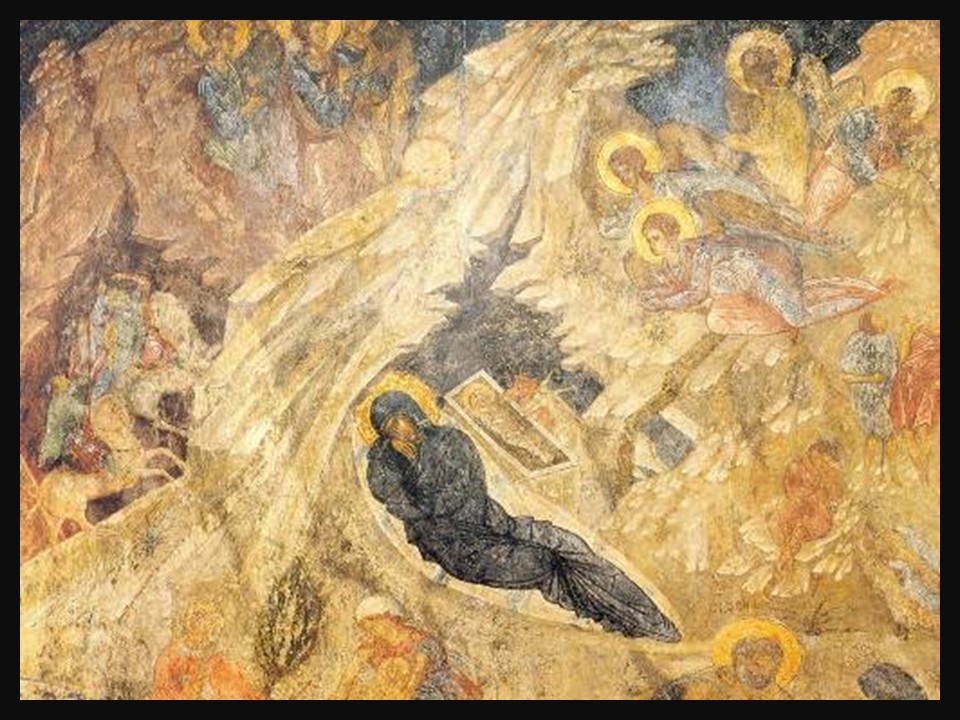
Byzantine fresco of the Nativity in the Perivleptos Monastery Katholikon at Mystra, showing the Virgin Mary reclining and the infant Jesus in a cave-like setting, surrounded by haloed figures and a rocky landscape rendered in rich, earth-toned pigments typical of 14th-century Orthodox iconography.

The Nativity Fresco of Peribleptos Monastery in Mystra

Byzantine fresco of the Nativity in the Perivleptos Monastery Katholikon at Mystra, showing the Virgin Mary reclining and the infant Jesus in a cave-like setting, surrounded by haloed figures and a rocky landscape rendered in rich, earth-toned pigments typical of 14th-century Orthodox iconography.
Nativity Scene, Peribleptos Monastery, circa 1348/80, Mystras, Greece
https://eclass.uoa.gr/modules/document/file.php/ARCH396/Didaktiko%20yliko/PanKal997.htm

The Nativity Fresco of Peribleptos Monastery in Mystras captures the spiritual heart of the season through the radiant artistry of Byzantine devotion. High on the slopes of Mistra, within the Monastery of Perivleptos, the Nativity scene painted across its frescoed walls unfolds as a vivid testament to Byzantine spirituality and artistic mastery. Created in the 14th century, this depiction of Christ’s birth captures both the human tenderness and divine mystery central to Orthodox faith. Beneath the soft light filtering through the dome windows, figures of Mary, Joseph, angels, and shepherds converge around the newborn Christ, embodying a theology of incarnation rendered through luminous color and sacred geometry. As we celebrate Christmas Day 2025, this fresco invites reflection on how art can transform stone and pigment into a living proclamation of hope and transcendence.

Mystras and the Late Byzantine World

Mystras, located near ancient Sparta in the Peloponnese, was one of the most significant centers of the late Byzantine Empire, flourishing between the 13th and 15th centuries. Established by the Franks in 1249 and later reclaimed by the Byzantines, it became the capital of the Despotate of the Morea, a major political, intellectual, and artistic hub during Byzantium’s final centuries. The city’s fortified acropolis, palaces, monasteries, and churches, including the Peribleptos, Pantanassa, and Hodegetria to mention just three, reveal a remarkable synthesis of political power and cultural refinement. Mystras nurtured a vibrant artistic school known for its refined frescoes and architecture, which combined classical Byzantine traditions with new stylistic developments that prefigured aspects of the Renaissance. Today, Mystras stands as a UNESCO World Heritage Site, representing the last brilliant flowering of Byzantine art and spirituality before the empire’s fall.
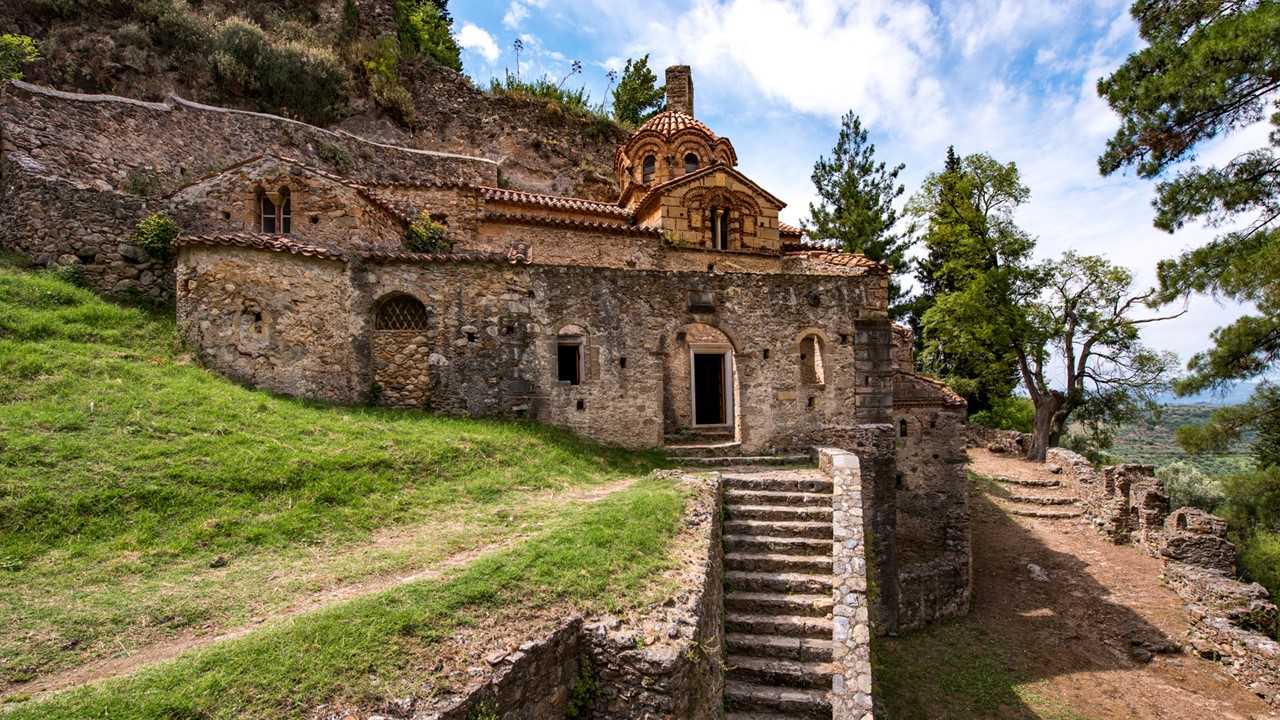
Exterior view of the Perivleptos Monastery Katholikon in Mystras, showing the late Byzantine stone and brick church built into the side of a cliff with its rugged masonry walls, traditional pitched roof, and adjacent tower and monastic buildings under a clear sky, reflecting its 14th-century Mystras architectural style and historic setting on the hillside.
Peribleptos Monastery, circa 1348/80, Mystras, Greece
https://www.religiousgreece.gr/en/attractions/monastery-perivleptos

Late Byzantine Frescoes of Peribleptos

Among its most notable monuments, the Katholikon (main church) of the Peribleptos (Perivleptos) Monastery was founded in the mid-14th century, most scholars attribute its patronage to the first Despot of the Morea, Manuel Kantakouzenos, and his wife Isabella (Isabelle) de Lusignan. Built into the southeast slope of the town and partly supported by a cave, the church is a two-column cross-in-square plan that exemplifies the local “Mystras style,” with squared stone and inlaid tilework that give the exterior a fortress-like appearance. Its dating is commonly placed around the 1350s–1370s, when Mystras was a lively cultural and political center of the late Byzantine Peloponnese.

The interior is celebrated for an extensive and unusually well-preserved cycle of late Byzantine frescoes (mid-14th century) that focus especially on the life of the Virgin and key Gospel scenes, paintings that art historians link stylistically to Cretan and Macedonian workshops and that show Palaeologan-era innovations in space and movement. Because these frescoes survive largely in situ, the Peribleptos Katholikon is considered crucial for understanding late Byzantine painting and the artistic renaissance in the Morea; the whole site of Mystras is protected for its outstanding medieval ensembles.
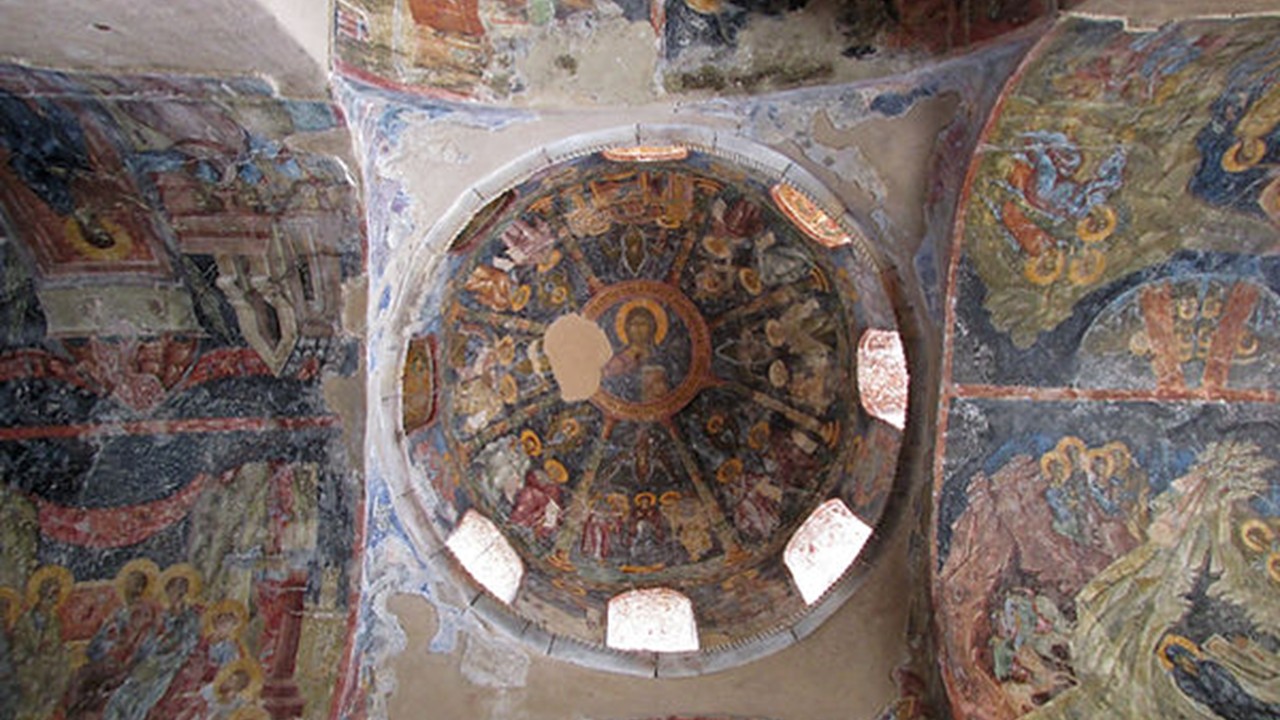
Interior view of the frescoed roof (dome) of the Katholikon at Perivléptos Monastery, showing the large central image of Christ Pantokrator (Christ as ruler of all) within the dome, painted in vivid colors on the curved vaults of this 14th-century church interior.
Peribleptos Monastery frescoes, circa 1348/80, Mystras, Greece
https://www.thebyzantinelegacy.com/peribleptos-mystras

The Nativity Fresco at Peribleptos

The Nativity scene in the Peribleptos Monastery at Mystra stands as one of the most evocative frescoes of the late Byzantine period, part of the church’s rich Christological cycle. Depicted with serene grace and otherworldly poise, the Virgin reclines beside the Christ Child in a rocky grotto, encircled by Joseph, the Magi, shepherds, and angels—each slender figure animated by elegant gestures and expressive faces. The artist achieves a vivid harmony of color and form, combining traditional Byzantine iconography with a confident, freer sense of spatial rhythm. The layered landscape, luminous tones, and effortless authority of each depiction reveal the maturity of the Mystras school, whose refinement would profoundly influence the later Cretan School of icon painters.

Aesthetically, the Nativity fresco exemplifies the serene elegance and emotional subtlety of late Byzantine art at its height. The soft modulation of color—from deep blues and warm ochres to pale rose and gold—infuses the composition with both tenderness and transcendence. Figures are modeled with a supple handling of light and shadow that departs from earlier rigidity, achieving a lyrical balance between solemnity and grace. This confident, almost Renaissance sensibility anticipates the stylistic currents that would flow from Mystras to Crete and, ultimately, to Venice. Through this luminous synthesis of theology and beauty, the Peribleptos Nativity becomes not merely a devotional image but a harbinger of artistic renewal across the Mediterranean world.

As we celebrate Christmas Day 2025, the Nativity fresco at Peribleptos reminds us that the story of Christ’s birth continues to inspire wonder, devotion, and artistic creation across the centuries. Just as the figures in the fresco gather around the newborn Savior, we too are invited to pause, reflect, and share in the warmth, hope, and light that this holy day brings. In the quiet glow of candlelight or the brilliance of a winter sunrise, the spirit of Mystra endures, connecting past and present in a timeless celebration of faith and beauty.

Explore further: Download our PowerPoint Presentation on the Byzantine Monuments of Mystras for educators, students, and art lovers… HERE!

Bibliography: analysed in detail by The Byzantine Legacy: https://churchesingreece.blogspot.com/2014/07/mystras-peribleptos.html and in Greek https://www.ime.gr/choros/mystras/gr/E/14E/14E12.html
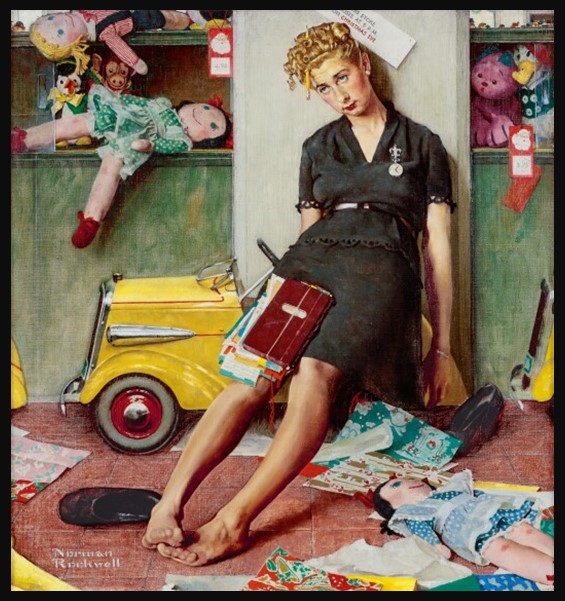
A tired young salesgirl slumps on a stool in a department store on Christmas Eve, surrounded by gift boxes and wrapping paper, conveying holiday exhaustion through Norman Rockwell’s realistic style.

Tired Salesgirl on Christmas Eve

A tired young salesgirl slumps on a stool in a department store on Christmas Eve, surrounded by gift boxes and wrapping paper, conveying holiday exhaustion through Norman Rockwell’s realistic style.
Norman Rockwell, American Artist, 1894-1978
Tired Salesgirl on Christmas Eve, 1947, Oil on Canvas, 77.2×71.8 cm, Private Collection
https://www.sothebys.com/en/auctions/ecatalogue/2018/american-art-n09939/lot.19.html?locale=en

Under the soft glow of a dim shop light, Norman Rockwell captures a rare moment of quiet humanity in Tired Salesgirl on Christmas Eve. Departing from his more festive and bustling holiday scenes, Rockwell instead lingers in stillness, an ode to the unseen fatigue and quiet dignity behind the season’s glittering façade. The weary young woman, slumped in exhaustion yet imbued with humble strength, invites viewers to pause and reflect on the hidden cost of holiday cheer. Through Rockwell’s tender realism, the painting becomes not merely a portrait of fatigue but a meditation on empathy, perseverance, and the fragile beauty found in life’s most ordinary moments.

Norman Rockwell and Postwar America

Painted in 1947, Tired Salesgirl on Christmas Eve emerged during a period when Norman Rockwell’s art both comforted and gently challenged postwar America. Known for his warm, narrative depictions of American life, Rockwell was celebrated for scenes of family gatherings, civic pride, and small-town cheer. Yet beneath his accessible style lay a deep interest in the quiet realities that accompany those ideals.

The Saturday Evening Post Cover of 1947

This painting first appeared on the December 27, 1947, cover, of the The Saturday Evening Post. Rockwell’s image, however, defied the glossy optimism often associated with holiday imagery. Rather than portraying festive joy, he chose to honor the fatigue of those who made it possible, the clerks, shop assistants, and unseen workers who sustained the season’s magic. In doing so, Rockwell bridged the gap between commercial illustration and social observation, creating a moment of artful empathy within a mass-market context.

Visual Storytelling and Quiet Exhaustion

In this work, Rockwell captures the quiet exhaustion of a department store employee after the frenzy of last-minute Christmas shopping. The young woman slumps against the wall, her shoes kicked off and forgotten among scraps of wrapping paper and discarded toys. Behind her, a crooked sign announces the store’s closing at 5:00 p.m., while her watch reads 5:05 — a subtle detail that deepens the sense of fatigue. A soft amber light pools around her, isolating her from the dim surroundings and transforming a moment of weariness into one of tender humanity. The forlorn dolls that echo her pose yet wear painted smiles emphasize Rockwell’s gift for visual storytelling, revealing the bittersweet undercurrent of the holiday season.

Every surface carries evidence of touch: the texture of fabric, the gleam of glass, the faint sheen of perspiration on her brow. Yet the tone remains tender rather than pitiful. Rockwell paints her not as a figure of complaint, but of endurance, a study in quiet perseverance and human worth. The restrained palette and focused lighting draw the viewer inward, evoking a sense of stillness rarely found in his more bustling compositions.

Tired Salesgirl on Christmas Eve reveals Rockwell’s capacity to dignify the ordinary. By choosing this moment of rest, he acknowledges the hidden labor behind holiday abundance. The young woman’s weariness speaks not only to her physical fatigue but to a universal truth: that celebration often depends on invisible work.

In the context of 1940s America, a nation balancing prosperity with postwar fatigue, this image would have resonated deeply. It aligned with Rockwell’s broader humanist vision, one that sought to find beauty in effort, humor in humility, and grace in imperfection. Today, that same sensibility feels remarkably contemporary, echoing ongoing conversations about emotional labor and the value of unseen work.

Why Tired Salesgirl on Christmas Eve Still Matters

More than seventy years later, Rockwell’s salesgirl continues to move viewers not through spectacle, but through empathy. She reminds us that art can elevate even the most fleeting moments of human vulnerability into symbols of shared experience. In an era when holiday imagery still tends to idealize perfection, Rockwell’s painting invites a different kind of reflection, one grounded in compassion and authenticity.

Ultimately, Tired Salesgirl on Christmas Eve stands among Rockwell’s most introspective works. Through his careful attention to gesture, light, and narrative restraint, he transforms a common scene into an enduring meditation on care, work, and quiet resilience. The painting whispers rather than declares, yet in that whisper lies Rockwell’s deepest gift: a reminder that every moment of exhaustion carries its own quiet form of grace.

Rockwell’s art endures because it recognizes the humanity in all of us, the moments when we pause, rest, and simply are. In Tired Salesgirl on Christmas Eve, that recognition becomes both personal and universal. It is not merely a scene of fatigue, but a portrait of empathy, a testament to the dignity of effort and the quiet beauty found at the close of a long day.

For a student activity on Norman Rockwell’s painting Tired Salesgirl on Christmas Eve, please… Click HERE!

Bibliography: Sotheby’s catalogue entry for Tired Salesgirl on Christmas Eve

Rockwell’s sensitivity to everyday labor can also be seen in Freedom from Want and Happy Birthday, Miss Jones, both discussed elsewhere on Teacher Curator: https://www.teachercurator.com/20th-century-art/freedom-from-want-by-norman-rockwell/ and https://www.teachercurator.com/student-activities/happy-birthday-miss-jones-by-norman-rockwell/?fbclid=IwY2xjawN2gpVleHRuA2FlbQIxMABicmlkETFacmdpSHp2SEZOb3lLZWFaAR6o_s1cbQ-iJ3seOTei9EK-NSGSKJwa-goSlQRlZ0OVo3e56Vs6jHCgU9nABw_aem_D0lNpQ7pRe6EhsgcZxX9CA&brid=zUGuYS_L6hPdqRsBBliuag

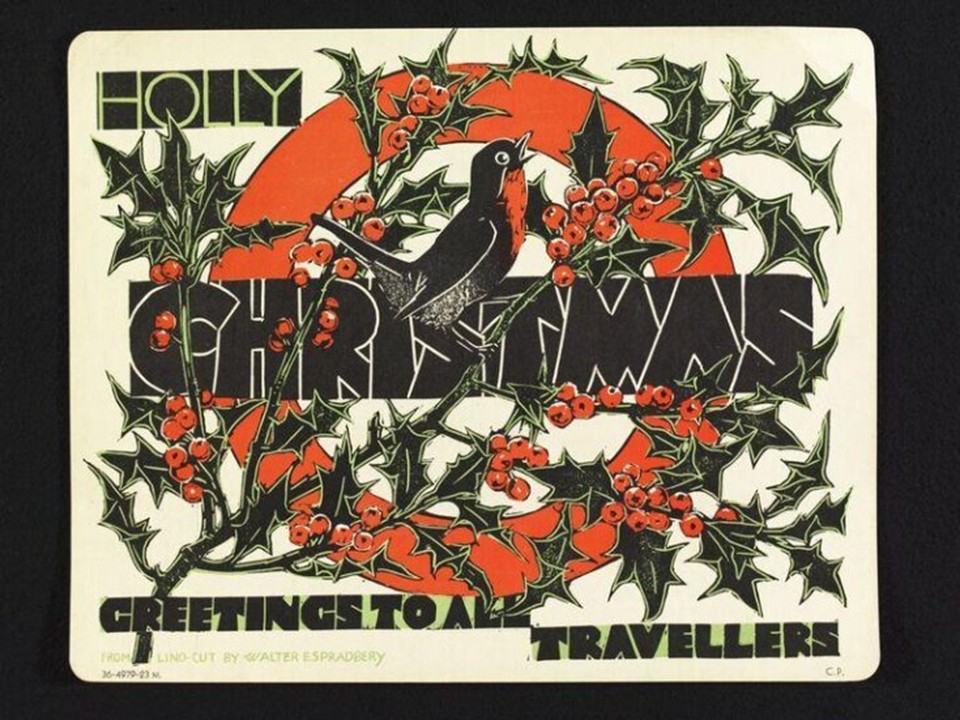
Walter E. Spradbery’s Holly

Artist: Walter E. Spradbery, English, 1889–1969
Issued by: Underground Electric Railways Company of London Ltd
Holly, 1936, Small format Poster, Victoria and Albert Museum, London, UK
https://collections.vam.ac.uk/item/O1023797/holly-poster-spradbery-walter-e/

Walter E. Spradbery’s Holly is a vibrant 1936 linocut poster commissioned by the Underground Electric Railways Company of London Ltd., embodying the festive spirit of Christmas while promoting travel on the London Underground. The artwork blends traditional holiday imagery, holly leaves, red berries, and a robin, with bold Art Deco typography and modern design sensibilities. Spradbery’s masterful use of color and composition not only celebrates seasonal joy but also reflects the company’s commitment to combining art and public transport, turning everyday journeys into opportunities for cultural enrichment.

Spradbery was an English artist, designer, and poet best known for his work as a poster artist during the early to mid-20th century. Born in London, he studied at the Walthamstow School of Art and later taught there, becoming a key figure in promoting art and design education. Spradbery served in the First World War as an official war artist, where his experiences deeply influenced his artistic outlook, emphasizing themes of resilience and beauty amid adversity. After the war, he continued to work prolifically as an illustrator, muralist, and printmaker, developing a distinctive style rooted in linocut printing and strong design principles.

Spradbery’s collaboration with major British transport companies, including the London & North Eastern Railway (LNER), Southern Railway, and London Transport (LT), played a central role in his career. His posters were part of a broader movement to use fine art to promote public travel, encouraging leisure and exploration through visually compelling imagery. For the LNER and Southern Railway, he created scenes that celebrated the beauty of the British landscape, inviting passengers to discover the countryside and coastlines by rail. For London Transport, Spradbery designed posters that combined practical information with artistic flair, often highlighting seasonal themes, gardens, and historical landmarks, thereby helping to shape the visual identity of public transport in the interwar period.

Aesthetically, Spradbery’s work is characterized by bold composition, rhythmic linework, and vibrant color contrasts, often achieved through his skilled use of the linocut technique. His designs fuse natural motifs, trees, flowers, birds, and architectural forms, with modern graphic design principles, creating images that feel both decorative and dynamic. Influenced by the Arts and Crafts movement and early modernism, Spradbery’s posters convey a sense of optimism and harmony between nature, art, and modern life. His works, including Holly, embody a timeless appeal, blending craftsmanship with a democratic vision of art accessible to the public through everyday encounters in stations and trains.

In his 1936 poster Holly, issued for the Underground Electric Railways Company of London Ltd., Walter E. Spradbery transforms a familiar seasonal motif into a striking graphic composition. Set against the stylised red ‘O’ of London Underground’s iconic roundel, a vibrant sprig of holly with lush green leaves and bright red berries encircles a singing robin at its centre. The design is executed as a bold linocut and retains the crisp simplicity of the technique, offering clear, high-contrast shapes and limited colour fields that draw the eye in. With the text ‘HOLLY CHRISTMAS GREETINGS TO ALL TRAVELLERS’ the poster functions both as a festive greeting and a visual invitation to travel, merging holiday cheer with the everyday mobility of London’s transport system. The piece is emblematic of Spradbery’s ability to unite artistic elegance with commercial purpose, turning a public-transport poster into an object of design worth preserving.

As December’s ‘Plant of the Month,’ Holly stands as a timeless symbol of resilience, renewal, and festive cheer, its evergreen leaves and bright red berries capturing the spirit of the season, Walter E. Spradbery’s Holly beautifully encapsulates these associations, blending art, nature, and celebration into a single uplifting image. Just as his 1936 poster wished ‘greetings to all travellers,’ we too can carry forward that message of warmth and goodwill. May this December bring you peace, creativity, and joy as we journey together into the festive season and the promise of a new year.

For a PowerPoint Presentation on Walter E. Spradbery’s oeuvre, please… Check HERE!

Bibliography: https://collections.vam.ac.uk/item/O1023797/holly-poster-spradbery-walter-e/ and https://www.ltmuseum.co.uk/collections/stories/design/walter-ernest-spradbery-artist-war-and-peace