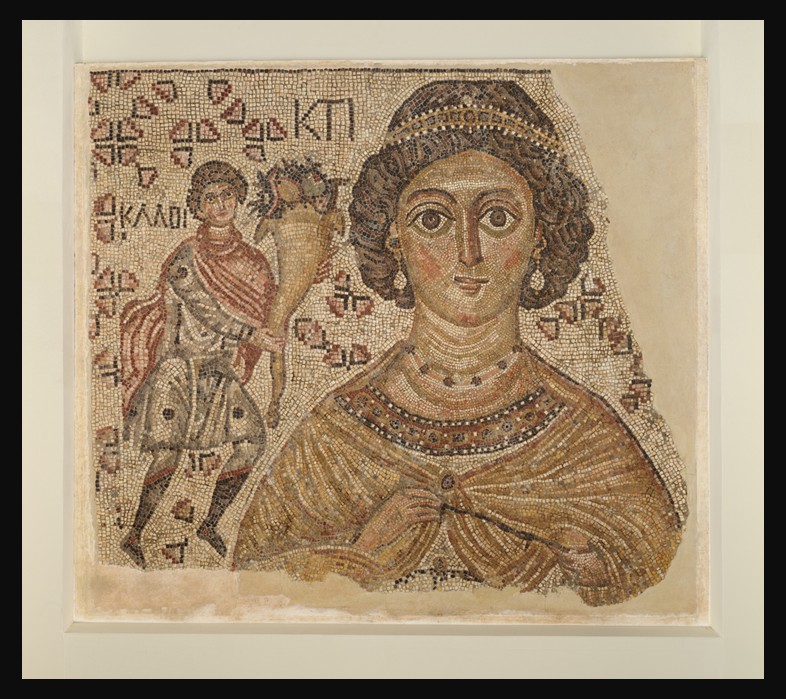
Byzantine floor mosaic fragment showing a richly bejeweled female figure holding a Roman measuring tool identified as Ktisis, the personification of generous foundation, with a partially visible male figure holding a cornucopia at left; made of marble and glass, ca. 500–550, Metropolitan Museum of Art, New York.

Ktisis

Byzantine floor mosaic fragment showing a richly bejeweled female figure holding a Roman measuring tool identified as Ktisis, the personification of generous foundation, with a partially visible male figure holding a cornucopia at left; made of marble and glass, ca. 500–550, Metropolitan Museum of Art, New York.
Fragment of a Floor Mosaic with a Personification of Ktisis, 500–550, with modern restoration, Marble and Glass, 151.1 x 199.7 x 2.5 cm, the MET, NY, USA
https://www.metmuseum.org/art/collection/search/469960

Step into the symbolic world of Late Antiquity through this remarkable mosaic fragment portraying Ktisis, the ancient personification of creation, foundation, and civic generosity. With her richly ornamented garments, expressive gaze, and accompanying figure holding a cornucopia, she embodies the ideals of prosperity and well-ordered society. Once part of an elegant floor, this mosaic invites us to reflect on how art, mythology, and civic identity were woven seamlessly into daily life in the ancient Mediterranean.

At the center of the composition appears the personification of Ktisis, depicted frontally with large, expressive eyes that engage the viewer directly and lend the figure a commanding, almost iconic presence. Her softly modeled face is framed by carefully arranged curls and crowned with a jeweled headband, details that underscore refinement and elevated status. She wears a richly patterned garment fastened with an ornate necklace, the dense ornamentation and shimmering tesserae emphasizing dignity, wealth, and abundance. In her hand she holds a Roman copper tool called a foot ruler, a clear visual sign of engineering closely tied to her symbolic role. The Greek inscription naming Ktisis identifies her unambiguously, guiding the viewer’s interpretation of the scene. To the left, a smaller standing male figure advances toward her holding a cornucopia, the classical emblem of plenty; an inscription beside him identifies his role and further clarifies the allegorical program of the mosaic. Scholars have suggested that Ktisis was originally flanked symmetrically by a second small male figure on her right, now lost, which would have created a more balanced composition emphasizing abundance and benefaction on both sides. Even in its fragmentary state, the surviving figure establishes a subtle narrative exchange that reinforces themes of prosperity, order, and civic well-being while enlivening the scene.

In late antiquity, Ktisis embodied the concepts of foundation, creation, and benefaction. She was closely associated with the act of building and with the generosity of patrons who endowed structures for private or communal use. Her presence in a floor mosaic would have communicated prosperity, stability, and divine or civic favor, transforming the architectural space into a visual statement of success and legitimacy.

Stylistically, the mosaic reflects a transitional moment between classical naturalism and the emerging Byzantine aesthetic. Subtle modeling of the face coexists with an increasingly abstracted body and decorative emphasis on surface pattern. The shimmering marble and glass tesserae enhance the figure’s presence, while the frontal pose and enlarged eyes anticipate later Byzantine iconography.

As a floor mosaic, this image would have been encountered from above and at close range, integrated into the rhythm of daily movement. Walking across the figure of Ktisis reinforced her symbolic role: prosperity and benefaction quite literally underfoot, embedded in the fabric of the building itself. The mosaic thus functioned not only as decoration but as a constant visual assertion of order and well-being.

Seen today as a fragment and displayed vertically, the mosaic invites a different kind of engagement. Removed from its architectural setting, it becomes an object of focused contemplation rather than lived experience. Yet even in isolation, the figure of Ktisis continues to speak eloquently about late antique values, patronage, and the evolving language of Byzantine art.

For a Student Activity inspired by the Roman Foot Ruler, please… Check HERE!

For a PowerPoint Presentation of Activities created by my students, please… Check HERE!

Bibliography: https://www.metmuseum.org/art/collection/search/469960 and Dr. Evan Freeman and Dr. Anne McClanan, “Byzantine Mosaic of a Personification, Ktisis,” in Smarthistory, February 3, 2020, accessed December 11, 2025, from smarthistory https://smarthistory.org/byzantine-ktisis/ and https://www.youtube.com/watch?v=nsvOinFR1qs and Personifications of KTISIS in early Byzantine mosaics, by Rederic Lecut, and from Academia https://www.academia.edu/42068332/Personifications_of_KTISIS_in_early_Byzantine_mosaics
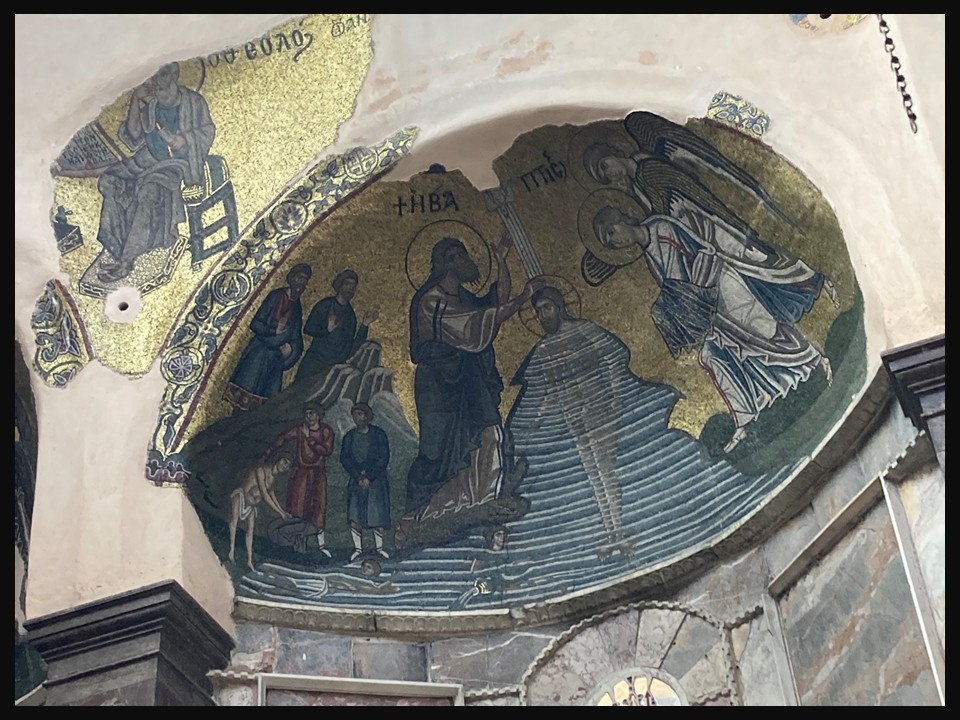
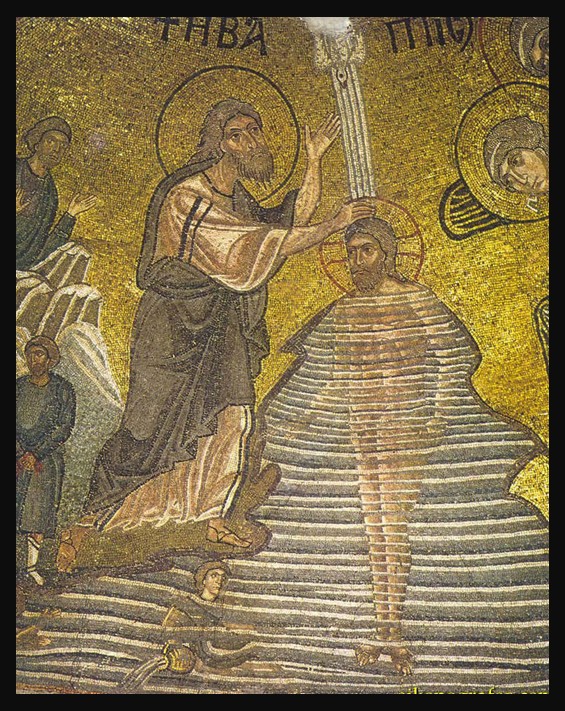
The Baptism of Christ mosaic at Nea Moni monastery, Chios, 11th century, depicting Christ in the Jordan with John the Forerunner and attendant angels.

Feast Day of Saint John the Forerunner

The Baptism of Christ mosaic at Nea Moni monastery, Chios, 11th century, depicting Christ in the Jordan with John the Forerunner and attendant angels.
The Baptism of Christ, Nea Moni, Chios, 11th century, Mosaic, Chios Island, Greece – Photo Credit: Amalia Spiliakou, 2025

Every year on January 7, the Orthodox Church celebrates the Feast of Saint John the Forerunner, the prophet who prepared the way for Christ and baptized Him in the Jordan River. On the island of Chios, this commemoration finds a particularly resonant setting in Nea Moni, the 11th-century monastic foundation distinguished for its architectural integrity and exceptional mosaic decoration. In the Katholiko, the mosaic of the Baptism of Christ stands out for its refined handling of the sacred narrative: the descending waters of the Jordan, the presence of attendant angels, and the hieratic figure of Christ are rendered in luminous gold and saturated blues typical of Middle Byzantine aesthetics. The composition not only conveys a key episode of Christian theology but also reflects the spiritual and artistic ambitions of the monastery’s patrons and craftsmen.

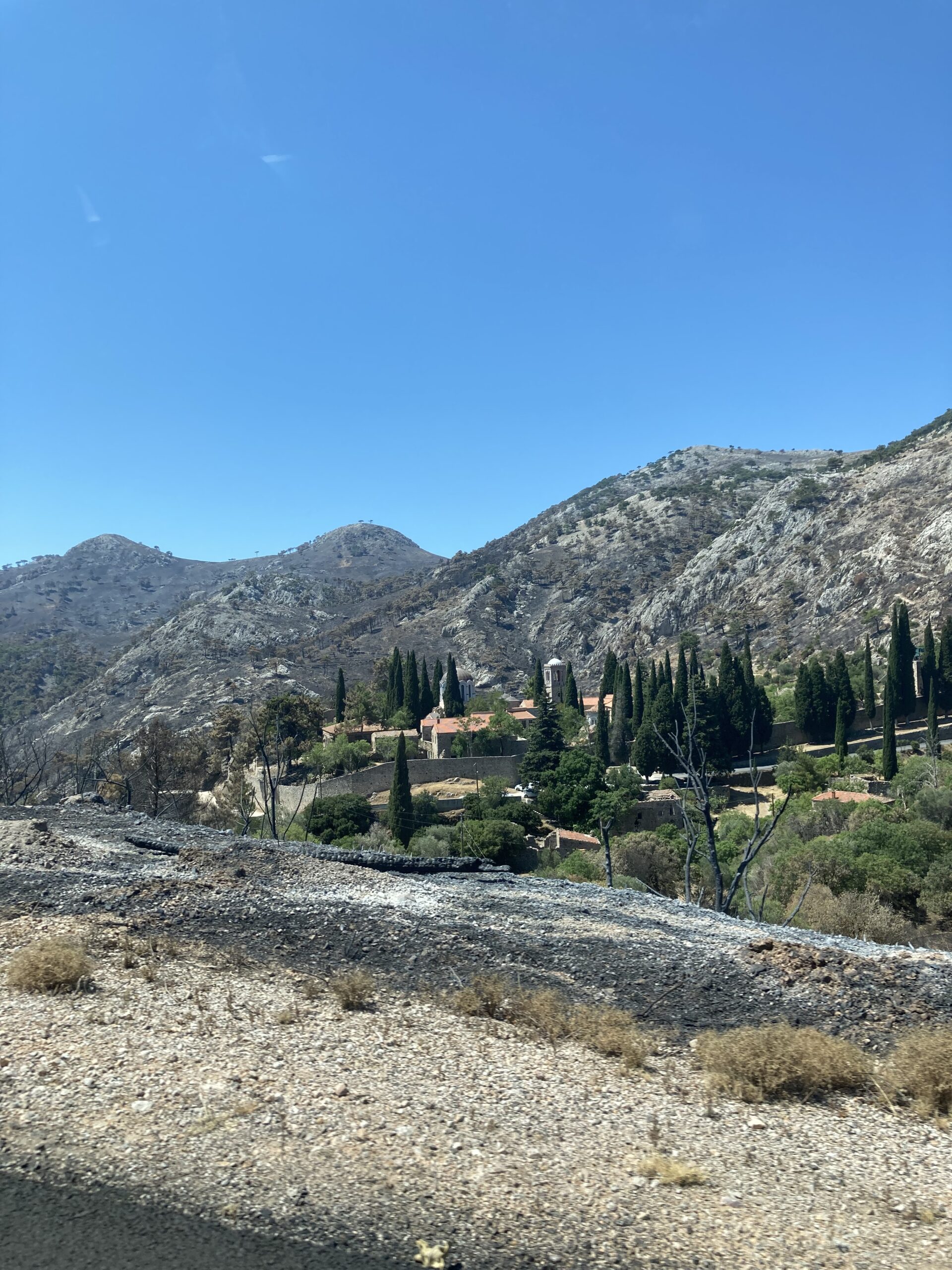
Exterior view of the Nea Moni monastery on Chios Island, Greece, a Byzantine complex set in a wooded hillside, with stone buildings and red-tiled roofs surrounding the central church.
Nea Moni, 11th century, Chios Island, Greece
Photo Credit: Amalia Spiliakou, 2025

Perched on the slopes of Mount Provateftis, Nea Moni’s founding is closely tied to a local legend involving three hermits who discovered a miraculous icon of the Virgin beneath a myrtle tree. Each attempt to relocate the icon resulted in its return to the original site, a phenomenon interpreted as divine intervention. Reports of the miracle reached Empress Zoe and the future Emperor Constantine IX Monomachos, whose visions of the Virgin prompted them to grant imperial patronage between 1049 and 1055. Their involvement enabled the construction of a monumental complex that united imperial ideology, theological symbolism, and monastic devotion. Over subsequent centuries, Nea Moni flourished as a center of worship, pilgrimage, and artistic production, even as it later endured phases of decline, particularly under Ottoman rule.

Middle Byzantine Mosaics and the Macedonian Renaissance

The monastery’s historical and artistic significance is encapsulated in its mid-11th-century mosaics, among the finest surviving ensembles of Middle Byzantine art. Although the dome mosaic of the Katholiko has perished, likely once depicting Christ Pantocrator with attendant angelic powers, substantial portions of the original decoration survive. In the pendentives, mosaics of the Cherubim and Seraphim remain, along with two Evangelists, John (despite heavy damage) and Mark. In the apse, the Virgin Platytera is preserved headless. Below these, the octagonal wall surfaces retain important scenes from the Dodekaorton, continuing also into the narthex. The Baptism, Crucifixion, and Anastasis form what is often regarded as the ensemble’s most accomplished triad, characterized by subtle modeling, expressive gestures, and a refined chromatic palette, while additional scenes include the Transfiguration and Deposition. The narthex once displayed a now-lost mosaic of the Virgin Orans in its small dome, surrounded by full-length military saints set within arched frames, and its vaults presented six Christological compositions, some of which survive only fragmentarily.

The Baptism of Christ mosaic (detail view) at Nea Moni monastery, Chios, 11th century, depicting Christ in the Jordan with John the Forerunner and attendant angels.
The Baptism of Christ (detail), Nea Moni, Chios, 11th century
https://www.pallasweb.com/deesis/byzantine-mosaics-of-nea-moni-on-chios.html

These works collectively reveal multiple stylistic currents of the late Macedonian period: classicizing figures with volumetric bodies and balanced stances appear alongside more linear, expressive compositions that anticipate later developments in Byzantine art. The extensive use of gold ground and deliberate reduction of spatial depth contribute to an ethereal, otherworldly atmosphere, while sophisticated optical adjustments on curved surfaces demonstrate the technical skill and theoretical awareness of artists likely trained in the imperial workshops of Constantinople.

When compared with contemporaneous mosaic cycles at Osios Loukas and Daphni on the Greek mainland, Nea Moni demonstrates both adherence to shared Byzantine conventions and distinctive regional features. All three complexes employ similar hierarchical structures, with Christ Pantocrator originally presiding from the dome and a surrounding ensemble of heavenly and apostolic figures reinforcing Middle Byzantine theological ideals. Yet while Osios Loukas and Daphni tend toward more monumental proportions and sculptural modeling, Nea Moni is marked by a lighter chromatic range, subtler facial expression, and delicate rendering of form. These distinctions highlight the diversity of artistic production across the Byzantine world and underscore Nea Moni’s significance as a particularly refined example of 11th-century Aegean mosaic art. Together, these monuments attest to a period of exceptional creativity in Middle Byzantine ecclesiastical decoration and affirm the enduring cultural and spiritual importance of Nea Moni.

For a PowerPoint Presentation, inspired by the ‘Feast Day of Saint John the Forerunner’ Blog Post and the Mosaics in the Nea Mony, in Chios, please… Click HERE!

Bibliography: https://smarthistory.org/mosaics-and-microcosm/ and from’My World of Byzantium’ https://www.pallasweb.com/deesis/byzantine-mosaics-of-nea-moni-on-chios.html