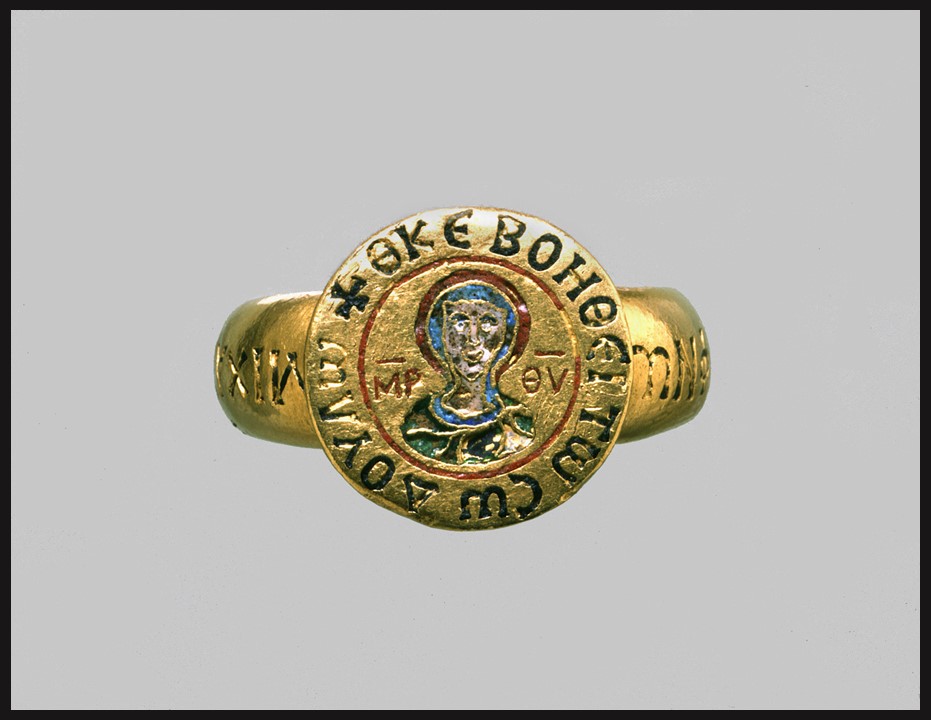
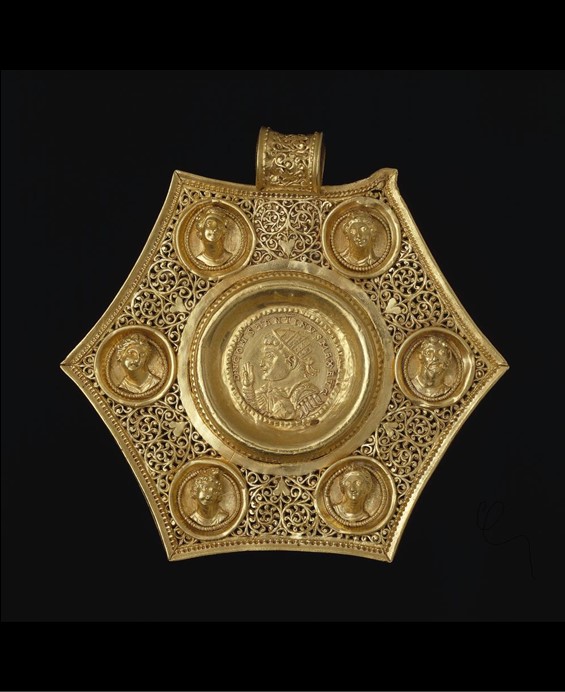
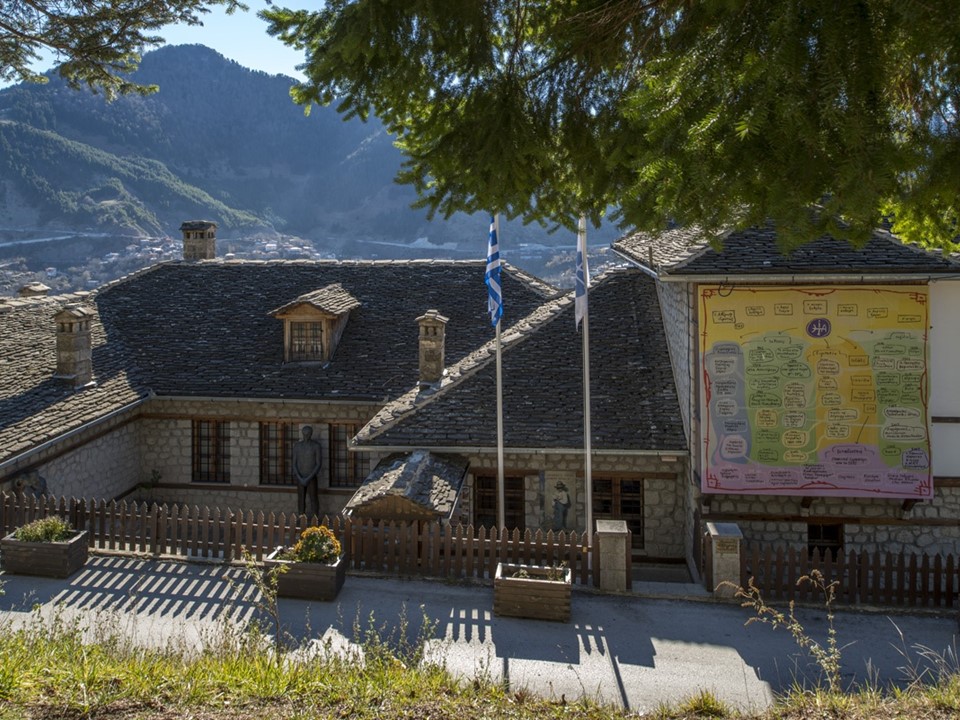
Angelos Giallinas, a master of atmospheric landscape painting, captured Corfu and Mediterranean scenes with luminous sensitivity, blending precise draftsmanship with the delicate spontaneity of watercolour.
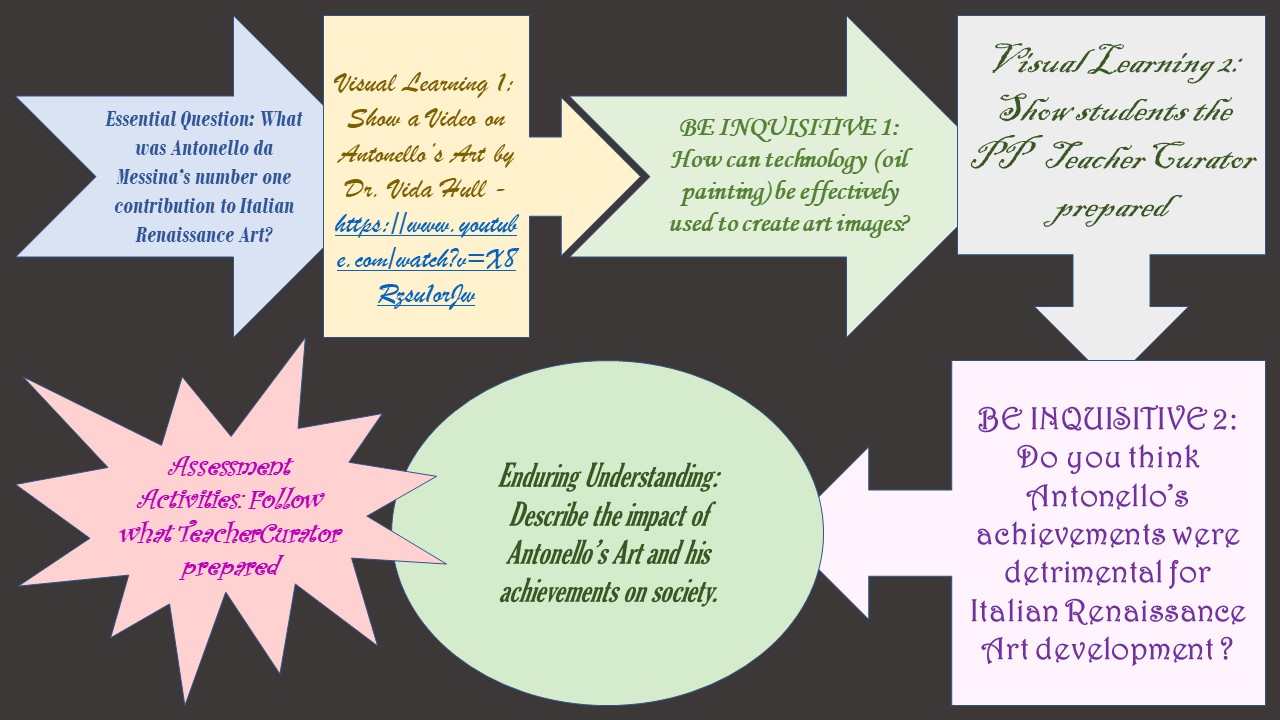
Teaching with Antonello da Messina
Antonello da Messina, inspired by Flemish oil painting, became a pioneering Italian innovator, blending Northern technique with Mediterranean sensibility, creating luminous, emotionally powerful sacred images that transformed Renaissance painting.
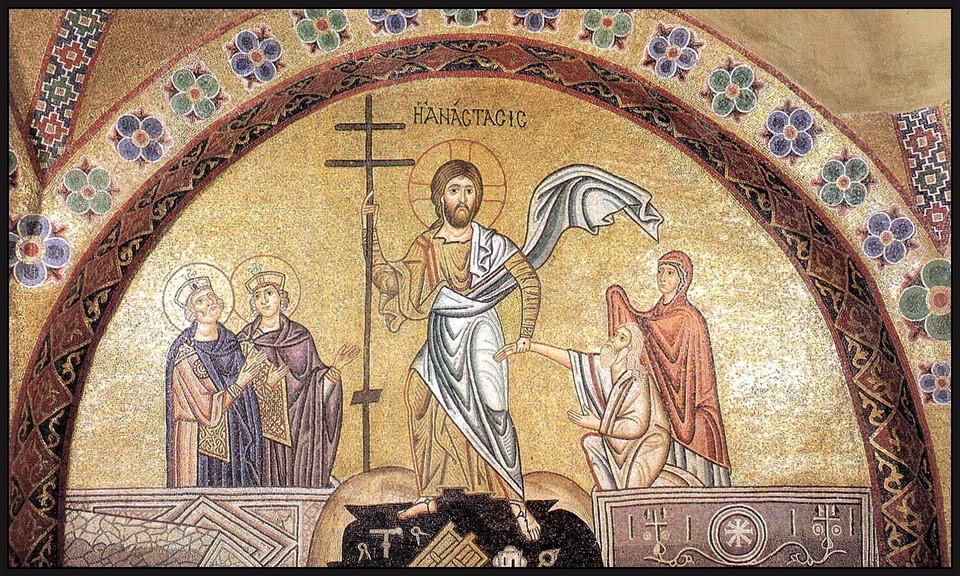
Anastasis at the Monastery of Hosios Loukas
The Anastasis mosaic at the Monastery of Hosios Loukas presents the Resurrection as Christ descends into Hades, a masterpiece of 11th-century Byzantine mosaic art radiating spiritual intensity and imperial grandeur.
The Raising of Lazarus by Duccio
The Maestà of Duccio di Buoninsegna, a monumental altarpiece for Siena Cathedral, bridges Byzantine tradition and emerging Renaissance naturalism in a profoundly devotional visual language.
The Interceding Theotokos at Dumbarton Oaks

“…denuded of all help, and deprived of human alliance, we were spiritually led on by holding fast to our hopes in the Mother of the Word, our God, urging her to implore her Son, invoking her for the expiation of our sins, her intercession of our salvation, her protection as an impregnable wall for us, begging her to break the boldness of the barbarians, her to crush their insolence, her to defend the despairing people and fight for her own flock…” writes Patriarch Photius in the second of his two homilies on the siege of Constantinople by the Rus’ and Sirarpie der Nersessian, in his 1960 Dumbarton Oaks Papers article titled Two Images of the Virgin, quotes him. I couldn’t find better introductory remarks for a BLOG POST on the marble Icon of The Interceding Theotokos at Dumbarton Oaks. https://www.jstor.org/stable/1291145?seq=15#metadata_info_tab_contents page 72 and https://www.doaks.org/resources/bliss-tyler-correspondence/art/bz/BZ.1938.62.jpg/view
The Dumbarton Oaks Museum is my favourite temple of the Muses in Washington DC! It breathes history, scholarship elegance and class… Its collection of Byzantine Art is top quality, the ways and the hows this collection was acquired fascinates me, the scholarship involved, I believe, is more than appreciated by everyone who loves Byzantium. https://www.academia.edu/3585132/_Royal_Tyler_and_the_Bliss_Collection_of_Byzantine_Art_in_James_N_Carder_ed_A_Home_of_the_Humanities_The_Collecting_and_Patronage_of_Mildred_and_Robert_Woods_Bliss_Washington_D_C_Dumbarton_Oaks_Research_Library_and_Collection_27_50?email_work_card=view-paper “Royal Tyler and the Bliss Collection of Byzantine Art,” in James N. Carder, ed., A Home of the Humanities: The Collecting and Patronage of Mildred and Robert Woods Bliss, Washington, D.C.: Dumbarton Oaks

https://www.doaks.org/visit/museum/explore/byzantine-gallery
I confess, I first noticed The Marble Interceding Theotokos in the collection of Dumbarton Oaks when I visited the grand Metropolitan Museum Exhibition The Glory of Byzantium back in 1997. Exhibited then, along with the Lips Monastery Icon of Saint Eudokia from the Archaeological Museum of Istanbul, the two marble Icons “opened my eyes” in the genre of Sculpted Marble Icons from the Byzantine era. Ever since I seek them out, and when I visit the Museum of Byzantine Culture in my hometown Thessaloniki, I always pay my respects to the marble ΜΗ(ΤΗ)Ρ Θ(ΕΟ)Υ(=Mother of God) Icon in Room 4, where artefacts of the Macedonian and Komnenian dynasties are presented. https://www.metmuseum.org/art/metpublications/The_Glory_of_Byzantium_Art_and_Culture_of_the_Middle_Byzantine_Era_AD_843_1261 and https://www.mbp.gr/en/object/marble-icon-praying-virgin

The Interceding Theotokos – Virgin Hagiosoritissa Relief, Middle Byzantine, mid-eleventh century, Marble, 104 cm x 40 cm x 7 cm, Dumbarton Oaks Museum, Washington, DC, USA
Praying ΜΗ(ΤΗ)Ρ Θ(ΕΟ)Υ(=Mother of God), 11th century, Marble, 135×70 cm, Museum of Byzantine Culture, Thessaloniki, Greece
https://www.johnsanidopoulos.com/2016/08/saint-eudocia-empress-wife-of-emperor.html
https://www.doaks.org/resources/bliss-tyler-correspondence/art/bz/BZ.1938.62.jpg/view
https://www.mbp.gr/en/object/marble-icon-praying-virgin
One more confession… the title of this BLOG POST was a decision that troubled me. At Dumbarton Oaks Museum the marble Icon of the Theotokos is presented as Virgin Hagiosoritissa Relief. The Glory of Byzantium Exhibition Catalogue uses a similar name Icon of the Virgin Hagiosoritissa. I thought, this is it…until I started reading Sirarpie der Nersessian article Two Images of the Virgin in the Dumbarton Oaks Collection, and I changed my mind! The author presents in detail the different styles, whereabouts and use of Interceding Theotokos Icons in every medium! Bottom line… I was not convinced the Marble Icon of the Theotokos is of the Hagiosoritissa type… and the title changed to The Interceding Theotokos at Dumbarton Oaks.
For a Student Activity on The Interceding Theotokos at Dumbarton Oaks, please… check HERE!
Kanaris Burning the Turkish Flagship

Kanaris Burning the Turkish Flagship, 1873, oil on canvas, 143×109 cm, Averoff Gallery, Metsovo, Greece https://www.averoffmuseum.gr/kanaris-burning-the-turkish-flagship/?lang=en
“Mais le bon Canaris, donc un ardent sillon / Suit la barque hardie, / Sur les vaisseaux qu’il prend, comme son pavillon, / Arbore l’incendie ! But good Kanaris, whose daring boat / Is followed by a burning wake, / On the vessels he seizes, as his ensign, / Displays the blaze!” Writes Victor Hugo inspired by the daring deeds of Konstantinos Kanaris (anglicised as Constantine Canaris), distinguished as a brave fire ship captain. In 1873, Nikiforos Lytras painted Kanaris Burning the Turkish Flagship, honouring the great man. https://poesie.webnet.fr/lesgrandsclassiques/poemes/victor_hugo/canaris and https://www.crwflags.com/fotw/flags/fr_canar.html

Every time I travel to Metsovo, in the Epirote mountains of Pindos, in Northern Greece, I visit the Averoff Gallery and stop in front of Nikiforos Lytras’s painting Kanaris Burning the Turkish Flagship. You cannot miss it… It is one of the most captivating 19th-century Greek paintings. https://www.averoffmuseum.gr/
Kanaris Burning the Turkish Flagship is an amazing departure from what Nykiforos Lytras studied in the Münchner Akademie der Bildenden Künste under the tutelage of Karl Theodor von Piloty (1826-1886). An influential Art School, the Münchner Akademie, attracted and trained artists from around the world to become leading painters, able to combine in their style, academic realism, baroque colourism and dark chiaroscuro. The artists of the Akademie were committed to monumental history paintings, landscapes, ethnography, portraits and still life. Naturalism in its depiction of human emotions was not among the School’s greatest artistic pursuits. http://www.artmag.gr/art-history/art-history/item/270-i-sxoli-you-monaxou

Greek and Philhellene Fighters in the Greek Revolution of 1821, Portraits of the German officer and Philhellene Karl Krazeisen
This is a rare series of the lithographs of Krazeisen, which are hand-painted.
https://www.eefshp.org/en/portfolio-item/konstantinos-kanaris-1793-1877/
Lytras’s painting on the heroic deed by Konstantinos Kanaris is a historic painting with a twist! The artist moves away “from the romantic tendency that prevailed in the School of Piloty to a more naturalistic one in which the genre element played the dominant role.” According to the description provided by the Averoff Museum “Lytras` anthropocentric painting… was not concerned so much with the historical event per se. More so it was the projection of the heroic act carried out by brave persons worthy of emulation. The flaming ship is thrust into the distance to form the backdrop for the human action that is played out on a plane close to the viewer. Thus, in contrast to the ambiguous treatment of the background, where the ship disappears half-hidden by the smoke, the realistic rendering of the Psarians with Kanaris in the boat gives the work the immediacy and truth that interested the artist.” https://www.averoffmuseum.gr/kanaris-burning-the-turkish-flagship/?lang=en
Nikiforos Lytras, the painter of Kanaris Burning the Turkish Flagship in Metsovo, was born in Pyrgi, on the Cycladic island of Tinos, the son of a marble sculptor. An exceptional talent, Lytras studied at the Athens School of Art from 1850 until 1860 and then, as the recipient of a state scholarship, he continued his studies at the Munich Academy, in the class of Karl von Piloty. In 1866 Lytras was back in Greece and was appointed professor at the Athens School of Fine Arts, a position he held for 38 productive years. A conscientious teacher, but interested to experience new ideas and always open to new trends, Nikiforos Lytras became the leading Greek artist of his time, popular with the people and honoured by his students and fellow artists.

Self-Portrait, 19th century, oil on canvas, 51,5 x 43,5 cm, National Gallery of Athens
There are two paintings on the theme of Kanaris Burning the Turkish Flagship. The earliest, chronologically, was painted by Nikiforos Lytras and today is exhibited in the Averoff Museum at Metsovo, one of my favourite Art Museums in Greece. The second painting, by Ivan Konstantinovich Aivazovsky, was painted in 1881 and is part of the E. Koutlidis Collection and is exhibited in Athens at the National Gallery. For a Student “Compare and Contrast” Activity, paintings, please… Check HERE!

The Burning of the Turkish Flagship, 1881,oil on canvas, 162×223 cm, National Gallery of Athens https://commons.wikimedia.org/wiki/File:The_Burning_of_the_Turkish_Flagship_by_Kanaris_-_Ivan_Aivazovsky,_1881.png
If you wish to learn more about the Greek War of Independence and the Bicentennial Celebrations in 2021, please VISIT the official Greece 1821-2021 Bicentennial site http://www.greece2021.gr, Twitter, https://twitter.com/Greece_2021, Facebook, https://www.facebook.com/Greece2021/, and Instagram, https://www.instagram.com/greece2021/?hl=el

Celebrating the Greek Revolution of 1821

Drums for the War of Independence – Young Drummer in Missolunghi, oil on canvas, 48.5 x 34.5 cm, Private Collection
https://www.dorotheum.com/en/l/2897144/ and http://ellas2021.eu/gallery.html
It was for these children that we fought… paraphrasing the words of Yanni Makrigianni, 1794-1864, Greek Revolutionary Fighter of 1821! Celebrating the Greek Revolution of 1821 and remembering the children who probably suffered the most.

ESTOURMEL, Joseph d’, Comte. Album du Journal d’un Voyage en Orient, Paris, Hellenic Library – Alexander S. Onassis Public Benefit Foundation
http://eng.travelogues.gr/item.php?view=39968
“The torch that was Missolonghi shed its light as far as Vasiladhi and Klisova and over the whole plain, and even reached us. The flashes of gunfire looked like a host of fireflies. From Missolonghi we heard the shrieks of women, the sound of gunfire, the explosion of powder magazines and mines, all combined in an indescribably fearful noise. The town was like a roaring furnace” remembers Nikolaos Kasomoulis (1795 – 1872), who took part, fought and survived the Exodus. I hope Perlberg’s Young Drummer Boy, so romantically groomed, successfully survived the tragedy… https://books.google.gr/books?id=GhCLDwAAQBAJ&pg=PA26-IA16&lpg=PA26-IA16&dq=%22The+flashes+of+gunfire+looked+like+a+host+of+fireflies.%22&source=bl&ots=sDTZ6TqHS3&sig=ACfU3U1jIfv4avEDAVvPpC9AfvJbcVkRmQ&hl=el&sa=X&ved=2ahUKEwiE8qvu2bvvAhWDO-wKHTb_A5MQ6AEwAnoECAEQAw#v=onepage&q=%22The%20flashes%20of%20gunfire%20looked%20like%20a%20host%20of%20fireflies.%22&f=false
For our Youngsters… the National Historical Museum in Athens

For celebratory mood and quality time with your youngster, you can VISIT the National Historical Museum site http://www.nhmuseum.gr/en and then go to http://www.nhmuseum.gr/el/ekpaideysi/ekpaideytiko-yliko/.
This is a “Colouring Page” Activity (in Greek BUT easy to understand and DO) on famous figures of the Greek War of Independence. It was inspired by the Exhibition The 1821 Greek War of Independence Retold in… Playmobil! The Activity is very EASY! http://www.nhmuseum.gr/el/ekpaideysi/ekpaideytiko-yliko/
To do the Colouring Activity Press on each picture you wish your child to colour – download it – print it – DONE! You can choose between heroes and heroines of the Greek War of Independence and celebrate an important moment in Greek History. From top to bottom, the Colouring Page Figures are: Theodoros Kolokotronis, Odysseas Androutsos, Laskarina Bouboulina, Konstantinos Kanaris, Manto Mavrogenous, Germanos, Metropolitan Paleon Patron, Andreas Lontos, Asimo Goura, Ioannis Makrigiannis, Domna Visvizi, Christos Kapsalis, Andreas Pipinos, Dimitrios Papanikolis
For our Youngsters… a List of Student Activities on the Greek Revolution of 1821 prepared by Greek Museums and Foundations… HERE!

For an easy to print Celebrating the Greek Revolution of 1821 Worksheet, please… Click HERE!
If you wish to learn more about the Greek Revolution of 1821 and the preparation for the Bicentennial Celebration in 2021, please VISIT the official Greece 1821-2021 Bicentennial site: https://www.greece2021.gr/en/ and/or https://www.greece2021.gr/

Clean Monday Feast

Clean Monday Feast, 1950, oil on wood, 125×78, Municipality of Rhodes Museum of Modern Greek Art
https://paletaart.wordpress.com/2012/08/06/%CE%B2%CE%B1%CF%83%CE%B9%CE%BB%CE%B5%CE%AF%CE%BF%CF%85-%CF%83%CF%80%CF%8D%CF%81%CE%BF%CF%82-spyros-vassiliou-1903-1985/#jp-carousel-4424
Could Isaiah (Isaiah 1:1–20) introduce us to the theme of Clean Monday with his Old Testament verses? “Wash yourselves; make yourselves clean; remove the evil of your doings from before my eyes; cease to do evil, learn to do good; seek justice, rescue the oppressed, defend the orphan, plead for the widow. Come now, let us argue it out, says the Lord: though your sins are like scarlet, they shall be like snow; though they are red like crimson, they shall become like wool. If you are willing and obedient, you shall eat the good of the land; but if you refuse and rebel, you shall be devoured by the sword; for the mouth of the Lord has spoken.” Are the following Matthew verses (Matthew 6:14–21) indicative of the Greek Orthodox festive, springtime atmosphere of Clean Monday? “When ye fast, be not, as the hypocrites, of a sad countenance: for they disfigure their faces, that they may appear unto men to fast. Verily I say unto you, They have their reward. But thou, when thou fastest, anoint thine head, and wash thy face, that thou appear not unto men to fast, but unto thy Father which is in secret…” I like to think that the painting Clean Monday Feast by Spero Vassiliou embodies Matthew’s recommendations and presents the glorious Greek Clean Monday at its best! https://bible.oremus.org/?passage=Isaiah%201:1%E2%80%9320&version=nrsv and https://bible.oremus.org/?passage=Matthew%206:14%E2%80%9321&version=nrsv
Austerity and Affluence… two words that best describe, in my humble opinion, Vassiliou’s painting Clean Monday Feast in the Municipality of Rhodes Museum of Modern Greek Art. Let me explain…
Austerity… in the green, tripod, metal table, centrally displayed, full of traditional νηστίσιμα(fasting foods) humble delicacies that mark the beginning of Lent… for the day, Clean Monday, when relatives and friends celebrate the upcoming period of humility, self-criticism and mutual forgiveness. Vassiliou’s green coloured table displays a piece of Lagana, the unleavened popular bread of the day, Throubes, sun-dried black olives, crunchy spring onions, the grocer’s halva with tasty almonds, the heart of tender lettuce, a deep yellow plate full of crisp, local “greens,” a white plate with salty, but so tasty red fish roe, and retsina, the Greek resinated white wine, popular in Greece for at least 2,000 years.
Affluence… in the love the artist held for the simple things of everyday life, insignificant at first sight, yet eloquent, meaningful and deeply moving for all the initiates of Greek Clean Monday rituals. Spero Vassiliou’s family tradition for Clean Monday was to invite his friends for a day’s feast on the roof(ταράτσα) of his house, below the Acropolis of Athens! The 1950 painting, titled Clean Monday Feast, is glowingly colourful, brightly sunny, gloriously festive!

Spero Vassiliou “studied painting at the “School of Arts” (later Athens School of Fine Arts) from 1921 to 1926. He was among the students who struggled for the reorganization of the School and who attended the studio of the newly elected professor, Nikos Lytras.” An active member of the Greek Artists Association, Vasiliou put together solo exhibitions as early as 1929, participated in creating stage design and costumes for about 140 plays, and won the prestigious Academy of Athens Award for designing the frescoes in the church of Saint Dionysius Areopagites in Athens. By the late 1940s, Vassiliou was an active member of the Greek intelligentsia representing a style linked to surrealism or pop art with a dominant dose of “aspects of contemporary Greek life in a picturesque and vivid way, sometimes inspired by folklore forms…” http://dp.iset.gr/en/artist/view.html?id=1080

https://www.rodos-palace.gr/discover-rhodes/510/Museums-and-Antiquities/
The painting Clean Monday Feast by Spero Vassiliou is part of the Collection of the Municipality of Rhodes Museum of Modern Greek Art. The driving force behind the creation of the Municipality Museum was Andreas Ioannou, “a distinguished scholar of modern Greek art, writer and prefect of Dodecanese.” He foresaw the leading role Rhodes could play as a cultural center of international fame and decided, back in the 1950s, to create an emblematic Museum of Modern Greek Art. “For this reason he came in contact with the leading Greek artists, acquired their emblematic works and housed them in the historic building of Symi Square at the entrance of the Medieval City of Rhodes, which is now a UNESCO World Heritage Site.” https://www.mgamuseum.gr/el/to-mouseio/
Today, the Municipality Museum has 4 very distinct Art Galleries. The original Historic Building on Symi Square is the center where Engravings of the 19th – 20th centuries, Publications and Posters will be exhibited. The “Nestorideion Melathron” houses the Museum’s permanent collection of 20th century Modern Greek Art, including Vassiliou’s Clean Monday Feast. The Modern Art Centre, situated at the main thoroughfare in the Medieval Town “Palaio Syssitio,” has been chosen as the center for the first permanent exhibition dedicated to the famous and characteristic Rhodesian Ceramic Art. Finally, in 2010, the Museum inaugurated a new center dedicated to the cultural activities of the island. https://www.mgamuseum.gr/el/to-mouseio/
Get enthused by Spero Vassiliou’s Painting Clean Monday Feast and prepare a Student Activity inspired by the depicted Kites! Use a List of ONLINE sites to find out what best suits your students! Click HERE!
Teaching with Andrea Mantegna

Camera degli Sposi, The West Wall: The Meeting, (detail of the left panel), 1465-74, Walnut oil on plaster, Camera degli Sposi, Palazzo Ducale, Mantua
https://commons.wikimedia.org/wiki/File:Andrea_Mantegna_075.jpg?uselang=it
“How great is the effect of reward on talent is known to him who labors valiantly and receives a certain measure of recompense, for he feels neither discomfort, nor hardship, nor fatigue, when he expects honor and reward for them; nay, what is more, they render his talent every day more renowned and illustrious. It is true, indeed, that there is not always one to recognize, esteem, and remunerate it as that of Andrea Mantegna was recognized. This man was born from very humble stock in the district of Mantua; and, although as a boy he was occupied in grazing herds, he was so greatly exalted by destiny and by his merit that he attained to the honorable rank of Chevalier, as will be told in the proper place…” This is how Giorgio Vasari introduces Andrea Mantegna, the artist who was is “seen to have been wrought with much art and diligence.” Teaching with Andrea Mantegna is a set of student activities and worksheets inspired by the great Italian artist I admire. To visit Andrea’ Camera degli Sposi in the Palazzo Publico in Mantua was for years an unreachable dream. In 1988 along with a group of students/friends my dream came to fruition and I was finally, in the middle of this amazing room… moved, I confess, and emotional. http://www.travelingintuscany.com/art/giorgiovasari/lives/andreamantegna.htm

The presentation of Christ in the temple (detail-Probably Self-portrait), 1465-1466, tempera on canvas, 86×67 cm, Gemäldegalerie, Berlin
https://commons.wikimedia.org/wiki/Category:Portraits_of_Andrea_Mantegna#/media/File:Andrea_Mantegna_049_detail_possible_self-portrait.jpg
When the time comes for me to introduce my students to Mantegna’s oeuvre I start with Giorgio Vasari’s final words. “Andrea was so kindly and praiseworthy in all his actions, that his memory will ever live, not only in his own country, but in the whole world; wherefore he well deserved, no less for the sweetness of his ways than for his excellence in painting…” and continue with the artist’s tutelage under Squarcione, who “made him practise much on casts taken from ancient statues and on pictures painted upon canvas which he caused to be brought from diverse places, particularly from Tuscany and from Rome. By these and other methods, therefore, Andrea learnt not a little in his youth…” I finish my presentation of Andrea Mantegna’s contribution to world art with his reaction to Squarcione’s criticism that “his pictures resembled not living figures but ancient statues of marble or other suchlike things.” My students are intrigued and a discussion takes place by how “This censure piqued the mind of Andrea; but, on the other hand, it was of great service to him, for, recognizing that Squarcione was in great measure speaking the truth, he set himself to portray living people, and made so much progress in this art, that, in a scene which still remained to be painted in the said chapel, he showed that he could wrest the good from living and natural objects no less than from those wrought by art. But for all this Andrea was ever of the opinion that the good ancient statues were more perfect and had greater beauty in their various parts than is shown by nature, since, as he judged and seemed to see from those statues, the excellent masters of old had wrested from living people all the perfection of nature, which rarely assembles and unites all possible beauty into one single body, so that it is necessary to take one part from one body and another part from another.” http://www.travelingintuscany.com/art/giorgiovasari/lives/andreamantegna.htm

The San Zeno Polyptych (detail), 1457-60, Tempera on panel, 480 x 450 cm, San Zeno, Verona
https://commons.wikimedia.org/wiki/Category:Details_of_Pala_di_San_Zeno_by_Andrea_Mantegna#/media/File:Andrea_Mantegna_024.jpg
Teaching with Andrea Mantegna References – References, a PowerPoint and Activities…
For the List of ONLINE References on Andrea Mantegna TeacherCurator put together, please… Click HERE!
For my PowerPoint on Andrea Mantegna, please… Click HERE!
I always feel confident discussing an artist with my students when I prepare my 7 Steps to Success Lesson Plan Outline…

For Student Activities (5 Activities), please… Click HERE!
I hope that Teaching with Andrea Mantegna will prove easy and helpful. Do you think it justifies my BLOG name Teacher Curator?

Ceiling decoration of the Camera degli Sposi (detail), 1465-74, Walnut oil on plaster and fresco, Camera degli Sposi, Palazzo Ducale, Mantua
https://commons.wikimedia.org/wiki/Category:Camera_picta_-_Ceiling#/media/File:Andrea_mantegna,_camera_degli_sposi,_1465-74,_volta,_oculo,_07.jpg
Boat of Greeks

Boat of Greeks, 1844 to 1847, oil on canvas, 29×23 cm, Averoff Museum, Metsovo, Greece
https://www.averoffmuseum.gr/boat-of-greeks/?lang=en
“…Fill high the bowl with Samian wine! / On Suli’s rock, and Parga’s shore, / Exists the remnant of a line / Such as the Doric mothers bore; / And there, perhaps, some seed is sown, / The Heracleidan blood might own. / Trust not for freedom to the Franks— / They have a king who buys and sells; / In native swords and native ranks / The only hope of courage dwells: / But Turkish force and Latin fraud / Would break your shield, however broad….” Writes George Gordon Byron in The Isles of Greece and makes the best possible introduction for Dionysis Tsokos’s Boat of Geeks at the Averoff Museum in Metsovo. https://englishverse.com/poems/the_isles_of_greece
Dionysis Tsokos’s painting Boat of Geeks is closely connected to the fate of the small city of Parga on the Ionian Coast of Epirus. Parga, a small city/fortress, was always closely connected to the European political interests of the Ionian Islands. Since 1360 when the fortress of Parga was built with the help of the Normans who held, at the time the island of Corfu, the Pargians faced countless Ottoman attacks while they were under Venetian, French or British rule. In 1815 the inhabitants of the city of Parga rebelled against the French rule, under the instigation of the British, and a short period of British rule started. Seeing Parga as the stepping stone to achieving their final goal: to occupy the Ionian Islands, the British, in 1817, sold Parga to Ali Pasha for 150,000 pounds. https://www.kastra.eu/castleen.php?kastro=parga

Parga, Journals of a Landscape painter in Albania etc., London, Richard Bentley, 1851, 14×21 cm, Benaki Museum Library
https://eng.travelogues.gr/collection.php?view=283
What happened next is best described in the October 1819 edition of the Edinburgh Review… “As soon as the notice was given [of how much Ali was to be charged for their homeland] every family marched solemnly out of its dwelling, without tears or lamentation; and the men, preceded by their priests, and followed by their sons, proceeded to the sepulchres of their fathers, and silently unearthed and collected their remains, – which they placed upon a huge pile of wood which they had previously erected before one of their churches. They even took their arms in their hands, and, setting fire to the pile, stood motionless and silent around it, till the whole was consumed. During this melancholy ceremony, some of Ali’s troops, impatient for possession, approached the gates of the town; upon which a deputation of citizens was sent to inform our Governor, that if a single Infidel was admitted before the remains of their ancestors were secured from profanation, and they themselves, with their families, fairly embarked, they would all instantly put to death their wives and children, – and die with their arms in their hands, – and not without a bloody revenge on those who had bought and sold their country. Such a remonstrance, at such a moment, was felt and respected, as it ought by those to whom it was addressed. General Adam succeeded in stopping the march of the Mussulmans. The pile burnt out – and the people embarked in silence…” http://newsteadabbeybyronsociety.org/works/downloads/sale_parga.pdf and https://books.google.gr/books?id=7kNBAAAAYAAJ&pg=RA1-PA12&lpg=RA1-PA12&dq=Edinburgh+Review+Sale+of+Parga&source=bl&ots=hZxwnxM1hD&sig=ACfU3U3ac4JXKloQ18zhWLsbpAsGjXXTtQ&hl=el&sa=X&ved=2ahUKEwjug-2Ly5jvAhVfQhUIHaLnBgkQ6AEwB3oECAkQAw#v=onepage&q=Edinburgh%20Review%20Sale%20of%20Parga&f=false pp. 22-23
Boat of Geeks by Dionysis Tsokos depicts the final act of Parga’s sale by the British to Ali Pasha… “a boat full of refugees – resistance fighters, a priest, and a woman – floundering on the waves as it heads for foreign shores. One gallant lad stands embracing the mast and holding the Greek flag, gazing intently at the fatherland he is abandoning, while the captain holds fast to the helm.” https://www.averoffmuseum.gr/boat-of-greeks/?lang=en

The Flight from Parga, after 1847, oil on canvas, 37×47 cm, E. Koutlidis Foundation Collection, National Gallery of Greece, Athens
https://www.nationalgallery.gr/en/painting-permanent-exhibition/painting/the-years-of-othon%E2%80%99s-reign/history-painting/the-flight-from-parga.html
Dionysis Tsokos created two paintings on the theme of Greeks fleeing Parga after the shocking 1819 British sale to Ali Pasha. The earliest, chronologically, of the two paintings, is today exhibited in the Averoff Museum at Metsovo, one of my favourite Art Museums in Greece, the second painting, dated a little later is part of the E. Koutlidis Collection and is exhibited in Athens at the National Gallery. For a Student “Compare and Contrast” Activity on Dionysis Tsokos’s paintings, please… Check HERE!
If you wish to learn more about the Greek War of Independence and the Bicentennial Celebrations in 2021, please VISIT the official Greece 1821-2021 Bicentennial site http://www.greece2021.gr, Twitter, https://twitter.com/Greece_2021, Facebook, https://www.facebook.com/Greece2021/, and Instagram, https://www.instagram.com/greece2021/?hl=el