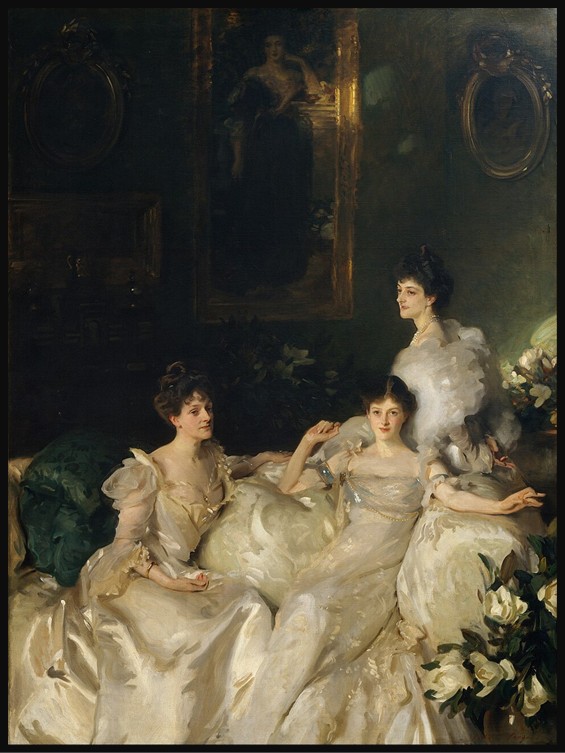
The Wyndham Sisters – Lady Elcho, Mrs. Adeane, and Mrs. Tennant, 1899, Oil on Canvas, 292.1 x 213.7 cm, Metropolitan Museum of Art, NY, USA
https://commons.wikimedia.org/wiki/File:The_Wyndham_Sisters_-_Lady_Elcho,_Mrs._Adeane,_and_Mrs._Tenant.jpg

The Portrait of the Wyndham Sisters by John Singer Sargent stands as one of the most compelling demonstrations of the artist’s ability to merge technical mastery with psychological depth. Far from a conventional society portrait, this monumental canvas reveals the artist at the height of his powers, orchestrating composition, movement, and character with remarkable sophistication. What continues to strike me is how effortlessly Sargent transforms what could have been a formal commission into something vivid, dynamic, and deeply perceptive.
At first glance, the painting impresses through its scale and elegance. From left to right, the three sisters, Madeline Adeane (1869–1941), Pamela Tennant (1871–1928), and Mary Constance Lady Elcho (1862–1937), are arranged in a sweeping, almost rhythmic formation that feels both unified and fluid. Sargent avoids the stiffness typical of formal group portraits by introducing a subtle sense of motion: their pale, off-white gowns flow into one another, forming a continuous, undulating passage across the canvas. The viewer’s eye moves almost instinctively through the composition, guided by posture, gesture, and gaze.
This carefully orchestrated arrangement is further enriched by the setting itself. The sisters posed in the drawing room of their family’s London residence, a space that quietly anchors the portrait within their social and familial identity. Above them, partially veiled in shadow, hangs a portrait by George Frederic Watts of their mother, Madeleine Campbell. I find this detail particularly compelling: its presence is more than decorative, it establishes the sisters’ genealogy, situating them within a lineage of prestige and continuity. At the same time, it creates an artistic dialogue across generations, subtly linking Sargent to an earlier tradition of British portraiture. The painting thus operates on two levels, presenting a modern vision of femininity while acknowledging the enduring weight of heritage.
What is especially striking is how Sargent balances individuality with harmony. Madeline Adeane, positioned to the left, leans slightly forward, her stance suggesting immediacy and engagement. At the center, Pamela Tennant turns with quiet assurance, her upright posture lending stability and composure to the group. To the right, Mary Constance Lady Elcho adopts a more relaxed, anchored pose, subtly grounding the composition. These nuanced differences create a psychological dialogue between the figures, suggesting distinct personalities without ever disrupting the overall unity, an equilibrium that, to me, reflects Sargent’s remarkable sensitivity to human presence.
Equally masterful is his handling of light and texture. The off-white gowns, far from being uniform, become a site of painterly experimentation. Sargent builds them through layers of cool greys, warm creams, and fleeting highlights, capturing the way fabric absorbs and reflects light. The dresses seem almost to shimmer, animated by confident, economical brushstrokes. Against the darker, more subdued background, the figures emerge with a soft luminosity that enhances their presence without overwhelming the composition.
Sargent’s brushwork reinforces this vitality. Seen up close, it appears loose, even improvisational. From a distance, it resolves into a harmonious whole. This interplay between spontaneity and control is, perhaps, one of the most fascinating aspects of his practice, allowing him to convey both immediacy and refinement.
In contrast to more rigid group portraits of the nineteenth century, this work feels strikingly modern. Sargent moves beyond static representation, using composition and light to evoke rhythm, atmosphere, and psychological nuance. The result is not simply a portrait of three women, but a carefully choreographed visual experience, one that continues to reward sustained looking.
Ultimately, The Wyndham Sisters exemplifies Sargent’s brilliance in transforming portraiture into something dynamic and alive. It is a work that, even today, invites us not only to observe but to engage, to look closely, and perhaps to reconsider what a portrait can truly convey.
For a PowerPoint Presentation of John Singer Sargent’s oeuvre, please… Check HERE!
Continue Exploring on Teacher Curator: La Carmencita by John Singer Sargent https://www.teachercurator.com/19th-century-art/la-carmencita-by-john-singer-sargent/
Bibliography: from the MET in NY, where the painting is exhibited https://www.metmuseum.org/art/collection/search/12477 the Guardian https://www.theguardian.com/books/2014/feb/03/those-wild-wyndhams-claudia-renton-review and Tatler https://www.tatler.com/article/wyndham-sisters-john-singer-sargent