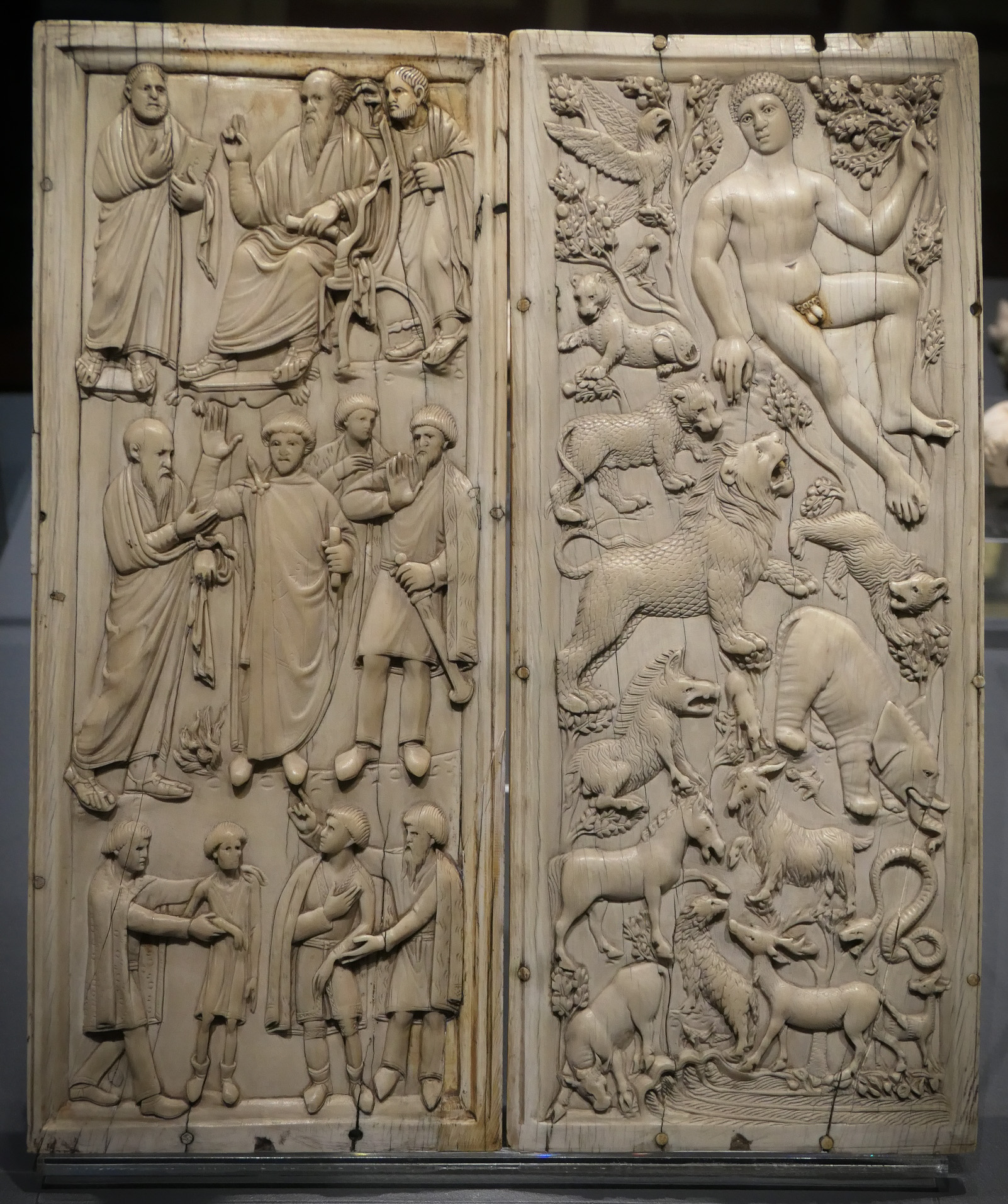
At first glance, the small Ivory Diptych St. Paul and Adam in the Earthly Paradise, now in the Bargello Museum, might seem like a refined but relatively modest object. Its scale is intimate, its carving delicate. And yet, the more time one spends with it, the clearer it becomes that this is anything but a simple devotional image. Instead, it feels like a carefully constructed visual argument, shaped at a moment when religious belief and political identity were deeply intertwined.
What immediately attracts my attention is the pairing itself. Why place Adam, seated peacefully among animals in Eden, alongside Saint Paul, confronted by a viper? At first, the connection is not obvious. But early Christian writers such as Basil of Caesarea and Ambrose of Milan begin to clarify the relationship. For them, Adam represents humanity before the Fall, when harmony governed the natural world. Paul, on the other hand, demonstrates how that harmony might be regained. His immunity to the viper’s venom, for example, becomes a sign that faith restores a lost balance between humans and nature.
Read together, the two panels suggest not a contrast, but a continuum. This interpretive framework is visually reinforced in Sant Paul’s panel which unfolds scenes from the life of Saint Paul. At the top register, the apostle, depicted as bald in accordance with conventional iconography, sits between two men who listen as he gestures in speech. In the middle register, he is shown in Malta during the miracle of the viper, where the snake emerging from the fire bites his hand without causing harm, while Publius, the island’s governor, reacts in astonishment. In the lower register, Paul heals the sick of the island, including Publius’s emaciated father. Seen in this way, Paul’s narrative does not merely parallel Adam’s paradisiac harmony but actively re-enacts and extends it through miracle and healing, reinforcing the idea of restored order between humanity and the natural world.
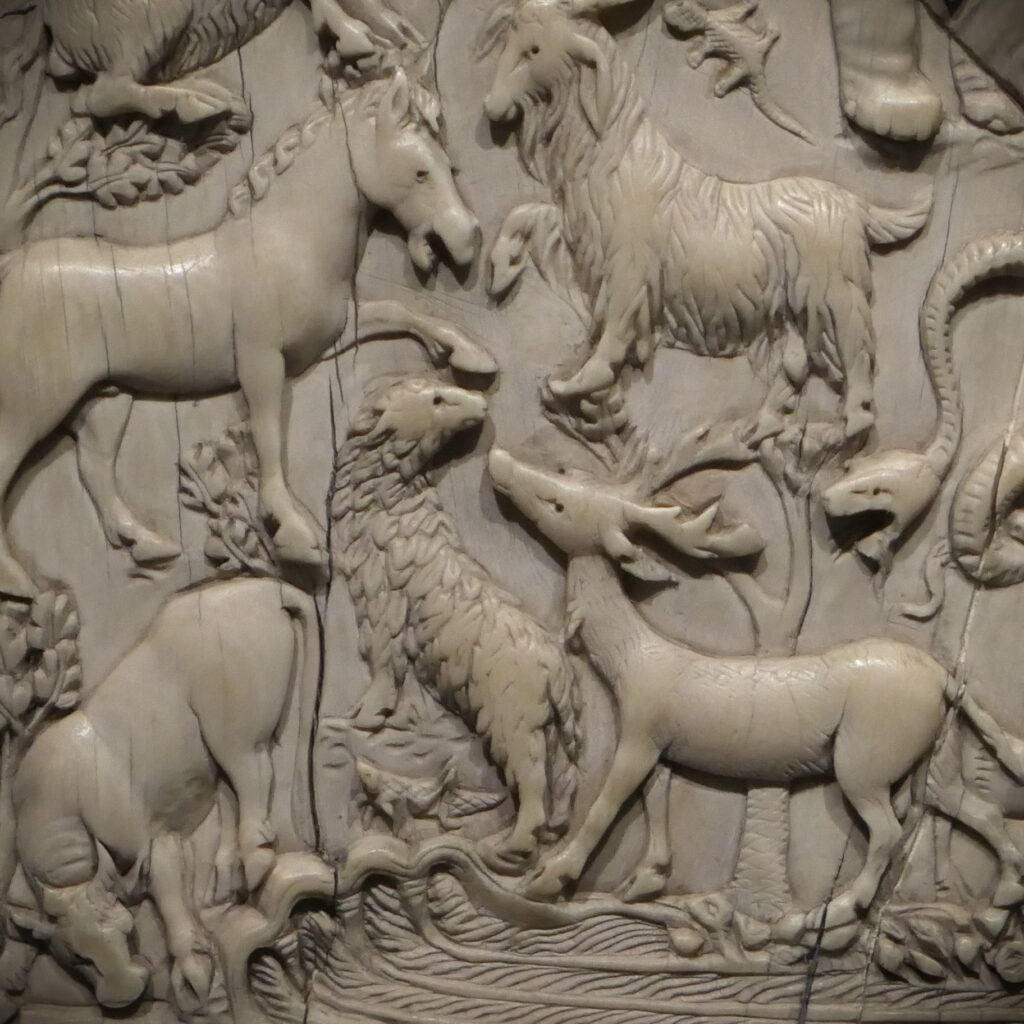
I find it difficult to see the diptych as purely theological. It seems to speak just as strongly to the tensions of its own time. The late Roman world was marked by sharp conflicts between pagan traditions and an increasingly assertive Christianity. In this context, the writings of Prudentius are particularly revealing. His comparisons, where pagan elites such as Quintus Aurelius Symmachus are likened to dangerous creatures, and converts to domesticated animals, offer a striking parallel to the imagery here. The animals around Adam, and even the subdued threat of the viper, begin to feel less like naturalistic details and more like metaphors for humanity itself: unruly, divided, but capable of transformation.
Seen from this perspective, the diptych takes on a more pointed meaning. It seems to assert not only the truth of Christian belief, but also its universal reach. All people, even those perceived as barbarian, can be brought into harmony, just as the animals gather peacefully around Adam. This is not a neutral image. It carries the quiet confidence of a worldview that sees itself as both inevitable and civilizing.
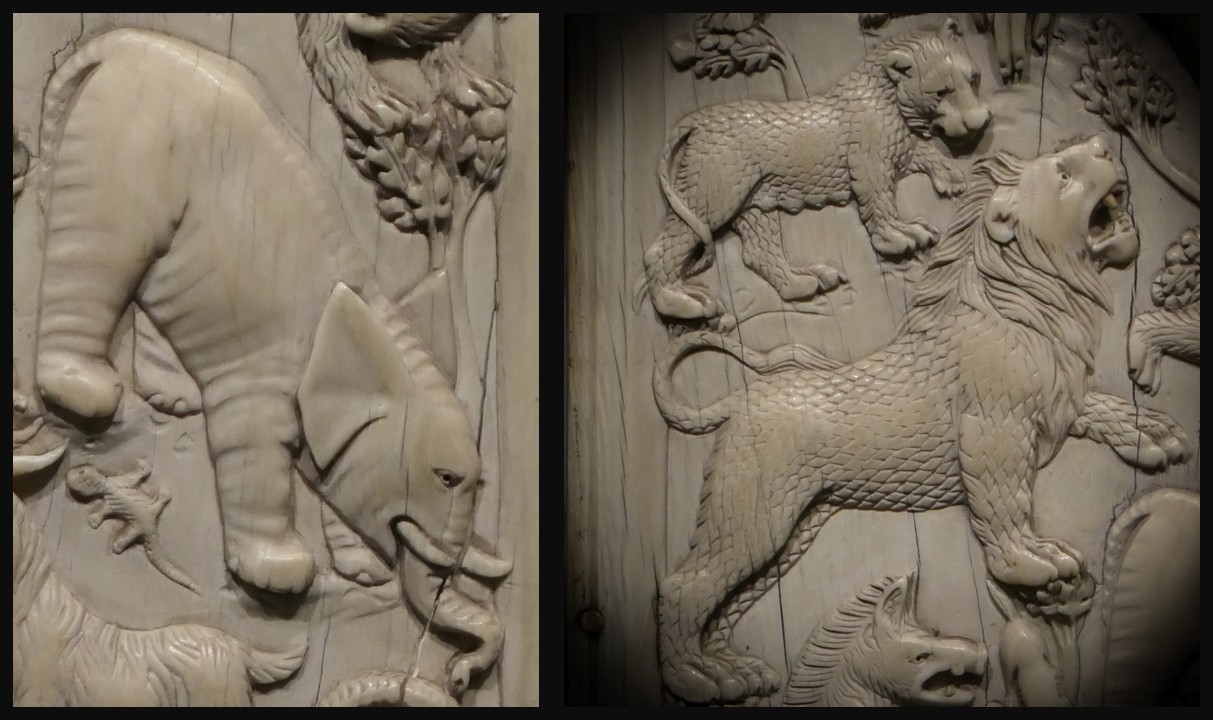
Even the stylistic differences between the two panels contribute to this impression. They appear to draw on distinct visual traditions, one more narrative, perhaps recalling early Christian cycles like those once associated with San Paolo fuori le Mura, the other echoing older classical motifs such as Orpheus charming the animals, here reinterpreted in a Christian key. The diptych, in other words, feels like a meeting point of different artistic languages, much like the culture that produced it.
In the end, what I find most compelling is how much is condensed into such a small object. This is not simply a work of devotion; it is a statement of belief and belonging. It suggests a patron who is not only pious, but also intellectually and politically engaged. And in doing so, it reminds us that works of art like this did not just reflect the world around them,they actively participated in shaping it.
For a Student Activity inspired by the animals presented in the Bargello Ivory Diptych, please… Check https://www.teachercurator.com/wp-content/uploads/2026/05/Diptych-StAct-1.docx
Sources and further Reading: the general catalogue of the Italian Ministry of Culture https://catalogo.beniculturali.it/detail/HistoricOrArtisticProperty/0901395332-0 and The Visual Commentary on Scripture https://thevcs.org/adam-naming-animals
If interested in the Early Christian Ivories exhibited in the Bargello Museum in Florence, please check Teacher Curator’s Blog Posts: https://www.teachercurator.com/art/empress-ariadne/ and https://www.teachercurator.com/archaeology/the-consular-diptych-of-anicius-faustus-albinus-basilius/ and https://thevcs.org/adam-naming-animals#intimations-immortality