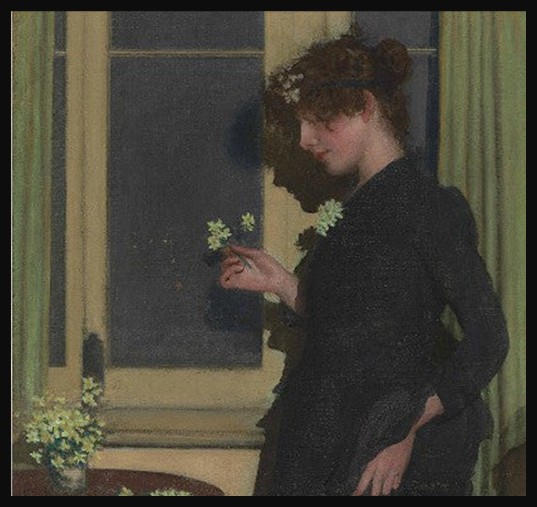
Philip Wilson Steer, Jonquil, British Impressionist interior with flowers

Philip Wilson Steer’s Jonquil

Philip Wilson Steer’s Jonquil
March 4, 2026 by Amalia Spiliakou with no comment 19th century ArtArt of the United KingdomTeaching Resources Edit
Philip Wilson Steer, Jonquil, British Impressionist interior with flowers
Philip Wilson Steer, English, 1860-1942
Jonquil, 1890, Oil on Canvas, 91.5×91.5cm, Private Collection
https://www.paulfrasercollectibles.com/blogs/art-photography/philip-wilson-steers-jonquil-will-lead-british-impressionist-art-sale?srsltid=AfmBOooN3TM25j_xhU_nVNGhK4y5qROs7_af7yFZ_Dpx-3wx8w8h2N41
March marks the quiet turning of the year, when winter light begins to soften and the first flowers appear almost shyly in gardens and hedgerows. For this month’s Flower of the Month, Philip Wilson Steer’s Jonquil offers a fitting celebration of early spring. The jonquil, long associated with renewal, modest joy, and the promise of warmer days, emerges here not as a botanical study, but as a moment of looking: intimate, fleeting, and tender. Steer, a leading figure in British Impressionism, was deeply attuned to atmosphere and seasonal change, and this small floral subject allows his sensitivity to come fully into focus.

Atmosphere, Light, and Everyday Beauty in Steer’s Work

Philip Wilson Steer (1860–1942) was born in Birkenhead and trained initially at the Gloucester School of Art before continuing his studies at the South Kensington School of Art in London. He later travelled to Paris, enrolling at the Académie Julian, where he encountered French Impressionist and Realist painting at first hand. This exposure proved formative. On his return to Britain, Steer became a central figure in the development of modern British painting, helping to introduce Impressionist approaches to colour, light, and natural observation. In 1886 he was a founding member of the New English Art Club, which offered an important alternative to the academic traditions of the Royal Academy. Steer went on to enjoy considerable professional success, exhibiting widely and later serving as an influential teacher at the Slade School of Fine Art, where he shaped a generation of British artists.

Steer’s aesthetic was grounded in close observation and a deep responsiveness to light and atmosphere. Rather than dramatic narratives or grand historical themes, he gravitated toward moments of quiet presence: coastal landscapes, figures absorbed in thought, and flowers encountered at close range. His brushwork often dissolves form at the edges, allowing light to become an active presence within the composition. Colour is handled with restraint and subtlety, creating a sense of harmony rather than contrast. This sensitivity gives his paintings a reflective quality, as if the viewer is invited to share in the artist’s own act of looking.

As a leading figure in British Impressionism, Steer played a crucial role in adapting continental ideas to the British landscape and temperament. While influenced by French Impressionists, his work remains distinctively measured and introspective, favouring mood over spectacle. Nature, for Steer, was not something to be mastered or idealised, but quietly attended to, whether in the shifting light of a shoreline or the modest presence of a single flower. His interest in everyday subjects reflects a belief that beauty resides in the ordinary, revealed through patience, attentiveness, and an openness to fleeting sensory experience.

Jonquil and the Spirit of Early Spring

Philip Wilson Steer’s Jonquil depicts a young woman standing in profile beside a tall window, absorbed in the quiet act of holding and examining a small spray of pale flowers. She is dressed in a dark, simple garment that contrasts gently with the soft yellows and greens of the interior setting. The window behind her admits a cool, diffused light, which falls across her face and hands, modelling her features with subtlety rather than clarity. A small table or ledge in the foreground holds additional blossoms, echoing the flowers in her hand and reinforcing the intimacy of the scene. The setting feels domestic and enclosed, yet permeated by light, creating a sense of stillness and inwardness.

Philip Wilson Steer, Jonquil, British Impressionist interior with flowers, a drawing
Philip Wilson Steer, English, 1860-1942
Jonquil, 1890, Pen; Ink; Card, 17.7 cm x 17.8 cm, National Museums, Liverpool
https://www.liverpoolmuseums.org.uk/artifact/jonquil
Steer’s aesthetics here are defined by restraint, atmosphere, and emotional understatement. The palette is carefully harmonised: muted yellows, soft greens, deep blues, and warm neutrals are balanced so that no single element asserts dominance. Brushwork is delicate and softened, particularly in the figure and background, allowing forms to merge gently with their surroundings. Light functions not as a dramatic spotlight but as an enveloping presence, dissolving edges and lending the scene a hushed, contemplative mood. The woman’s absorbed pose and the modest scale of the flowers suggest an interest in private, everyday experience rather than narrative or symbolism. Rather than sharply observing the flowers or the figure, Steer seems to suggest them emotionally, capturing a fleeting moment of quiet attention, where nature and human presence meet in a shared atmosphere of calm reflection.

In Jonquil, Steer offers not a celebration of the flower’s brightness, but a meditation on attentiveness itself. The painting’s quiet harmony of light, colour, and gesture invites the viewer to slow down and share in a moment of private contemplation, where the simple act of holding a flower becomes a reflection on season, presence, and renewal. As a work chosen for March, Jonquil gently captures the spirit of early spring—modest, inward, and full of promise.

For a PowerPoint Presentation, of Philip Wilson Steer’s oeuvre, please… Check HERE!

Bibliography: From the Walker Art Gallery https://www.liverpoolmuseums.org.uk/walker-art-gallery and from Sotheby’s https://www.sothebys.com/en/auctions/ecatalogue/2006/20th-century-british-art-l06141/lot.7.html

October, ca. 1480, Clear and coloured glass window.

‘October’ Stained Glass Roundel

October, ca. 1480, Clear and coloured glass window.
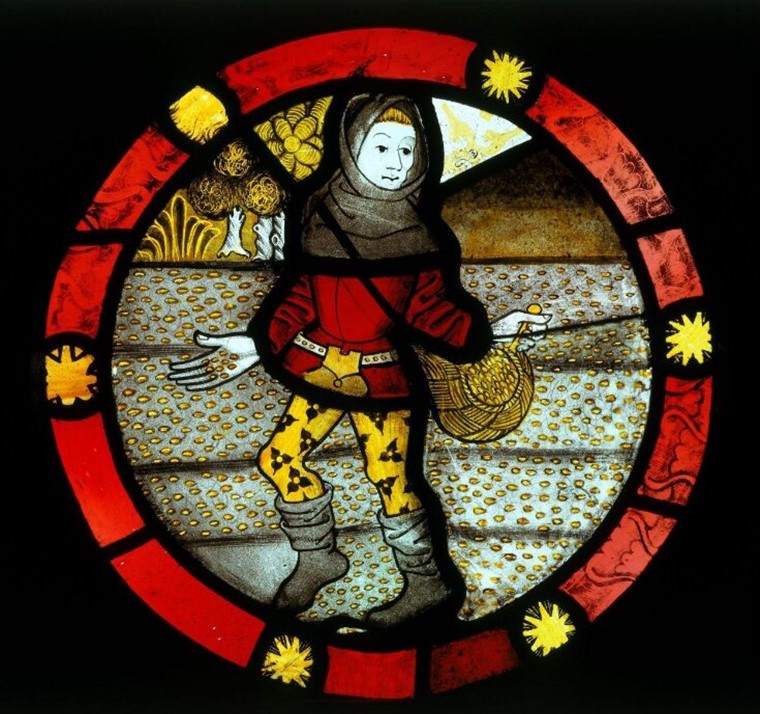
October, ca. 1480, Clear and coloured glass with painted details in brown/black pigment and yellow (silver) stain, Diameter: 29.2cm, V&A Museum, London, UK https://collections.vam.ac.uk/item/O7620/october-roundel-unknown/

I’m not sure if you enjoy Japanese Haiku, those brief poems with 3 lines and 17 syllables. As I look at the ‘October’ Stained Glass Roundel at the Victoria and Albert Museum depicting a farmer sowing seeds, I reminisce about the ‘Haiku’ games I used to play with my students. And just like that, a new Haiku came to life… Red and yellow glow, / Seeds are sown in glass and light, / Medieval blooms…

Stained glass roundels offer a vivid glimpse into the daily lives and seasonal rhythms of medieval society, and the Victoria and Albert Museum holds a remarkable example in its collection. Among the treasures acquired by the museum in 1931 are three roundels, which once formed part of a larger set depicting the ‘Labours of the Months.’ Although the original location of these roundels remains a mystery, they are believed to have originated from the old parsonage at St Michael-at-Coslany in Norwich. One of the missing pieces, illustrating the month of January or February, now resides in the Burrell Collection in Glasgow, connecting these scattered remnants of medieval art across time and space.

The ‘Labours of the Months’ is a captivating iconographic theme in medieval art, reflecting the cyclical nature of rural life and the deep connection between humanity and the seasons. Each month was traditionally represented by a specific task or activity, from sowing seeds in October to harvesting in August, offering a visual calendar of rural labour. These depictions often appeared in illuminated manuscripts, sculptures, and stained glass, serving as both educational tools and spiritual reflections of the divine order of the world. In churches and cathedrals, the ‘Labours of the Months’ provided parishioners with a relatable visual narrative that connected the rhythms of the natural world with their spiritual lives.

The Stained Glass Roundel depicting ‘October’ in the Victoria and Albert Museum beautifully exemplifies the role of stained glass in medieval church decoration. With its vibrant colours and intricate design, this roundel transforms the agricultural task of sowing seeds into a luminous spectacle of divine light. Like many stained glass windows of the period, this piece is not just a work of art but a powerful symbol of spiritual illumination. The depiction of a farmer scattering seeds is rendered in brilliant hues that would have cast vivid images across the stone interiors of the church, engaging and educating the faithful.

According to the V&A experts, …the farmer is depicted dressed in a red tunic and yellow hose, his head covered by a capuchon, indicating cool weather conditions. He has a pouch attached to a belt around his waist, and over his shoulder, he carries a wicker basket containing seed that he strews across the fields. He is probably sowing seed for wheat that will be harvested in the spring. https://collections.vam.ac.uk/item/O7620/october-roundel-unknown/

This roundel, believed to have originated from the old parsonage at St Michael-at-Coslany in Norwich, required exceptional craftsmanship—each piece of glass was carefully selected, painted, and assembled to convey the rhythm of life and labour in harmony with the divine. Serving both as an educational illustration for a largely illiterate medieval population and as a spiritual tool, this roundel is a testament to the enduring legacy of stained glass in guiding the faithful toward contemplation and connection with the divine.

For a Student Activity inspired by the V&A Museum roundel of ‘October’, please… Check HERE!

Sir Edward Coley Burne-Jones, The March Marigold

The March Marigold by Sir Edward Coley Burne-Jones

Sir Edward Coley Burne-Jones, The March Marigold
Sir Edward Coley Burne-Jones, British Artist, 1833–1898
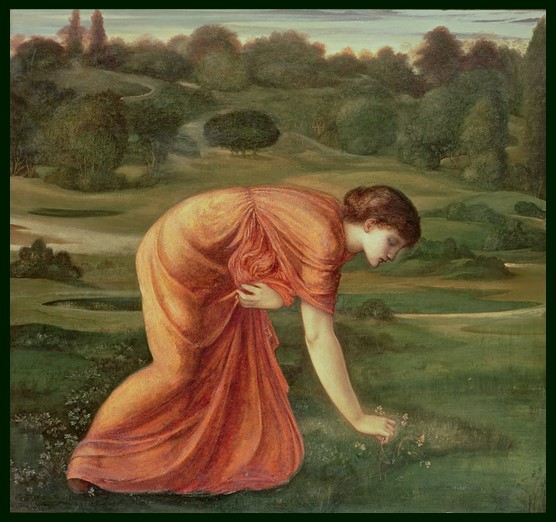
The March Marigold, circa the 1870s, Oil and Mixed Media on Canvas, 71.7×77.4 cm, Private Collection https://www.wikiart.org/en/edward-burne-jones/the-march-marigold

The March Marigold by Sir Edward Coley Burne-Jones celebrates the vibrantly tinted and warmly hued, Μarigold, the flower that carries rich symbolic meaning across various cultures. Often associated with the sun, these flowers symbolize positivity, joy, and the life-giving energy of sunlight. In many traditions, marigolds are also linked to themes of celebration, prosperity, and good fortune, making them popular choices for festivals, weddings, and other auspicious occasions. Additionally, marigolds are known for their resilience and ability to thrive in diverse conditions, serving as a symbol of endurance and tenacity. Whether used in religious ceremonies, cultural celebrations, or simply as decorative elements, marigolds convey a profound message of optimism, resilience, and the enduring beauty that can emerge from even challenging circumstances.

So… What Do Marigolds Symbolize Internationally?

The scientific name of the Marigold flower is Calendula officinalis, and it comes from Latin. The Romans noticed the plant’s consistent flowering on the Calends, the first days of each month in the Roman Calendar and associated it with the regular intervals of their calendar, hence the name Calendula. The specific epithet officinalis, Latin as well, indicates that the plant was officially used as a medicinal or culinary herb, emphasizing its recognized and established role in traditional practices.

In ancient Greece and Rome, the bright and vibrant marigold flowers were seen as a reflection of the sun’s rays, and they were sometimes considered symbols of light and positivity, often linked to the God Apollo, and Goddesses Aphrodite or Hera. They were also valued for their medicinal properties. Calendula flowers, used for their healing attributes, were employed in salves and ointments to treat wounds, inflammation, and various skin conditions. Additionally, Calendula petals were incorporated into culinary practices, lending color to salads and dishes. The plant’s association with health and well-being is reflected in its use in rituals and ceremonies, demonstrating its cultural and practical importance in ancient Greek and Roman society.

Sir Edward Coley Burne-Jones, Stooping Woman
Sir Edward Coley Burne-Jones, British Artist, 1833–1898
Stooping Woman, circa the 1870s, Chalk on paper, 152 × 165 mm, TATE, London, UK https://www.tate.org.uk/art/artworks/burne-jones-stooping-woman-a00069

In Europe, during the Middle Ages, the golden color of the Marigolds, reminiscent of the radiance associated with Mary’s purity and divine nature in the Christian tradition, was linked to the Virgin Mary and her pure heart. Over time, this visual connection, coupled with the flowers’ frequent use in religious ceremonies and art, solidified the link between marigolds and the Virgin Mary in Christian symbolism. While marigolds are not explicitly mentioned in the Bible, their use in religious and cultural practices reflects a rich tapestry of symbolic meanings within the Christian context.

In Mexico, Marigolds, or Cempasúchil in Spanish, hold deep cultural significance, particularly during the Dia de los Muertos (Day of the Dead) celebration. Marigolds are thought to guide the spirits of the deceased back to the world of the living with their vibrant orange and yellow colors. Families often create intricate floral arrangements and altars adorned with marigolds, candles, and mementos to honor and remember loved ones who have passed away. The flower’s strong aroma is believed to attract the spirits, and its use in Day of the Dead rituals reflects a blend of indigenous traditions with Catholicism, symbolizing the interconnectedness of life and death in Mexican culture. Marigold’s role in these traditions goes beyond aesthetics, embodying a powerful symbol of remembrance, spirituality, and the enduring connection between the living and the deceased.

In India, Marigolds hold multifaceted cultural and religious significance. These vibrant flowers, known as Genda Phool in Hindi, are commonly used in religious ceremonies, festivals, and decorations. Marigold garlands are often offered in temples to various deities, symbolizing purity and auspiciousness. The golden hue of Marigolds is associated with the sun, representing positive energy and prosperity. Additionally, during festivals like Diwali and Durga Puja, Marigolds are extensively used for decoration, adorning homes, and public spaces as a symbol of joy and celebration. The flower’s resilience and vibrant color contribute to its popularity in Indian culture, where marigolds serve as more than mere ornamental elements, embodying spiritual, cultural, and festive significance.

For a Student Activity inspired by the Marigold Flower, please… Check HERE!

Sir Lawrence Alma-Tadema, O.M., R.A., R.W.S., A Solicitation

Sir Lawrence Alma-Tadema and Romantic Love

Sir Lawrence Alma-Tadema, O.M., R.A., R.W.S., A Solicitation
Sir Lawrence Alma-Tadema, O.M., R.A., R.W.S., British Artist, 1836-1912
A Solicitation, 1878, pencil and watercolour on paper, 22.9 x 45.1 cm, Private Collection https://www.mutualart.com/Artwork/A-Solicitation/8FB915CF2DFA260B4CC9A753186F8298

On Saint Valentine’s Day, I think of Sir Lawrence Alma-Tadema and Romantic Love. I think of his many paintings portraying the emotional nuances of romantic interactions, the courtship scenes with a heightened sense of intimacy, the use of rich colors and the exquisite settings often applied to evoke a romantic ambiance.  I reflect upon his gentle gestures, unambiguous glances, and subtle expressions that capture the essence of romantic relationships in a bygone era. Alma-Tadema’s paintings, whether set in ancient Rome, Greece, or other historical periods, convey a sense of timeless beauty and the universal aspects of love and courtship. The artist’s ability to infuse his works with a sense of elegance and emotion allowed viewers to connect with the theme of courtship on a deeply human level, transcending the specific historical context of each painting. Sir Lawrence Alma-Tadema was a master in representing Romantic Love!

On the 13th of December 2022, a small watercolour painting by Alma-Tadema, titled A Solicitation, was auctioned at Christie’s, with great success. The composition is entirely typical of his work, with a young woman sitting upright on a marble bench, listening to the entreaties of the young man who reclines beside her. Is she swayed by his ‘words? I do not know… I see her holding on to her lap the flowers ‘he’ probably gave her contemplating his ‘proposition’. https://www.christies.com/lot/lot-6408828?ldp_breadcrumb=back&intObjectID=6408828&from=salessummary&lid=1

The painting A Solicitation has all the characteristics of the Sir Lawrence Alma-Tadema artistic style. Renowned for his expertise in portraying various facets of sun-soaked, glowing marble, the artist, for example, presents a large, almost luminescent bench to the viewer, by skillfully utilizing watercolour transparency to evoke the hues of the marble. Equally interesting is how the depicted young couple, dressed in off-white clothes, stands out, due to Alma-Tadema’s adept handling of different textures. Finally, it is essential to mention the Mediterranean oleander tree in the right part of the middle ground, which the artist used to harmonize the rectangular shape of the composition, and the blue hues of the sea and distant coast in the background that seamlessly merge with the bright sky, creating a splendid morning scene. https://www.christies.com/lot/lot-6408828?ldp_breadcrumb=back&intObjectID=6408828&from=salessummary&lid=1

Alma-Tadema’s patrons were captivated by the romantically appealing compositions depicting courtship, prompting the artist to create multiple versions of this theme. The inaugural scene, titled “Pleading,” was crafted in 1876 and is currently housed in the Guildhall Art Gallery in London. Following this, in approximately 1877, Alma-Tadema produced another courtship scene titled “The Question,” now part of the Colección Pérez Simón in Mexico City. The third installment in this series is the watercolor painting from 1878, named “A Solicitation.” Subsequently, three additional paintings, dating back to 1883, are dispersed across prominent locations—the British Museum (Op. CCLVIII), a private collection, and the Walters Art Museum in the United States (Op. CCLIX). Throughout these various iterations of the courtship composition, Alma-Tadema maintained a consistent portrayal of the fundamental relationship between the two figures: a contemplative female and a beseeching, submissive male gazing up at her. The compositions also feature an expansive, almost panoramic view extending beyond the edge of the bench, revealing the vast sea and its miniature sailing boats. https://www.christies.com/lot/lot-6408828?ldp_breadcrumb=back&intObjectID=6408828&from=salessummary&lid=1

The photograph shows Alma-Tadema's studio at Townsend House
The photograph shows Alma-Tadema’s studio at Townsend House, after its reconstruction following the destruction caused by an explosion on a barge on the Regent’s Canal in 1874. Alma-Tadema decorated the small first-floor studio in a Pompeian style, with a dark red ceiling and red and yellow wall panels with garlands and medallions. Over the fireplace can be seen a bronze bust of his wife backed by a curtain of cloth of gold. On the easel appears to be a variation of the watercolour ‘A Declaration’ 1883 and just below it, on the floor, is a reproduction of ‘Anthony and Cleopatra’, 1883. The studio also housed Alma-Tadema’s extensive collection of photographs. https://www.royalacademy.org.uk/art-artists/work-of-art/sir-lawrence-alma-tadema-r-a

Sir Lawrence Alma-Tadema (1836–1912) was a renowned Dutch-born Victorian painter who achieved international acclaim for his vivid and meticulously detailed depictions of classical antiquity. Known for his mastery of historical accuracy and meticulous attention to architectural and ornamental details, Alma-Tadema’s paintings often showcased scenes from ancient Rome, Greece, and Egypt. His works, characterized by their sumptuous colors, intricate compositions, and a focus on the opulent lifestyles of the classical world, captivated audiences during the late 19th and early 20th centuries. Alma-Tadema’s artistic contributions left an enduring impact on the academic art scene, and his legacy continues to be celebrated for the way he brought ancient history to life through his extraordinary talent and dedication to historical accuracy.

For a PowerPoint Presentation of six paintings by Sir Lawrence Alma-Tadema, presenting Courtship Scenes, please… Check HERE!

George Derville Rowlandson, The Month of February: Coursing, the Waterloo Cup

February and the Waterloo Cup

George Derville Rowlandson, The Month of February: Coursing, the Waterloo Cup
George Derville Rowlandson, British, 1861-1918
The Month of February: Coursing, the Waterloo Cup, unknown date, pen & ink and w/c on paper, Private Collection https://www.meisterdrucke.uk/fine-art-prints/George-Derville-Rowlandson/179537/The-Month-of-February:-Coursing-%28pen-and-ink-and-wc-on-paper%29.html

I’ll tell of the Magna Charter / As were signed at the Barons’ command / On Runningmead Island in t’ middle of t’ Thames / By King John, as were known as “Lack Land.”    /    …”We’ll get him a Magna Charter,” / Said Fitz when his face he had freed; / Said the Barons “That’s right and if one’s not enough, / Get a couple and happen they’ll breed.”    /    So they set about making a Charter, / When at finish they’d got it drawn up, / It looked like a paper on cattle disease, Or the entries for t’ Waterloo Cup… humorously wrote Edgar Marriott, and I think of February and the Waterloo Cup by George Derville Rowlandson. https://allpoetry.com/Magna-Charta

George Derville Rowlandson (1861–1928) was a British artist known for his contributions to the field of illustration and watercolour painting. Rowlandson was born on the 11th of December 1861 in Secunderabad, Madras, India, the son of George Rowlandson an Indian Army colonel, and studied at the Gloucester Art School as well as the Westminster School of Art, London, and in Paris. He was part of the Rowlandson artistic family, his grandfather being the famous caricaturist and satirist Thomas Rowlandson (1757-1827).

His works often depicted charming rural scenes, equestrian portraits, sporting scenes and military subjects as he was one of the first official WWI artists of the UK. At first, that is between 1897 and 1900, Rowlandson worked as an illustrator for The Illustrated London News, and then, from 1899 to 1900, he worked for the English Illustrated Magazine. As a freelance artist, he exhibited oil paintings and watercolours at the British Institution and the Royal Institute of Painters in Watercolours. https://en.wikipedia.org/wiki/George_Derville_Rowlandson

On the 1st of February, I present you with a lovely watercolour by George Derville Rowlandson, titled February, The Waterloo Cup. It is part of a set of twelve small watercolour paintings depicting a sporting event, one for each month of the year.  

George Derville Rowlandson, Every Month, a different Sporting Event
Every Month, a different Sporting Event, unknown date, pen & ink and w/c on paper, 11.4 x 14.9 cm, Private Collection https://www.christies.com/en/lot/lot-4210691

Christie’s experts have identified the Months along with their corresponding sporting events as: January, the skating championships; February, the Waterloo cup; March, point to point; April, cross country; May, Rotten Row; June, Hurlingham; July, not out; August, common objects by the sea; September, his first fish – a fifty pounder at least; October, a rocketer; November, forward away; December, well passed sir all signed with initials ‘G.D.R.’ (seven lower right); and five (lower left) and inscribed ‘January, the skating championships’ (lower centre); ‘February, the Waterloo cup’ (lower centre); ‘March, point to point’ (lower centre); ‘April, cross country’ (lower centre); ‘May, Rotten Row’ (lower centre); ‘June, Hurlingham’ (lower centre); ‘July, not out’ (lower centre); ‘August, common objects by the sea’ (lower centre); ‘September, his first fish -a fifty pounder at least’ (on the reverse); ‘October a rocketer’ (lower centre); ‘November, forward away’ (lower centre); ‘December, well passed Sir’ (lower centre) respectively. https://www.christies.com/en/lot/lot-4210691

Artistically, the scene depicting February and the Waterloo Cup stands out as my favourite, distinct from it being a favoured sporting event. Full of energy and excitement, the scene presents a renowned coursing event organized by the National Coursing Club (NCC). Established in 1836, the competition held a prestigious status in the world of greyhound coursing. The event took place annually at Altcar near Liverpool in England and was named after the Waterloo Hotel, which hosted the inaugural meeting.

Coursing involves setting greyhounds after a hare, and the Waterloo Cup was a prominent fixture attracting participants and spectators alike. The competition’s history spans decades, contributing to the rich tapestry of traditional British sporting events. Not only did it showcase the speed and agility of greyhounds, but it also became a social and cultural phenomenon. The Waterloo Cup held its last meeting in 2005, marking the end of an era in coursing history due to changes in legislation related to animal welfare. Despite its closure, the Waterloo Cup remains a significant historical chapter in the world of coursing and sportsmanship.

For a PowerPoint presentation, please… Check HERE!