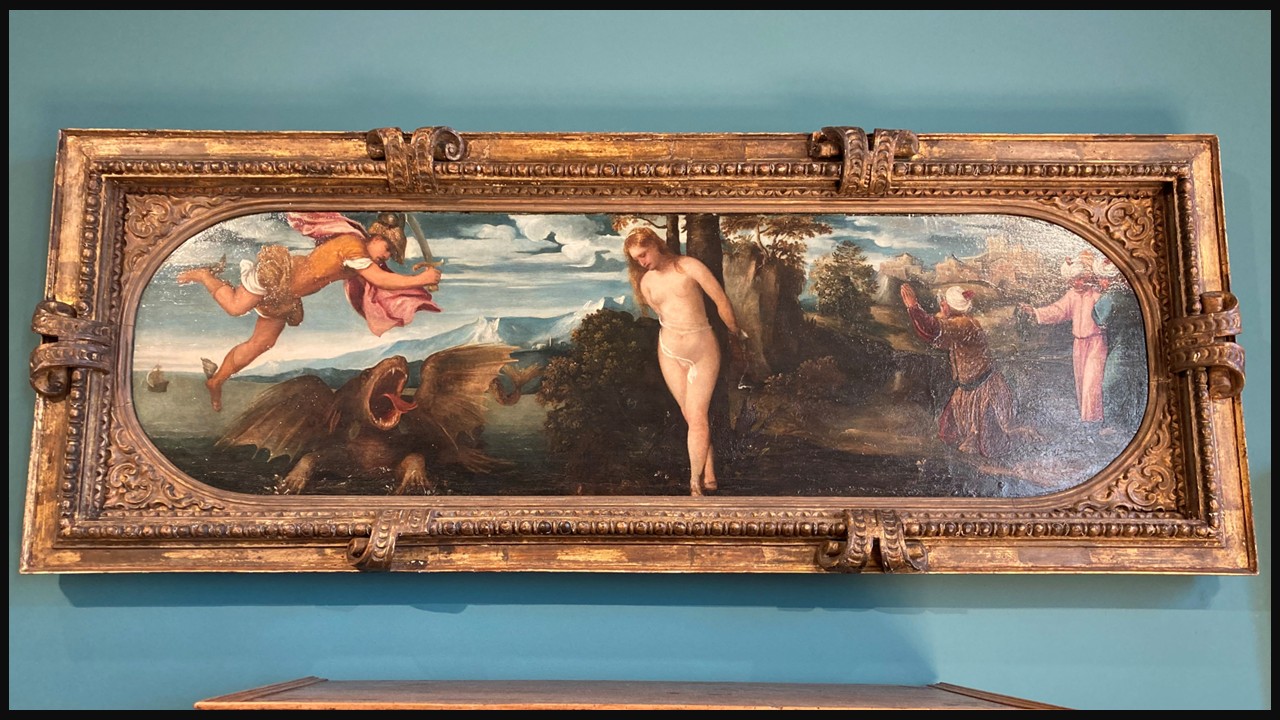
Perseus freeing Andromeda, 1543, Oil on Panel, Palazzo Maffei, Verona, Italy – Photo Credit: Amalia Spiliakou, September, 2025
In the refined interior of Palazzo Maffei, Bonifazio de’ Pitati’s Perseus Freeing Andromeda captures one of the most dramatic moments in classical mythology. A young woman is bound, a sea monster approaches, and a hero descends from the sky. Yet this painting is more than a mythological scene, it may once have decorated a Renaissance wedding chest, a precious Cassone, transforming an ancient story into a visual lesson about marriage.
The Myth of Perseus and Andromeda
The myth of Andromeda begins with pride and punishment, but its resolution depends on the extraordinary journey of Perseus. Andromeda is the daughter of Cepheus and Cassiopeia, whose vanity provokes the anger of Poseidon. Condemned to be sacrificed to a sea monster, Andromeda is chained and left to await her fate. At this crucial moment, Perseus appears, not merely as a passing hero, but already celebrated for his daring exploits. The son of Zeus, he had just defeated the Gorgon Medusa, using divine gifts: a mirrored shield, a curved sword, and winged sandals that allowed him to fly. Carrying Medusa’s head, whose gaze could still turn enemies to stone, Perseus descends from the sky, confronts the monster, and defeats it, either by force or by petrifying it. He then frees Andromeda and, with her parents’ consent, takes her as his bride. Their union transforms a moment of terror into one of salvation, linking heroism with marriage and reinforcing the idea of divine protection and destined love.
This powerful narrative was shaped for centuries by Ovid in his Metamorphoses, a cornerstone of classical literature. Ovid describes Andromeda with striking sensitivity: The maiden stood fastened to the rock, / her arms spread wide like marble shaped by art— / save that her gentle tears betrayed her life. In these lines, beauty and vulnerability coexist. Renaissance painters like Bonifazio translated this poetic tension into visual form, capturing both the stillness of fear and the anticipation of rescue.
Understanding the function of this Perseus freeing Andromeda painting adds another layer of meaning. In Renaissance Italy, richly decorated chests known as cassoni were essential to wedding traditions. These objects, given at marriage, held the bride’s possessions and symbolized her transition into a new life. Mythological scenes were often chosen for their moral and symbolic value. Andromeda’s story, in particular, offered a powerful message: the ideal bride is virtuous and patient, while the husband is courageous and protective. The rescue becomes a metaphor for marriage itself.
Bonifazio de’ Pitati’s interpretation of the Myth
Bonifazio’s composition enhances this interpretation through carefully observed details. Andromeda is tied to a tree rather than a rock, integrating her into the natural landscape. Behind her, a distant city and small groups of figures, some gesturing, others in prayer, create a sense of a wider world witnessing the event. These elements bridge myth and reality, making the story feel immediate and relevant to Renaissance viewers.
As an artist, Bonifazio de’ Pitati occupies an important place within the Venetian Renaissance. Often associated with the workshop tradition that followed Titian, he developed a distinctive style marked by luminous colour, narrative clarity, and an ability to translate complex literary themes into accessible visual stories. His works were especially suited to domestic settings, where beauty and meaning needed to coexist. In this painting, his balanced composition and sensitivity to atmosphere demonstrate not only technical skill but also an awareness of his audience: viewers who would engage with myth not as distant history, but as a reflection of their own lives, values, and aspirations.
Ultimately, this Perseus freeing Andromeda painting reveals how art, literature, and daily life were deeply intertwined. What appears to be a dramatic mythological rescue is also a reflection of social ideals and personal aspirations. Displayed on a wedding chest, the image would have accompanied a couple at the very beginning of their shared life, offering a timeless message: that love, like myth, is a journey from danger to harmony.
For a Student Activity inspired by Bonifazio de’ Pitati’s painting of Perseus freeing Andromeda, please… Check HERE!
By Teacher Curator: another Blog Post on a Renaissance Cassone was titled ‘Lo Scheggia’s Reclining Youth’ https://www.teachercurator.com/15th-century-italian-renaissance-art/lo-scheggias-reclining-youth/
Sources and further Reading: The myth of Perseus freeing Andromeda as described in Ovid’s Metamorphoses is available at: https://www.poetryintranslation.com/PITBR/Latin/Metamorph4.php#anchor_Toc64106270 and information on Bonifazio de’ Pitati, the Italian artist of the Renaissance,is available at: https://artsandculture.google.com/entity/bonifazio-veronese/m07pw80?hl=en and information on to Palazzo Maffei available at: https://palazzomaffeiverona.com/en/