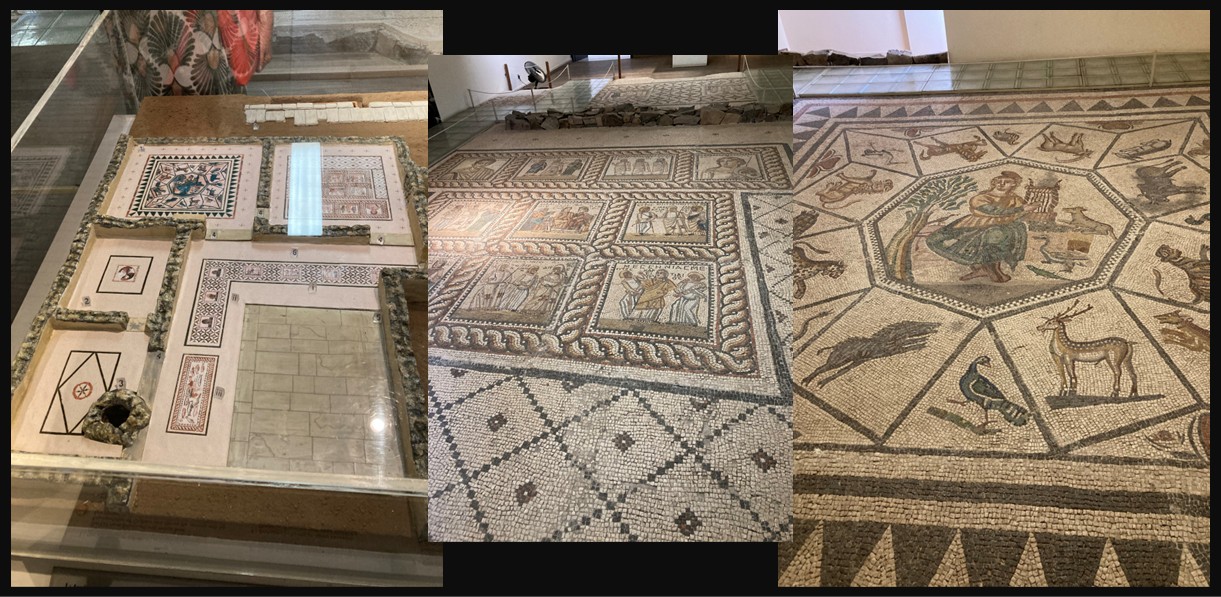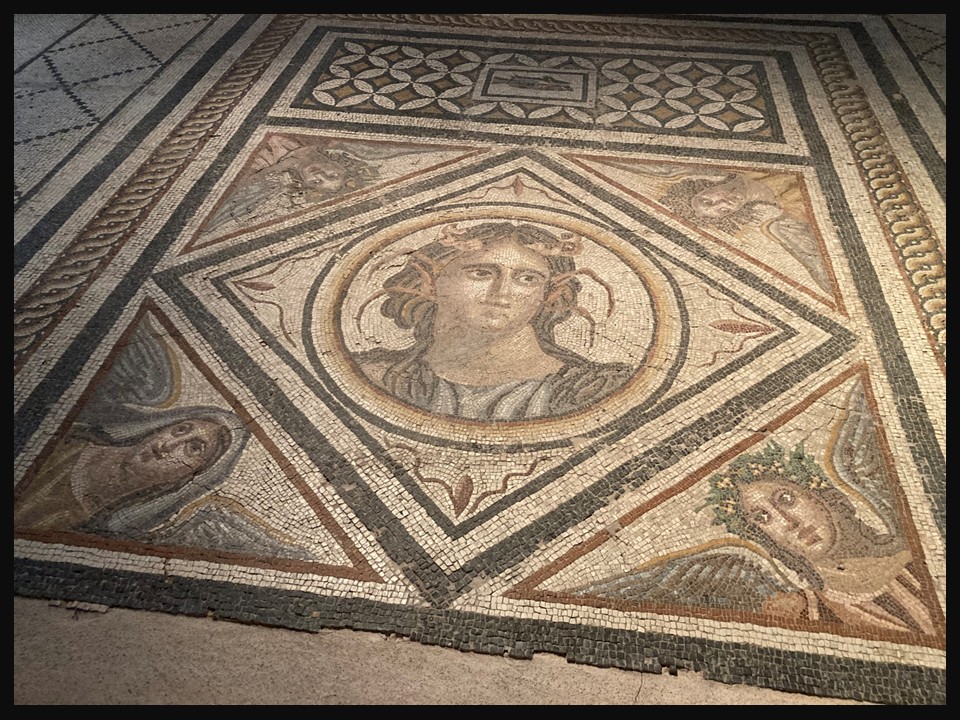
Floor mosaic from the House of Euripos (2nd–3rd century AD), showing a central youthful sea spirit surrounded by personifications of the Four Seasons, Archaeological Museum of Mytilene, Greece.

Roman Mosaic from the House of Euripos

Floor mosaic from the House of Euripos (2nd–3rd century AD), showing a central youthful sea spirit surrounded by personifications of the Four Seasons, Archaeological Museum of Mytilene, Greece.
House of Euripos, Floor Mosaic of the Four Seasons, 2nd-3rd century AD, Archaeological Museum of Mytilene, Greece – Photo Credit: Amalia Spiliakou, 2025

The first day of spring, March 20, 2026, arrives as it always has — quietly, persistently, with light lingering a little longer and the earth stirring back to life. Across cultures and centuries, this moment has marked renewal, balance, and the return of growth. Fittingly, an ancient work of art from the island of Lesvos captures this same eternal rhythm: the remarkable Roman mosaic from the House of Euripos, now displayed in the Archaeological Museum of Mytilene, Greece.

Created in the 2nd–3rd century AD, this mosaic once decorated the atrium of a grand Roman house on the hill of Agia Kyriaki. Like other elite homes of its time, the structure was likely organized around a sun-lit courtyard with rooms opening onto it,  spaces for welcoming guests, sharing meals, and everyday family life, all designed to make the most of light and air. Interestingly, the natural slope of the land made space for an underground stone cistern with an arched roof, neatly built into the structure. But it’s the Roman mosaic floor that truly steals the show, turning the setting from simply elegant into something memorable, with imagery that reflects the powerful forces shaping both nature and everyday human life.

The Mosaic of the Four Seasons

At its center appears a striking figure: a young, beardless sea spirit, framed within a medallion set inside a diamond shape. His identity is closely tied to the waters that sustained ancient Mytilene. Scholars interpret him as Euripos, representing either a key waterway near the city or the Pyrrhaean Euripos, today’s Gulf of Kalloni, famed since antiquity for its rich fisheries. His marine nature is unmistakable: dolphins and lobster claws woven into his hair signal his dominion over the sea. He is not merely decorative; he embodies abundance, movement, and the life-giving power of water, a reminder that prosperity in island communities has always depended on the rhythms of the natural world.
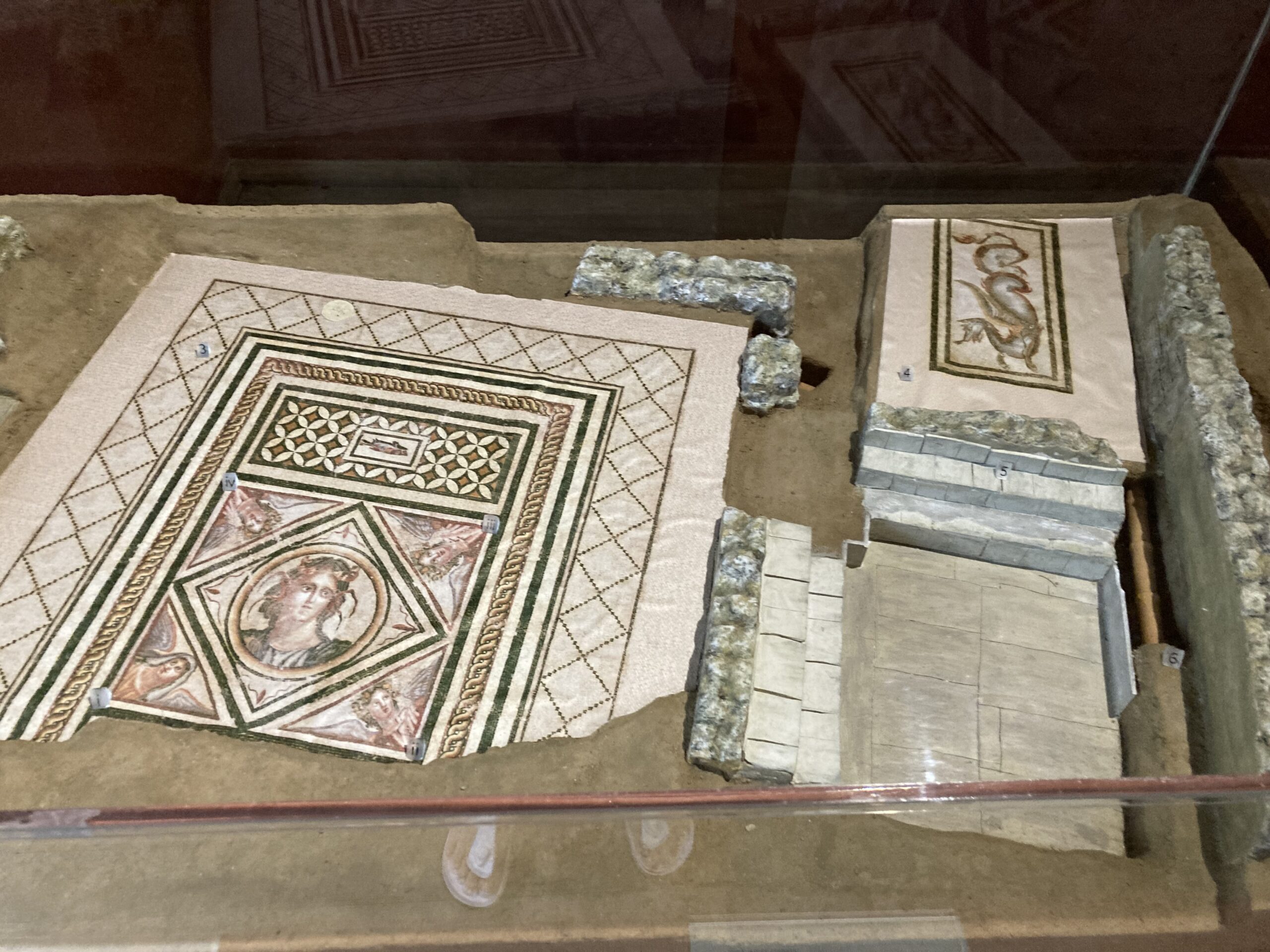
House of Euripos representation of the triclinium floor mosaic of the four Seasons with a sea divinity in the center and the 'Dragon' passageway floor mosaic.
House of Euripos (museum representation of the triclinium floor mosaic and the ‘Dragon’ passageway mosaic), 2nd-3rd century AD, Archaeological Museum of Mytilene, Greece – Photo Credit: Amalia Spiliakou, 2025

Surrounding this central sea being, at the four corners of the diamond, are the Four Seasons, shown as winged figures, both male and female, each with distinct attributes. Together they form a complete cycle of the year, a cosmic calendar in stone. Spring, the season we celebrate today, is depicted with flowers and fresh green leaves, symbols of rebirth and vitality. Her presence radiates softness and promise, much like the first blossoms that now dot fields and gardens. Summer holds sheaves of grain, a sign of harvest to come and the sun’s nurturing strength. Autumn bears fruits, representing maturity, fulfillment, and the rewards of the earth. Winter, in contrast, appears with a somber expression and wrapped in heavy drapery, embodying cold, stillness, and the dormancy from which life will soon re-emerge.
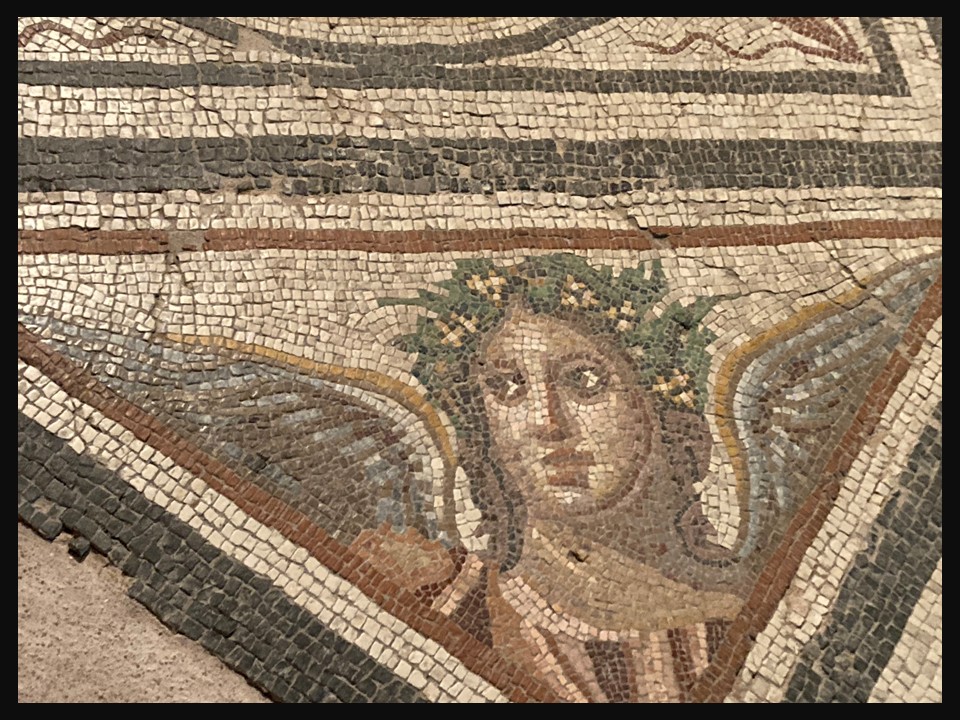
Mosaic detail from the House of Euripos depicting Spring.
House of Euripos (detail of ‘Spring’), 2nd-3rd century AD, Floor Mosaic, Archaeological Museum of Mytilene, Greece – Photo Credit: Amalia Spiliakou, 2025

Together, these figures do more than decorate a floor, they express an ancient understanding of time as a cycle rather than a straight line. The people who walked across this mosaic nearly two thousand years ago lived in close awareness of seasonal change. Agriculture, fishing, travel, and daily routines all depended on nature’s shifting moods. By placing the Seasons around a sea divinity, the mosaic’s artist wove land, water, and time into a unified vision of existence. Even the guardian dragon once positioned at the entrance of the house fits within this worldview. Fierce and protective, it symbolically stood watch over the household, guarding the harmony between the human domain and the powerful natural and supernatural forces represented inside.
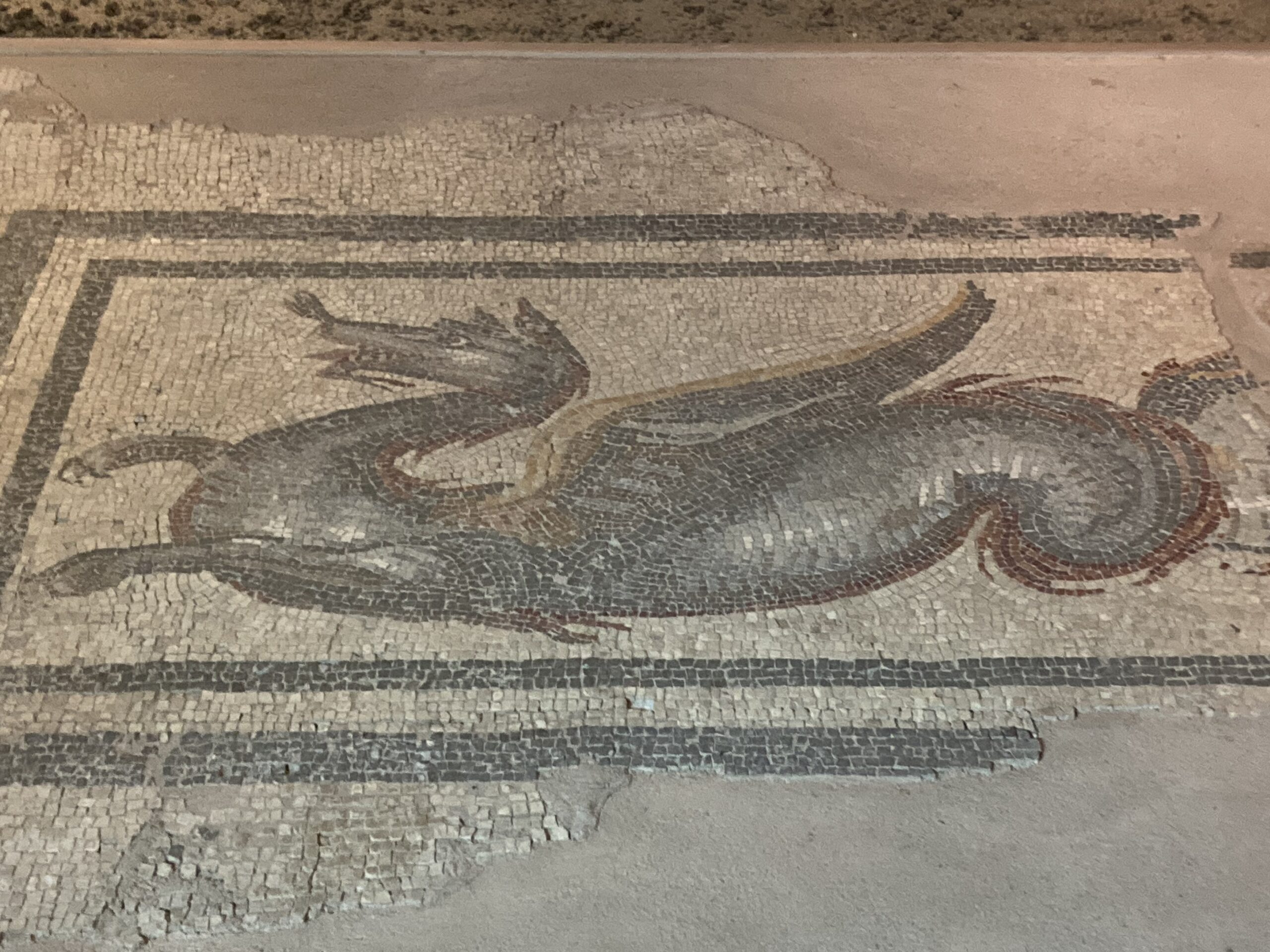
Detail of the passageway 'Dragon' floor mosaic from the House of Euripos in Mytilene, 2nd-3rd century AD.
House of Euripos (detail of the passageway ‘Dragon’ floor mosaic), 2nd-3rd century AD, Floor Mosaic, Archaeological Museum of Mytilene, Greece – Photo Credit: Amalia Spiliakou, 2025

Artistically, the mosaic from the House of Euripus is a masterpiece of subtlety. The creator employed delicate shades of gray, pink, green, and yellow, achieving depth and liveliness with remarkable sensitivity. Though made in the Roman period, the style reflects the enduring influence of the rich Hellenistic artistic tradition, a blend of technical skill and emotional nuance that gives the figures both grace and presence. On this first day of spring, the mosaic feels especially resonant. Spring’s figure in the composition does not stand alone; she exists as part of a greater cycle that includes growth, abundance, decline, and rest. The message is timeless: renewal is meaningful because it follows dormancy. Light returns because darkness had its turn.

As we step into longer days and warmer air, the Roman Mosaic from the House of Euripos reminds us that the changing seasons have always shaped human imagination. Nearly two millennia ago, an artist in Mytilene, Greece captured the same sense of wonder we feel today when the first flowers open. Stone and tesserae preserve that moment for us, a quiet but enduring celebration of nature’s rhythms and the promise carried in every new spring.

For a PowerPoint presentation of the Roman Mosaic from the House of Euripos mosaic in Mytilene, please, check… HERE!

The House of Euripos is not an isolated example. Roman Mytilene was home to a number of richly decorated villas, including the House of Menander, whose extraordinary mosaics, featuring theatrical scenes, philosophers, and mythological imagery, offer a fascinating parallel to the artistic and cultural world reflected here. Together, these residences reveal the prosperity and refined tastes of the island during the Roman period. Read more about the House of Menander

Bibliography: from the Lesvos News https://www.lesvosnews.net/articles/news-categories/afieromata/ti-na-deite-sto-arhaiologiko-moyseio-mytilinis-grafei-o and the site of the new Archaeological Museum of Mytilene https://archaeologicalmuseums.gr/en/museum/5df34af3deca5e2d79e8c122/new-archaeological-museum-of-mytilini
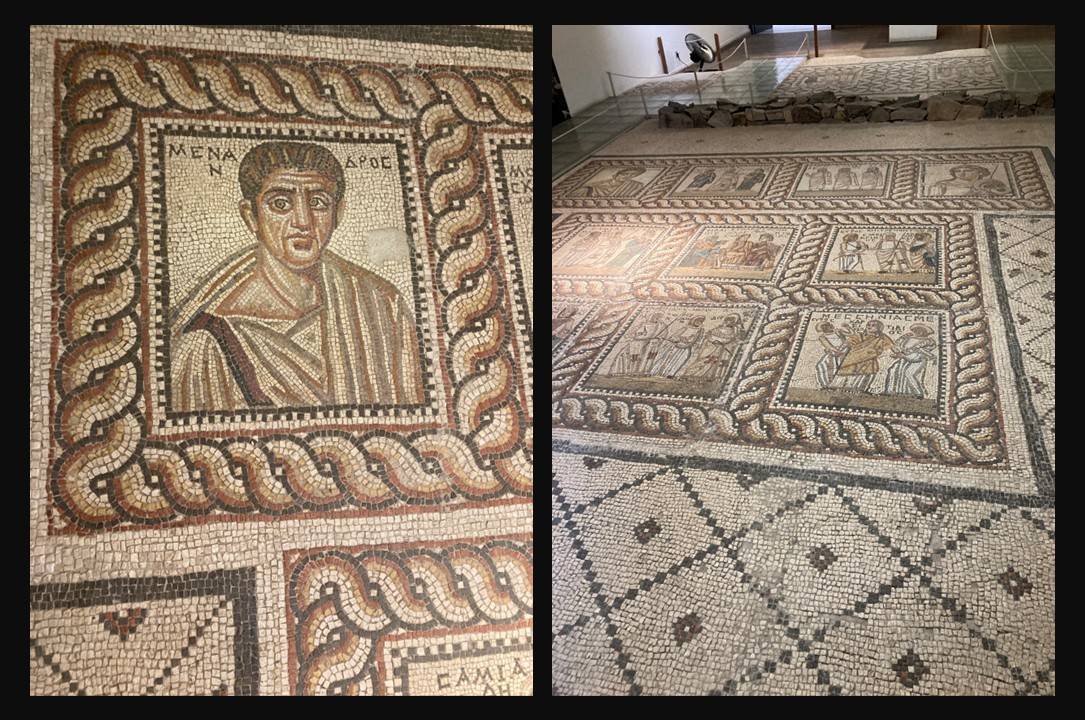
Floor mosaics in the House of Menander in Mytilene, featuring the Portrait of Menander and figural scenes from his Comedies, preserved within the remains of a Roman-period domestic interior.

The House of Menander

Floor mosaics in the House of Menander in Mytilene, featuring the Portrait of Menander and figural scenes from his Comedies, preserved within the remains of a Roman-period domestic interior.
The House of Menander, built after the 2nd century AD, on earlier remains of the Hellenistic period, Mytilene, Greece – Photo Credit for the mosaic of Menander: Amalia Spiliakou, Summer 2025

In ancient times, the landscape west of the Euripos river, opposite the island-city of Mytilene, underwent a remarkable transformation. What began in the Archaic period as an extensive cemetery gradually evolved into a thriving residential district as the city expanded beyond its original fortified island in the early Hellenistic era. By the Roman period, this southeastern area near the hill of Agia Kyriaki had become a prestigious neighbourhood, home to affluent residents whose villas reflected the economic prosperity and cultural vitality of the island of Lesvos. Among these residences, the so-called House of Menander stands out as one of the most impressive discoveries.

Although parts of its mosaic floors had surfaced as early as 1930, the House of Menander was properly excavated in stages between 1961–63, 1973–75, and again between 2010–15 through the ‘Unification of the Archaeological Sites of Mytilene’ project. The excavations revealed continuous use of the site from the Late Classical/Hellenistic period into the Early Byzantine era, including a long-lived east–west road equipped with a stone culvert, clay pipes, and later a monumental colonnade. The villa itself, built after the 2nd century AD atop earlier Hellenistic remains, went through at least two major building phases before it was ultimately destroyed by fire in the late 3rd century.

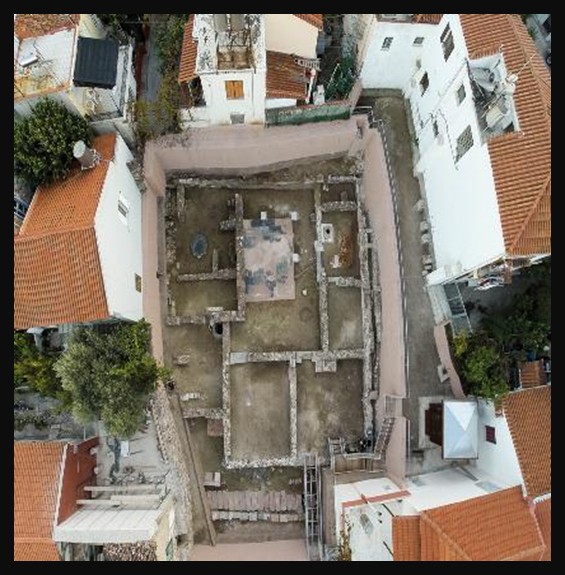
Architecturally, the House of Menander represents the late Roman peristyle house at its finest. At its center lay a marble-paved courtyard framed by three columns on each side and surrounded by covered stoae that led to the wings of the house. Much of the north and west wings survive today, including representative rooms used for meetings, dining, and entertainment, while other parts were lost to later Early Byzantine construction and the 20th-century refugee housing built after the Asia Minor Catastrophe. Even in its fragmentary state, the villa conveys a sense of refinement, wealth, and a strong commitment to artistic expression.

Aerial view of the House of Menander archaeological site in Mytilene, Lesbos, showing the rectangular remains of a late Roman-period peristyle house with visible outlines of walls and courtyard foundations set into the urban fabric.
The House of Menander, Areal View of the archaeological site, built after the 2nd century AD, on earlier remains of the Hellenistic period, Mytilene, Greecehttp://odysseus.culture.gr/h/2/gh2560.jsp?obj_id=19976

The Mosaics in the House of Menander

This artistic identity is best revealed in the villa’s extraordinary mosaics. The northern stoa features intersecting geometric patterns framing metopes inspired by the comedies of Menander, the great Athenian playwright of the New Comedy, whose name has been symbolically attached to the house. The western stoa continues the theme with more geometric motifs, theatrical masks, and a charming fishing scene. Inside the north wing, the hall (oecus) contains a magnificent Orpheus mosaic: the legendary poet-musician sits playing his lyre, enchanting animals and even the nearby tree whose branches bend towards him. The neighbouring triclinium presents an even richer narrative tapestry, with ten mosaic panels depicting Menander’s portraits, scenes from his comedies, Socrates with his disciples, and the muse Thalia. Inscriptions identify the plays, scenes, and actors, underscoring the cultural literacy and theatrical tastes of the villa’s occupants.

Roman floor mosaics from the House of Menander in Mytilene, composed of multicolored tesserae.
Mosaics from the House of Menander in the Archaeological Museum of Mytilene, after the 2nd century AD, Mytilene, Greece – Photo Credit: Amalia Spiliakou, Summer 2025

Beyond their beauty, these mosaics offer compelling insights into the household’s identity. The built altar and marble-lined offering table in the hall, as well as the burnt cesspit near the triclinium, point to domestic ritual practices. Combined with the overwhelming theatrical and philosophical themes of the mosaics, they suggest two possibilities: either the villa belonged to a wealthy citizen deeply engaged with drama, music, and intellectual life, or it served as the seat of a Dionysiac actors’ association, a guild dedicated to the god of theatre. In either case, the House of Menander stands as a celebration of performance, artistry, and cultural memory within a domestic setting.

After the villa’s discovery, its mosaics were painstakingly detached, conserved, and restored throughout the mid-20th century. Since 1998, they have been the star attraction of the New Archaeological Museum of Mytilene, where visitors can admire their detail up close. Meanwhile, the remains of the house itself, still embedded in the quiet neighborhood of Krinagoras Street, are accessible to the public, offering a rare opportunity to walk through a Roman residence where poetry, philosophy, and theatre once animated the floors beneath its inhabitants’ feet.

For a downloadable PowerPoint Presentation on the House of Menander and its mosaics, please… Click HERE!

Another remarkable example of mosaic decoration from Roman Mytilene can be seen in the House of Euripos, where the Four Seasons are arranged around a central marine divinity, reflecting a different but equally symbolic approach to domestic art… https://www.teachercurator.com/uncategorized/roman-mosaic-house-of-euripos-four-seasons-mytilene/

Bibliography: from the Archaeological Routes of Lesvos https://www.efales-ar.gr/en/ancient_site/the-house-of-menander-in-mytilene/ and the Greek Ministry of Culture http://odysseus.culture.gr/h/2/eh2560.jsp?obj_id=19976