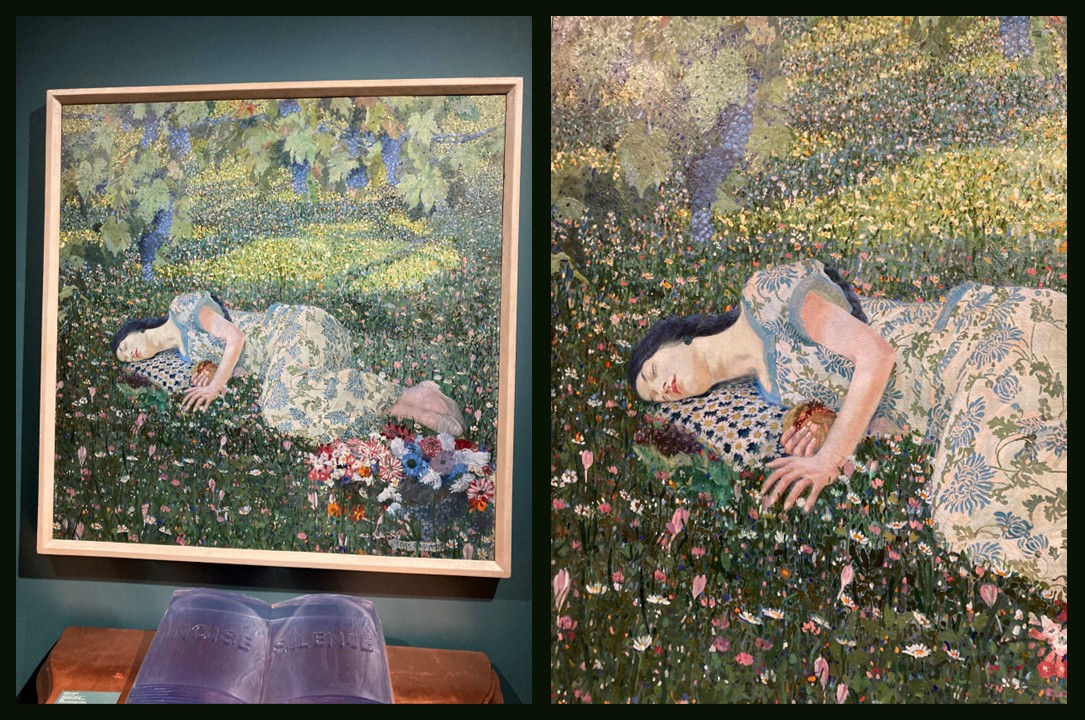
Felice Casorati’s 1913 oil painting The Dream of the Pomegranate depicting a young woman asleep on a floral meadow holding a pomegranate, symbolizing an oneiric, poetic scene in the Palazzo Maffei, Verona.

The Dream of the Pomegranate

Felice Casorati’s 1913 oil painting The Dream of the Pomegranate depicting a young woman asleep on a floral meadow holding a pomegranate, symbolizing an oneiric, poetic scene in the Palazzo Maffei, Verona.
Felice Casorati, Italian, 1883-1963
The Dream of the Pomegranate, 1913, Oil on Canvas, Palazzo Maffei, Verona Italy – Photo Credit: Amalia Spiliakou, September 2025

At first glance, The Dream of the Pomegranate feels hushed, almost suspended in time. A young woman sleeps in a meadow dense with wildflowers, her body gently folded into the grass beneath a canopy of heavy grape leaves. Nothing disturbs her rest; there is no breeze, no narrative action, only an enveloping stillness. Felice Casorati invites us into a private, interior space, one shaped not by events, but by dreams. Painted in 1913, on the eve of World War I, the work belongs to the artist’s early Symbolist phase, when mood, psychology, and poetic suggestion mattered more than realism or story.

Casorati renders the figure with deliberate calm. Her pose is natural yet carefully arranged, her patterned dress echoing the decorative rhythms of the surrounding flowers. The meadow is not a landscape to be entered but a surface to be contemplated: flattened, densely patterned, and quietly immersive. This emphasis on decoration and harmony reveals Casorati’s dialogue with European Secessionist painting, particularly Gustav Klimt, while retaining a distinctly Italian sensitivity to structure and balance. The dreamlike quality is heightened by the painting’s silence; even abundance here feels restrained, held in equilibrium.

The pomegranate, cradled near the sleeper’s hand, anchors the painting’s symbolic dimension. Traditionally associated with fertility, rebirth, and the cyclical nature of life, it also carries darker associations with sleep, death, and the unconscious. In this context, the fruit functions less as an attribute than as a threshold, marking the passage between waking life and inner vision. Casorati does not illustrate a specific myth or allegory, instead, he offers a state of being, where nature and body merge into a single, contemplative rhythm.

This work is especially significant within Casorati’s career because it represents a moment of transition. In the years following World War I, he would abandon the decorative richness and Symbolist reverie seen here, moving toward a more austere, classical style defined by geometric clarity, emotional restraint, and metaphysical quiet. Yet the core of his artistic identity is already present in The Dream of the Pomegranate: the fascination with stillness, the tension between intimacy and distance, and the conviction that silence can be profoundly expressive.

Viewed today, the painting feels uncannily contemporary. In a world saturated with speed and noise, Casorati’s sleeping figure offers an alternative mode of attention—slow, inward, and reflective. The Dream of the Pomegranate does not ask to be decoded so much as experienced. Like a dream remembered upon waking, it lingers softly, reminding us that rest, introspection, and quiet beauty are not escapes from reality, but essential ways of understanding it.

Finally, the setting in which The Dream of the Pomegranate is encountered today adds a further layer of meaning. The painting is housed at Palazzo Maffei – Casa Museo in Verona, an historic palace overlooking Piazza delle Erbe that brings modern and contemporary art into dialogue with architecture, antiquity, and lived space. Displayed within this intimate, carefully curated environment, Casorati’s work feels less like a museum object and more like a quiet presence, something discovered rather than announced. Palazzo Maffei’s emphasis on contemplation, domestic scale, and visual dialogue perfectly complements Casorati’s poetics of silence, allowing the painting’s dreamlike stillness to unfold slowly and personally for each viewer.

For a PowerPoint Presentation of Felice Casorati oeuvre, please… Check HERE!

Bibliography: from the Palazzo Maffei site https://palazzomaffeiverona.com/evento/felice-casorati-incontro/, from an Instagram post https://www.instagram.com/p/CpGKc78rniR/
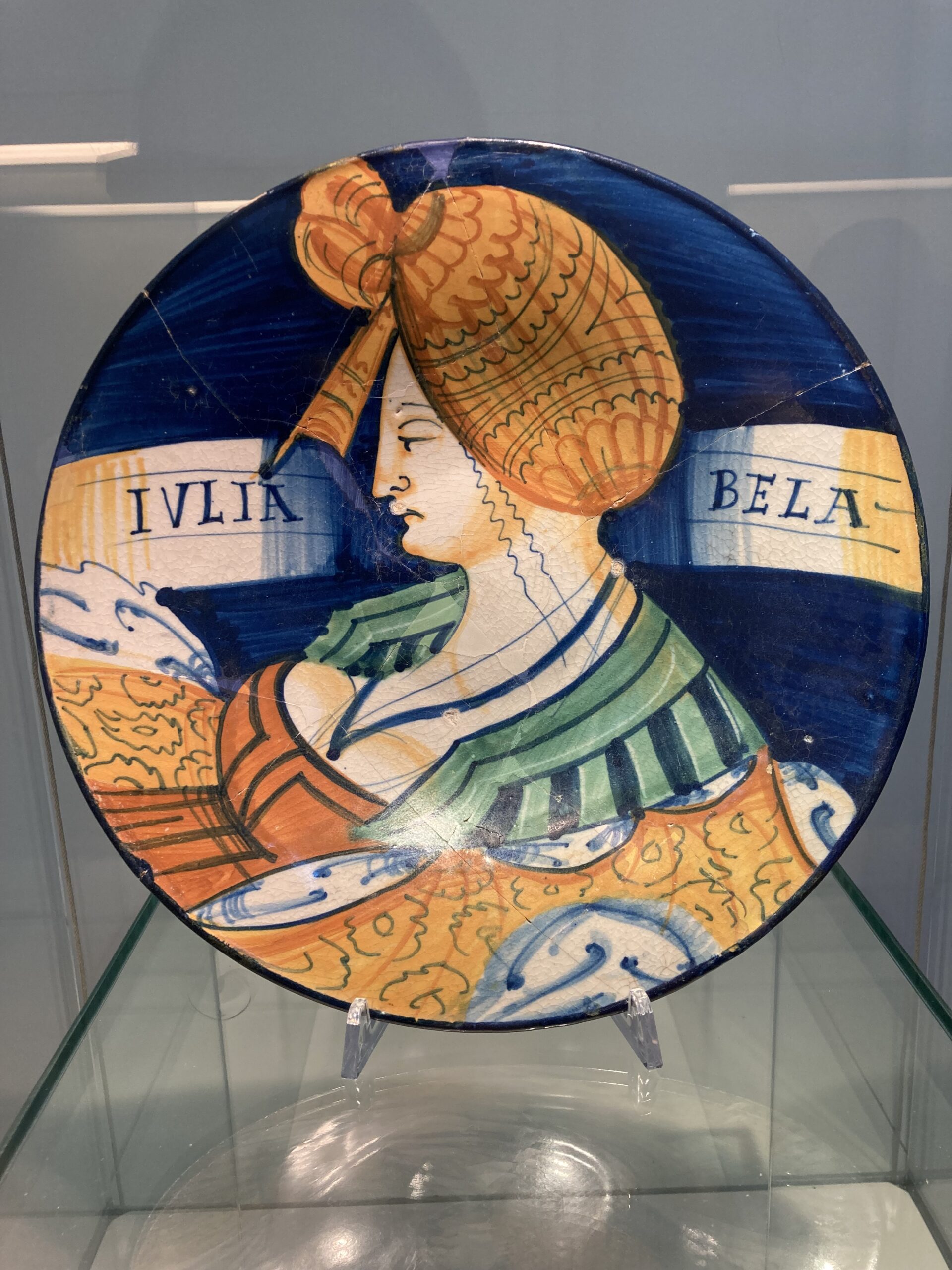
IVLIA BELLA

Iulia Bella plate, Faenza, end of 15th – beginning of 16th cent., Maiolica, Diameter: 28.2 cm, International Ceramics Museum in Faenza, Italy – Photo Credit: Amalia Spiliakou, April 2025

The IVLIA BELLA plate, housed at the Museo Internazionale delle Ceramiche in Faenza, stands as a luminous example of early Renaissance maiolica and the city’s mastery of ceramic portraiture. Crafted in the late 15th or early 16th century, the plate portrays the bust of a refined young woman in profile—her name, “Iulia Bella,” inscribed gracefully on a scroll behind her. This delicate work reflects a pivotal cultural shift in Faenza’s ceramic tradition, as artists moved away from Gothic and Oriental motifs toward the celebration of human beauty and individuality. With its elegant design and rich symbolism of love and virtue, the IVLIA BELLA plate captures both the artistry and humanism that defined the Italian Renaissance.

Let’s explore the ‘who’, ‘where’, when’, ‘why’ and ‘what’ of the amazing Majolica Plate of IVLIA BELLA in theInternational Museum of Ceramics in Faenzaby posing some questions!

Who was Iulia Bella? While her exact identity remains unknown, “Iulia Bella” likely represents a young bride or an idealized figure of feminine beauty. The name inscription personalizes the plate, suggesting it may have been commissioned to celebrate marriage, virtue, or social status, reflecting Renaissance ideals of elegance and moral refinement.

What artistic techniques make this plate stand out? The plate exemplifies Faenza maiolica through its tin-glazed surface, vibrant enamel colors, and finely painted portrait in profile. The careful rendering of her hairstyle, damask dress, and the inscribed scroll demonstrates a mastery of detail and the shift from decorative patterns to human-centered imagery.

When and in what cultural context was it created? Created in the late 15th or early 16th century, the plate emerges during the Italian Renaissance, when Faenza workshops transitioned from Gothic and Oriental motifs toward portraits and figurative art. This period emphasized humanism, individuality, and the celebration of beauty in daily life.

Where would the plate have been displayed? Such plates were likely display items rather than functional tableware, placed in domestic interiors or marriage chambers to be admired. Their role was both decorative and symbolic, showcasing refinement, wealth, and cultural sophistication.

Why were ceramics chosen for commemorative or amatory portraits? Ceramics offered a durable, portable, and visually striking medium for personal or commemorative imagery. A painted plate like IVLIA BELLA combined practical elegance with social signaling, allowing patrons to celebrate beauty, virtue, and status within the home in a tangible, everyday object.

Why is the International Museum of Ceramics in Faenza considered an important institution in the world of ceramic art and history? The International Museum of Ceramics in Faenza is considered one of the most important institutions in the world of ceramic art and history due to its vast and diverse collection, its historical significance, and its role in preserving and promoting ceramic heritage. Founded in 1908, the museum houses work from ancient civilizations to contemporary ceramic art, representing cultures from across the globe. It is especially renowned for its comprehensive display of Italian Majolica, with masterpieces from key production centers like Faenza, Deruta, and Urbino. The museum also serves as a vital center for research, education, and innovation in ceramics, hosting exhibitions, workshops, and scholarly initiatives. Its presence in Faenza, a city with centuries-old ceramic traditions, further cements its role as a guardian of both local craftsmanship and international ceramic excellence.

For a Student Activity inspired by the Faenza Plate of Iulia Bella, please… Click HERE!

Bibliography: https://www.micfaenza.org/en/opera/iulia-bella-plate/ and https://lauramorelli.com/ceramics-faenza/