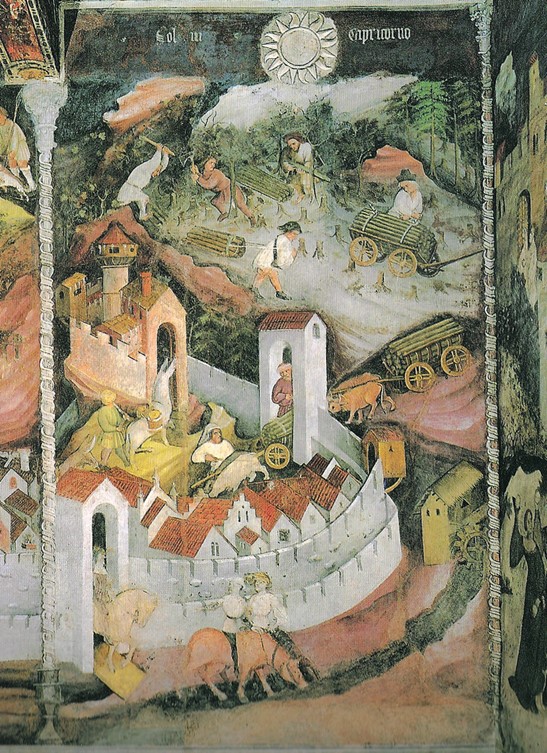
The Month of December, latest 1407, possibly by Maestro Venceslao, Fresco, Torre Aquila, Castello del Buonconsiglio in Trento, Italy

The Month of December

The Month of December, latest 1407, possibly by Maestro Venceslao, Fresco, Torre Aquila, Castello del Buonconsiglio in Trento, Italy

Last, for December, houses on the plain,  /  Ground-floors to live in, logs heaped mountain-high,  /  And carpets stretched, and newest games to try,  /  And torches lit, and gifts from man to man  /  (Your host, a drunkard and a Catalan);  /  And whole dead pigs, and cunning cooks to ply  /  Each throat with tit-bits that shall satisfy;  /  And wine-butts of Saint Galganus’ brave span.  /  And be your coats well-lined and tightly bound,  /  And wrap yourselves in cloaks of strength and weight,  /  With gallant hoods to put your faces through.  /  And make your game of abject vagabond  /  Abandoned miserable reprobate  /  Misers; don’t let them have a chance with you. My new BLOG POST: The Month of December starts with a sonnet by Folgore Da San Geminiano (c. 1250-1317), translated by Dante Gabriel Rossetti in his book “Dante and His Circle,” (Roberts Brothers, Boston, 1893).     http://www.sonnets.org/folgore.htm

Torre Aquila and Garden in Castello del Buonconsiglio, in Trento, Italy

The Month of December is a fresco, and it comes from the Torre Aquila in the Castello del Buonconsiglio, in Trento, Italy. It is part of an amazing fresco Cycle of the Twelve Months painted on the walls of the tower’s 2nd-floor main room. Today, only eleven of the original 12 panels survive as a 16th-century wooden spiral staircase, connecting the tower floors, destroyed the painted panel of March. The famous painted Cycle of the Months is divided into twelve panels, one for each month. Each one of the twelve panels is separated by a slender column, distinctive yet subtle, so as not to disturb the natural continuity between months and the seasons.

Months of September, October, November and December - Torre Aquila North Wall
Months of September, October, November and December – Torre Aquila North Wall

This exceptional room, 6 x 5,8 x 3 m in size, was commissioned by Prince-Bishop George of Liechtenstein, as a quiet, atmospheric retreat, away from the rest of the Castello’s busy and noisy state quarters. It has been suggested and widely accepted that the painter of this extraordinary fresco Cycle of the Months was Maestro Venceslao, a Czech painter, popular in the Tyrol area of the time.     https://www.cultura.trentino.it/eng/Cultural-venues/All-cultural-venues/Documentation-centres2/Torre-Aquila-Eagle-Tower  

Fresco panels in Torre Aquila are rare and special. They document life in the Trentino area, with references to the aristocratic pastimes throughout the year, or the peasant activities and duties to their masters. They also depict a vivid landscape, romanticized…bare and covered with snow for the January panel, rich and fertile, autumnal, covered with fallen leaves, harsh and inhospitable for the scene depicting December.  

The Month of December, latest 1407, possibly by Maestro Venceslao, Fresco, Torre Aquila, Castello del Buonconsiglio in Trento, Italy

My attention turns to the upper right corner where on the frozen ground of a forest, the Trentino peasants are busy once more. Numb by the cold, wearing short white tunicles, one of them even bear-footed, with axes and hatchets in their hands, they are depicted wood harvesting. They chop forest trees down, pile wood logs up, carry heavy loads to the wagons, stack wagons up with neatly cut logs and finally carry precious firewood to the city, to heat the houses during the long winter days. What an accomplishment in such uninviting circumstances…

The Month of December, latest 1407, possibly by Maestro Venceslao, Fresco, Torre Aquila, Castello del Buonconsiglio in Trento, Italy

Trentino Torre Aquila frescoes love presenting anecdotal details. The depicted city, cold and bleak, is setting the tone … Icicles hang from the attics, neatly built in stone and wood, of the Buonconsiglio Castle and the top of its circular tower. The city boasts double defensive walls and plenty of gabled houses with red roof tiles that deftly form a neat residential area, with a decorated church on its left side. It is a stark and unembellished scene, yet… a caravan of mules, loaded with goods, heads towards the castle at the top of the city, while, on the lower part of the composition, two knights on horseback, escort a riding noble lady for a winter outing. Harry up… they seem to tell her, and water your horse before setting off! Let’s follow the stream and visit the Water Mill for an al fresco lunch. What a sight…

Maestro Venceslao painted a dream world for Prince-Bishop George of Liechtenstein… a world that collapsed in 1407 with a successful rebellion. The Prince was not particularly liked by the locals. He was a conservative, authoritative and harsh leader of anachronistic demands. The painted room of Torre Aquila was sealed up, almost forgotten… Walking back in time in a world of endlessly working peasants and privileged aristocrats was no more…          https://www.buonconsiglio.it/index.php/en/Buonconsiglio-Castle/collections/Introduction     and     https://books.google.gr/books?id=L3e0BgAAQBAJ&pg=PA11&lpg=PA11&dq=cycle+of+the+months+paintings&source=bl&ots=PDmmhZPn37&sig=ACfU3U0ZvpPwd-ZSa8dnhL4AUn2uBLt26g&hl=el&sa=X&ved=2ahUKEwjVxcGIzNzmAhWRGewKHQiuD5g4ChDoATAGegQIBxAB#v=onepage&q=cycle%20of%20the%20months%20paintings&f=false

For a student Activity, please … Check HERE!

The Month of November, latest 1407, possibly by Maestro Venceslao, Fresco, Torre Aquila, Castello del Buonconsiglio in Trento, Italy

The Month of November

The Month of November, latest 1407, possibly by Maestro Venceslao, Fresco, Torre Aquila, Castello del Buonconsiglio in Trento, Italy

Yet one smile more, departing, distant sun! / One mellow smile through the soft vapoury air, / Ere, o’er the frozen earth, the loud winds ran, / Or snows are sifted o’er the meadows bare. / One smile on the brown hills and naked trees, / And the dark rocks whose summer wreaths are cast, / And the blue Gentian flower, that, in the breeze, / Nods lonely, of her beauteous race the last. / Yet a few sunny days, in which the bee / Shall murmur by the hedge that skim the way, / The cricket chirp upon the russet lea, / And man delight to linger in thy ray. / Yet one rich smile, and we will try to bear / The piercing winter frost, and winds, and darkened air. Wrote for The Month of November the American poet William Cullen Bryant… Hundreds of years earlier, another artist, Maestro Venceslao, decorated the walls of Torre Aquila in Trento, Italy, with paintings depicting the twelve months of the year. The Month of November is a striking example of his perception.     https://www.youtube.com/watch?v=UJOCrB7zH4g

Panoramic View of Trento in Italy

There is no way for the visitor of the beautiful Italian town of Trento to miss Castello del Buonconsiglio, this imposing, impressive and unique example of secular architecture! It is equally impossible for the Trento visitor not to explore the Castello, where, since the 13th century, the prince bishops of Trento resided and embellished with two Palazzos, an Italianate Park, a Gothic-Venetian Loggia and massive Towers.

Castello del Buonconsiglio

In 1973 the Castello became an Italian regional Museum of Art, known as Castello del Buonconsiglio Museum. This is where the Trento visitor can admire numerous art collections, ranging from paintings and manuscripts to period furniture and local archaeological finds. La piece-de-resistance among the Museum’s treasures is the so-called “Ciclo dei Mesi” in Torre Aquila.     https://www.trentino.com/en/highlights/castles/castello-del-buonconsiglio/

“Ciclo dei Mesi” is a favourite theme in the arts of the Middle Ages and the Early Renaissance. Often linked to the signs of the Zodiac, the Cycle of the Months is often perceived as a link between the work of man, the seasons of the year and God’s ordering of the Universe. As a theme, it is recurred in sculptural decorations of cathedrals and churches across Europe, in illuminated manuscripts like the popular Books of Hours, palace frescoes and, rarely, panel paintings.

The fresco panels of September, October, November and December at Torre Aquila

Trento’s November fresco panel at Torre Aquila is characteristic of Maestro Venceslao’s, the artist who painted the “Ciclo dei Mesi”, creative abilities. It is rich, colourful and informative. It tells us of how hard the Trentino farmers worked and how idle and pleasure-seeking its aristocrats were.

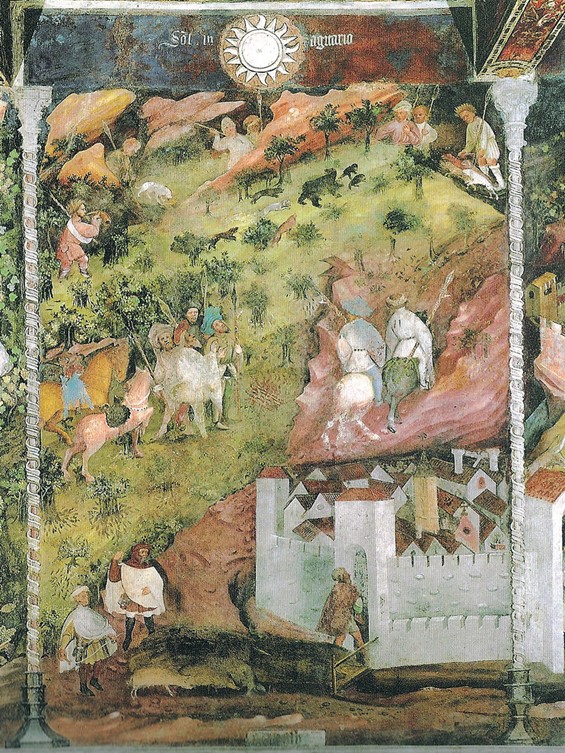
For Maestro Venceslao, November is a month dedicated to the leisures of the nobles and their favourite activity… hunting! The upper and middle parts of the November composition show groups of aristocrats accompanied by their servants chasing a bear with her young. The scene is colourful, full of energy and thunderous! The sound of the Hunting Horn, barking dogs, a crowd of tree-beater servants and galloping hunters move effortlessly among rocky mountains, fields and trees clad in autumnal colours.

The Month of November, latest 1407, possibly by Maestro Venceslao, Fresco, Torre Aquila, Castello del Buonconsiglio in Trento, Italy
The fresco panels (detail) of November and December at Torre Aquila

The fields however are deserted and the peasants, with winter approaching, have little outdoors activities to perform. They have suspended their jobs but remain vigilant guards of the countryside and support the aristocrats in any way possible. The activity is now concentrated at the gates of the cities, where, in view of the approaching bad season, peasants provide food supplies and the products of the countryside.

The lower part of the composition depicts the city of Trento… fairytale like, white walled, well-built, comfortable and warm with lots of chimneys and graced with the pointed bell tower of a church. Trento is a major city and the composition, interrupted by the slender column that divides the fresco scenes of November and December, continues with activities of peasants and professionals that are attention-grabbing to say the least…

For a Student Activity, please… Check HERE!

The Month of October, latest 1407, possibly by Maestro Venceslao, Torre Aquila, Castello del Buonconsiglio in Trento, Italy

The Month of October

The Month of October, latest 1407, possibly by Maestro Venceslao, Torre Aquila, Castello del Buonconsiglio in Trento, Italy
The Month of October, latest 1407, possibly by Maestro Venceslao, Fresco, Torre Aquila, Castello del Buonconsiglio in Trento, Italy

I’m not sure everyone has understood, October,  /  your great beauty:  /  in those fat vats, as large as a full stomach,  /  you brew must and inebriation, you brew must and inebriation.  /  On my mountains, like mournful birds,  /  mad clouds flee,  /  on my copper-tinged mountains  /  low clouds raise like smoke, low clouds raise like smoke.          –         Oh days, oh months that run away endlessly, /  my life is always similar to you,  /  different every year, yet the same every year,  /  a hand of tarot cards one never learns to play,  /  one never learns to play… writes for The Month of October Francesco Guccini in his Canzone dei dodici mesi.   https://lyricstranslate.com/el/canzone-dei-dodici-mesi-song-twelve-months.html

The Month of October fresco comes from Torre Aquila in the Castello del Buonconsiglio in Trento, Italy. It is part of an amazing fresco Cycle of the Twelve Months painted on the walls of the tower’s 2nd-floor main room and presents autumn at its best. This exceptional room, 6 x 5,8 x 3 m in size, was commissioned by Prince-Bishop George of Liechtenstein, as a quiet, atmospheric retreat, away from the rest of the Castello’s busy and noisy state quarters. Master Wenceslas, a Bohemian painter active in Trento since 1397, creates a rich October scene, full of natural beauty and pastoral activities. There is no doubt that Prince-Bishop George of Liechtenstein, looking at the October scene, was tasting his top-quality Trentino wine as well!

Torre Aquila, Castello del Buonconsiglio in Trento, Italy
Torre Aquila in Castello del Buonconsiglio in Trento, Italy and the Month of October fresco to the right of the picture…

October is a busy month for farmers in Trento and Master Wenceslas is documenting it in the best possible way. The scene is rich, dense and joyful… inspired by real-life but immensely beautified. The commissioner of this fresco, Prince-Bishop George of Liechtenstein wants to present the idea that his territories flourish under his good governance and prudent guidance. The painter, Master Wenceslas, understood this very well, and created an autumn scene of dazzling green colours, verve and dynamism!

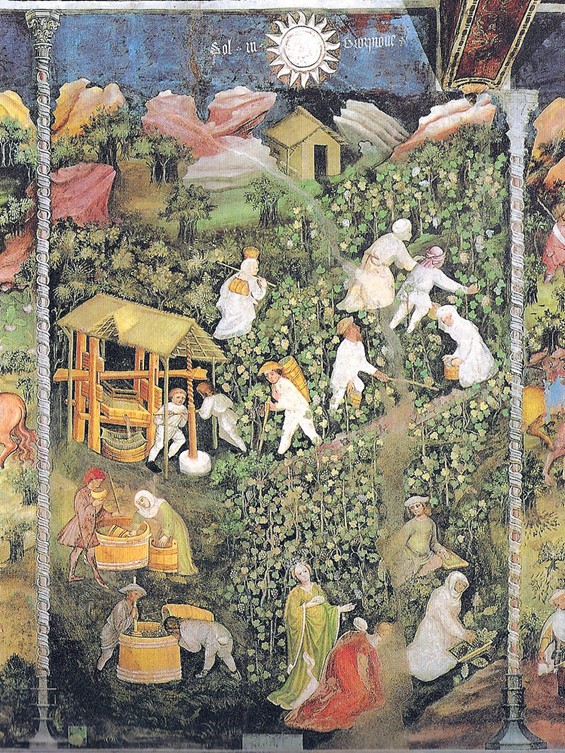
The Month of October Torre Aquila scene is dedicated to wine making, from the very beginning of the process, picking up the grapes, to pressing, grape must preparation and tasting…

The Month of October, latest 1407, possibly by Maestro Venceslao, Torre Aquila, Castello del Buonconsiglio in Trento, Italy

The sun is bright and shining over the Trentino valleys, and well-tended rows of vines cover the painted scene, touching the colourful mountains at the very top. Trentino was at the time a famous wine-producing territory, and Master Wenceslas presents extensive vineyards, their branches heavy with grapes, ready to be harvested. Everyone must work hard… everywhere you look, there is a zeal for activity.

The first thing you notice are the Trentino peasants, men and women, all dressed in white robes assigned to different harvesting tasks. Some of them pick up clusters of white or red grapes while others carry them on their shoulders in large baskets. On the left side of the composition, a screw-press is in action. What a luxury! Only gentlemen of great wealth could afford such an item, let alone a screw-press large enough to require at least two people to operate it. Master Wenceslas was apparently quite familiar with pastoral activities like that because he renders the process with fine precision! We can only assume that as a European travelling artist, Master Wenceslas had acquired first-hand experiences and visions of such joyful harvest events… where… aristocrats and farmers can, for once, forget the worries of everyday life, and “work” together enjoying the small pleasures of life. 

For a Student Activity, please… Check HERE!

The Month of October, latest 1407, possibly by Maestro Venceslao, Torre Aquila, Castello del Buonconsiglio in Trento, Italy
The Month of September, latest 1407, possibly by Maestro Venceslao, Torre Aquila, Castello del Buonconsiglio in Trento, Italy

The Month of September

The Month of September, latest 1407, possibly by Maestro Venceslao, Torre Aquila, Castello del Buonconsiglio in Trento, Italy
The Month of September, latest 1407, possibly by Maestro Venceslao, Fresco, Torre Aquila, Castello del Buonconsiglio in Trento, Italy

And in September, O what keen delight!  /  Falcons and astors astors, merlins, sparrow-hawks;  /  Decoy-birds that shall lure your game in flocks;  /  And hounds with bells: and gauntlets stout and tight;  /  Wide pouches; crossbows shooting out of sight;  /  Arblasts and javelins; balls and ball-cases;  /  All birds the best to fly at; moulting these,  /  Those reared by hand ; with finches mean and slight;  /  And for their chase, all birds the best to fly; /  And each to each of you be lavish still  /  In gifts; and robbery find no gainsaying;  /  And if you meet with travellers going by,  /  Their purses from your purse’s flow shall fill;  /  And Avarice be the only outcast thing. The Month of September is a Sonnet by Folgore Da San Geminiano (c. 1250-1317), is translated by Dante Gabriel Rossetti in his book “Dante and His Circle,” (Roberts Brothers, Boston, 1893).    http://www.sonnets.org/folgore.htm

There is no way for the visitor of the beautiful Italian town of Trento to miss Castello del Buonconsiglio, this imposing, impressive and unique example of secular architecture! It is equally impossible for the Trento visitor not to explore the Castello, where, since the 13th century, the prince bishops of Trento resided and embellished with two Palazzos, an Italianate Park, a Gothic-Venetian Loggia and massive Towers.

Castello del Buonconsiglio

In 1973 the Castello became an Italian regional Museum of Art, known as Castello del Buonconsiglio Museum. This is where the Trento visitor can admire numerous art collections, ranging from paintings and manuscripts to period furniture and local archaeological finds. La piece-de-resistance among the Museum’s treasures is the so-called “Ciclo dei Mesi” in Torre Aquila.     https://www.trentino.com/en/highlights/castles/castello-del-buonconsiglio/

“Ciclo dei Mesi” is a favourite theme in the arts of the Middle Ages and the Early Renaissance. Often linked to the signs of the Zodiac, the Cycle of the Months is often perceived as a link between the work of man, the seasons of the year and God’s ordering of the Universe. As a theme, it recurred in the sculptural decorations of cathedrals and churches across Europe, in illuminated manuscripts like the popular Book of Hours, palace frescoes and, rarely, panel paintings.

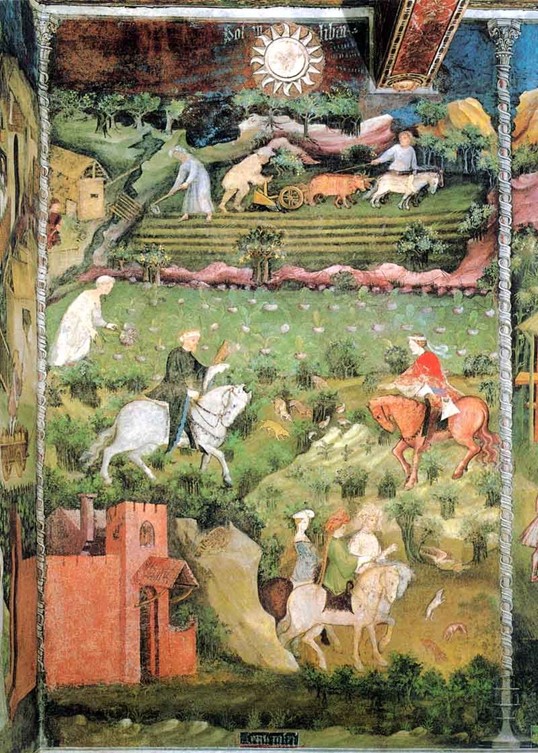
Trento’s September fresco panel in Torre Aquila is characteristic of Maestro Venceslao’s, the artist who painted the “Ciclo dei Mesi”, creative abilities. It is rich, colourful and informative. It tells us of how hard the Trentino farmers worked and how idle and pleasure-seeking its aristocrats were.

The Month of September, latest 1407, possibly by Maestro Venceslao, Torre Aquila, Castello del Buonconsiglio in Trento, Italy

The upper half of September’s composition depicts the typical agricultural activities of the month: the preparation of the land and the harvest of seasonal products.  At the very top, a shepherd watches over his sheltered flock, while three farmers across a bridged river plough a well-tended piece of land. The two men are dressed in short light tunics and lead the plough, pulled by a pair of oxen and a horse. The woman, on the other hand, dressed in a white robe but with bare feet works with the hoe along the perfectly traced lines of the furrows. The middle composition presents another peasant woman busy in collecting turnips. The white turnip was very popular at the time. Peasants cultivated turnips in vegetable gardens or in open fields in abundance as, along with cabbages, turnips were the indispensable food for the long winters of northern European territories.

The Month of September, latest 1407, possibly by Maestro Venceslao, Torre Aquila, Castello del Buonconsiglio in Trento, Italy

The Trentino aristocrats, however, in the lower half of the composition, are depicted still interested in their favourite entertainment: hunting with a hawk. The same red castle Maestro Venceslao painted in the August scene seems to be the residence of a group of three young aristocrats, galloping and ready to go hunting. A lady and two knights, surrounded by their dogs, are about to practice falconry with their well-trained hawks. They seem eager to join two more gentlemen, depicted higher up in the composition, who are already energetically hunting among the rocks and low bushes of the Trentino landscape. Who knows… they might of Folgore, the poet from San Gimignano, and his September poem on the pleasures of September hunting with birds of prey… 

A PowerPoint on Torre Aquila’s frescoes for the Months of August and September is… HERE!

The Month of August, latest 1407, possibly by Maestro Venceslao, Torre Aquila, Castello del Buonconsiglio in Trento, Italy

The Month of August

The Month of August, latest 1407, possibly by Maestro Venceslao, Torre Aquila, Castello del Buonconsiglio in Trento, Italy
The Month of August, latest 1407, possibly by Maestro Venceslao, Fresco, Torre Aquila, Castello del Buonconsiglio in Trento, Italy

“I am a reaper whose muscles set at sun-down. All my oats are cradled.  /  But I am too chilled, and too fatigued to bind them. And I hunger.  /  I crack a grain between my teeth. I do not taste it.  /  I have been in the fields all day. My throat is dry. I hunger  /  My eyes are caked with dust of oat-fields at harvest-time.  /  I am a blind man who stares across the hills, seeking stack’d fields of other harvesters. …” writes the African-American poet, Jean Toomer (1894—1967) and I think of The Month of August by Maestro Venceslao, in Torre Aquila, Castello del Buonconsiglio in Trento, Italy.     https://www.poetryfoundation.org/poems/53989/harvest-song

The Cycle of the Twelve Months is a favourite theme in the arts of the Middle Ages and the Early Renaissance. Often linked to the signs of the Zodiac, the Cycle of the Months is often perceived as a link between the work of man, the seasons of the year and God’s ordering of the Universe. As a theme, it recurred in the sculptural decorations of cathedrals and churches across Europe, in illuminated manuscripts like the popular Books of Hours, palace frescoes and, rarely, panel paintings.

The Month of August, latest 1407, possibly by Maestro Venceslao, Torre Aquila, Castello del Buonconsiglio in Trento, Italy

The fresco panels in Torre Aquila are rare and special. They document life in the Trentino area, with references to aristocratic pastimes throughout the year, or the peasant activities and duties to their masters. They also depict a vivid landscape, romanticized even then, from bare and covered with snow, to rich and fertile, to autumnal, covered with fallen leaves.

August is a special month for Trentino residents and Maestro Venceslao painted it to remind us. We can easily imagine Prince Giorgio di Liechtenstein relaxing in this special room, away from his noisy Court… and among his books and curios enjoy the perfect world that Maestro Venceslao created for him! What a treat!

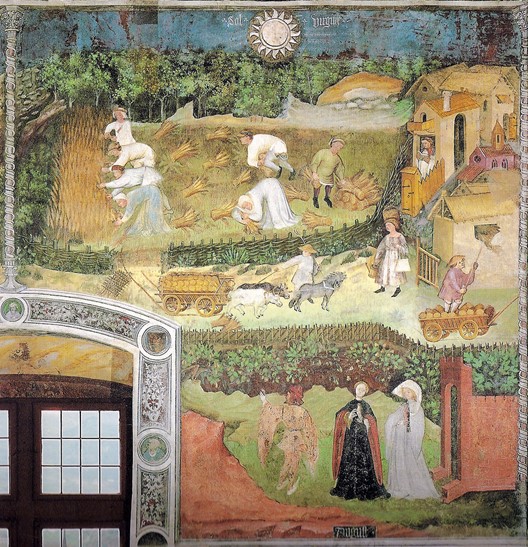
The Month of August fresco is horizontally divided into three zones, the lower of which is dedicated, once more, to falconry, the European sport par excellence, for the aristocracy. The fresco depicts two elegant ladies, one dressed in light blue, the other in blue-black and a gentleman holding a long stick, ready to start hunting! They just came out of the crenellated door of a castle and they walk towards a wooded area, their hawks in hand, trained for hunting. August is a summer month of leisure and moments of falconry show privilege, power and social status.

The Month of August, latest 1407, possibly by Maestro Venceslao, Torre Aquila, Castello del Buonconsiglio in Trento, Italy

Defining Falconry, we would say that it is the “hunting of wild animals in their natural state and habitat by means of a trained bird of prey.” Falconry most probably began in Mesopotamia, or in western Mongolia. In Europe, and towards the latter part of his life, King Frederick II, a man of extraordinary culture, energy, and ability, wrote a decisive treatise on falconry titled De arte venandi cum avibus (“The Art of Hunting with Birds”) for the sport that “was probably introduced around AD 400, when the Huns and Alans invaded Europe from the east.” Apparently Falconry was an aristocratic sport enjoyed equally by men and women.     https://en.wikipedia.org/wiki/Falconry

Maestro Venceslao dedicates the biggest part of the August composition to the hard-working peasants of Trento. In the upper zone, the farmers have a lot to work on. It is harvest time, the landscape is turned to golden yellow and both men and women work hard, bending under the blazing sun, to scythe the crops, collect the ears, tie them in sheaves and arrange them in stacks. And this is not enough! Farmers still have to load their wagons with heavy grain, as depicted in the middle zone, and to transport their day’s hard work on the dirt road, to the neighbouring village, where they will store it in the local barn. The village is undoubtedly picturesque, with ocher-coloured houses, thatched roofs, and a small church, brightly coloured pink. My favourite vignette, the depiction of the village priest, standing on the rectory’s threshold intent on reading, oblivious to the commodity around him.     https://www.buonconsiglio.it/index.php/Castello-del-Buonconsiglio/monumento/Percorso-di-visita/Torri/Torre-Aquila

A PowerPoint on Torre Aquila’s frescoes for the Months of August and September is… HERE!

The Month of August, latest 1407, possibly by Maestro Venceslao, Torre Aquila, Castello del Buonconsiglio in Trento, Italy
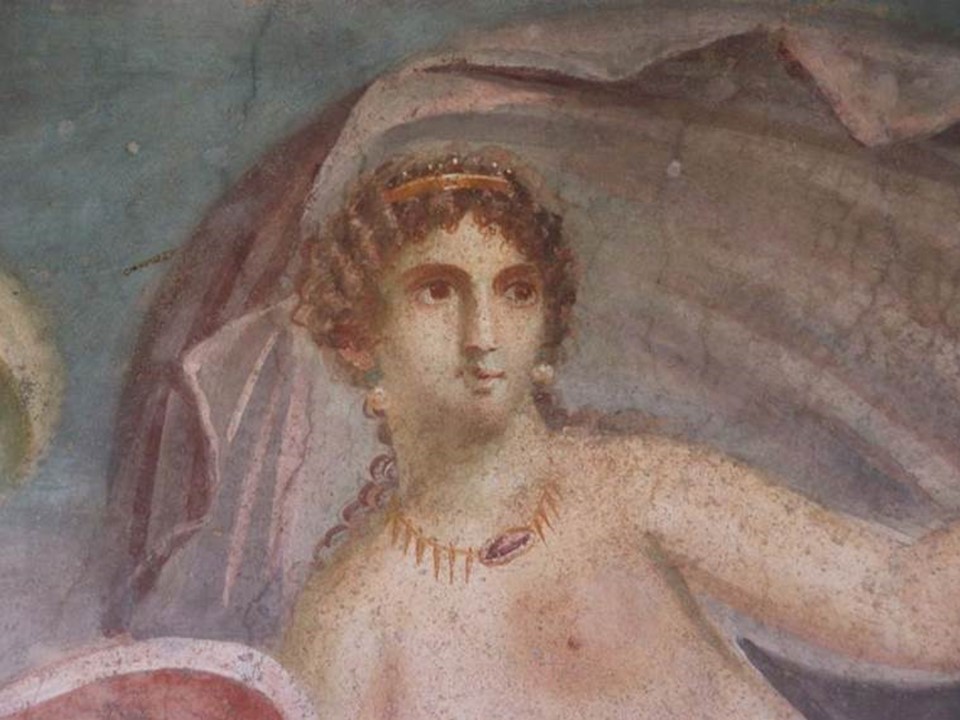
Fresco of Dionysos and Ariadne in the House of Capitelli Colorati, in Pompeii

Ariadne on Naxos

Fresco of Dionysos and Ariadne in the House of Capitelli Colorati, in Pompeii
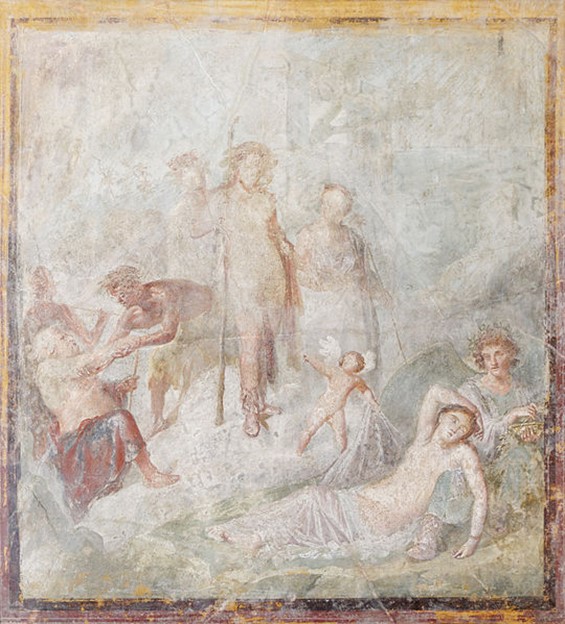
Dionysos and Ariadne, 1st century AD, Pompeii, from the House of Capitelli Colorati, now in the National Archaeological Museum of Naples

Ariadne on Naxos… what an inspiration… “Eros  /  The archipelago  /  And the prow of his seafoam  /  And the seagulls of his dreams  /  In his highest mast, the sailor flutters  /  A song” the Archipelago Song by Odysseas Elytis, 1979, Nobel Prize in Literature.     https://www.nobelprize.org/prizes/literature/1979/elytis/biographical/     and     https://www.greeklyrics.gr/stixoi/to-tragoudi-tou-arxipelagous/

The Islet of Palatia in Naxos
The Islet of Palatia in Naxos, where today, since the 6th century BC, stands “Portatra,” the entrance to the Temple of Apollo, Naxos’s most recognized monument.

Naxos is one of the most interesting destinations in Greece! In the center of the Aegean Sea, the biggest and greenest Cycladic island, with a glorious ancient Greek past and the strong influences of the Venetians and the Franks, Naxos is not simply beautiful… it breathes history …and Mythology I would like to add! Naxos was the playground of the Olympian gods, the place where virtuous or naughty, entangled with beautiful women and brave men, gods created a scenery of love and adventure, reality and imagination. The story I like most involves the god Dionysus, the Minoan princess Ariadne and the Islet of Palatia, where today, since the 6th century BC, stands “Portara,” the entrance to the Temple of Apollo, Naxos’s most recognized monument. https://www.greeka.com/cyclades/naxos/

Imagine the scene… Theseus and Ariadne flee Crete in a hurry. With the help of Ariadne, Theseus had just killed the horrible Minotaur in the depths of Knossos’s palace maze. Their first stop to rest on their way to Athens is the island of Naxos… where the story unfolds dramatically and excitingly. God Dionysus, in love with Ariadne, appears to Theseus in his sleep and convinces him to abandon Ariadne at Naxos and continue his trip alone. Ariadne, unaware of divine intervention, disembarks at Naxos, enchanted by the beauty of the island, happily explores it, and tired falls asleep on the beautiful islet of Palatia. When she wakes up… god Dionysus, the son of Zeus and Dione, looks at her adoringly and a new love-affair is in the making. A glorious wedding follows and an eternal gift is still with us to admire… the constellation known as Corona Borealis is said to be Dionysus’s wedding gift to Ariadne, a special ornament to adorn her beautiful head.

Fresco of Dionysos and Ariadne in the House of Capitelli Colorati, in Pompeii

In Pompeii, the House of the Coloured Capitals is one of the oldest excavated, back in 1822, again in 1832/33 and 1846. It is one of the largest houses in Pompeii as well, with more than 40 rooms on the ground floor alone, beautifully decorated with frescoes and floor mosaics, combining architecturally, Samnite and Roman features.  The name of the house comes from the brightly coloured capitals of the columns of the central peristyle.

You enter the House through a rectangular Atrium (area marked b) with a central Impluvium and proceed to a porticoed Peristyle (area marked f). One of the bigger rooms opening to the peristyle (area marked h), the oecus, is beautifully decorated with frescoes in the 4th Pompeiian Style on a yellow ground. Dilapidated today and neglected since it was initially excavated in 1822, the house’ oecus featured central panels on each wall with a mythological scene. The single panel, faded yet still holding its original charm, character portrays Dionysus and the sleeping Ariadne on the island of Naxos. Dionysus, holding a thyrsus, standing tall in the center of the composition, gazes in wonderment at Ariadne, still sleeping at the knees of god Hypnos. A naughty cupid reveals Ariadne’s covered beauty to Dionysus while an old Silenus, in need of support, and an entourage of satyrs and maenads seem to follow the young god of revelry. https://sites.google.com/site/ad79eruption/pompeii/regio-vii/reg-vii-ins-4/house-of-the-coloured-capitals

The fresco depicting Dionysus discovering the sleeping Ariadne was luckily removed and can now be seen in the National Archaeological Museum in Naples. The scenes left in situ, however, have all but faded away…

For a student RWAP (RWAP stands for Research-Writing-Art-Project), please… check HERE!

Oecus is the Latinized form of Greek Oikos (House), used by Vitruvius for the principal hall or salon in a Roman house, which was used occasionally as a triclinium for banquets.     https://en.wikipedia.org/wiki/Oecus

Fresco of Dionysos and Ariadne in the House of Capitelli Colorati, in Pompeii, Student Activity
The Month of July fresco, possibly by Maestro Venceslao, Torre Aquila, Castello del Buonconsiglio in Trento, Italy

The Month of July

The Month of July fresco, possibly by Maestro Venceslao, Torre Aquila, Castello del Buonconsiglio in Trento, Italy
The Month of July, latest 1407, possibly by Maestro Venceslao, Fresco, Torre Aquila, Castello del Buonconsiglio in Trento, Italy

The Month of July fresco comes from Torre Aquila in the Castello del Buonconsiglio, in Trento, Italy. It is part of an amazing fresco Cycle of the Twelve Months painted on the walls of the tower’s 2nd-floor main room and presents summer at its best. This exceptional room, 6 x 5,8 x 3 m in size, was commissioned by Prince-Bishop George of Liechtenstein, as a quiet, atmospheric retreat, away from the rest of the Castello’s busy and noisy state quarters. Master Wenceslas, a Bohemian painter active in Trento since 1397, creates a rich July scene, full of natural beauty and pastoral activities.

Valle dei Laghi, Italy
Valle dei Laghi is one of the sixteen districts of Trentino in the Italian region of Trentino-Alto Adige/Südtirol. https://www.discovertrento.it/valle-dei-laghi/territorio#.XvucvSgzZPY

July is a busy month for labourers at Trento and Master Wenceslas is documenting it in the best possible way. The farmers catch up with their activities and the Court aristocrats enjoy summer bliss. The scene is rich, dense and joyful… inspired by real-life but immensely beautified. The commissioner of this fresco, Prince-Bishop George of Liechtenstein wants to present the idea that his territories flourish under his good governance and prudent guidance. The painter, Master Wenceslas, understood this very well, and created a summer scene of dazzling colours, greens and yellows dominating the open expanse of the countryside!

Castello Toblino in the province of Trento, Italy
Castello Toblino is located in the valley of the lakes between Padergnone and Sarche in the municipal area of Madruzzo, in the province of Trento. https://www.trentino.com/en/highlights/castles/castel-toblino/

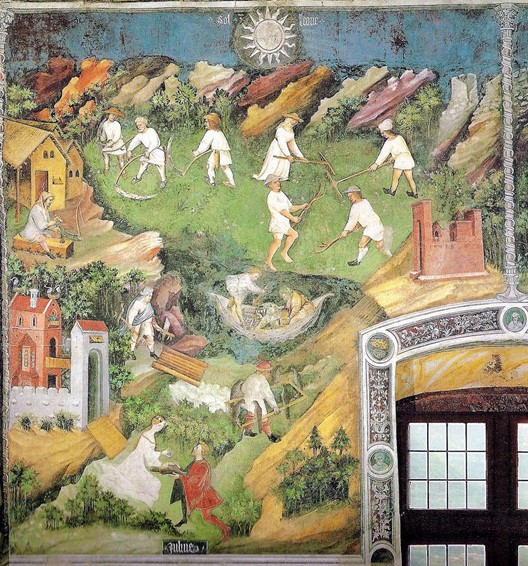
Multi-coloured mountains, lush shrubbery, a lake, a Castello by its shore and a red country Villa are just a few of the landscape props Master Wenceslas uses to identify the area as the beautiful Trentino Valle dei Laghi. Castello in particular, defensive walls, crenellations, drawing bridges, large glass windows, balconies full of flowers and stork nests on the rooftop make up for a beautiful vignette on a lakeshore.

The Month of July fresco, possibly by Maestro Venceslao, Torre Aquila, Castello del Buonconsiglio in Trento, Italy

Right in the middle of the composition the depiction of the lake, the boat and three fishermen set the tone. The lower part is a vivid illustration of the activities of the nobles and their servants as summer settles in. It is falconing season, and Master Wenceslas beautifully presents it. Hunting with a hawk was the favorite activity of the Trento nobility, an expensive one to keep up with, as specialized servants, destined exclusively for the care and breeding of precious birds, were required and handsomely payed for. In the July fresco, one such falconer, carrying two hunting hawks returns from hunting. A little further down an elegant gentleman, dressed in a red and black doublet, with a gesture of polite refinement, seems to offer the hunting catch, two beautiful birds, gallantly to a lady dressed in white. A truly generous gift for a beautiful Lady!

The Month of July fresco, possibly by Maestro Venceslao, Torre Aquila, Castello del Buonconsiglio in Trento, Italy

Horizons are kept high in Master Wenceslas’s July fresco to make room for the depiction of busy Trento farmers and their agricultural activities. Surrounded by a crown of colourful mountains, purple, white or ochre, up in the highest Trento meadows, the typical activity of the season takes place: haymaking. Farmers are depicted mowing and raking, one of them even scythe sharpening. It is a vivid illustration of the month’s required work for both men and women. They wear perfectly white cloths and hats, cloth or even made of straw, and against a bright green background, they effortlessly move, carrying their instruments of work, as if they are part of an elaborate ballet chorus. The reality is that haymaking is a hard and tiring job, not a summer holiday for sure! Entire families were involved in mowing grass, letting it dry in the sun, and turning it over very often with the hay pitchfork, in order to make it dry faster. 

Prince-Bishop George of Liechtenstein was probably very happy looking from a distance the work accomplished on the meadows of his territories by his “loyal” farmers. His guests probably marveled at how busy and well-ordered life was under his rule. At Torre Aquila the aristocracy was allowed to dream… Reality was, however, different and peasants, exhausted and exasperated were on the verge of revolt…

For Student Activity please… check HERE!

The Month of July  and August frescoes, possibly by Maestro Venceslao, Torre Aquila, Castello del Buonconsiglio in Trento, Italy
The Months of July and August
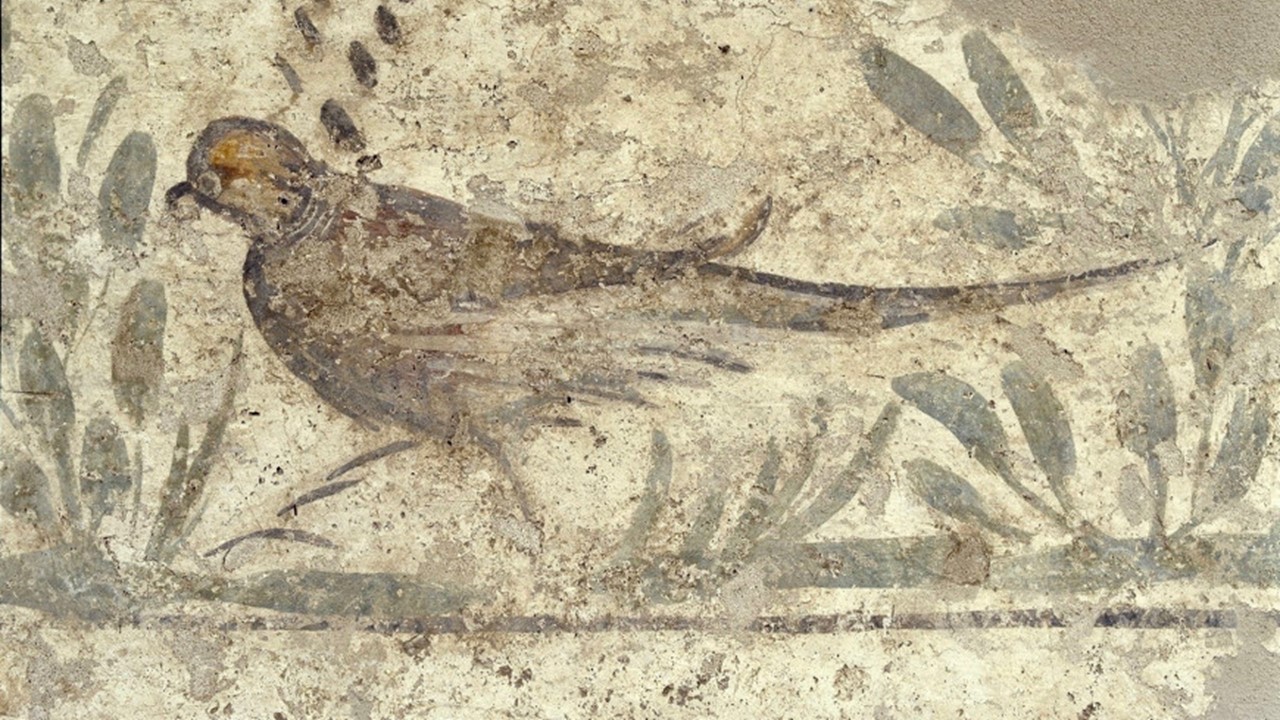
Tomb Painting of a Bird (Lark?), Museum for Byzantine Culture, Thessaloniki

Early Christian Funerary Paintings

Tomb Painting of a Bird (Lark?), Museum for Byzantine Culture, Thessaloniki
Tomb Painting of a Bird (Lark?), early 5th century, fresco painting,  Museum for Byzantine Culture, Thessaloniki (Photo: Makis Skiatharesis, ΜΒΠ archive)

“A Work of Art which did not begin in Emotion is not Art” Paul Cezanne said… and I think of him every time I visit Room 3, “From the Elysian Fields to the Christian Paradise” in the Museum of Byzantine Culture in Thessaloniki, to admire the exhibited Early Christian Funerary Paintings.    http://mbp.gr/en/room-3-elysian-fields-christian-paradise

Museum of Byzantine Culture in Thessaloniki

Visiting the Thessaloniki Museum of Byzantine Culture is a true cultural experience. For years now, I have visited it with my Pinewood students, trying to instil upon them the fine essence of Byzantine art and culture. The actual Museum building comes to my assistance… every time!  In 1989, the Museum’s architect, Kyriakos Krokos, wrote: I wanted a space within which movement would create a feeling of freedom, stirring up the senses, and where the exhibit would be a surprise within the movement. Walking through the Museum with my students, one surprise surpasses the other. The floor and wall mosaics in the first Early Christian Period Room, attract everybody’s attention, the Byzantine tunics with their fine embroideries are eye-catching, the icons and the intricately illuminated manuscript in the Middle Byzantine Period Room are definitely noticed. Finally, as we are about to leave, one last surprise: a beautiful Post-Byzantine golden eikonostaasi, one last startling work of art to ponder. After each visit, my students, pencils, notebooks and cameras, in hand, surprised and dazzled, come one step closer to understanding our Byzantine heritage! What more can I ask…    

Students exploring the Museum of Byzantine Culture in Thessaloniki
Grade 6 students exploring the Museum of Byzantine Culture in Thessaloniki, photographed by Kostas Papantoniou

When I visit the Museum of Byzantine Culture alone and am in a mood, I cannot fully describe, my steps take me directly to Room 3: “From the Elysian Fields to the Christian Paradise.” Dimly lit, usually very quiet, full of elusive treasures to discover, this is my place, the Room, I love…

Room 3: “From the Elysian Fields to the Christian Paradise” was the first Exhibition Room in the Museum to open, back on the 29th of March 1997. It was the result of an EU funded Research Program,  titled “The Transformation of the Roman World AD 400-900.” As the title of the Exhibition Room connotates, this is an area dedicated to afterlife during Late Antiquity. All exhibited items come from tombs in cemeteries excavated outside the Walls of Thessaloniki. They consist of funerary gifts, inscriptions, and items of worship of the dead. According to the Museum experts “The exhibit is complete with a series of extremely rare and unique funerary paintings. These illustrate in an exceptional way the transition from the Late Antiquity concept of the afterlife into a heavenly place of material prosperity, along with the shift from the funerary customs and decoration of Antiquity that still survives to the final triumph of the Cross with the emergence of the New Religion and the establishment of the belief for the Last Judgment and the Resurrection of the Dead.” http://mbp.gr/en/room-3-elysian-fields-christian-paradise

View of Room 3: “From the Elysian Fields to the Christian Paradise” in the Museum of Byzantine Culture in Thessaloniki
View of Room 3: “From the Elysian Fields to the Christian Paradise” in the Museum of Byzantine Culture in Thessaloniki (Photo: ΜΒΠ archive)

It is these unique funerary paintings I seek out every time I visit my favourite Museum in Thessaloniki. They carry Hellenistic Naturalism and Roman Verism, traditional Late Antique or novel Christian subject matter, higher or poorer quality craftsmanship… all together, these amazing frescoes transfer me to an exciting world of unwavering changes and exciting cultural developments… the world of the Early Christian period and the artistic milieu of Thessaloniki, a city worth visiting!

Articles you might find interesting about Early Christian Funerary Paintings in Thessaloniki:    https://www.academia.edu/24852527/Iconographic_Programs_of_the_Early_Christian_Tombs_of_Thessaloniki_in_the_Context_of_the_Contemporary_Traditions_of_the_Funerary_Art_English_translation_     and    https://bookonlime.ru/lecture/8-early-christian-funerary-painting-thessaloniki-macedonian-and-roman-traditions    and    https://www.didaktorika.gr/eadd/handle/10442/13516

For a Student Activity on Early Christian Funerary Painting, please… Click HERE!

The Month of June, by Maestro Venceslao, Fresco, Torre Aquila, Castello del Buonconsiglio in Trento, Italy

The Month of June

The Month of June, by Maestro Venceslao, Fresco, Torre Aquila, Castello del Buonconsiglio in Trento, Italy
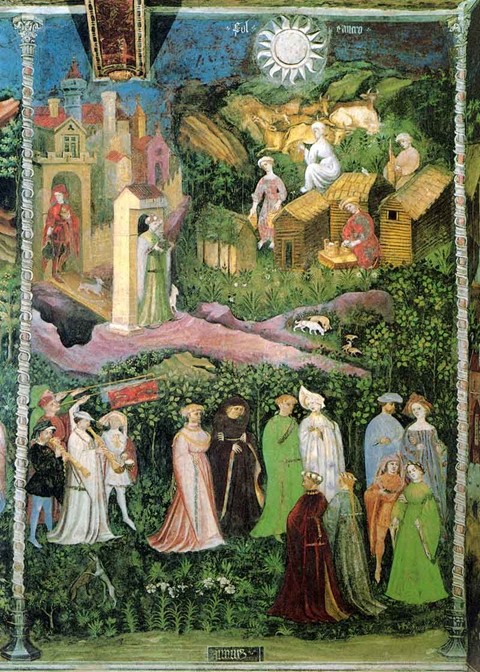
The Month of June, latest 1407, possibly by Maestro Venceslao, Fresco, Torre Aquila, Castello del Buonconsiglio in Trento, Italy

The Month of June is an amazing fresco that comes from the Torre Aquila in the Castello del Buonconsiglio, in Trento, Italy. It is part of a fresco Cycle of the Twelve Months painted on the walls of the tower’s 2nd-floor main room. Today, only eleven of the original 12 panels survive as a 16th-century wooden spiral staircase, connecting the tower floors, destroyed the painted panel of March. The famous painted Cycle of the Months is divided into twelve panels, one for each month. Each one of the twelve panels is separated by a slender column, distinctive yet subtle, so as not to disturb the natural continuity between months and the seasons.

Frescoes, Torre Aquila, Castello del Buonconsiglio in Trento, Italy

This exceptional room, 6 x 5,8 x 3 m in size, was commissioned by Prince-Bishop George of Liechtenstein, as a quiet, atmospheric retreat, away from the rest of the Castello’s busy and noisy state quarters. It has been suggested and widely accepted that the painter of this extraordinary fresco Cycle of the Months was Maestro Venceslao, a Czech painter, popular in the Tyrol area of the time.

June is the 6th month of the Year and the beginning of summer. A glorious, busy month for both the aristocrats and the peasants of Trento. With snow disappearing even at the highest peaks, the shepherds and the servants of the Prince-Bishop George of Liechtenstein, need to move to the mountainous pastures, where most of the Prince’s possessions are. They need to take care of his cows, while their women do the milking, and the processing of milk to butter and cheese. Are they making a 15th century version of the famous Trentino cheese Bela Badia? In May, all citizens of Trento had a moment to rest, but in June, they all go back to their daily chores!    https://www.tasteatlas.com/most-popular-cheeses-in-trentino-alto-adige-sudtirol

The Month of June, by Maestro Venceslao, Fresco, Torre Aquila, Castello del Buonconsiglio in Trento, Italy (detail)

One might wonder how the young Trento noblemen and ladies spend their June days… think no further, the answers are in the Trento fresco. Enjoying the best time of the year, young men and ladies of noble birth spend their days in the countryside! They walk out of their walled cities, as depicted in the upper left side of the painting, wearing their finest clothes, and join in the festivities of the month. Long summer days are on their thresholds and they embrace them! The lower part of the painting shows 5 couples dancing in a circle accompanied by their dogs and a group of musicians who set the tone. Are they celebrating the first day of Summer? The scene is inviting to say the least… a garden surrounded by green hedges, beautiful lilies, playful dogs and a quintet of merry musicians! https://www.worldwidewriter.co.uk/frescoes-of-trento-the-painted-city.html

The Month of June, by Maestro Venceslao, Fresco, Torre Aquila, Castello del Buonconsiglio in Trento, Italy

The Best Art You’ve Never Seen: 101 Hidden Treasures From Around the World by Julian Spalding, Rough Guides Reference, 2010 https://books.google.gr/books?id=L3e0BgAAQBAJ&pg=PA11&lpg=PA11&dq=cycle+of+the+months+paintings&source=bl&ots=PDmmhZPn37&sig=ACfU3U0ZvpPwd-ZSa8dnhL4AUn2uBLt26g&hl=el&sa=X&ved=2ahUKEwjVxcGIzNzmAhWRGewKHQiuD5g4ChDoATAGegQIBxAB#v=onepage&q=cycle%20of%20the%20months%20paintings&f=false

Until Next Month… check HERE! for a PowerPoint!

The Month of May, possibly by Maestro Venceslao, Torre Aquila, Castello del Buonconsiglio in Trento, Italy

The Month of May

The Month of May, possibly by Maestro Venceslao, Torre Aquila, Castello del Buonconsiglio in Trento, Italy
The Month of May, latest 1407, possibly by Maestro Venceslao, Fresco, Torre Aquila, Castello del Buonconsiglio in Trento, Italy

“Fresh new rose Delighting Spring,    By field and stream,    Singing gaily,    I declare your rarity    – to the flowers.” by Guido Cavalcanti (between 1250 and 1259 – August 1300), the Italian poet, troubadour, and best friend of Dante Alighieri. https://www.poetryintranslation.com/PITBR/Italian/Italianpoetry.php

The Month of May fresco comes from the Torre Aquila in the Castello del Buonconsiglio, in Trento, Italy. It is part of an amazing fresco Cycle of the Twelve Months painted on the walls of the tower’s 2nd-floor main room. It was commissioned by Prince-Bishop George of Liechtenstein, who wanted to show life and prosperity in his “well-governed” territories. The painter of these remarkable frescoes, Master Wenceslas, understanding well what he was commissioned to do, created the best 15th-century advertising brochure for the Alpine city of Trento. The Month of May presents a bright spring scene, crowded with well-dressed aristocrats who, in the lush local countryside, serenely enjoy the splendours of their privileged life. 

Torre Aquila, Castello del Buonconsiglio in Trento, Italy

Master Wenceslas, a Bohemian painter active in Trento since 1397, creates an amazing May scene, full of natural beauty… the sun triumphs, nature is in full bloom, and roses are present wherever you see! This is the time for Trento peasants to rest after a busy April, preparing and sowing the fields, repairing or rebuilding the fences of the vegetable gardens.  Their duties accomplished by April 23, the feast of San Giorgio, as the custom dictates, they are out of the “picture.” The Month of May scene is dedicated to the local ladies and gentlemen and their idle aristocratic activities.

The Month of May, possibly by Maestro Venceslao, Torre Aquila, Castello del Buonconsiglio in Trento, Italy

Master Wenceslas paints a striking May scene introducing themes and focusing on details. A city on the upper left side of the panel, surrounded by bright red walls sets the tone… bright, elaborate, almost otherworldly. The white Gothic church within its Walls balances the effect and stands out, introducing one of the four main colours present in the composition, white, red, green and blue. Next to the walled city but connected with it through a bridge, two aristocratic couples are about to eat al fresco, as a circular white-clothed table displays an abundance of delicacies. What an amazing and luxurious “picnic” setting this is… rugged mountains, a deep dark green forest, and a well-constructed fountain of spring water! They sit comfortably and talk amicably around the table, dressed in their brightest and finest, while one of the ladies is about to fetch water from the spring. Is this vignette a reference to the Fountain of Youth, which, according to legend, could renew beauty and youth for eternity?

The Month of May, possibly by Maestro Venceslao, Torre Aquila, Castello del Buonconsiglio in Trento, Italy

The lower part of the composition is entirely devoted to the pleasures and amusements of courtly society. In a lush meadow filled with roses and wildflowers, gracious gentlemen and beautiful ladies gather, mostly in pairs, to celebrate spring and the month of love! A young man kneels, in an act of homage, in front of his lady, another bends his forehead to be crowned with a wreath of flowers, and couples talk intimately or hold hands, lovingly. They wear their finest multicoloured garments, jewelled crowns or wreaths of flowers. Men wear tight-fitting jackets with coloured socks, or large cloaks with frayed edges, women are dressed in tight-fitting overcoats. The most fashion-conscious wear the long-toed shoes that are furious in France. The Trento scene of May is cheerful, sunny, elegant and optimistic! http://italianocontesti.ru/il-calendario-medievale-torre-aquila-a-trento-maggio/ and https://www.discovertrento.it/en/citta-di-trento/eventi/dettaglio/-/dettaglio/Torre+Aquila-Buonconsiglio+Castle/569149#.Xqui86gzZPZ

For a PowerPoint, please… check HERE!

The Month of May, possibly by Maestro Venceslao, Torre Aquila, Castello del Buonconsiglio in Trento, Italy