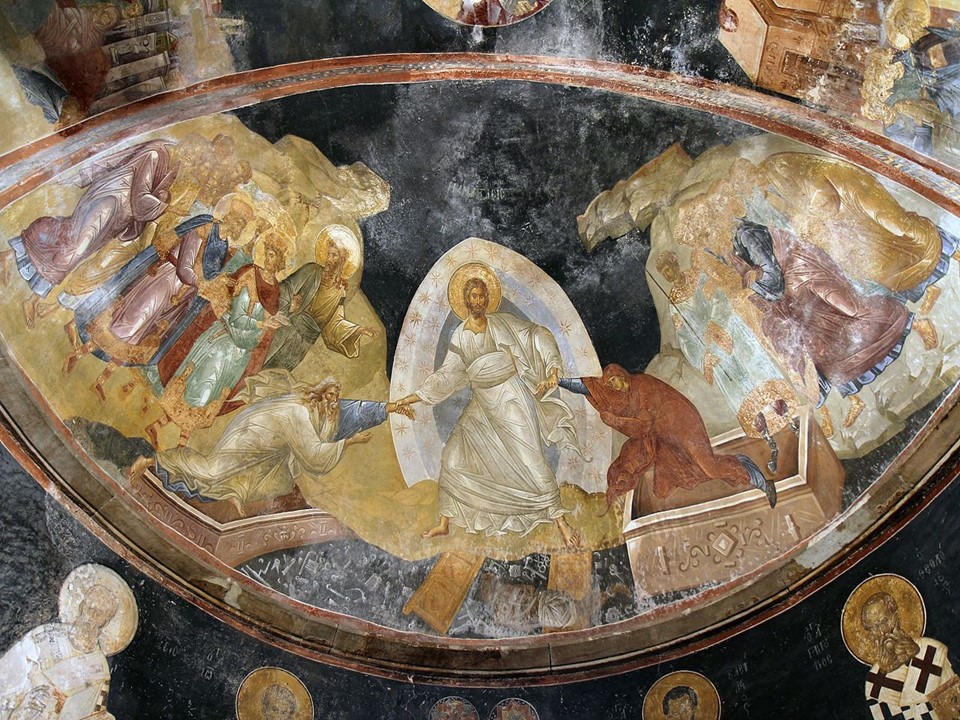
Harrowing of Hell, 1310-20, Fresco, Church of St. Savior in Chora

Holy Week in the Greek Orthodox Church

Harrowing of Hell, 1310-20, Fresco, Church of St. Savior in Chora
Harrowing of Hell, 1310-20, Fresco, Church of St. Savior in Chora, Constantinople, present-day Istanbul

“For I delivered unto you first of all that which I also received, how that Christ died for our sins according to the Scriptures; and that He was buried, and that He rose again the third day according to the Scriptures; and that He was seen of Cephas, then of the twelve; after that, He was seen of above five thousand brethren at once.” 1 Cor. 15:3-6… Holy Week in the Greek Orthodox Church https://www.goarch.org/-/holy-week-in-the-eastern-orthodox-church

The Raising of Lazarus, 12th century, from an Iconostasis in a Mount Athos Monastery
The Raising of Lazarus, 12th century, from an Iconostasis in a Mount Athos Monastery, Byzantine and Christian Museum, Athens

Lazarus Saturday… “Six days before the Passover, Jesus came to Bethany…” (John 12:1)

According to Pseudo-Dionysius the Areopagite, a Christian theologian and philosopher of the late 5th to early 6th century, colour RED is the colour of fire, flames, and Devine Energy… It is also the colour of blood, Christ’s blood to be more specific and thus the colour of Salvation for Mankind… https://plato.stanford.edu/entries/pseudo-dionysius-areopagite/

The Raising of Lazarus, in this amazing 12th century Icon from Mount Athos, takes place in front of a blazing Byzantine RED background… It is part of the Collection of the Byzantine and Christian Museum at Athens, a Museum that houses over 25,000 artefacts dating from the 3rd century AD to present time. The Byzantine and Christian Museum is housed in Villa Ilissia, one of the loveliest buildings erected in Athens during its early years as the capital of the newly-founded Greek state. Villa Ilissia, designed by the architect Stamatis Kleanthis, was the winter residence of Sophie de Marbois-Lebrun, Duchess of Plaisance, a formidable lady with a remarkable fortune! https://www.byzantinemuseum.gr/en/    and https://www.byzantinemuseum.gr/en/museum/villa_ilissia/

Rossano Gospels or Codex Purpureus Rossanensis, The Entry of the Lord into Jerusalem
Rossano Gospels or Codex Purpureus Rossanensis, The Entry of the Lord into Jerusalem, 6th-century illuminated manuscript Gospel Book, Diocesan Museum, Rossano, Italy

Palm Sunday… “Rejoice greatly…O daughter of Jerusalem; behold, the King comes unto Thee; he is just, and having salvation; lowly, and riding upon an ass, and upon a colt the foal of an ass.” (Zech. 9:9)

The Entry of the Lord into Jerusalem Manuscript Illumination in the 6th century Rossano Gospels is yet another blazing RED coloured Byzantine artwork. The fragmentary manuscript presents scenes from the Life of Christ, and sometimes small portraits of Old Testament prophets, prefiguring an event described in the New Testament. It contains the texts of Matthew and Mark written in fine silver and gold uncials on purple vellum. https://www.artesacrarossano.it/eng/codex.php

“The Rossano miniatures are painted with extraordinary refinement and economy. Like the illustrations in the Vienna Genesis, they distil the narrative action in a few convincing gestures. Hellenistic naturalism survives in the soft, highlighted garments, dramatic action, and details of the setting. Christ’s trial, for example, is depicted as an authentic court procedure. Nevertheless, a weakening of classical verisimilitude and vigour is evident throughout the manuscript; in the Mark page, the personification and garden wall appear flattened and show a tendency toward abstract pattern.” https://www.thebyzantinelegacy.com/rossano-gospels

Byzantine Ivory Throne of Maximianus
Throne of Maximianus, 6th century, carved ivory panels on a wooden frame, height: 1.50 m, Archiepiscopal Museum, Ravenna

Great Monday… “May no fruit ever come from you again!” (Matt. 21:19)

Monday of Holy Week commemorates the blessed and noble Joseph and the fig tree which was cursed and withered by the Lord. The story of Joseph of the Old Testament (Genesis 37-41) serves as a great example of a virtuous man, a model of propriety and sincere observance of ethical principles. https://www.goarch.org/-/holy-week-in-the-eastern-orthodox-church

The Throne of Maximianus, in the Archiepiscopal Museum of Ravenna, is one of the greatest examples of 6th century Byzantine Art. The wooden core of this monumental Cattedra was covered with panels of ivory carvings wonderfully encased with strips of vine scrolls inhabited by birds and animals. Ivory panels decorating the back of the Throne show scenes from the Life of Christ, while the side panels depict scenes from the Story of Joseph from the Book of Genesis. The panels used in the front of the Throne depict the Four Evangelists left and right of John the Baptist, who is holding a medallion with the Lamb of God and Maximianus’s name above him. Scholars identify two different artists working on this amazing Early Byzantine masterpiece. The explanation can be simple… the Plague of Justinian probably caused the death of the first, maybe of Alexandrian origin, artist, so that a second artist was introduced to finish this amazing imperial commission. https://www.thebyzantinelegacy.com/maximian-throne

Julia Bridget Hayes, Kassiani the Hymnographer
Julia Bridget Hayes, St. Kassiani the Hymnographer, 20thcentury hand panted Icon, Egg Tempera and Gold Leaf, private collection of the artist https://fineartamerica.com/featured/st-kassiani-the-hymnographer-julia-bridget-hayes.html

Great Tuesday… “Lord, she who has fallen in many sins, Recognizing Your Divinity, Took up the myrrh-bearer’s office, With tears brought you myrrh before your entombment.”

Every Great Tuesday Greek Churches are full of people waiting to hear the bittersweet hymn of Kassiani. Admired, popular and beloved, this hymn is universally acknowledged to be a masterpiece of religious poetry that possesses both beauty and richness of meaning. https://www.academia.edu/11959468/Kassia_A_female_hymnographer_of_9th_century_Byzantium_and_her_hymnographic_poem_on_the_Vesper_of_Holy_Tuesday

Κύριε, ἡ ἐν πολλαῖς ἁμαρτίαις περιπεσοῦσα γυνή… enjoy it as sang by Nektaria Karantzi    https://www.youtube.com/watch?v=c4v2kVmoeB4

Kassiani, born in the early 9th century into a wealthy family of Constantinople, was to become a Byzantine abbess, poet, composer, and hymnographer, known to have written in her own name just like the Porphyrogenita Anna Comnene. https://www.johnsanidopoulos.com/2015/09/saint-kassiani-hymnographer.html

Manuscript Illumination depicting Mary of Bethany Anoints Jesus
Mary of Bethany Anoints Jesus, 1684, Walters manuscript W.592, f. 240B, Illuminated manuscript on paper, 11.0 cm wide by 16.0 cm high, Walters Art Gallery

Great Wednesday… “Let no fear separate you from Me…” this is the evening of repentance, confession and the remission of sins by Christ, preparing the faithful to receive Holy Communion…

Walters manuscript W.592 is an illuminated and illustrated Arabic manuscript of the Gospels by Matthew (Mattá), Mark (Marqus), Luke (Luqa), and John (Yuhanna) and was copied in Egypt by Ilyas Basim Khuri Bazzi Rahib, who was most likely a Coptic monk, in Anno Mundi 7192/AD 1684. The text is written in Naskh in black ink with rubrics in red. The decoration is comprised of illuminated headpieces, numerous floral paintings, and approximately fifty illustrations. It is worth browsing through its pages…  https://art.thewalters.org/detail/17922

The Walters Art Gallery Manuscript 592, is becoming one of my favourites… I enjoy the clarity of the compositions, the vibrancy of colours applied, the bold outlines and the pure joy of the floral decorative patterns used by the artist!

Last Supper, 6th century, mosaic, Sant'Apollinare Nuovo, Ravenna
Last Supper, 6th century, mosaic, Sant’Apollinare Nuovo, Ravenna

Great Thursday… “Take, eat; this is my Body. Drink of it all of you; for this is my Blood of the New Covenant” (Matthew 26:26-28)

Scenes of a Byzantine Mystical Supper, usually depict the event in a straight-forward manner, as described in the Gospels: the Twelve Disciples are seated around an oval table, John usually rests on Jesus’ bosom, and Judas dips his hand in the dish, revealing him to be Christ’s traitor. This is not the case in the 6th century Church of Sant’Apollinare Nuovo in Ravenna. Chris, dressed in purple, along with the 12 Disciples dressed in white, recline around a central table. The bread and fish on the table may refer to the miracle of the loaves and fishes portrayed on the opposite wall of the Church while the Bread explicitly relates that miracle to the Eucharist, which Jesus is believed to have instituted at the Last Supper. This is one of the 13 mosaics of the Passion and Resurrection of Christ along with the upper band of the right wall of the nave. https://www.christianiconography.info/Edited%20in%202013/Italy/sApolNuovoRightNave.lastSupper.html

Ivory Panel of the Last Supper
Last Supper, 6th century, mosaic, Sant’Apollinare Nuovo, Ravenna , mid-10th century, ivory, 15.1 × 8.9 × 0.8 cm, the MET, NY

Great Friday… Oh my sweet spring, my sweetest child, where does your beauty fade? (Excerpt from the Lamentations of Good Friday)

The Metropolitan Museum of Art has among its many Byzantine Treasures, an Ivory Icon of the Crucifixion I particularly like. It is small in size like all Byzantine Ivory panels, but so rich in quality work… Under a richly textured canopy, the MET Crucifixion emphasizes Christ’s victory over death. Christ’s body lifelessly “suspends” on the Cross while his head gracefully falls forward and leans to his left shoulder. Mary and John stand on the sides of the Cross mourning with dignity, the three soldiers divide Christ’s garment, and at the very bottom, unique to this small ivory piece, the personification of Hades! Panofsky’s Renascence at its best! https://www.metmuseum.org/art/collection/search/464428

Ω γλυκύ μου έαρ… Enjoy one of the most moving Byzantine Hymns, sung by no other than Flery Dandonaki    https://www.youtube.com/watch?v=jUJwTe5QC7I

Harrowing of Hell, late 14th century Icon from Constantinople, Hellenic Institute for Byzantine and Post-Byzantine Studies in Venice
Harrowing of Hell, late 14th century Icon from Constantinople, 47,2 x 62 cm, Hellenic Institute for Byzantine and Post-Byzantine Studies in Venice

Great Saturday… “Arise, O God, and judge Thou the earth…” (Vespers and Divine Liturgy of Saturday evening)

This amazing Icon at the Hellenic Institute in Venice comes from Constantinople and dates from the late 14th century. It is elegant and sophisticated, a fine example of the Late Paleologean style in painting. It depicts the Resurrection of Christ, or in true Byzantine style, the Descent of Christ into Hades, according to the occult gospel of Nicodemus. Christ is depicted in the center of the composition, within a radiant glory, stepping at the gates of Hades and lifting Adam from within an open sarcophagus. Behind Adam are Eve, the prophets and on the opposite side Biblical kings like Solomon, David, and prophets from the Old Testament. In the lower central part, an angel chains Hades, while at the top, against a glorious golden background, two angels fly, holding the symbols of Christ’s Passion… http://eib.xanthi.ilsp.gr/gr/icons.asp

For a PowerPoint on The Holy Week in the Greek Orthodox Church, please… click HERE!

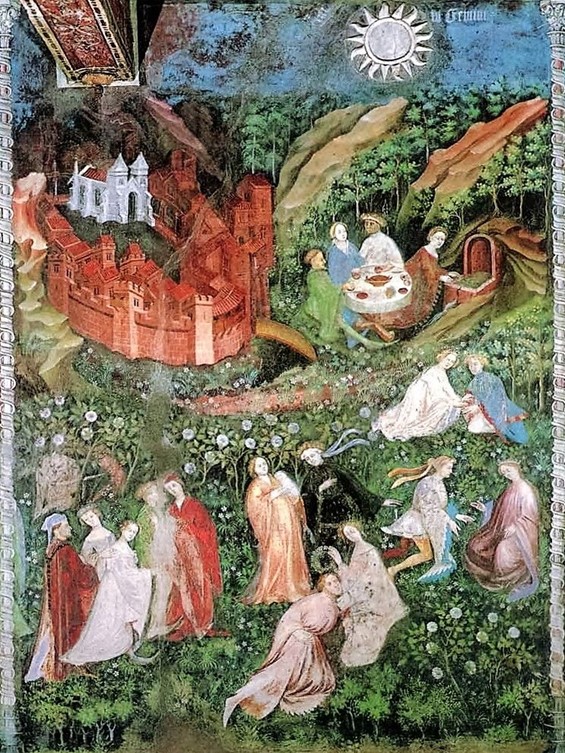
The Month of April, 1407, possibly by Maestro Venceslao, Fresco, Torre Aquila, Castello del Buonconsiglio in Trento, Italy

The Month of April

The Month of April, 1407, possibly by Maestro Venceslao, Fresco, Torre Aquila, Castello del Buonconsiglio in Trento, Italy

The Italian proverb “Aprile dolce dormire” certainly does not suit the fourth scene of the calendar of the Cycle of Months of Torre Aquila in Trento. Here, under the great April sun, one does not sleep, nor is one idle, but it is all a fervour of activity. http://senzadedica.blogspot.com/2013/04/il-ciclo-dei-mesi-aprile.html

The Month of April fresco comes from Torre Aquila in the Castello del Buonconsiglio, in Trento, Italy. It is part of an amazing fresco Cycle of the Twelve Months painted on the walls of the tower’s 2nd-floor main room. It was commissioned by Prince-Bishop George of Liechtenstein, who wanted to show how well-governed his territories were and how his labourers thrived. The painter of these remarkable paintings, Master Wenceslas, understood well what he was asked to do, created the best 15th-century advertising brochure for Trento, and for the Month of April fashioned a dazzling spring scene, crowded with a well-dressed crowd who, in the lush local countryside, serenely performed their necessary everyday chores. 

Master Wenceslas, a Bohemian painter active in Trento since 1397, creates a rich April scene, full of natural beauty and pastoral activities. Nature awakens and the citizens of Trento are busy. The farmers catch up with their activities and the Ladies of the Court and enjoy a stroll in the woods. The scene is rich, dense and joyful… inspired by real-life but immensely beautified. The commissioner of this fresco, Prince-Bishop George of Liechtenstein, wants to give the idea that his territories flourish under his good governance. and prudent guidance. The painter, Master Wenceslas, understood this very well, and created a verdant scene of dazzling colours, the winter greys have disappeared, crowded with well-dressed farmers and elegant ladies.  https://it.wikipedia.org/wiki/Ciclo_dei_mesi

Maestro Venceslao, Fresco, Torre Aquila, Castello del Buonconsiglio in Trento, Italy
…the month of April, Many and June

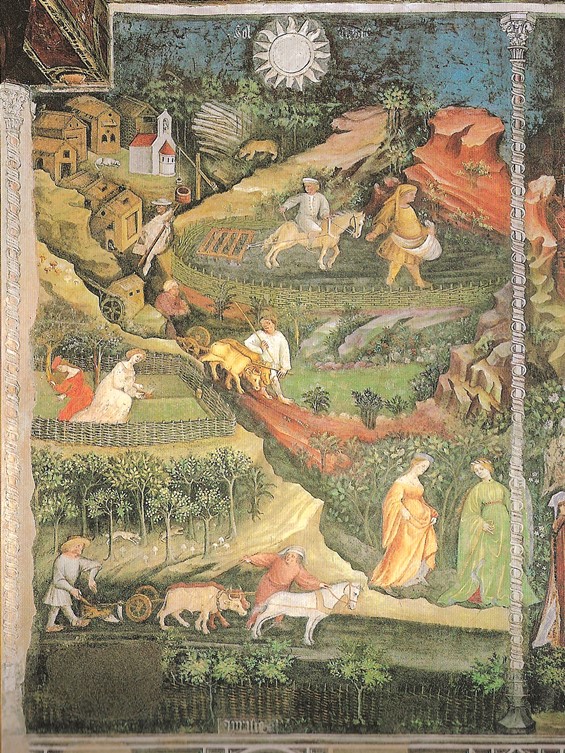
Wenceslas’s countryside is fertile and well organized. The fields are separated in an orderly manner and protected, like precious gardens, by braided willow fences. Everything is represented with such precision… the land, the buildings, the farmers’ chores. The April fresco looks as if it is the page of a textbook for a young farmer to study and learn! https://www.ilmiraggio.com/ciclo-dei-mesi-torre-aquila/

At the top of the composition, a lush fir forest offers refuge to one of those bears that populated the Alps at the time. Further down, a pilgrim, fully dressed in white with a hat and a cane, walks through a borough of thatched-roof houses arranged around a small church, empty of villagers… silent. Even the dogs in this village keep silent, as they are both dozing.

The Month of April, 1407, possibly by Maestro Venceslao, Fresco, Torre Aquila, Castello del Buonconsiglio in Trento, Italy

The farmers are busy with their pastoral duties. In a fenced and already ploughed field a farmer sows, while another farmer works the land with a harrow pulled by a horse. Further down to the left, two men, probably coming from a water-mill, carry sacks of flour on a cart driven by oxen. In the foreground, two other farmers plough the land with a heavy wheeled plough pulled by a pair of oxen and a horse. Women do not remain idle. Two of them, taking advantage of the beautiful weather, participate in the fervour of spring activities, gardening their well-fenced plot! Their precious land is on the border of a small forest where, among immense mushrooms, a dog chases a hare!

The Month of April, 1407, possibly by Maestro Venceslao, Fresco, Torre Aquila, Castello del Buonconsiglio in Trento, Italy

The month of April fresco is not only about hard work. The presence of two aristocratic young ladies, in the lower, right part of the composition, can not be missed. Depicted on the edge of the painted scene, the elegant ladies seem to walk towards the festive procession depicted in the following month of May. One of them, wearing an elegant green gown with long sleeves, crosses the thin, pillar-like, frame that divides the two months, and effortlessly, just as the succession of seasons is constant and uninterrupted, guides us to the next composition… that of May!

Until Next Month… check HERE! for a student Activity!

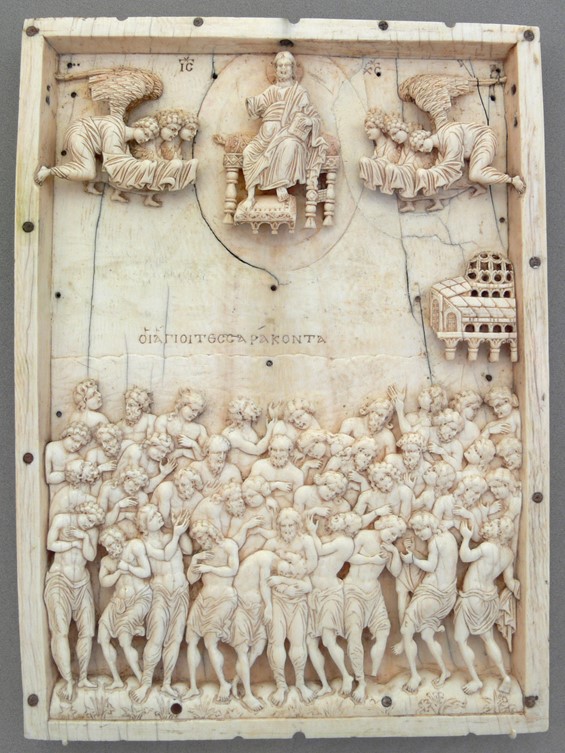
The Forty Martyrs of Sebaste, 10th century AD Byzantine Ivory Panel

The Forty Martyrs of Sebaste

The Forty Martyrs of Sebaste, 10th century AD Byzantine Ivory Panel
The Forty Martyrs of Sebaste, 10th century AD,  ivory relief panel from Constantinople, Museum für Byzantinische Kunst, BODE Museum, Berlin
https://history2701.fandom.com/wiki/The_Forty_Martyrs_of_Sebaste

The Forty Martyrs of Sebaste Ivory Icon at the BODE Museum in Berlin is a favorite of mine for making me think, reflect and compare.

First of all, I like the story of these 40 tough Roman soldiers, devoted to their faith, suffering… in the city of Sevaste, in Armenia, during the reign of Emperor Licinius, and under the presidency of Agricolaus, in the year 320 AD. Their story is beautifully told by MATHEW in http://dignareme.blogspot.com/2017/03/the-40-martyrs-of-sebaste.html
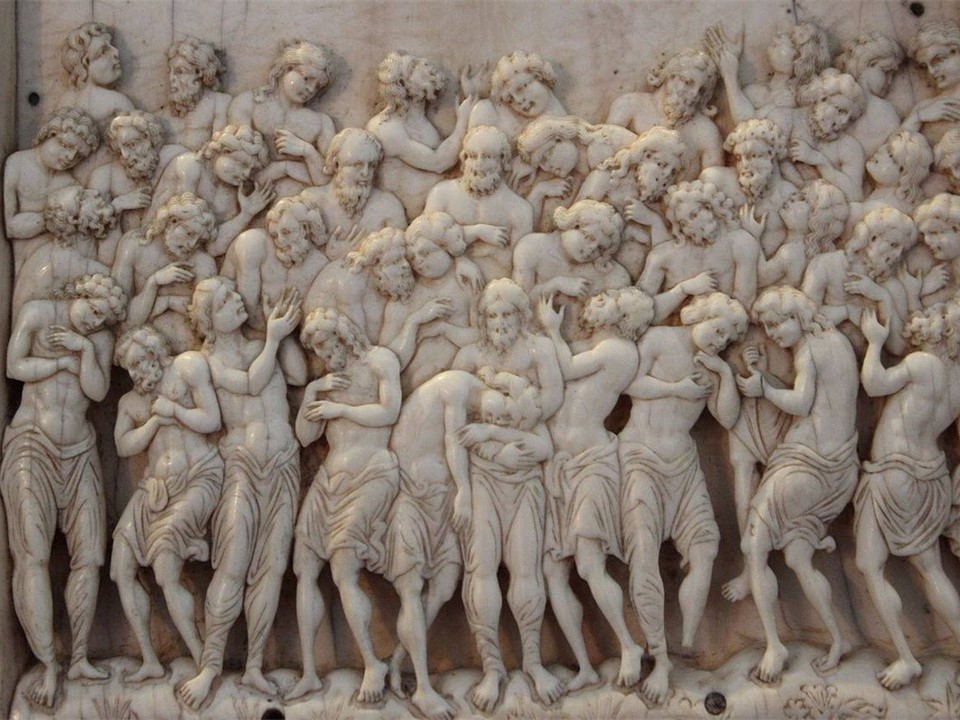
The Forty Martyrs of Sebaste, 10th century AD Byzantine Ivory Panel (detail)

Then, I like Byzantine Ivory Carving! What a magnificent medium in… small-scale. Byzantine Art is not only about monumental, awe-inspiring mosaics and frescoes. The aficionados of Byzantium find equal pleasure even more! in artifacts of smaller scale, like luxurious ivories, silverware, glassware, and jewelry, even humble pottery and woodwork.

I am fascinated by Ivory itself. One only has to imagine the caravans or the galleys bringing to Constantinople African elephant tasks, the anticipation of the artisans ready to put their expertise into practice, and the eagerness of the buyers as they consider one more coveted possession. During the 10th and the 11th centuries, Byzantine Ivories were popular among the City’s aristocrats and highly prized as Imperial gifts to foreign dignitaries.

Meticulously carved, ivory icons, consular diptychs, or pyxides, enchant us today with their beauty. “The allure of this substance is easily understood: its smooth, tactile quality and creamy color made it ideal for the creation of” amazing works of art, just like the Icon of the Forty Martyrs of Sevaste in the BODE Museum.
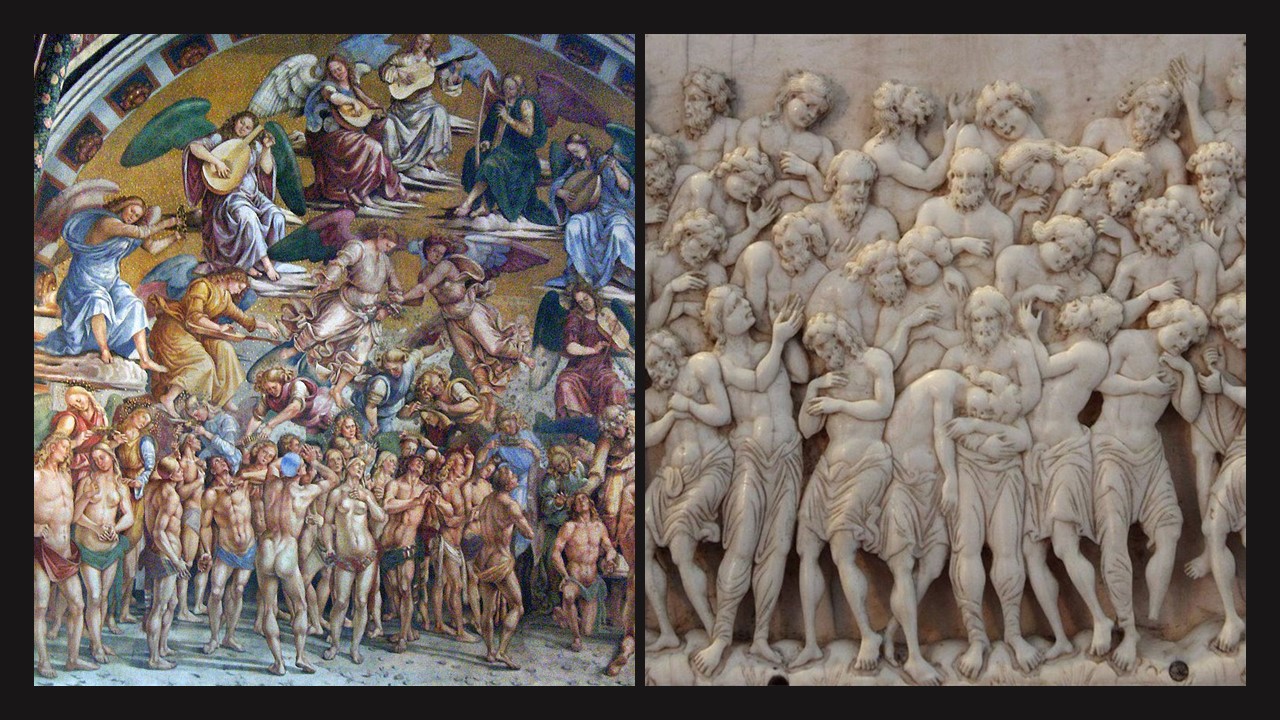
The Forty Martyrs of Sebaste, 10th century AD Byzantine Ivory Panel and Luca Signorelli's fresco painting of Paradise
Fresco painting by Luca Signorelli (1499) of Paradise, Orvieto Cathedral, Orvieto, Umbria
The Forty Martyrs of Sebaste, 10th century AD,  ivory relief panel from Constantinople, Museum für Byzantinische Kunst, BODE Museum, Berlin

Is this amazing carving a case of Byzantine Renascence? The depiction of forty agonizing bodies, winding and twisting, reminds me of Signorelli’s fantasia of Paradise and Hell in Orvioto’s Cathedral, in the Capella of San Brizio.  Are there missing links connecting these two masterpieces I don’t know about? Whatever the answer is, the BODE Ivory Icon is a strategic player in the equation. https://www.metmuseum.org/toah/hd/ivor/hd_ivor.htm and http://www.travelingintuscany.com/art/lucasignorelli/sanbriziochapel.htm

For a “Similarities and Differences” Student Activity, please… check HERE!
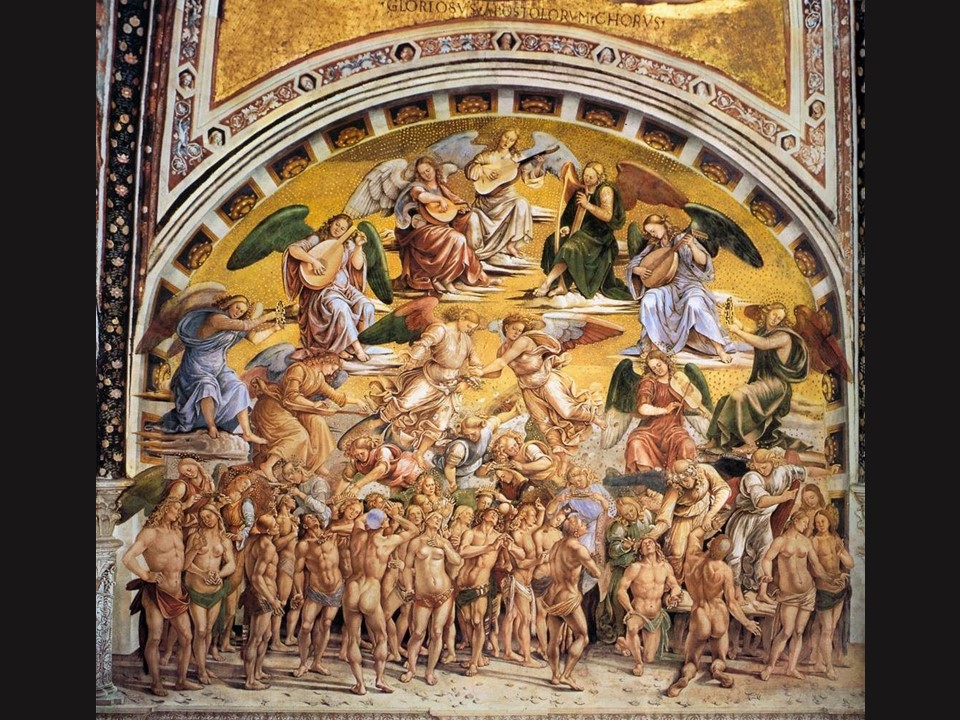
Luca Signorelli, Paradise
Fresco painting by Luca Signorelli (1499) of Paradise, Orvieto Cathedral, Orvieto, Umbria
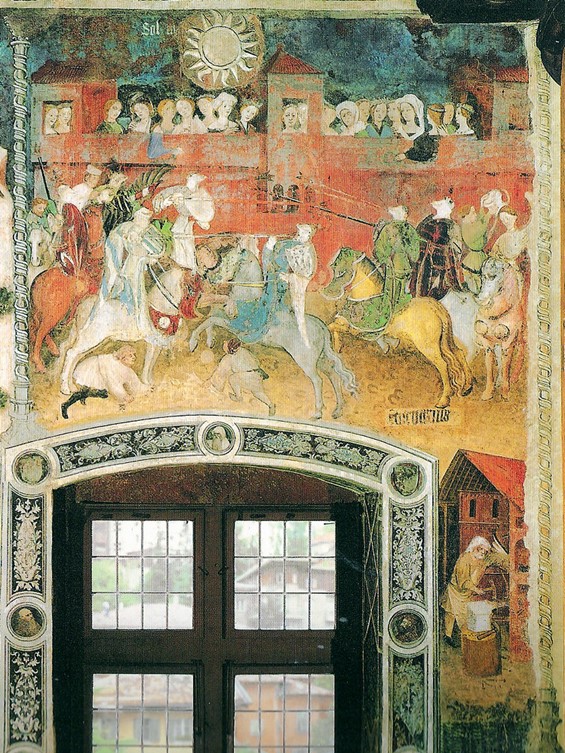
The Month of February fresco, possibly by Maestro Venceslao, in Torre Aquila, Castello del Buonconsiglio in Trento, Italy

The Month of February

The Month of February fresco, possibly by Maestro Venceslao, in Torre Aquila, Castello del Buonconsiglio in Trento, Italy
The Month of February, late 14th century-latest 1407, possibly by Maestro Venceslao, Fresco, Torre Aquila, Castello del Buonconsiglio in Trento, Italy

The Month of February fresco comes from Torre Aquila in the Castello del Buonconsiglio, in Trento, Italy. It is part of an amazing fresco Cycle of the Twelve Months painted on the walls of the tower’s 2nd-floor main room and presents the quintessential game of chivalry…

Is there among you any gentleman who for the love of his lady is willing to try with me some feat of arms? If there should be any such, here I am, quite ready to sally forth completely armed and mounted, to tilt three courses with the lance, to give three blows with the battle axe, and three strokes with the dagger. Now look, you English, if there be none among you in love. … and so Gauvain Micaille, the gallant Frenchman squire from Beauce, a gentleman of tried courage, who had advanced himself on his own merit, without any assistance from others, jousts for the honour of France showing his courage and bravery… https://uts.nipissingu.ca/muhlberger/FROISSART/GAUVAIN.HTM

The February fresco at Torre Aquila presents an impressive and festive Tournament where Jousting is the protagonist of the day. The Trento artist, maybe Maestro Venceslao, using warm tones of orange and ochre, organizes a two parts composition. The background presents Trento Ladies sitting behind an elaborate, purpose-built, parapet. They are finely dressed and adorned with elaborate headdresses, crowns, and wreaths, talking to each other, full of excitement… maybe contemplating, even debating whom they are going to favor! The Knights, fully armored and carrying their cotes-of-arm are depicted in the art of Jousting, their goal, to show gallantry and honour, their hope to attract the attention of “their” Lady and get a token of her favor… a veil, a ribbon, a wreath!

The Month of February fresco, possibly by Maestro Venceslao, in Torre Aquila, Castello del Buonconsiglio in Trento, Italy (detail)

According to Wikipedia: “Jousting is a martial game or hastilude between two horsemen wielding lances with blunted tips, often as part of a tournament. The primary aim was to replicate a clash of heavy cavalry, with each participant trying hard to strike the opponent while riding towards him at high speed, breaking the lance on the opponent’s shield or jousting armor if possible, or unhorsing him. The joust became an iconic characteristic of the knight in Romantic medievalism. The participants experience close to three and a quarter times their body weight in G-forces when the lances collide with their armor.” https://en.wikipedia.org/wiki/Jousting#CITEREFColtman1919

The Trento fresco for February has another interesting genre scene. In the narrow space between the room’s window and the staircase, the artist included a vignette of an older blacksmith toiling hard in his workshop. Let’s not forget this is a fresco cycle of the Labors of the Months, illustrating the activities of aristocrats and peasants, every month, throughout the year!

For a PowerPoint, please… check HERE!

The Month of January, late 14thcentury fresco, possibly by Maestro Venceslao

The Month of January

The Month of January, late 14thcentury fresco, possibly by Maestro Venceslao
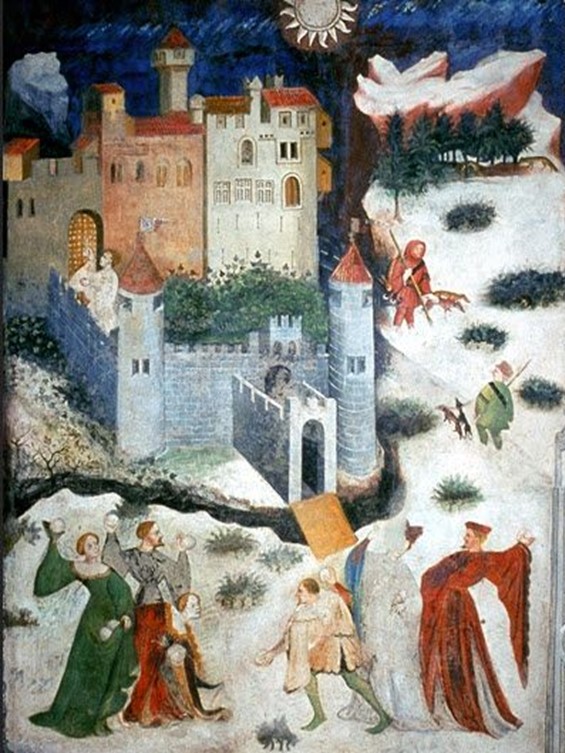
The Month of January, late 14thcentury-latest 1407, possibly by Maestro Venceslao, Fresco, Torre Aquila, Castello del Buonconsiglio in Trento, Italy
https://www.cultura.trentino.it/eng/Cultural-venues/All-cultural-venues/Documentation-centres2/Torre-Aquila-Aquila-Tower

The Month of January is a fresco, and it comes from the Torre Aquila in the Castello del Buonconsiglio, in Trento, Italy. It is part of an amazing fresco Cycle of the Twelve Months painted on the walls of the tower’s 2nd-floor main room. Today, only eleven of the original 12 panels survive as a 16th-century wooden spiral staircase, connecting the tower floors, destroyed the painted panel of March. The famous painted Cycle of the Months is divided into twelve panels, one for each month. Each one of the twelve panels is separated by a slender column, distinctive yet subtle, so as not to disturb the natural continuity between months and the seasons.

This exceptional room, 6 x 5,8 x 3 m in size, was commissioned by Prince-Bishop George of Liechtenstein, as a quiet, atmospheric retreat, away from the rest of the Castello’s busy and noisy state quarters. It has been suggested and widely accepted that the painter of this extraordinary fresco Cycle of the Months was Maestro Venceslao, a Czech painter, popular in the Tyrol area of the time.

Frescoes of the Twelve Months at Torre Aquila, Castello del Buonconsiglio in Trento, Italy

The Cycle of the Twelve Months is a favourite theme in the arts of the Middle Ages and the Early Renaissance. Often linked to the signs of the Zodiac, the Cycle of the Months is often perceived as a link between the work of man, the seasons of the year and God’s ordering of the Universe. As a theme, it recurred in the sculptural decoration of cathedrals and churches across Europe, in illuminated manuscripts like the popular Books of Hours, palace frescoes and rarely, panel painting.

The fresco panels in Torre Aquila are rare and special. They document life in the Trentino area, with references to the aristocratic pastimes throughout the year, or the peasant activities and duties to their masters. They also depict a vivid landscape, romanticized even then, from bare and covered with snow, to rich and fertile, to autumnal, covered with fallen leaves.

The Trentino frescoes love presenting anecdotal details. The depiction of fashionable outfits for the rich, multicoloured and extravagant in style, or shabby for the farmers and artisans, is only one such striking example. The January panel is “a case in point: nowhere else in art do aristocrats come to play in the snow, men and women alike, chuckling snowballs about with determined, impish delight, their long sleeves dragging in the drifts. Oddly – but surely intentionally – the castle’s roof is snow-free, and its garden is full of summer growth. It’s an image of the warmth of their protected life. Maestro Venceslao was painting a dream, but he wanted to make it as real as possible…”

The Best Art You’ve Never Seen: 101 Hidden Treasures From Around the World by Julian Spalding, Rough Guides Reference, 2010 https://books.google.gr/books?id=L3e0BgAAQBAJ&pg=PA11&lpg=PA11&dq=cycle+of+the+months+paintings&source=bl&ots=PDmmhZPn37&sig=ACfU3U0ZvpPwd-ZSa8dnhL4AUn2uBLt26g&hl=el&sa=X&ved=2ahUKEwjVxcGIzNzmAhWRGewKHQiuD5g4ChDoATAGegQIBxAB#v=onepage&q=cycle%20of%20the%20months%20paintings&f=false

For a PowerPoint, please… check HERE!

For a Student Activity on the discussed Fresco Panel depicting the Month of January, please… check HERE!

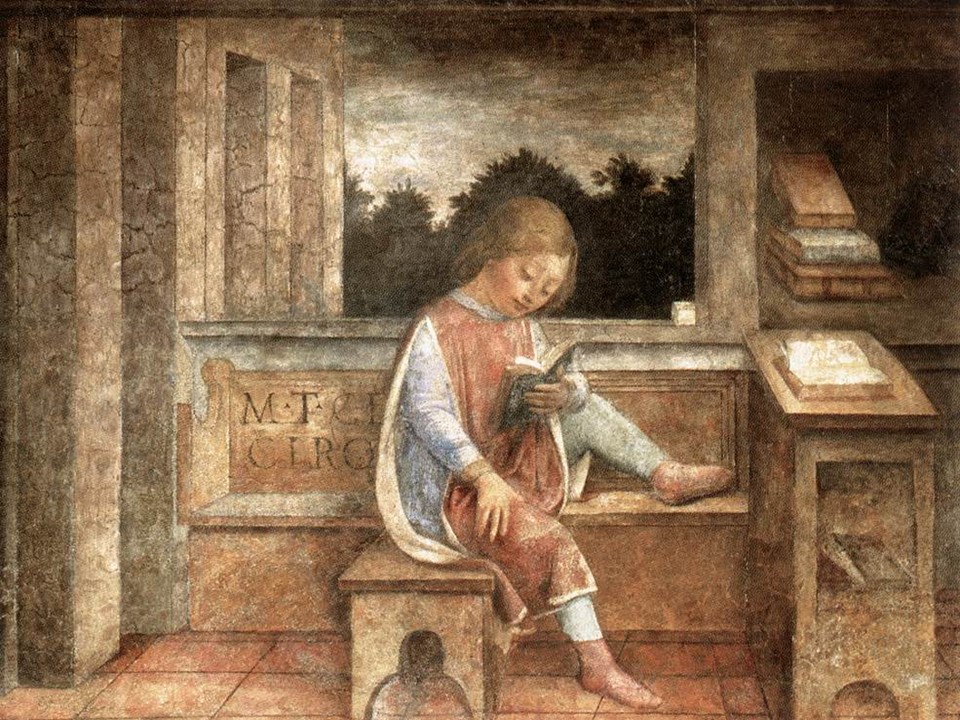
A painting by Vincenzo Foppa showing young Cicero reading.

Renaissance Student Revisited

A painting by Vincenzo Foppa showing young Cicero reading.
Vincenzo Foppa, 1427- 1515
The Young Cicero Reading, c.1464, fresco, 101.6×143.7 cm, Wallace Collection, London
https://artuk.org/discover/artworks/the-young-cicero-reading-209572

Renaissance Student Revisited is my new post. It is inspired by the 15th century Italian Renaissance painting of The Young Cicero Reading, a wonderful example of a Renaissance Student engrossed in his studies!

BEST WISHES to all students, parents and teachers who are about to start a new and exciting academic adventure! May their trip be fruitful, productive and successful!

Some suggestions for Renaissance Student Revisited Activities

Discuss with students where and how Young Cicero is presented READING. Ask students to write a paragraph describing WHERE and HOW they like to READ a book.

This next Activity is for younger students. Use the provided Worksheet, and ask students to answer the recommended questions.

Ask students to pick up a favourite BOOK and then POSE like CICERO. Take their pictures and create a Renaissance Student Revisited Bulletin Board Presentation with your students READING!

This is a Grade 6 Social Studies Activity. Ask students to create an A3 size poster on CICERO. The Poster should include a well-thought title, pictures of artworks depicting CICERO, and information about his life and work.

For the teachercurator Worksheets… Click HERE!

Grade 2 student work inspired by Vincenzo Foppa.
My precious Grade 2 students
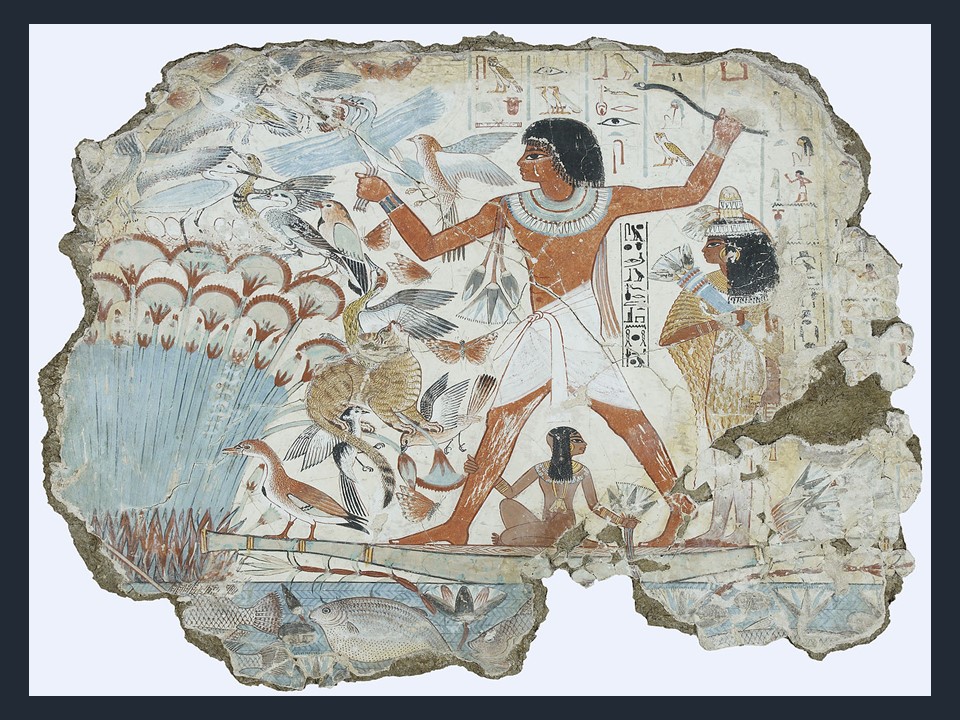
An ancient Egyptian fresco painting depicting Nebamun hunting.

Nebamun

An ancient Egyptian fresco painting depicting Nebamun hunting.
Hunting Scene, c 1350 BC, Wall Painting from the Tomb of Nebamun, British Museum
https://commons.wikimedia.org/wiki/File:Tomb_of_Nebamun.jpg

Among the many treasures exhibited in the British Museum is a set of 11 frescoes from the tomb of an Egyptian official called Nebamun who lived in the ancient city of Thebes during the 18th Dynasty circa 1325 BC. He was an educated man, a scribe, and an administrator in charge of grain collection for the Temple of Amun at Thebes. His Tomb, discovered in the Theban Necropolis, on the west bank of the Nile, present-day Luxor, was richly decorated with high-quality frescoes depicting scenes of Nebamun and his family engaging in everyday life activities like hunting, attending a banquet and overseeing a count of geese and cattle.

The British Museum frescoes of Nebamun’s Tomb were discovered back in 1820 by a young man called Yanni d’Athanasi, who was at the time working for Henry Salt, the British Consul-General and collector of Antiquities. The Tomb, its location unknown today, was probably badly destroyed by d’Athanasi’s team of tomb robbers. The frescoes, however, were sold to Henry Salt and then, in 1821, by Salt, to the British Museum. Since 2009, beautifully restored, the frescoes have been displayed in a new gallery at the British Museum.

https://www.britishmuseum.org/visiting/galleries/ancient_egypt/room_61_tomb-chapel_nebamun.aspx and https://www.khanacademy.org/humanities/ancient-art-civilizations/egypt-art/new-kingdom/a/paintings-from-the-tomb-chapel-of-nebamun and http://www.artinsociety.com/lost-masterpieces-of-ancient-egyptian-art-from-the-nebamun-tomb-chapel.html

For an interesting 3D interactive animation of the tomb-chapel of Nebamun check… https://www.britishmuseum.org/visiting/galleries/ancient_egypt/room_61_tomb-chapel_nebamun/nebamun_animation.aspx

Please check the PowerPoint on Nebamun’s frescoes “teachercurator” prepared… Here!

Student Activity on the Tomb of Nebamun frescoes can be found if you… Click HERE!