The Dolphin Frieze fresco from the Mycenaean Acropolis of Gla

The Dolphin Frieze from the Mycenaean Acropolis of Gla

The Dolphin Frieze fresco from the Mycenaean Acropolis of Gla
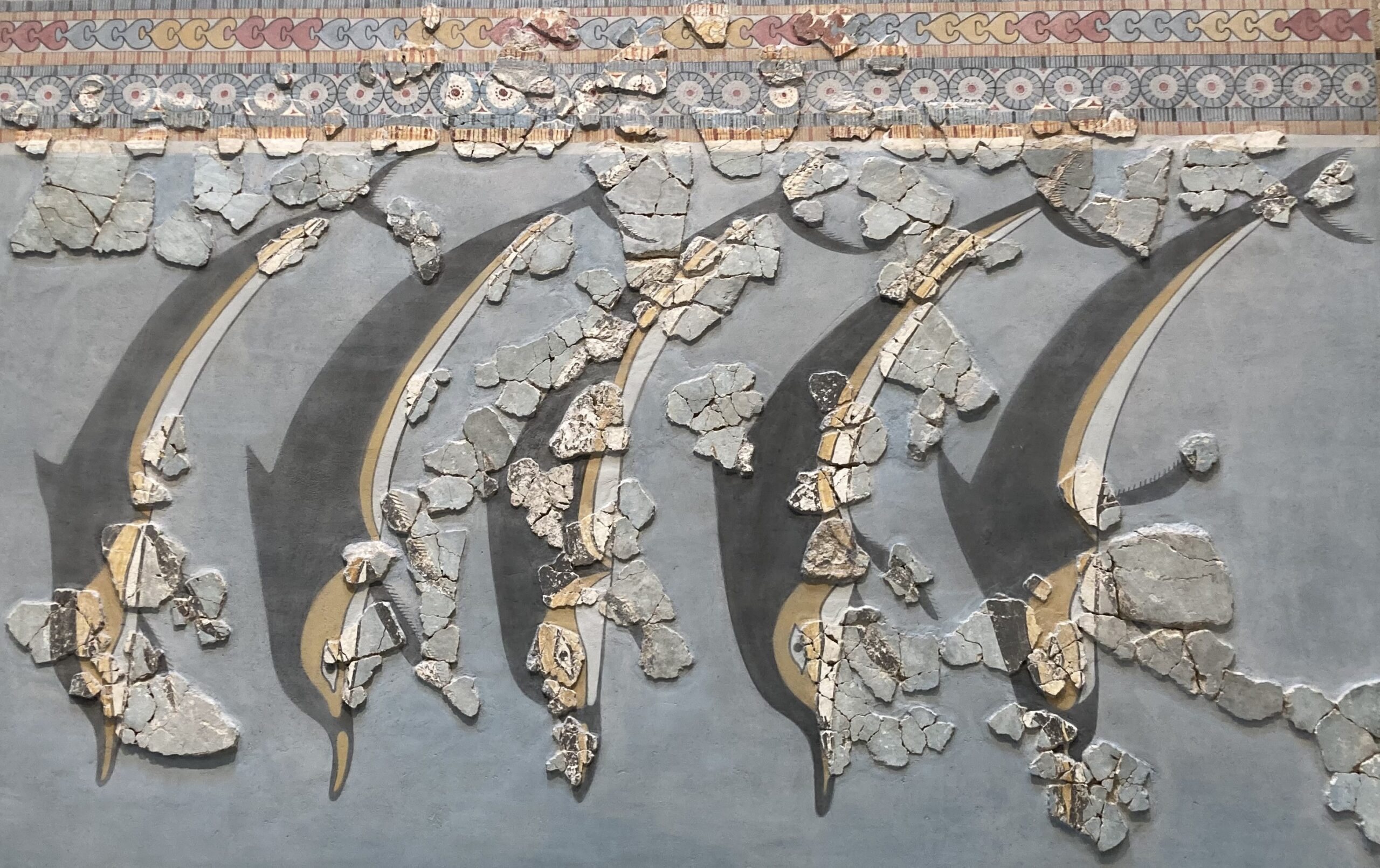
Dolphin Frieze, Second half of the 13th century BC, Fresco, from the Mycenaean Acropolis of Gla in Boeotia, Archaeological Museum of Thebes, Greece – Photo Credit: Amalia Spiliakou, February 19, 2024

On February 19, 2024, I fulfilled a long-awaited wish by visiting the Archaeological Museum of Thebes, one of Greece’s most significant archaeological museums. The collections, some of which are rare or unique, have been on my bucket list for quite some time. These artefacts, originating from excavations across Boeotia, span from the Paleolithic era to post-Byzantine times, providing a comprehensive view of the region’s cultural history. The Dolphin Frieze from the Mycenaean Acropolis of Gla was at the top of my list; seeing it in person was a moment of sheer delight and fulfilment.

The Mycenaean period is of profound significance in both art and history, acting as a vital cultural link between the Bronze Age civilizations of the Aegean and the classical world of ancient Greece. Artefacts from this era, ranging from architecture to fresco painting and pottery, illuminate the emergence of distinct artistic styles and techniques that greatly influenced classical Greek artistry. Mycenaean builders demonstrated their prowess through the construction of grand palaces, robust fortifications, and imposing tombs, showcasing advanced architectural and engineering capabilities. Their vibrant fresco paintings, characterized by bold depictions of figures, animals, and geometric patterns, stand as a testament to their artistic abilities. Moreover, the Mycenaean civilization played a pivotal role in shaping the socio-political landscape of ancient Greece, laying the groundwork for the development of Greek culture and identity.

Model of the Archaeological site of Gla, Archaeological Museum of Thebes, Greece
https://commons.wikimedia.org/wiki/File:Gla_-_Modell_of_archaeological_site.JPG

The least known of all Mycenaean Palaces is probably that of Gla in Central Greece. Perched atop a rugged hill, the Mycenaean Acropolis of Gla is a site of historical and archaeological significance dating back to the Late Bronze Age. This fortified settlement, strategically positioned on the Boeotian plain jutted into Lake Kopais (now drained) or formed an island within it. It served as a vital center of the Mycenaean civilization, showcasing the architectural prowess and strategic foresight of its ancient inhabitants. With its imposing Cyclopean Walls, about 3 m thick, and 2.8 km long, enclosing about 235,000 square meters of land, and commanding views, the Acropolis of Gla stands as a testament to the military and cultural achievements of the Mycenaeans, offering invaluable insights into their society, economy, and interactions within the broader Aegean world.

The Acropolis of Gla is famously associated with the ambitious endeavour to drain Lake Kopais, a feat considered unparalleled in Bronze Age antiquity, highlighting the advanced technical knowledge possessed by Mycenaean engineers. It is also known for its sheer magnitude and complexity. Encircled by robust Cyclopean Walls featuring four gates constructed from imposing stone blocks, Gla reigns as the largest fortified Mycenaean Acropolis within Greek territory. Less known, but equally important is the site’s residential area, a sprawling L-shaped edifice, often hailed as a ‘Palace’, and situated in the site’s northern expanse. Built atop an engineered plateau, this ‘Palace’ or, Melathron’, unfolds into three distinct sections, featuring a layout reminiscent of the renowned Megaron structures found in ancient centers like Tiryns, Mycenae, and Pylos. However, the absence of hallmark Mycenaean Palace elements, specifically a “throne room”, a circular hearth, and a “bathroom”, raises questions about its classification as a fully-fledged Mycenaean Megaron.

Among the buildings’ debris, archaeologists discovered as early as 1893, evidence of a wastewater system, unique clay roof tiles suggesting pitched roofs, and evidence of decorative wall frescoes, damaged and fragmentary, but extremely precious. Today, these fragments, discovered in the elongated East Wing of the South Enclosure, during excavations conducted by S. Iakovidis, in the early 1980s and 1990s are exhibited in the Archaeological Museum of Thebes. The most remarkable of these fragments show diving Dolphins and parts of other maritime scenes, including large Argonauts. These fresco fragments were expertly reconstructed by Christos Boulotis. (See Bibliography)

The Dolphin Frieze fresco from the Mycenaean Acropolis of Gla
Dolphin Frieze, Second half of the 13th century BC, Fresco, from the Mycenaean Acropolis of Gla in Boeotia, Archaeological Museum of Thebes, Greece – Photo Credit: Amalia Spiliakou, February 19, 2024

The Dolphin Fresco from the Mycenaean Acropolis of Gla is a remarkable artefact that showcases an unusual naturalism and a sophisticated understanding of marine life, captured through the depiction of Dolphins with an astonishing level of detail and realism. These elegant creatures, spanning 75 to 80 cm in height, are painted against a vivid blue background, highlighting their dynamic forms and graceful postures. The Dolphins, numbering between six and seven, are depicted in a uniform size and posture, their bodies elegantly curved into open arches or crescents, embodying the fluidity and grace of living dolphins. Their upper bodies are painted black, featuring a triangular dorsal fin, while their bellies are a contrasting white, delineated from the black with yellow stripes. Their eyes are almond-shaped, set against a yellow background, adding a striking detail to their overall appearance.

The use of colours in the Gla Dolphins fresco draws closer to the real hues of these marine creatures, with the black, white, and yellow providing a stark contrast to the deep blue sea they inhabit. This colour choice not only enhances the naturalism of the scene but also demonstrates the Mycenaeans’ advanced skills in pigment selection and application. Indeed, recent analyses have revealed the use of rare, imported lapis lazuli mixed with hematite and possibly an organic colour derived from murex, underscoring the significant effort and resources devoted to achieving the fresco’s vibrant colours.

This fresco, along with other Dolphin Paintings of the Aegean Bronze Age period demonstrates a persistence of themes drawn from nature within Mycenaean art, suggesting a deep-rooted appreciation for the natural world. The Gla Dolphins, with their lifelike appearance and intricate detailing, stand as a testament to the Mycenaean civilization’s artistic prowess and their enduring fascination with the sea and its inhabitants.

For a Student Activity, inspired by the Dolphin Freeze, please… Check HERE!

Bibliography: Christos Boulotis, Reconstructing a Dolphin Frieze and Argonauts from the Mycenaean Citadel of Gla, ΜΕΛΕΤΗΜΑΤΑ 72, Mycenaean Wall Painting in Context, National Hellenic Research Foundation, Athens, 2015, pp. 371… https://www.academia.edu/39148590/RECONSTRUCTING_A_DOLPHIN_FRIEZE_AND_ARGONAUTS_FROM_THE_MYCENAEAN_CITADEL_OF_GLA_In_MYCENAEAN_WALL_PAINTING_IN_CONTEXT_ATHENS_2015_371_403

Eros Punished, 1st century AD, Fresco, 126x162.3 cm, from the House of Punished Eros in Pompeii

Eros Punished

Eros Punished, 1st century AD, Fresco, 126x162.3 cm, from the House of Punished Eros in Pompeii
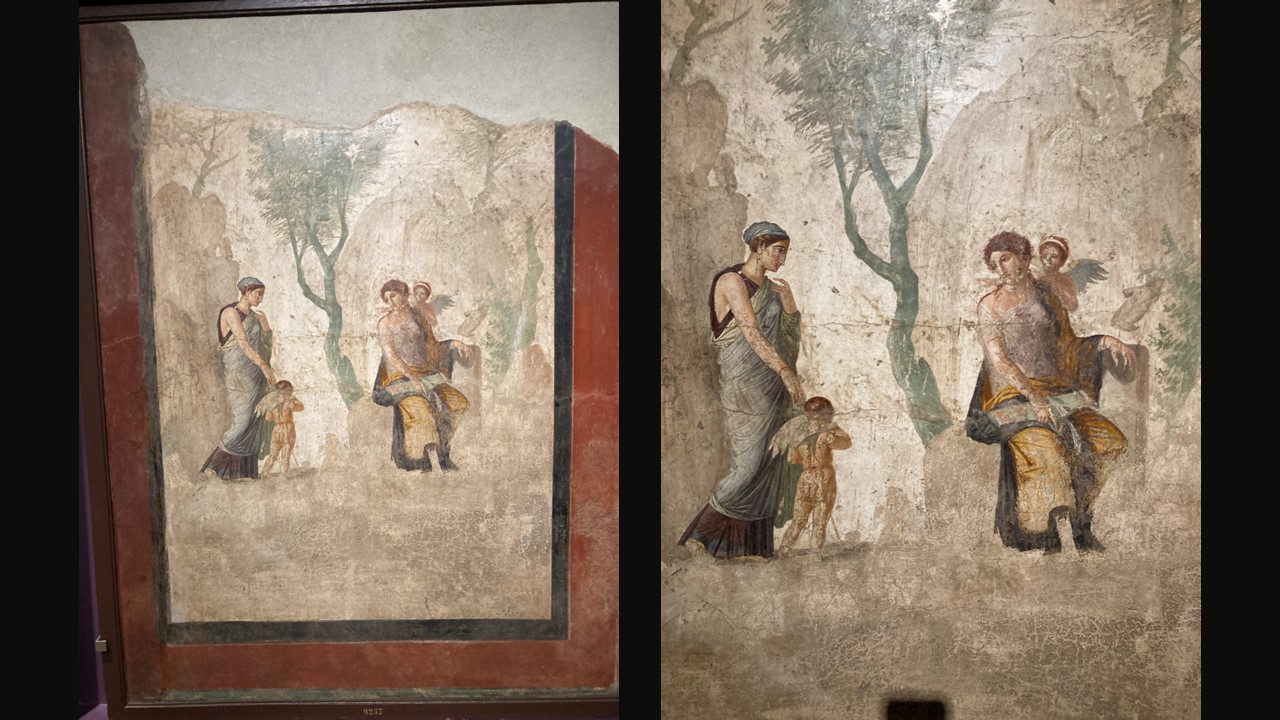
Eros Punished, 1st century AD, Fresco, 126×162.3 cm, from the House of Punished Eros in Pompeii, National Archaeological Museum of Naples, Italy – Photo Credit: Amalia Spiliakou, February 18, 2024, ‘Meanings’. Personifications and Allegories from Antiquity to Today Exhibition, Acropolis Museum, Athens, Greece

On February 17, 2024, in Athens, attending an exceptional exhibition, titled ‘NοΗΜΑΤΑ’: Personifications and Allegories from Antiquity to Today, held at the Acropolis Museum, I came face to face with an adorable Pompeiian fresco titled Eros Punished. It is now part of the Museo Archaeologico Nazionale di Napoli, but back in the 1st century AD, adorned the wall of a triclinium in the House of Love Punished in Pompeii.

The fresco’s narrative unfolds amidst the timeless strokes of fine ancient artistry. Peithò, (Persuasion Personified), leads Eros to his mother Aphrodite, terribly crossed with him, for an impending punishment. Eros used his arrows to kindle Ares’s passion for another woman, and Aphrodite is unwilling to forgive such mischief. Peithò, Persuasion personified, affectionately holds Eros’s hand, who bearing the weight of his misdeed, seems like crying, hesitant to proceed. Aphrodite, seated regally upon a rugged perch, emanates an aura of solemnity. She holds Eros’s bow and cuirass and looks at him sadly, but firmly. Anteros, the younger sibling of Eros, lurks behind her, poised to witness the unfolding consequence with a mixture of anticipation and childish delight. This tableau, frozen in time, capturing the intricate interplay of familial bonds, divine intervention, and the immutable consequences of love’s transgressions, delights me!

Eros Punished, 1st century AD, Fresco, 126x162.3 cm, from the House of Punished Eros in Pompeii
Eros Punished (detail), 1st century AD, Fresco, 126×162.3 cm, from the House of Punished Eros in Pompeii, National Archaeological Museum of Naples, Italy
https://www.planetpompeii.com/en/blog/eros-and-anteros-the-love-needs-to-be-reciprocated-to-grow.html
Eros Punished, 1st century AD, Fresco, 126x162.3 cm, from the House of Punished Eros in Pompeii (detail)
Eros Punished (detail), 1st century AD, Fresco, 126×162.3 cm, from the House of Punished Eros in Pompeii, National Archaeological Museum of Naples, Italy
https://www.planetpompeii.com/en/blog/eros-and-anteros-the-love-needs-to-be-reciprocated-to-grow.html

In exploring this scene, I cannot overlook the intriguing presence of God Eros and his younger brother Anteros within the same composition. The relationship between Eros and Anteros, symbolizing the two counterparts of reciprocal love, finds its vivid portrayal in a fanciful myth recounted by the fourth-century rhetorician Themistius. Through Themistius’s narrative, we glimpse into the depths of brotherly affection and the profound consequences it entails…

When Aphrodite gave birth to Eros, the child was beautiful and befitted his mother in any respect but one: he did not grow to a size appropriate to his beauty… The baby’s mother and the Graces, his nurses, did not know what to do when confronted with this situation. They went to Themis… and asked her to find some means by which they might be delivered from their strange and astonishing misfortune. Themis said: “I shall put an end to your predicament. The problem is that you do not yet know the true nature of the baby. Eros, your genuine offspring, may perhaps have been born alone but he cannot grow up in any part of the body: you need Anteros if you want Eros to grow. These brothers will have the same nature; each will be responsible for the other’s growth. For when they see each other, they will both shoot up equally; but if one of them is deprived of the other, they will both shrink in size.” And so Aphrodite conceived Anteros, and Eros immediately had a spurt of growth and sprouted wings and was tall. Since this is Eros’s fortune, he often endures strange transformations, now sprouting up, now shrinking, then growing again. He always needs his brother’s presence. If he sees that his brother is of sizable stature, he is eager to appear bigger himself; but he often shrinks in size, against his own will, once he has discovered that his brother is shrunken and small.

Eros Punished, 1st century AD, Fresco, 126x162.3 cm, from the House of Punished Eros in Pompeii (detail)
Eros Punished (detail), 1st century AD, Fresco, 126×162.3 cm, from the House of Punished Eros in Pompeii, National Archaeological Museum of Naples, Italy
https://www.planetpompeii.com/en/blog/eros-and-anteros-the-love-needs-to-be-reciprocated-to-grow.html

For a PowerPoint on Eros and Anteros in Art, please… Check HERE!

Bibliography on Eros and Anteros: Eros and Anteros or Reciprocal Love in Ancient and Renaissance Art by Guy de Tervarent, Journal of the Warburg and Courtauld Institutes, Vol. 28 (1965), pp. 205-208 p.272 https://www.jstor.org/stable/2853330?read-now=1&seq=8#page_scan_tab_contents  and Grecian and Roman mythology by Dwight, M. A. (Mary Ann), 1806-1858, p. 266 https://archive.org/details/cu31924029135651/page/n269/mode/1up and Anteros: On Friendship Between Rivals and Rivalry Between Friends p. 9 file:///C:/Users/aspil/Downloads/Post_columbia_0054D_11776.pdf

The Bicentenary House, the fresco of Aphrodite and Aris, Herculaneum

The House of the Bicentenary in Herculaneum

The Bicentenary House, the fresco of Aphrodite and Aris, Herculaneum
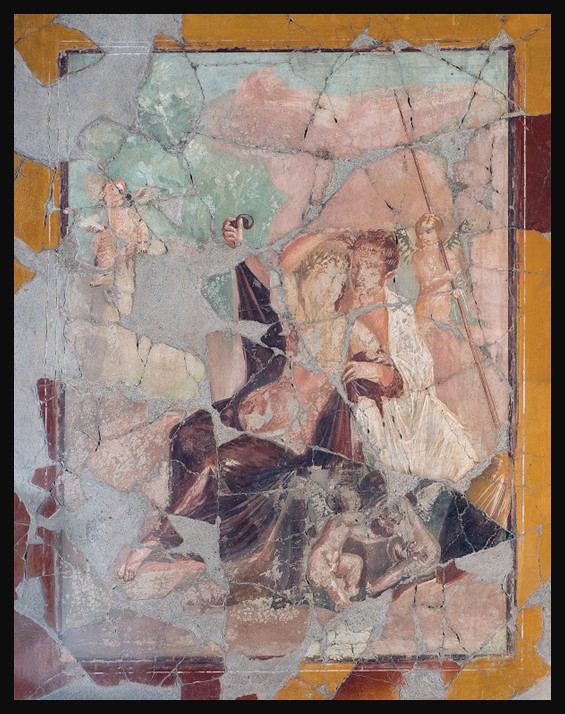
The Bicentenary House, the fresco of Aphrodite and Aris, 1st century AD, Tablinum, Herculaneum, Italy https://minervamagazine.com/grand-designs-at-herculaneum.html

The House of the Bicentenary in Herculaneum is one of the site’s jewels. Back in the 1930s, archaeologist Amedeo Maiuri described it as a sumptuous noble house of elegant proportions. It is one of Herculaneum’s largest townhouses, as would be expected for a property with such a prominent location on the main street of the town, close to the theatre, the law courts, and the forum. The stately 1st-century BC house was built on two storeys and its façade was decorated with a brightly coloured green-and-red chequerboard pattern, with a balcony looking over the street. Inside, a large atrium with a central marble pool led to an elegant room for receiving guests. Both were covered with lavish mosaic pavements and wall paintings, all indicating that this was a noble house that belonged at some point to prosperous owners… https://minervamagazine.com/grand-designs-at-herculaneum.html

The Bicentenary House, Herculaneum
The House of the Bicentenary is one of the best preserved noble houses at Herculaneum, with highly refined wall paintings and mosaic pavements, 1st century AD, Herculaneum, Italy https://www.getty.edu/conservation/our_projects/field_projects/herculaneum/overview.html

History of the Archaeological Site

The House of the Bicentenary was unearthed under the direction of archaeologist Amedeo Maiuri, in 1938, amidst the bicentennial celebrations of the excavations at Herculaneum. Concurrently, efforts were made to stabilize, restore, and exhibit the site, with artefacts showcased in the atrium’s left hall and a preserved wood screen displayed in the right hall. By 1983, however, the house faced severe deterioration, worsened by exposure to the elements and heavy tourist traffic. Structural instability, deteriorating wall paintings, crumbling tuffa walls, flaking paint layers, and lifting mosaics plagued the once-grand villa, necessitating urgent restoration efforts.

Plan of the Bicentenary House in Herculaneum

In a decisive move, the House underwent closure to visitors, heralding a transformative period in 2011. A collaborative effort ensued, with the participation of the Getty Conservation Institute (GCI), the Archaeological Park of Herculaneum, and the Herculaneum Conservation Project, united in a mission to comprehensively research, analyze, document, and stabilize the edifice’s architectural framework, wall surfaces, frescoes, and mosaic pavements. Particular focus was directed towards the restoration of the remarkable Tablinum area. The outcome of this concerted effort has been nothing short of remarkable. Such was the extent of the achievement that Domenico Camardo, the chief archaeologist at the Herculaneum Conservation Project, expressed the endeavour as not only a pivotal moment in the house’s preservation but also an opportunity for pioneering advancements in conservation methodologies and materials, with implications reaching far beyond the site itself. https://www.thehistoryblog.com/archives/56824

An Overview of the House of the Bicentenary…

Nestled along Herculaneum’s bustling main thoroughfare, the city’s Decumanus Maximus, the Bicentenary House once hosted Gaius Petronius Stephanus and his wife Calantonia Themis within its exquisite confines. Renowned as one of the city’s most opulent residences, sprawling across over 600 square meters and boasting an upper floor, its halls were adorned with meticulously preserved mosaic floors and frescoes breathing life into mythological narratives and intricate architectural and animal motifs. Particularly noteworthy is the Tablinum (Room 10 on the Plan), adorned with a collection of 4th Pompeian Style paintings renowned for their beauty and craftsmanship, offering visitors a glimpse into the peak of artistic expression within the site.

The Bicentenary House in Herculaneum
The Bicentenary House, 1st century AD, Tablinum, Herculaneum, Italy https://minervamagazine.com/grand-designs-at-herculaneum.html

On the Tablinum Frescoes…

The decoration of the Tablinum is superb. The room’s ensemble of wall paintings exhibits artistic and archaeological importance portraying mythological scenes, cupids in a variety of activities, and portraits of Dionysiac figures of the utmost elegance and sophistication. Finally, the unique mosaic pavement in opus sectile and opus tessellatum, creates a unique mosaic floor, blending opulent reds, yellows, and blacks in a sophisticated scheme.

The Bicentenary House, the fresco of Aphrodite and Aris with medallions of Dionysiac portraits, Herculaneum
The Bicentenary House, the fresco of Aphrodite and Aris with medallions of Dionysiac portraits, 1st century AD, Tablinum, fresco, Herculaneum, Italy https://minervamagazine.com/grand-designs-at-herculaneum.html

According to Amedeo Maiuri… The tablinum preserves a rich, sparkling marble pavement, like a polychrome carpet, and on the walls, paintings, medallions, and a frieze; in the panels are represented the myths of Daedalus and Pasiphae and of Venus and Mars; in the medallions are busts of Satyrs, Sileni and Maenads. On the upper part of the walls runs a frieze with cupids. From the tablinum, we reach the little portico with the garden and the rustic rooms on the ground floor. https://herculaneum.uk/Ins%205/Herculaneum%205%2015%20p3.htm

For a PowerPoint on the House of the Bicentenary, please… Check HERE!

The Bicentenary House, the fresco of Aphrodite and Aris with medallions of Dionysiac portraits, Herculaneum (detail)
The Bicentenary House, the fresco of Aphrodite and Aris with medallions of Dionysiac portraits, 1st century AD, Tablinum, fresco, Herculaneum, Italy https://minervamagazine.com/grand-designs-at-herculaneum.html
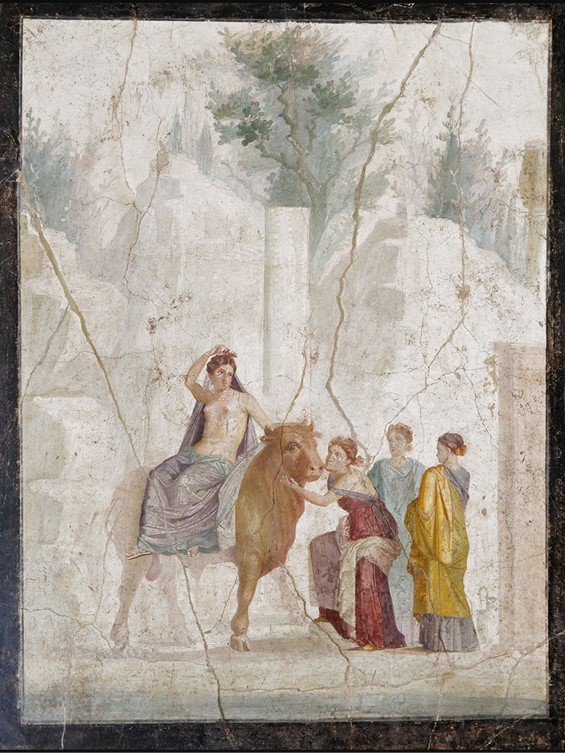
Europe on the Bull from Pompeii, Room ‘f’ in the House of Jason

Europa on the Bull in the House of Jason in Pompeii

Europe on the Bull from Pompeii, Room ‘f’ in the House of Jason
Europe on the Bull, 20-25 AD, Fresco Painting,125×95 cm, from Pompeii, Room ‘f’ in the House of Jason, today, in the National Archaeological Museum, Naples, Italy https://ancientrome.ru/art/artworken/img.htm?id=2092

In 1878 archaeologists discovered a most wonderful fresco of the Myth of Europa on the Bull in the House of Jason in Pompeii! Let’s explore the ‘where’, ‘which’, ‘how’, and ‘what’ of this amazing fresco by posing some questions!

What is the Myth of Europa and Zeus? In the myth of the Abduction of Europa, Zeus, the king of the gods, is captivated by the beauty of Europa, a Phoenician princess and daughter of King Agenor. Seized by desire, Zeus transforms into a magnificent bull and approaches Europa with an air of gentleness. Europa, charmed by the bull’s allure, climbs onto its back, only for Zeus to swiftly take off, and carry her across the sea to the island of Crete. Upon reaching Crete, Zeus discloses his identity, and Europa becomes his queen. This myth of love and adventure, steeped in symbolism and divine intrigue, has left a lasting legacy, not only in the naming of the continent of Europe but also in its enduring influence on art, literature, and the understanding of ancient cultural values.

How does Ovis describe the Myth of the Abduction described in his Metamorphoses? So the father and ruler of the gods, who is armed with the three-forked lightning in his right hand, whose nod shakes the world, setting aside his royal sceptre, took on the shape of a bull, lowed among the other cattle, and, beautiful to look at, wandered in the tender grass.  /   In colour he was white as the snow that rough feet have not trampled, and the rain-filled south wind has not melted. The muscles rounded out his neck, the dewlaps hung down in front, the horns were twisted, but one might argue they were made by hand, purer and brighter than pearl. His forehead was not fearful, his eyes were not formidable, and his expression was peaceful. Agenor’s daughter marvelled at how beautiful he was and how unthreatening. But though he seemed so gentle she was afraid at first to touch him. Soon she drew close and held flowers out to his glistening mouth. The lover was joyful and while he waited for his hoped-for pleasure he kissed her hands. He could scarcely separate then from now. At one moment he frolics and runs riot in the grass, at another he lies down, white as snow on the yellow sands. When her fear has gradually lessened he offers his chest now for virgin hands to pat and now his horns to twine with fresh wreaths of flowers. The royal virgin even dares to sit on the bull’s back, not realising whom she presses on, while the god, first from dry land and then from the shoreline, gradually slips his deceitful hooves into the waves. Then he goes further out and carries his prize over the mid-surface of the sea. She is terrified and looks back at the abandoned shore she has been stolen from and her right hand grips a horn, the other his back, her clothes fluttering, winding, behind her in the breeze. This is how Ovid describes in Bk II:833-875 Zeus’s abduction of Europa. https://ovid.lib.virginia.edu/trans/Metamorph2.htm#476707521

House of Jason in Pompeii
House of Jason in Pompeii, Ground Plan, Photo of the entrance hall ‘a’ of Jason’s House looking towards the Atrium ‘b’, central living room and Photo of the internal garden/Atrium ‘b’, looking west towards room ‘f’, where three amazing fresco panels, including the Abduction of Europa, were discovered https://ermakvagus.com/Europe/Italy/Pompeii/jason.html and https://www.pompeiiinpictures.com/pompeiiinpictures/R9/9%2005%2018%20p1.htm    and https://www.pompeiiinpictures.com/pompeiiinpictures/R9/9%2005%2018%20p9.htm

Where did archaeologists discover the Roman fresco of Europa’s Abduction? The fresco was discovered in the House of Jason, in 1878, in Pompeii, in Region IX, Insula 5, Entrance 18. Today, the building is in a fairly sad dilapidated condition due to weather erosion. It is a relatively small residence compared to other Pompeiian Houses, but rich in exceptional frescoes which, taken to the National Archaeological Museum in Naples, are currently exhibited.

Which famous fresco panels, exhibited in the National Archaeological Museum in Naples, were discovered in the House of Jason? In Room ‘d’, one of the House’s cubicula (bedrooms), archaeologists discovered three large mythological scenes (they have long been removed to the National Museum in Naples) depicting Paris waiting for Aphrodite, Medea, and Phaedra. Two more frescoes, Phoenix and Polyxena, and Jason and Pelias were discovered in the triclinium marked as ‘e’. Finally, Room ‘f’ provides us with three more fresco panels presenting the Abduction of Europa, Pan and the Nymphs, and Hercules, Deianira, and Nessus. https://ermakvagus.com/Europe/Italy/Pompeii/jason.html

What do we know about the discovery of the Pompeiian fresco of the Abduction of Europa? The House of Jason was originally discovered in 1878 in Pompeii, Italy. On the western side of the House, in a small Room, marked ‘f’ in the Plan, archaeologists discovered three frescoes, exhibited today in the National Archaeological Museum in Naples, the Abduction of Europa being one of them.

Europe on the Bull from Pompeii, Room ‘f’ in the House of Jason (detail)
Europe on the Bull (detail), 20-25 AD, Fresco Painting,125×95 cm, from Pompeii, Room ‘f’ in the House of Jason, today, in the National Archaeological Museum, Naples, Italy https://www.sciencesource.com/1719661-europa-fresco-pompeii.html

How can the Abduction fresco be described? The Abduction fresco captures the poignant opening of the famous Myth of Europa, where the Phoenician king Agenor’s young daughter finds herself captivated by the bull’s gentle demeanor and striking beauty. Overwhelmed by the creature’s tranquil presence, her initial fear gradually dissipates, encouraging her to daringly mount its back. Positioned on the right side of the fresco are three of Europa’s companions, with one leaning forward to tenderly caress the bull’s face. The entire composition unfolds against a backdrop of breathtaking ‘Hellenistic’ scenery, characterized by intricate rock formations, architectural motifs such as the central column, and lush greenery.

For a PowerPoint of all frescoes discovered in the House of Jason and exhibited in the National Archaeological Museum in Naples, please… Check HERE!

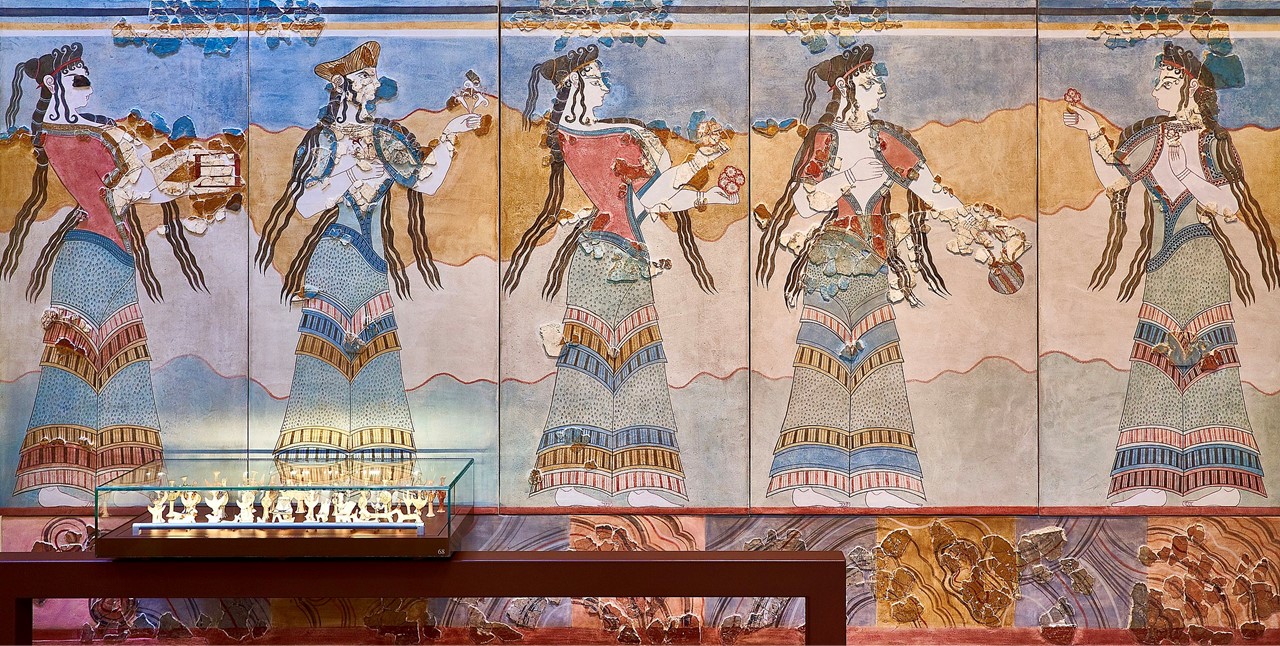
Procession of Mycenaean Female Worshippers from Kadmeia Palace of Thebes, c. 1400 BC, Wall Painting, Archaeological Museum of Thebes, Greece

Mycenaean Procession of Female Worshippers

Procession of Mycenaean Female Worshippers from Kadmeia Palace of Thebes, c. 1400 BC, Wall Painting, Archaeological Museum of Thebes, Greece
Procession of Mycenaean Female Worshippers from Kadmeia Palace of Thebes, c. 1400 BC, Wall Painting, Archaeological Museum of Thebes, Greece https://www.reddit.com/r/ArtefactPorn/comments/n6sgl8/mural_composition_showing_female_worshippers/

One of the most frequent themes in the Mycenaean wall painting is a procession of lifesize women in Minoan Dress (tight bodice with exposed breasts and flounced skirt), each figure bearing an offering and proceeding either to the left or right toward an unspecified goal, which was very likely a seated representation of the goddess. A circa 1400 BC fresco example, titled Mycenaean Procession of Female Worshippers comes, from the Kadmeia Palace in Thebes… and is exceptional! Three articles provided me with the necessary information so I can better understand the fresco’s importance. The same articles helped me codify six interesting facts about it… (see Bibliography)

Fact 1: Kadmeia Palace in Thebes was the nucleus of many important Greek Myths… it was connected to Gods and Heroes! The city of Thebes in ancient Greece has a rich mythological tradition. It starts with Kadmos, the Phoenician Prince, who searched for his abducted sister Europa and eventually settled in Boeotia, where he founded the city of Thebes, and built the first Palace. The myth of Oedipus, tragic in every aspect, and the riddle of the Sphinx, is equally known. The myth of the Seven Against Thebes revolves around the conflict between Eteocles and Polyneices, both sons of Oedipus, the fight over the rule of Thebes, and the heartbreaking end of Antigone, their sister, who became a symbol of resistance against unjust laws. Finally, the myth of Zeus, Semele, and Dionysus was closely connected to Thebes and the Palace of Kadmos.

Fact 2: The Greek archaeologist who discovered, in 1906, the Theban Palace, and subsequently the Procession of Female Worshipers fresco was Antonios Keramopoulos. In 1906 Antonios Keramopoulos was the first archaeologist to excavate, in the city of Thebes, a sizable and well-built, but burnt building of the Mycenaean period. He also discovered fragments of a Procession fresco, pieces of gold, agate or quartz artifacts, and numerous jars inscribed with the undeciphered then, Linear B script. Keramopoulos compared his discovery with similar discoveries in Mycenae or, for example, Pylos, and concluded that what he discovered was the Palace of Kadmos, the legendary founder of Thebes.

Architectural Plan of the Old Kadmeia Palace (Ground Floor ‘Court’ Area) in Thebes. The room marked with a blue Star is the area where the Procession fresco was found and The Archaeological site of the Palace in Thebes
Architectural Plan of the Old Kadmeia Palace (Ground Floor ‘Court’ Area) in Thebes. The room marked with a blue Star is the area where the Procession fresco was found.
The Archaeological site of the Palace in Thebes http://www.austriaca.at/0xc1aa5576_0x0032aa44.pdf and https://www.mthv.gr/en/beyond-the-museum/tour-in-thebes/the-archaeological-area-of-the-mycenaean-palace-of-thebes-%E2%80%98kadmeio%E2%80%99/

Fact 3: The Procession of Female Worshipers fresco was discovered in Room N (marked with a Blue Star) of the Old Kadmeia Palace. Early during the Keramopoulos excavations, fragments of fresco pieces were discovered in Room N (marked with a Blue Star in the Photo). These fragments employed both the buon fresco and the fresco al secco techniques. Keramopoulos decided that these fragments were part of a long, probably 14 m, fresco presenting a life-size Procession of Female Worshipers, facing both right and left.

Fact 4: The Procession of Female Worshipers fresco found in the Old Kadmeia Palace dates from the Early 14th century BC ( LH III A period, 1400-1300 BC). It is the oldest such fresco discovered in mainland Greece. The Procession of Female Worshipers fresco in the Theban Palace is the oldest wall painting discovered in Boetia. In 1978, Dr. Christos Boulotis embarked on fresh research regarding this fresco. During his investigation, he stumbled upon “forgotten” pieces stored in the warehouse of the Theban Museum. Dr. Boulotis added these fragments to the existing Procession fresco and reassembled the fresco’s composition. By conducting extensive research, comparisons with Mycenaean frescoes, and new local finds, Dr. Boulotis proposed a date of the 14th century BC for the fresco.

Fact 5: The Procession of Female Worshipers fresco in the Palace of Thebes marks the beginning of the Boaetian fresco School of Painting. Dr. Christos Boulotis once again proposed the Palace of Thebes to be established as the focal point of a Boetian workshop, responsible for disseminating innovative ideas in fresco painting across the Palatial areas of Central Greece. To support his proposition, Dr. Boulotis drew comparisons between frescoes found in the Theban Palace, such as the Procession of Female Worshipers, and those discovered in locations like Gla and Orchomenos. Additionally, Dr. Boulotis put forth the idea that groups of itinerant artists, initially from Crete, introduced the Minoan style of fresco painting to Palatial centers in the Peloponnese. The same groups trained local Mycenaean artists who then transmitted the newly developed Mycenaean style of fresco painting to Thebes. The presence of resemblances in patterns, compositions, and styles further suggests a high probability that these groups of traveling artists possessed “pattern/composition books” for their prospective clients to choose from.

Museum View of the ‘Procession of Mycenaean Female Worshippers’ from the Palace of Thebes, late 2000 BC, Wall Painting, Archaeological Museum of Thebes, Greece
Museum View of the ‘Procession of Mycenaean Female Worshippers’ from the Palace of Thebes, late 2000 BC, Wall Painting, Archaeological Museum of Thebes, Greece https://www.mthv.gr/en/permanent-exhibition/mycenaean-period/#image-1

Fact 6: The Procession of Female Worshipers fresco in the Palace of Thebes is the oldest and the finest in mainland Greece. It presents a life-size Procession of Women, finely dressed facing both right and left. The Theban fresco was originally 14 meters long, consisting of three zones: 1. a decorative band in the upper part, 2. the main composition, known as the Procession of Female Worshipers, in the middle, and 3. a lower decorative zone, imitating marble. Interestingly to note is that all pigments were from natural materials, red and ocher, for example, came from iron oxides, and black from carbon. Equally interesting, is that red pigment was used by the Mycenaean painter to outline each female figure.

According to Dr. Immerwahr’s description, the painters of the Theban Procession fresco were excellent draftsmen capable of depicting the human form in a conventional manner while infusing it with a dose of naturalism, allowing the figures to be shown in various positions. The depicted women appear to be wearing the traditional Minoan dress, which is colorful and exquisitely adorned with patterned borders. Their long wavy hair cascades loosely down to their narrow waists. They have spit curls fashioned across the forehead, twisted shoulder coils, and ponytails, some short and others longer. All the women wear fine jewelry, including necklaces and bracelets, each of which is individualized with round-shaped beads, lentoid shapes, or papyriform designs.

This is a large mural composition and a unique fresco of female worshipers striding majestically in two opposite directions, perhaps towards a central female deity who receives their offerings. Archaeologists were able to reconstruct five women from the original composition, one of them facing left, and the other four facing right. According to the latest reconstruction of the fresco, as exhibited in the Archaeological Museum in Thebes, the female worshiper facing left is posing, showing her chest frontally and holding wild roses. Two of the remaining four women facing right are depicted in profile, one of them holding a heavy casket with jewelry, and the other holding wild roses as well. The remaining two worshipers are depicted showing their frontal chests, holding lilies, and a luxury vase, perhaps filled with aromatic oil.

For a PowerPoint on the Mycenaean Procession of Female Worshippers Fresco, please… Check HERE!

Bibliography

1. Aegean Painting of the Bronze Age by Sara A. Immerwahr, The Pennsylvania State University Press, 1990 https://eclass.uoa.gr/modules/document/file.php/ARCH133/%CE%91%CF%81%CF%87%CE%B5%CE%AF%CE%B1%20%CE%B2%CE%B9%CE%B2%CE%BB%CE%B9%CE%BF%CE%B3%CF%81%CE%B1%CF%86%CE%AF%CE%B1%CF%82%20%CF%83%CE%B5%20pdf/Immerwahr%2C%20Aegean%20painting%20in%20the%20Bronze%20Age.pdf

2. Χρήστος Μπουλιώτης, Η Τέχνη των Τοιχογραφιών στη Μυκηναϊκή Βοιωτία, ΕΠΕΤΗΡΙΣ ΤΗΣ ΕΤΑΙΡΕΙΑΣ ΒΟΙΩΤΙΚΩΝ ΜΕΛΕΤΩ, ΤΟΜΟΣ Γ’, ΤΕΥΧΟΣ α’, Αθήνα, 2000 σελίδες 1095-1149 http://users.uoi.gr/gramisar/prosopiko/vlaxopoulos/epetiris.pdf

3. The House of Kadmos in Mycenaean Thebes Reconsidered: Architecture, Chronology, and Context by Anastasia Dakouri-Hild, The Annual of the British School at Athens, Vol. 96 (2001), pp. 81-122 (47 pages) https://www.jstor.org/stable/30073274

An interesting Video titled Mycenaean Thebes, by @HellenicCosmos… https://www.youtube.com/watch?v=rzqIHbCdydk

Villa Arianna Fresco of Flora, (Room W. 26),  1st century AD, fresco, 38x32 cm, from Villa Arianna in Stabiae, National Archaeological Museum of Naples, Italy

Flora

Villa Arianna Fresco of Flora, (Room W. 26),  1st century AD, fresco, 38x32 cm, from Villa Arianna in Stabiae, National Archaeological Museum of Naples, Italy
Villa Arianna Fresco of Flora, (Room W. 26),  1st century AD, fresco, 38×32 cm, from Villa Arianna in Stabiae, National Archaeological Museum of Naples, Italy
https://commons.wikimedia.org/wiki/File:Primavera_di_Stabiae.jpg

Love came to Flora asking for a flower / That would of flowers be undisputed queen, / The lily and the rose, long, long had been / Rivals for that high honor. Bards of power / Had sung their claims. “The rose can never tower / Like the pale lily with her Juno mien” — “But is the lily lovelier?” Thus between / Flower-factions rang the strife in Psyche’s bower. / “Give me a flower delicious as the rose / And stately as the lily in her pride” — But of what color?” — “Rose-red,” Love first chose, / Then prayed — “No, lily-white — or, both provide;”  / And Flora gave the lotus, “rose-red” dyed, / And “lily-white” — the queenliest flower that blows… writes the Indian poet Toru Dutt and I think of Flora my favorite fresco in Villa Arianna in Stabiae. https://allpoetry.com/Toru-Dutt

Where is Stabiae? Stabiae was an ancient Roman city, or rather a string of luxury villas stretching along the coast, located on the western side of Italy, in the modern-day region of Campania. It was well known for its luxurious villas and rich maritime trade. The city was destroyed by the eruption of Mount Vesuvius in 79 AD, along with the nearby city of Pompeii. The well-preserved remains of Stabiae, including frescoes and mosaics, offer a unique glimpse into the daily life and culture of ancient Rome. During the Archaic period (8th century BC) Stabiae already played an important strategic and commercial role. The city reached its highest population density between its destruction by Sulla (89 B.C.) and the eruption of Mount Vesuvius (79 A.D.). During this period, on the northernmost edge of the Varano hill, many Villas were built taking advantage of the panoramic views. They were mainly residential villas, with beautifully decorated large apartments, thermal baths, porticoes, and nymphaea. At present, only some of these villas, not entirely excavated yet, can be visited…

Information about Villa Arianna… On the western hills of Varano, and overlooking the Bay of Naples, Villa Arianna, is impressive, to say the least. It is estimated that it covered an area of over 11,000 sq.m., whereas its excavated parts cover only 2,500 sq.m. The villa has an unconventional layout, due in part to its continuous development but also to the sloping nature of the site. As much of the building is still buried, the original floor plan is quite difficult to interpret. Certainly, the main range of rooms was at the front of the highest of a series of terraces; some of these rooms featured views both of the sea on one side and of the mountains on the other. There was also a long tunnel (B) leading from the stables and farm court under the residential quarters to the shore. https://sites.google.com/site/ad79eruption/stabiae/villa-arianna

Excavations at Villa Arianna, When, How, and by Whom… Excavations in Villa Arianna started in 1757 and were conducted by the Swiss engineer Karl Weber, until 1762. At the time, the archaeological site of the Villa was seen more like a treasure hunt exploration site. The Weber team dug underground tunnels, explored the excavated areas, and whatever was discovered and considered of value, like furnishings and frescoes, were detached and taken to the Bourbon Museum at the Royal Palace of Portici. A lot, deemed unworthy or ruined, were left behind and much was ruined by the methods employed by the “archaeologists” of the time. Today, parts of the Villa nearest the sea have collapsed down the cliff and perished forever, extended areas of the site are still buried awaiting excavations, but thanks to a Bourbon-period map showing where tunnels were dug and thereafter re-buried, archaeologists resumed excavations in 1950, and proceed with proper scientific research.

Discuss the Fresco of Flora… Among the many treasures discovered in Villa Arianna is the fresco of Flora, exhibited today in the National Archaeological Museum of Naples. It is a 38×32 cm fresco, created for the triclinium area of the Villa (Room W. 26 in the Plan). The fresco depicts the goddess Flora, the Roman goddess of flowers and spring, surrounded by a variety of plants and flowers.

Villa Arianna Fresco of Flora, (Room W. 26),  1st century AD, fresco, 38x32 cm, from Villa Arianna in Stabiae, National Archaeological Museum of Naples, Italy
Villa Arianna Fresco of Flora (detail), (Room W. 26),  1st century AD, fresco, 38×32 cm, from Villa Arianna in Stabiae, National Archaeological Museum of Naples, Italy https://mariasannino.com/2021/03/08/la-fanciulla-che-coglie-fiori/

In vibrant colors, intricate details, and naturalistic depictions of plants and flowers, the lovely Flora, a young girl shown with her back to us, delicately gathering spring flowers, is a fine example of the 3rd Pompeian style in painting. Barefoot with a light step, her veil and the hem of her dress floating in the air, Flora turns suddenly to the side to pick a spring from a thin shrub with white flowers. Shown in a relaxed and carefree manner, the goddess is thought to reflect the changing cultural attitudes of the time, the increasing wealth and luxury of the Roman Empire, and may suggest a greater appreciation for the beauty and abundance of nature in ancient Campania!

For a Student Activity, please… Check HERE!