Patriarch Joseph II of Constantinople

Tomb of Joseph II Patriarch of Constantinople, Florentine sculptor, 1440, Santa Maria Novella, Florence
Painted Portrait of Patriarch Joseph II of Constantinople, 1590-92, Santa Maria Novella, Florence, Italy
Photo credit: Amalia Spiliakou, April 2025

Patriarch Joseph II of Constantinople was a pivotal figure in the history of the Eastern Orthodox Church, most notably for his participation in the Council of Ferrara-Florence (1438–1439), a major attempt to reconcile the long-standing schism between the Eastern and Western Christian churches. As the spiritual leader of the Eastern delegation, he played a crucial role in the theological dialogues aimed at achieving ecclesiastical unity. Though the union was short-lived, his involvement marked a significant moment of engagement between East and West. Patriarch Joseph II passed away during the council in Florence in 1439, and fittingly, his tomb remains in the Dominican church of Santa Maria Novella, an enduring symbol of his commitment to bridging divided faiths.

Born around 1360, likely in Constantinople, he was of noble origin and possibly related, on his father’s side, to the Bulgarian royal family. Before rising to the patriarchate, Joseph became a monk on Mount Athos and later served as the Metropolitan of Ephesus. In 1416, he was elected Ecumenical Patriarch of Constantinople, leading the Orthodox Church during a time of both spiritual and geopolitical crisis as the Byzantine Empire faced increasing pressure from the advancing Ottoman Turks.

A staunch supporter of church unity, Joseph II was a central participant in the Council of Ferrara-Florence (1438–1445), convened to heal the East-West Schism between the Orthodox and Roman Catholic Churches. His delegation sought Western military aid in exchange for theological concessions, a strategy driven by the empire’s desperate political situation. Despite his ill health, Joseph played a vital role in the negotiations, advocating dialogue and reconciliation. He died in Florence on June 10, 1439, before the council concluded, and was buried with honor in the church of Santa Maria Novella. His tomb remains there today, a rare and poignant symbol of his commitment to Christian unity and the enduring legacy of his leadership in a time of upheaval.

Although no literary or theological works by Patriarch Joseph II of Constantinople are known to have survived, his contemporaries spoke highly of his intellect and character. Ambrogio Traversari, in a letter dated February 20, 1438, praised him as venerable, so refined, with common sense, experience in life, and added, in my judgment, I think that today one could not find his like in all of Greece [Byzantium], noting that their conversation and the patriarch’s demeanor arouses respect. In Personalities of the Council of Florence, and Other Essays, Joseph Gill echoes this view, portraying Joseph II as a spiritually and intellectually vibrant leader despite his old age and deteriorating health. Nearly eight years old and suffering from heart disease, the Patriarch nonetheless demonstrated keen insight, prudent judgment, and steadfast dedication to the cause of church union until his death in Florence, shortly before the council concluded.

The Tomb of Patriarch Joseph II of Constantinople in the church of Santa Maria Novella, Florence, is a striking monument that reflects both historical reverence and artistic devotion. Created by a Florentine sculptor around 1440, the tomb commemorates the Eastern Patriarch who died in Florence during the Council of Florence, a major attempt at reunifying the Eastern and Western Churches. A later painted portrait (1590–92) complements the sculptural work, offering a vivid image of the patriarch. Ambrogio Traversari, a key figure in the council and admirer of Joseph II, described him with deep respect… The father is old, and, like his age, his grey hair, long beard and face make him a venerable figure to all who see him. This description is poignantly echoed in both the tomb and the painting, which together convey the spiritual dignity and serene wisdom of a man who symbolized unity and holiness at a crucial moment in church history. https://www.scribd.com/document/688389117/GILL-J-Personalities-of-the-Council-of-Florence-Joseph-II

For a Student Activity, please… Check HERE!

Saint Constantine in Arezzo

Piero della Francesca, 1416-1492
View of the Cappella Maggiore, 1452-66, Fresco, San Francesco, Arezzo, Italy – Photo Credit: Amalia Spiliakou, Spring 2025
Constantine’s face: https://www.wga.hu/frames-e.html?/html/p/piero/index.html

On the occasion of Saint Constantine’s name day, we turn our gaze to Piero della Francesca’s majestic fresco cycle, The Legend of the True Cross, in Arezzo. Painted in the mid-15th century on the walls of the Basilica of San Francesco, this monumental series draws from Jacopo da Varagine’s Legenda Aurea, a medieval text brought to life through della Francesca’s luminous palette, serene figures, and masterful use of perspective. Set against the familiar landscapes of Arezzo and Sansepolcro, the ten scenes trace the mythical journey of the wood of the Cross, from Eden to Jerusalem. Saint Constantine in Arezzo plays a pivotal role, both visionary and imperial. He is rendered with the calm authority and timeless grace that define della Francesca’s style—making this cycle not only a meditation on faith and history, but also a fitting tribute to the saint’s enduring legacy.

Piero della Francesca (c. 1412–1492) was born in the Tuscan town of Sansepolcro, where he would later return and spend much of his life. He likely received his early training in local workshops before working in Florence, where he encountered the innovations of artists such as Masaccio and Fra Angelico. By the 1440s, he had established himself as an independent master, receiving important commissions across central Italy. He painted for the courts of Ferrara, Rimini, and Urbino—centers of Renaissance humanism—most famously executing the fresco cycle The Legend of the True Cross in Arezzo between the 1450s and 1460s. His patrons included powerful figures like Sigismondo Malatesta and Federico da Montefeltro, the latter of whom he portrayed in one of his best-known portraits. In his later years, Piero devoted himself increasingly to writing treatises on mathematics and perspective, including De Prospectiva Pingendi and Libellus de Quinque Corporibus Regularibus. His eyesight deteriorated in old age, likely leading to the end of his painting career, and he died in his hometown in 1492. Giorgio Vasari praised him in his Lives of the Artists, calling him ‘a man so devoted to geometry and to the mathematical sciences, and so excellent in them, that he has left in writing many treatises which are no less useful than delightful.’ https://it.wikisource.org/wiki/Le_vite_de%27_pi%C3%B9_eccellenti_pittori,_scultori_e_architettori_(1568)/Piero_della_Francesca

Piero della Francesca, 1416-1492
View of the Cappella Maggiore, 1452-66, Fresco, San Francesco, Arezzo, Italy https://www.iguzzini.com/de/news/neues-licht-fur-piero-della-francesca/
View of the Cappella Maggiore, Photo Credit: Amalia Spiliakou, Spring 2025

The artist’s fresco cycle The Legend of the True Cross, is one of the masterpieces of Renaissance art. The cycle narrates the legendary history of the wood of the Cross, from the time of Adam to its rediscovery by Saint Helena. Executed with remarkable clarity, balance, and use of perspective, the frescoes reflect Piero’s intellectual engagement with geometry and humanist ideals. Among the most striking scenes is The Victory of Constantine over Maxentius, where Piero stages the miraculous triumph of Constantine, guided by a vision of the Cross in the sky. Bathed in soft, ethereal light, the battle scene showcases Piero’s mastery of atmosphere and foreshadows the spiritual power attributed to the relic, underscoring themes of divine intervention and the legitimacy of Christian rule.

Piero della Francesca, 1416-1492
View of the Cappella Maggiore, 1452-66, Fresco, San Francesco, Arezzo, Italy – Photo Credit: Amalia Spiliakou, Spring 2025

Giorgio Vasari, writing in the Lives of the Artists, offers a vivid and admiring account of Piero della Francesca’s depiction of the fresco at San Francesco in Arezzo. Vasari highlights Piero’s extraordinary ability to convey the psychological and physical intensity of battle, writing: “In this same story he effectively expressed in a battle the fear, the animosity, the dexterity, the strength and all the other emotions that can be considered in those who fight, and the accidents likewise, with an almost incredible slaughter of wounded, fallen and dead. In which, for having counterfeited in fresco the arms that shine, Peter deserves the greatest praise, no less than for having made on the other side, where there is the flight and submersion of Maxentius, a group of cavalry in foreshortening, so marvelously executed, that compared to those times they can be called too beautiful and too excellent.” Vasari is particularly struck by Piero’s anatomical precision, noting a “half-naked and half-dressed Saracen on a dry horse, very well discovered in anatomy, little known in his time.” The praise concludes with recognition of Piero’s impact on the city of Arezzo and his patrons: “For this work he deserved to be richly rewarded by Luigi Bacci… and to be, as he was afterwards, always loved and revered in that city, which had so illustrious his works.” Vasari’s words underscore the technical brilliance and emotional depth of Piero’s art, as well as its lasting cultural significance. https://it.wikisource.org/wiki/Le_vite_de%27_pi%C3%B9_eccellenti_pittori,_scultori_e_architettori_(1568)/Piero_della_Francesca

Piero della Francesca, 1416-1492
View of the Cappella Maggiore, 1452-66, Fresco, San Francesco, Arezzo, Italy – Photo Credit: Amalia Spiliakou, Spring 2025
Constantine’s face: https://www.wga.hu/frames-e.html?/html/p/piero/index.html
Piero della Francesca, 1416-1492
Constantine’s Victory over Maxentius, 1452-66, Fresco, San Francesco, Cappella Maggiore,Arezzo, Italy https://gr.pinterest.com/pin/736127501580922200/
Pisanello’s Medallion of Ioannis VIII Palaiologos, a loan from the Galleria Giorgio Franchetti at the Ca’ d’Oro, Venice, as exhibited in the Hôtel de la Marine, in Paris, France – Photo Credit: Amalia Spiliakou, March 2023

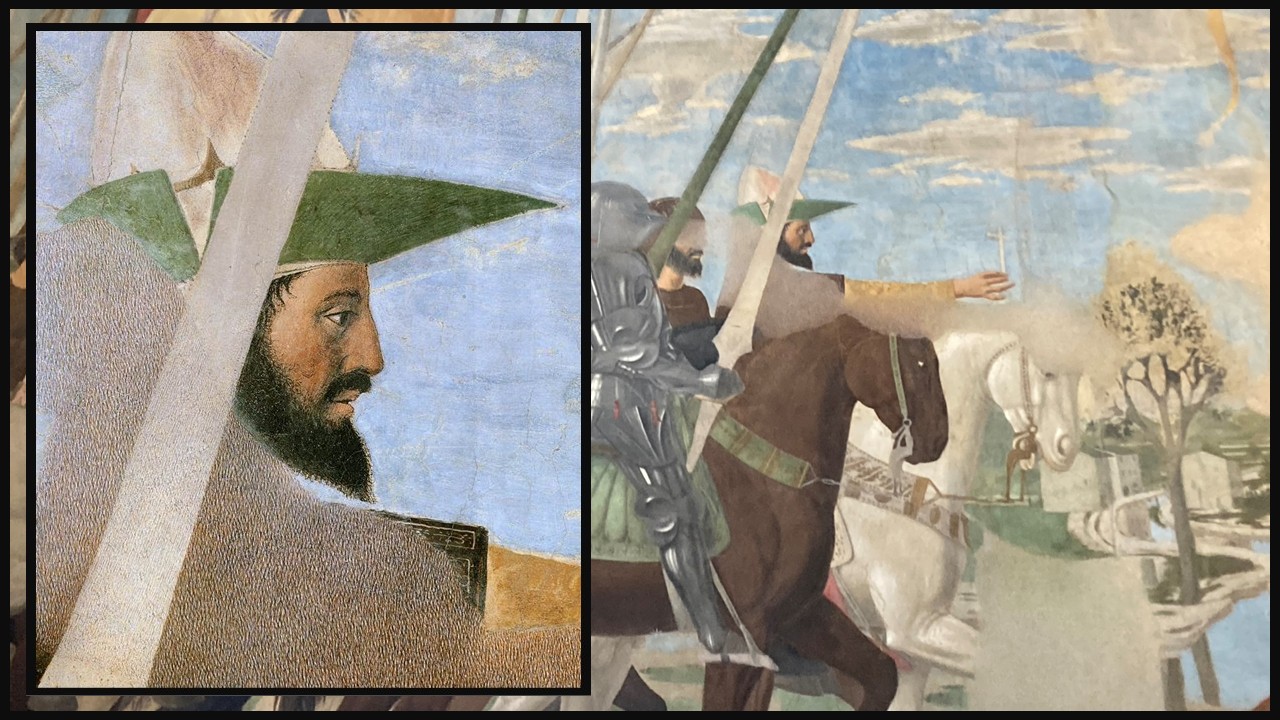
One of the most intriguing details in Piero della Francesca’s depiction of Emperor Constantine in The Victory over Maxentius is how closely the Roman leader resembles the Byzantine Emperor Ioannis VIII Palaiologos. Dressed in an ornate, exotic hat that echoes the imperial skaranikon worn by Palaiologos, Constantine seems less like a Roman general and more like a figure from the fading Byzantine court. The resemblance is especially striking when compared to Pisanello’s famous medallion of the Byzantine emperor, created during Ioannis’s visit to Italy in the 1430s. That historic journey, which brought the emperor to Florence in 1439 for the Council of Florence, a major attempt to reconcile the Eastern and Western Churches, had a profound impact on the cultural imagination of the time. His presence sparked fascination with Byzantine customs and appearances, influencing artists, intellectuals, and patrons alike. In this light, Piero’s portrayal of Constantine may be seen not only as a historical scene, but also as a subtle homage to a contemporary symbol of imperial dignity and spiritual unity, bridging the classical past with the complexities of Piero’s own era.

For a PowerPoint Presentation of Piero della Francesca’s frescoes in Cappella Maggiore, in the church of San Francesco in Arezzo, Italy, please… Check HERE!

For a teacher Curator BLOG POST on Byzantine Emperor Ioannis VIII Palaiologos, and his portrait on Pisanello’s famous Medallion, please Check… https://www.teachercurator.com/art/face-to-face-with-emperor-ioannis-viii-palaiologos/

Bibliography: https://museiarezzo.it/affreschi-di-piero-della-francesca/  

Pietro Lorenzetti's painting of the Crucifixion in the Lower Church, San Francesco, Assisi, Italy

Good Friday – ΜεγάληΠαρασκευή

Pietro Lorenzetti's painting of the Crucifixion in the Lower Church, San Francesco, Assisi, Italy
Pietro Lornzetti, ca. 1280-1348
Panoramic view of the frescoes,
1320-40, Fresco, Lower Church, San Francesco, Assisi, Italy – Photo Credit: Amalia Spiliakou, April 2025

Σήμερον κρεμᾶται ἐπὶ ξύλου ὁ ἐν ὕδασι τὴν γῆν κρεμάσας. Στέφανον ἐξ ἀκανθῶν περιτίθεται ὁ τῶν Ἀγγέλων Βασιλεύς. Ψευδῆ πορφύραν περιβάλλεται ὁ περιβάλλων τὸν οὐρανὸν ἐν νεφέλαις. Ῥάπισμα κατεδέξατο ὁ ἐν Ἰορδάνῃ ἐλευθερώσας τὸν Ἀδάμ. Ἥλοις προσηλώθη ὁ Νυμφίος τῆς Ἐκκλησίας. Λόγχῃ ἐκεντήθη ὁ Υἱὸς τῆς Παρθένου. Προσκυνοῦμέν σου τὰ Πάθη, Χριστέ. Δεῖξον ἡμῖν καὶ τὴν ἔνδοξόν σου Ἀνάστασιν/ (Good Friday – Μεγάλη Παρασκευή) Ἀντίφωνον ΙΒ΄ – ἦχος πλ. δ΄) http://www.hchc.edu/assets/files/CD/All_Creation_Trembled_ebook.pdf

Today he who hung the earth upon the waters is hung upon a Tree. He who is King of the Angels is arrayed in a crown of thorns. He who wraps the heaven in clouds is wrapped in mocking purple. He who freed Adam in the Jordan receives a blow on the face. The Bridegroom of the Church is transfixed with nails. The Son of the Virgin is pierced by a lance. We worship your Sufferings, O Christ. Show us also your glorious Resurrection. (Good Friday – Μεγάλη Παρασκευή Twelfth Antiphon – plagal fourth mode) http://www.hchc.edu/assets/files/CD/All_Creation_Trembled_ebook.pdf

Nestled within the hallowed walls of the Lower Church of San Francesco in Assisi, Pietro Lorenzetti’s Crucifixion fresco stands as a haunting yet masterful portrayal of sorrow, sacrifice, and divine transcendence. Painted in the early 14th century, this monumental work is a cornerstone of Lorenzetti’s artistic legacy, embodying the emotional intensity and narrative depth that defined Sienese painting. As part of the broader cycle of frescoes adorning the basilica, the Crucifixion transforms the left transept into a space of profound contemplation, where art and faith converge in striking realism and dramatic composition. In this post, we will explore the fresco’s artistic significance, its place within the basilica’s iconographic program, and the deeply human expressions that set Lorenzetti’s vision apart from his contemporaries.

Pietro Lorenzetti's painting of the Crucifixion in the Lower Church, San Francesco, Assisi, Italy
Pietro Lornzetti, ca. 1280-1348
Panoramic view of the frescoes,
1320-40, Fresco, Lower Church, San Francesco, Assisi, Italy https://www.wga.hu/frames-e.html?/html/l/lorenzet/pietro/index.html

The Basilica of San Francesco in Assisi is one of the most revered pilgrimage sites in Italy, built to honor Saint Francis of Assisi, the founder of the Franciscan Order. Constructed shortly after his canonization in 1228, the basilica is a masterpiece of medieval architecture, blending Romanesque solidity with the soaring elegance of early Gothic design. It consists of two distinct churches, the Upper Church, with its luminous frescoes by Giotto and Cimabue, and the Lower Church, a more intimate, shadowed space adorned with the works of Pietro Lorenzetti and Simone Martini. Beneath these sacred walls lies the Crypt of Saint Francis, drawing countless visitors who seek spiritual reflection and artistic inspiration. Beyond its role as a religious site, the basilica is a testament to the power of art in shaping faith, as its fresco cycles revolutionized narrative painting in the 13th and 14th centuries, setting a precedent for Renaissance masters to come.

Stepping into the Lower Church of San Francesco is like entering a sanctuary of shadow and splendor, where the interplay of dim light and rich color creates an atmosphere of deep reverence. In contrast to the soaring luminosity of the Upper Church, the Lower Church is a more intimate and solemn space, its vaulted ceilings and walls covered in some of the most exquisite fresco cycles of the 13th and 14th centuries. The Sienese masters Pietro Lorenzetti and Simone Martini, along with other painters, adorned the chapels and transepts with emotionally charged narratives from the life of Christ and the Virgin Mary, employing striking realism, dramatic gestures, and a masterful use of color. Lorenzetti’s Crucifixion and Deposition stand out for their raw human expression, while Martini’s elegant, courtly style infuses his frescoes with a lyrical grace. Gold accents, deep blues, and rich ochres further heighten the mystical aura, turning the church into a profound visual meditation on faith, sacrifice, and redemption.

Details of Pietro Lorenzetti's painting of the Crucifixion in the Lower Church, San Francesco, Assisi, Italy
Pietro Lornzetti, ca. 1280-1348
Panoramic view of the frescoes,
1320-40, Fresco, Lower Church, San Francesco, Assisi, Italy – Photo Credit: Amalia Spiliakou, April 2025

Pietro Lorenzetti’s Crucifixion in the Left Transept of the Lower Church of San Francesco is a profoundly dramatic and emotionally charged depiction of Christ’s suffering. Painted in the early 14th century, the fresco exemplifies Lorenzetti’s mastery of naturalism, spatial depth, and psychological intensity, setting it apart from the more hieratic Byzantine traditions. The composition is filled with raw human emotion. The anguished expressions of the gathered crowd, including Roman soldiers and sorrowful onlookers, heighten the sense of immediacy and realism. Lorenzetti employs bold foreshortening, dynamic gestures, and chiaroscuro effects to create depth and a sense of movement, drawing the viewer into the heart of the scene. The somber colour palette, dominated by earthy reds, deep blues, and stark contrasts, reinforces the tragic weight of the moment. As part of the broader fresco cycle in the transept, this Crucifixion not only serves as a meditation on Christ’s sacrifice but also marks a pivotal moment in the evolution of Sienese painting, bridging the gap between Gothic spirituality and the emerging naturalism that would shape the Renaissance.

For a PowerPoint Presentation of Pietro Lorenzetti’s oeuvre, please… Check HERE!

Bibliography: https://www.keytoumbria.com/Assisi/S_Francesco_LC_Transepts.html and https://www.visit-assisi.it/en/monuments/religious-buildings/papal-basilica-of-saint-francis-and-the-sacred-convent/

Pietro Lornzetti's fresco of .Entry of Christ into Jerusalem.

Palm Sunday fresco scene in Assisi

Pietro Lornzetti's fresco of .Entry of Christ into Jerusalem.
Pietro Lornzetti, ca. 1280-1348
Entry of Christ into Jerusalem, c. 1320, Fresco, Lower Church, View of the south arm of the western transept, San Francesco, Assisi, Italy https://www.wga.hu/html_m/l/lorenzet/pietro/1/1vault/1entry.html

Pietro Laurati (commonly known as Pietro Lorenzetti), an excellent painter of Siena, proved in his life how great is the contentment of the truly able, who feel that their works are prized both at home and abroad, and who see themselves sought after by all men, for the reason that in the course of his life he was sent for and held dear throughout all Tuscany… and Umbria, if I may add, as his Palm Sunday fresco scene in Assisi is truly magnificent! https://www.gutenberg.org/files/25326/25326-h/25326-h.htm

Pietro Lorenzetti was a renowned Sienese painter of the Early Renaissance, known for his expressive and naturalistic approach to religious art. Alongside his younger brother, Ambrogio Lorenzetti, he played a crucial role in advancing Sienese painting by incorporating elements of spatial depth and emotional realism, bridging the gap between Byzantine traditions and the emerging Renaissance style. His most celebrated works include the frescoes in the Lower Basilica of San Francesco in Assisi, notably the Palm Sunday scene and the Crucifixion of Christ, which showcase his mastery of dramatic composition and human expression. His contributions, along with those of Duccio and Simone Martini, helped define the distinctive elegance and narrative richness of Sienese art. Like many artists of his time, it is believed that Pietro fell victim to the Black Death around 1348, marking the end of an influential career that significantly shaped early Italian painting.

Pietro Lornzetti's view of the south arm of the western transept in the Lower Church of San Francesco, Assisi
Pietro Lornzetti, ca. 1280-1348
View of the south arm of the western transept, c. 1320, Fresco, Lower Church, View of the south arm of the western transept, San Francesco, Assisi https://arsartisticadventureofmankind.wordpress.com/tag/basilica-of-saint-francis-of-assisi/

The artist’s frescoes in the Lower Basilica of San Francesco in Assisi are among the most significant works of early 14th-century Italian painting. Commissioned as part of the extensive decorative program honoring St. Francis of Assisi, these frescoes depict various scenes from the Passion of Christ. Created between 1320 and 1340, they showcase Lorenzetti’s innovative approach to storytelling, blending the spiritual intensity of Gothic tradition with a heightened sense of realism. His compositions introduce a more profound emotional depth and spatial complexity compared to earlier Sienese paintings. Unfortunately, time and environmental factors have caused some deterioration, but the surviving sections still provide a remarkable glimpse into Lorenzetti’s mastery of fresco technique and his contribution to the evolution of Italian art.

Pietro Lornzetti fresco of the Deposition in the Lower Church, San Francesco, Assisi
Pietro Lornzetti, ca. 1280-1348
The Deposition, c. 1320, Fresco, Lower Church, San Francesco, Assisi, Italy https://arsartisticadventureofmankind.wordpress.com/tag/basilica-of-saint-francis-of-assisi/

Aesthetically, Lorenzetti’s frescoes in Assisi are striking for their dramatic use of chiaroscuro, spatial illusionism, and expressive human figures. Unlike the rigid and hieratic figures of earlier Byzantine-style painting, his characters convey deep emotion and dynamic movement, making the biblical narratives more immediate and relatable. The Deposition of Christ, for example, is renowned for its intense sorrow, as mourners delicately cradle Christ’s lifeless body in a composition that feels both weighty and fluid. His use of architectural elements to frame and organize space enhances the sense of depth, allowing figures to appear more grounded and three-dimensional. The naturalistic drapery, individualized facial expressions, and carefully observed gestures reveal a sophisticated understanding of human emotion and physicality, marking a significant step toward the artistic advancements of the Renaissance.

The Entry to Jerusalem fresco, part of Pietro’s cycle depicting the Passion of Christ in the Lower Basilica of San Francesco in Assisi, is a favourite example of his oeuvre, as it masterfully captures the dramatic moment when Christ enters Jerusalem, greeted by a crowd laying down garments and palm branches in reverence. The composition is notable for its structured yet dynamic arrangement, with Christ positioned centrally, riding a donkey, surrounded by his disciples and the expectant citizens of Jerusalem. Lorenzetti’s ability to create narrative clarity while maintaining a rich visual complexity is evident in the fresco’s layered depth and the variety of gestures that convey both reverence and excitement. The scene is framed by an architectural backdrop, suggesting an awareness of spatial organization, a characteristic that distinguishes Lorenzetti from earlier, more rigidly structured Byzantine-influenced compositions.

Pietro Lornzetti's fresco of the Entry of Christ into Jerusalem (details) in the Lower Church, San Francesco, Assisi
Pietro Lornzetti, ca. 1280-1348
Entry of Christ into Jerusalem (details), c. 1320, Fresco, Lower Church, San Francesco, Assisi, Italy https://commons.wikimedia.org/wiki/File:Pietro_Lorenzetti_-_Entry_of_Christ_into_Jerusalem_%28detail%29_-_WGA13504.jpg

Aesthetically, Lorenzetti’s Entry to Jerusalem is remarkable for its expressive realism, and innovative spatial depth. The figures, though arranged in a relatively shallow space, are rendered with a keen sense of individualization, each face reflecting distinct emotions ranging from joy to solemn contemplation. His use of chiaroscuro adds volume and weight to the figures, making them appear more three-dimensional, a technique that anticipates the later advancements of the Renaissance. The drapery of the garments flows naturally, and the figures interact convincingly within the setting, creating a sense of immediacy and liveliness. Additionally, Lorenzetti’s handling of colour and light enhances the emotional intensity of the scene—earthy tones provide warmth and depth, while brighter highlights emphasize key focal points, such as Christ and the welcoming crowd. This fresco not only reflects Lorenzetti’s technical mastery but also underscores his role in pushing Sienese painting beyond decorative elegance into a more humanized and spatially aware visual language.

For a PowerPoint Presentation of Pietro Lorenzetti’s oeuvre, please… Check HERE!

Tomb of Philosophers Fresco Paintings, Pella, Greece

Tomb of the Philosophers

Tomb of Philosophers Fresco Paintings, Pella, Greece
Tomb of Philosophers, c. 300 BC, Fresco Paintings, Pella, Greece
West Wall: Main figural frieze showing a man in a red himation with a wooden rod, pointing at a blue globe. North Wall: On the right side of the photo, a bearded man is depicted, absorbed in reading a papyrus roll. South Wall: On the left side of the photo, another wreathed, bearded ‘philosopher’ is vividly presented.
https://www.palaceofpella.gr/ancient-pella-the-areas-and-the-monuments/?lang=en

Nestled in the heart of ancient Pella, the Tomb of Philosophers stands as one of the most remarkable and enigmatic funerary monuments in Greece, dating back to circa 300 BC. As one of the largest cist-graves ever discovered, its unique decoration sets it apart from any other known ancient tomb. The six figures depicted on its walls, reminiscent of later Roman gatherings of philosophers, provide the earliest known portrayal of an intellectual tradition that links Pella’s vibrant cultural life to the Late Classical period. Among these depictions, a celestial globe suggests the deceased may have been a philosopher with an interest in astronomy or a patron of intellectual pursuits. Above them, scenes of horsemen and grave steles evoke Homeric funeral games, connecting the tomb to the epic, heroic past. The tomb’s intricate design and profound symbolism reflect the high level of cultural and intellectual development that defined ancient Pella, where philosophy and the sciences were integral to a humanist education.

Let’s explore the ‘who’, ‘where”, ‘when’ and ‘what’ of this amazing Hellenistic tomb by posing some questions!

Where is the Tomb of Philosophers located in ancient Pella? The Tomb of Philosophers is located in the ancient city of Pella, which was once the capital of the Macedonian Kingdom in northern Greece. Pella is situated in the region of Central Macedonia, approximately 40 kilometers west of modern-day Thessaloniki. Located in the region of the so-called Eastern Cemetery of Pella, the Tomb is situated just outside the city’s eastern walls. This area, used for burials from the mid-4th century BC until the early 1st century BC, became a principal necropolis following Pella’s major expansion in the late 4th century BC. The Eastern Cemetery is notable for its diverse funerary architecture, with cist graves being a predominant feature. These graves, often arranged in clusters and surrounded by enclosures with sculpted monuments, reflect the wealth and social complexity of the era. The Tomb of Philosophers (the burial chamber is 4.40 m long, 1.95 m wide and 3.00 m high) stands out among these for its exceptional decoration and significance, providing insight into the intellectual and cultural achievements of ancient Pella during its peak.

What is a Cist Tomb? A Cist Tomb is a type of ancient burial structure characterized by its box-like design, typically made of large stone slabs forming the walls, floor, and roof, or sometimes constructed with wood. These tombs were often hewn directly into rock or built within shallow pits and were commonly used for single or multiple burials. Frequently found in ancient cemeteries, cist tombs often contained grave goods such as pottery, jewelry, or personal items meant to accompany the deceased into the afterlife. In Pella’s Eastern Cemetery, Cist Tombs were a prominent feature, reflecting the wealth, social status, and cultural sophistication of the individuals buried within them.

Who was the owner of the Tomb of Philosophers located in ancient Pella? The owner of the Tomb of Philosophers in ancient Pella remains unknown, but the burial context offers intriguing insights. The tomb contained the remains of three individuals: a man in his forties, a woman in her thirties, and an infant. These findings suggest it was a family grave, likely serving as a resting place for multiple generations. The assumption that the family members died at different times aligns with the practice of reusing cist tombs over years, a common custom in ancient burial traditions. The artistic and intellectual significance of the tomb, combined with the presence of elaborate frescoes and symbolic elements such as a celestial globe, suggests the family belonged to the intellectual or social elite of Pella. The man, given the philosophical themes of the tomb, may have been a scholar, astronomer, or patron of knowledge, while the woman and infant reflect the familial connections integral to the tomb’s purpose.

What is depicted in the frescoes decorating the Tomb of Philosophers? The frescoes decorating the Tomb of Philosophers in ancient Pella are a testament to the intellectual and artistic sophistication of Macedonian society during the late Classical and early Hellenistic periods. The walls of the tomb feature a combination of architectural elements, ornamental motifs, and elaborate figurative compositions. These decorations reflect the philosophical and cosmological interests of the time, with the main iconographic theme centered around figures of literati or philosophers. The most striking element is a deep blue sphere depicted on the west wall, symbolizing celestial and cosmological themes, likely influenced by Aristotelian teachings and works like Aratus’s Phaenomena, written in Macedonia during the poet’s time at the court of Antigonus II Gonatas.

Detail from the Tomb of Philosophers Fresco Paintings, Pella, Greece
Tomb of Philosophers, South Wall, c. 300 BC, Fresco Paintings, Pella, Greece
https://x.com/ancientorigins/status/1585557691497418753

It is interesting to note that the Tomb frescoes illustrate the blending of symbolic and decorative elements to convey both personal identity and cultural values. The use of deep blue tones, floral patterns, and heroic imagery like galloping horsemen suggests a connection to both intellectual and heroic ideals. These visual elements not only commemorate the deceased but also serve as a testament to the vibrant intellectual and artistic achievements of ancient Pella, offering valuable insights into the social, philosophical, and aesthetic priorities of the Macedonian kingdom.

When was the Tomb of Philosophers discovered? The Tomb was unearthed in 2001 by the 17th Ephorate of Prehistoric and Classical Antiquities of Greece, under the leadership of its then-Director, Maria Lilimpaki-Akamati, alongside her team of collaborators.

For a PowerPoint of frescoes preserved in the Tomb of Philosophers in ancient Pella, please… Check HERE!

Bibliography: https://www.palaceofpella.gr/ancient-pella-the-areas-and-the-monuments/?lang=en and https://ejournals.epublishing.ekt.gr/index.php/tekmiria/article/view/36631/27647 and https://www.latsis-foundation.org/content/elib/book_18/pella_gr.pdf pp 185-186

Mycenaean warriors holding the Figure of Eight Shield.

The Figure of Eight Shield

Wall painting depicting the Figure of Eight Shield, 
Fresco from the Cult Center of the Acropolis 
of Mycenae.
Wall painting depicting the Figure of Eight Shield,
Fresco from the Cult Center of the Acropolis
of Mycenae, 1250-1180 BC, National Archaeological Museum
of Athens, Greece https://commons.wikimedia.org/wiki/File:Mycenaean_mural_
depicting_a_shield_at_the_National_Archaeological_Museum_of_Athens_on_October_26,_2021.jpg

The Figure of Eight Shield is a distinctive type of shield originating in the Aegean region, particularly prominent during the Late Bronze Age. Its unique design, resembling the number ‘8’, featured a curving outline that provided comprehensive protection while allowing for ease of movement. Typically constructed from a wooden frame, it was reinforced with layers of leather or metal to enhance durability and resistance in combat. This shield is closely associated with the warrior culture of Mycenaean Greece and is frequently depicted in frescoes and artifacts from that period, symbolizing both practicality and status in the martial practices of the time.

Let me present you with ’10 Facts’ about the amazing Figure of Eight Mycenaean Shields!

Unique Shape: The ‘Figure of Eight’ shield was shaped like two large, connected ovals, creating a narrow waist-like middle. This design not only made it visually distinctive but also allowed for a balance between size and ease of handling.

Large Size: These shields were massive, often covering a soldier from head to toe, providing extensive body protection. Their size was advantageous in phalanx formations or defensive stances but made them cumbersome in fast, mobile combat.

Construction Materials: The construction of the ‘Figure of Eight’ shields reflects the technological ingenuity of the Mycenaeans. The core of the shield was typically a wooden frame, chosen for its balance of strength and lightness, allowing the shield to remain functional despite its large size. The wooden frame was then covered with multiple layers of tightly stretched cowhide, often up to several layers thick, which added durability and the ability to absorb impact from weapons like spears and arrows. To further enhance their strength, some shields were reinforced with bronze fittings or edging. These metal elements made the shields more resistant to slashing or piercing blows, ensuring they could withstand the demands of battle. Additionally, the cowhide was sometimes treated with oils or other substances to make it more durable and less susceptible to wear from environmental factors like moisture. These materials worked in harmony to produce a shield that was both protective and flexible, suited for the needs of Mycenaean warriors in close combat or defensive formations.

Mycenaean warriors holding the Figure of Eight Shield.
Mycenaean warrior, complete with Boar’s Tusk Helmet and the Figure of Eight Shield, ca. 13th Century BC, Ivory, Archaeological Museum, Delos, Greece https://twitter.com/DocCrom/status/1264518112386396160
Mycenaean Dagger Blade with Hunters attacking Lions, c. 1,600-1,500 BC, inlaid in gold, silver and niello, National Archaeological Museum of Athens, Greece https://archeology.dalatcamping.net/the-bronze-legacy-unveiling-the-artistry-of-mycenaean-daggers/

Artistic Depictions: Artistic depictions of the ‘Figure of Eight’ shields are found in various media, including frescoes, pottery, and engraved seals, offering valuable insights into their role in Mycenaean and Minoan societies. Frescoes from palatial sites like Knossos and Tiryns often show warriors wielding these shields, emphasizing their importance in both warfare and ceremonial contexts. Seal engravings, frequently detailed and symbolic, also depict the shields, suggesting their association with elite status or divine protection. Such representations indicate that the shields were not just practical tools for defense but also symbols of power, prestige, and cultural identity in the Late Bronze Age.

Use in Warfare: The shield was designed for full-body protection, particularly in close combat or during sieges. Its large size made it especially effective against projectile weapons, though it required significant strength to wield.

Ceremonial and Symbolic Roles: These shields were likely used in rituals or as symbols of power, as seen in artistic representations. Their association with elite warriors or deities underscores their importance beyond mere battlefield use.

Origins and Chronology: The ‘Figure of Eight’ shield originated in the Late Bronze Age, around 1600 BCE, and was likely influenced by earlier Minoan designs. It fell out of use by the end of the Bronze Age as combat tactics evolved.

Flexibility and Mobility: The narrow middle of the shield allowed soldiers to maneuver it more easily despite its large size. This feature improved mobility in combat, making it versatile for both offense and defense.

Decline in Use: By the 12th century BCE, the ‘Figure of Eight’ shield was replaced by smaller, lighter designs like circular or tower shields. This change reflected the increasing importance of agility and individual mobility in warfare.

Connection to Homeric Epics: Homer’s descriptions of large shields, though generally round, may have been inspired by earlier designs like the ‘Figure of Eight.’ These shields serve as a link between Mycenaean warfare and later Greek military traditions.

For a PowerPoint on Student Activities inspired by the Mycenaean Shields, please… Check HERE!

The Dolphin Frieze fresco from the Mycenaean Acropolis of Gla

The Dolphin Frieze from the Mycenaean Acropolis of Gla

The Dolphin Frieze fresco from the Mycenaean Acropolis of Gla
Dolphin Frieze, Second half of the 13th century BC, Fresco, from the Mycenaean Acropolis of Gla in Boeotia, Archaeological Museum of Thebes, Greece – Photo Credit: Amalia Spiliakou, February 19, 2024

On February 19, 2024, I fulfilled a long-awaited wish by visiting the Archaeological Museum of Thebes, one of Greece’s most significant archaeological museums. The collections, some of which are rare or unique, have been on my bucket list for quite some time. These artefacts, originating from excavations across Boeotia, span from the Paleolithic era to post-Byzantine times, providing a comprehensive view of the region’s cultural history. The Dolphin Frieze from the Mycenaean Acropolis of Gla was at the top of my list; seeing it in person was a moment of sheer delight and fulfilment.

The Mycenaean period is of profound significance in both art and history, acting as a vital cultural link between the Bronze Age civilizations of the Aegean and the classical world of ancient Greece. Artefacts from this era, ranging from architecture to fresco painting and pottery, illuminate the emergence of distinct artistic styles and techniques that greatly influenced classical Greek artistry. Mycenaean builders demonstrated their prowess through the construction of grand palaces, robust fortifications, and imposing tombs, showcasing advanced architectural and engineering capabilities. Their vibrant fresco paintings, characterized by bold depictions of figures, animals, and geometric patterns, stand as a testament to their artistic abilities. Moreover, the Mycenaean civilization played a pivotal role in shaping the socio-political landscape of ancient Greece, laying the groundwork for the development of Greek culture and identity.

Model of the Archaeological site of Gla, Archaeological Museum of Thebes, Greece
https://commons.wikimedia.org/wiki/File:Gla_-_Modell_of_archaeological_site.JPG

The least known of all Mycenaean Palaces is probably that of Gla in Central Greece. Perched atop a rugged hill, the Mycenaean Acropolis of Gla is a site of historical and archaeological significance dating back to the Late Bronze Age. This fortified settlement, strategically positioned on the Boeotian plain jutted into Lake Kopais (now drained) or formed an island within it. It served as a vital center of the Mycenaean civilization, showcasing the architectural prowess and strategic foresight of its ancient inhabitants. With its imposing Cyclopean Walls, about 3 m thick, and 2.8 km long, enclosing about 235,000 square meters of land, and commanding views, the Acropolis of Gla stands as a testament to the military and cultural achievements of the Mycenaeans, offering invaluable insights into their society, economy, and interactions within the broader Aegean world.

The Acropolis of Gla is famously associated with the ambitious endeavour to drain Lake Kopais, a feat considered unparalleled in Bronze Age antiquity, highlighting the advanced technical knowledge possessed by Mycenaean engineers. It is also known for its sheer magnitude and complexity. Encircled by robust Cyclopean Walls featuring four gates constructed from imposing stone blocks, Gla reigns as the largest fortified Mycenaean Acropolis within Greek territory. Less known, but equally important is the site’s residential area, a sprawling L-shaped edifice, often hailed as a ‘Palace’, and situated in the site’s northern expanse. Built atop an engineered plateau, this ‘Palace’ or, Melathron’, unfolds into three distinct sections, featuring a layout reminiscent of the renowned Megaron structures found in ancient centers like Tiryns, Mycenae, and Pylos. However, the absence of hallmark Mycenaean Palace elements, specifically a “throne room”, a circular hearth, and a “bathroom”, raises questions about its classification as a fully-fledged Mycenaean Megaron.

Among the buildings’ debris, archaeologists discovered as early as 1893, evidence of a wastewater system, unique clay roof tiles suggesting pitched roofs, and evidence of decorative wall frescoes, damaged and fragmentary, but extremely precious. Today, these fragments, discovered in the elongated East Wing of the South Enclosure, during excavations conducted by S. Iakovidis, in the early 1980s and 1990s are exhibited in the Archaeological Museum of Thebes. The most remarkable of these fragments show diving Dolphins and parts of other maritime scenes, including large Argonauts. These fresco fragments were expertly reconstructed by Christos Boulotis. (See Bibliography)

The Dolphin Frieze fresco from the Mycenaean Acropolis of Gla
Dolphin Frieze, Second half of the 13th century BC, Fresco, from the Mycenaean Acropolis of Gla in Boeotia, Archaeological Museum of Thebes, Greece – Photo Credit: Amalia Spiliakou, February 19, 2024

The Dolphin Fresco from the Mycenaean Acropolis of Gla is a remarkable artefact that showcases an unusual naturalism and a sophisticated understanding of marine life, captured through the depiction of Dolphins with an astonishing level of detail and realism. These elegant creatures, spanning 75 to 80 cm in height, are painted against a vivid blue background, highlighting their dynamic forms and graceful postures. The Dolphins, numbering between six and seven, are depicted in a uniform size and posture, their bodies elegantly curved into open arches or crescents, embodying the fluidity and grace of living dolphins. Their upper bodies are painted black, featuring a triangular dorsal fin, while their bellies are a contrasting white, delineated from the black with yellow stripes. Their eyes are almond-shaped, set against a yellow background, adding a striking detail to their overall appearance.

The use of colours in the Gla Dolphins fresco draws closer to the real hues of these marine creatures, with the black, white, and yellow providing a stark contrast to the deep blue sea they inhabit. This colour choice not only enhances the naturalism of the scene but also demonstrates the Mycenaeans’ advanced skills in pigment selection and application. Indeed, recent analyses have revealed the use of rare, imported lapis lazuli mixed with hematite and possibly an organic colour derived from murex, underscoring the significant effort and resources devoted to achieving the fresco’s vibrant colours.

This fresco, along with other Dolphin Paintings of the Aegean Bronze Age period demonstrates a persistence of themes drawn from nature within Mycenaean art, suggesting a deep-rooted appreciation for the natural world. The Gla Dolphins, with their lifelike appearance and intricate detailing, stand as a testament to the Mycenaean civilization’s artistic prowess and their enduring fascination with the sea and its inhabitants.

For a Student Activity, inspired by the Dolphin Freeze, please… Check HERE!

Bibliography: Christos Boulotis, Reconstructing a Dolphin Frieze and Argonauts from the Mycenaean Citadel of Gla, ΜΕΛΕΤΗΜΑΤΑ 72, Mycenaean Wall Painting in Context, National Hellenic Research Foundation, Athens, 2015, pp. 371… https://www.academia.edu/39148590/RECONSTRUCTING_A_DOLPHIN_FRIEZE_AND_ARGONAUTS_FROM_THE_MYCENAEAN_CITADEL_OF_GLA_In_MYCENAEAN_WALL_PAINTING_IN_CONTEXT_ATHENS_2015_371_403

Procession of Mycenaean Female Worshippers from Kadmeia Palace of Thebes, c. 1400 BC, Wall Painting, Archaeological Museum of Thebes, Greece

Mycenaean Procession of Female Worshippers

Procession of Mycenaean Female Worshippers from Kadmeia Palace of Thebes, c. 1400 BC, Wall Painting, Archaeological Museum of Thebes, Greece
Procession of Mycenaean Female Worshippers from Kadmeia Palace of Thebes, c. 1400 BC, Wall Painting, Archaeological Museum of Thebes, Greece https://www.reddit.com/r/ArtefactPorn/comments/n6sgl8/mural_composition_showing_female_worshippers/

One of the most frequent themes in the Mycenaean wall painting is a procession of lifesize women in Minoan Dress (tight bodice with exposed breasts and flounced skirt), each figure bearing an offering and proceeding either to the left or right toward an unspecified goal, which was very likely a seated representation of the goddess. A circa 1400 BC fresco example, titled Mycenaean Procession of Female Worshippers comes, from the Kadmeia Palace in Thebes… and is exceptional! Three articles provided me with the necessary information so I can better understand the fresco’s importance. The same articles helped me codify six interesting facts about it… (see Bibliography)

Fact 1: Kadmeia Palace in Thebes was the nucleus of many important Greek Myths… it was connected to Gods and Heroes! The city of Thebes in ancient Greece has a rich mythological tradition. It starts with Kadmos, the Phoenician Prince, who searched for his abducted sister Europa and eventually settled in Boeotia, where he founded the city of Thebes, and built the first Palace. The myth of Oedipus, tragic in every aspect, and the riddle of the Sphinx, is equally known. The myth of the Seven Against Thebes revolves around the conflict between Eteocles and Polyneices, both sons of Oedipus, the fight over the rule of Thebes, and the heartbreaking end of Antigone, their sister, who became a symbol of resistance against unjust laws. Finally, the myth of Zeus, Semele, and Dionysus was closely connected to Thebes and the Palace of Kadmos.

Fact 2: The Greek archaeologist who discovered, in 1906, the Theban Palace, and subsequently the Procession of Female Worshipers fresco was Antonios Keramopoulos. In 1906 Antonios Keramopoulos was the first archaeologist to excavate, in the city of Thebes, a sizable and well-built, but burnt building of the Mycenaean period. He also discovered fragments of a Procession fresco, pieces of gold, agate or quartz artifacts, and numerous jars inscribed with the undeciphered then, Linear B script. Keramopoulos compared his discovery with similar discoveries in Mycenae or, for example, Pylos, and concluded that what he discovered was the Palace of Kadmos, the legendary founder of Thebes.

Architectural Plan of the Old Kadmeia Palace (Ground Floor ‘Court’ Area) in Thebes. The room marked with a blue Star is the area where the Procession fresco was found and The Archaeological site of the Palace in Thebes
Architectural Plan of the Old Kadmeia Palace (Ground Floor ‘Court’ Area) in Thebes. The room marked with a blue Star is the area where the Procession fresco was found.
The Archaeological site of the Palace in Thebes http://www.austriaca.at/0xc1aa5576_0x0032aa44.pdf and https://www.mthv.gr/en/beyond-the-museum/tour-in-thebes/the-archaeological-area-of-the-mycenaean-palace-of-thebes-%E2%80%98kadmeio%E2%80%99/

Fact 3: The Procession of Female Worshipers fresco was discovered in Room N (marked with a Blue Star) of the Old Kadmeia Palace. Early during the Keramopoulos excavations, fragments of fresco pieces were discovered in Room N (marked with a Blue Star in the Photo). These fragments employed both the buon fresco and the fresco al secco techniques. Keramopoulos decided that these fragments were part of a long, probably 14 m, fresco presenting a life-size Procession of Female Worshipers, facing both right and left.

Fact 4: The Procession of Female Worshipers fresco found in the Old Kadmeia Palace dates from the Early 14th century BC ( LH III A period, 1400-1300 BC). It is the oldest such fresco discovered in mainland Greece. The Procession of Female Worshipers fresco in the Theban Palace is the oldest wall painting discovered in Boetia. In 1978, Dr. Christos Boulotis embarked on fresh research regarding this fresco. During his investigation, he stumbled upon “forgotten” pieces stored in the warehouse of the Theban Museum. Dr. Boulotis added these fragments to the existing Procession fresco and reassembled the fresco’s composition. By conducting extensive research, comparisons with Mycenaean frescoes, and new local finds, Dr. Boulotis proposed a date of the 14th century BC for the fresco.

Fact 5: The Procession of Female Worshipers fresco in the Palace of Thebes marks the beginning of the Boaetian fresco School of Painting. Dr. Christos Boulotis once again proposed the Palace of Thebes to be established as the focal point of a Boetian workshop, responsible for disseminating innovative ideas in fresco painting across the Palatial areas of Central Greece. To support his proposition, Dr. Boulotis drew comparisons between frescoes found in the Theban Palace, such as the Procession of Female Worshipers, and those discovered in locations like Gla and Orchomenos. Additionally, Dr. Boulotis put forth the idea that groups of itinerant artists, initially from Crete, introduced the Minoan style of fresco painting to Palatial centers in the Peloponnese. The same groups trained local Mycenaean artists who then transmitted the newly developed Mycenaean style of fresco painting to Thebes. The presence of resemblances in patterns, compositions, and styles further suggests a high probability that these groups of traveling artists possessed “pattern/composition books” for their prospective clients to choose from.

Museum View of the ‘Procession of Mycenaean Female Worshippers’ from the Palace of Thebes, late 2000 BC, Wall Painting, Archaeological Museum of Thebes, Greece
Museum View of the ‘Procession of Mycenaean Female Worshippers’ from the Palace of Thebes, late 2000 BC, Wall Painting, Archaeological Museum of Thebes, Greece https://www.mthv.gr/en/permanent-exhibition/mycenaean-period/#image-1

Fact 6: The Procession of Female Worshipers fresco in the Palace of Thebes is the oldest and the finest in mainland Greece. It presents a life-size Procession of Women, finely dressed facing both right and left. The Theban fresco was originally 14 meters long, consisting of three zones: 1. a decorative band in the upper part, 2. the main composition, known as the Procession of Female Worshipers, in the middle, and 3. a lower decorative zone, imitating marble. Interestingly to note is that all pigments were from natural materials, red and ocher, for example, came from iron oxides, and black from carbon. Equally interesting, is that red pigment was used by the Mycenaean painter to outline each female figure.

According to Dr. Immerwahr’s description, the painters of the Theban Procession fresco were excellent draftsmen capable of depicting the human form in a conventional manner while infusing it with a dose of naturalism, allowing the figures to be shown in various positions. The depicted women appear to be wearing the traditional Minoan dress, which is colorful and exquisitely adorned with patterned borders. Their long wavy hair cascades loosely down to their narrow waists. They have spit curls fashioned across the forehead, twisted shoulder coils, and ponytails, some short and others longer. All the women wear fine jewelry, including necklaces and bracelets, each of which is individualized with round-shaped beads, lentoid shapes, or papyriform designs.

This is a large mural composition and a unique fresco of female worshipers striding majestically in two opposite directions, perhaps towards a central female deity who receives their offerings. Archaeologists were able to reconstruct five women from the original composition, one of them facing left, and the other four facing right. According to the latest reconstruction of the fresco, as exhibited in the Archaeological Museum in Thebes, the female worshiper facing left is posing, showing her chest frontally and holding wild roses. Two of the remaining four women facing right are depicted in profile, one of them holding a heavy casket with jewelry, and the other holding wild roses as well. The remaining two worshipers are depicted showing their frontal chests, holding lilies, and a luxury vase, perhaps filled with aromatic oil.

For a PowerPoint on the Mycenaean Procession of Female Worshippers Fresco, please… Check HERE!

Bibliography

1. Aegean Painting of the Bronze Age by Sara A. Immerwahr, The Pennsylvania State University Press, 1990 https://eclass.uoa.gr/modules/document/file.php/ARCH133/%CE%91%CF%81%CF%87%CE%B5%CE%AF%CE%B1%20%CE%B2%CE%B9%CE%B2%CE%BB%CE%B9%CE%BF%CE%B3%CF%81%CE%B1%CF%86%CE%AF%CE%B1%CF%82%20%CF%83%CE%B5%20pdf/Immerwahr%2C%20Aegean%20painting%20in%20the%20Bronze%20Age.pdf

2. Χρήστος Μπουλιώτης, Η Τέχνη των Τοιχογραφιών στη Μυκηναϊκή Βοιωτία, ΕΠΕΤΗΡΙΣ ΤΗΣ ΕΤΑΙΡΕΙΑΣ ΒΟΙΩΤΙΚΩΝ ΜΕΛΕΤΩ, ΤΟΜΟΣ Γ’, ΤΕΥΧΟΣ α’, Αθήνα, 2000 σελίδες 1095-1149 http://users.uoi.gr/gramisar/prosopiko/vlaxopoulos/epetiris.pdf

3. The House of Kadmos in Mycenaean Thebes Reconsidered: Architecture, Chronology, and Context by Anastasia Dakouri-Hild, The Annual of the British School at Athens, Vol. 96 (2001), pp. 81-122 (47 pages) https://www.jstor.org/stable/30073274

An interesting Video titled Mycenaean Thebes, by @HellenicCosmos… https://www.youtube.com/watch?v=rzqIHbCdydk