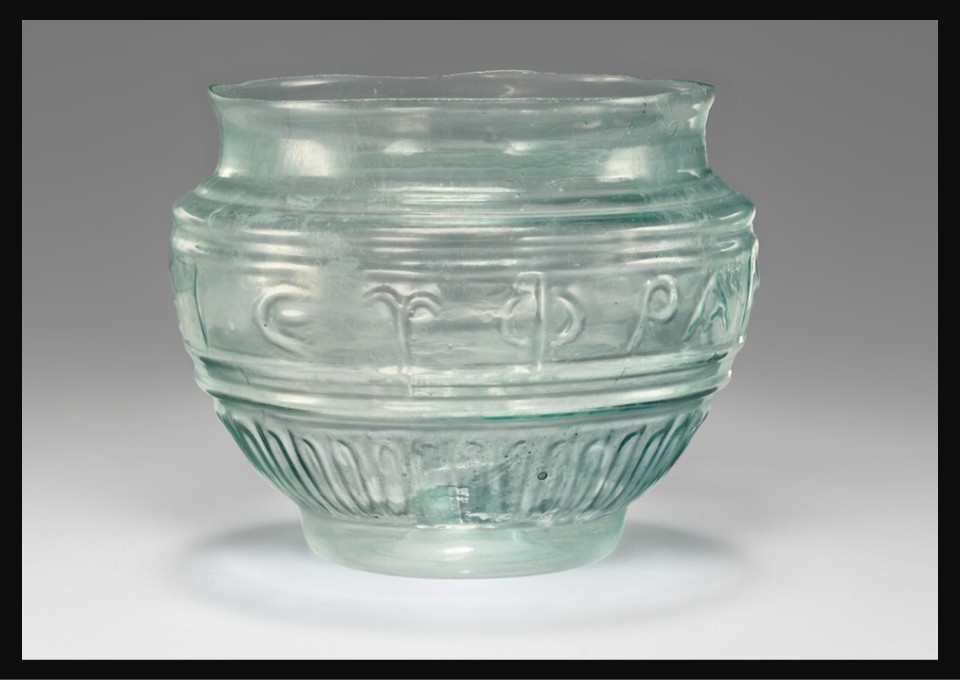
Mold-blown cup, first half of 1st century AD, Glass, Hight: 6.9 cm, Getty Villa, CA, USA
https://www.getty.edu/art/collection/object/10400N
The name of the Master Glassmaker Ennion appears on some of the most remarkable glass vessels of the early Roman Empire. Active during the first half of the 1st century AD, Ennion is widely regarded as one of the most innovative craftsmen in the history of ancient glass. Although little is known about his life, scholars generally believe that he worked in the eastern Mediterranean, possibly in the Phoenician city of Sidon, an important center of glass production in antiquity. What distinguishes Ennion from many other ancient artisans is that he signed his works, proudly proclaiming authorship at a time when craftsmen rarely did so.
Glassblowing itself had been invented only a few decades earlier, around the mid-1st century BC, probably in the Syro-Palestinian region. The technique revolutionized glass production, allowing vessels to be made more quickly and in greater numbers than before. Early Roman glassmakers soon began experimenting with blowing molten glass into decorated molds, a process known as mold-blown glass. In this method, a gather of hot glass was placed into a carved mold and then expanded by blowing through a pipe so that the soft glass pressed against the mold’s interior surface. Once removed, the vessel retained the mold’s relief decoration.
Ennion appears to have been one of the earliest and most accomplished masters of this technique. His molds often included carefully arranged decorative zones, bands of vegetal motifs, geometric patterns, and framed panels containing inscriptions. These inscriptions frequently read “ΕΝΝΙΩΝ ΕΠΟΙΗΣΕΝ” (“Ennion made it”) or similar formulas, which not only identified the maker but also functioned as a kind of ancient brand mark. The precision of the molds and the clarity of the relief suggest a highly organized workshop capable of producing vessels that were both technically sophisticated and visually striking. Finds of Ennion-signed glass across the Mediterranean indicate that his products were widely traded throughout the Roman world.
A beautiful example illustrating the style associated with his workshop is a small mold-blown cup now in the J. Paul Getty Museum (Getty Villa).
Produced during the first half of the 1st century AD, this small mold-blown cup, described as Possibly from the Workshop of Ennion, is made of transparent glass ranging in color from blue to greenish blue. Its decoration is organized around a striking Greek inscription that encircles the body at its widest point, framed above and below by horizontal ribs. The inscription reads ΕΦΡΑΙΝΟΥ ΕΦΩ ΠΑΡΕΙ, which may be translated as “Be glad that you have come.” Beneath this band, the lower part of the vessel is decorated with closely spaced tonged ribs that create a rhythmic vertical texture. The base has a flat resting surface ornamented with concentric circles and is slightly pushed inward, forming a raised boss inside the cup. The rim is uneven, having been cracked off the blowpipe after inflation and later lightly finished by grinding once the vessel had cooled. The mold used to form the cup consisted of three separate sections, and the seams where these segments joined remain visible. Remarkably well preserved, with only a small chip on the rim and no surface iridescence, the vessel may have been placed in a grave as a funerary offering.
Although this cup does not preserve the famous signature of Ennion, its quality and decorative scheme closely resemble signed examples attributed to him. Objects like this reveal how a technical innovation, mold-blown glass, could become a vehicle for artistic creativity. Through his mastery of form, decoration, and technique, Ennion helped transform glass from a utilitarian material into a medium capable of elegance and prestige. Nearly two thousand years later, these fragile vessels continue to testify to the skill and ambition of one of antiquity’s most celebrated glassmakers.
For a PowerPoint Presentation of mold-blown glass vessels by Ennion, please… Check HERE!
Bibliography: The J. Paul Getty Museum Journal: Volume 24, 1996 https://books.google.gr/books?id=oHAmAgAAQBAJ&printsec=frontcover&redir_esc=y#v=onepage&q&f=false – Interview with Christopher S. Lightfoot, Author and Curator of Ennion: Master of Roman Glass https://yalebooks.yale.edu/2015/01/13/interview-with-christopher-s-lightfoot-author-and-curator-of-ennion-master-of-roman-glass/ – Exhibition of Mold-Blown Glass from Ancient Rome Organized by The Corning Museum of Glass https://press.cmog.org/2014/largest-ever-exhibition-mold-blown-glass-ancient-rome-organized – the 2015 Exhibition Catalogue Ennion: Master of Roman Glass at The Metropolitan Museum of Art, New York https://www.metmuseum.org/met-publications/ennion-master-of-roman-glass
Teacher Curator. Blue Glass Amphoriskos from Pompeii (Blog Post). Teacher Curator Blog, August 8, 2020 https://www.teachercurator.com/roman-art/blue-glass-amphoriskos-from-pompeii/