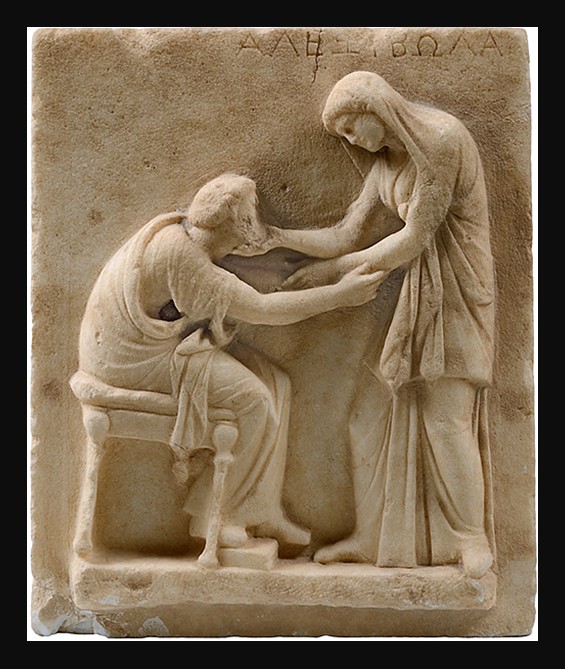
Funerary Stele of Alexibola

Alexibola: Funerary Stele with Scene of Greeting, early 3rd century BC, Marble, Archaeological Museum of Thera, Greece
https://www.ias.edu/ideas/2017/chaniotis-world-of-emotions

Among the treasures of the Archaeological Museum of Thera, the Funerary Stele of Alexibola stands out as a moving testament to the emotional depth of Classical Greek art. Carved in marble in the early 3rd century BC, the relief depicts Alexibola, the deceased, standing before a seated older man, probably her father, as they exchange a final, tender farewell. The woman’s gesture, gently touching the man’s beard, is met by his reciprocal touch on her arm, creating a moment of quiet intimacy and profound affection. Their calm expressions and composed postures convey sorrow and love without excess, embodying the Greek ideal of dignity even in grief.

Displayed in the acclaimed 2017 exhibition “A World of Emotions: Greece, 700 BC–AD 200” (Onassis Cultural Center, New York; Acropolis Museum, Athens), this stele beautifully illustrates how emotion was central to Greek experience. As curator Angelos Chaniotis observed, emotions shaped Greek culture no less than reason. The stele of Alexibola reveals how artists of the Classical world captured not only the likeness of individuals but also the enduring human capacity for feeling, transforming private loss into timeless art.

Funerary stelae held a vital place in ancient Greek art, serving as both commemorations of the dead and reflections of deeply personal emotion within a public setting. These marble reliefs, often depicting the deceased in moments of quiet interaction with loved ones, reveal how the Greeks balanced restraint and feeling, translating private grief into graceful, idealized form. Rather than dramatic displays of sorrow, they communicate emotion through subtle gestures: a clasped hand, a downward gaze, or a tender touch. The Stele of Alexibola exemplifies this tradition perfectly, its depiction of a final farewell between a daughter and her father transforms the pain of parting into a timeless image of love, respect, and composure. Through such works, Greek artists gave emotional depth to stone, reminding viewers that even in death, the bonds of human affection endure.
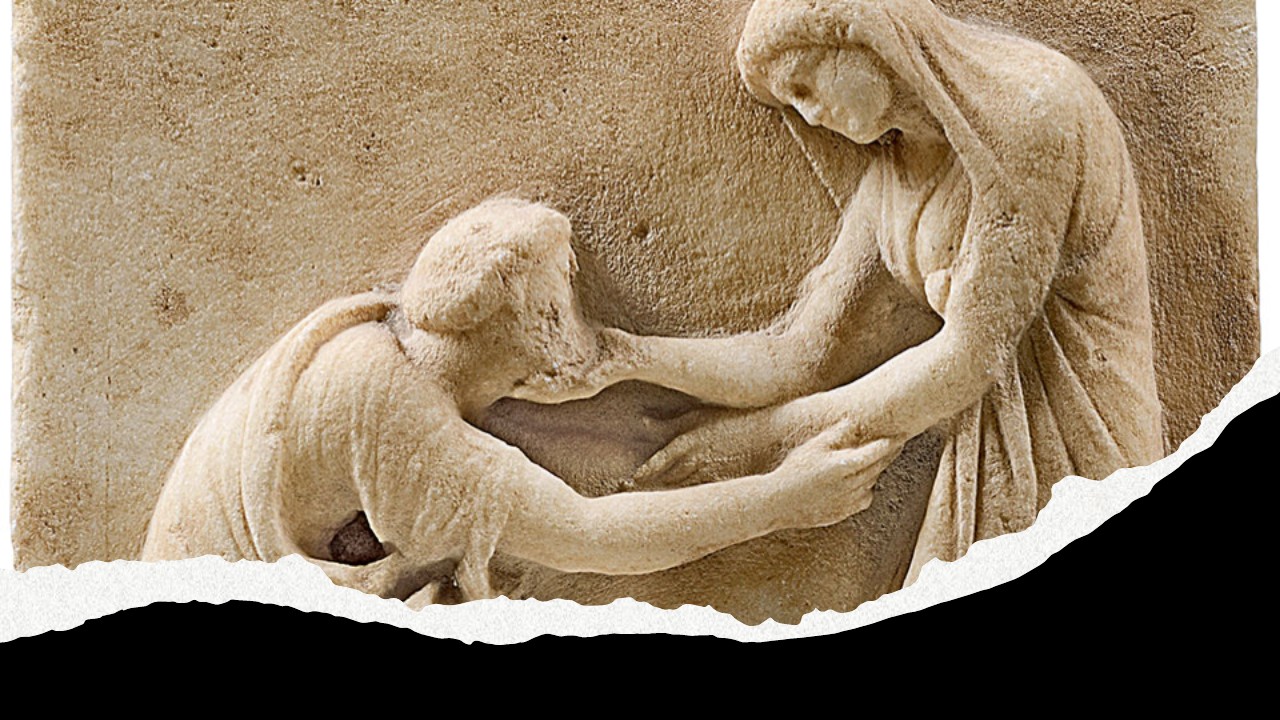
The Funerary Stele of Alexibola was discovered on the Cycladic island of Thera, modern Santorini, an island that has long held a significant place in the history of Greek art and culture. Thera was a thriving center of Aegean civilization, strategically located between Crete and mainland Greece, and its artistic legacy reflects this blend of influences. From the vivid frescoes of the prehistoric settlement at Akrotiri, which reveal a sophisticated visual culture rivaling that of Minoan Crete, to later Classical and Hellenistic sculptures such as the stele of Alexibola, Thera demonstrates the island’s continuous engagement with the broader artistic currents of the Greek world. The stele itself embodies the island’s role as both participant in and preserver of Greek aesthetic value, melding technical mastery with emotional subtlety, and reminding us that even on this volcanic outpost, art served as a bridge between personal memory and collective tradition.
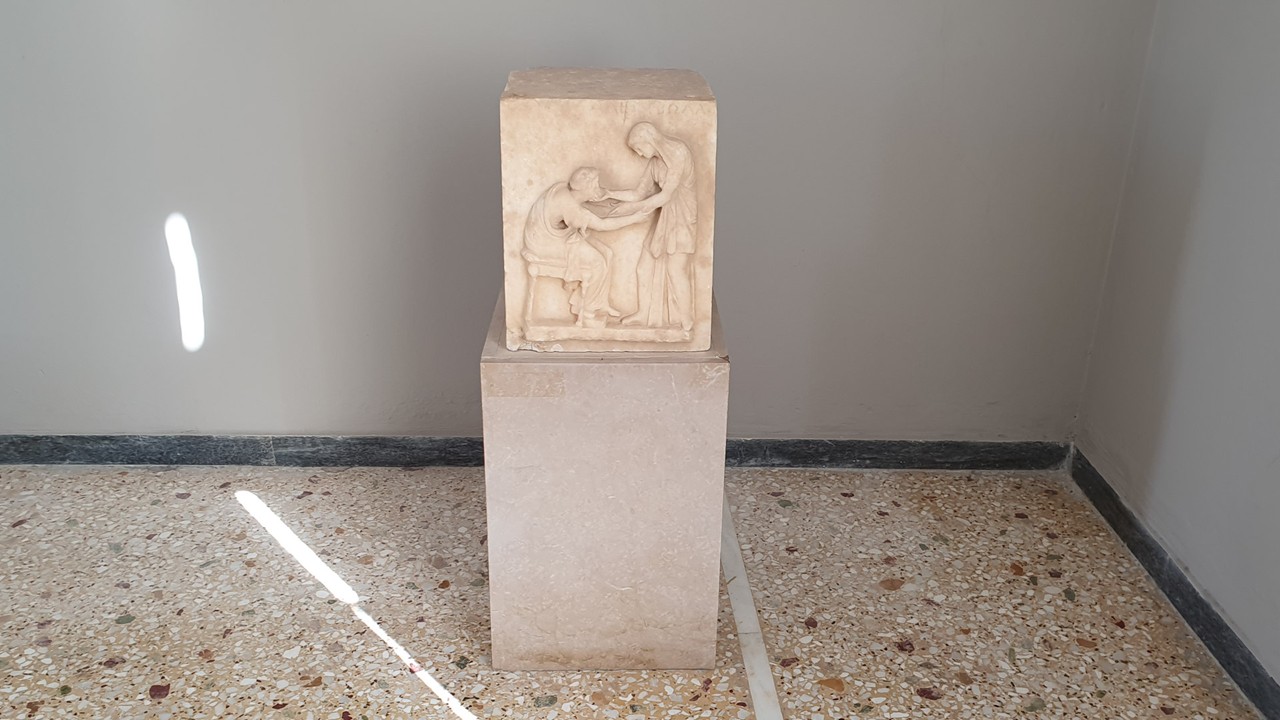
Alexibola: Funerary Stele with Scene of Greeting, early 3rd century BC, Marble, Archaeological Museum of Thera, Greece
https://www.greece-is.com/millennia-tour-santorini-ages/

Today, the Funerary Stele of Alexibola continues to speak across millennia, its message as clear and touching as when it was first carved. In its quiet grace, we recognize the timeless human emotions of love, loss, and remembrance, feelings that unite us with those who lived and grieved long ago. The simplicity of the figures, their tender gestures, and the dignified calm of their farewell remind us that art can express what words often cannot. Through Alexibola’s parting moment with her father, we are invited into an intimate world where ancient stone becomes a vessel for enduring emotion, proving that even in silence, the human heart has always sought connection, beauty, and meaning.

For a PowerPoint Presentation of important ancient Greek Funerary Stele, please… Check HERE!

Bibliography: https://www.ias.edu/ideas/2017/chaniotis-world-of-emotions

More Posts on ancient Greek Funerary Stele by Teacher Curator… https://www.teachercurator.com/art/hegeso-daughter-of-proxenos/ and https://www.teachercurator.com/ancient-greek-art/telling-us-goodbye/ and https://www.teachercurator.com/ancient-greek-art/grave-stele-of-a-youth-and-a-little-girl/
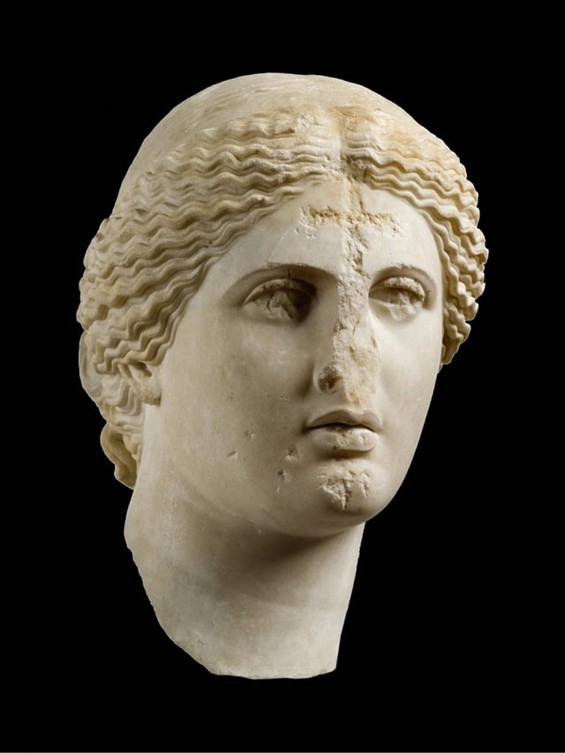
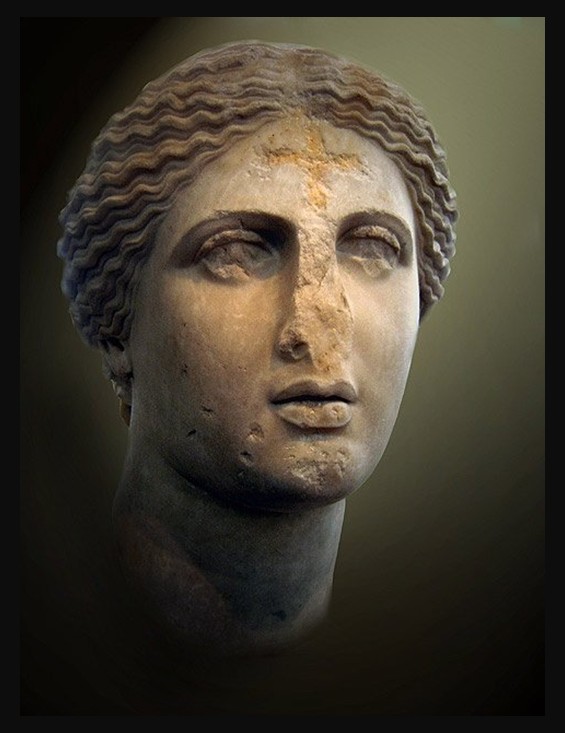
Head of Aphrodite of the Aspremont-Lynden/Arles type 

Head of Aphrodite of the Aspremont-Lynden/Arles type, 1st c. AD copy of an original 4th century BC work by Praxiteles, Marble, possibly Parian (Marathi), Height: 32 cm, National Archaeological Museum, Athens, Greece
https://blogs.getty.edu/iris/the-christian-empire-that-grew-from-classical-roots/

The Head of Aphrodite of the Aspremont-Lynden/Arles type, housed in the National Archaeological Museum in Athens, offers a compelling glimpse into the classical ideals of beauty and divinity shaped by the legacy of Praxiteles. As a copy of a lost 4th-century BC original, possibly the first known depiction of Aphrodite with a nude upper body, this sculptural type reflects the evolving representation of the goddess, bridging the serene sensuality of the Aphrodite of Knidos with the more voluptuous forms of later works like the Aphrodite of Melos. The surviving head, now divorced from its torso, carries echoes of a refined, yet idealized femininity that would influence Roman and Renaissance aesthetics alike. Its later restoration by François Girardon, under the patronage of Louis XIV, introduced symbolic elements like the mirror and apple, both deeply charged with mythological meaning, underscoring not just Aphrodite’s divine allure, but also the enduring power of classical art to adapt to new cultural narratives. An incised cross on her forehead, likely added in the early Christian era, marks a moment when pagan imagery was recontextualized within a new religious worldview.

Carved from Parian marble, the Head of Aphrodite once belonged to an over-life-size statue of a clothed Aphrodite, though some scholars have suggested it may instead portray the famed courtesan Phryne due to its individualized features. The face, turned slightly to the right, is serene and harmonious, with soft, fleshy contours and delicately incised features: a smooth triangular forehead framed by parted curls, a broad nose (now broken), full lips, and a rounded chin. A thick bun gathers the hair at the nape, secured by a wide band. The eyes, beneath gently curved brows, show signs of deliberate Christian-era defacement, likely part of an effort to “close” the eyes and “silence” the mouth. A small, incised cross on the forehead reinforces this reinterpretation of pagan art within a Christian context, suggesting the statue may have been reused as a sacred image. Despite the damage, most notably to the nose and facial extremities, the head remains in relatively good condition and serves as a compelling testament to both the endurance of classical ideals and their transformation in later religious and cultural landscapes.

Head of Aphrodite of the Aspremont-Lynden/Arles type, 1st c. AD copy of an original 4th century BC work by Praxiteles, Marble, possibly Parian (Marathi), Height: 32 cm, National Archaeological Museum, Athens, Greece
https://x.com/ArysPan/status/1513155769000247301/photo/1

The statue’s discovery near the Clock of Andronikos Kyrrhestes in the Roman Agora of Athens further grounds it in the layered urban fabric of ancient Athens, where temples, markets, and later churches coexisted and often repurposed one another’s remains. This setting, close to the sanctuary of Aphrodite and Eros on the north slope of the Acropolis, reinforces the likelihood that the statue originally served a votive or cultic function. The artistic style—marked by its naturalistic modeling, graceful asymmetry, and subtle anatomical details like the “Venus rings” on the neck—embodies the Praxitelian ideal of ethereal beauty softened by human warmth. In this way, the head is not only a remnant of a once-complete devotional image but also a rare survivor of artistic transitions: from Classical to Hellenistic, pagan to Christian, and ultimately, from sacred object to museum artifact.

For a Student Activity, please… Check HERE

Bibliography: https://blogs.getty.edu/iris/the-christian-empire-that-grew-from-classical-roots/ and https://collections.louvre.fr/en/ark:/53355/cl010277986

Head of Nemesis, the personification of attribution of Justice in the Museum of Ancient Agora, Athens.

Head of Nemesis

Head of Nemesis, the personification of attribution of Justice in the Museum of Ancient Agora, Athens.
Head of Nemesis, the personification of attribution of Justice, 2nd century AD, Marble, Museum of Ancient Agora, Athens, Greece – Photo Credit: Amalia Spiliakou, February 18, 2024, ‘Meanings’. Personifications and Allegories from Antiquity to Today Exhibition, Acropolis Museum, Athens, Greece

Of Nemesis we sing, undying goddess, stern Victory with spreading wings, infallible, seated by the throne of Justice; of thee that resentest man’s arrogance and sweepest it down to Tartarus… wrote Mesomedes of Crete, the Greek lyric poet and musician of the 2nd century AD, who served at the court of Emperor Hadrian. Standing before the Head of Nemesis from the Museum of ancient Agora in Athens I can almost feel the weight of divine retribution she carries, much like in Mesomedes’ Hymn to Nemesis, where she is invoked as the ever-watchful enforcer of balance, striking down human arrogance. https://laudatortemporisacti.blogspot.com/2008/07/mesomedes-hymn-to-nemesis.html

Goddess Nemesis in ancient Greek mythology was the personification of divine retribution and justice, often associated with the punishment of hubris (excessive pride or arrogance, in Greek Ύβρις). She was believed to maintain balance by ensuring that no individual, mortal or divine, grew too proud or overstepped moral boundaries. Nemesis was depicted as a stern and impartial force who imposed punishment on those who defied the natural order, often by bringing misfortune to those who had gained undeserved success or wealth.

Nemesis was traditionally viewed as a daughter of Nyx (Night), though her parentage varies in different accounts. She was also sometimes seen as an agent of fate, aligning her with themes of destiny and the unavoidable consequences of one’s actions. The goddess was often portrayed as a winged figure holding a sword, scales, or a wheel, symbolizing the cyclical nature of fortune and justice. https://www.perseus.tufts.edu/hopper/text?doc=Perseus%3Atext%3A1999.01.0130%3Acard%3D207

Worship of Nemesis was widespread, and she had a notable cult center at Rhamnous in Attica, where she was honored as a protector of justice. The temple at Rhamnous housed a large statue of the goddess, created by the sculptor Agorakritos, a student of Phidias, and was considered one of the finest representations of the goddess. Located near the fortress of Rhamnous, the temple symbolized her role as a guardian of law and order, watching over the region and its people, ensuring that justice was upheld in both mortal and divine realms.

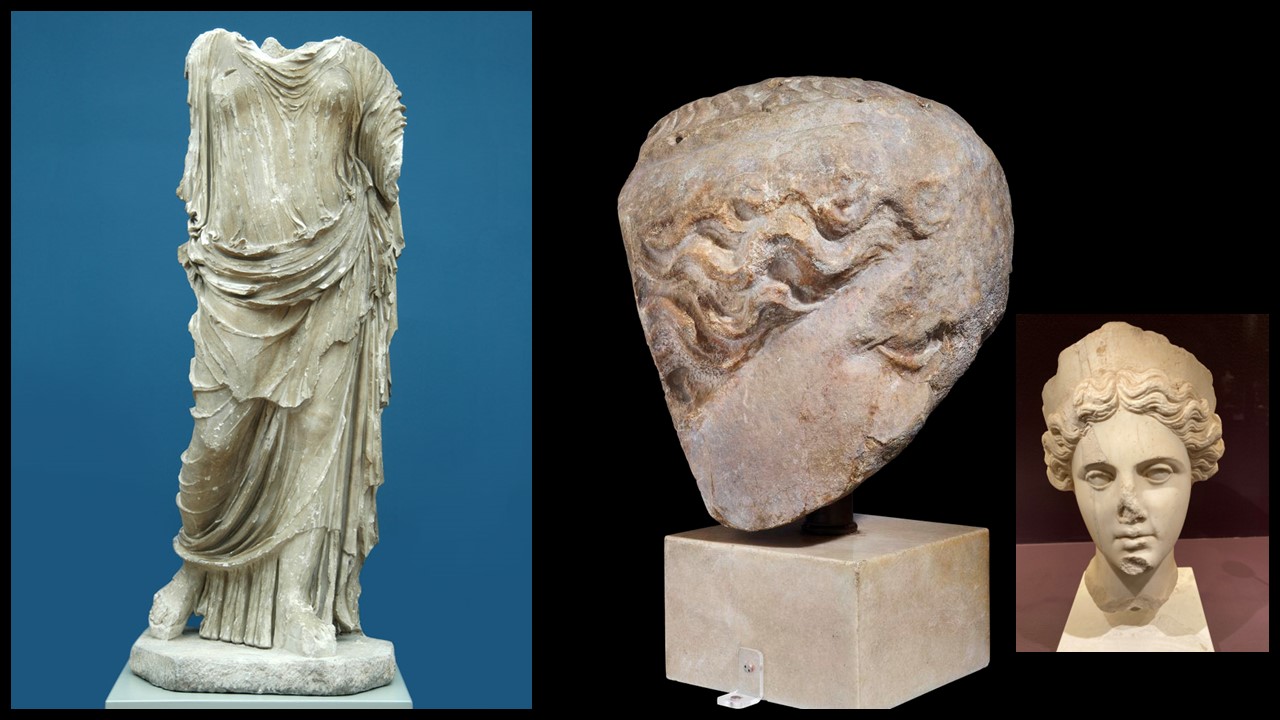
Roman Copy of the statue of Nemesis of Agorakritos in the Ny Carisberg Glyptothek, Copenhagen and Head of Nemesis, the personification of attribution of Justice
Roman Copy of the statue of Nemesis of Agorakritos in the Ny Carisberg Glyptothek, Copenhagen https://www.worldtravelimages.net/Copenhagen_Glyptotek.php
Agorakritos of Paros, 5th century BC
Head of Nemesis, the personification of attribution of Justice, 430-420 BC, Marble, Height: 41.91 cm, British Museum, London, UK https://www.britishmuseum.org/collection/object/G_1820-0513-2
Head of Nemesis, the personification of attribution of Justice, 2nd century AD, Marble, Museum of Ancient Agora, Athens, Greece – Photo Credit: Amalia Spiliakou, February 18, 2024, ‘Meanings’. Personifications and Allegories from Antiquity to Today Exhibition, Acropolis Museum, Athens, Greece

The Statue of Nemesis by Agorakritos, a celebrated pupil of the renowned sculptor Phidias, was a masterpiece of classical Greek art housed in the temple of Rhamnous in Attica. Crafted in the 5th century BC, this statue depicted Nemesis as a stern, majestic figure embodying divine retribution and justice. Made from Parian marble, the statue was renowned for its exquisite detail and symbolic attributes, including a wreath, rein, and a branch, symbolizing punishment, control, and the restoration of balance.

After three years of meticulous research, Professor of Archaeology at Thessaloniki University, George Despinis, has made a significant breakthrough by assembling around 340 fragments of the Nemesis statue, supplementing the previously known head fragment held at the British Museum. While about one-fifth of the statue has been recovered, Despinis’ work goes beyond merely reconstructing this admired masterpiece. His analysis of the fragments has, for the first time, precisely revealed the unique style of Agorakritos, allowing him to identify parts of the Parthenon pediments and friezes created under the direction of Pheidias. https://www.penn.museum/sites/expedition/nemesis/

According to Pausanias and other sources, the Nemesis statue originated from a large marble slab that Datis, the Persian general under Darius, intended to use for a victory monument after defeating the Athenians during his campaign. However, following the Persian defeat at the Battle of Marathon, the Athenians discovered the massive slab abandoned on the battlefield. Based on Professor George Despinis’ calculations, the stone must have been nearly half the height of a Stonehenge monolith. Though the exact method of transporting the stone from Marathon to the Rhamnous sanctuary remains a mystery, it is widely believed that Agorakritos, a pupil of Pheidias, sculpted the statue, completing it by the onset of the Peloponnesian War, with its intricate pedestal and frieze finalized during the Peace of Nikias. https://www.the-athenian.com/site/1989/04/01/the-temples-of-rhamnous/

On February 17, 2024, during my visit to Athens, Greece, I had the pleasure of attending the exceptional exhibition titled ‘NοΗΜΑΤΑ’: Personifications and Allegories from Antiquity to Today, held at the Acropolis Museum. Curated by Professor Nikolaos Chr. Stampolidis and his associates, this exhibition formed a unique Tetralogy, wherein the Greek word ‘ΝΟΗΜΑ’ (‘Meaning’ in English) metaphorically transformed into ‘ΝΗΜΑ’ (‘Thread’), weaving together diverse artworks including statues, reliefs, vases, coins, jewelry, Byzantine icons, and paintings. Among the exhibition artworks that impressed me most was the 2nd-century AD marble Head of Nemesis, the personification of justice, displayed, currently, at the Museum of Ancient Agora in Athens, Greece. According to museum experts, this Head is one of many Roman copies of the original 5th-century statue by Agorakritos from Rhamnous, whose masterful work combined idealized beauty with the imposing presence of a goddess who embodied the consequences of human arrogance and excess.

For a Student Activity, please… Check HERE!

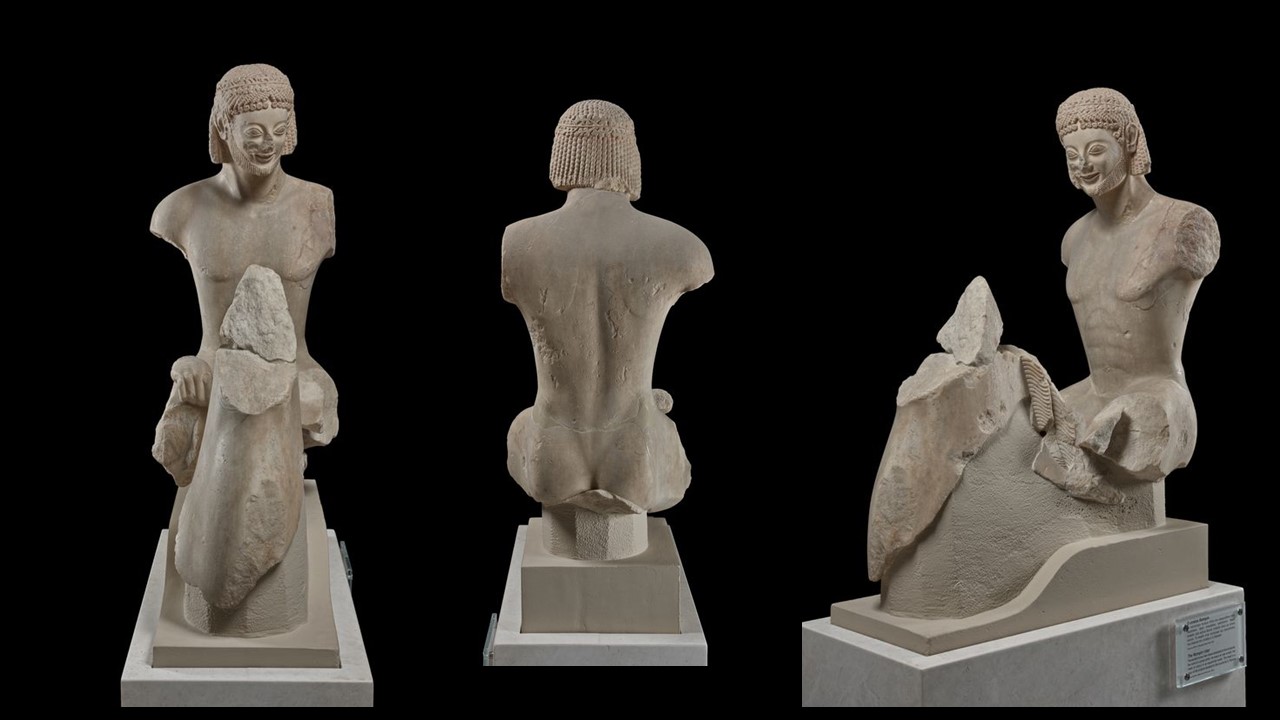
The Rampin Rider is an Archaic Period statue.

The Rampin Rider

The Rampin Rider is an Archaic Period statue.
The Rampin Rider, Archaic Period, around 550 BC, Marble from Paros, Height: 1.08 m, Length: 0.77 m, Width: 0.38 m, Acropolis Museum, Athens, Greece https://www.theacropolismuseum.gr/en/statue-rider-rampin-rider

…Come, take the Dorian lyre down from its peg, if the splendor of Pisa and of Pherenicus placed your mind under the influence of sweetest thoughts, [20] when that horse ran swiftly beside the Alpheus, not needing to be spurred on in the race, and brought victory to his master, the king of Syracuse who delights in horses… writes Pindar in his Olympian Ode 1, and I think of The Rampin Rider in the Acropolis Museum!

The Rampin Rider is an ancient Greek marble Archaic statue dating back to around 550 BC. It depicts a young horseman in a dynamic pose and is believed to represent a victorious athlete or a noble youth. The statue is renowned for its detailed craftsmanship and is a prime example of early Greek sculpture, combining Archaic stylization with emerging naturalism. https://www.theacropolismuseum.gr/en/statue-rider-rampin-rider

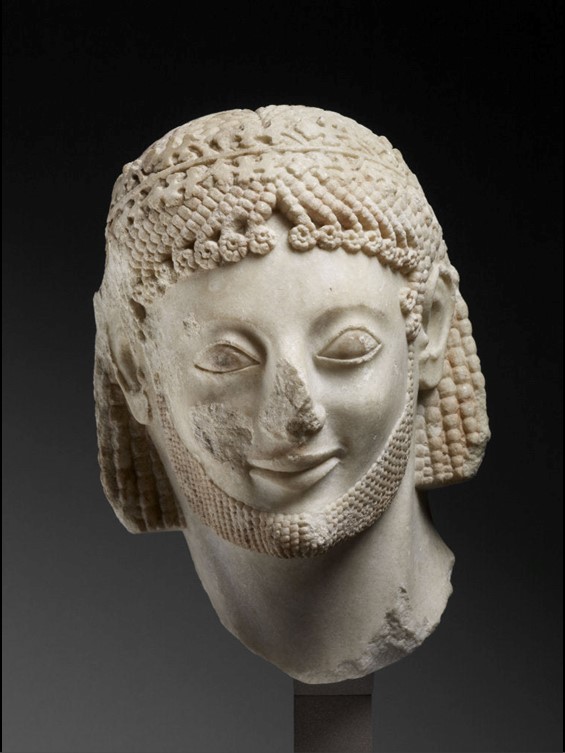
Today, the Rampin Rider statue is unfortunately divided between two major museums. The larger portion, including the torso and horse, is housed in the Acropolis Museum in Athens, Greece, where it is displayed alongside a plaster cast of the missing head. Meanwhile, the head of the rider, known for its distinctive Archaic smile, is displayed at the Louvre Museum in Paris, France, accompanied by a cast of the rest of the statue. This arrangement highlights the division of this significant artefact between the two institutions. https://collections.louvre.fr/ark:/53355/cl010276879

The Head of the Rampin Rider
The Head of the Rampin Rider, Archaic Period, around 550 BC, Marble from Paros, Height: 27 cm, Louvre Museum, Paris, France
https://www.neo-mfg.com/products/history-roman-rampin-rider-60671

The Rampin Rider statue, the oldest and most renowned equestrian statue dedicated to the Acropolis, depicts a naked youth seated forward on his horse, almost on its neck. Once holding a metal bridle and reins attached through drilled holes in the horse’s mane, the rider is portrayed with keen attention to anatomical detail, especially in the physique and abdomen. Adorning his head is a wreath made of wild celery or oak leaves, signifying his victory in an equestrian event, possibly at the Nemean or Olympic Games. The rider’s face, characteristic of the Archaic period, features large almond-shaped eyes, thin eyebrows, and the distinct “archaic smile.” Remarkably, traces of original colour still remain on the rider’s face and hair, as well as on the horse’s mane, offering a glimpse into its original vibrant appearance.

During the Archaic period of ancient Greece, statues depicting riders held significant importance as symbols of wealth, status, and military prowess. These expensive dedications were commissioned by members of the upper socio-economic classes, specifically the pentacosiomedimnoi and triacosiomedimnoi, who were responsible for maintaining war horses. Participation in equestrian events was exclusive to affluent nobles, either as athletes or horse owners, reflecting their elite status. The rider statues, such as the Rampin Rider, were often dedicated on the Acropolis as commemorative monuments to celebrate victories in prestigious games, underscoring the social and political influence of the aristocracy in ancient Greek society.

The larger portion of the Rampin Rider statue, including the rider’s torso and the horse, was unearthed in a Perserschutt ditch, a significant archaeological context filled with statues and other artefacts deliberately buried after the 480 BC Persian sack of Athens. These ditches were created by the Athenians to dispose of the destroyed remnants of their sacred and civic monuments after the Persians razed the city. The Perserschutt deposits are invaluable to archaeology because they provide a well-preserved snapshot of Athenian art and culture before the Persian invasion, capturing details of early Greek sculpture, architecture, and religious practices. The discovery of the Rampin Rider in this context highlights the cultural loss and resilience of Athens, as these broken yet revered artworks were buried with care and later played a crucial role in reconstructing the history of Archaic Greece.

For a Student Activity, please Check… HERE!

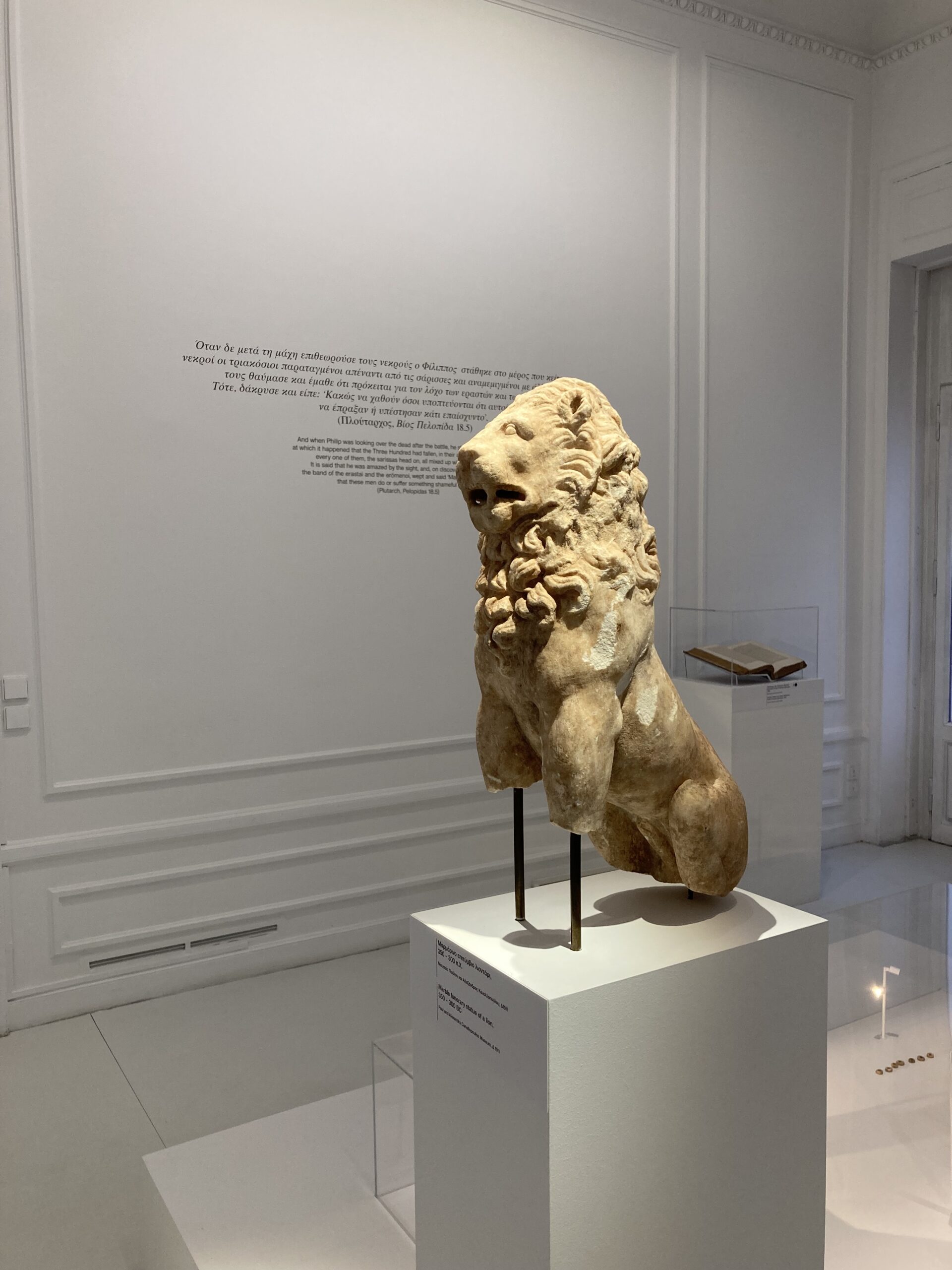
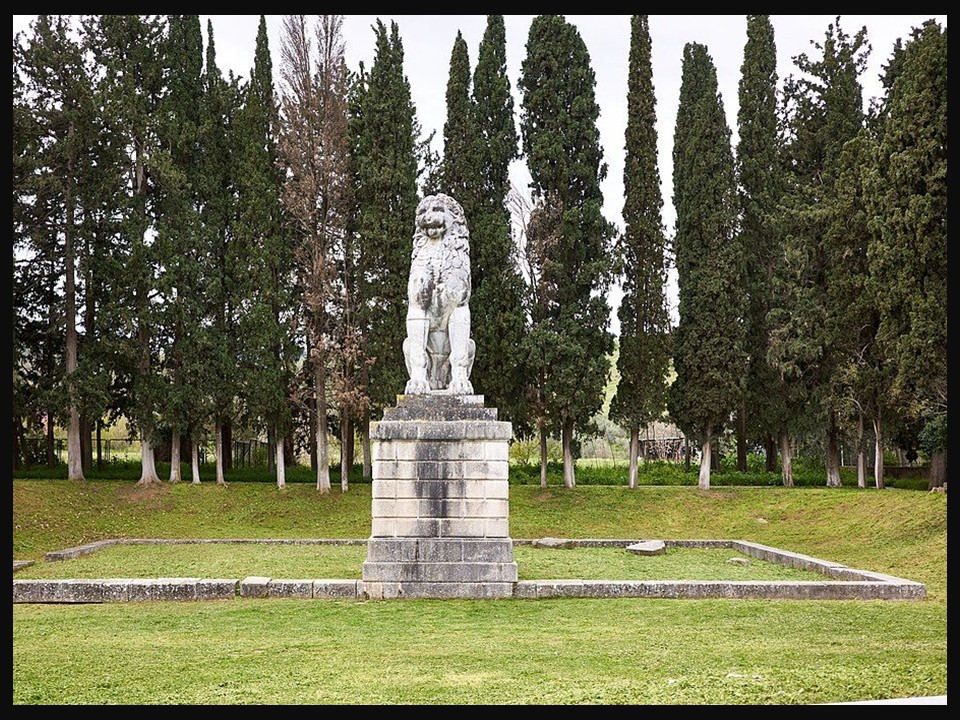
Lion from a grave monument, Paul and Alexandra Canellopoulos Museum, Athens, Greece

Lion from a Grave Monument in the Canellopoulos Museum

Lion from a grave monument, Paul and Alexandra Canellopoulos Museum, Athens, Greece
Lion from a grave monument, 4th century BC, White Marble, Height: 41.5 cm, Paul and Alexandra Canellopoulos Museum, Athens, Greece – Photo Credit: Amalia Spiliakou, Museum of Cycladic Art, Chaeronea, 2 August 338 BC: A day that changed the world Exhibition, February 2024

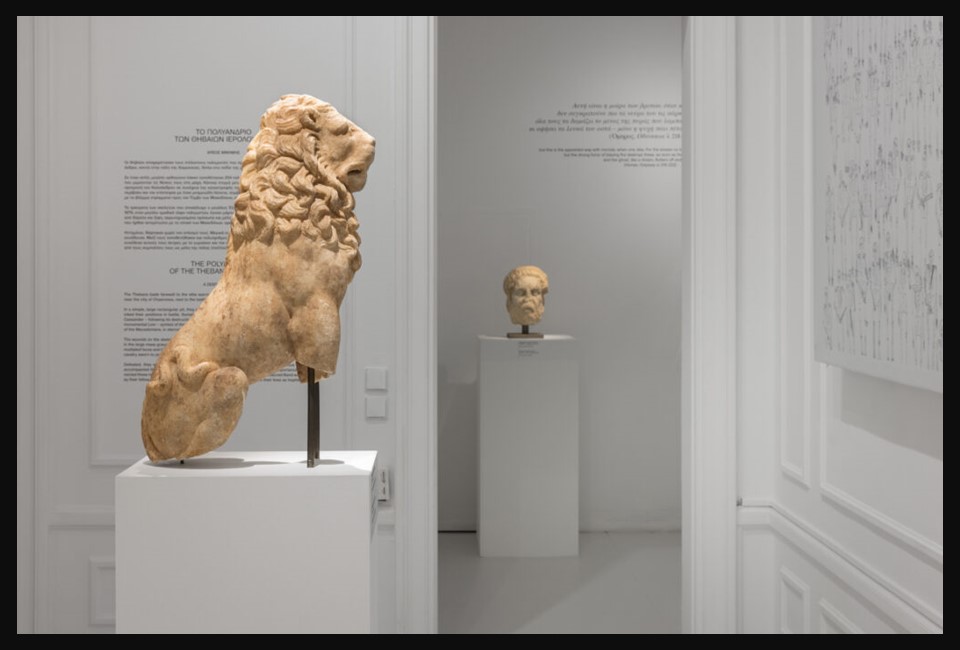
The lion sits on his haunches and looks straight ahead, with his mouth half open, evidently portrayed as growling. Anatomical details of the head have been realistically rendered. The eyes are small and fairly deeply set, the nose flat and wide. The slender, supple body and the swelling of the chest and leg muscles suggest tension. The rich mane has dense, thick, unruly curls, that were divided from each other by means of a drill. They cover the head, the upper part of the spine, the neck and the upper part of the chest. A crest of curls runs down the spinal ridge. The curls are rendered without the sharp tips that are usual on the Attic lions of the 4th century B.C. The long tail runs under the right hind leg and in snake-like curves ends in a tuft over the right haunch. This is how the Lion from a Grave Monument in the Canellopoulos Museum is described by the Museum experts, and I couldn’t agree more… https://camu.gr/en/item/epitymvio-liontari/

On the 17th of February, while visiting the Chaeronea, 2 August 338 BC: A Day That Changed the World Exhibition at the Cycladic Museum, I was captivated by the Lion from the Canellopoulos Museum. The statue’s imposing presence immediately drew my thoughts to grave monuments of lions in ancient Greek art, which are emblematic of power, courage, and enduring legacy. These sculptures, often placed atop graves, served as guardians and symbols of honour for the deceased. The lion’s fierce yet dignified expression evoked the valour of fallen warriors and the deep respect afforded to them in Greek culture. This connection underscored the lion’s role as a potent symbol across various contexts, from battlefield commemorations to funerary art, illustrating the profound layers of meaning that these majestic creatures held in ancient Greek society.

Lion from a grave monument, Paul and Alexandra Canellopoulos Museum, Athens, Greece
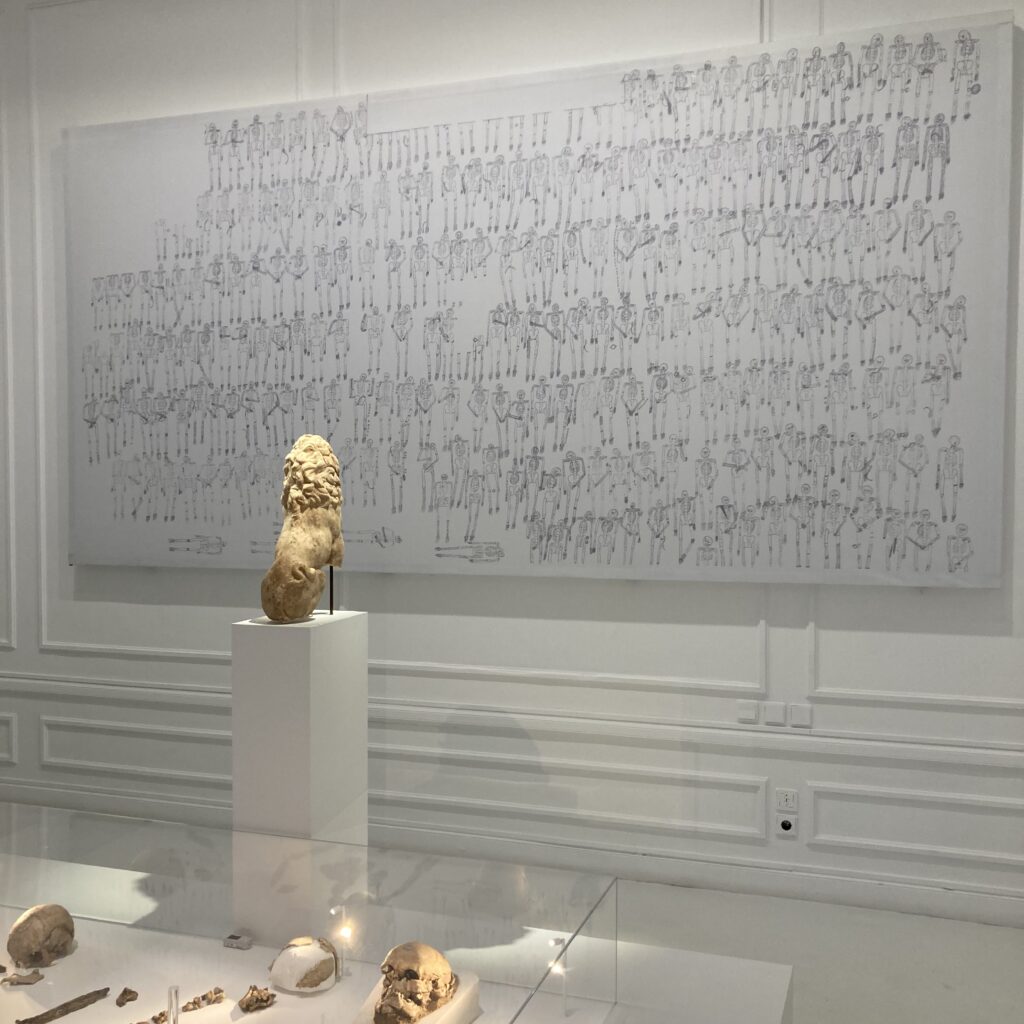
Lion from a grave monument, 4th century BC, White Marble, Height: 41.5 cm, Paul and Alexandra Canellopoulos Museum, Athens, Greece – Photo Credit: Amalia Spiliakou, Museum of Cycladic Art, Chaeronea, 2 August 338 BC: A day that changed the world Exhibition, February 2024

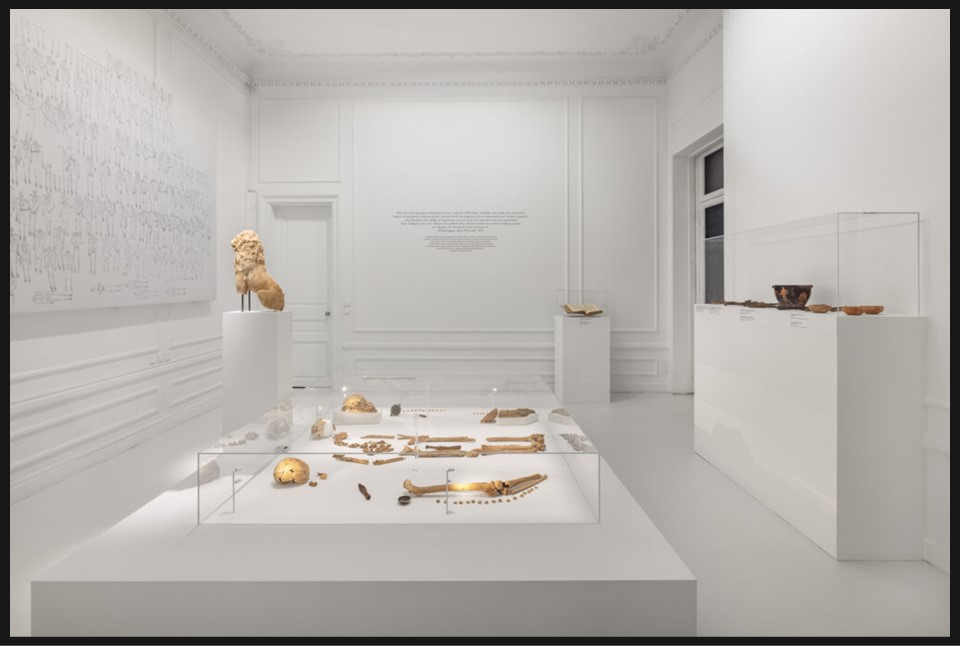
At the Chaeronea Exhibition, the Canellopoulos Lion is placed facing a sketch showing how the deceased were positioned in the Polyandrion of the Theban Sacred Band. This arrangement piques my eagerness to examine the monumental Lion of Chaeronea as well. This iconic grave monument, erected to honour the fallen Theban warriors of the Battle of Chaeronea, embodies the valour and enduring legacy of those who perished. Both sculptures’ powerful presence and dignified expression serve as a testament to the ancient Greeks’ deep reverence for their heroes, making them a compelling subject for exploration.

The Lion of Chaeronea stands as a significant symbol of ancient Greek history, commemorating the Battle of Chaeronea in 338 BCE, where Philip II of Macedon and his son, Alexander the Great, decisively defeated the combined forces of Athens and Thebes. This battle marked the end of Greek city-states’ independence and the rise of Macedonian dominance, setting the stage for Alexander’s future conquests and the spread of Hellenistic culture. The monument is believed to honour the Sacred Band of Thebes, an elite military unit renowned for its bravery and cohesion, which was annihilated during the battle. The Lion of Chaeronea thus serves as both a memorial to the fallen soldiers and a pivotal marker of the power shift that shaped the course of Western civilization.

According to the Chaeronea Museum experts… At the entrance of Chaeronea, at a distance of 13 kilometres from the city of Livadia, stands a marble pedestal with a large lion. The tomb monument was erected in honour of the Theban soldiers of the ‘sacred band’ who fell in the Battle of Chaeronea in 338 BC, in which the Macedonians emerged victorious. When after his victory Philip II allowed the burial of the dead, the Lion of Chaeronea was erected to mark their burial place. Indeed, excavations at the site brought to light the skeletons of 254 men and some of their weapons.

The statue of the Lion is 5.30 meters tall and is depicted sitting on his hind legs. The lion is considered to symbolize the heroism of the soldiers of Thebes, which Philip II himself had recognized. The Lion was revealed after excavations in 1818, broken into five pieces. It was restored standing on a 3-meter-high pedestal. Today it is located next to the Archaeological Museum of Chaeronea, in front of a row of cypress trees.

For a Student Activity, please… Check HERE!

Bibliography: https://www.mthv.gr/el/pera-apo-to-mouseio/peripatos-sti-boiotia/arhaiologiko-mouseio-haironeias-leon-tis-haironeias/#image-2 and https://camu.gr/en/item/epitymvio-liontari/

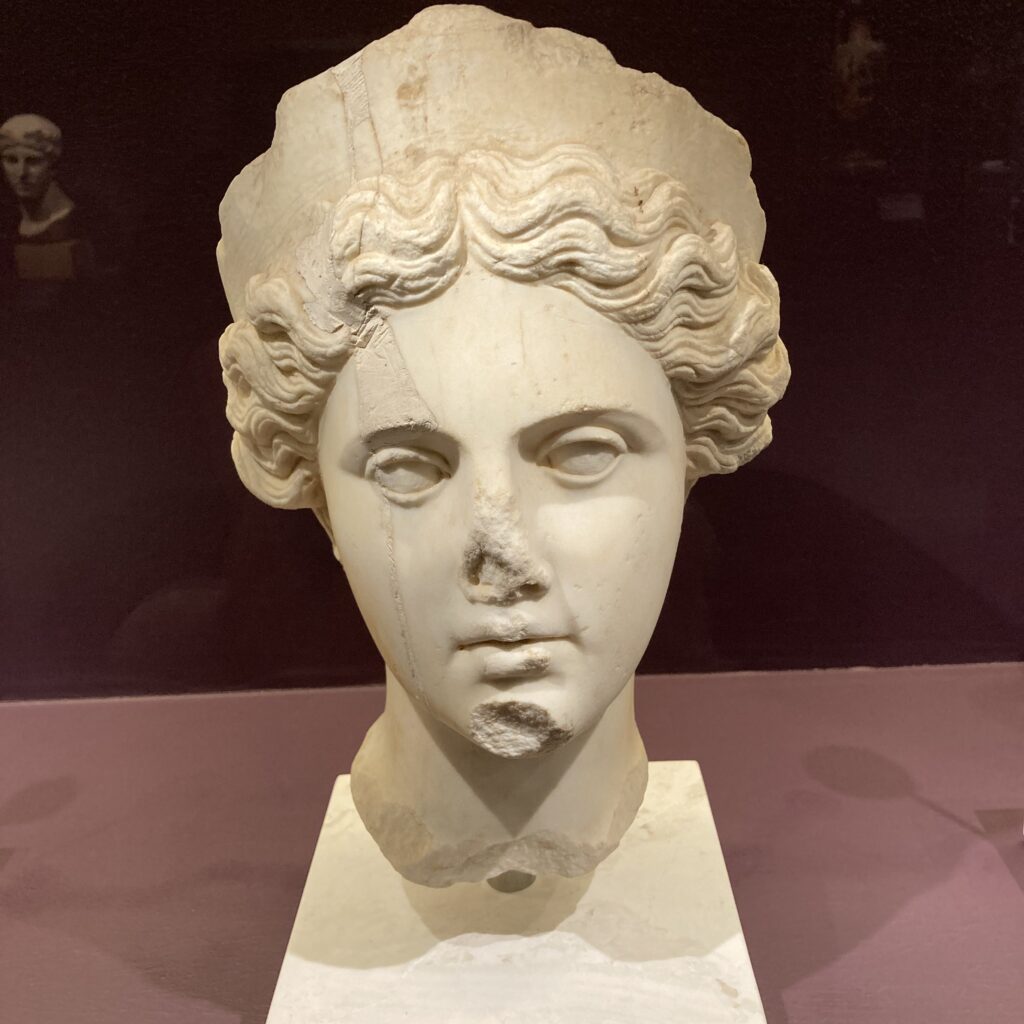
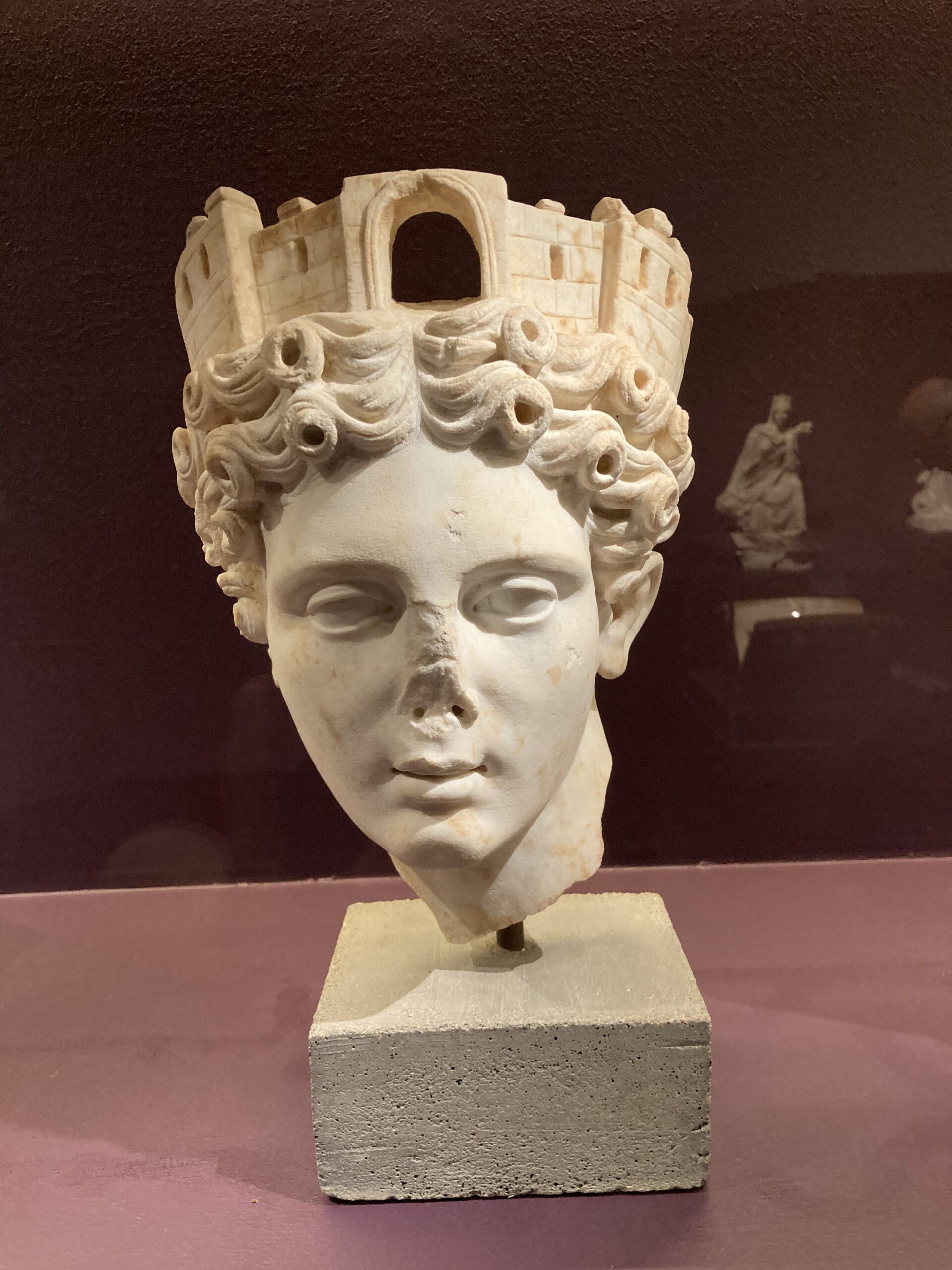
Head of Goddess Tyche (Fortune) with a mural crown, the personification of the city of Corinth

Head of Goddess Tyche from Corinth

Head of Goddess Tyche (Fortune) with a mural crown, the personification of the city of Corinth
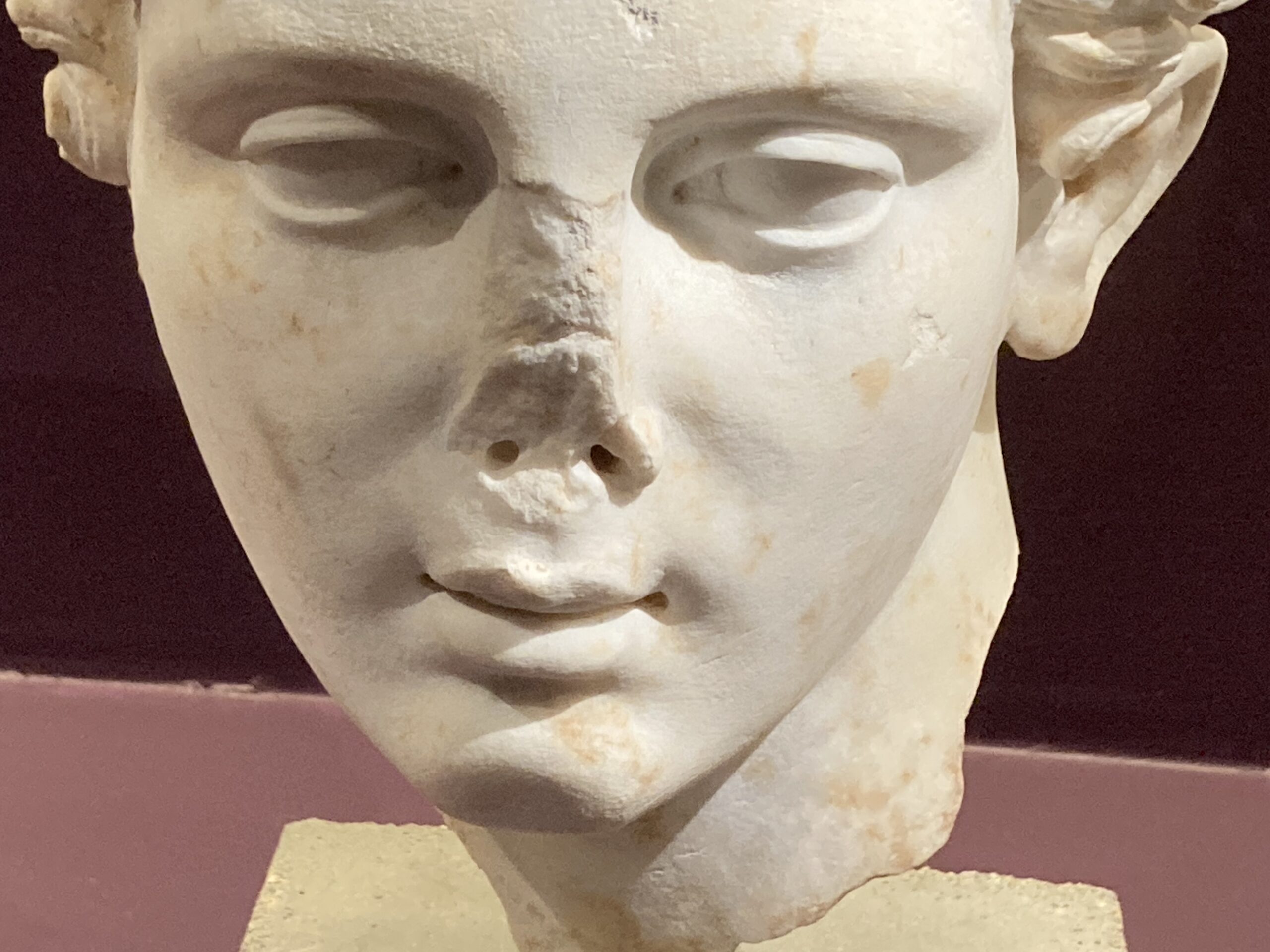
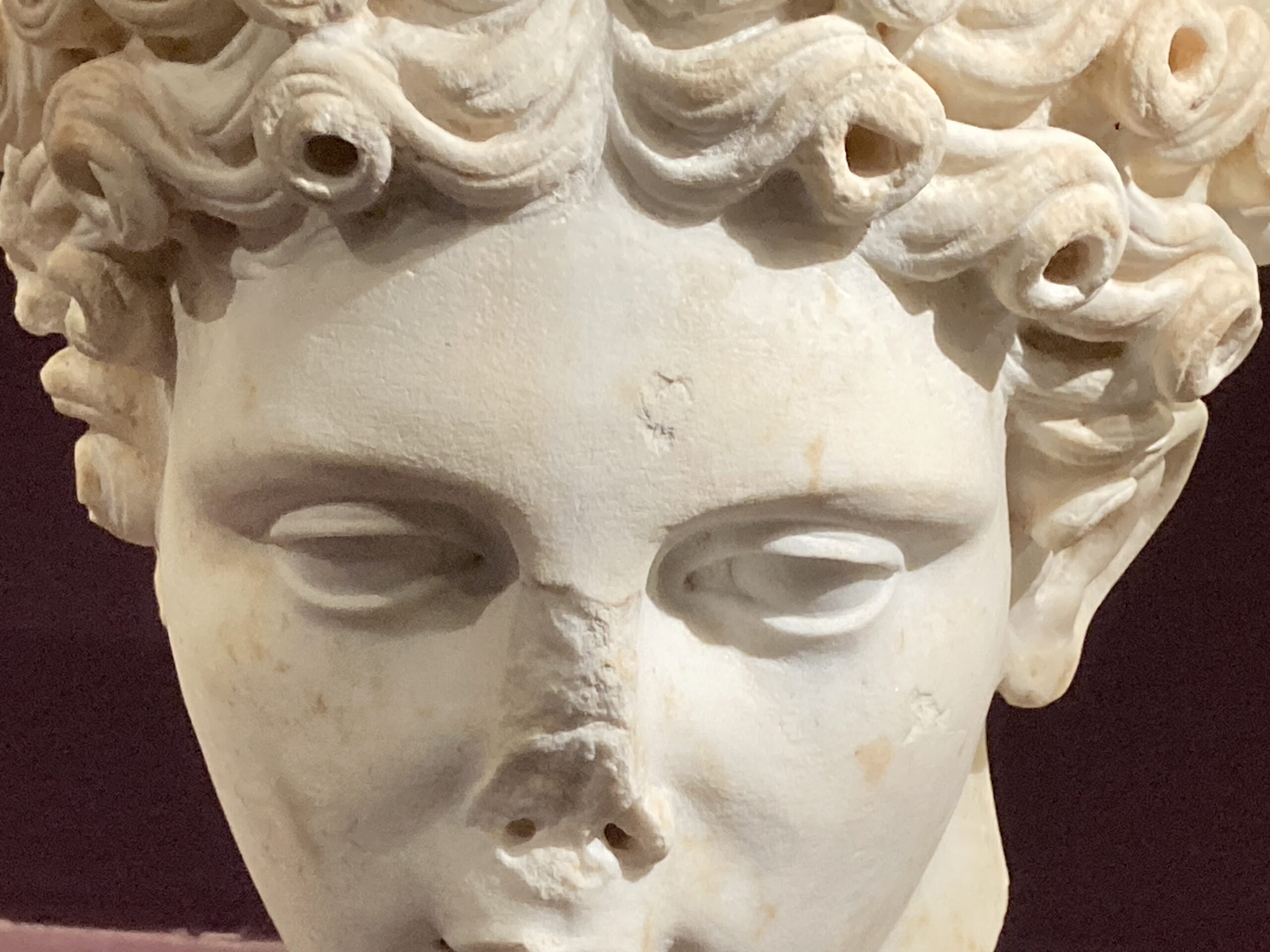
Head of Goddess Tyche (Fortune) with a mural crown, the personification of the city of Corinth, late 1st century AD, Marble, Archaeological Museum of Ancient Corinth, Greece – Photo Credit: Amalia Spiliakou, Acropolis Museum, February 2024

The beautiful Head of Goddess Tyche from Corinth takes us back on a journey to Roman Greece.  Displayed as part of the exhibition titled ‘ΝοΗΜΑΤΑ’: Personifications and Allegories from Antiquity to Today at the Acropolis Museum, this Roman masterwork travelled to Athens from the Archaeological Museum of Corinth, offering a unique opportunity to explore the multifaceted world of art and personifications.

The Head of Tyche, as a beloved symbol of fortune and protection for cities, was part of the Exhibition’s 5th Unit of ‘Institutions,’ where personifications and allegories that represent communal—not individual—human activities were presented. These are the activities of organized societies characterized by homogeneity and unity, embodying public, social, political, and civic life. This Exhibition Unit featured not only Tyche but also Themis, Justice, and Injustice, Eunomia (Order), Hybris and Punishment, Nemesis, along with personifications of the City, Demos, Senate, Gerousia, along with various Processions and Ceremonies. Each piece offered a glimpse into the institutions governing human societies, providing context to how the ancients envisioned the forces that shaped their world.

My favourite sculpture of Tyche dates from the 1st century AD and comes from Corinth! Let’s explore the ‘who’, ‘which’, ‘how’, and ‘what’ of this amazing sculpture by posing some questions!

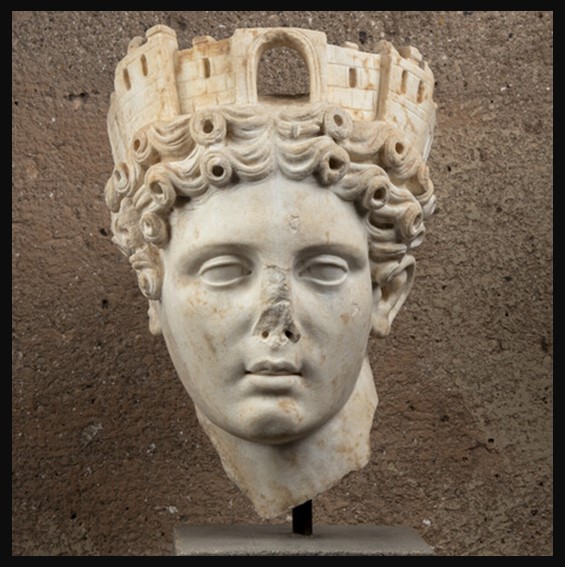
Head of Goddess Tyche (Fortune) with a mural crown, the personification of the city of Corinth
Head of Goddess Tyche (Fortune) with a mural crown, the personification of the city of Corinth, late 1st century AD, Marble, Archaeological Museum of Ancient Corinth, Greece https://www.lifo.gr/culture/eikastika/noimata-i-nea-ekthesi-sto-moyseio-tis-akropolis

Who is Tyche? Tyche, the daughter of the Titans Tethys and Oceanus was a significant figure in both Greek and Roman mythology, embodying the concept of fortune—both good and bad—and destiny. She was revered as the tutelary deity who governed the fortune and prosperity of a city, its destiny, and the personal fortunes of its inhabitants.

How did the Greeks and the Romans perceive her? For the Greeks, Tyche, the daughter of the Titans Tethys and Oceanus, originally emerged as a relatively minor deity, but her importance grew over time, especially during the Hellenistic period following the conquests of Alexander the Great. In a world where cities could rise and fall quickly due to war, economic change, and political upheaval, Tyche began to be worshipped as a powerful protector of cities and a bringer of fortune. Greek cities would often depict Tyche with symbols of plenty, like a cornucopia, and sometimes featured elements like a mural crown (representing city walls) or a rudder (symbolizing navigation or control over fate). She was also occasionally depicted with a wheel, representing the unpredictability of fortune.

For the Romans, Tyche was assimilated into Roman culture as Fortuna, who became an immensely popular deity in her own right. The Romans expanded on the concept of Tyche/Fortuna, creating various aspects of the goddess to represent different types of luck and fortunes, such as Fortuna Redux (bringing one safely home), Fortuna Augusta (fortune of the emperor), and Fortuna Privata (personal fortune). Temples and shrines to Fortuna were common in Rome and throughout the Roman Empire, reflecting her integral role in both public and private life. Roman depictions of Fortuna included similar symbols as Tyche, with the addition of the wheel and the globe, underscoring her control over the circular nature of fate and the vastness of the empire.

In both cultures, Tyche/Fortuna was more than just a symbol of arbitrary events; she represented the idea that life’s fortunes are beyond human control, yet intimately involved in the everyday workings of both cities and individuals. Her worship indicates a kind of resignation to the unpredictability of life, but also an attempt to appease and gain favour from the forces believed to govern it.

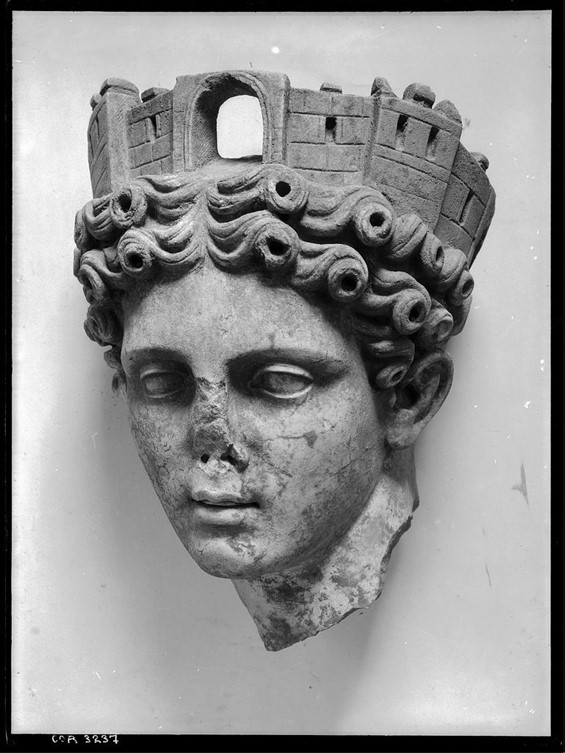
Head of Goddess Tyche (Fortune) with a mural crown, the personification of the city of Corinth
Black and White 1932 Photo of a Marble Head of Tyche, the Fortune of the City of Corinth – Photo Credit: American School of Classical Studies, Athens, Greece

What was the symbolic role of the Heads of Goddess Tyche during the Roman Empire? The Heads of Goddess Tyche, also known as Tyche Heads or City-Goddess Heads, were a common motif in the Roman Empire. These sculptures typically depicted the head of Tyche adorned with various symbols or attributes that represented the city she personified. One of the most distinctive features of these sculptures is the city mural crown, where the city’s walls were depicted as a crown adorning the head of Tyche. This imagery served not only as religious and artistic symbols but also as expressions of civic pride and identity. They reinforced the idea that the fate and prosperity of a city were closely tied to the favour of the gods, particularly Tyche, and they were often placed in prominent locations such as city squares or temples.

Head of Goddess Tyche (Fortune) with a mural crown, the personification of the city of Corinth
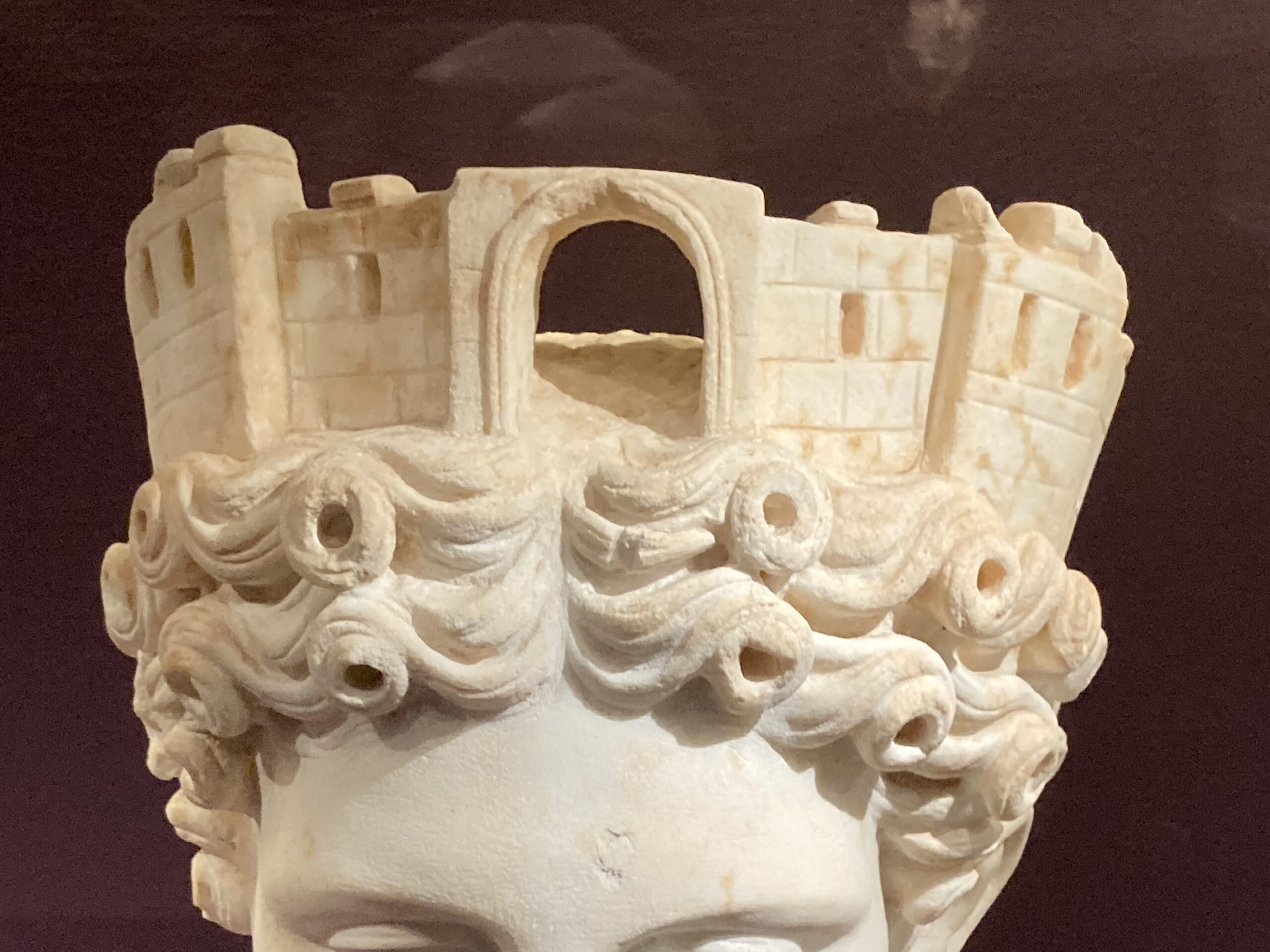
Head of Goddess Tyche (Fortune) with a mural crown, the personification of the city of Corinth, late 1st century AD, Marble, Archaeological Museum of Ancient Corinth, Greece – Photo Credit: Amalia Spiliakou, Acropolis Museum, February 2024
Head of Goddess Tyche (Fortune) with a mural crown, the personification of the city of Corinth (detail)
Head of Goddess Tyche (Fortune) with a mural crown, the personification of the city of Corinth, late 1st century AD, Marble, Archaeological Museum of Ancient Corinth, Greece – Photo Credit: Amalia Spiliakou, Acropolis Museum, February 2024

Which is my favourite Head of Goddess Tyche? It is a 1st century AD fine crystalled white marble piece, discovered in Temple E, in ancient Corinth. Some scholars attribute it to Octavia, the sister of Augustus, although modern scholars have offered alternative suggestions.

Head of Goddess Tyche (Fortune) with a mural crown, the personification of the city of Corinth
Head of Goddess Tyche (Fortune) with a mural crown, the personification of the city of Corinth, late 1st century AD, Marble, Archaeological Museum of Ancient Corinth, Greece – Photo Credit: Amalia Spiliakou, Acropolis Museum, February 2024

How can this remarkable Head of Tyche be described? This is the striking portrayal, steeped in symbolism and artistry, of an almost life-sized head of an idealized woman. Wearing a mural crown adorned with a central gate, towers, slit windows and meticulously crafted coursed masonry, the woman’s head emanates a regal aura befitting its divine subject. Her hair, meticulously detailed with two rows of tight curls featuring drilled centers, gracefully frames her oval face from the forehead to the back of her ears, with a single lock before each ear and shorter locks behind the left ear sculpted in low relief. The top of her head exhibits intricate craftsmanship, worked with delicate precision. Her countenance, marked by a broad forehead and a narrow chin, is characterized by sharp brow ridges and upper lids, lightly incised irises, and drilled nostrils, evoking a sense of lifelike realism. The slightly open mouth, revealing a tongue, adds a touch of dynamism to the serene visage. Though the face is worked smoothly, it lacks a polished finish, with faint traces of rasping evident on the neck, underscoring the meticulous yet organic nature of its creation. This remarkable artefact not only offers a glimpse into the artistic mastery of ancient Corinthian craftsmen but also invites contemplation of the cultural and religious significance imbued within its form.

For a Student Activity, please… Check HERE!

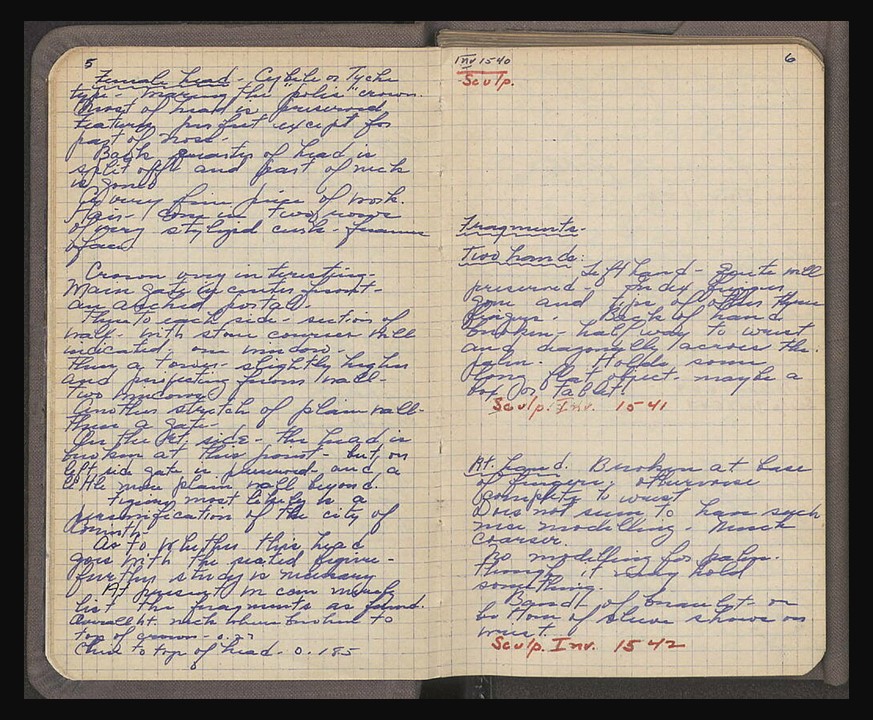
Corinth Notebook Page
Corinth Notebook Page: NB 128, spread 8 (pp. 5 – 6) https://corinth.ascsa.net

Bibliography: https://www.theacropolismuseum.gr/en/noemata-exhibition and https://www.jstor.org/stable/147882  and https://www.jstor.org/stable/40514500?read-now=1&seq=2#page_scan_tab_contents The Goddess Tyche by Susan B. Matheson, Yale University Art Gallery Bulletin, An Obsession with Fortune: Tyche in Greek and Roman Art (1994), pp. 18-33 (16 pages)

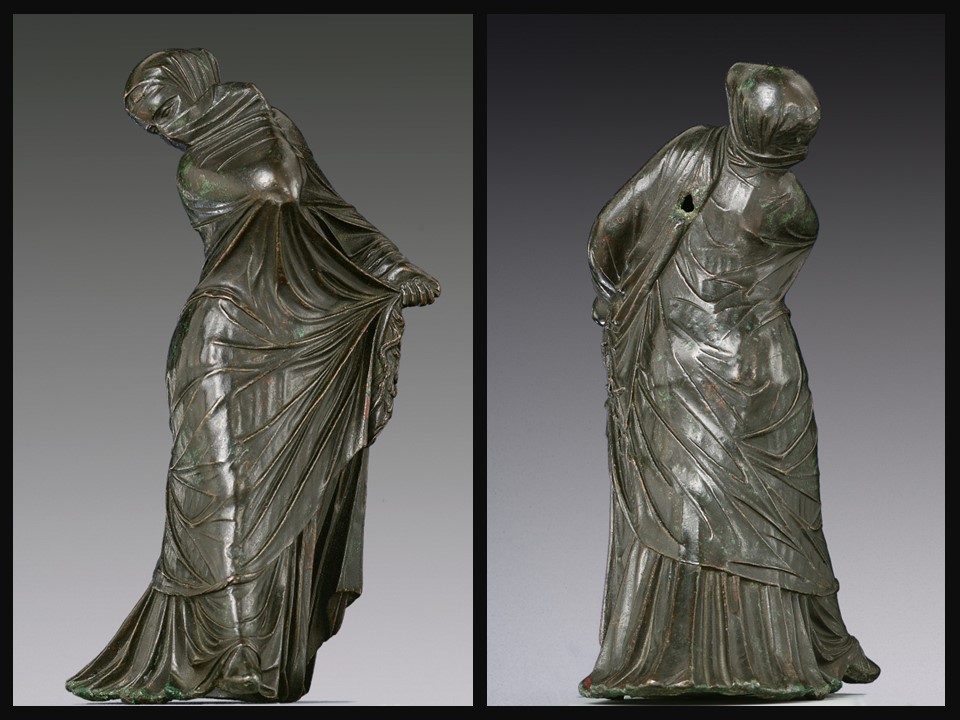
Ancient Greek Bronze statuette of a veiled and masked dancer

The Bronze Hellenistic Dancer at the MET

Ancient Greek Bronze statuette of a veiled and masked dancer
Bronze statuette of a veiled and masked dancer, 3rd–2nd century BC, Bronze, 20.5 × 8.9 × 11.4 cm, the MET, NY, USA https://www.metmuseum.org/art/collection/search/255408?pkgids=351&pos=20&nextInternalLocale=en&ft=*&oid=255408&rpp=4&exhibitionId=%7Bc81fa618-19f5-47a1-a089-fd1b22309109%7D&pg=1

Dance is an ephemeral art. Is it about sentiment, imagination, and expression? Is The Bronze Hellenistic Dancer at the MET the quintessence of a Hellenistic Dancer’s soul?

The MET Dancer emerges, as if from the shadows, draped in layers of gleaming veils that conceal and reveal her movements. With each step, she gracefully twists and turns to the left, casting a downward gaze. As she dances, her left hand lifts a veil over her left hip, while her right arm, holding folds of fabric, shields the lower part of her veiled head, which arches backward. The ethereal dance causes her dress to swirl around her body, and the edges of her enveloping cloak flare out at her sides.

The complex motion of this dancer, the MET experts tell us, is conveyed exclusively through the interaction of the body with several layers of dress… This Hellenistic Bronze statuette of a Dancer not only provides insights into the cultural context of its creation but also invites speculation about the statue’s original owner. Questions arise: Where was this captivating figure displayed? What thoughts and emotions did she elicit? How much joy did she bring to those who beheld her? https://www.metmuseum.org/art/collection/search/255408?pkgids=351&pos=20&nextInternalLocale=en&ft=*&oid=255408&rpp=4&exhibitionId=%7Bc81fa618-19f5-47a1-a089-fd1b22309109%7D&pg=1

Quoting the MET experts… The bronze Dancer performs a private dance for the viewer—a kind of dance of the seven veils—that is both alluring and surprisingly contemporary in appearance, having been rendered in a realistic style. Nonetheless, it is undoubtedly very much a product of the ethos of the Hellenistic Age, the work of a master sculptor perhaps from Alexandria, Egypt… This dancer has been convincingly identified as one of the professional entertainers, a combination of mime and dancer, for which the cosmopolitan city of Alexandria was famous in antiquity… https://www.metmuseum.org/blogs/now-at-the-met/2016/pergamon and https://www.metmuseum.org/art/collection/search/255408?pkgids=351&pos=20&nextInternalLocale=en&ft=*&oid=255408&rpp=4&exhibitionId=%7Bc81fa618-19f5-47a1-a089-fd1b22309109%7D&pg=1

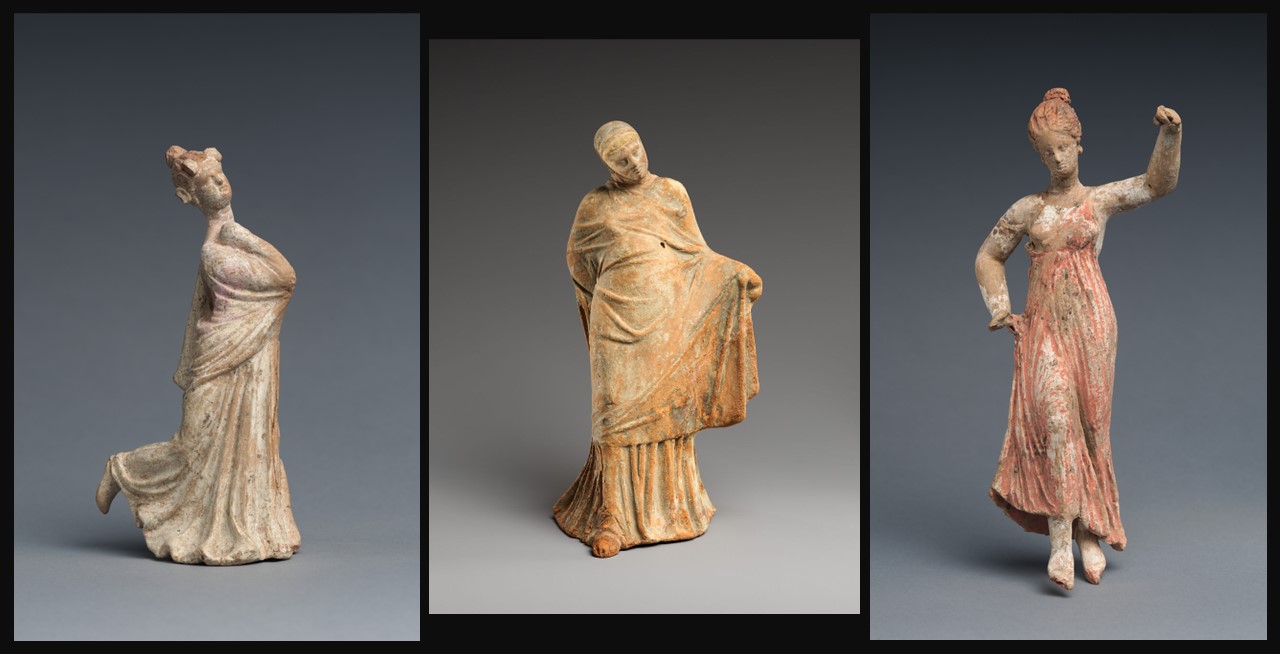
She is, luckily, not alone. In addition to the captivating Hellenistic Bronze statue showcased at the MET, the collection also features a charming array of clay statuettes portraying dancers.

Three ancient Greek Terracotta statuettes of a Dancing Women
Terracotta statuette of a Dancing Woman, 3rd century BC, Terracotta, 24.1 × 10.2 × 8.3 cm, the MET, NY, USA https://www.metmuseum.org/art/collection/search/248712
Terracotta statuette of a Dancing Woman, 3rd century BC, Terracotta, 15.2 × 6.2 × 8.6 cm, the MET, NY, USA https://www.metmuseum.org/art/collection/search/248601
Terracotta statuette of a Veiled Dancer, 3rd century BC, Terracotta, H. 20.0 cm, the MET, NY, USA https://www.metmuseum.org/art/collection/search/251216

Sculptures of dancers from this era often captured the dynamic and graceful movements of the human body, showcasing the Hellenistic fascination with naturalism and the portrayal of emotion. These sculpted dancers, whether in bronze or clay, reflected the cultural significance of dance as a form of entertainment, religious ritual, and social expression. The intricate detailing of their poses and flowing garments not only celebrated the physical prowess of the human form but also conveyed a sense of vitality and joy, providing a testament to the Hellenistic commitment to aesthetic excellence and the embodiment of life in art.

For a Student Activity on Hellenistic Dancing, please… Check HERE!

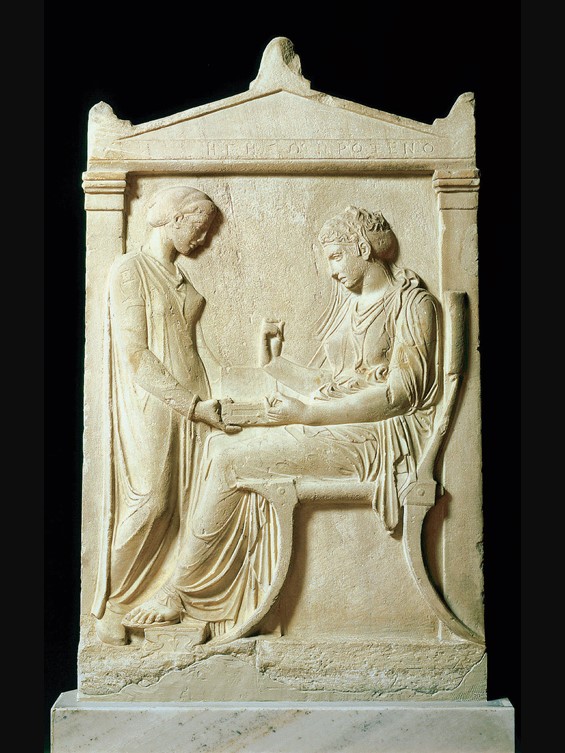
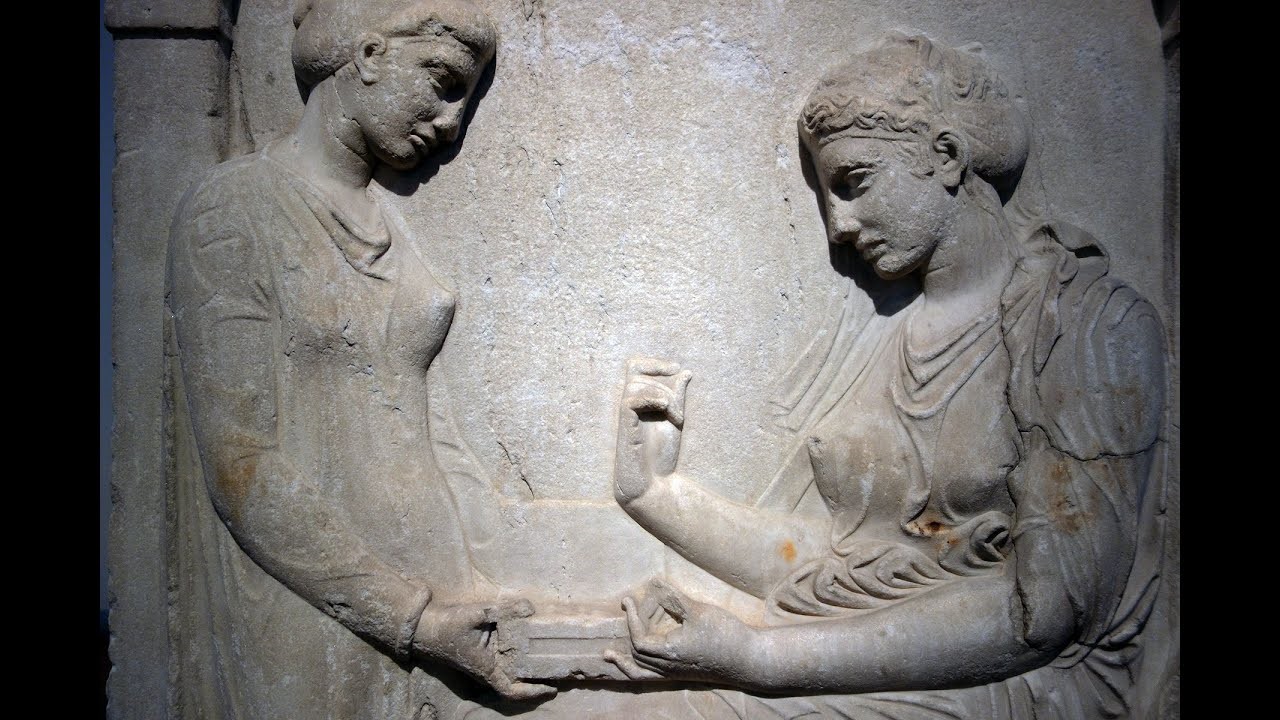
Ancient Greek Funerary Grave Stelae of Hegeso

Hegeso, daughter of Proxenos

Ancient Greek Funerary Grave Stelae of Hegeso
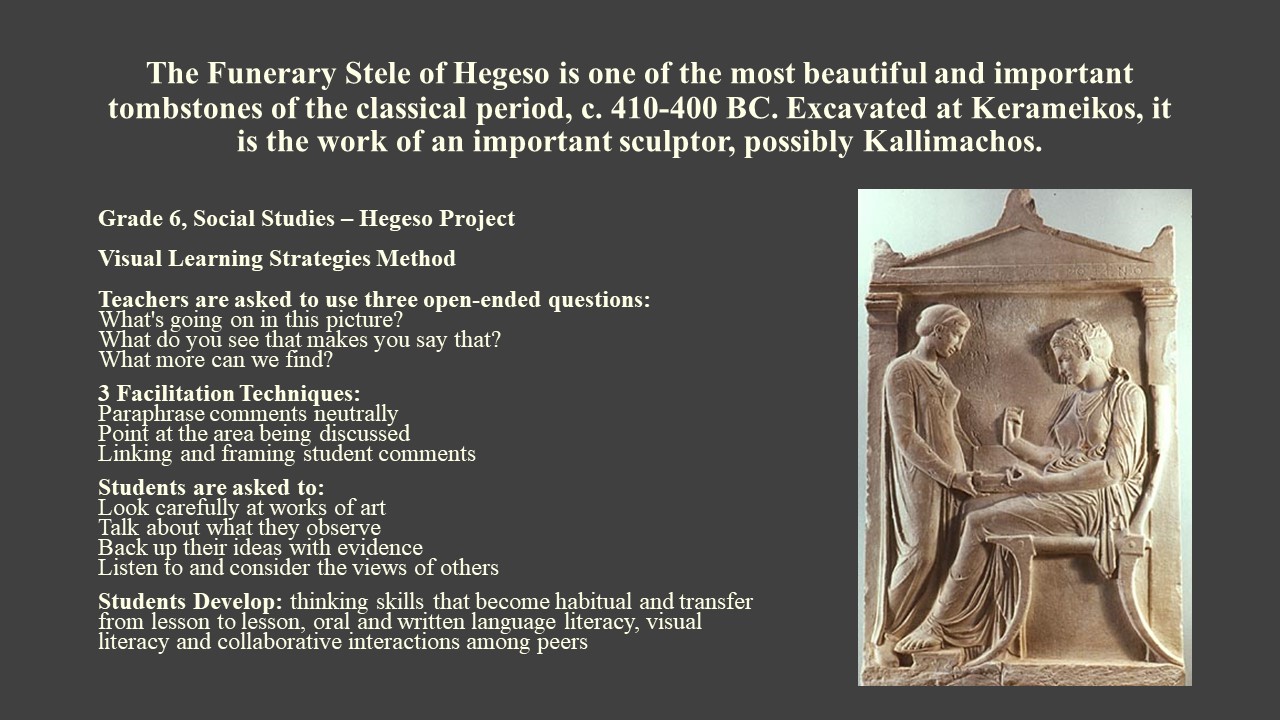
Attributed to Kallimachos architect and sculptor working in the second half of the 5th century BC, Funerary Grave Stelae of Hegeso, c. 410-400 BC, found in Kerameikos, Pentelic Marble, 1,56  x 0,97 m, National Archaeological Museum of Athens

“Sometimes, staring at Hegeso. I am thinking that through tears the best smiles grow up.” The smile and the tears of Hegeso, daughter of Proxenos by Katerina Samara

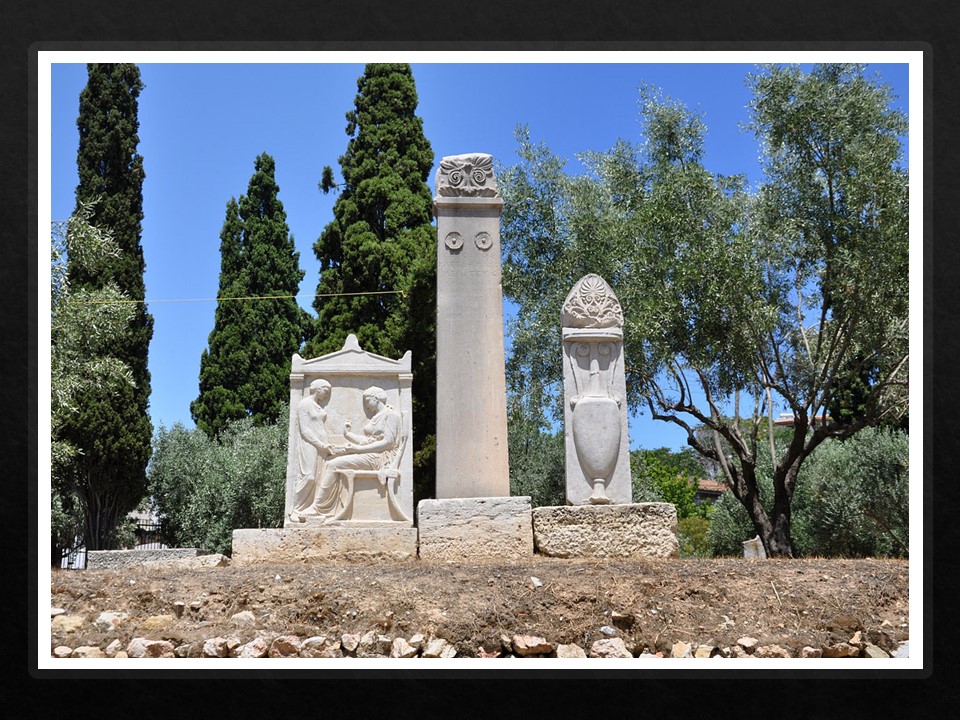
Kerameikos Cemetery of ancient Athens

The amazing Funerary Stelae of Hegeso, daughter of Proxenos, is one of the many masterpieces exhibited in the National Archaeological Museum in Athens. Found during the 1870 archaeological excavation period at the ancient Athenian Cemetery of Kerameikos, Hegeso’s Stelae was made of Pentelic marble and has been attributed to the sculptor and architect Kallimachos. She was a cherished member of a prominent Athenian family, as the magnificence of the relief sculptural Stelae and the family grave plot to which the Stelae was paced, indicate. https://www.namuseum.gr/en/collection/klasiki-periodos-2/

Hegeso’s Stelae is an exquisite example of the so-called “Rich” style that dates to the end of the 5th century and its main characteristics are the artists’ interest in the human body, on garments with elaborate pleats and on airy figures that move gracefully in space. Hegeso is depicted seated on a smart seat (klismos), her feet resting on a footstall. She wears a chiton, a himation, and a transparent veil on her head. With her right hand, she takes a jewel (originally painted) from a pyxis (jewel box) handed to her by a young servant girl, who solemnly stands before her. The servant wears a “barbarian” (not Greek) garment, with long sleeves, and a net on her hair. What a simple, and unpretentious composition the artist achieved! At the same time elegance, grace, class, and sophistication prevail.

Ancient Greek Funerary Grave Stelae of Hegeso (detail)

The relief sculpture of Hegeso, daughter of Proxenos, according to the epigram on the top of the stele which kept alive the Lady’s name for 25 centuries, is probably the work of a skillful artist called Kallimachos. Little is known about the artist, not even if he was Athenian or Corinthian. He is, however, reputed to have worked in the building of the Athenian Acropolis, and for designing the first Corinthian Capital at the Temple of Apollo Epicurius at Bassae, after observing acanthus leaves growing out of a basket placed on top of a young girl’s tomb. Kallimachos, according to Pausanias, is described as clever, innovative, and “catatexitechnus,” meaning he was an extreme perfectionist. https://en.wikipedia.org/wiki/Callimachus_(sculptor)

The Theban poet Pindar wrote that “We are things of a day… When brightness comes, and the gods give it, there is shining light on man, and his life is sweet.” Let me quote Gabriela Chartier and her comments on how “People should not strive only to be remembered after death, but instead to enjoy the sweetness of life…” and how “Hegeso’s stele seems to coincide with Pindar’s idea. Hegeso is not doing anything heroic; the image does not refer to myths or to the epic past. Instead, she is shown in an event of everyday life: a moment in democratic Athens when the light was shining on her. The fact that this image is on a grave stele reinforces Pindar’s message. Placing such scenes along the main road in the Kerameikos would have offered a constant reminder: human life is passing. We are things of a day.” https://archaeologystudentsspeak.wordpress.com/2016/05/02/gabriela-chartier-on-the-grave-stele-of-hegeso/

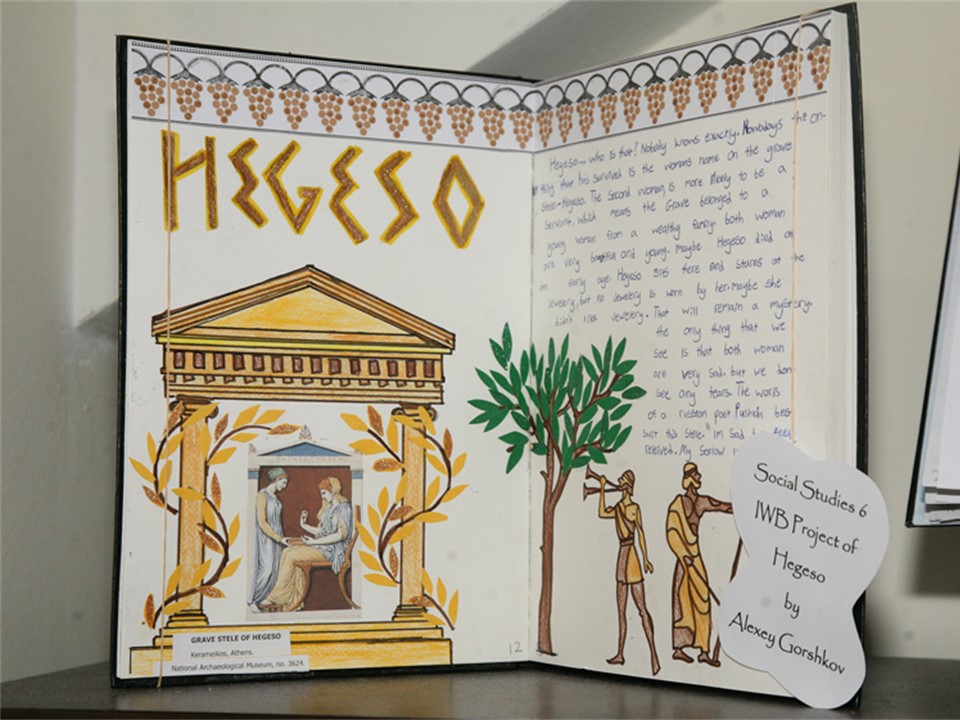
Funerary Grave Stelae of Hegeso, Student Activity

Hegeso, daughter of Proxenos RWAP (stands for Research-Writing-Art-Project) is… HERE!

Examples of student RWAP (stands for Research-Writing-Art-Project) Sketchbooks… HERE!

Funerary Grave Stelae of Hegeso, Visual Learning Strategy Method
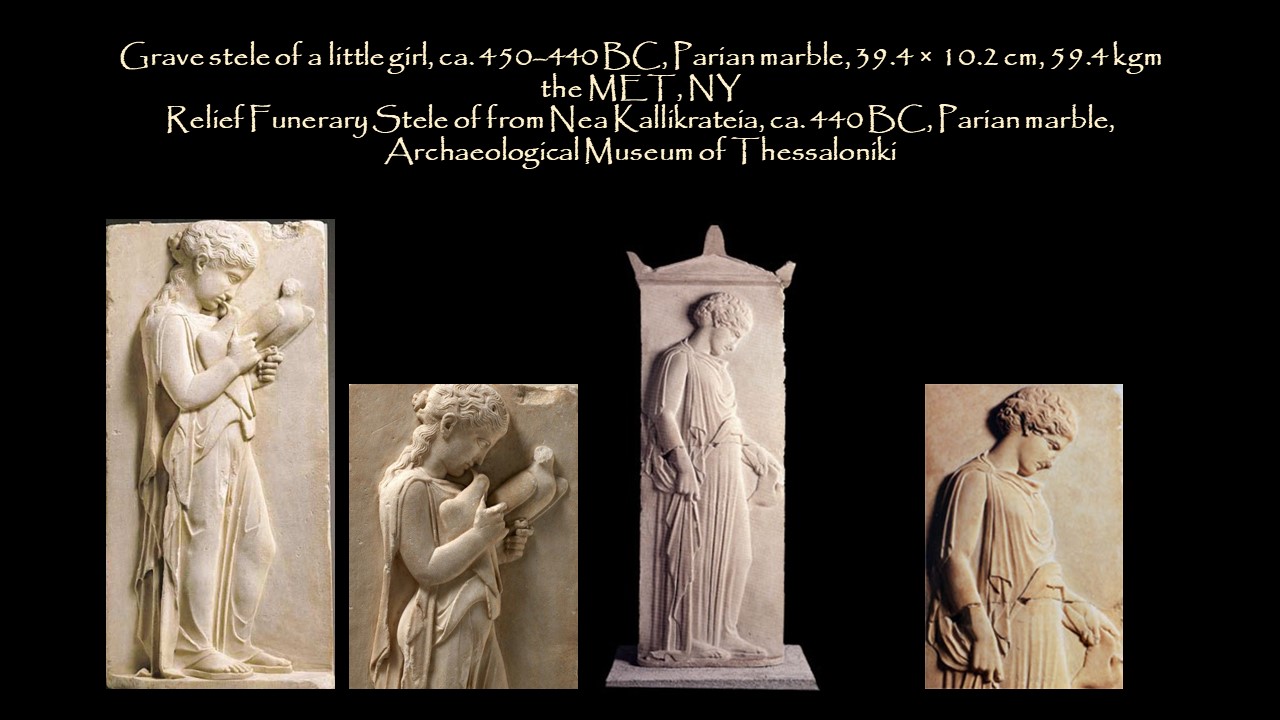
Two ancient Greek Grave Stele. one in Thessaloniki the other in New York City.

Telling us goodbye…

Two ancient Greek Grave Stele. one in Thessaloniki the other in New York City.

They were young and charming, elegant and playful yet sad as they were Telling us Goodbye…

Two of my favourite Ancient Greek Funerary Stele depict a young girl holding a Bird (in the Archaeological Museum of Thessaloniki) or in the case of the Metropolitan Museum in New York, two Birds. Both Stelae were made of Parian marble, around 440 BC.

The Funerary Stele in Thessaloniki “depicts a girl wearing a peplos and holding a dove by its wings with her left hand, while the right one lifts the edge of her garment, to reveal her body.” It is characterized by the superb quality of craftsmanship, a subtle sense of movement, and controlled emotions. Undoubtedly, it occupies a central part in the history of ancient Greek sculpture.

“The gentle gravity of this child is beautifully expressed through her sweet farewell to her pet doves. Her peplos is unbelted and falls open at the side, while the folds of drapery clearly reveal her stance…” The Metropolitan Museum Funerary Stele is the work of a great master sculptor, an artist who manages to enhance the white, translucent Parian marble by creating a “charming composition and delicate carving.”

Both Funerary Stelae grace with their beauty the Archaeological Museum of Thessaloniki (https://www.amth.gr/en/exhibitions/highlights and scroll down to ” Relief Funerary Stele from Nea Kallikrateia”) and the MET in New York ( https://www.metmuseum.org/art/collection/search/252890 ).

If you choose to use this Activity for your class, Grade 6 Social Studies or an Introductory Middle School class on Ancient Greek Art, it will be also nice to show Adam Fuss (the Photographer) discussing the MET Marble Grave Stele of a little girl.

The Metropolitan Museum of Art – THE ARTIST PROJECT Video http://artistproject.metmuseum.org/4/adam-fuss/

Examples of student RWAP (stands for Research-Writing-Art-Project) Sketchbooks… HERE!

Telling us Goodbye RWAP (stands for Research-Writing-Art-Project) is… HERE!