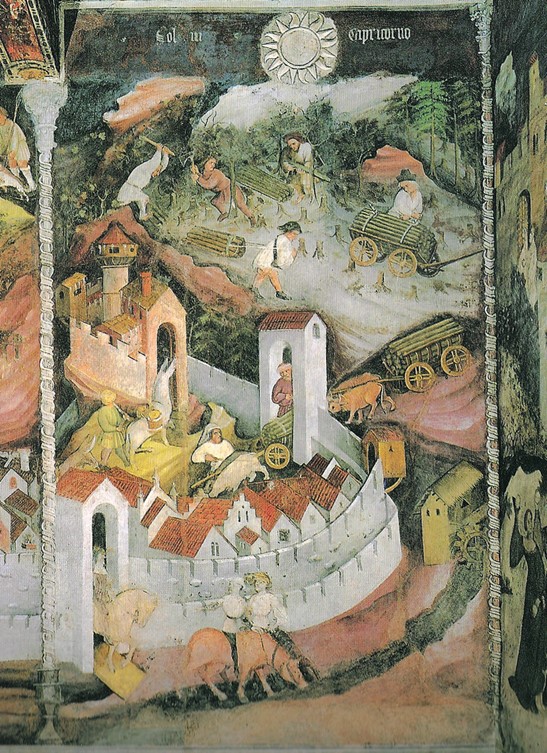
The Month of April, 1407, possibly by Maestro Venceslao, Fresco, Torre Aquila, Castello del Buonconsiglio in Trento, Italy

The Month of April

The Month of April, 1407, possibly by Maestro Venceslao, Fresco, Torre Aquila, Castello del Buonconsiglio in Trento, Italy

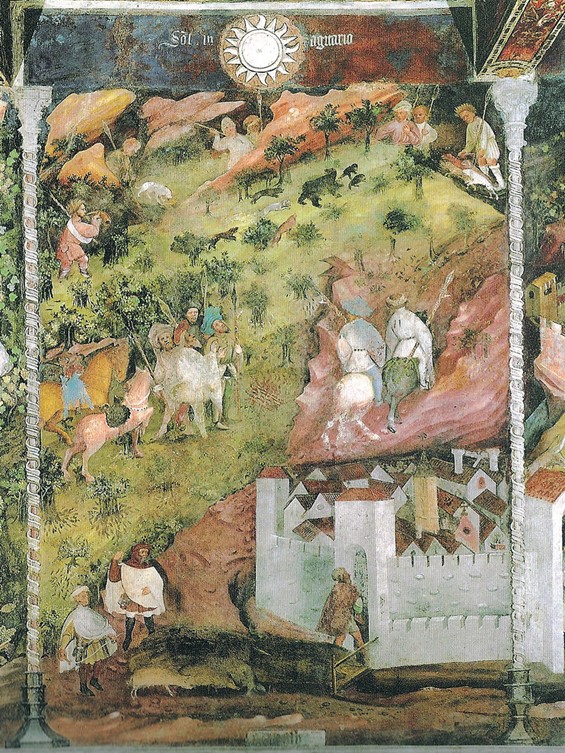
The Italian proverb “Aprile dolce dormire” certainly does not suit the fourth scene of the calendar of the Cycle of Months of Torre Aquila in Trento. Here, under the great April sun, one does not sleep, nor is one idle, but it is all a fervour of activity. http://senzadedica.blogspot.com/2013/04/il-ciclo-dei-mesi-aprile.html

The Month of April fresco comes from Torre Aquila in the Castello del Buonconsiglio, in Trento, Italy. It is part of an amazing fresco Cycle of the Twelve Months painted on the walls of the tower’s 2nd-floor main room. It was commissioned by Prince-Bishop George of Liechtenstein, who wanted to show how well-governed his territories were and how his labourers thrived. The painter of these remarkable paintings, Master Wenceslas, understood well what he was asked to do, created the best 15th-century advertising brochure for Trento, and for the Month of April fashioned a dazzling spring scene, crowded with a well-dressed crowd who, in the lush local countryside, serenely performed their necessary everyday chores. 

Master Wenceslas, a Bohemian painter active in Trento since 1397, creates a rich April scene, full of natural beauty and pastoral activities. Nature awakens and the citizens of Trento are busy. The farmers catch up with their activities and the Ladies of the Court and enjoy a stroll in the woods. The scene is rich, dense and joyful… inspired by real-life but immensely beautified. The commissioner of this fresco, Prince-Bishop George of Liechtenstein, wants to give the idea that his territories flourish under his good governance. and prudent guidance. The painter, Master Wenceslas, understood this very well, and created a verdant scene of dazzling colours, the winter greys have disappeared, crowded with well-dressed farmers and elegant ladies.  https://it.wikipedia.org/wiki/Ciclo_dei_mesi

Maestro Venceslao, Fresco, Torre Aquila, Castello del Buonconsiglio in Trento, Italy
…the month of April, Many and June

Wenceslas’s countryside is fertile and well organized. The fields are separated in an orderly manner and protected, like precious gardens, by braided willow fences. Everything is represented with such precision… the land, the buildings, the farmers’ chores. The April fresco looks as if it is the page of a textbook for a young farmer to study and learn! https://www.ilmiraggio.com/ciclo-dei-mesi-torre-aquila/

At the top of the composition, a lush fir forest offers refuge to one of those bears that populated the Alps at the time. Further down, a pilgrim, fully dressed in white with a hat and a cane, walks through a borough of thatched-roof houses arranged around a small church, empty of villagers… silent. Even the dogs in this village keep silent, as they are both dozing.

The Month of April, 1407, possibly by Maestro Venceslao, Fresco, Torre Aquila, Castello del Buonconsiglio in Trento, Italy

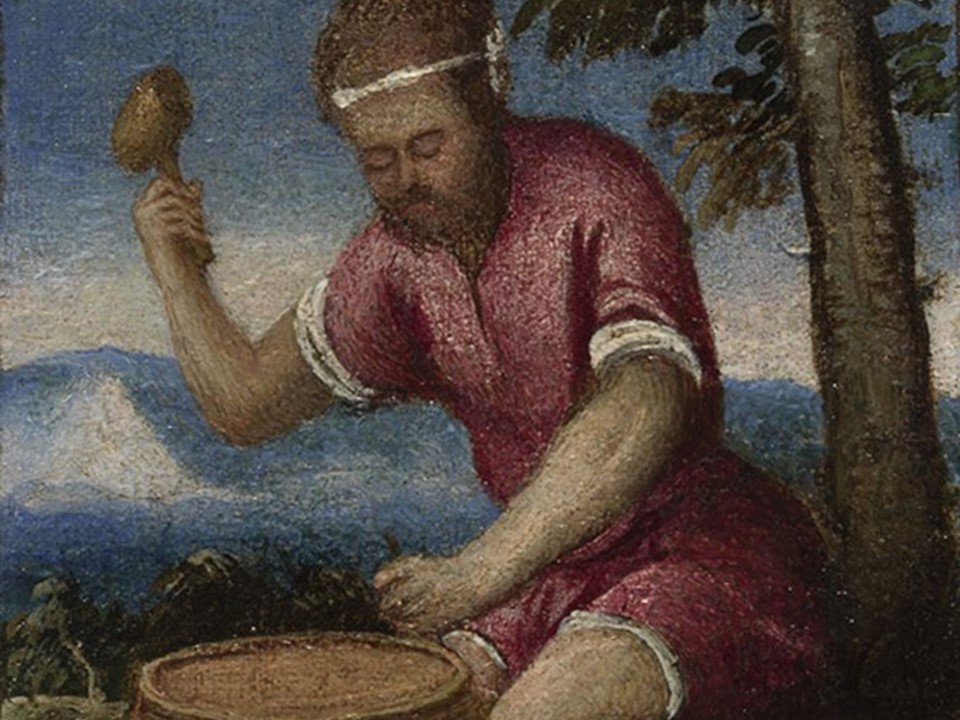
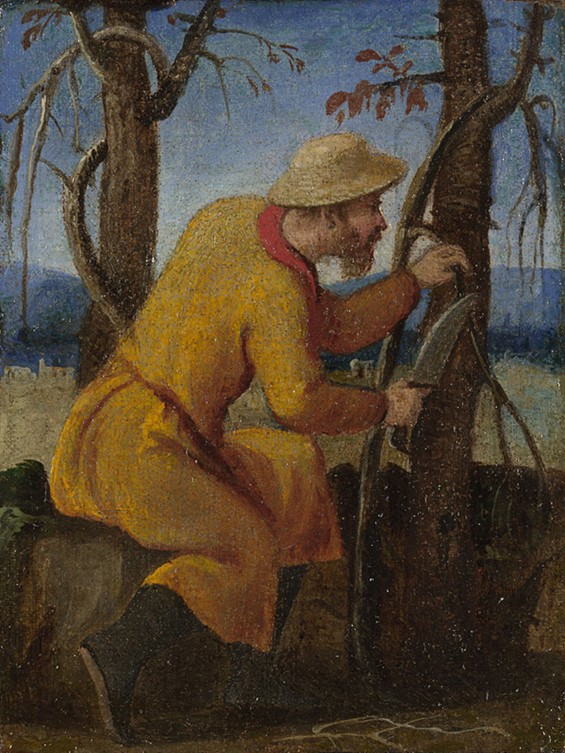
The farmers are busy with their pastoral duties. In a fenced and already ploughed field a farmer sows, while another farmer works the land with a harrow pulled by a horse. Further down to the left, two men, probably coming from a water-mill, carry sacks of flour on a cart driven by oxen. In the foreground, two other farmers plough the land with a heavy wheeled plough pulled by a pair of oxen and a horse. Women do not remain idle. Two of them, taking advantage of the beautiful weather, participate in the fervour of spring activities, gardening their well-fenced plot! Their precious land is on the border of a small forest where, among immense mushrooms, a dog chases a hare!

The Month of April, 1407, possibly by Maestro Venceslao, Fresco, Torre Aquila, Castello del Buonconsiglio in Trento, Italy

The month of April fresco is not only about hard work. The presence of two aristocratic young ladies, in the lower, right part of the composition, can not be missed. Depicted on the edge of the painted scene, the elegant ladies seem to walk towards the festive procession depicted in the following month of May. One of them, wearing an elegant green gown with long sleeves, crosses the thin, pillar-like, frame that divides the two months, and effortlessly, just as the succession of seasons is constant and uninterrupted, guides us to the next composition… that of May!

Until Next Month… check HERE! for a student Activity!

Antonio Allegri da Correggio's painting of Jupiter and Io (detail)

Correggio’s Jupiter and Io

Antonio Allegri da Correggio's painting of Jupiter and Io (detail)
Antonio Allegri da Correggio, 1489 – 1534
Jupiter and Io, 1531-32, oil on canvas, 163.5 × 70.5 cm, Kunsthisstorisches Museums, Vienna
Photo credited to https://da.khanacademy.org/humanities/renaissance-reformation/high-ren-florence-rome/late-renaissance-venice/v/correggio-jupiter-and-io

According to Kelly Richman-Abdou “Mannerism is the Style That Put an Elaborate Twist on Renaissance Art.” I like her comment, and how it applies to our Mannerist painting in focus, Correggio’s Jupiter and Io! MY MODERN MET, October 21, 2018, https://mymodernmet.com/what-is-mannerism/

Antonio Allegri da Correggio's painting of Jupiter and Io

My question is how can order, harmony, and balance, ideals of Classical Art and the Renaissance be “turned/twisted” into something fresh and exciting? Is Mannerism to Renaissance what Hellenistic Art was to 5th century BC Classicism? This is not an easy question to answer. Is Correggio’s mythological painting of Jupiter and Io a good example to start… better so, scratch the mere surface?

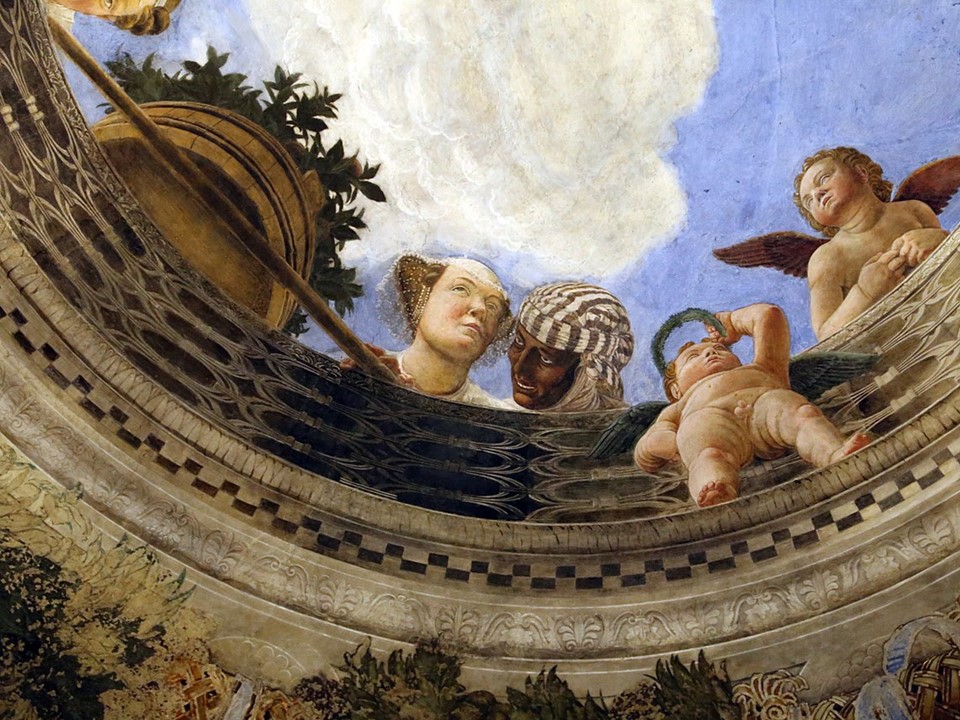
Antonio Allegri da Correggio is an interesting artist to consider. Famous today for his illusionistic, grand domed ceilings, Correggio is a protagonist of Mannerism! Giorgio Vasari wrote, “…everything that is to be seen by his [Correggio’s] hand is admired as something divine.” He is so right! Correggio’s paintings were appreciated by generations of fervent art patrons and artists… from Dukes to Emperors and from Rubens to Boucher. Vasari was also the first to write about Corregggio’s handling of colours, chiaroscuro, and textures, as well. “It may, at least, be held for certain that no one ever handled colors better than he and that no craftsman ever painted with greater delicacy or with more relief, such was the softness of his flesh-painting and such the grace with which he finished his works…” Today, describing the unique “softness” of his painting technique, we use the term “morbidezza,” meaning extreme softness, delicacy, and fuzziness. https://www.oxfordreference.com/noresults;jsessionid=58804597E272C2C21C9F375C6CEFC612?btog=chap&noresults=true&pageSize=20&q=morbid+ezza&sort=relevance

Correggio’s Jupiter and Io was most probably, one of four mythological paintings representing the Loves of Zeus, or Jupiter for the Romans, commissioned by the Duke of Mantua, Federico Il Gonzaga, for the decoration of his private Studiolo. These paintings render the myths of, 1. Jupiter and Io, 1531-32, oil on canvas, 163.5 × 70.5 cm, Kunsthisstorisches Museums, Vienna 2. Danaë, 1531, oil on canvas, 161 x 193 cm, Galleria Borghese, Rome 3. Leda and the Swan, 1532, oil on canvas, 156.2 x 195.3 cm, Gemäldegalerie, Berlin 4. Ganymede Abducted by the Eagle, 1531-1532, oil on canvas, 163.5 × 70.5 cm, Kunsthistorisches Museum, Vienna

Four paintings by Antonio Allegri da Correggio depicting mythological scenes

The myth of Jupiter and Io, depicted in one of the two Vienna paintings by Correggio, is popular and well-liked since antiquity. Lust, deceit, jealousy, revenge and suffering, interwind, creating a fascinating story to render in art. Correggio did an amazing job! I love his Mannerist “twisted” use of posture, movement, and texture. Using a narrow upright format he creates a stable, vertical composition, but Io’s body turns, curls and entwines, so unnaturally, around the charcoal grey cloud of Zeus, it is impossible not to notice. Her firm naked body shimmers in the light and contrasts with the thick, dark, fuzzy cloud that envelops her. What a magnificent contrast of colours and textures. The faces of Zeus and Io make you wonder… what is he whispering to her ear that makes her look so “abandoned”?

For a Student RWAP (Research-Writing-Art-Project), please… check HERE!

The Forty Martyrs of Sebaste, 10th century AD Byzantine Ivory Panel

The Forty Martyrs of Sebaste

The Forty Martyrs of Sebaste, 10th century AD Byzantine Ivory Panel
The Forty Martyrs of Sebaste, 10th century AD,  ivory relief panel from Constantinople, Museum für Byzantinische Kunst, BODE Museum, Berlin
https://history2701.fandom.com/wiki/The_Forty_Martyrs_of_Sebaste

The Forty Martyrs of Sebaste Ivory Icon at the BODE Museum in Berlin is a favorite of mine for making me think, reflect and compare.

First of all, I like the story of these 40 tough Roman soldiers, devoted to their faith, suffering… in the city of Sevaste, in Armenia, during the reign of Emperor Licinius, and under the presidency of Agricolaus, in the year 320 AD. Their story is beautifully told by MATHEW in http://dignareme.blogspot.com/2017/03/the-40-martyrs-of-sebaste.html

The Forty Martyrs of Sebaste, 10th century AD Byzantine Ivory Panel (detail)

Then, I like Byzantine Ivory Carving! What a magnificent medium in… small-scale. Byzantine Art is not only about monumental, awe-inspiring mosaics and frescoes. The aficionados of Byzantium find equal pleasure even more! in artifacts of smaller scale, like luxurious ivories, silverware, glassware, and jewelry, even humble pottery and woodwork.

I am fascinated by Ivory itself. One only has to imagine the caravans or the galleys bringing to Constantinople African elephant tasks, the anticipation of the artisans ready to put their expertise into practice, and the eagerness of the buyers as they consider one more coveted possession. During the 10th and the 11th centuries, Byzantine Ivories were popular among the City’s aristocrats and highly prized as Imperial gifts to foreign dignitaries.

Meticulously carved, ivory icons, consular diptychs, or pyxides, enchant us today with their beauty. “The allure of this substance is easily understood: its smooth, tactile quality and creamy color made it ideal for the creation of” amazing works of art, just like the Icon of the Forty Martyrs of Sevaste in the BODE Museum.

The Forty Martyrs of Sebaste, 10th century AD Byzantine Ivory Panel and Luca Signorelli's fresco painting of Paradise
Fresco painting by Luca Signorelli (1499) of Paradise, Orvieto Cathedral, Orvieto, Umbria
The Forty Martyrs of Sebaste, 10th century AD,  ivory relief panel from Constantinople, Museum für Byzantinische Kunst, BODE Museum, Berlin

Is this amazing carving a case of Byzantine Renascence? The depiction of forty agonizing bodies, winding and twisting, reminds me of Signorelli’s fantasia of Paradise and Hell in Orvioto’s Cathedral, in the Capella of San Brizio.  Are there missing links connecting these two masterpieces I don’t know about? Whatever the answer is, the BODE Ivory Icon is a strategic player in the equation. https://www.metmuseum.org/toah/hd/ivor/hd_ivor.htm and http://www.travelingintuscany.com/art/lucasignorelli/sanbriziochapel.htm

For a “Similarities and Differences” Student Activity, please… check HERE!

Luca Signorelli, Paradise
Fresco painting by Luca Signorelli (1499) of Paradise, Orvieto Cathedral, Orvieto, Umbria
Alessandro Allori's Portrait of Bianca Cappello

What a life you had Bianca Cappello!

Alessandro Allori's Portrait of Bianca Cappello
Alessandro Allori, 1535–1607
Portrait of Bianca Cappello, Second Wife of Francesco I de’ Medici, c. 1580, fresco – tempera on plaster, 75 x 52 cm, Galleria degli Uffizi, Florence
https://centuriespast.tumblr.com/post/67158750360/allori-alessandro-portrait-of-bianca-cappello

What a life you had Bianca Cappello! Rich, powerful and passionate! Born a Venetian lady of noble birth, you chose love over propriety and married Pietro Bonaventuri, escaped to Florence… and found your destiny with Francesco I de’ Medici, Grand Duke of Tuscany… as a mistress, mother, and wife! You were loved devotedly! In 1579 you married the Grand Duke and on the 12th of June 1579, you were crowned the Grand Duchess of Tuscany at the Palazzo Vecchio in Florence. You were probably disliked equally strongly. You died along with Francesco in October 1587, at the famous Villa Medici in Poggio a Caiano. Some historians and scientific evidence suggest malaria fever, others believe you were both poisoned with arsenic! What a life you had Bianca Cappello! http://www.travelingintuscany.com/art/biancacappello.htm

Of all of Bianca’s Portraits, my favorite, painted by Alessandro Allori, c.1580, is in the Galleria Degli Uffizi, in Florence. She is depicted as the Grand Duchess of Tuscany, her beauty assured, elegant in an understated way, self-content, looking at us… critically thinking… are we among her supporters or her foes?  

Alessandro Allori's Portrait of Bianca Cappello (detail)

Where can we “feel” Bianca’s presence in Florence?

As soon as Bianca became Francesco’s mistress she moved from the humble lodgings of her in-laws, where she was expected to do manual work, to the Palazzo Venturi-Ginori. a splendid estate with a fine garden (so-called Oricellari Gardens) and a prestigious history. According to Giorgio Vasari, between 1483 and 1500, Bernardo Rucellai commissioned the construction of the Palazzo and the planting of the famous gardens following designs by Leon Battista Albert. It was during the same period that several meetings of the famous Neo-Platonic Academy took place in the Palazzo. In 1534, the property passed to Bianca Cappello and the Palazzo was turned into a place for leisure and entertainment. The gardens, in particular, were the stage for numerous festivities staged by Bianca Cappello, some of which… quite profane!

Palazzo Venturi-Ginori with a view of the  Oricellari Gardens
http://www.palazzospinelli.org/architetture/scheda.asp?ID=689  
and for Bianca’s Garden Parties…
https://books.google.gr/books?id=guN0CgAAQBAJ&pg=PA1&lpg=PA1&dq=Bianca+Cappello+Oricellari+Gardens&source=bl&ots=WTbhv9Bq6X&sig=ACfU3U0uHjTZbXkTksrfXPDP7aYoc_xwng&hl=el&sa=X&ved=2ahUKEwi315eT68vnAhWPyqQKHS2xBuwQ6AEwDHoECAcQAQ#v=onepage&q=Bianca%20Cappello%20Oricellari%20Gardens&f=false

In 1974, Francesco, still deeply in love with Bianca Cappello, commissioned  Bernardo Buontalenti to design and build a new house for his mistress, much closer to his official residence, Palazzo Pitti. The now-famous Casa Bianca Capello is one of the Florentine historical landmarks you can’t miss! The exterior decoration of the Casa, by Bernardino Pocetti, is done in the black and white sgraffito technique, in which Pocetti was considered an expert. To please the Venetian Lady, the artist designed the Medici crest along with that of the Capello family crest and motifs of marine life within an extravagance of Renaissance designs.

Casa Bianca Capello in Florence
https://en.wikipedia.org/wiki/Palazzo_di_Bianca_Cappello

For a Student Activity, on “What a Life you had Bianca Cappello!” please check… HERE!

The Month of February fresco, possibly by Maestro Venceslao, in Torre Aquila, Castello del Buonconsiglio in Trento, Italy

The Month of February

The Month of February fresco, possibly by Maestro Venceslao, in Torre Aquila, Castello del Buonconsiglio in Trento, Italy
The Month of February, late 14th century-latest 1407, possibly by Maestro Venceslao, Fresco, Torre Aquila, Castello del Buonconsiglio in Trento, Italy

The Month of February fresco comes from Torre Aquila in the Castello del Buonconsiglio, in Trento, Italy. It is part of an amazing fresco Cycle of the Twelve Months painted on the walls of the tower’s 2nd-floor main room and presents the quintessential game of chivalry…

Is there among you any gentleman who for the love of his lady is willing to try with me some feat of arms? If there should be any such, here I am, quite ready to sally forth completely armed and mounted, to tilt three courses with the lance, to give three blows with the battle axe, and three strokes with the dagger. Now look, you English, if there be none among you in love. … and so Gauvain Micaille, the gallant Frenchman squire from Beauce, a gentleman of tried courage, who had advanced himself on his own merit, without any assistance from others, jousts for the honour of France showing his courage and bravery… https://uts.nipissingu.ca/muhlberger/FROISSART/GAUVAIN.HTM

The February fresco at Torre Aquila presents an impressive and festive Tournament where Jousting is the protagonist of the day. The Trento artist, maybe Maestro Venceslao, using warm tones of orange and ochre, organizes a two parts composition. The background presents Trento Ladies sitting behind an elaborate, purpose-built, parapet. They are finely dressed and adorned with elaborate headdresses, crowns, and wreaths, talking to each other, full of excitement… maybe contemplating, even debating whom they are going to favor! The Knights, fully armored and carrying their cotes-of-arm are depicted in the art of Jousting, their goal, to show gallantry and honour, their hope to attract the attention of “their” Lady and get a token of her favor… a veil, a ribbon, a wreath!

The Month of February fresco, possibly by Maestro Venceslao, in Torre Aquila, Castello del Buonconsiglio in Trento, Italy (detail)

According to Wikipedia: “Jousting is a martial game or hastilude between two horsemen wielding lances with blunted tips, often as part of a tournament. The primary aim was to replicate a clash of heavy cavalry, with each participant trying hard to strike the opponent while riding towards him at high speed, breaking the lance on the opponent’s shield or jousting armor if possible, or unhorsing him. The joust became an iconic characteristic of the knight in Romantic medievalism. The participants experience close to three and a quarter times their body weight in G-forces when the lances collide with their armor.” https://en.wikipedia.org/wiki/Jousting#CITEREFColtman1919

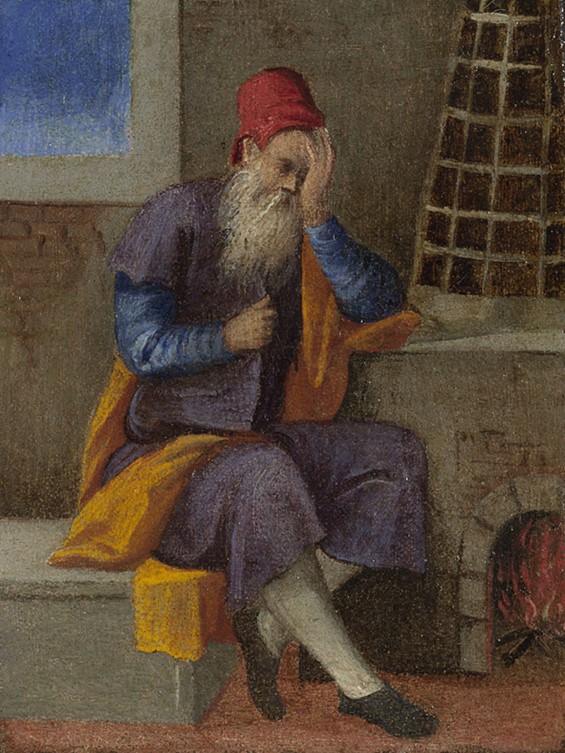
The Trento fresco for February has another interesting genre scene. In the narrow space between the room’s window and the staircase, the artist included a vignette of an older blacksmith toiling hard in his workshop. Let’s not forget this is a fresco cycle of the Labors of the Months, illustrating the activities of aristocrats and peasants, every month, throughout the year!

For a PowerPoint, please… check HERE!

Feast of the Gods by Giovanni Bellini

Feast of the Gods

Feast of the Gods by Giovanni Bellini
https://en.wikipedia.org/wiki/The_Feast_of_the_Gods#/media/File:Feastofthegods.jpg

The Feast of the Gods is the story of a Renaissance Patron of the Arts, three Master Painters and a… very special Room, the camerino d’alabastro (alabaster study) of the Ferrara Castle.

The story starts with the desire of Duke Alfonso d’Este to decorate his studiolo, the camerino d’alabastro, with a series of bacchanals, mythological paintings that celebrate Bacchus and Venus, the gods of wine and love. Alfonso’s private studiolo in Ferrara was his retreat, where he would collect, exhibit and admire his collection of ancient medals, antique statuettes, and mythological paintings, celebrating the delights of nature and love. It was a very private place, only a handful of people ever saw while the Duke was still alive. Soon after he died, the room was disassembled, the paintings were taken to Rome, ending up in Washington DC, London, and Madrid.

For his first bacchanal, Alfonso turned to Giovanni Bellini, the Venetian master, who “very old, but still the best there is” as Albrecht Dürer said in one of his letters, was famous at the time for his “luminous color that would be the glory of Venetian painting for centuries to come.” The Feast of the Gods, Bellini’s creation, turned to be a very unique painting. Bellini, reluctant at first, accepted the Duke’s invitation and drawing inspiration from Ovid’s Poems, created “a wooded pastoral setting, in which the gods, with Jupiter, Neptune, and Apollo among them, revel eating and drinking, attended by nymphs and satyrs.” The painting has all the characteristics of Bellini’s excellence: brilliant colors, lush pastoral setting, an engaging story and an ambiance of sensuality.

The painting was completed in 1514 but a few years later Alfonso commissioned two artists, Dosso Dossi and Titian, to rework parts of the painting’s landscape background. Dosso Dossi changed parts of the landscape on the left side and added a pheasant resting on bright foliage at the upper right part of the painting. Then, Bellini’s student, Titian, added his own alterations. He reworked Dosso’s alterations adding the dramatic, mountainous backdrop that can be seen now, leaving only Dosso’s pheasant intact. The painted figures and decorative elements of the painting were untouched and remain Bellini’s own. There is, however, an enigma and further questions! “Did Alfonso, an amateur painter who was reported to fancy pheasants, paint the bird himself? Did Alfonso “picture” himself in another way as well? Some evidence suggests that Feast of the Gods contains cryptic references to the duke’s marriage to Lucrezia Borgia, perhaps even portraits of the couple.” https://www.nga.gov/collection/highlights/bellini-titian-the-feast-of-the-gods.html and https://www.nga.gov/collection/art-object-page.1138.html

Feast of the Gods by Giovanni Bellini (detail)
https://en.wikipedia.org/wiki/The_Feast_of_the_Gods#/media/File:Giovanni_Bellini_and_Titian_-_The_Feast_of_the_Gods_-_Detail-_trees_&_pheasant.jpg

Many scholars believe that Alfonso’s studiolo was the finest of its kind, a shining jewel box! The first commission went to the elderly Giovanni Bellini and the Feast of the Gods (NGA Washingon DC) was the result. Michelangelo and Raphael were also commissioned to create works of art for the Duke’s studiolo but their commissions never materialized.   With Bellini’s death in 1514, Titian, and the Duke’s court artist, Dosso Dossi, stepped in to complete this ambitious project. Dosso Dossi’s painting was destroyed centuries ago, but Titian’s Bacchus and Ariadne (National Gallery, London) The Worship of Venus (Museo del Prado, Madrid) and the Bacchanal of the Andrians (Museo del Prado, Madrid) still survive to tell us their story. https://www.theguardian.com/uk/2003/feb/08/artsandhumanities.arts1

For Student Activity, please… check HERE!

The Month of January, late 14thcentury fresco, possibly by Maestro Venceslao

The Month of January

The Month of January, late 14thcentury fresco, possibly by Maestro Venceslao
The Month of January, late 14thcentury-latest 1407, possibly by Maestro Venceslao, Fresco, Torre Aquila, Castello del Buonconsiglio in Trento, Italy
https://www.cultura.trentino.it/eng/Cultural-venues/All-cultural-venues/Documentation-centres2/Torre-Aquila-Aquila-Tower

The Month of January is a fresco, and it comes from the Torre Aquila in the Castello del Buonconsiglio, in Trento, Italy. It is part of an amazing fresco Cycle of the Twelve Months painted on the walls of the tower’s 2nd-floor main room. Today, only eleven of the original 12 panels survive as a 16th-century wooden spiral staircase, connecting the tower floors, destroyed the painted panel of March. The famous painted Cycle of the Months is divided into twelve panels, one for each month. Each one of the twelve panels is separated by a slender column, distinctive yet subtle, so as not to disturb the natural continuity between months and the seasons.

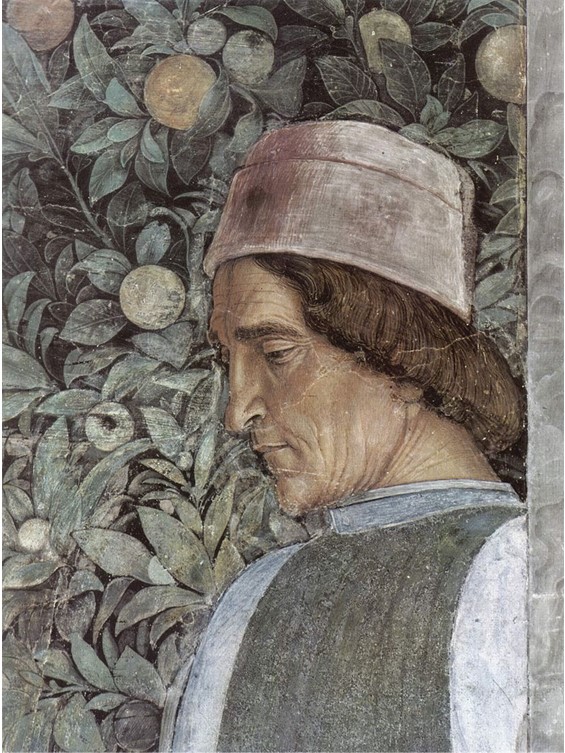
This exceptional room, 6 x 5,8 x 3 m in size, was commissioned by Prince-Bishop George of Liechtenstein, as a quiet, atmospheric retreat, away from the rest of the Castello’s busy and noisy state quarters. It has been suggested and widely accepted that the painter of this extraordinary fresco Cycle of the Months was Maestro Venceslao, a Czech painter, popular in the Tyrol area of the time.

Frescoes of the Twelve Months at Torre Aquila, Castello del Buonconsiglio in Trento, Italy

The Cycle of the Twelve Months is a favourite theme in the arts of the Middle Ages and the Early Renaissance. Often linked to the signs of the Zodiac, the Cycle of the Months is often perceived as a link between the work of man, the seasons of the year and God’s ordering of the Universe. As a theme, it recurred in the sculptural decoration of cathedrals and churches across Europe, in illuminated manuscripts like the popular Books of Hours, palace frescoes and rarely, panel painting.

The fresco panels in Torre Aquila are rare and special. They document life in the Trentino area, with references to the aristocratic pastimes throughout the year, or the peasant activities and duties to their masters. They also depict a vivid landscape, romanticized even then, from bare and covered with snow, to rich and fertile, to autumnal, covered with fallen leaves.

The Trentino frescoes love presenting anecdotal details. The depiction of fashionable outfits for the rich, multicoloured and extravagant in style, or shabby for the farmers and artisans, is only one such striking example. The January panel is “a case in point: nowhere else in art do aristocrats come to play in the snow, men and women alike, chuckling snowballs about with determined, impish delight, their long sleeves dragging in the drifts. Oddly – but surely intentionally – the castle’s roof is snow-free, and its garden is full of summer growth. It’s an image of the warmth of their protected life. Maestro Venceslao was painting a dream, but he wanted to make it as real as possible…”

The Best Art You’ve Never Seen: 101 Hidden Treasures From Around the World by Julian Spalding, Rough Guides Reference, 2010 https://books.google.gr/books?id=L3e0BgAAQBAJ&pg=PA11&lpg=PA11&dq=cycle+of+the+months+paintings&source=bl&ots=PDmmhZPn37&sig=ACfU3U0ZvpPwd-ZSa8dnhL4AUn2uBLt26g&hl=el&sa=X&ved=2ahUKEwjVxcGIzNzmAhWRGewKHQiuD5g4ChDoATAGegQIBxAB#v=onepage&q=cycle%20of%20the%20months%20paintings&f=false

For a PowerPoint, please… check HERE!

For a Student Activity on the discussed Fresco Panel depicting the Month of January, please… check HERE!

Sandro Botticelli, Mystical Nativity

Mystical Nativity by Sandro Botticelli

Sandro Botticelli, Mystical Nativity
Sandro Botticelli, about 1445 – 1510
 Mystical Nativity, about 1501, Tempera on canvas, 108.6 x 74.9 cm, National Gallery, London

Our 1st Christmas story is about the… Mystical Nativity by Sandro Botticelli.

“I Sandro painted this picture at the end of the year 1500 in the troubles in Italy in the half time after the time according to the 11th chapter of St. John in the second woe of the Apocalypse…”

This small Botticelli painting makes us dream, encourages us to be pensive, romantic and adoring, urges us to study details in the composition, colours, conflicting perspectives and depicted figures. It is a mystery, difficult to solve! John Ruskin saw it in London and referring to its ‘mystic symbolism’ became the painting’s godfather! Its composition is rather unusual combining all of the traditional events of the birth of Jesus and more. Is Botticelli, an ardent follower of Girolamo Savonarola, presenting us with a vision of the Nativity inspired by the prophecies in the biblical Book of Revelation of Saint John? Does Botticelli’s Nativity reveal Christ’s second coming and the end of the world?”

“The infant Christ reaches up towards the Virgin Mary, oblivious of his visitors – the Three Kings on the left and the shepherds on the right. The golden dome of heaven has opened up and is circled by 12 angels holding olive branches entwined with scrolls and hung with crowns. In the foreground, three pairs of angels and men embrace; among their feet demons scuttle for shelter in the underworld through cracks in the rocks. The Greek inscription mentions ‘the troubles of Italy’, a reference to the invasion of the French, who took Naples in 1494 and Milan in 1499, and to the civil strife in Florence itself. Botticelli associated these events with the turmoil mentioned in the biblical Book of Revelation, which talks about the end of the world and Christ’s second coming. The period of upheaval it described would end upon Christ’s return, when the devil would be buried, as in this picture.” This is the description provided by the National Gallery of London https://www.nationalgallery.org.uk/paintings/sandro-botticelli-mystic-nativity

For a PowerPoint on Botticelli’s Mystical Nativity, please… check HERE!

Three monumental paintings by Cimabue - Giotto - Duccio in the Uffizi Gallery in Florence.

Cimabue – Giotto – Duccio

Three monumental paintings by Cimabue - Giotto - Duccio in the Uffizi Gallery in Florence.

Cimabue – Giotto – Duccio, how important are they? You simply have to visit the Uffizi Gallery in Florence, Hall 2 to be more specific, stand in front of these three monumental panels and allow their masters to take you on a trip to the late 13th, early 14th century revolutionary Italian Painting.

According to Giorgio Vasari,“…instead of paying attention to his literary studies, Cimabue, as if inspired by his nature, spent the whole day drawing men, horses, houses and various other fantasies in his books and papers.” Cenni di Pepo, known as Cimabue, is recognized as the last painter of the Italo-Byzantine style. Yet. he is credited to step forward in moving his art towards achieving the first hint of naturalism, paving the way for the next generation of great Italian masters.

O vanity of human powers, how briefly lasts the crowning green of glory, unless an age of darkness follows! In painting Cimabue thought he held the field but now it’s Giotto has the cry, so that the other’s fame is dimmed. Writes about Giotto, the poet Dante in Canto XI of his Purgatorio, and he is so right. Giotto creates “a new kind of pictorial space with an almost measurable depth” and figures that are “volumetric rather than linear” expressing “varied and convincingly human rather than stylized” emotions. Justifiably, Giotto is considered the father of modern European painting. https://www.metmuseum.org/toah/hd/iptg/hd_iptg.htm

“Duccio, painter of Siena and much esteemed, deserved to carry off the palm (of an inventor in the Arts) from those who came many years after him…” writes Giorgio Vasari in his book The Lives of the Most Excellent Painters, Sculptors, and Architects. Today, Duccio Duccio is considered to bring through his art elegance, lyricism, and spirituality along with spatial complexity and refined use of colours.

There are two Uffizi Gallery sites you simply need to visit: https://www.visituffizi.org/halls/hall-2-of-giotto-and-the-13th-century/ and https://www.virtualuffizi.com/13th-century-and-giotto-room.html

For a student Activity, my Grade 9 Art History students enjoy… click HERE!

A PowerPoint on the three Madonnas is… HERE!

Leonardo's La Belle Ferronnière (detail)

Leonardo da Vinci

Leonardo's La Belle Ferronnière (detail)
La Belle Ferronnière (detail), 1495 – 1499, oil on wood, 62 cm × 44 cm, Louvre Museum, Paris Photo Copyright: https://www.bbc.com/news/world-europe-50127095
…and her mesmerizing eyes

Five hundred years ago, one of the greatest Renaissance Homo Universalis passed away at the Château du Clos Lucé, in the Loire Valley. The Louvre Museum, wishing to commemorate the fifth centenary of the artist’s death, organizes an International Retrospective Exhibition on Leonardo da Vinci and his oeuvre. https://www.louvre.fr/en/expositions/leonardo-da-vinci

The Louvre Museum in Paris holds the largest collection in the world of the artist’s paintings, five of the fourteen to seventeen paintings now attributed to Leonardo, as well as 22 drawings. This collection is the core of the Retrospective that will also present “the latest research findings, critical editions of key documents and the results of the latest analysis carried out in laboratories or during recent conservation treatment by the Louvre.” https://www.louvre.fr/en/leonardo-da-vinci

A unique feature that the Exhibition presents to its visitors is the Virtual Reality experience for the Mona Lisa painting, the first of its kind at the Louvre. Virtual Reality enables visitors to go through the glass-case that protects the Mona Lisa and see minute details within the painting invisible otherwise to the naked eye. https://arts.vive.com/us/articles/projects/art-photography/mona_lisa_beyond_the_glass/ and https://www.youtube.com/watch?v=Au_UpzhzHwk

The PowerPoint I use for my Art History class on the artist… is HERE!

Virtual Reality and the Mona Lisa painting