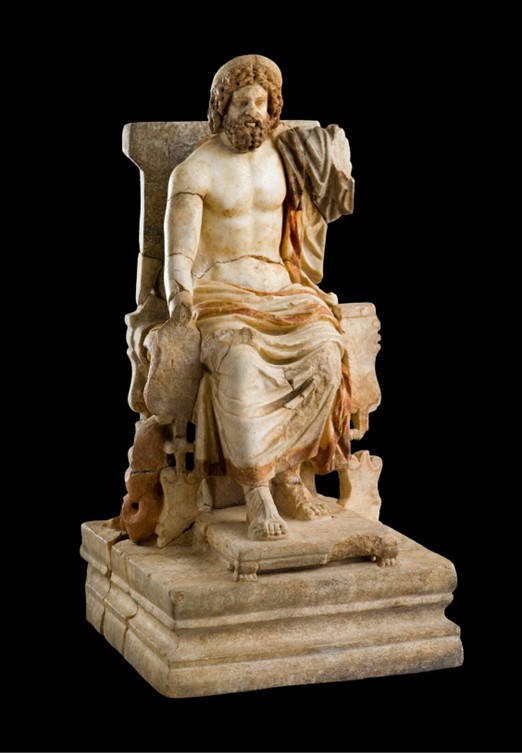
Statuette of Asklepios Enthroned

Statuette of Asklepios Enthroned, Athenian workshop, 150 – 200 AD, Marble, Height: 42.3 cm, Archaeological Museum of Ancient Corinth, Greece https://www.facebook.com/photo.php?fbid=1019102956923674&id=100064719367083&set=a.462183875948921&locale=el_GR

…Asclepius, that gentle craftsman who drove pain from the limbs that he healed, that hero who cured all types of diseases… as Pindar writes in Pythian 3, was the ancient Greek god of medicine and healing, both revered and deified for his mastery over human suffering. This divine healer is brought vividly to life in the Statuette of Asklepios Enthroned, crafted in an Athenian workshop between 150–200 AD and now housed in the Archaeological Museum of Ancient Corinth. Carved from marble and standing 42.3 cm tall, the figure captures Asclepius in a moment of quiet authority, seated with the familiar serpent-entwined staff at his side—a timeless symbol of restoration and medical care. Though created centuries after the height of his cult, the statuette reflects the enduring presence of Asclepius in both public worship and private devotion, embodying the belief in divine healing that spanned from the classical world into the Roman era. https://www.perseus.tufts.edu/hopper/text?doc=Perseus%3Atext%3A1999.01.0162%3Abook%3DP.%3Apoem%3D3

The Ancient Greek myths of Asclepius tell the story of a mortal born to the god Apollo and the human woman Coronis, who was raised and taught the healing arts by the wise centaur Chiron. Gifted beyond any healer before him, Asclepius became so skilled that he was said to cure incurable diseases and even bring the dead back to life. This miraculous power, however, drew the ire of Zeus, who feared that such abilities would upset the natural balance between life and death. In response, Zeus struck Asclepius down with a thunderbolt, ending his mortal life but paving the way for his deification. Worshipped across the Greek world, particularly in healing sanctuaries known as Asclepieia, Asclepius became a symbol of divine compassion and medical wisdom, bridging the realms of myth, religion, and early medical practice.

The healing sanctuaries of Asclepios become some of the most important religious and medical centers of the classical world. The most famous of these was at Epidaurus in the northeastern Peloponnese, a sprawling complex that included temples, dormitories for dream incubation, and even a theater. Other major centers of his cult were located on the island of Kos, where the physician Hippocrates is said to have trained, and at Pergamon in Asia Minor. In Athens, he was worshipped at the Asclepieion located at the foot of the Acropolis, near the Theater of Dionysus. These sanctuaries attracted the sick and afflicted from across the Greek world, who came seeking cures through ritual purification, offerings, and dreams in which Asclepius or his sacred serpent revealed treatments. His worship was not only a spiritual experience but also a foundational element in the evolution of ancient medicine.
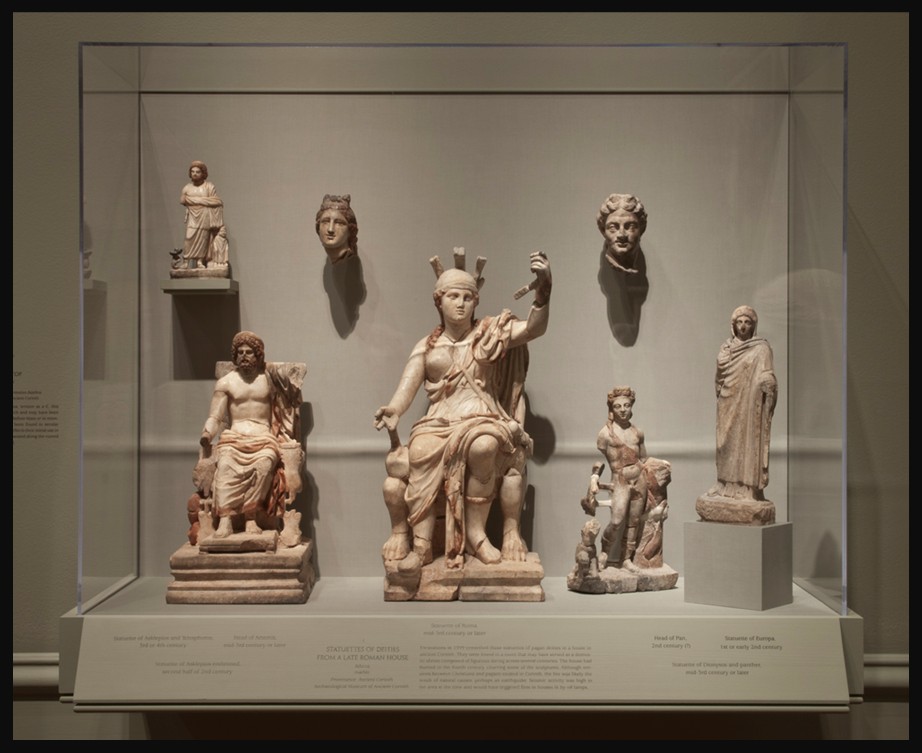
Statuettes of deities from a late Roman house, Marble, Archaeological Museum of Ancient Corinth in Greece Photo: https://www.nga.gov/features/slideshows/from-the-ancient-to-the-byzantine-world.html#slide_2

The Statuette of Asklepios Enthroned, now housed in the Archaeological Museum of Ancient Corinth, was discovered during 1999 excavation period (by the American School of Classical Studies) of a domestic shrine within a luxurious Roman villa in the Panayia Field area of Corinth. The villa was destroyed by a violent earthquake in the late fourth century AD, preserving a collection of marble statuettes representing various deities, including Artemis, Dionysos, Herakles, Pan, Europa and Roma, alongside Asklepios (Sanders 1999, 441–444). These statuettes were part of a private cultic assemblage, suggesting ongoing pagan devotional practices within the home, even as Christianity was becoming dominant in the region. The presence of these figures in such an opulent residence reflects the persistence—albeit increasingly private—of traditional Greco-Roman religious customs among segments of the local elite during the final phases of pagan worship in Late Antique Corinth

Dated to 150–200 AD and discovered in Corinth, the Statuette presents a richly detailed image of the healing god seated in quiet authority. Asclepius is shown leaning slightly forward on a high-backed throne, his head turned gently to the right. He wears a plain round wreath atop his parted, curling hair, which falls to his shoulders, and his face is framed by a mustache and full, curly beard. Draped in a himation that cascades from his left shoulder in V-shaped folds with a zigzag border, the god’s right arm once rested over a large coiled snake, his sacred symbol, positioned along the right side of the throne. His network-style sandals, tied above the ankle, rest on a substantial footstool with squat animal feet and a central groove, while the throne itself is ornately carved with square-incised panels on the back, lyre-shaped legs, and projecting wings. A cushion beneath him adds to the sense of formality and comfort, enhancing the image of divine majesty.

Scholars suggest that this statuette may be a scaled marble reinterpretation of the famed chryselephantine cult statue of Asclepius by Thrasymedes of Paros, described by Pausanias in the temple at Epidaurus (2.27.2). Like the legendary cult image, the Corinthian figure holds a staff in his left arm and extends his right hand toward the coiled serpent, reflecting iconography seen on fourth-century BC Epidaurian coins. The white marble and traces of gilding on the Panagia statuette evoke the luxurious materials of ivory and gold used in the original, indicating it was likely crafted in homage to the Epidaurian prototype. This connection underscores the continuity of Asclepius’ cult and the enduring reverence for his divine healing power well into the Roman period.

For a Student Activity inspired by the Statuette of Asklepios Enthroned in Corinth, please… Check HERE!

Bibliography: chrome-extension://efaidnbmnnnibpcajpcglclefindmkaj/https://www.ascsa.edu.gr/uploads/media/hesperia/25068051.pdf  Pagan Statuettes in Late Antique Corinth, Sculptures from the Panayia Domus, HESPERIA 77 (2008), Pages 89-161
2nd century AD sculptural piece of Aion-Phanes in Galleria Estense, Modena, Italy

Mithraic Aion and Orphic Phanes

2nd century AD sculptural piece of Aion-Phanes in Galleria Estense, Modena, Italy
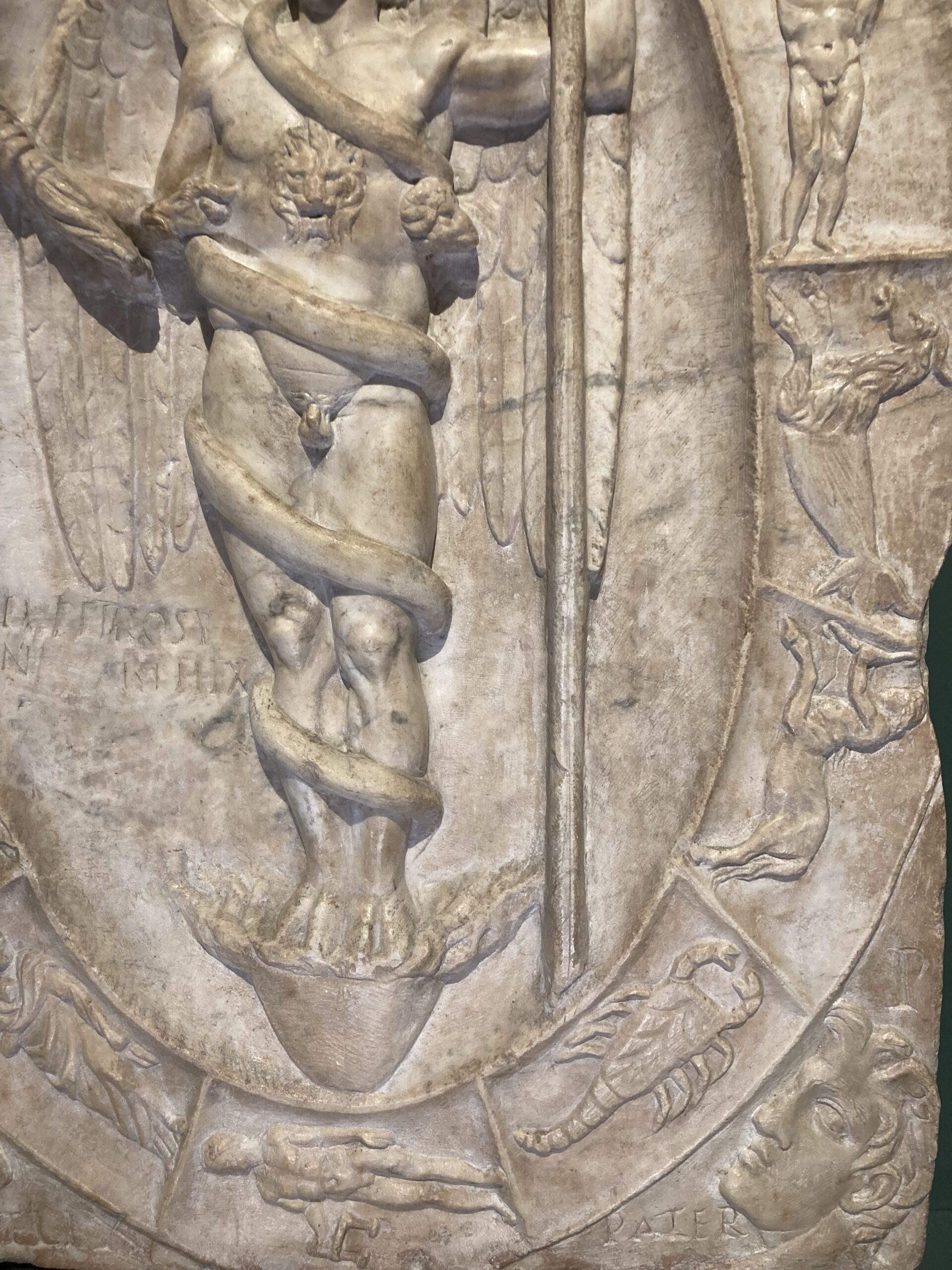
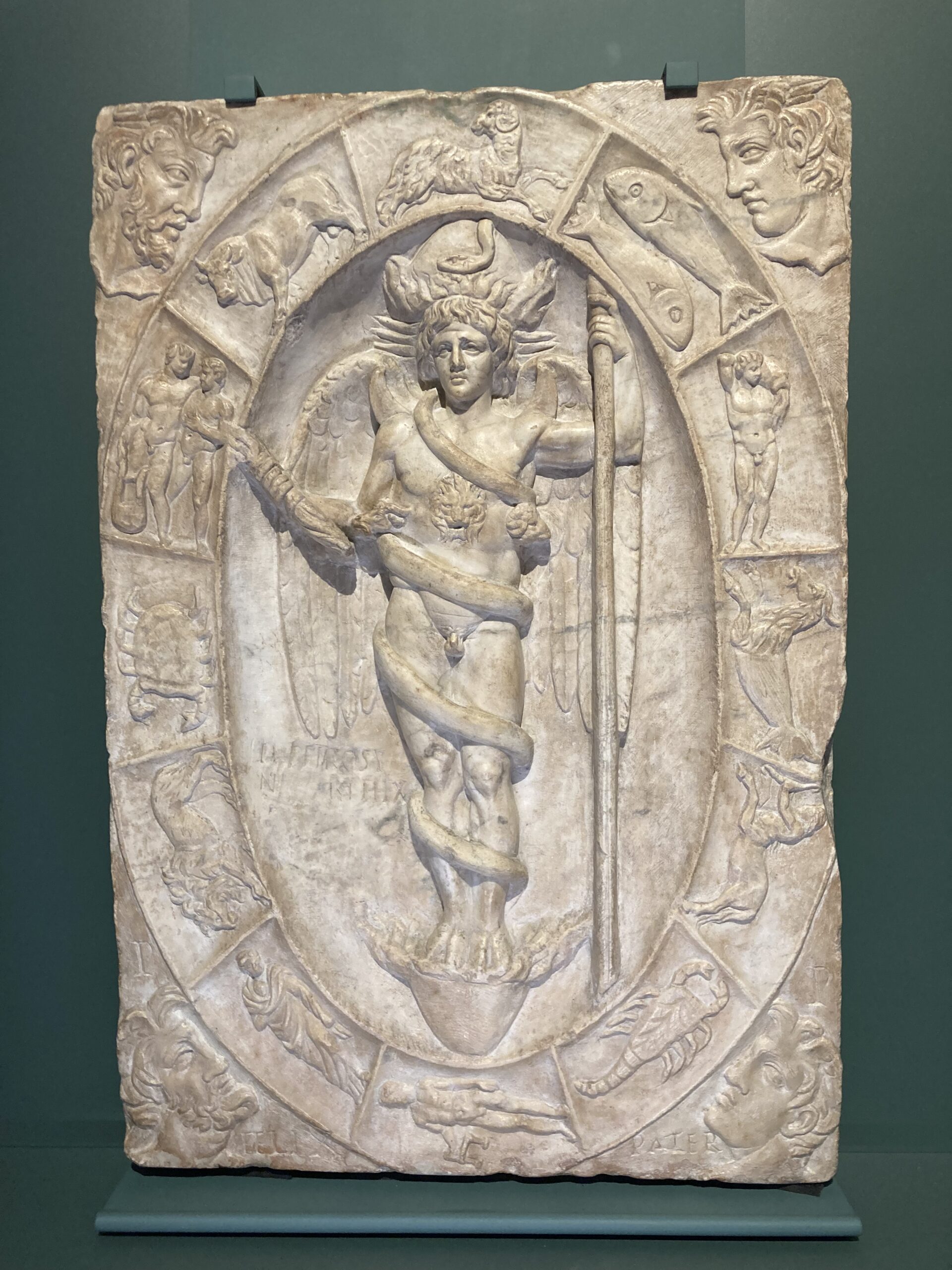
Syncretistic deity Aion-Phanes, second quarter of 2nd century AD, Marble, 71×48,5 cm, Galleria Estense, Modena, Italy – Photo Credit: Amalia Spiliakou, April 2025

In the richly symbolic world of late antiquity, the Roman relief sculpture housed in the Galleria Estense in Modena, Italy, offers a captivating glimpse into the syncretic religious landscape of the 2nd century AD. This intricate relief brings together two enigmatic deities—Mithraic Aion and Orphic Phanes—whose fusion reflects a profound cosmological vision. Aion, central to Mithraic mystery cults, embodies boundless time and eternity, often depicted encircled by the zodiac, signifying the cyclical nature of existence. Phanes, a radiant, primordial god of light and creation in Orphic tradition, emerges from the cosmic egg, symbolizing the birth of order from chaos. The pairing of these figures on a single relief not only highlights the cross-pollination of Eastern and Hellenic religious ideas within the Roman Empire but also reveals a deep fascination with the mysteries of time, origin, and divine illumination.

Let’s explore the ‘what’, and the ‘how’ of this amazing Roman relief sculpture by posing some questions!

What does the figure of Aion represent in the context of Mithraic iconography, and how does his symbolism reflect the cosmological themes of Mithraism? Aion, in the context of Mithraism, is a mysterious and symbolic deity associated with eternal, cyclical time and the cosmos. While not a central figure in the Mithraic mysteries, he appears in some Mithraic iconography, most notably as a lion-headed figure entwined by a serpent, often standing on a globe and surrounded by zodiac symbols. This image represents cosmic time, the eternal cycle of the heavens, and possibly the control of celestial forces. Though not named explicitly in surviving texts, this figure is often identified as Aion, drawing parallels with the Greek personification of time, the Persian god Zurvan, and even with Gnostic aeons. Aion’s presence in Mithraism underscores the religion’s deep cosmological and esoteric focus, blending influences from Greco-Roman, Persian, and later philosophical traditions into a symbolic representation of the eternal and mysterious forces that govern the universe.

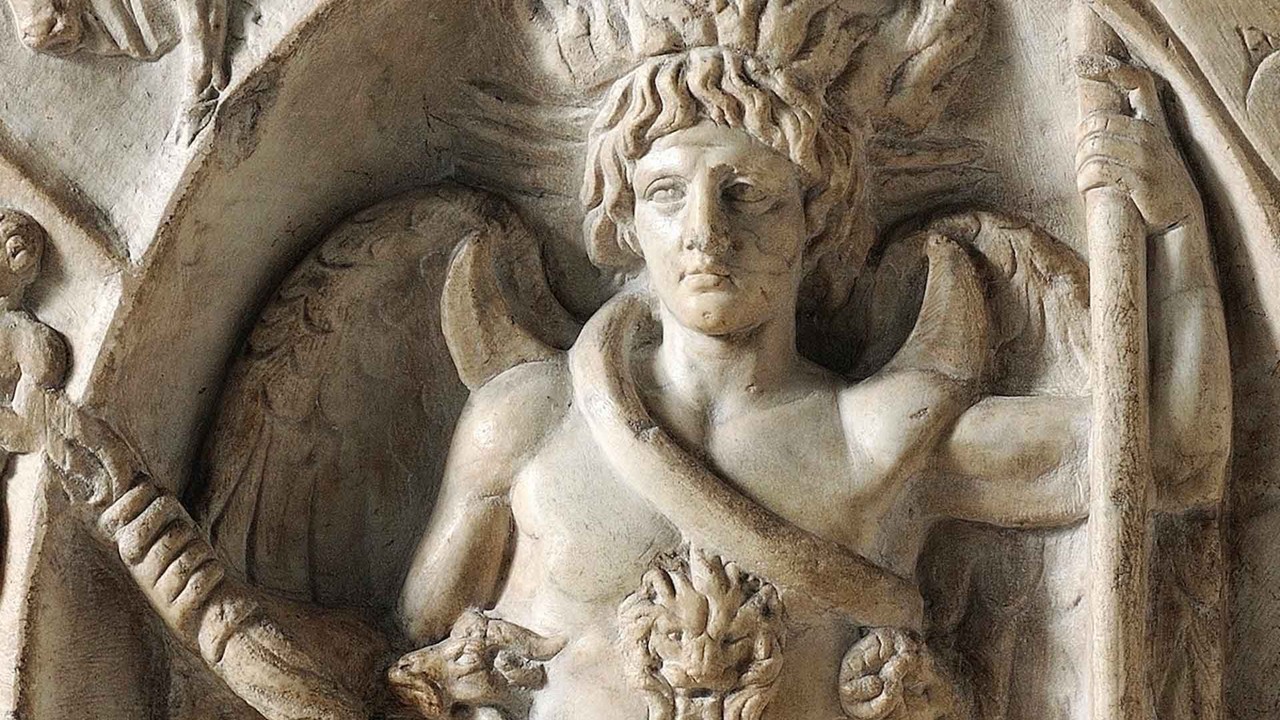
Detail of the 2nd century AD sculptural piece of Aion-Phanes in Galleria Estense, Modena, Italy
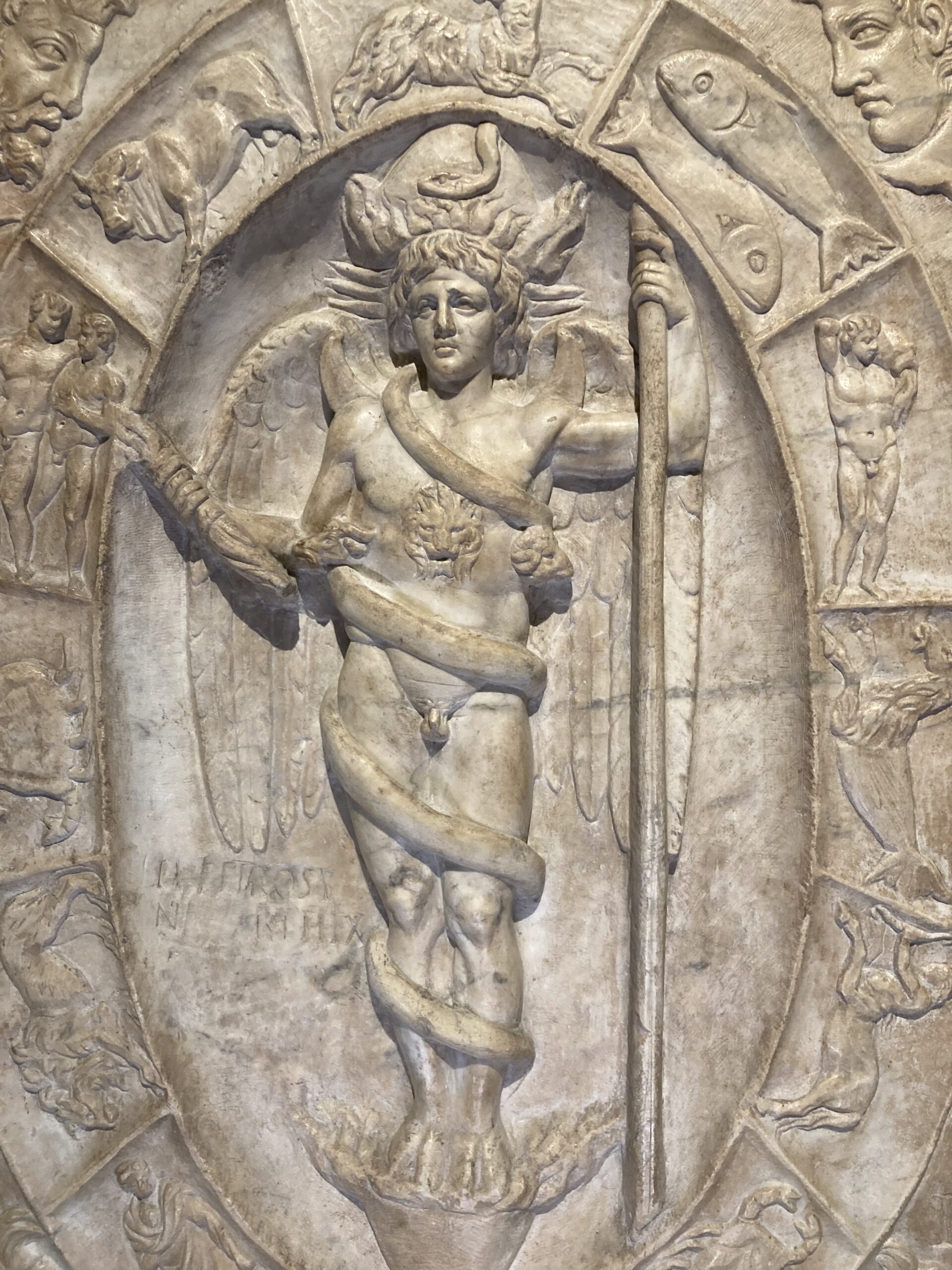
Syncretistic deity Aion-Phanes, second quarter of 2nd century AD, Marble, 71×48,5 cm, Galleria Estense, Modena, Italy – Photo Credit: Amalia Spiliakou, April 2025

What does the figure of Phanes represent in the context of Orphic iconography, and how does his symbolism reflect the cosmological themes of Orphism? In the context of Orphic iconography, Phanes represents the primordial god of creation, light, and life, embodying the emergence of the cosmos from a state of chaos. He is often depicted as a radiant, androgynous figure, sometimes with wings, surrounded by zodiac symbols, and entwined by a serpent, much like the later images of Aion. In Orphic cosmology, Phanes is the first-born deity who emerges from the cosmic egg, breaking it open to release the ordered universe. He is the source of all gods and beings, radiating divine intelligence and life into the cosmos. His symbolism reflects key Orphic themes such as rebirth, cosmic order, and divine light, and his role as a creator positions him at the center of a spiritual narrative in which the soul seeks to return to its divine origin. Phanes illustrates the Orphic belief in a hidden, mystical structure underlying the universe, one governed by divine reason and illuminated by sacred knowledge.

Detail of 2nd century AD sculptural piece of Aion-Phanes in Galleria Estense, Modena, Italy
Syncretistic deity Aion-Phanes, second quarter of 2nd century AD, Marble, 71×48,5 cm, Galleria Estense, Modena, Italy – Photo Credit: Amalia Spiliakou, April 2025
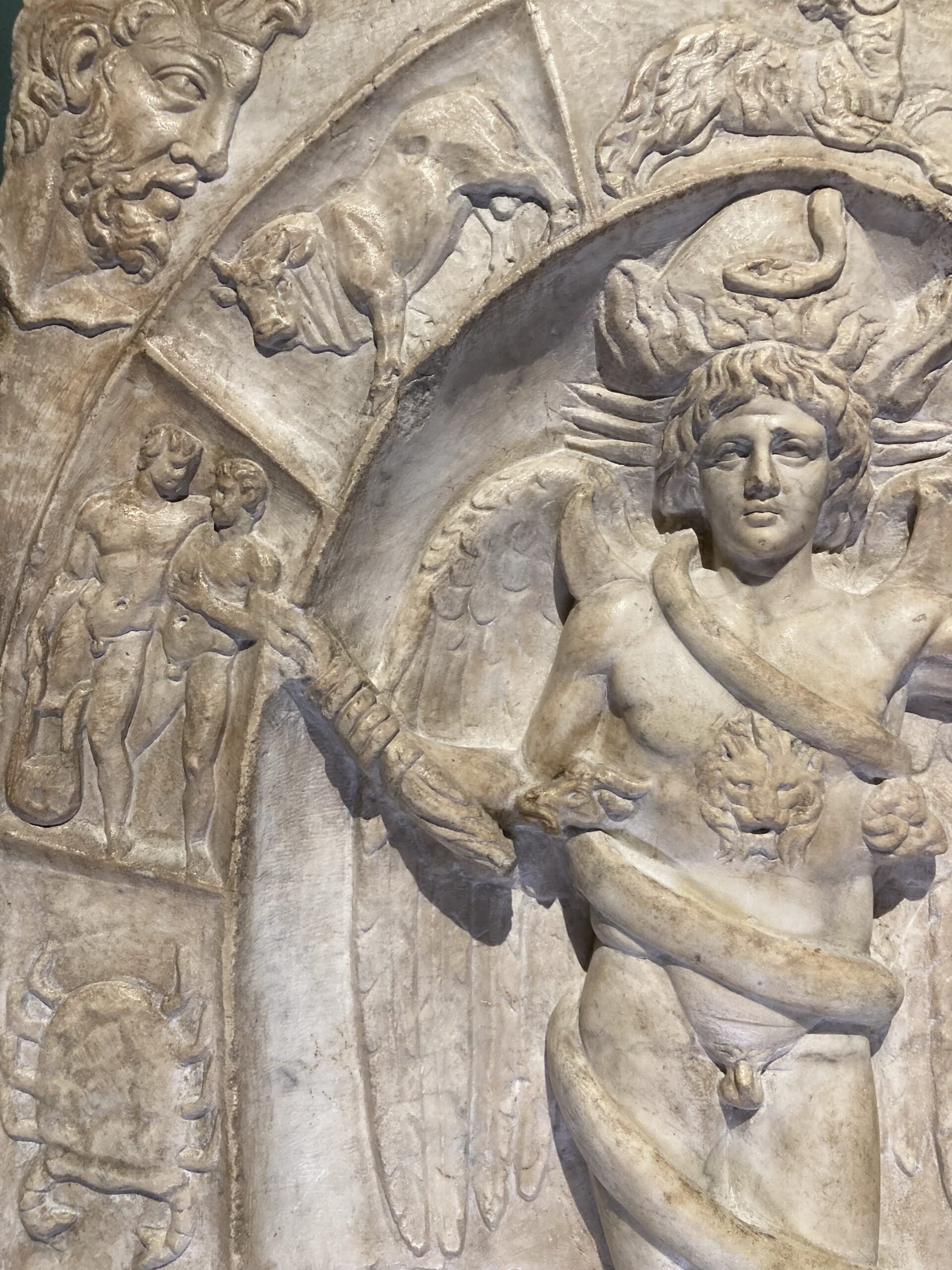
Detail of the 2nd century AD sculptural piece of Aion-Phanes in Galleria Estense, Modena, Italy
Syncretistic deity Aion-Phanes, second quarter of 2nd century AD, Marble, 71×48,5 cm, Galleria Estense, Modena, Italy https://gallerie-estensi.beniculturali.it/blog/il-rilievo-marmoreo-con-il-dio-aion-phanes/

How does the Modena relief of Aion/Phanes visually represent the cosmological and theological concepts of time, creation, and divine order in Roman mystery religions? The Roman relief sculpture from the second quarter of the second century AD, housed in the Galleria Estense in Modena, presents a richly symbolic and cosmologically charged depiction of a deity identified with Aion, Phanes, Chronos, or Eros—various names for a single primordial figure associated with cosmic time, creation, and divine light. At the center stands a radiant, naked youth whose powerful presence merges multiple divine attributes. He holds a thunderbolt in his right hand and a long staff in his left, suggesting authority over both cosmic order and divine revelation. His hoof-shaped feet rest on an upturned cone, half of a cosmic egg, from which flames burst—symbolizing the act of creation. A matching, flame-emitting cone rises above his five-rayed, curly-haired head, reinforcing the theme of birth from chaos. Encircling his body in four spirals is a serpent, its head emerging above the flames—an ancient symbol of eternity, rebirth, and cosmic continuity. The figure’s wings, lion’s head chest mask, and emerging animal heads (a ram and a buck) further emphasize his fusion of natural, divine, and astrological forces. The crescent moon behind his shoulders adds a lunar dimension, balancing the solar imagery of fire and rays.

Detail of the 2nd century AD sculptural piece of Aion-Phanes in Galleria Estense, Modena, Italy
Syncretistic deity Aion-Phanes, second quarter of 2nd century AD, Marble, 71×48,5 cm, Galleria Estense, Modena, Italy – Photo Credit: Amalia Spiliakou, April 2025

This figure is enclosed within an elliptical zodiacal band, divided into twelve sections, each containing a zodiac sign, beginning with Aries above the deity’s head and continuing counterclockwise through the signs to Pisces. Each sign is carefully personified—for instance, Gemini are shown embracing, with one playing a lyre, while Aquarius is represented as a naked youth pouring water from an amphora. The full zodiac, surrounding the god, positions him at the center of cosmic time and astral influence, underscoring his identity as a divine force who governs the heavens and the passage of time. In each corner of the relief, the four winds are personified—Zephyrus, Notus, Boreas, and Eurus—contributing to the all-encompassing cosmological vision. An inscription dedicates the sculpture to Felix and Euphrosyne, though her name was later partially erased, likely due to the Mithraic ban on female initiates. This relief encapsulates the esoteric worldview of late Roman religious thought, where divine creation, astrological order, and mystery cult symbolism intertwine in a single, intricate visual theology.

From fire and serpent, time itself takes form—Aion-Phanes rises, eternal guardian of the stars and the spark of creation.

For Student Activities inspired by the amazing Roman relief sculpture of Aion-Phanes in Galleria Estense in Modena, please… Check HERE!

Bibliography: Aion by Doro Levi, Hesperia: The Journal of the American School of Classical Studies at Athens, Vol. 13, No. 4 (Oct. – Dec., 1944), pp. 269-314 (46 pages) https://www.jstor.org/stable/146699?read-now=1&seq=42#page_scan_tab_contents and https://gallerie-estensi.beniculturali.it/en/collections/works-of-art/#/dettaglio/821254_Aion/Phanes%20all’interno%20dello%20zodiaco and https://www.tertullian.org/rpearse/mithras/display.php?page=cimrm695

Eros and Psyche is a Roman marble sculpture after a Hellenistic, 2nd century BC original.

Eros and Psyche

Eros and Psyche is a Roman marble sculpture after a Hellenistic, 2nd century BC original.
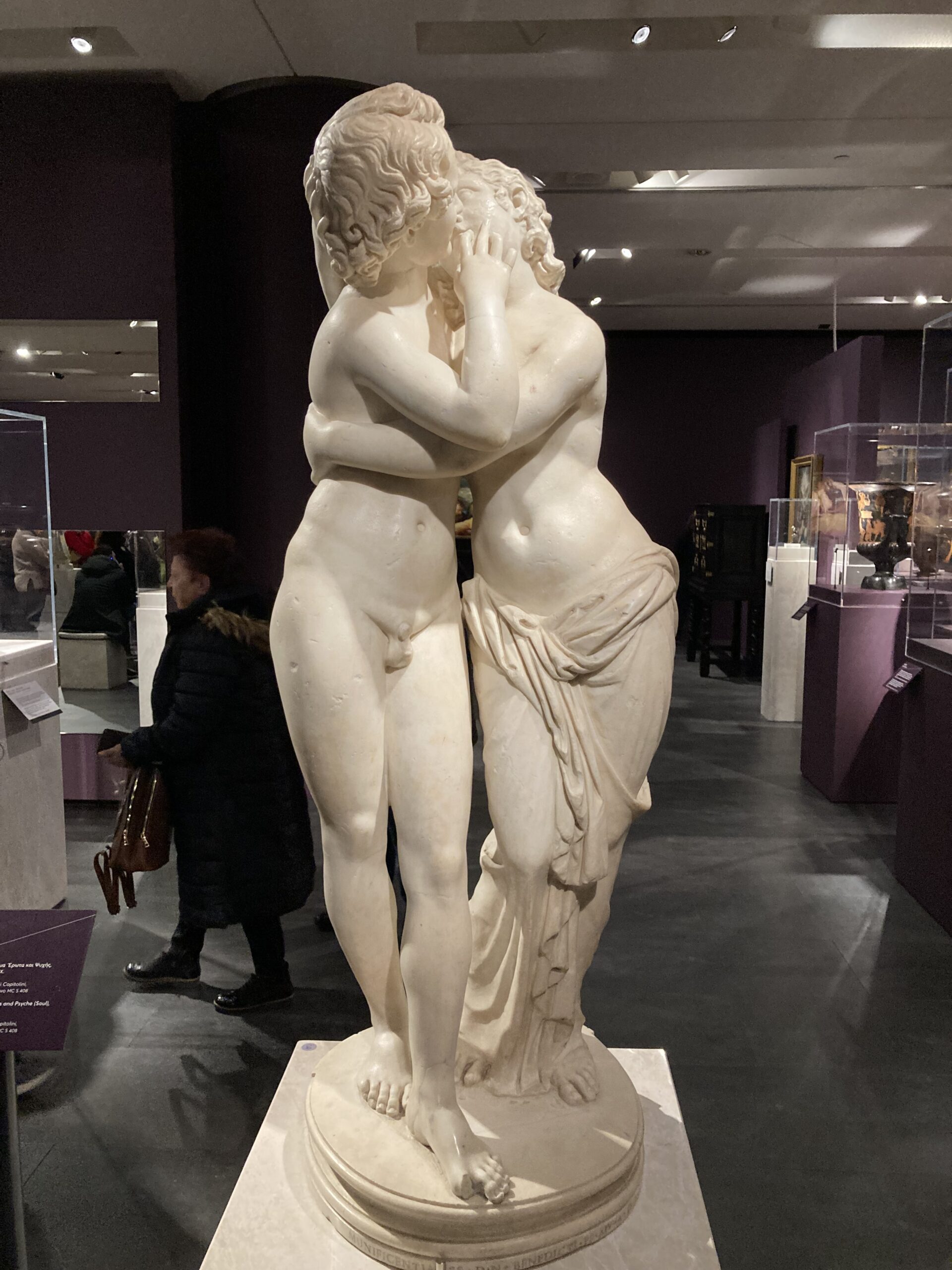
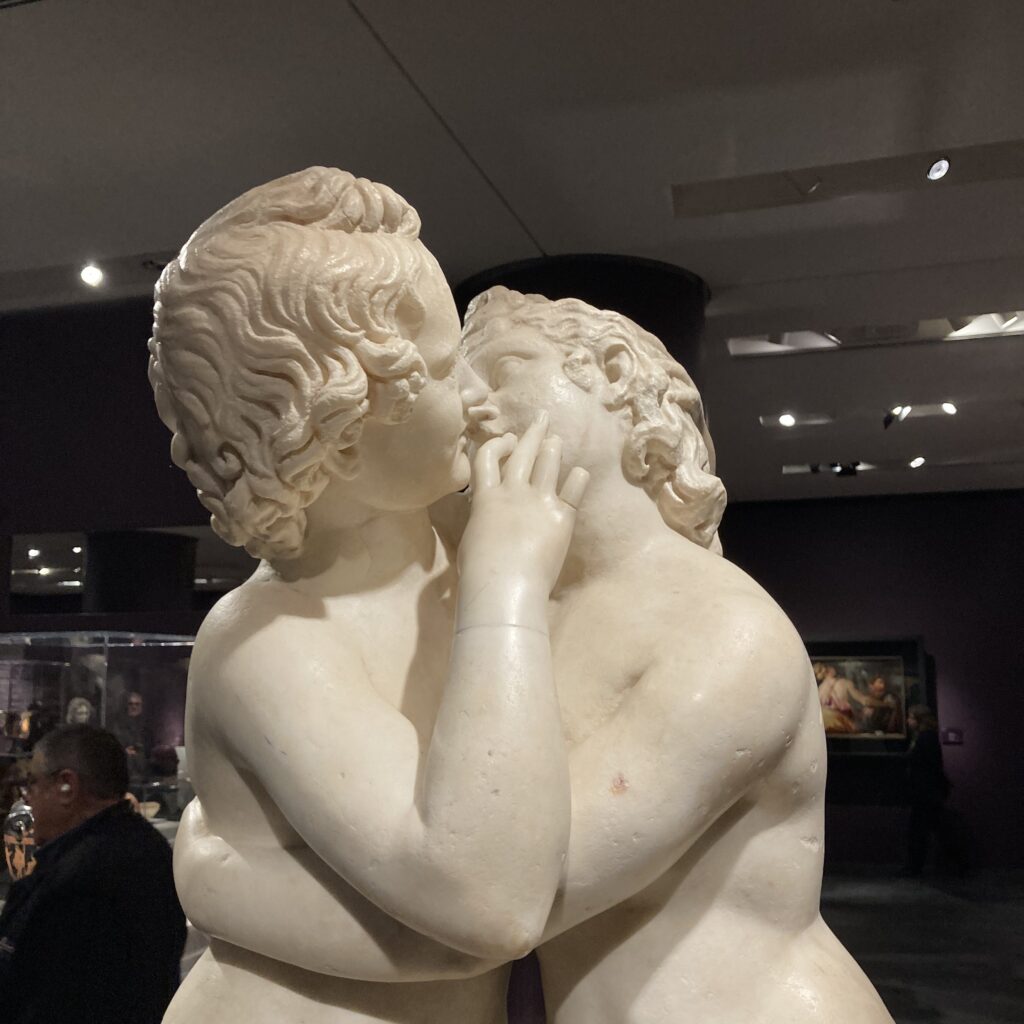
Eros and Psyche, Roman marble sculpture, 300 AD, after a Hellenistic, 2nd century BC original statue, Marble, Height: 1.25 m, Capitoline Museums, Rome, Italy – Photo Credit: Amalia Spiliakou, February 18, 2024, ‘Meanings’. Personifications and Allegories from Antiquity to Today Exhibition, Acropolis Museum, Athens, Greece

Nestled within the Musei Capitolini in Rome, the charming marble statue of Eros and Psyche captures a tender moment of love and longing from ancient mythology. About a year ago, on February 17, 2024, while attending ΝοΗΜΑΤΑ: Personifications and Allegories from Antiquity to Today, an exceptional exhibition at the Acropolis Museum in Athens, I came face to face with this adorable work of art. I was enchanted, as it beautifully portrays the intimate bond between the god of love and the mortal maiden, offering visitors a glimpse into the artistry and emotion of classical antiquity.

When I ask questions, starting with ‘who,’ ‘how,’ ‘where,’ ‘why,’ and ‘what,’ about the statue of Eros and Psyche in Rome, I find myself uncovering its historical context, artistic significance, and the captivating story behind its creation. Let’s do it!

Who are ‘Eros and Psyche’ in classical mythology, and How do their roles and stories shape the meaning and emotional resonance of the statue? Eros (Cupid in Roman mythology) is the god of love and desire, often depicted as a youthful figure with wings, symbolizing the fleeting and unpredictable nature of love. Psyche, whose name means “soul” in Greek, is a mortal woman of extraordinary beauty. Their story, immortalized in Apuleius’ The Golden Ass (also known as Metamorphoses), narrates the trials and ultimate union of love (Eros) and the soul (Psyche), symbolizing the transformative power of love and its ability to overcome challenges.

Who was the sculptor of ‘Eros and Psyche’ in the Musei Capitolini? The sculptor of the ‘Eros and Psyche’ statue in the Musei Capitolini is unknown. This marble work is a Roman copy (1st or 2nd century AD) of a Hellenistic original, typical of the 2nd century BC. Roman sculptors frequently replicated Greek masterpieces, adapting them to suit Roman tastes while preserving the essence of the original composition. The anonymity of the artist adds an air of mystery to the statue, leaving its artistry to speak for itself.

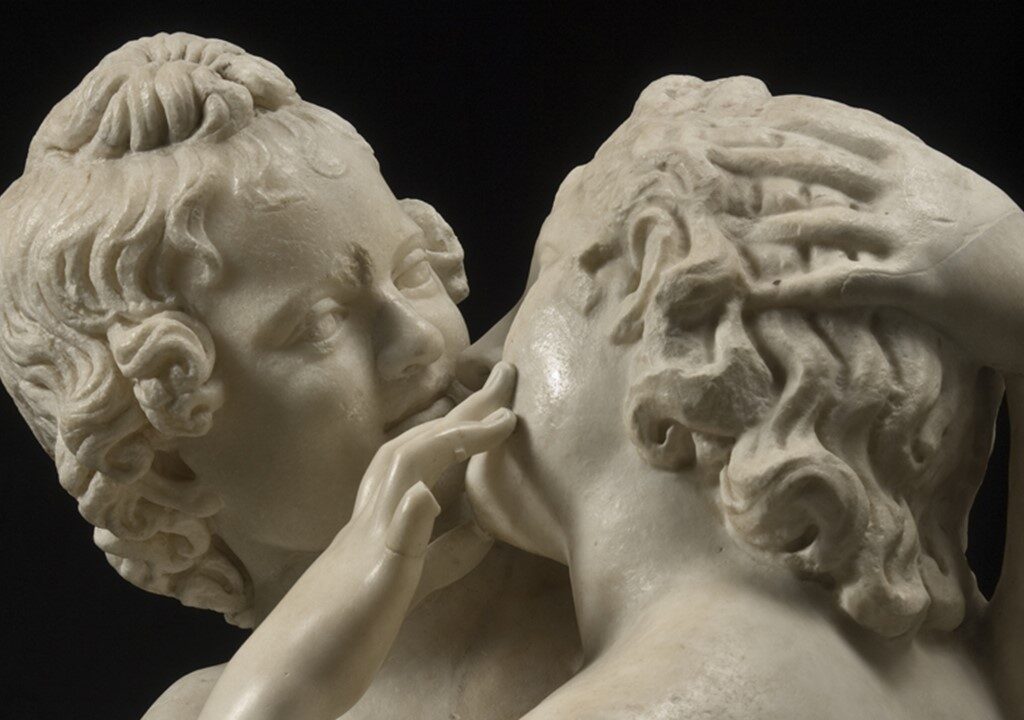
How does the statue of ‘Eros and Psyche’ convey the universal themes of love, perseverance, and redemption through its composition and emotional resonance? In the statue, their tender embrace embodies the culmination of their myth: the union of love and soul after overcoming trials. This intimate moment resonates emotionally, as it speaks to universal themes of love, perseverance, and redemption. The depiction elevates their myth from a simple narrative to an allegory of human experience, giving the statue profound meaning and aesthetic significance.

Detail of Eros and Psyche, a Roman marble sculpture after a Hellenistic, 2nd century BC original.
Eros and Psyche, Roman marble sculpture, 300 AD, after a Hellenistic, 2nd century BC original statue, Marble, Height: 1.25 m,, Capitoline Museums, Rome, Italy https://www.museicapitolini.org/en/node/1013819

What techniques did the artist employ to achieve the statue’s graceful balance and sentimental appearance? The artist of the ‘Eros and Psyche’ statue employed classical techniques to achieve its graceful balance and sentimental appearance. The use of a contrapposto stance gives the figures a dynamic yet harmonious pose, while the smooth textures and finely carved drapery add a sensual softness that enhances their tender connection. Subtle facial expressions and intertwined gestures evoke emotional depth, while meticulous attention to proportion and symmetry underscores their unity as counterparts—love and soul. The dynamic composition, with its circular flow, draws the viewer’s eye and reinforces the theme of eternal unity, making the statue both aesthetically captivating and emotionally resonant.

How does the Roman statue of ‘Eros and Psyche’ reflect the artistic trends or cultural values of its time? The statue reflects the artistic trends and cultural values of its time by embodying the Roman fascination with Greek mythology and the idealized human form. Created during the Roman Imperial period, it demonstrates the Roman practice of replicating and adapting Hellenistic art, emphasizing naturalism, emotional expression, and harmonious proportions. The statue’s tender depiction of love and the soul aligns with the Roman cultural appreciation for storytelling, allegory, and themes of morality and virtue. Additionally, it reflects the Roman value placed on intimate and domestic scenes, which were often used to adorn villas and gardens, symbolizing love, beauty, and emotional depth in everyday life.

Where was the statue discovered, and what does its provenance reveal about its historical journey before becoming part of the Capitoline collection? The Eros and Psyche statue was discovered on the Aventine Hill in Rome during the 18th century, in the garden of the vigna of Panicale in February 1749, to be specific. Its provenance highlights its origins as a Roman Imperial copy of a Hellenistic Greek original, crafted to adorn an elite Roman residence or garden. The discovery on the Aventine Hill, an area historically associated with wealthy Roman villas, suggests the statue was a decorative piece intended to evoke classical ideals of love and beauty in a private, refined setting. Its acquisition by the Capitoline Museums, through a Pope Benedict XIV donation shortly after the statue’s discovery, underscores the Enlightenment-era fascination with antiquity and the desire to preserve and showcase classical art as a cultural and historical treasure.

Detail of Eros and Psyche, a Roman marble sculpture after a Hellenistic, 2nd century BC original.
Eros and Psyche, Roman marble sculpture, 300 AD, after a Hellenistic, 2nd century BC original statue, Marble, Height: 1.25 m, Capitoline Museums, Rome, Italy – Photo Credit: Amalia Spiliakou, February 18, 2024, ‘Meanings’. Personifications and Allegories from Antiquity to Today Exhibition, Acropolis Museum, Athens, Greece

Why has this statue inspired numerous artists to create their own interpretations of the Cupid and Psyche myth? The Eros and Psyche statue has inspired numerous artists, including Antonio Canova, because it captures the timeless themes of love, desire, and the union of the human soul with divine affection. Its tender composition and emotional resonance offer a perfect balance of aesthetic beauty and narrative depth, making it an ideal subject for reinterpretation. For artists like Canova, who sought to revive classical ideals during the Neoclassical period, the statue’s portrayal of mythological characters in a moment of intimacy provided a rich source of inspiration to explore human emotions and the universal power of love through their own artistic lens.

For a PowerPoint Presentation of the Eros and Psyche theme, please… Check HERE!

Bibliography: https://en.wikipedia.org/wiki/Cupid_and_Psyche_(Capitoline_Museums) and https://www.museicapitolini.org/en/opera/statua-di-amore-e-psiche and https://human.libretexts.org/Courses/Saint_Mary’s_College_(Notre_Dame_IN)/Humanistic_Studies/HUST_292%3A_Reclaiming_the_Classical_Past_for_a_Diverse_and_Global_World/01%3A_Apuleius-_Cupid_and_Psyche

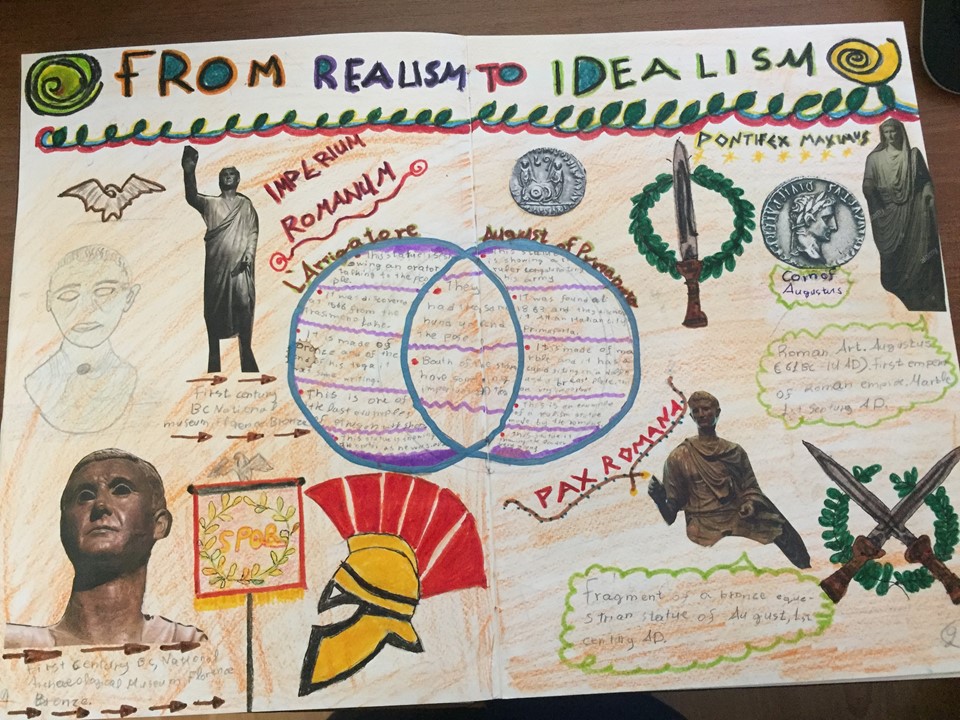
Student Activity inspired by the Portraits of  Aulus Metellus and Emperor Augustus.

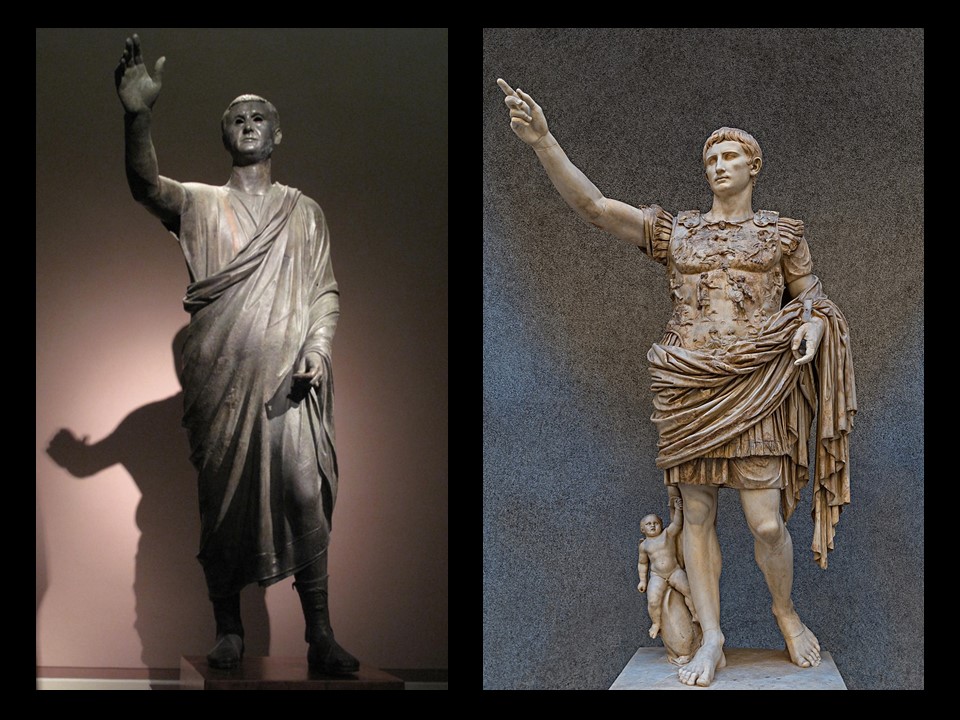
Augustus of Primaporta VS Aulus Matellus

Student Activity inspired by the Portraits of  Aulus Metellus and Emperor Augustus.
Grade 6, Social Studies Unit Project on Roman Government

How two great Roman statues can be used to discuss the Roman Government.  Augustus of Primaporta VS Aulus Matellus” is a Project my spirited Grade 6 students enjoy doing for their Social Studies Roman Unit.

Roman Portraits of Aulus Metellus,  and Emperor Augustus.,
Aulus Metellus, 1st century BC, bronze, National Archaeological Museum, Florence
Augustus of Primaporta, 1st century AD, marble, Vatican Museums

A lot of my Projects, I call them RWAP (Research Writing Art Project), ask students to focus on 4 parts: 1. Title 2. Provide colored copies of at least 2 artworks related to their Project, correctly identified. For the correct identification, I expect them to write the name of the artist (if known), the title of the work, date, medium, and current location, 3. Writing Assignment as required, 4. Art Assignment is open to student imagination and creativity.

For the Augustus vs Matellus Project students are asked to study their Social Studies Textbook Unit on Roman Government, and the following Khan Academy articles:

https://www.khanacademy.org/humanities/ancient-art-civilizations/etruscan/a/larringatore

https://www.khanacademy.org/humanities/ancient-art-civilizations/roman/early-empire/a/augustus-of-primaporta

Their Writing Assignment is to 1. Create a Ven Diagram comparing Matellus to Augustus. They are asked to use their RWAP Book and write in Bullet Points their Comments. 2. Write a paragraph presenting which of the two statues they prefer, explaining why by giving at least 3 reasons.

Their Art Assignment is to “study” the two statues and…  Be imaginative! Be creative! Be original!

For a PP on student Work… Click HERE!

For Student Project Worksheet… Click HERE!