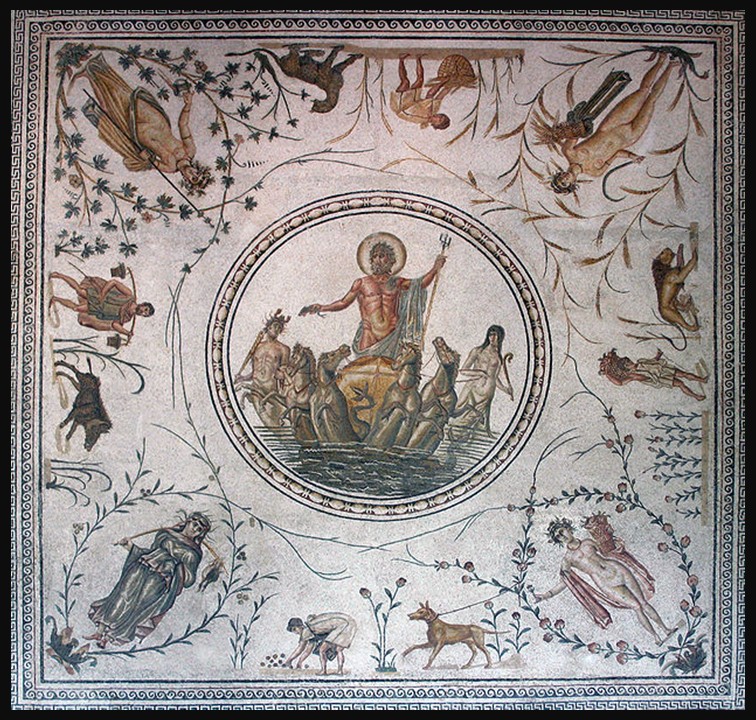
Triumph of Neptune and the Four Seasons

Triumph of Neptune and the Four Seasons, from La Chebba, Tunisia, late 2nd century AD,  Mosaic, Bardo National Museum, Tunis, Tunisia https://en.m.wikipedia.org/wiki/File:Neptune_Roman_mosaic_Bardo_Museum_Tunis.jpg

I remember standing before the Triumph of Neptune and the Four Seasons mosaic at the Bardo Museum, in Tunisia, sunlight filtering through the high windows as if to echo the brilliance of the scene before me. Neptune, regal and commanding, surged forward in his chariot drawn by sea creatures, while the Four Seasons circled him in a dance of eternal return, each one marked by fruits, flowers, or flowing cloaks. It was as if time itself had been trapped in tesserae, inviting me to reflect on nature’s rhythms and the grandeur of ancient imagination. Today, on the first day of Summer 2025, I’m drawn back to that moment, a reminder that every season begins with awe and the quiet power of renewal.

The Triumph of Neptune and the Four Seasons mosaic was unearthed in 1902 during archaeological excavations at a Roman seaside villa in La Chebba, a coastal town in northeastern Tunisia. The excavation, carried out by archaeologists D. Novak and A. Epinat, revealed a Roman villa comprising twelve rooms, most of which were paved with mosaics of notably good style. The principal room featured a grand composition: at the center, Neptune rides over the waves, attended by two companions, while the four corners are occupied by elegant personifications of the Four Seasons. Likely serving as an atrium or formal reception space, this square, columned room showcased the opulence and artistic refinement of Roman domestic life. Dating from the mid-2nd century AD, during the reign of Antoninus Pius, the mosaic reflects the cultural and aesthetic heights achieved in Roman Africa. After its discovery, it was transferred to the Bardo National Museum in Tunis, where it remains one of the most admired treasures of the collection.

The central medallion of the mosaic from La Chebba presents a commanding depiction of Neptune, the Roman god of the sea. He stands prominently in a quadriga—a four-horse chariot—drawn by hippocamps, mythical sea creatures that are part horse and part fish. Neptune is portrayed nearly nude, showcasing a muscular physique, and is adorned with a nimbus, symbolizing his divinity. In his hands, he holds a trident and a dolphin, traditional attributes associated with his dominion over the sea. The chariot is guided by a Triton and a Nereid, both depicted partially submerged, emphasizing the marine setting of the scene. This composition, as analyzed by Gifty Ako-Adounvo in her 1991 thesis, is unique in Roman mosaic art for combining Neptune with the Four Seasons, reflecting a sophisticated iconography that intertwines themes of nature’s cycles and divine authority.

In the Tunisian mosaic, the Four Seasons are strategically placed at the four corners of the square composition, creating a visual framework around the central circular medallion that features Neptune in his marine chariot. This architectural arrangement draws the viewer’s eye inward while symbolically enclosing Neptune’s dominion within the eternal cycle of time.

In the Triumph of Neptune and the Four Seasons mosaic from La Chebba, each Season is personified as a female figure and placed in one of the four corners of the square composition, surrounding the central medallion of Neptune. These figures are accompanied by specific animals that enrich the symbolic and seasonal imagery. Spring, adorned with floral motifs, wears a floral crown, evoking rebirth and the blossoming of nature. She is paired with a dog, possibly a greyhound, evoking themes of pastoral vitality and energy. Summer, holding sheaves of wheat, is flanked by a lion, representing the strength and intensity of the sun at its peak. Autumn, bearing grapes or a cornucopia, appears with a leopard, reinforcing the season’s association with Dionysian festivity and harvest. Winter, heavily cloaked and bearing pinecones or bare branches, is accompanied by a boar, an animal linked to the hunt and the harshness of the cold months.

Together, the figures of the Four Seasons not only anchor the composition visually but also embody a deeper message of natural rhythm and divine governance. Their accompanying animals, drawn from both myth and the natural world, intensify the seasonal symbolism while reflecting the broader North African mosaic tradition, which skillfully weaves cosmic order with scenes of rural life and agricultural labor.

For Student Activities inspired by the La Chebba mosaic, please… Check HERE!

Bibliography: American Journal of Archaeology, Jul. – Sep., 1903, Vol. 7, No. 3 (Jul. – Sep., 1903), pp. 357-404 Published by: Archaeological Institute of America, and https://honorthegodsblog.wordpress.com/2015/02/25/triumph-of-neptune-and-the-four-seasons-from-la/, and https://www.romeartlover.it/Bardo.html
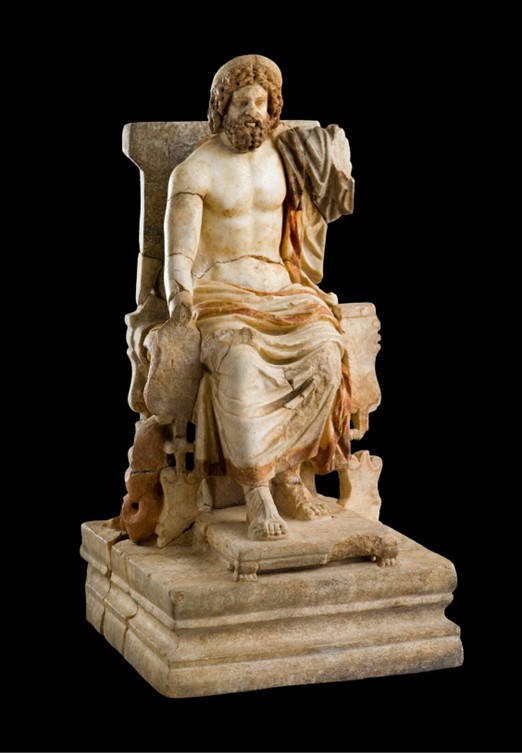
Statuette of Asklepios Enthroned

Statuette of Asklepios Enthroned, Athenian workshop, 150 – 200 AD, Marble, Height: 42.3 cm, Archaeological Museum of Ancient Corinth, Greece https://www.facebook.com/photo.php?fbid=1019102956923674&id=100064719367083&set=a.462183875948921&locale=el_GR

…Asclepius, that gentle craftsman who drove pain from the limbs that he healed, that hero who cured all types of diseases… as Pindar writes in Pythian 3, was the ancient Greek god of medicine and healing, both revered and deified for his mastery over human suffering. This divine healer is brought vividly to life in the Statuette of Asklepios Enthroned, crafted in an Athenian workshop between 150–200 AD and now housed in the Archaeological Museum of Ancient Corinth. Carved from marble and standing 42.3 cm tall, the figure captures Asclepius in a moment of quiet authority, seated with the familiar serpent-entwined staff at his side—a timeless symbol of restoration and medical care. Though created centuries after the height of his cult, the statuette reflects the enduring presence of Asclepius in both public worship and private devotion, embodying the belief in divine healing that spanned from the classical world into the Roman era. https://www.perseus.tufts.edu/hopper/text?doc=Perseus%3Atext%3A1999.01.0162%3Abook%3DP.%3Apoem%3D3

The Ancient Greek myths of Asclepius tell the story of a mortal born to the god Apollo and the human woman Coronis, who was raised and taught the healing arts by the wise centaur Chiron. Gifted beyond any healer before him, Asclepius became so skilled that he was said to cure incurable diseases and even bring the dead back to life. This miraculous power, however, drew the ire of Zeus, who feared that such abilities would upset the natural balance between life and death. In response, Zeus struck Asclepius down with a thunderbolt, ending his mortal life but paving the way for his deification. Worshipped across the Greek world, particularly in healing sanctuaries known as Asclepieia, Asclepius became a symbol of divine compassion and medical wisdom, bridging the realms of myth, religion, and early medical practice.

The healing sanctuaries of Asclepios become some of the most important religious and medical centers of the classical world. The most famous of these was at Epidaurus in the northeastern Peloponnese, a sprawling complex that included temples, dormitories for dream incubation, and even a theater. Other major centers of his cult were located on the island of Kos, where the physician Hippocrates is said to have trained, and at Pergamon in Asia Minor. In Athens, he was worshipped at the Asclepieion located at the foot of the Acropolis, near the Theater of Dionysus. These sanctuaries attracted the sick and afflicted from across the Greek world, who came seeking cures through ritual purification, offerings, and dreams in which Asclepius or his sacred serpent revealed treatments. His worship was not only a spiritual experience but also a foundational element in the evolution of ancient medicine.

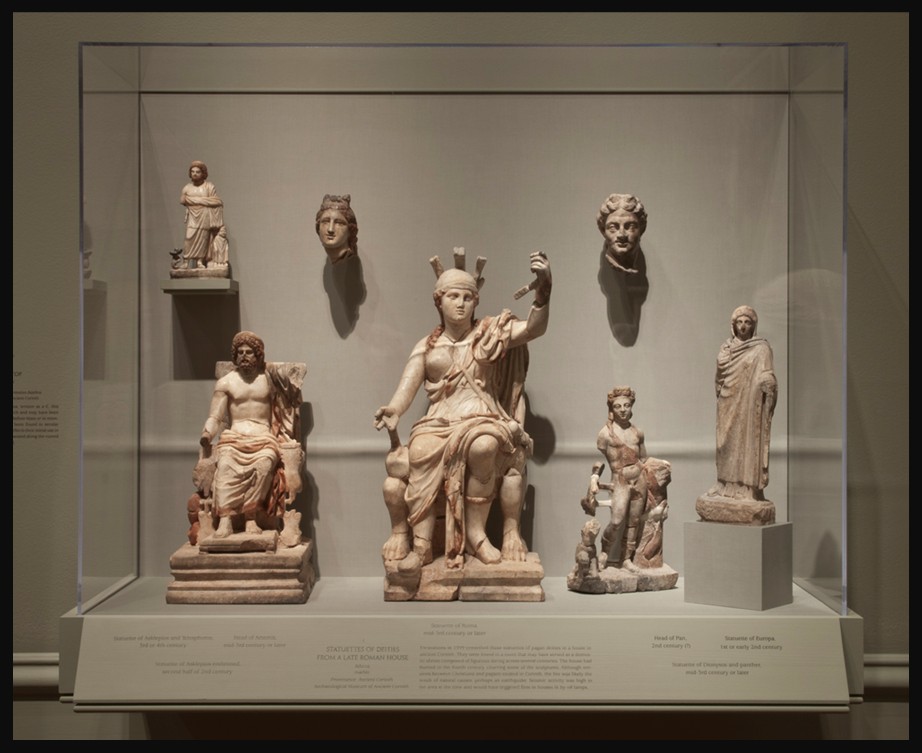
Statuettes of deities from a late Roman house, Marble, Archaeological Museum of Ancient Corinth in Greece Photo: https://www.nga.gov/features/slideshows/from-the-ancient-to-the-byzantine-world.html#slide_2

The Statuette of Asklepios Enthroned, now housed in the Archaeological Museum of Ancient Corinth, was discovered during 1999 excavation period (by the American School of Classical Studies) of a domestic shrine within a luxurious Roman villa in the Panayia Field area of Corinth. The villa was destroyed by a violent earthquake in the late fourth century AD, preserving a collection of marble statuettes representing various deities, including Artemis, Dionysos, Herakles, Pan, Europa and Roma, alongside Asklepios (Sanders 1999, 441–444). These statuettes were part of a private cultic assemblage, suggesting ongoing pagan devotional practices within the home, even as Christianity was becoming dominant in the region. The presence of these figures in such an opulent residence reflects the persistence—albeit increasingly private—of traditional Greco-Roman religious customs among segments of the local elite during the final phases of pagan worship in Late Antique Corinth

Dated to 150–200 AD and discovered in Corinth, the Statuette presents a richly detailed image of the healing god seated in quiet authority. Asclepius is shown leaning slightly forward on a high-backed throne, his head turned gently to the right. He wears a plain round wreath atop his parted, curling hair, which falls to his shoulders, and his face is framed by a mustache and full, curly beard. Draped in a himation that cascades from his left shoulder in V-shaped folds with a zigzag border, the god’s right arm once rested over a large coiled snake, his sacred symbol, positioned along the right side of the throne. His network-style sandals, tied above the ankle, rest on a substantial footstool with squat animal feet and a central groove, while the throne itself is ornately carved with square-incised panels on the back, lyre-shaped legs, and projecting wings. A cushion beneath him adds to the sense of formality and comfort, enhancing the image of divine majesty.

Scholars suggest that this statuette may be a scaled marble reinterpretation of the famed chryselephantine cult statue of Asclepius by Thrasymedes of Paros, described by Pausanias in the temple at Epidaurus (2.27.2). Like the legendary cult image, the Corinthian figure holds a staff in his left arm and extends his right hand toward the coiled serpent, reflecting iconography seen on fourth-century BC Epidaurian coins. The white marble and traces of gilding on the Panagia statuette evoke the luxurious materials of ivory and gold used in the original, indicating it was likely crafted in homage to the Epidaurian prototype. This connection underscores the continuity of Asclepius’ cult and the enduring reverence for his divine healing power well into the Roman period.

For a Student Activity inspired by the Statuette of Asklepios Enthroned in Corinth, please… Check HERE!

Bibliography: chrome-extension://efaidnbmnnnibpcajpcglclefindmkaj/https://www.ascsa.edu.gr/uploads/media/hesperia/25068051.pdf  Pagan Statuettes in Late Antique Corinth, Sculptures from the Panayia Domus, HESPERIA 77 (2008), Pages 89-161