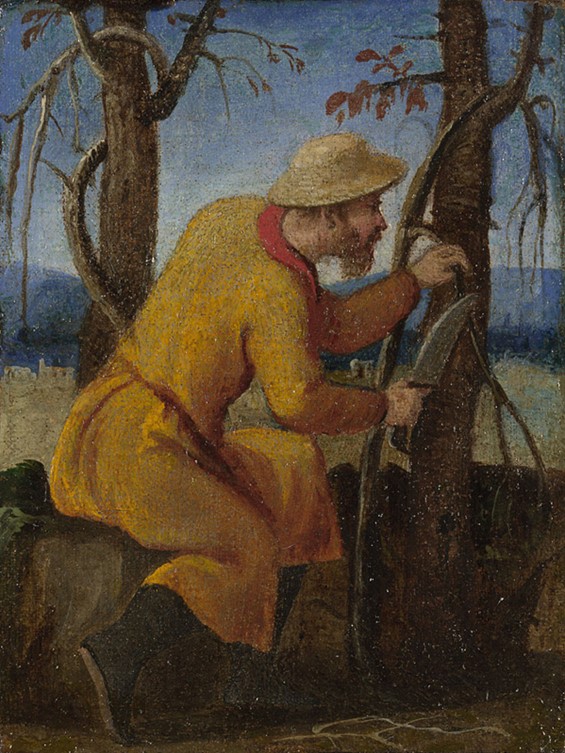
By an unknown Venetian artist… The Labours of the Months: March, about 1580

The Labours of the Months: March

By an unknown Venetian artist… The Labours of the Months: March, about 1580
By an unknown Venetian artist…
The Labours of the Months: March, about 1580, oil on canvas, 13.6 x 10.6 cm, National Gallery, London
https://www.nationalgallery.org.uk/paintings/italian-venetian-the-labours-of-the-months-march

Dear March – Come in – / How glad I am – / I hoped for you before – / Put down your Hat – / You must have walked – / How out of Breath you are – / Dear March, how are you, and the Rest – / Did you leave Nature well – /Oh March, Come right upstairs with me –/I have so much to tell –     /     I got your Letter, and the Birds – / The Maples never knew that you were coming – / I declare – how Red their Faces grew – / But March, forgive me – / And all those Hills you left for me to Hue – / There was no Purple suitable – / You took it all with you –     /     Who knocks? That April – / Lock the Door – / I will not be pursued – / He stayed away a Year to call / When I am occupied –  / But trifles look so trivial / As soon as you have come     /     That blame is just as dear as Praise / And Praise as mere as Blame –   Dear March, Come in!, a poem by Emily Dickinson, is about the love and joy it brought to her… She personifies March as if he were a friend… and I find it a fitting introduction to the new POST The Labours of the Months: March!     https://poets.org/poem/dear-march-come-1320     and     https://www.poetryfoundation.org/poets/emily-dickinson
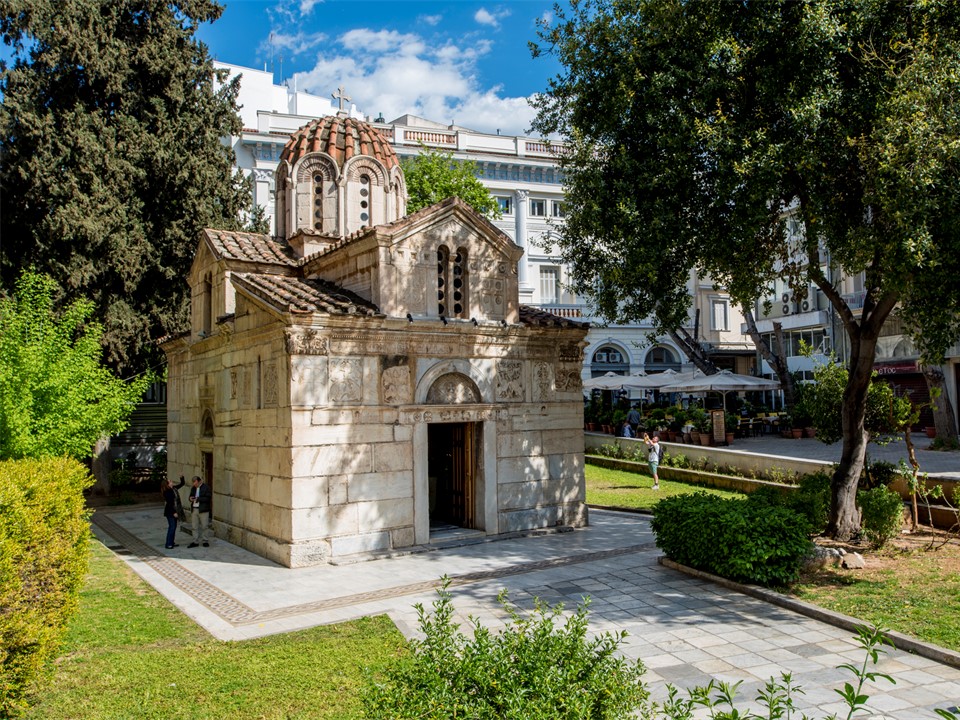
Church of Panagia Gorgoepikoos, or Hagios Eleftherios or Mikri Mitropolis, 12th or 15th century, Athens
http://www.religiousgreece.gr/athens-attica/-/asset_publisher/lpcrESlL5iOO/content/panagia-gorgoepekoos

Depicting The Labours of the Months in works of art is a tradition that goes back to ancient Greek times. The charming Church of Hagios Eleutherios in Athens, also known as the Panagia Gorgoepikoos or the Mikri (Small) Metropolis, made up entirely of spolia of both ancient and Christian monuments, is a good example to start with. Above the main entrance to the Church and under the roof cornice, the builders of this extraordinary church placed “a frieze of Pentelic marble, which shows the months of the Attic Calendar, some festivals, and the complete circle of the Zodiac.” This ancient frieze “attempts to put together and coordinate the lunar calendar (Attic months and festivals) and the solar calendar (the signs of the Zodiac).” Amazing…     https://hellenismo.wordpress.com/2012/12/01/the-frieze-of-the-attic-calendar/
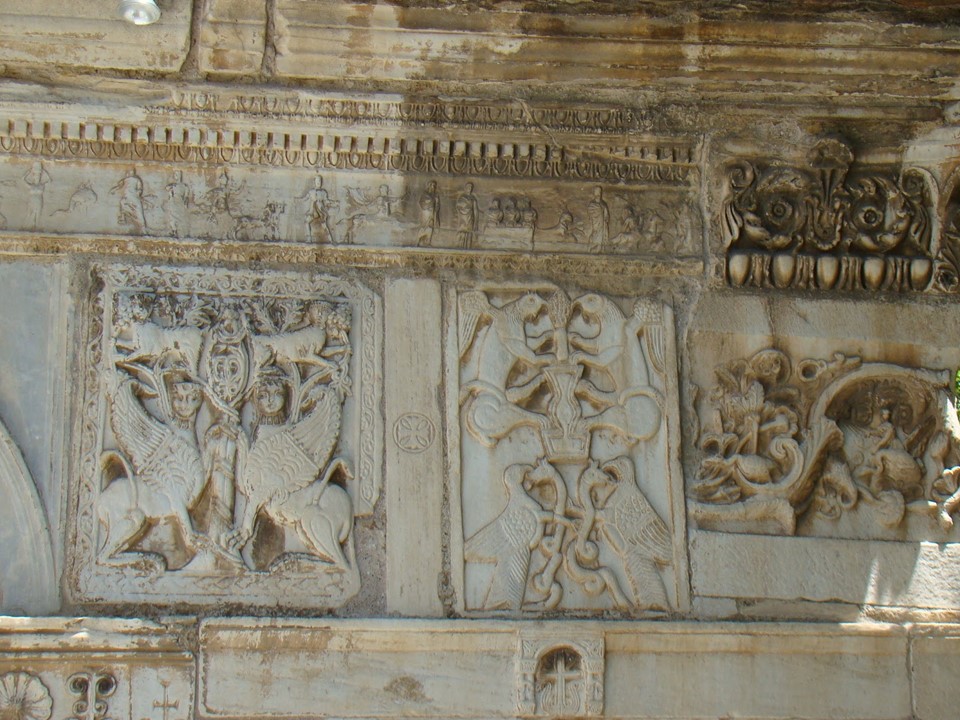
Calendar Frieze at the Church of Panagia Gorgoepikoos or Hagios Eleftherios or Mikri Mitropolis (Date of the Calendar Frieze: 2nd century BC- Date of the Church: 12th or 15th century) Athens
Photo credit: http://surprisedbytime.blogspot.com/2011/10/cyriaco-and-little-metropolis.html
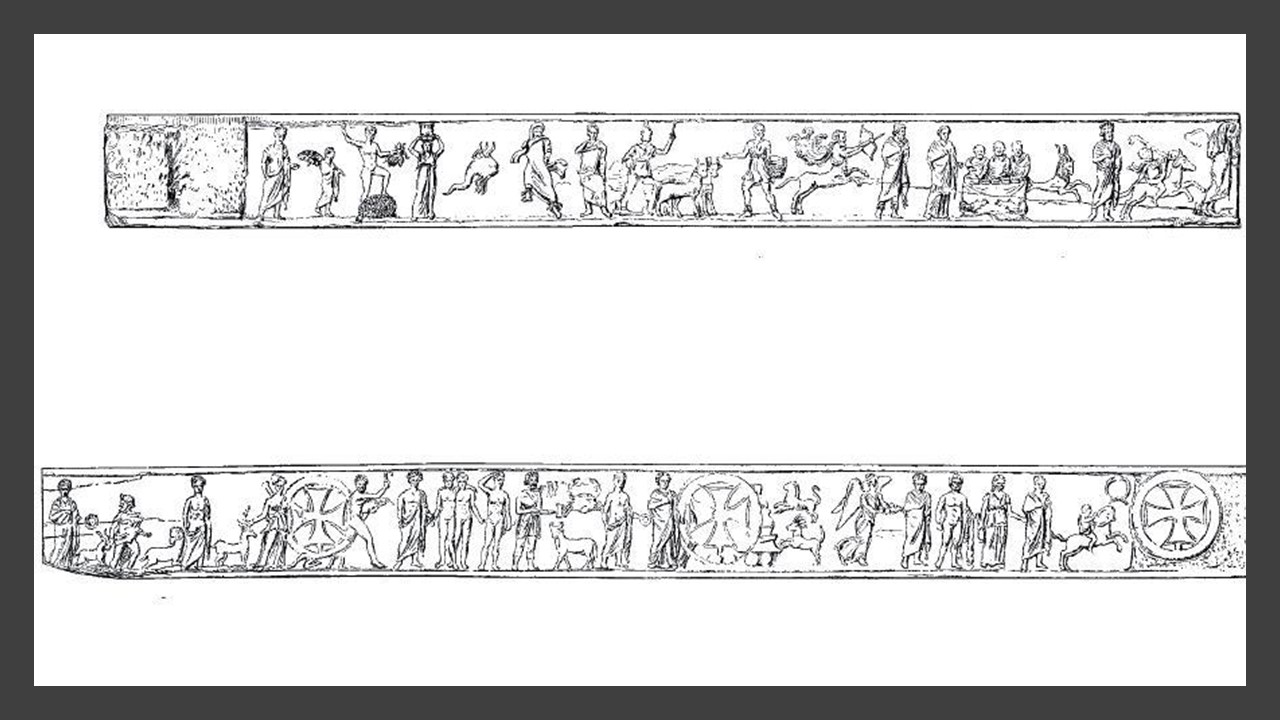
Drawings of the Calendar Frieze in the Church of Panagia Gorgoepikoos or Hagios Eleftherios or Mikri Mitropoli (Date of the Calendar Frieze: 2nd or 15th  century BC- Date of the Church: 12th century) Athens

Drawings of the Calendar Frieze in the Church of Panagia Gorgoepikoos or Hagios Eleftherios or Mikri Mitropoli (Date of the Calendar Frieze: 2nd or 15th  century BC- Date of the Church: 12th century) Athens
https://hellenismo.wordpress.com/2012/12/01/the-frieze-of-the-attic-calendar/

Olga Palagia, Professor of Classical Archeology at the National and Kapodistrian University of Athens, argues that the Calendar Frieze, in most probability,  was created in Athens for the Great Panathenaic festivities of the year 142/3. If this small Attic Calendar Frieze, Palagia still argues, is tied to Herodes Atticus, who presented Athens with a number of public buildings…if this Calendar Frieze was part of the grand Athenian marble Panathenaic Stadium complex, built entirely at the expense of Herodes Atticus for the Great Panathenaia that fell in 142/3… well,  makes it most interesting evidence of public Calendar representation… but in the realm of pure speculation!     The date and iconography of the calendar frieze on the little metropolis, Athens, JdI 123, 2008, by Olga Palagia,     https://www.academia.edu/843544/The_date_and_iconography_of_the_calendar_frieze_on_the_little_metropolis_Athens_JdI_123_2008

SO… The Calendar of the Months during Antiquity and the Labours of the Months later in history attracts our attention in Calendar works of Art adorning public buildings, Churches and Cathedrals of the time, striking Vitreaux Windows, amazingly colourful manuscripts, and paintings, monumental, like the eleven surviving panels in Torre Aquila I presented in 2020 (check: https://www.teachercurator.com/?s=torre%20aquila&cat=plus-5-results), or small, like the paintings in the National Gallery, in London, we will explore in 2021… month by month…     https://archive.org/details/labormonth00webs/page/n9/mode/2up Webster, James Carson – 1905-1989, The labors of the months in antique and mediaeval art to the end of the twelfth century, 1938, Evanston, Ill., Northwestern University,     and      https://www.nationalgallery.org.uk/paintings/italian-venetian-the-labours-of-the-months-march
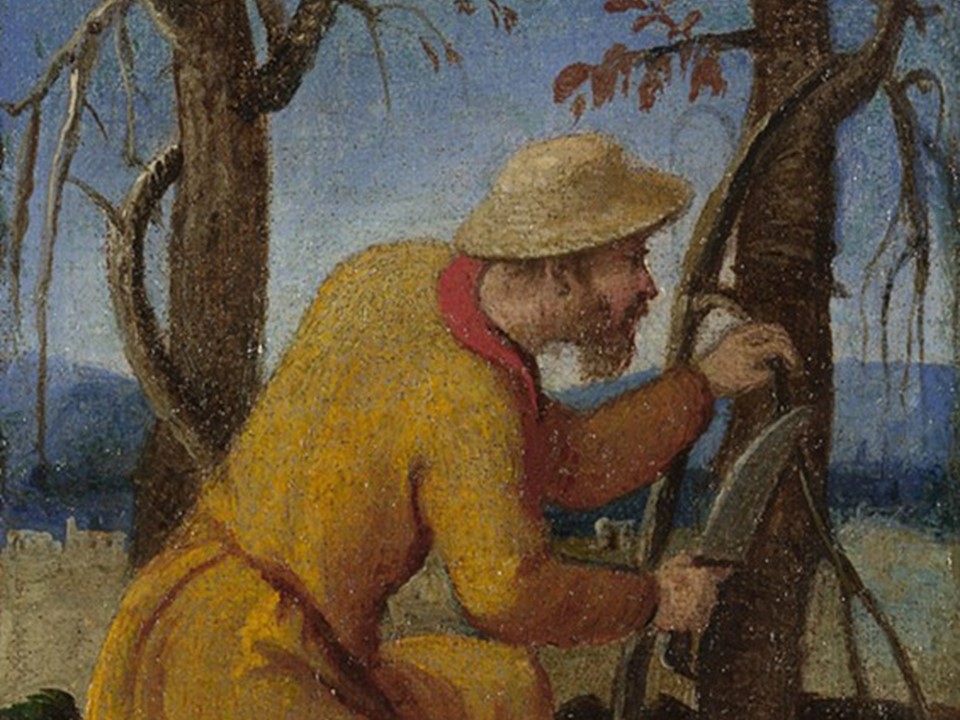
By an unknown Venetian artist…
The Labours of the Months: March (detail) , about 1580
By an unknown Venetian artist…
The Labours of the Months: March (detail) , about 1580, oil on canvas, 13.6 x 10.6 cm, National Gallery, London
https://www.nationalgallery.org.uk/paintings/italian-venetian-the-labours-of-the-months-march

For the Venetian Month of March at the National Gallery, we have yet another outdoor scene. “A bearded man wearing a yellow tunic trims vines that have been trained to grow up two trees. The branches of the vine are bare, while the trees have a few brownish leaves. Pruning vines is an activity carried out in Italy in winter, when the plant is dormant, and in spring when the new leaves have started to grow.” Once more, young farmers need to bundle up and take care of the daily chores…     https://www.nationalgallery.org.uk/paintings/italian-venetian-the-labours-of-the-months-march

For a PowerPoint on The Labours of the Months at the National Gallery in London, please… Check HERE!
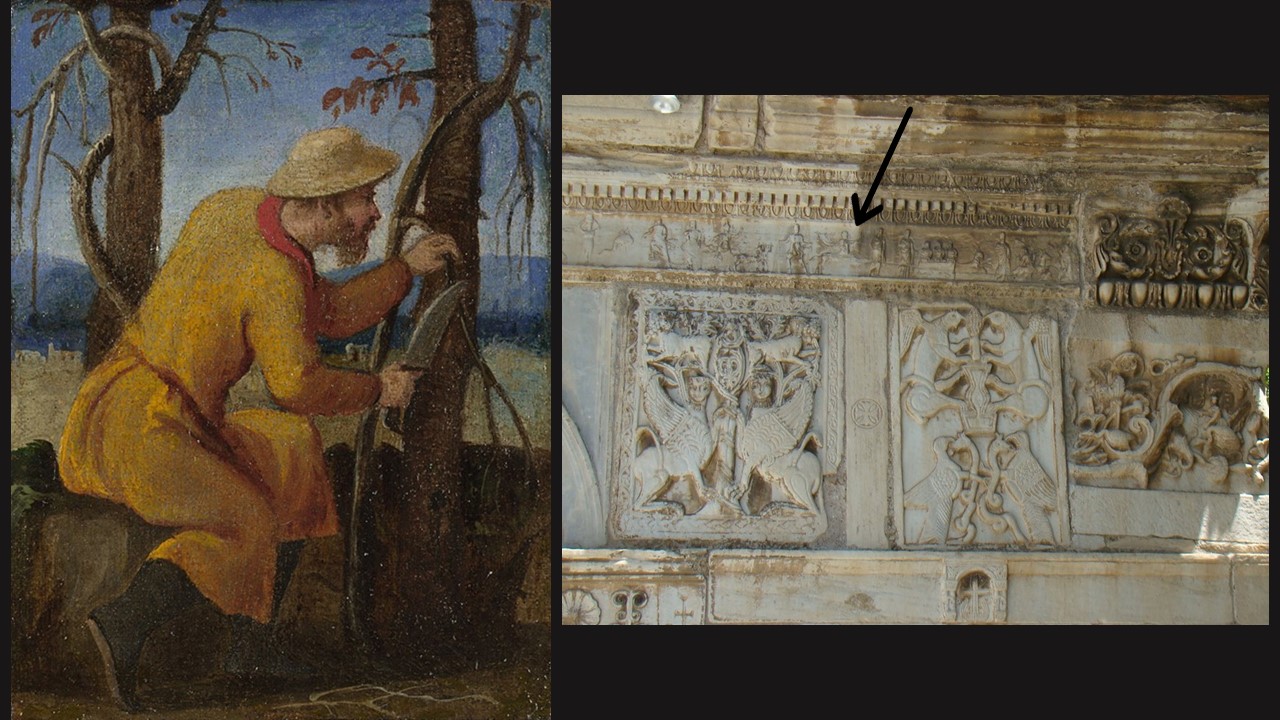
By an unknown Venetian artist… The Labours of the Months: March, about 1580, and Calendar Frieze at the Church of Panagia Gorgoepikoos, Hagios Eleftherios or Mikri Mitropoli (Date of the Calendar Frieze: 2nd century BC- Date of the Church: 12th or 15th century) Athens  
By an unknown Venetian artist…
The Labours of the Months: March, about 1580, oil on canvas, 13.6 x 10.6 cm, National Gallery, London     https://www.nationalgallery.org.uk/paintings/italian-venetian-the-labours-of-the-months-march
Calendar Frieze at the Church of Panagia Gorgoepikoos, Hagios Eleftherios or Mikri Mitropoli (Date of the Calendar Frieze: 2nd century BC- Date of the Church: 12th or 15th century) Athens     http://surprisedbytime.blogspot.com/2011/10/cyriaco-and-little-metropolis.html
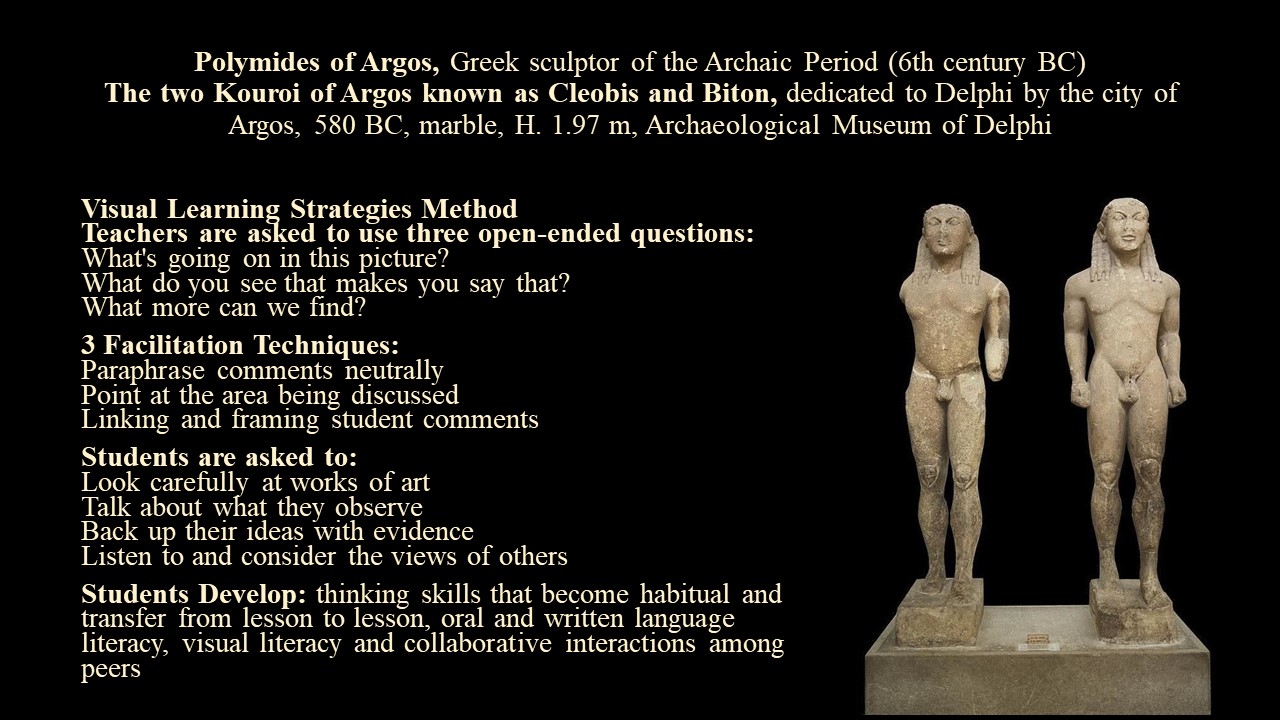
Visual Learning Strategies Method for Cleobis and Biton

Cleobis and Biton

Polymides of Argos, a Greek sculptor of the Archaic Period (6th century BC)
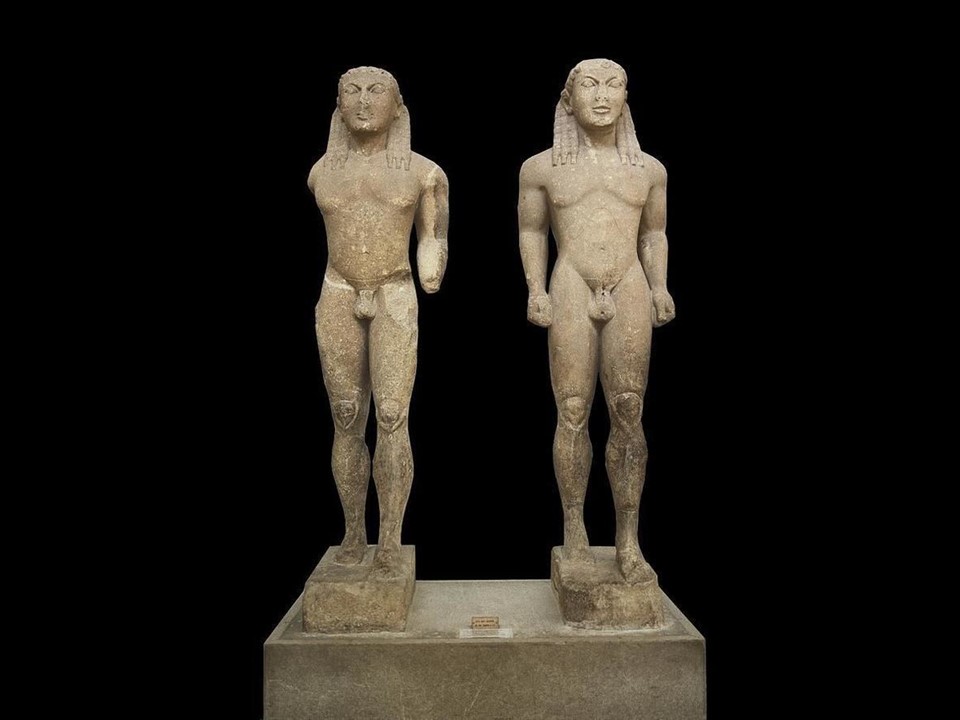
The two Kouroi of Argos, known as Cleobis and Biton, dedicated to Delphi by the city of Argos, 580 BC
Polymides of Argos, a Greek sculptor of the Archaic Period (6th century BC)
The two Kouroi of Argos, known as Cleobis and Biton, dedicated to Delphi by the city of Argos, 580 BC, marble, H. 1.97 m, Archaeological Museum of Delphi
https://alchetron.com/Kleobis-and-Biton

“Cleobis and Biton,” according to Herodotus “were of Argive stock, had enough to live on, and on top of this had great bodily strength. Both had won prizes in the athletic contests, and this story is told about them: there was a festival of Hera in Argos, and their mother absolutely had to be conveyed to the temple by a team of oxen. But their oxen had not come back from the fields in time, so the youths took the yoke upon their own shoulders under constraint of time. They drew the wagon, with their mother riding atop it, traveling five miles until they arrived at the temple.  When they had done this and had been seen by the entire gathering, their lives came to an excellent end, and in their case the god made clear that for human beings it is a better thing to die than to live. The Argive men stood around the youths and congratulated them on their strength; the Argive women congratulated their mother for having borne such children.  She was overjoyed at the feat and at the praise, so she stood before the image and prayed that the goddess might grant the best thing for man to her children Cleobis and Biton, who had given great honor to the goddess. After this prayer they sacrificed and feasted. The youths then lay down in the temple and went to sleep and never rose again; death held them there. The Argives made and dedicated at Delphi statues of them as being the best of men.” What a story…     http://www.perseus.tufts.edu/hopper/text?doc=Perseus%3Atext%3A1999.01.0126%3Abook%3D1%3Achapter%3D31    and     https://www.jstor.org/stable/4476541?read-now=1&refreqid=excelsior%3A696d910b4f58214d895c34828b1f43ce&seq=3#page_scan_tab_contents

The two statues affectionately called The Twins of Argos hold me in fascination! They were sent to Delphi by the Argives back in the early 6th century BC… the first monumental commemorative monument to grace Apollo’s sanctuary. Many, resplended monuments followed… but the Kouroi of Cleobis and Biton forever bedazzle us with their monumentality and grace.

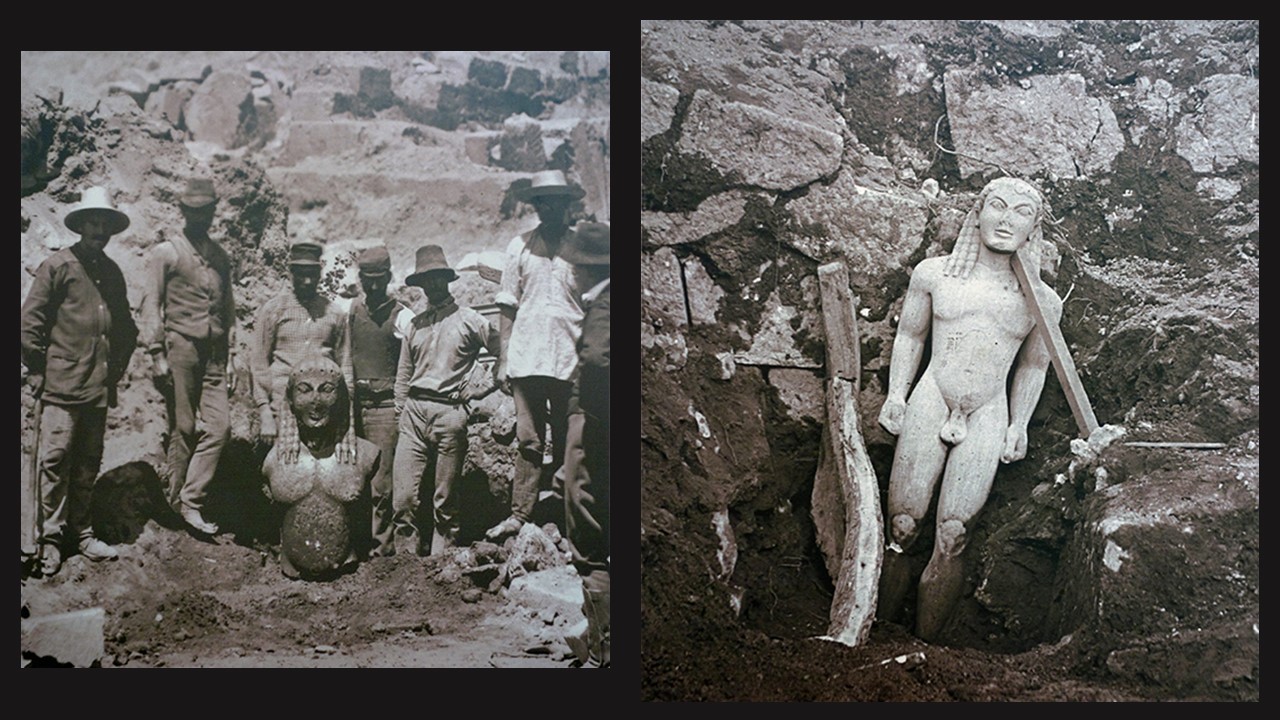
Unearthing Biton, 1894, the sanctuary of Apollo, Delphi, Greece
Archaeologists excavating Cleobis, 1894
Unearthing Biton, 1894, the sanctuary of Apollo, Delphi, Greece
Archaeologists excavating Cleobis, 1894
https://www.khanacademy.org/humanities/ancient-art-civilizations/greek-art/daedalic-archaic/a/the-kouroi-of-kleobis-and-biton

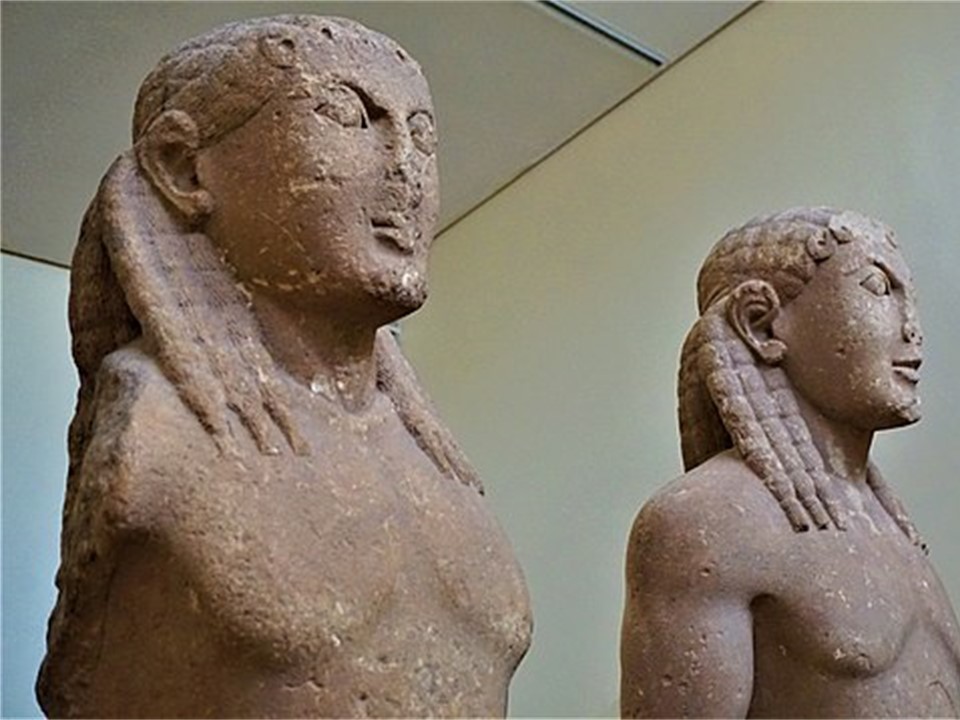
The Twins of Argos were excavated in Delphi by French archaeologists in 1893 and 1894. The discovery of two extremely similar statues of idealized nude male youths is a rare find of the kouros type. Like other kouroi, they are “naked except for boots, which distinguish them from images of Apollo and may mark them as travellers. They are stockily built, short though over-life-size, with broad shoulders and broad faces… The round eyes are set within curving upper and lower lids, the entire eye unit cut deeply into the head beneath heavy brows. The mouth is full. The large ears are set far back at the side of the head; the lobe is a flat disk. The transition between the front and sides of the head is very abrupt. A single row of large disk-like curls line the forehead. The rest of the hair, emphasizing the flat top of the head, is combed and then subdivided into large bead-like elements. In back the hair springs out from beneath the double cord which holds it in place, at the top of the ears and, again, at the base of the neck. Each of the tendrils, front and back, is neatly finished with a tie… The abdomen is defined linearly… The round knees are set off by incision as well as by modeling. The arms are held close to the body, the clenched hands securely attached to the thighs, the thumbs facing outward…”     http://www.perseus.tufts.edu/hopper/artifact?name=Delphi%2C+Kleobis+and+Biton&object=Sculpture

Polymides of Argos, a Greek sculptor of the Archaic Period (6th century BC)
The two Kouroi of Argos, known as Cleobis and Biton (detail), dedicated to Delphi by the city of Argos, 580 BC
Polymides of Argos, a Greek sculptor of the Archaic Period (6th century BC)
The two Kouroi of Argos, known as Cleobis and Biton (detail), dedicated to Delphi by the city of Argos, 580 BC, marble, H. 1.97 m, Archaeological Museum of Delphi
https://www.khanacademy.org/humanities/ancient-art-civilizations/greek-art/daedalic-archaic/a/the-kouroi-of-kleobis-and-biton

To introduce my students to ancient Greek Archaic Art and the Kouros Brothers from Argos, Cleobis and Biton, I use the Inquiry-based teaching method known as Visual Thinking Strategy introduced by Abigail Housen and Philip Yenawine which “uses art to teach visual literacy, thinking, and communication skills—listening and expressing oneself. Growth is stimulated by looking at artworks of increasing complexity, answering developmentally based questions, and participating in peer-group discussions carefully facilitated by teachers.” Philip Yenawine, Visual Thinking Strategies: Using Art to Deepen Learning Across School Disciplines, 2013  https://www.amazon.com/Visual-Thinking-Strategies-Learning-Disciplines-ebook/dp/B00XO20380

Visual Learning Strategies Method for Cleobis and Biton

For a student “RWAP”, (RWAP stands for Research – Writing – Art – Project), please… Check HERE!

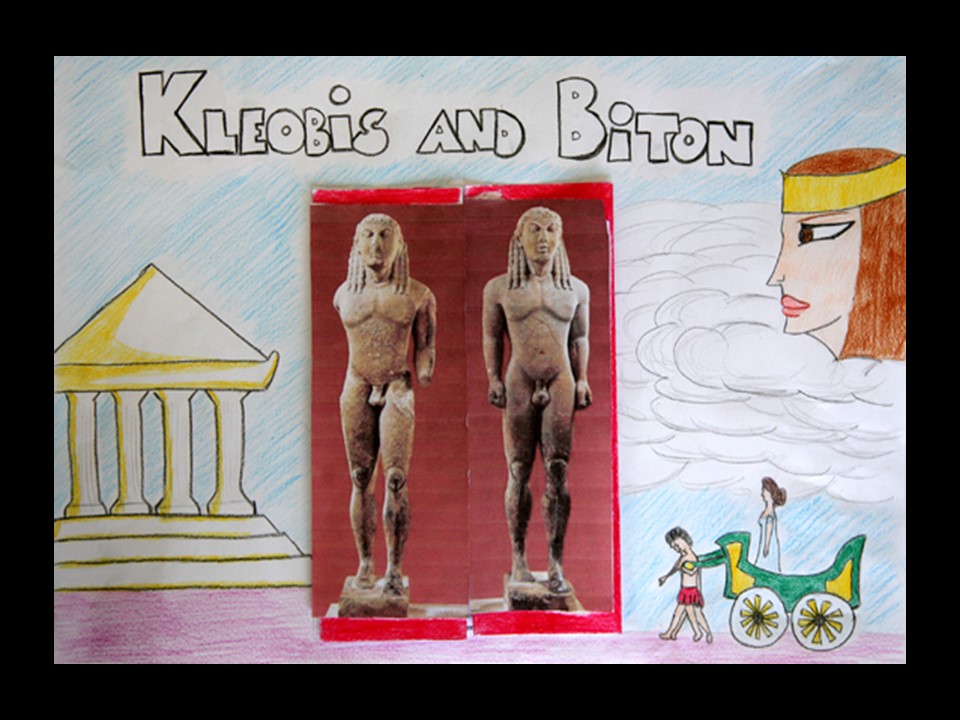
Grade 7 student Work
In 2016, after visiting the Archaeological Museum of Delphi… one of my Grade 7 students, inspired by Cleobis and Biton, presented me with the above poster!
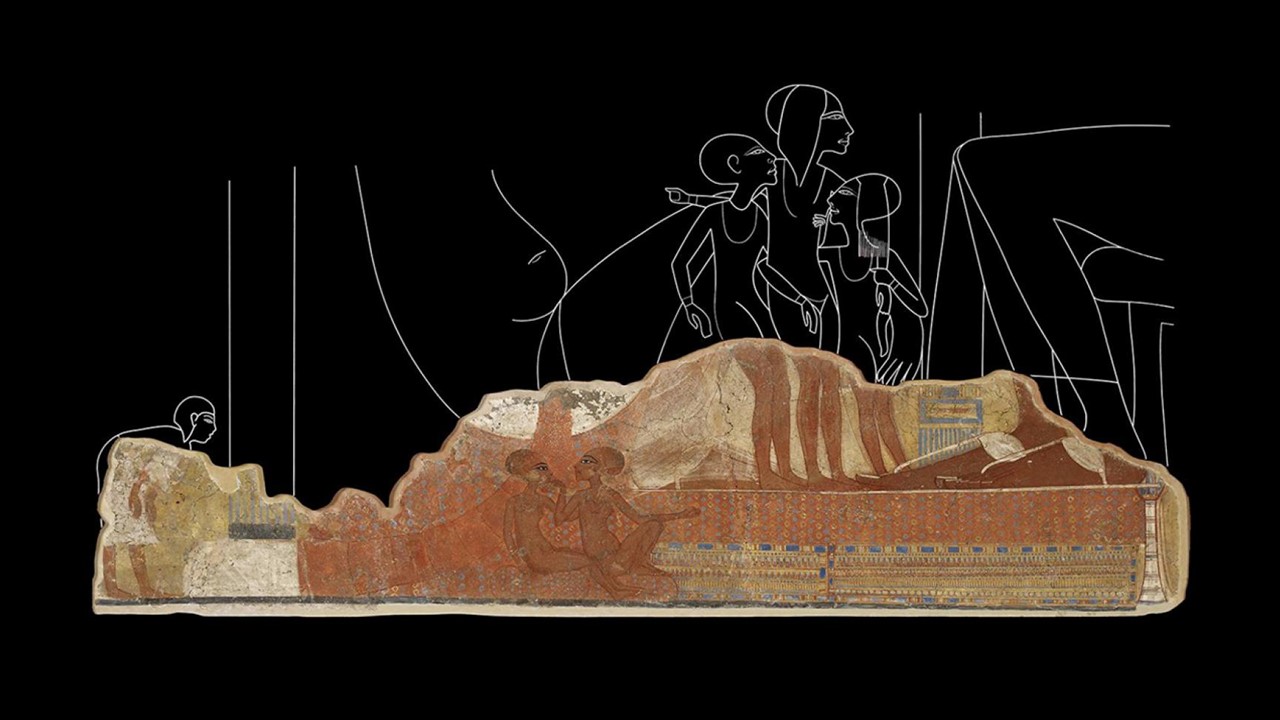
PRINCESS FRESCO - The idyllic life of the daughters of Pharaoh, circa 1343-1335, painted plaster, 40x165, Ashmolean Museum

Nofernoferuaton and Nofernoferure

PRINCESS FRESCO - The idyllic life of the daughters of Pharaoh, circa 1343-1335, painted plaster, 40x165, Ashmolean Museum
PRINCESS FRESCO – The idyllic life of the daughters of Pharaoh, circa 1343-1335, painted plaster, 40×165, Ashmolean Museum
https://www.ashmolean.org/princess-fresco

“With the move to Amarna the art becomes less exaggerated, but while it is often described as ‘naturalistic’ it remains highly stylised in its portrayal of the human figure. The royal family are shown with elongated skulls and pear-shaped bodies with skinny torsos and arms but fuller hips, stomachs and thighs. The subject matter of royal art also changes. Although formal scenes of the king worshipping remain important there is an increasing emphasis on ordinary, day-to-day activities which include intimate portrayals of Akhenaten and Nefertiti playing with their daughters beneath the rays of the Aten… While traditional Egyptian art tends to emphasise the eternal, Amarna art focuses on the minutiae of life which only occur because of the light – and life-giving power of the sun.” writes Dr Kate Spence for BBC History and I use this quote as an introduction to Nofernoferuaton and Nofernoferure, my new POST on Egyptian Art.     http://www.bbc.co.uk/history/ancient/egyptians/akhenaten_01.shtml

I would like to continue with another short quote by Dr Kate Spence “Akhenaten is a source of endless fascination and speculation – this often masks the fact that we actually know very little about him.” This quote marks the beginning of my Grade 7 Unit on the Art of the Amarna Period. I have been teaching this Unit for years and I can only testify to the fact that the Amarna Period allure attracts my student’s attention and captivates their imagination. They like to read and listen to their teacher describe the genesis of an almost “monotheistic” religion, the dynamics within a powerful royal family, the building of a new capital city, and how Egyptian Art of the period moved towards naturalism and informality.

The Amarna Idiom is an artistic style that captivates human reaction. My students are “hypnotized” by the unique Amarna pictorial beauty of deformation. They are charmed, yet question how in the depiction of faces, thin, long necks, hold greatly elongated skulls… facial folds are the norm, narrow, slitted eyes are prominent and jaws seem to be “hanging” low. The Amarna style body rendering amazes my students as well, particularly the discrepancy between the upper, lower and middle parts of the human body… the dropped, thin shoulders, heavy potbelly, large hips and thighs, and the rather thin, almost frail, legs.

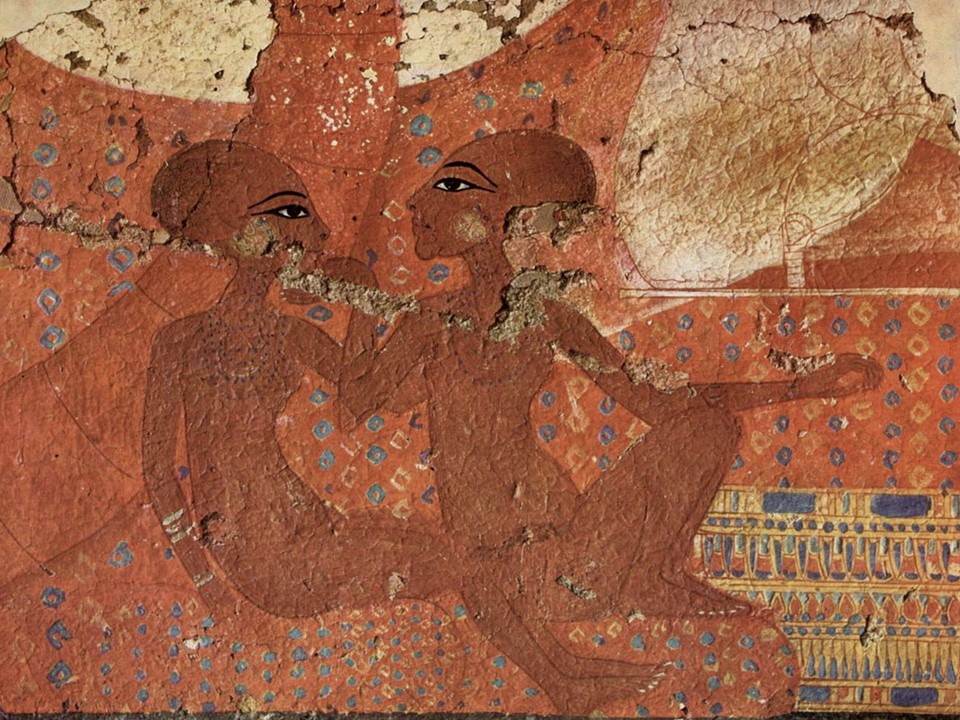
PRINCESS FRESCO - The idyllic life of the daughters of Pharaoh, circa 1343-1335, painted plaster, 40x165, Ashmolean Museum
PRINCESS FRESCO – The idyllic life of the daughters of Pharaoh, circa 1343-1335, painted plaster, 40×165, Ashmolean Museum
https://www.ashmolean.org/princess-fresco

At some point, towards the end of my Amarna Unit, I ran a survey, titled “My Favourite Amarna Work of Art,” as I am always interested to understand what artistic qualities attract the admiration of my students. Among the finalists in my survey is the fresco painting of Nofernoferuaton and Nofernoferure, coming from Akhenaton’s capital city Akhetaten, known today as Tell el- Amarna, and exhibited in the Ashmolean Museum. Students love the bright, warm, terracotta-coloured palette, the casual, relaxed composition theme, the depicted stylistic exaggerations, and the overall sense of family affection that embraces the pictorial arrangement.

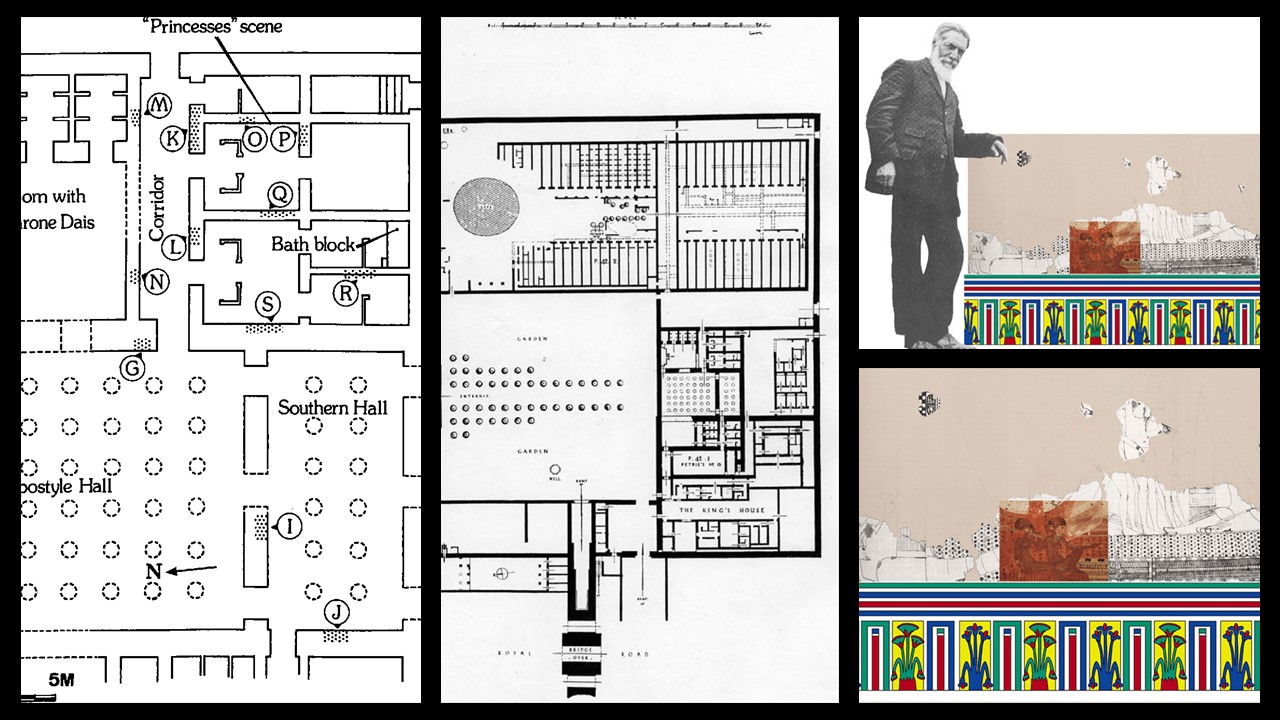
This fresco, fragile and precious, was discovered in the early 1890s by William Flinders Petrie, the renown archaeologist, at Akhetaten, “The horizon of the Aten,” where the visionary Pharaoh Akhenaton lived with his queen, Nefertiti, their six daughters, Nofernoferuaton and Nofernoferure among them, and the rest of the royal family. “The painting was made on a thin layer of gesso – powdered gypsum mixed with a glue – applied to mud plaster on a brick wall… (Petrie) discovered that the wall had been much damaged by ants and its preservation is a tribute to Petrie’s remarkable skills as an archaeologist.” https://www.ashmolean.org/princess-fresco     and     https://www.amarnaproject.com/pages/amarna_the_place/central_city/index.shtml

Plans of the King’s House in Amarna and the area where the fresco of the two Princesses was located. The discussed fresco, with the figure of the discoverer (F. Petrie), added to give scale. The scene of princesses (Ashmolean Museum) as it was originally located on a wall in the King’s House, with the painted dado restored
https://www.amarnaproject.com/pages/amarna_the_place/central_city/index.shtml
https://www.semanticscholar.org/paper/Wall-Paintings-from-the-King%27s-House-at-Amarna-*-Weatherhead/6939baf93dc88d6774e539c9cda0f3e920d54515/figure/2

Unearthed in the King’s House, “an enclosure measuring 123 by 140 meters, inside of which the building took the form of a U around a garden, with the actual residence of the king at the rear,” the Princess’s fresco depicts “Akhenaten and Nefertiti relaxing with their daughters, two of which are sitting casually on floor cushions in the foreground. The red sash of Nefertiti’s dress falls behind them, and to the right are Akhenaten’s sandaled feet. Between them stand three more daughters; the sixth daughter was probably shown seated on her mother’s lap, as suggested by a surviving fragment depicting a baby’s hand. The style and subject of this painting are in direct contrast to conventional Egyptian art and reflects the revolutionary character of the period.” Simply but beautifully said…     http://www.touregypt.net/featurestories/royalestate.htm     and     https://www.ashmolean.org/princess-fresco

For a PowerPoint on Nofernoferuaton and Nofernoferure, please… Check HERE!

For a Student Activity, please… Check HERE!

If interested in smart Amarna period Resources and Activities, please… Check https://www.arch.cam.ac.uk/research/projects/current-projects/life-ancient-egypt-amarna-resources-schools/ancient-amarna  

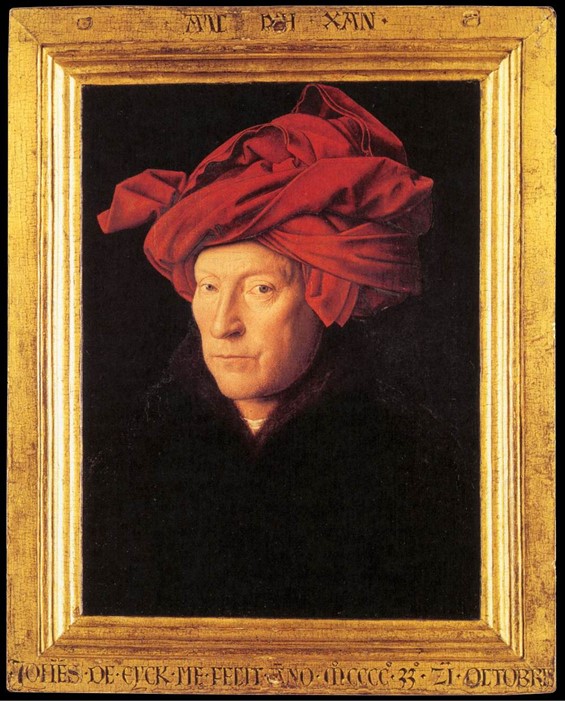
Jan van Eyck, before 1395-1441, Portrait of a Man (Self Portrait?), 1433

Teaching with Jan van Eyck

Jan van Eyck, before 1395-1441, Portrait of a Man (Self Portrait?), 1433
Jan van Eyck, before 1395-1441
Portrait of a Man (Self Portrait?),
1433, oil on wood, 25,5 x 19 cm, National Gallery, London
https://www.wga.hu/frames-e.html?/html/e/eyck_van/jan/01page/13turban.html

When the time comes for me to introduce my students to Jan van Eyck’s oeuvre I start with his remarkable motto, Als Ich Can – As well as I can, inscribed in large Greek letters on the upper part of the frame of his Self-Portrait? at the National Gallery in London. Humble words… but appreciate how subtly they draw attention to his extraordinary skills as a painter. Where can you go wrong Teaching with Jan van Eyck?     https://www.nationalgallery.org.uk/paintings/jan-van-eyck-portrait-of-a-man-self-portrait

“Jan van Eyck is credited with originating a style of painting characterised by minutely realistic depictions of surface effects and natural light. This was made possible by using an oil medium, which allowed the building up of paint in translucent layers, or glazes.” These three lines by the National Gallery in London embody the essence of van Eyck’s painting style and technique. I like to read it to my students emphasizing his contribution to Western European Art. Information about his training and his life is scarce, we do know, however, that he was a member of the gentry class and that by 1425 he lived in Bruges and Lille as court painter to Philip the Good, Duke of Burgundy. We also know that in 1428 he travelled to Portugal to paint Philip the Good’s future wife, Isabella of Portugal.     https://www.nationalgallery.org.uk/artists/jan-van-eyck

“Hubrecht van Eyck, the most famous painter ever known, started this work of art; his brother Jan, who was second in the art, finished the task at the request of Joos Vijd. With this verse the donor consigns the work to your charge on May 6th 1432. Admire what they have done for you”. The famous inscription on the frame of the Ghent Altarpiece sets off my Jan van Eyck PowerPoint Presentation and lets my students admire what they (Hubrecht and Jan) have done for us.

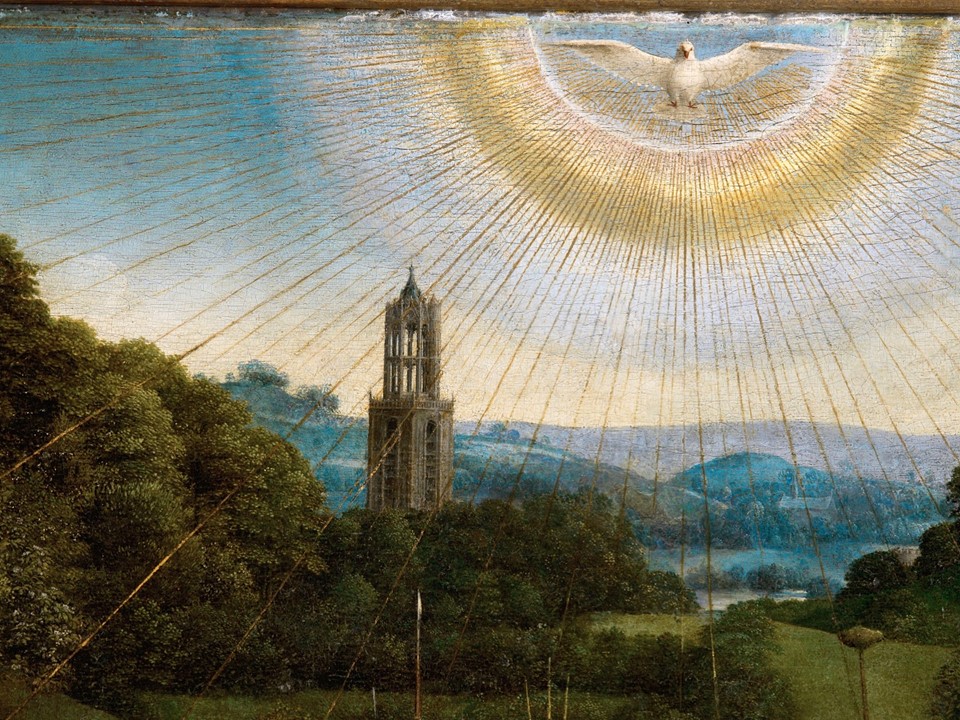
The Adoration of the Mystic Lamb in the Ghent Altarpiece (detail) by Jan van Eyck, 1432, St. Bavo’s Cathedral, Ghent, Belgium
https://artsandculture.google.com/asset/the-ghent-altarpiece-adoration-of-the-mystic-lamb-detail-of-the-holy-spirit-in-the-guise-of-a-dove-hubert-and-jan-van-eyck/MwEFlDeCLbw9RQ

Introducing a former BLOG POST at the 2020 Ghent Museum of Fine Arts Exhibition, titled Van Eyck – An Optical Revolution, I further discuss with my students his painting characteristics: 1. How he perfected the Oil Technique by adding siccatives. With oil paints, he created rich, deep, lustrous colours, flawless golden tones, and amazing life-like textures. 2. How Observation of reality is key to Jan’s Art. For example, his portraits are lifelike to the minutest detail, his depiction of nature and natural phenomena are credible and authentic, his art seems like it’s competing with reality itself! 3. How Observation of Reality is key to Jan’s Art. For example, his portraits are lifelike to the minutest detail, his depiction of nature and natural phenomena are credible and authentic, his art seems like it’s competing with reality itself! 3. How Observing and Painting Optical Light Phenomena shows an artist deeply interested “in the painting of light, so crucial to his optical revolution.” Scholars believe that Jan van Eyck “not only gathers practical but also theoretical knowledge in order to reproduce the effects of light.”     https://vaneyck2020.be/en/the-optical-revolution/     and     https://www.teachercurator.com/art/van-eyck-an-optical-revolution/

Teaching with Jan van Eyck… Online References PowerPoints and Activities…

For the List of ONLINE References on Jan van Eyck’s oeuvre, TeacherCurator put together, please… Click HERE!

For my PowerPoint on the Ghent Altarpiece, please… Click HERE! https://www.teachercurator.com/wp-content/uploads/2021/02/Twith-JvanE-Ghent2-PP.pptx. List of Slides and Photo Credits for the Ghent Altarpiece PowerPoint, please… Click HERE!

For my PowerPoint on Jan van Eyck’s Oeuvre, please… Click HERE! List of Slides and Photo Credits for Jan van Eyck’s Oeuvre PowerPoint, please… Click HERE!

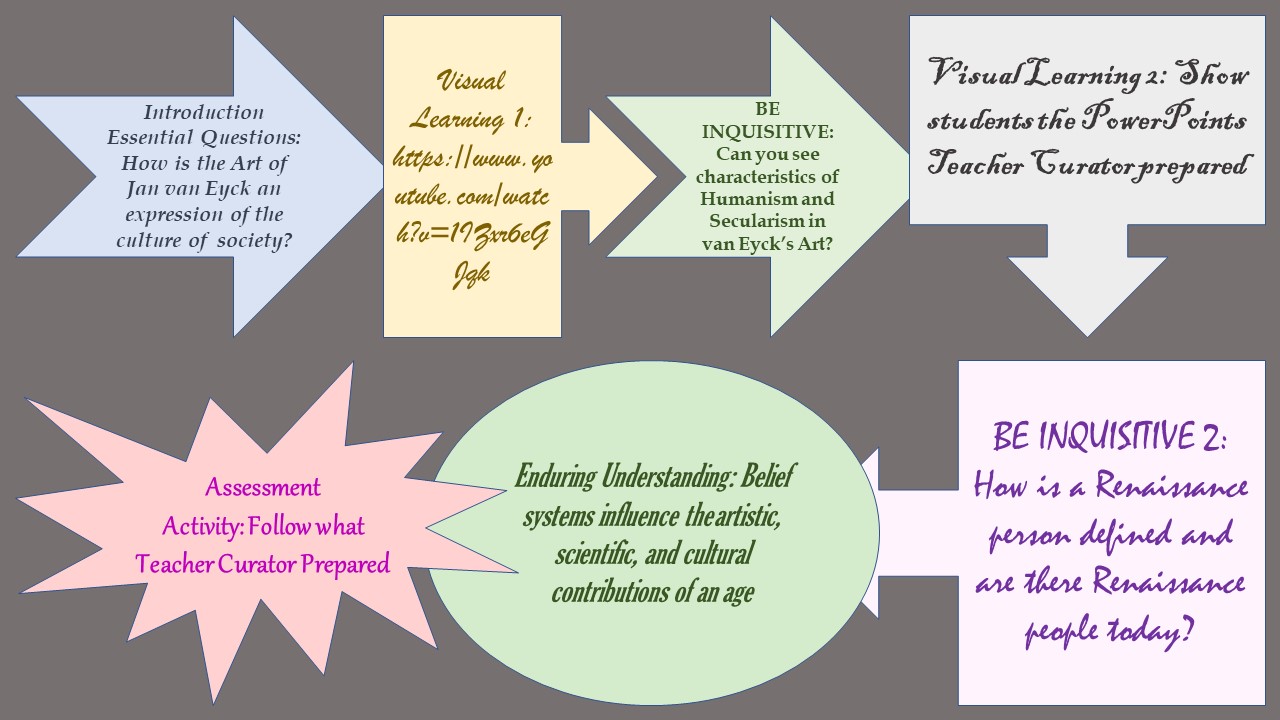
I always feel confident discussing an artist with my students when I prepare my Steps to Success Lesson Plan Outline…

Seven Steps to Success Plan

For High School level Student Activity, please… Click HERE!

For a RWAP (Research-Writing-Art-Project), please… Click HERE!

I hope that teaching with Jan van Eyck will prove easy and helpful. Do you think it justifies my BLOG name TeacherCurator?

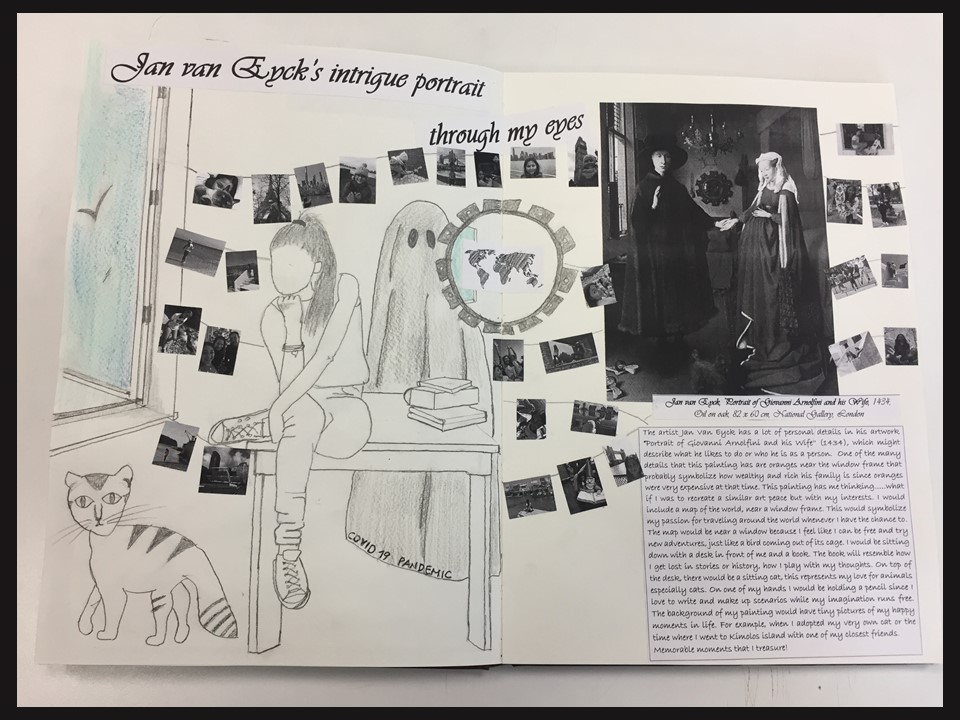
Student Activity
Alexandra D. and her Arnolfini Wedding RWAP Sketchbook Pages
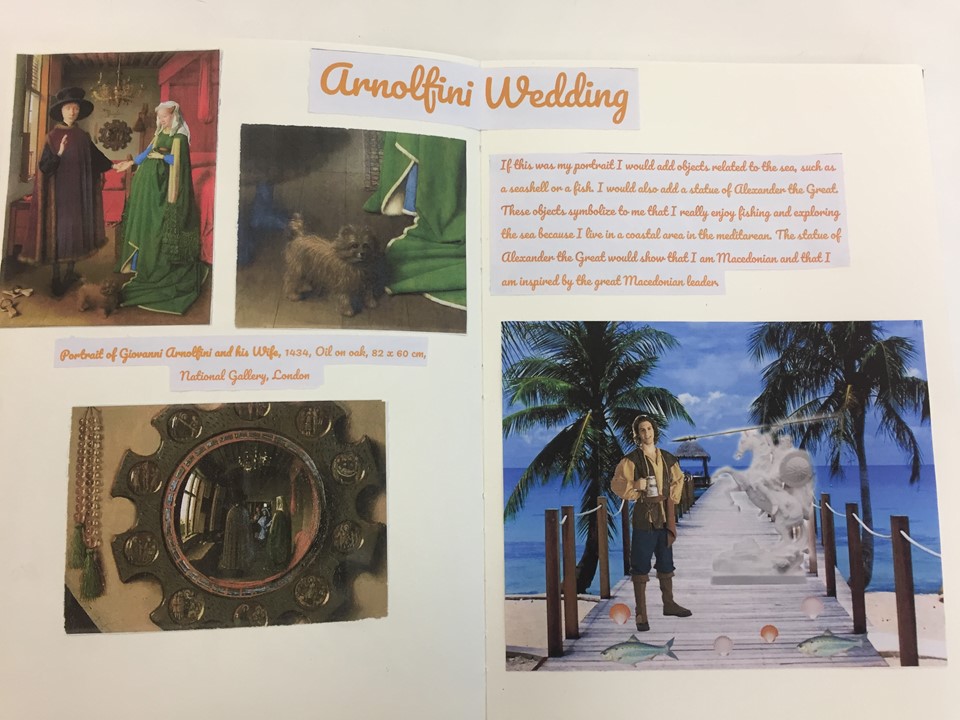
Arnolfini Wedding Student Activities Sketchbook Pages
Marios M. and his Arnolfini Wedding RWAP Sketchbook Pages