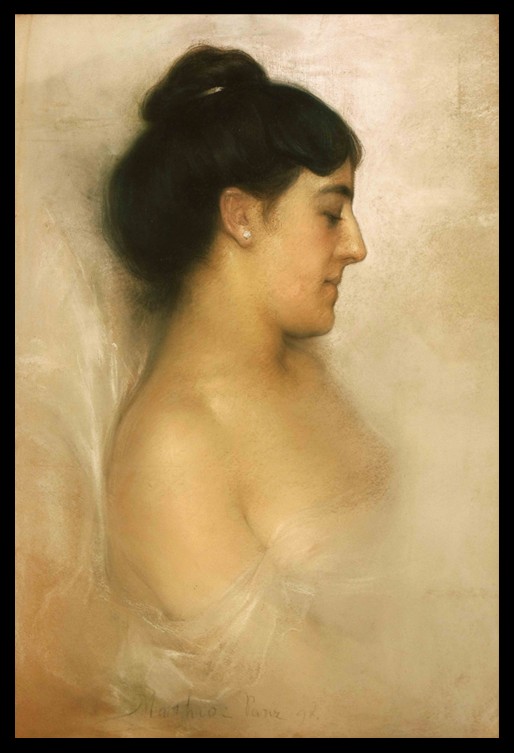
Portrait of a Lady, 1897, Pastel on Cardboard, 62,5×45 cm, Museum of Modern Greek Art of Rhodes, Greece
https://portal.mgamuseum.gr/collections/0b54c751-62b6-4175-afba-60faca0e7566
In 1897, a young Greek painter fresh out of the Athens School of Fine Arts arrived in Paris to continue his training. That painter was Pavlos Mathiopoulos, and one of the works he produced in this pivotal year was Portrait of a Lady, a delicate pastel on cardboard now held in the collection of the Museum of Modern Greek Art of Rhodes, Greece.
At first glance, it’s a simple composition: a woman shown in profile, emerging from an indistinct, undefined background. But look closer, and this small pastel reveals a great deal about a young artist absorbing the most progressive ideas of his time.
Who Was Pavlos Mathiopoulos?
Mathiopoulos was born in Athens in 1876. He began his studies at the Athens School of Fine Arts under Nikiforos Lytras, one of the most influential figures in 19th-century Greek painting. After graduating in 1897, he traveled to Paris, where he trained under three major academic painters: Jules Lefebvre, Jean-Paul Laurens, and Benjamin Constant.
His time in Paris proved transformative. In 1900, he won a silver medal at the Paris Exposition for his painting The Lady with the Little Dog. Upon returning to Greece in 1903, Mathiopoulos became one of the most sought-after portraitists among Athenian high society and the royal court, celebrated especially for his female portraits and nudes, works marked by refined aestheticism and carefully studied poses.
A Study in Contrasts
Portrait of a Lady was made during that formative Parisian period, and it’s an unusual object for its time and place. Pastel was a rare medium in Greek art of the late 19th century, and Mathiopoulos’s choice to work in it signals just how quickly he was absorbing the artistic currents swirling around him in France, currents shaped by artists like Degas, who had elevated pastel from a preparatory sketching tool to a serious medium in its own right.
The portrait focuses almost entirely on the woman’s face, hair, and shoulders. Yet rather than reading as a polished, finished likeness, it has a deliberately unresolved quality. The bust is rendered with striking freedom, and its faint contours dissolve into the background through sfumato, the soft blending technique that avoids hard outlines in favor of smoky, atmospheric transitions.
One of the most compelling aspects of this small work is its handling of color. Mathiopoulos builds the composition around a contrast between: cool tones in the surrounding, undefined space, warm tones in the sitter’s skin, dark, deep tones in her hair, which further sharpen the contrast. This isn’t academic color theory at work, it’s something closer to Impressionist color logic, where atmosphere and light take precedence over precise, even modeling. It’s a clear departure from the more disciplined, controlled palette Mathiopoulos would have learned under Lytras in Athens.
Where to See It
Portrait of a Lady is part of the permanent collection of the Museum of Modern Greek Art of Rhodes, one of the key institutions dedicated to preserving and showcasing modern Greek art. The museum’s collection offers valuable insight into how Greek artists like Mathiopoulos engaged with, adapted, and reinterpreted the major European art movements of their time.
For educators, art historians, and curious visitors alike, this small pastel is a wonderful entry point into a bigger conversation: how Greek art of the late 19th century balanced academic tradition with the pull of Parisian modernism — and how a single portrait, barely 62.5 centimeters tall, can hold the seeds of an entire artistic evolution.
PowerPoint Presentation: Ready to Dive Deeper? Download the presentation on Portraits by Pavlos Mathiopoulos, at your own pace, ideal for sharing, discussing, or simply learning more. Get the PowerPoint →
Continue Exploring on Teacher Curator: Interested in more figures from Greek art history? Explore our other profiles of Greek painters who studied and worked in Paris during the late 19th and early 20th centuries – Nikos Hadjikyriakos-Ghika’s Interior with Woman and Mirror and Theodoros Ralli
Sources and further Reading: For more information about Pavlos Mathiopoulos’s Portrait of a Lady, see the Museum of Modern Greek Art of Rhodes collection entry, which provides details about the painting, including its date, medium, dimensions, and collection: https://portal.mgamuseum.gr/collections/0b54c751-62b6-4175-afba-60faca0e7566?utm_source=chatgpt.com. For a broader understanding of Pavlos Mathiopoulos and his artistic development, see the National Gallery of Greece artist biography, which discusses his studies in Athens and Paris, his teaching career at the Athens School of Fine Arts, and his particular reputation as a portraitist working primarily in pastel: https://www.nationalgallery.gr/en/artist/mathiopoulos-pavlos-paul/?utm_source=chatgpt.com.