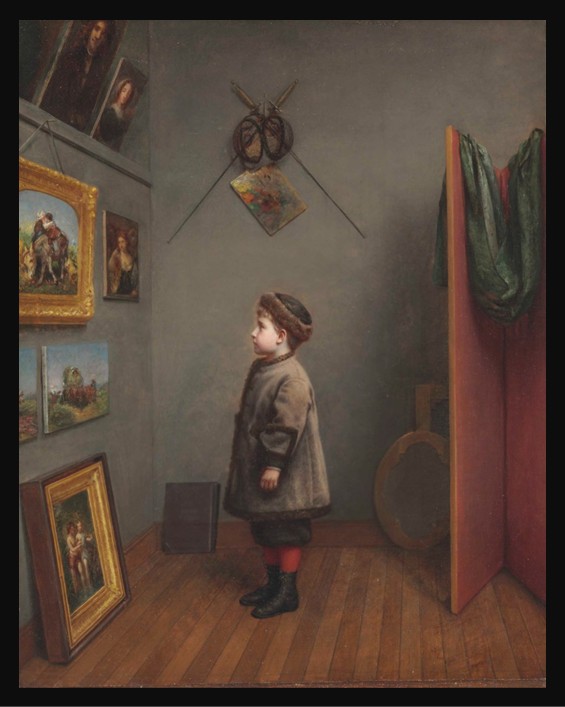
The Young Connoisseur, date unknown, oil on canvas, 33.7 x 27.3 cm, Private Collection
https://www.christies.com/en/lot/lot-6569213?ldp_breadcrumb=back#related-articles
A young boy stands in front of a wall crowded with framed paintings, hands clasped behind his back, chin tilted up, studying them with a concentration well beyond his years. This is Robert M. Pratt’s The Young Connoisseur, a small nineteenth-century American genre painting with an outsized amount to say about how children, and really, any of us, first learn to see.
Pratt, active in the United States in the middle decades of the 1800s, worked mostly as a portraitist, so it’s fitting that his most memorable genre scene is itself a study in looking: a painting about someone looking at paintings. The canvas he’s chosen to paint is modest in scale, but he crowds it with incident, the boy is dwarfed by the gilt frames stacked and hung around him, an ordinary child dropped into a room built for adults.
A child in a grown-up’s world
The title does a lot of work here. A connoisseur is someone with trained, discerning judgment, the last person you’d expect to find in a short-trousered boy who can barely see over the frames around him. Pratt clearly enjoys that mismatch. But he doesn’t play it only for a joke. The boy’s stillness, his slightly furrowed attention, the way he seems to be genuinely weighing what’s in front of him, all of it makes his absorption believable rather than merely cute. He isn’t performing connoisseurship. He’s doing the one thing every real connoisseur actually does, before any of the vocabulary or expertise arrives: he’s looking closely.
That’s the small joke and the real point of the painting at once. Expertise is built on attention, and attention is something a child already has in abundance.
Learning through looking
Children meet art differently than adults do. Before they have the words for movement, medium, or period, they respond to colour, shape, faces, gesture, and the small human stories a picture seems to imply. They notice things adults have learned to stop seeing, and they ask the kind of plain, direct questions, why is he sad, what’s behind that door, that can catch even a practiced viewer off guard.
We can’t know what the boy in Pratt’s painting is actually thinking as he looks up at that wall of pictures, and that’s part of what makes the image work. His response belongs entirely to him. Pratt gives us the posture of looking without narrating the thought behind it, which is, in miniature, a good argument for how to introduce a child to art at all: not by leading with dates and attributions, but by asking what catches their eye, what seems strange, or what they think is happening in the scene. The history and the names can follow later. The looking has to come first.
Why it fits Children’s Day
Paintings of children were everywhere in nineteenth-century American art, usually cast as scenes of innocence, play, or family life. Pratt’s boy is doing none of that. He isn’t posing for a portrait or playing with a toy; he’s working, in his own quiet way, at the same thing an adult visitor to a gallery would be doing. That small shift, treating a child’s engagement with art as serious rather than merely charming, is exactly why the painting resonates with UN Children’s Day, observed each year on 20 November, which centres children’s rights, wellbeing, and access to the tools that let them develop on their own terms.
Access to art and culture belongs on that list. Museums, books, music, theatre, and the chance to simply stand and look at something can build imagination, empathy, and independent thought as surely as any lesson can. Pratt’s little connoisseur is standing still in a quiet room, but nothing about his mind looks idle.
Looking with children
What I like most about this painting is that it models a way of encountering art with children rather than explaining art at them. A child doesn’t need to know who painted a picture, or when, to have a real response to it, that knowledge can come later, once the looking has already done its work.
More than 150 years on, that may be exactly why Pratt’s small, unassuming picture still holds up: it insists that becoming an art lover can start with something almost embarrassingly simple. A child stops. A child looks.
PowerPoint Presentation: Want to look closer at Pratt’s world? The companion PowerPoint walks through The Young Connoisseur in more detail, sets it alongside two more of Pratt’s portraits, and traces his career as a working nineteenth-century American painter, a quick way to bring this story into a classroom or gallery talk. Get the PowerPoint →
Continue Exploring on Teacher Curator: For more on how nineteenth-century American artists painted childhood, education, and everyday life, see – John George Brown’s Paintings of Children and Back to School with Winslow Homer.
Sources and further Reading: For more on Robert M. Pratt and The Young Connoisseur, including its sale history, see Christie’s lot record, which draws on the auction house’s own cataloguing – https://www.christies.com/en/lot/lot-6569213?ldp_breadcrumb=back#related-articles. For broader context on how children were depicted in this period, see the Smithsonian American Art Museum’s past exhibition, American ABC: Childhood in 19th-Century America, on view in Washington, D.C. in 2006, which examined how images of children shaped and reflected ideas of American identity – https://americanart.si.edu/exhibitions/american-abc?utm_source=chatgpt.com.