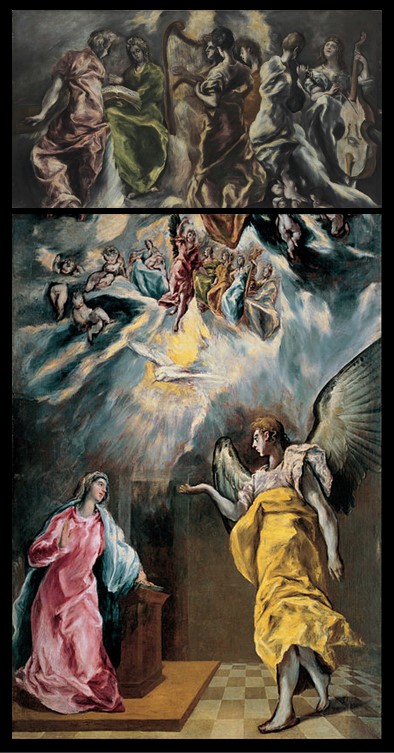
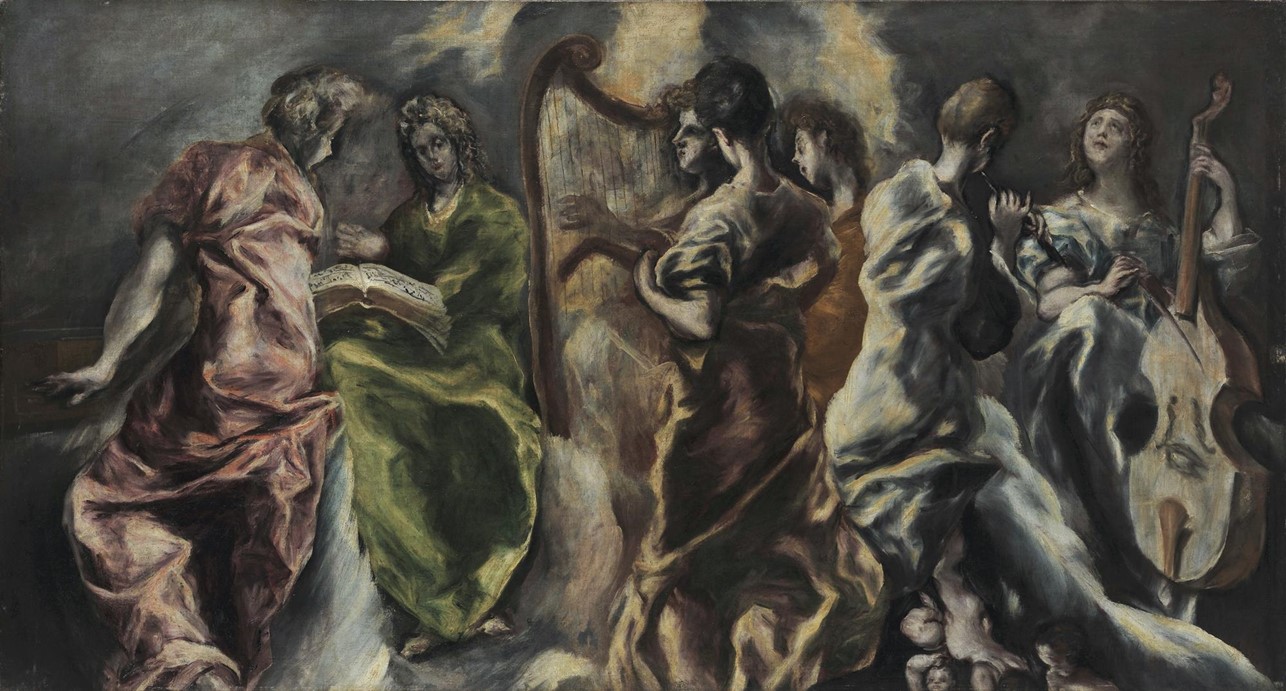
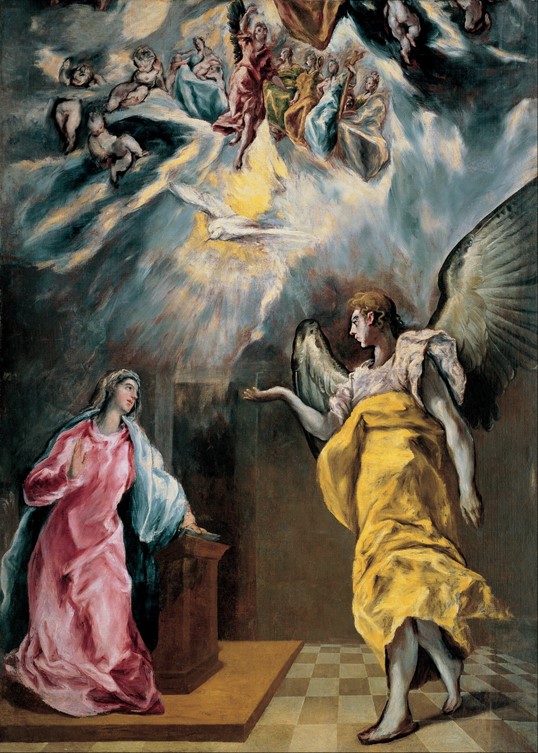
Domenicos Theotokopoulos, The Concert of the Angels, c. 1608-1614 and The Annunciation, 1614

Angelic Musicians

Domenicos Theotokopoulos is in my heart. I find him an attractive personality in every aspect… talented, educated, ambitious, curious, adventurous, persistent…  Art is everywhere you look for it, hail the twinkling stars for they are God’s careless splatters…” he wrote and I think of his Angelic Musicians, shining like flickering stars, in the National Gallery in Athens. http://elgreco.net/el-greco-quotes.jsp and https://www.nationalgallery.gr/en/painting-permanent-exhibition/painting/domenicos-theotokopoulos-el-greco/the-concert-of-the-angels.html

Domenicos Theotokopoulos was a Cretan Greek, born in Handaka-Candia, present-day Herakleion, part, at the time, of the thriving Republic of Venice. Archival research in Venice showed that between 1526-28 his family relocated from Chania to Handaka where in 1541 Domenicos was born. His orthodox-Greek family belonged to the upper-middle class, as his father, Giorgos Theotokopoulos, worked for the government of the Venetian Republic, most probably as a merchant and a tax collector. Very little is known of  Domenicos’s mother and early childhood. He was undoubtedly talented, and his father, realizing it, placed him as an apprentice in a painter’s workshop to learn this profitable trade. The name of his teacher is unknown, but judging from Domenicos’s earliest paintings, he was a great master of the Post-Byzantine Cretan School. Crete at the time was the center of a thriving artistic community and understanding the artist’s early influences and style is important in decoding his later work! https://www.historical-museum.gr/webapps/elgreco/xronologio.php?lang=en

By 1567/8 Theotokopoulos travelled to Venice, by 1570, he was in Rome, by 1576 he moved to Spain and in 1577 the artist settled in Toledo, where he found his spiritual home and remained for the rest of his life. He died on the 7th of April 1614, admired for his unique fluid style, temperamental character and humanist education. One of his friends and admirers, Hortensio Félix Paravicino y Arteaga (1580-1633) the Spanish poet, preacher and a member of the Trinitarian Order, wrote for the artist “O Greek divine! We wonder not that in thy works / The imagery surpasses actual being.” Paravicino also wrote, foreseeing Theotokopoulos’s legacy “Future generations will admire his strange genius, but for centuries he will not be imitated.” http://www.nccsc.net/essays/spanish-style  

I would like the reader of this BLOG POST, titled Angelic Musicians, to focus on two paintings. One of them is in Athens and is titled The Concert of the Angels, the other is in Madrid, and is an Annunciation scene. Now imagine them together and you will see one of the last, if not the last painting, the artist created but never finished. The original painting, an Annunciation scene, was commissioned for the Chapel of the Hospital of St. John the Baptist outside the walls of Toledo. Today, separated, the product of 19h century vandalism, may look slightly odd, but still, enthral the viewer with their unique “beauty.”

Domenicos Theotokopoulos, 1541-1614, The Concert of the Angels, c. 1608-1614
Domenicos Theotokopoulos, 1541-1614
The Concert of the Angels, c. 1608-1614, oil on canvas, 115-217 cm, National Gallery – Alexandros Soutsos Museum – Evripidis Koutlidis Foundation, Athens
https://www.nationalgallery.gr/en/painting-permanent-exhibition/painting/domenicos-theotokopoulos-el-greco/the-concert-of-the-angels.html

The Concert of the Angels in Athens is for me a wonderful depiction of an imaginary, celestial concert, full of energy and vibrato. Domenicos Theotokopoulos, the so-called El Greco, loved music and treated it with respect. The painting in Athens shows a musical ensemble with seven “ecstatic” angels, reading music, singing or playing the spinet, a harp, a flute and a viola da gamba. I wonder what kind of music Domenico enjoyed most, and which musician of his time he favoured… https://www.nationalgallery.gr/en/painting-permanent-exhibition/painting/domenicos-theotokopoulos-el-greco/the-concert-of-the-angels.html

The artist uses swift brushwork and swaying movement in postures and robes to create excitement in his composition. Like tongues of fire, his swirling figures look more like spiritual beings than real bodies…

The colour palette that the artist uses is another distinctive characteristic of his mannerism. The colours are iridescent but bold. He uses oranges in red and green and yellow/gold in blue. Tints and shades are juxtaposed. Values of high or low intensity are treasured. Theotokopoulos’s final Annunciation was never finished but whether you see its upper part in Athens or the actual Annunciation part in Madrid, its expressive power is unquestionable.

For a PowerPoint on Theotokopoulos’s paintings of the Annunciation, please … Click. HERE!

The National Gallery – Alexandros Soutsos Museum – Evripidis Koutlidis Foundation in Athens has uploaded a wonderful (in Greek) Video to watch… https://www.facebook.com/watch/?v=316373302403183  

Domenicos Theotokopoulos, 1541-1614, The Annunciation, 1614
Domenicos Theotokopoulos, 1541-1614
The Annunciation, 1614, oil on canvas, 2.940,00×2.090,00 mm, Banco Santander, Spain
https://el.m.wikipedia.org/wiki/%CE%91%CF%81%CF%87%CE%B5%CE%AF%CE%BF:Domenikos_Theotokopoulos,_El_Greco_-_The_Annunciation_-_Google_Art_Project.jpg

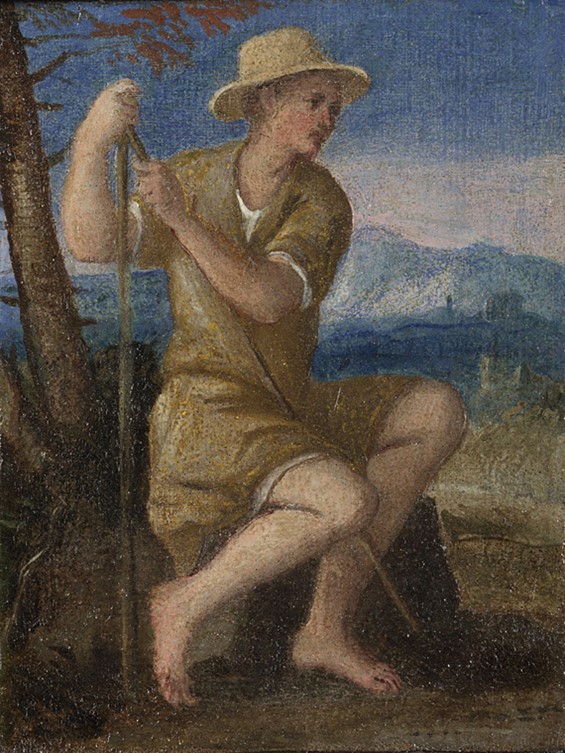
The Labours of the Months: April

By an unknown Venetian artist…
The Labours of the Months: April, about 1580
By an unknown Venetian artist…
The Labours of the Months: April, about 1580, oil on canvas, 13.6 x 10.6 cm, National Gallery, London
https://www.nationalgallery.org.uk/paintings/italian-venetian-the-labours-of-the-months-january#painting-group-info

Whan that Aprill with his shoures soote:   When April with its sweet-smelling showers  /  The droghte of March hath perced to the roote,  Has pierced the drought of March to the root,   /  And bathed every veyne in swich licour  And bathed every vein (of the plants) in such liquid  /  Of which vertu engendred is the flour;   By the power of which the flower is created;  /  Whan Zephirus eek with his sweete breeth   When the West Wind also with its sweet breath,  /  Inspired hath in every holt and heeth   In every holt and heath, has breathed life into  /  The tendre croppes, and the yonge sonne   The tender crops, and the young sun  /  Hath in the Ram his half cours yronne,   Has run its half course in Aries,  /  And smale foweles maken melodye,  And small fowls make melody,  /  That slepen al the nyght with open ye   Those that sleep all the night with open eyes  /  (So priketh hem Nature in hir corages),   (So Nature incites them in their hearts)… Geoffrey Chaucer first line for The Canterbury Tales refers to April…   for The Labours of the Months: April cer/gp-aloud.htm

In London, at the National Gallery there are 12 small pictures, “painted on canvas and then each glued to a wooden panel. It is possible that they were made to decorate the recessed panels of a pair of doors. The paintings seem to have been planned in pairs with the figures facing each other and are currently displayed in two frames in groups of six. They show the ‘labours of the months’ – the rural activities that take place each month throughout the year.” This set of painted Doors combines simplicity in execution and extravagance in visual effect! https://www.nationalgallery.org.uk/paintings/italian-venetian-the-labours-of-the-months-january#painting-group-info

The painting that may represent “sweet-smelling” April, shows  a cooper making a wooden barrel. “He raises his mallet ready to strike the tool in his other hand. The work must be physically hard as he has tied a band of white cloth around his forehead to keep the sweat out of his eyes. The barrel will be used to store wine made from the grapes we see being pressed in September.”     https://www.nationalgallery.org.uk/paintings/italian-venetian-the-labours-of-the-months-april

By an unknown Venetian artist…
The Labours of the Months: April, about 1580
By an unknown Venetian artist…
The Labours of the Months: April, about 1580, oil on canvas, 13.6 x 10.6 cm, National Gallery, London
https://www.nationalgallery.org.uk/paintings/italian-venetian-the-labours-of-the-months-january#painting-group-info

Coopers were important craftsmen during the Middle Ages and the Renaissance. They created wooden barrels to store wine, spirits and salted meats, buckets to draw and carry water, wooden bowls and plates for daily use, pails, churns and tubs for various agricultural or home-industry needs. Coopers, like the one depicted in the small London painting, were respected and valued Renaissance professionals.

Depicting the Labours of the Months was a popular artistic theme that was frequently used in the decoration of Cathedrals and Churches, Castles and  Palaces, Psalters, Breviaries and Books of Hours across Europe during the Medieval and Early Renaissance period. Each month, depicting popular activities of peasants or/and the gentry throughout the year were sometimes paired with the Signs of the Zodiac circle. They would be either simple and small in size or large and elaborate, crafted in stone, wood, stained glass, painted in murals or often enough, painted in parchment. Many great Monuments and Libraries in Europe display fine examples of such artefacts for art lovers to enjoy.  http://www.livingfield.co.uk/ages/labours-of-the-months/

For a PowerPoint on The Labours of the Months at the National Gallery in London, please… Check HERE!

Andrea Mantegna, 1431-1506, Camera degli Sposi, The West Wall: The Meeting, (detail of the left panel), 1465-74

Teaching with Andrea Mantegna

Andrea Mantegna, 1431-1506, Camera degli Sposi, The West Wall: The Meeting, (detail of the left panel), 1465-74
Andrea Mantegna, 1431-1506
Camera degli Sposi, The West Wall: The Meeting, (detail of the left panel), 1465-74, Walnut oil on plaster, Camera degli Sposi, Palazzo Ducale, Mantua
https://commons.wikimedia.org/wiki/File:Andrea_Mantegna_075.jpg?uselang=it

“How great is the effect of reward on talent is known to him who labors valiantly and receives a certain measure of recompense, for he feels neither discomfort, nor hardship, nor fatigue, when he expects honor and reward for them; nay, what is more, they render his talent every day more renowned and illustrious. It is true, indeed, that there is not always one to recognize, esteem, and remunerate it as that of Andrea Mantegna was recognized. This man was born from very humble stock in the district of Mantua; and, although as a boy he was occupied in grazing herds, he was so greatly exalted by destiny and by his merit that he attained to the honorable rank of Chevalier, as will be told in the proper place…” This is how Giorgio Vasari introduces Andrea Mantegna, the artist who was is “seen to have been wrought with much art and diligence.” Teaching with Andrea Mantegna is a set of student activities and worksheets inspired by the great Italian artist I admire. To visit Andrea’ Camera degli Sposi in the Palazzo Publico in Mantua was for years an unreachable dream. In 1988 along with a group of students/friends my dream came to fruition and I was finally, in the middle of this amazing room… moved, I confess, and emotional.     http://www.travelingintuscany.com/art/giorgiovasari/lives/andreamantegna.htm

Andrea Mantegna, 1431-1506, The presentation of Christ in the temple (detail-Probably Self-portrait), 1465-1466
Andrea Mantegna, 1431-1506
The presentation of Christ in the temple (detail-Probably Self-portrait), 1465-1466, tempera on canvas, 86×67 cm, Gemäldegalerie, Berlin
https://commons.wikimedia.org/wiki/Category:Portraits_of_Andrea_Mantegna#/media/File:Andrea_Mantegna_049_detail_possible_self-portrait.jpg

When the time comes for me to introduce my students to Mantegna’s oeuvre I start with Giorgio Vasari’s final words. “Andrea was so kindly and praiseworthy in all his actions, that his memory will ever live, not only in his own country, but in the whole world; wherefore he well deserved, no less for the sweetness of his ways than for his excellence in painting…” and continue with the artist’s tutelage under Squarcione, who “made him practise much on casts taken from ancient statues and on pictures painted upon canvas which he caused to be brought from diverse places, particularly from Tuscany and from Rome. By these and other methods, therefore, Andrea learnt not a little in his youth…” I finish my presentation of Andrea Mantegna’s contribution to world art with his reaction to Squarcione’s criticism that “his pictures resembled not living figures but ancient statues of marble or other suchlike things.” My students are intrigued and a discussion takes place by how “This censure piqued the mind of Andrea; but, on the other hand, it was of great service to him, for, recognizing that Squarcione was in great measure speaking the truth, he set himself to portray living people, and made so much progress in this art, that, in a scene which still remained to be painted in the said chapel, he showed that he could wrest the good from living and natural objects no less than from those wrought by art. But for all this Andrea was ever of the opinion that the good ancient statues were more perfect and had greater beauty in their various parts than is shown by nature, since, as he judged and seemed to see from those statues, the excellent masters of old had wrested from living people all the perfection of nature, which rarely assembles and unites all possible beauty into one single body, so that it is necessary to take one part from one body and another part from another.”     http://www.travelingintuscany.com/art/giorgiovasari/lives/andreamantegna.htm

Andrea Mantegna, 1431-1506, The San Zeno Polyptych (detail), 1457-60
Andrea Mantegna, 1431-1506
The San Zeno Polyptych (detail), 1457-60, Tempera on panel,  480 x 450 cm, San Zeno, Verona
https://commons.wikimedia.org/wiki/Category:Details_of_Pala_di_San_Zeno_by_Andrea_Mantegna#/media/File:Andrea_Mantegna_024.jpg

Teaching with Andrea Mantegna References – References, a PowerPoint and Activities…

For the List of ONLINE References on Andrea Mantegna TeacherCurator put together, please… Click HERE!

For my PowerPoint on Andrea Mantegna, please… Click HERE!

I always feel confident discussing an artist with my students when I prepare my 7 Steps to Success Lesson Plan Outline

7Steps to Success Plan

For Student Activities (5 Activities), please… Click HERE!

I hope that Teaching with Andrea Mantegna will prove easy and helpful. Do you think it justifies my BLOG name Teacher Curator?

Andrea Mantegna, 1431-1506, Ceiling decoration of the Camera degli Sposi (detail), 1465-74
Andrea Mantegna, 1431-1506
Ceiling decoration of the Camera degli Sposi (detail), 1465-74, Walnut oil on plaster and fresco, Camera degli Sposi, Palazzo Ducale, Mantua
https://commons.wikimedia.org/wiki/Category:Camera_picta_-_Ceiling#/media/File:Andrea_mantegna,_camera_degli_sposi,_1465-74,_volta,_oculo,_07.jpg

By an unknown Venetian artist… The Labours of the Months: March, about 1580

The Labours of the Months: March

By an unknown Venetian artist… The Labours of the Months: March, about 1580
By an unknown Venetian artist…
The Labours of the Months: March, about 1580, oil on canvas, 13.6 x 10.6 cm, National Gallery, London
https://www.nationalgallery.org.uk/paintings/italian-venetian-the-labours-of-the-months-march

Dear March – Come in – / How glad I am – / I hoped for you before – / Put down your Hat – / You must have walked – / How out of Breath you are – / Dear March, how are you, and the Rest – / Did you leave Nature well – /Oh March, Come right upstairs with me –/I have so much to tell –     /     I got your Letter, and the Birds – / The Maples never knew that you were coming – / I declare – how Red their Faces grew – / But March, forgive me – / And all those Hills you left for me to Hue – / There was no Purple suitable – / You took it all with you –     /     Who knocks? That April – / Lock the Door – / I will not be pursued – / He stayed away a Year to call / When I am occupied –  / But trifles look so trivial / As soon as you have come     /     That blame is just as dear as Praise / And Praise as mere as Blame –   Dear March, Come in!, a poem by Emily Dickinson, is about the love and joy it brought to her… She personifies March as if he were a friend… and I find it a fitting introduction to the new POST The Labours of the Months: March!     https://poets.org/poem/dear-march-come-1320     and     https://www.poetryfoundation.org/poets/emily-dickinson

Church of Panagia Gorgoepikoos, or Hagios Eleftherios or Mikri Mitropolis, 12th or 15th century, Athens
http://www.religiousgreece.gr/athens-attica/-/asset_publisher/lpcrESlL5iOO/content/panagia-gorgoepekoos

Depicting The Labours of the Months in works of art is a tradition that goes back to ancient Greek times. The charming Church of Hagios Eleutherios in Athens, also known as the Panagia Gorgoepikoos or the Mikri (Small) Metropolis, made up entirely of spolia of both ancient and Christian monuments, is a good example to start with. Above the main entrance to the Church and under the roof cornice, the builders of this extraordinary church placed “a frieze of Pentelic marble, which shows the months of the Attic Calendar, some festivals, and the complete circle of the Zodiac.” This ancient frieze “attempts to put together and coordinate the lunar calendar (Attic months and festivals) and the solar calendar (the signs of the Zodiac).” Amazing…     https://hellenismo.wordpress.com/2012/12/01/the-frieze-of-the-attic-calendar/

Calendar Frieze at the Church of Panagia Gorgoepikoos or Hagios Eleftherios or Mikri Mitropolis (Date of the Calendar Frieze: 2nd century BC- Date of the Church: 12th or 15th century) Athens
Photo credit: http://surprisedbytime.blogspot.com/2011/10/cyriaco-and-little-metropolis.html
Drawings of the Calendar Frieze in the Church of Panagia Gorgoepikoos or Hagios Eleftherios or Mikri Mitropoli (Date of the Calendar Frieze: 2nd or 15th  century BC- Date of the Church: 12th century) Athens

Drawings of the Calendar Frieze in the Church of Panagia Gorgoepikoos or Hagios Eleftherios or Mikri Mitropoli (Date of the Calendar Frieze: 2nd or 15th  century BC- Date of the Church: 12th century) Athens
https://hellenismo.wordpress.com/2012/12/01/the-frieze-of-the-attic-calendar/

Olga Palagia, Professor of Classical Archeology at the National and Kapodistrian University of Athens, argues that the Calendar Frieze, in most probability,  was created in Athens for the Great Panathenaic festivities of the year 142/3. If this small Attic Calendar Frieze, Palagia still argues, is tied to Herodes Atticus, who presented Athens with a number of public buildings…if this Calendar Frieze was part of the grand Athenian marble Panathenaic Stadium complex, built entirely at the expense of Herodes Atticus for the Great Panathenaia that fell in 142/3… well,  makes it most interesting evidence of public Calendar representation… but in the realm of pure speculation!     The date and iconography of the calendar frieze on the little metropolis, Athens, JdI 123, 2008, by Olga Palagia,     https://www.academia.edu/843544/The_date_and_iconography_of_the_calendar_frieze_on_the_little_metropolis_Athens_JdI_123_2008

SO… The Calendar of the Months during Antiquity and the Labours of the Months later in history attracts our attention in Calendar works of Art adorning public buildings, Churches and Cathedrals of the time, striking Vitreaux Windows, amazingly colourful manuscripts, and paintings, monumental, like the eleven surviving panels in Torre Aquila I presented in 2020 (check: https://www.teachercurator.com/?s=torre%20aquila&cat=plus-5-results), or small, like the paintings in the National Gallery, in London, we will explore in 2021… month by month…     https://archive.org/details/labormonth00webs/page/n9/mode/2up Webster, James Carson – 1905-1989, The labors of the months in antique and mediaeval art to the end of the twelfth century, 1938, Evanston, Ill., Northwestern University,     and      https://www.nationalgallery.org.uk/paintings/italian-venetian-the-labours-of-the-months-march

By an unknown Venetian artist…
The Labours of the Months: March (detail) , about 1580
By an unknown Venetian artist…
The Labours of the Months: March (detail) , about 1580, oil on canvas, 13.6 x 10.6 cm, National Gallery, London
https://www.nationalgallery.org.uk/paintings/italian-venetian-the-labours-of-the-months-march

For the Venetian Month of March at the National Gallery, we have yet another outdoor scene. “A bearded man wearing a yellow tunic trims vines that have been trained to grow up two trees. The branches of the vine are bare, while the trees have a few brownish leaves. Pruning vines is an activity carried out in Italy in winter, when the plant is dormant, and in spring when the new leaves have started to grow.” Once more, young farmers need to bundle up and take care of the daily chores…     https://www.nationalgallery.org.uk/paintings/italian-venetian-the-labours-of-the-months-march

For a PowerPoint on The Labours of the Months at the National Gallery in London, please… Check HERE!

By an unknown Venetian artist… The Labours of the Months: March, about 1580, and Calendar Frieze at the Church of Panagia Gorgoepikoos, Hagios Eleftherios or Mikri Mitropoli (Date of the Calendar Frieze: 2nd century BC- Date of the Church: 12th or 15th century) Athens  
By an unknown Venetian artist…
The Labours of the Months: March, about 1580, oil on canvas, 13.6 x 10.6 cm, National Gallery, London     https://www.nationalgallery.org.uk/paintings/italian-venetian-the-labours-of-the-months-march
Calendar Frieze at the Church of Panagia Gorgoepikoos, Hagios Eleftherios or Mikri Mitropoli (Date of the Calendar Frieze: 2nd century BC- Date of the Church: 12th or 15th century) Athens     http://surprisedbytime.blogspot.com/2011/10/cyriaco-and-little-metropolis.html