https://www.metmuseum.org/art/collection/search/252884
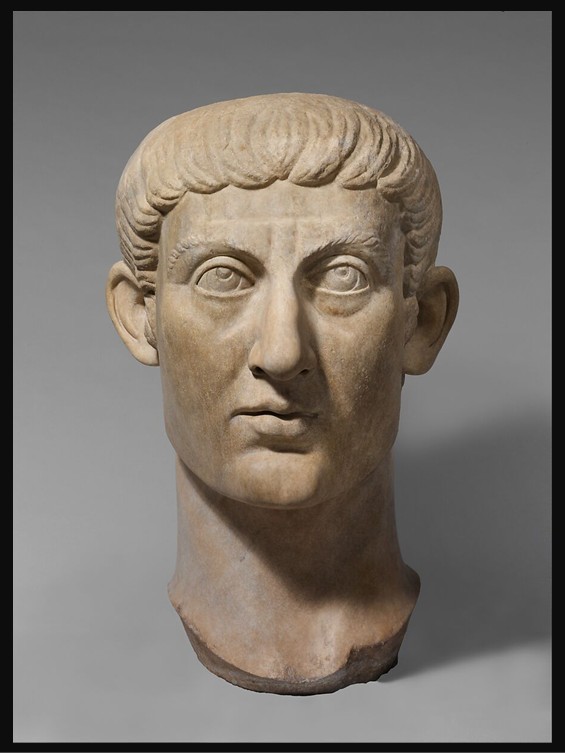
The Marble Portrait of Constantine the Great is more than a portrait. It is a visual turning point in Roman history, where imperial identity, political ideology, and the rise of Christianity converge in carved stone. The marble portrait head of Constantine the Great dated ca. 325–370 AD, and now in the Metropolitan Museum of Art, in New York city, captures not only an emperor’s likeness but also a carefully constructed message of power, continuity, and transformation.
A Face Between Two Empires: The Marble Portrait of Constantine the Great
Constantine stands at a defining threshold in the ancient world. As the first Roman emperor to embrace Christianity and the ruler who reunified the empire after civil conflict, he reshaped both governance and cultural identity. By 325 AD, after defeating Licinius, he controlled the entire Roman Empire and soon began laying the foundations for a new imperial center at Constantinople. Yet, even as he turned toward a new future, his public image remained deeply anchored in Rome’s classical traditions.
The marble head reflects this duality with remarkable subtlety. The emperor’s face is idealised: broad forehead, composed gaze, and carefully arranged hair. He is clean-shaven, a deliberate stylistic choice that visually aligns him with earlier good emperors such as Trajan rather than with his immediate predecessors. This was not a neutral aesthetic decision; it was political communication in sculptural form. The portrait constructs Constantine not as a man of his turbulent age, but as an heir to Rome’s most stable and admired imperial ideals.
In this sense, the head does not simply depict Constantine. It repositions him within a lineage of authority. It visually edits history, linking his reign to an imagined continuity of Roman greatness. The result is a portrait that functions less as likeness and more as ideology.
Spolia and Imperial Authority in Constantine’s Rome
This strategy is echoed across Constantine’s building programme in Rome. Monuments such as the Arch of Constantine near the Colosseum famously incorporate sculptural reliefs taken from earlier imperial structures. This practice of reuse, known as spolia, was not merely practical. It was symbolic. By embedding fragments of earlier emperors into his own monuments, Constantine visually absorbed their authority, aligning his rule with Rome’s most celebrated past.
At the same time, Constantine’s world was undergoing profound religious transformation. Christianity, once a marginal faith, was becoming central to imperial ideology and patronage. This shift gradually altered the visual language of power, introducing new ways of imagining authority that moved beyond purely classical ideals. Yet in this portrait, those changes remain subtle. The sculpture still speaks fluently in the language of Roman imperial tradition, even as it stands at the edge of a new Christian visual order.
What makes The Marble Portrait of Constantine the Great portrait so compelling is precisely this tension. It belongs to two worlds at once. On one hand, it is rooted in the classical Roman tradition of idealised imperial portraiture. On the other, it hints at the emerging abstraction of Late Antiquity, where identity becomes less about individual physical likeness and more about symbolic presence and ideological weight.
Seen from this perspective, the marble head is not simply a representation of power, it is an attempt to stabilise transformation. It presents Constantine as both continuation and rupture: a ruler who preserves Rome’s visual memory while simultaneously redirecting its future. Ultimately, the portrait invites us to see Constantine not only as a historical figure, but as a constructed image of authority. In its calm expression and idealised form, we encounter an emperor who is less a man than an idea—carefully shaped to bridge two worlds.
In this way, A Face Between Two Empires: Constantine in Marble becomes more than a title. It becomes a lens through which we read a civilisation in transition, carved into stone and preserved between past and future.
Looking for a creative classroom idea? Discover a hands-on Student Activity inspired by the iconic Marble Portrait of Constantine the Great at the MET and explore the full Student Activity →
Continue Exploring on Teacher Curator: Discover more blog posts on Saint Constantine, from Byzantium to the Renaissance. Explore Saint Constantine in Arezzo and discover Triptych Leaf with St. Constantine
Sources and further Reading: Marble portrait head of the Emperor Constantine I– Metropolitan Museum of Art, New York: https://www.metmuseum.org/art/collection/search/252884 and David H. Wright, The True Face of Constantine the Great, Dumbarton Oaks Papers, Vol. 41, 1987, pp. 493-507: https://webhelper.brown.edu/joukowsky/courses/ageofaugustus/files/5271503.pdf