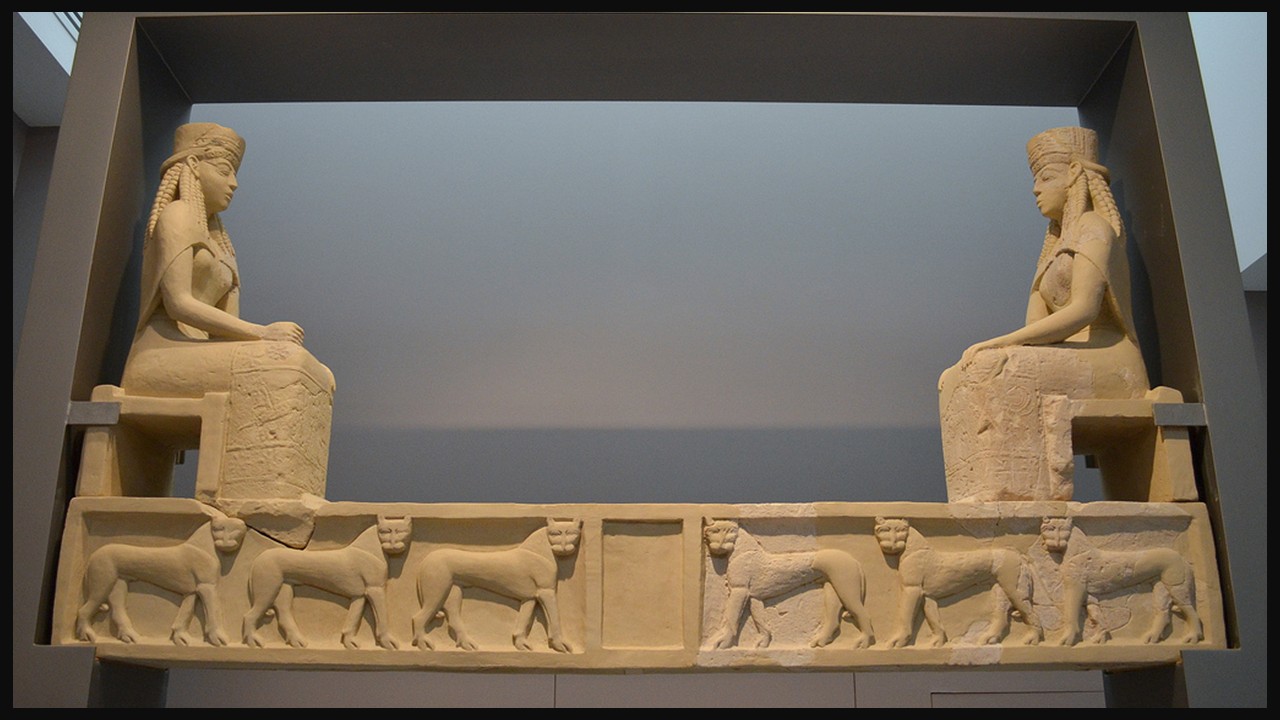
At the top, two identical enthroned goddesses, seated facing each other with their hands on their knees. Under the goddesses, the epistyle of the doorway is decorated with six panthers in relief.
https://www.flickr.com/photos/dandiffendale/9456678798
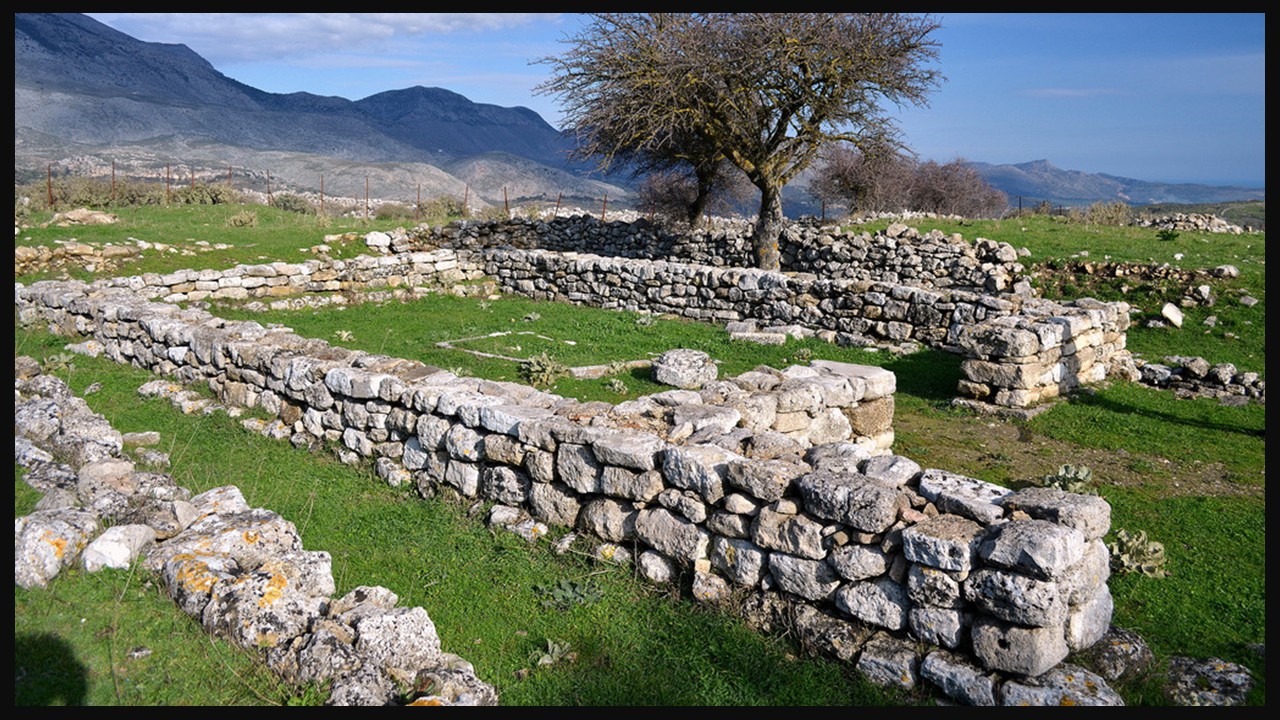
At first glance, the remains of Temple A at Prinias in central Crete may seem modest compared to the grand temples of later Greek antiquity. There are no towering columns or fully preserved pediments. However, this Early Archaic structure, dating to the 7th century BC, is far more significant than its fragmentary appearance suggests. It represents a key moment in early Greek architecture, when builders and artists were still experimenting with what a Greek temple could be, before the emergence of fully developed classical forms.
One of the most important aspects of Temple A is its architectural form. Unlike the standardized Doric and Ionic temples that would later dominate the Greek world, this building reflects a transitional stage. Its plan draws on earlier megaron-type structures, rectangular halls with a central focus, rather than the fully developed peripteral temple surrounded by columns. The arrangement of space feels more enclosed, more inward-looking, and less concerned with external symmetry than later examples. This tells us that the concept of the Greek temple was not yet fixed. Instead, it was evolving, influenced by local traditions, practical needs, and emerging aesthetic ideas.
https://archaicwonder.tumblr.com/post/67432631115/temple-a-in-prinias-crete-occupation-of
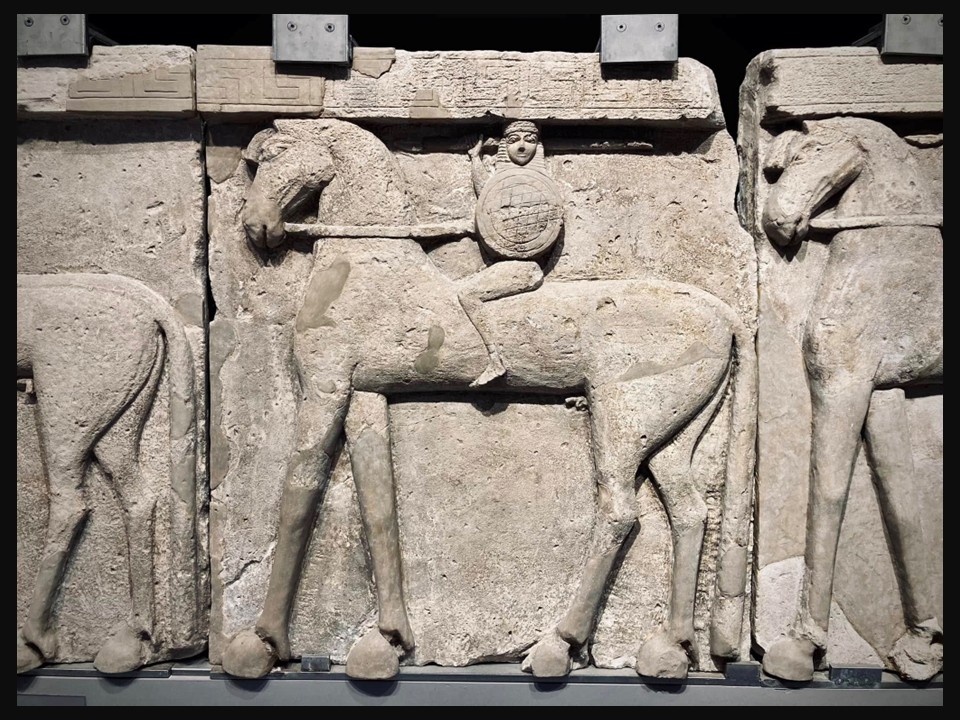
Equally significant is the temple’s sculptural decoration, which marks a bold and innovative step in the integration of sculpture and architecture. Above the entrance was a sculpted frieze featuring seated female figures, often interpreted as deities. These figures are among the earliest known examples of large-scale narrative sculpture incorporated directly into a temple’s structure. Their presence signals a shift: architecture is no longer just functional or symbolic, but also a surface for storytelling and visual expression.
The style of these figures is characteristic of what is often called the Daedalic style, named after the mythical craftsman Daedalus. The figures have triangular faces, large eyes, and highly stylized hair arranged in patterned locks. Their bodies are rigid and frontal, lacking the naturalism that would later define Classical Greek sculpture. Yet this stylization is not a limitation, it is a deliberate visual language. It reflects a moment when artists were experimenting with how to represent the human form in monumental contexts, balancing abstraction with emerging observational detail.
https://www.facebook.com/photo?fbid=6648940575190257&set=pcb.3180989068872329
Another reason Temple A matters lies in its regional identity. Crete, during the Archaic period, was not simply a peripheral area imitating development from mainland Greece. Instead, it was an active participant in shaping early Greek culture, with its own artistic traditions and influences. The temple’s design and decoration show connections to the broader Mediterranean world, including Near Eastern and Egyptian artistic conventions, while still maintaining a distinct local character. This reminds us that Greek art did not develop in isolation but was part of a network of cultural exchange.
The integration of sculpture into the architectural framework also anticipates later developments in Greek temple design. In the centuries that followed, sculptural programs would become central to temple decoration, especially in pediments and friezes. However, in Temple A, we see an early and somewhat experimental version of this idea. The placement of the figures above the entrance emphasizes the threshold between the human and the divine, marking the act of entering the temple as both a physical and symbolic transition. It is a powerful concept, even if the execution is still evolving.
Finally, Temple A invites us to reconsider how we define importance in ancient art. It is easy to focus on the most refined and complete examples, the Parthenon, for instance, and to see them as the culmination of Greek achievement. But sites like Prinias are equally vital because they reveal the process behind that achievement. They show us uncertainty, creativity, and adaptation. They remind us that what later becomes classical was once experimental.
In this sense, Temple A at Prinias is not just an early temple, it is a key document of artistic thinking. It captures a moment when architecture, sculpture, and cultural identity were all in flux. By studying it, we gain insight not only into what Greek temples became, but also into how and why they developed in the first place.
For a PowerPoint Presentation of ‘Why Prinias Temple A Matters’, please… Check HERE!
Sources: Η εξέλιξη της αρχιτεκτονικής και τα πρώτα μνημειακά κτήρια με πλαστικό και γραπτό διάκοσμο (The evolution of ancient Greek architecture and the first monumental buildings with sculptural and painted decoration) available at: https://www.greek-language.gr/digitalResources/ancient_greek/history/art/page_025.html and https://www.greek-language.gr/digitalResources/ancient_greek/navigator/browse.html?object_id=30385