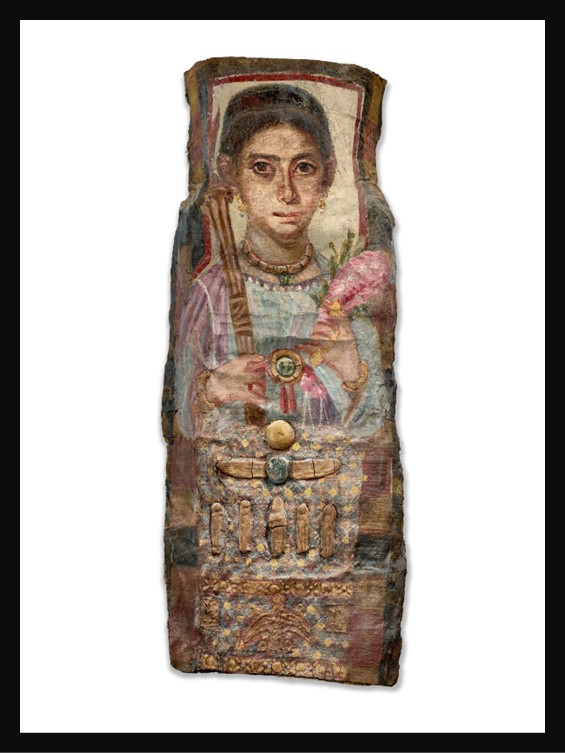
A Roman-period Fayum Mummy portrait of a young woman, painted in encaustic with gilded stucco motifs on linen. She is shown front-facing, with large dark eyes framed by heavy brows, and wears rich gold jewelry including a broad neck torque and rings.

Fayum Mummy Portraits

A Roman-period Fayum Mummy portrait of a young woman, painted in encaustic with gilded stucco motifs on linen. She is shown front-facing, with large dark eyes framed by heavy brows, and wears rich gold jewelry including a broad neck torque and rings.
Mummy Portrait of a Lady, c. 225-250 AD, Encaustic painting on linen and motifs with gilded stucco, Height: 95.8 cm, Private Collection
https://www.christies.com/en/lot/lot-6552510?ldp_breadcrumb=back

Fayum Mummy Portraits stand among the most haunting and intimate survivals of the ancient world, faces painted nearly two millennia ago that still meet our gaze with striking immediacy. Created in Roman Egypt between the 1st and 3rd centuries AD, these portraits were composed on wooden panels or linen shrouds using encaustic (hot wax) or tempera techniques. They were placed over the faces of mummified bodies, merging Egyptian funerary tradition with Roman artistic naturalism. The result is a genre unlike anything else from antiquity: individualized likenesses rendered with soft modeling, luminous skin tones, and expressive eyes that seem to bridge the divide between life and death. Their preservation owes much to Egypt’s dry climate, allowing modern viewers to experience a rare continuity with people of the distant past.

The Painted Linen and Stucco Mummy Portrait of a Woman dated to circa 225–250 A.D., offered through Christie’s, illustrates the sophistication of the tradition at its height. The figure is richly adorned, holding symbolic objects and framed by an intricate blend of painting and molded stucco work that elevates the shroud from a simple funerary covering to a deeply personal memorial. Details such as jewelry, garments, and ritual motifs reflect both the sitter’s status and the multicultural world of Roman-period Egypt. As archaeological evidence and scientific study continue to expand our understanding of these portraits, each example adds to the compelling story of identity, memory, and artistry in an era where cultures converged along the Nile.

The Meaning and Symbolism of Fayum Mummy Portraits

It is within this broader cultural and artistic landscape that Antinoöpolis, founded by Emperor Hadrian around 130 AD, emerges as a particularly important center of production. Situated on the east bank of the Nile, the city became renowned for its distinctive mummy portraits, many of which were uncovered during Albert Gayet’s excavations between 1896 and 1911. These shrouds share a recognizable aesthetic: expressive eyes, refined brushwork, and a fusion of Roman naturalism with Egyptian funerary tradition. The portrait discussed here aligns closely with this Antinoöpolitan style, leading art historian D. L. Thompson to attribute it to the hand of “Painter L,” a talented artist, or workshop, active in the city during the 2nd and 3rd centuries AD. Thompson identified hallmark traits such as large, dark, almond-shaped eyes and strong arched brows, features also seen in works now housed in the Louvre and the Benaki Museum. This connection situates the Christie’s portrait firmly within one of the most accomplished artistic traditions of Roman Egypt.

The refined style associated with Antinoöpolis is matched by the remarkable richness of the portrait’s iconography, which conveys the high social status of the woman depicted. Her gold jewelry is rendered with particular care: a heavy torque set with what may be a beryl stone, a prominent round brooch or buckle, and multiple rings that shimmer against her fingers. Gilding highlights additional decorative elements on the lower body, including applied stucco figures such as a winged sun-disk and standing deities interpreted as the four sons of Horus, underscoring the fusion of wealth, protection, and sacred symbolism. Even more striking is the object held in her right hand, interpreted by Ortiz-García as a torch linked to the underworld’s darkness, suggesting a possible identification of the deceased with Isis-Demeter, and by extension with the Pharaonic harvest deity Renenutet. In her left hand, a vivid pink funerary wreath provides a more conventional attribute for this category of shrouds. Together with the Osirian elements surrounding her, an implied chapel setting, gilded uraei once crowning the composition, and a bead-net motif recalling ancient faience networks, the portrait presents a powerful, multilayered vision of the deceased as both an elite woman of Roman Egypt and a figure ritually transformed for eternal life.

For a PowerPoint Presentation on Fayum Mummy Portraits, please… Click HERE!

Bibliography: From the Christie’s site https://www.christies.com/en/lot/lot-6552510?ldp_breadcrumb=back and from the J. Paul Getty Museum chrome-extension://efaidnbmnnnibpcajpcglclefindmkaj/https://www.getty.edu/publications/resources/virtuallibrary/0892360380.pdf  

Andrea della Robbia’s tender Portrait of a Child

Andrea Della Robbia, 1435-1525
Portrait of a Child, ca 1475 – ca 1480, Glazed Terracotta, Height: 34 cm, National Museum of Bargello, Florence, Italy – Photo Credit: Amalia Spiliakou, April 2025

To mark UN World Children’s Day on November 20, a celebration of children’s rights and their place at the heart of our shared humanity, it feels fitting to turn our attention to Andrea della Robbia’s tender Portrait of a Child, housed in Florence’s Bargello Museum. Crafted in the late 15th century, this glazed terracotta bust captures the purity and quiet dignity of childhood with remarkable grace. Della Robbia’s mastery of the terracotta invetriata technique lends the work its luminous surface and soft, lifelike expression, qualities that make the child’s gentle gaze as moving today as it was five centuries ago. This piece serves as both an artistic treasure and a timeless reminder of innocence, compassion, and the enduring importance of nurturing the young. https://www.un.org/en/observances/world-childrens-day

Andrea della Robbia (1435–1525) was a prominent Florentine sculptor and a key figure in the celebrated Della Robbia family workshop, renowned for its innovative glazed terracotta sculptures. The nephew of Luca della Robbia, who first perfected the family’s distinctive enamel technique, Andrea inherited both the workshop and his uncle’s passion for combining sculpture with color. Working in Renaissance Florence during a period of extraordinary artistic flourishing, he produced devotional works, portraits, and architectural reliefs that blended religious feeling with human warmth. His works adorned churches, hospitals, and cloisters throughout Tuscany, where his serene Madonnas and angelic figures became beloved symbols of faith and tenderness.

Andrea della Robbia’s artistic legacy lies in his refinement of the terracotta invetriata technique, a process that coated clay sculptures with brightly colored, tin-based glazes to achieve both durability and visual brilliance. This innovation, first pioneered by his uncle Luca, was transformed under Andrea’s hand into a sophisticated artistic language that united practicality, beauty, and devotion. His mastery of color and form allowed him to create works that combined the sculptural depth of relief with the vibrancy of painting, resulting in pieces that glowed with a sense of divine light. The luminous surfaces of his sculptures not only protected them from weathering but also made them accessible to a broader audience, adorning churches, hospitals, and civic spaces across Tuscany. Beyond technical achievement, Andrea infused his figures with spiritual purity and emotional tenderness, particularly visible in his serene Madonnas and the famous swaddled infants of the Ospedale degli Innocenti. Through his craftsmanship and sensitivity, he elevated glazed terracotta into one of the Renaissance’s most distinctive and enduring expressions of faith, compassion, and artistic innovation.

Designed by Filippo Brunelleschi, 1377-1446
Spedale degli Innocenti, Construction: 1417-1436 – Inauguration: 1445, Piazza della Santissima Annunziata, Florence, Italy https://it.wikipedia.org/wiki/Spedale_degli_Innocenti
Andrea della Robbia, 1435-1525
Infant in Swaddling Clothes, 1487, Glazed Terracotta, Diameter about 100 cm, Ospedale degli Innocenti, Piazza della Santissima Annunziata, Florence, Italy https://smarthistory.org/andrea-della-robbia-bambini-ospedale-degli-innocenti/

Andrea della Robbia’s Head of a Boy, housed in the Bargello Museum in Florence, is a finely modeled glazed terracotta bust that captures the quiet grace and innocence of childhood. The sculpture portrays a young boy with softly curling hair, serene features, and a gentle, introspective expression. His head is slightly turned, lending the figure a sense of naturalism and presence, while the delicate modeling of the lips and eyes reflects Andrea’s remarkable sensitivity to human emotion. The figure’s clothing, rendered in vivid blue and green glazes, contrasts beautifully with the pure white of the face, emphasizing both the luminosity and purity that the invetriata technique made possible. This harmony of color and form, combined with the lifelike modeling, embodies the Renaissance ideal of blending spiritual serenity with human warmth. The piece radiates quiet dignity and emotional restraint, standing as a testament to Andrea della Robbia’s gift for transforming humble terracotta into art of transcendent beauty.

For a PowerPoint Presentation of Andrea della Robbia’s oeuvre, please… Check HERE!

For more information on Andrea della Robbia’s contribution to the Florentine Ospedale degli Innocenti, please visit the Teacher Curator’s Blog Post… https://www.teachercurator.com/art/spedale-degli-innocenti-in-florence/

Bibliography: https://catalogo.beniculturali.it/detail/HistoricOrArtisticProperty/0900383750 and https://wahooart.com/en/artists/andrea-della-robbia-en/ and chrome-extension://efaidnbmnnnibpcajpcglclefindmkaj/https://www.nga.gov/sites/default/files/2025-06/exhibition-della-robbia.pdf

Guido Mazzoni’s Portrait of an Old Man

Guido Mazzoni, c. 1445-1518
Head of a Man, 1480s, Polychrome Terracotta, Height: 26 cm, Galleria Estense, Modena, Italy – Photo Credit: Amalia Spiliakou, April 2025

Among the many treasures of Renaissance Modena, Guido Mazzoni’s Portrait of an Old Man stands out as a striking testament to the artist’s gift for capturing human presence in all its fragile dignity. Unlike the idealised faces often associated with the period, this work confronts the viewer with unmistakable signs of age, including wrinkles, sagging skin, and weary eyes, rendered with sculptural intensity. It is a portrait that resists flattery, instead offering an unvarnished meditation on mortality and memory, reminding us that true artistry lies not only in beauty but in truth.

Guido Mazzoni (c. 1445–1518), also known as Il Modanino, was an Italian sculptor celebrated for his extraordinary terracotta figures that combined lifelike detail with deep emotional resonance. Born in Modena, he trained in the local artistic traditions before developing a distinctive style that blended Renaissance naturalism with theatrical intensity. His talent for capturing individuality and human vulnerability is especially evident in his devotional groups, such as the famous Lamentation over the Dead Christ in Modena, where each figure is imbued with unique gestures and striking realism.

Mazzoni’s reputation spread beyond his native city, earning him commissions in Ferrara, Naples, and even at the French court of Charles VIII, where he created funerary monuments that secured his international acclaim. Though he worked in an era dominated by marble and bronze, his masterful use of painted terracotta gave his sculptures an immediacy and humanity that resonated deeply with contemporary audiences. Today, he is remembered as a pioneer of Renaissance naturalism, a sculptor who elevated humble clay into a medium of profound psychological and spiritual depth.

Mazzoni’s terracotta portraits hold a special place within Renaissance art, bridging devotional practice and the emerging culture of individual likeness. Unlike the idealised forms of classical revival, his works present faces lined with age, grief, or quiet dignity, revealing a concern for truthful representation rarely achieved in sculpture of the time. These portraits not only embodied the Renaissance fascination with humanism and personal identity but also offered a powerful medium for viewers to confront mortality and faith in profoundly tangible form. Through his clay figures, Mazzoni expanded the role of portraiture from commemoration to intimate encounter, leaving behind works that still speak with raw immediacy across centuries.

Guido Mazzoni, c. 1445-1518
Head of a Man, 1480s, Polychrome Terracotta, Height: 26 cm, Galleria Estense, Modena, Italy https://www.facebook.com/groups/203138520642/posts/10168057091855643/

Mazzoni’s Portrait of an Old Man, formally titled Head of a Man, is a strikingly naturalistic polychrome terracotta bust dating to the 1480s and currently housed in Modena’s Galleria Estense. What appears today as a standalone head was likely cut from a larger Passion-group sculpture, either a Lamentation or adoration scene, functioning perhaps as the representation of a donor within a devotional tableau. The life-sized head, richly painted and finely modelled, reveals Mazzoni’s remarkable ability to render individual features, the drooping jawline, deeply incised wrinkles, stippled beard, and even the weathered texture of aged skin, in a way that seems to echo the direct observation, almost like a moulded life cast sculpted into clay. The sitter’s berettone (a type of upper-class hat) further hints at his social status, lending an air of quiet dignity rather than theatrical grandeur.

What makes this terracotta portrait especially compelling is its unvarnished realism. Mazzoni does not smooth away the signs of ageing; instead, he embraces them, allowing each line, sagging plane, and subtle blemish to coexist with a steady, penetrating gaze, a gaze that forges an intimate, psychologically charged connection with the viewer. Smarthistory underscores how the painted surface, though now restored, would have once enhanced the illusion of living flesh, infusing the clay with lifelike presence and emotional resonance. In the Renaissance context, such individuality marked a departure from idealised portrayals. It connected deeply with humanist ideals: the acknowledgement of personal identity, wisdom that comes with age, and the blending of spiritual humility with worldly reality. As part of a devotional ensemble, this head may have invited viewers to see the donor, and by extension themselves, as active participants in spiritual reflection and empathy, all rendered in a medium both accessible and profoundly expressive.

For a PowerPoint Presentation of Guido Mazzoni’s oeuvre, please… Check HERE!

Bibliography: https://smarthistory.org/guido-mazzoni-head-of-a-man/ and https://www.artsupp.com/en/artists/guido-mazzoni/testa-di-vecchio and https://gallerie-estensi.beniculturali.it/blog/longform/guardare-all-anima-delle-opere/

Isabella Brant

Pieter Paul Rubens, 1577- 1640   
Portrait of Isabella Brant, 1626, Oil on canvas, 86×62 cm, Uffizi Gallery, Florence, Italy
Photo Credit: Amalia Spiliakou, April 2025

Isabella Brant (1591–1626) was the first wife of the celebrated Flemish painter Peter Paul Rubens and a woman of notable grace and social standing in early 17th-century Antwerp. Born into a prominent family, she was the daughter of Jan Brant, a respected city official and scholar, which placed her at the heart of Antwerp’s intellectual and cultural life. Isabella married Rubens in 1609, a union that combined affection with advantageous connections, strengthening the artist’s ties to influential circles in the city. Known for her charm, wit, and refinement, Isabella was admired not only as a devoted wife and mother—she and Rubens had three children together—but also as a figure who embodied the elegance and sophistication of her time. Her life, though tragically brief, left a lasting impression on those around her and continues to be remembered as an integral part of Rubens’ story.

The artist painted his first wife, Isabella Brant, numerous times, leaving behind a vivid record of her presence in his life. One of their earliest joint portrayals is the famous Honeysuckle Bower (1609), a double portrait celebrating their marriage with symbolic gestures of love and harmony. Beyond this, Rubens created several individual portraits of Isabella, including the elegant Portrait of Isabella Brant now in the Uffizi Gallery, painted around 1620, where her calm dignity and refined beauty are captured with remarkable sensitivity. Her likeness also appears in drawings and informal sketches, suggesting she was both a willing sitter and a constant source of inspiration. Even after her untimely death in 1626, Rubens continued to evoke her image in allegorical works, blending memory with artistry. Taken together, these portraits reveal not only Isabella’s grace but also the depth of affection and admiration with which Rubens regarded her, preserving her legacy through his masterful brush.

Pieter Paul Rubens, 1577- 1640   
Portrait of Isabella Brant, c.1621-1622, Black and red chalk, with some brown wash, heightened with white, on light grey-brown paper, 381×294 millimeters, British Museum, London, UK
https://www.britishmuseum.org/collection/object/P_1893-0731-21

Rubens’s Portrait of Isabella Brant in Galleria degli Uffizi, in Florence, Italy, shows the artist’s first wife at half-length, turned slightly left against a neutral setting punctuated by a stone column and a sweep of reddish drapery. She wears a sumptuous dark gown with jewels and chains, her alert gaze and faint smile animating the likeness. Painted circa 1625–26 in oil on panel (about 86 × 62 cm), the work likely entered Medici collections as a gift sent in 1705 by the Elector of Düsseldorf to Ferdinando de’ Medici and has been recorded in the Uffizi since the 18th century.

Aesthetically, the painting distills Baroque ideals into an intimate format… supple, luminous flesh set against a subdued ground, softly modelled forms created by confident, fluid brushwork, and a poised interplay of light and shadow that gives Isabella psychological presence as well as social stature. Rather than theatrical gesture, Rubens opts for restrained dignity, rich fabrics, tactile surfaces, and a living, breathing immediacy, embodying the Baroque’s preference for sensuous color, dynamism of paint, and persuasive naturalism in the service of status, piety, and affection.

Peter Paul Rubens (1577–1640) stands as one of the greatest masters of the Baroque, celebrated not only for his monumental altarpieces and mythological scenes but also for the intimacy and vitality of his portraits. In his likenesses, Rubens combined acute psychological insight with a painterly richness that gave his sitters both dignity and immediacy. His portraits of Isabella Brant exemplify this mastery: the fluidity of his brushwork, the luminosity of skin tones, and the nuanced handling of fabric and jewelry all serve to elevate the sitter while preserving her individuality. Rubens’s genius lay in his ability to balance grandeur with naturalism, portraying figures of status with humanity and warmth. Through such works, he transformed portraiture into a vibrant art form that communicated not only outward likeness but also inner character, securing his reputation as one of the most accomplished portraitists of his time.

For a PowerPoint Presentation of Rubens and Isabella Brant, please… Check HERE!

Bibliography: https://catalogo.beniculturali.it/detail/HistoricOrArtisticProperty/0900129546?utm_source=chatgpt.com and https://www.artchive.com/artwork/portrait-of-isabella-brant-peter-paul-rubens-c-1625-26/ and https://www.virtualuffizi.com/peter-paul-rubens.html

Bust of a Lady

Bust of a Lady, circa 410 AD, from an Asia Minor workshop, possibly in
Aphrodisias, circa 410, white Phrygian (Dokimion) Marble, Height: 56 cm, Archaeological Museum of Chania, Greece

In the Archaeological Museum of Chania on the island of Crete, the Bust of a Lady offers a rare window into the shifting artistic and cultural values of the Late Roman and Early Christian period through the medium of female portraiture. During this era, women’s portraits began to diverge from classical Roman realism and overt displays of status, embracing a more stylized, introspective aesthetic aligned with emerging Christian ideals. Features such as large, contemplative eyes and serene expressions came to symbolize inner virtue and spiritual depth. While hairstyles and clothing still hinted at social rank, they also reflected increasing modesty, mirroring broader societal transformations.

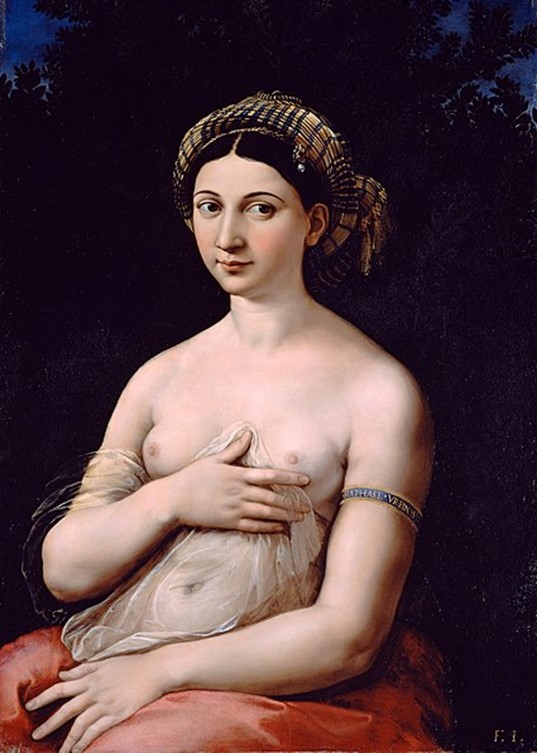
This particular bust depicts a woman of aristocratic beauty in the prime of her life, aged approximately 25 to 30. She is shown frontally, with her neck gently turned to the right, lending the portrait a poised and lifelike presence. Her oval face is framed by a tall forehead, almond-shaped eyes once inlaid with rose-colored glass, small full lips, and a strong chin—features that convey both grace and inner fortitude. A decorative band of twenty-two stylized curls runs across her forehead and temples, while four braids crown her head, testifying to her refined appearance.

She is draped in a heavy himation falling in deep, classical folds over a lighter chiton, a detail that evokes the sculptural traditions of earlier periods and enhances the portrait’s intellectual elegance. Although her left shoulder is only partially modeled, the form suggests the bust was designed for a niche setting, likely within a private villa, where such an omission would remain unseen. The combination of fine craftsmanship, classical references, and material opulence speaks to both her high status and the enduring artistry of late Roman Crete.

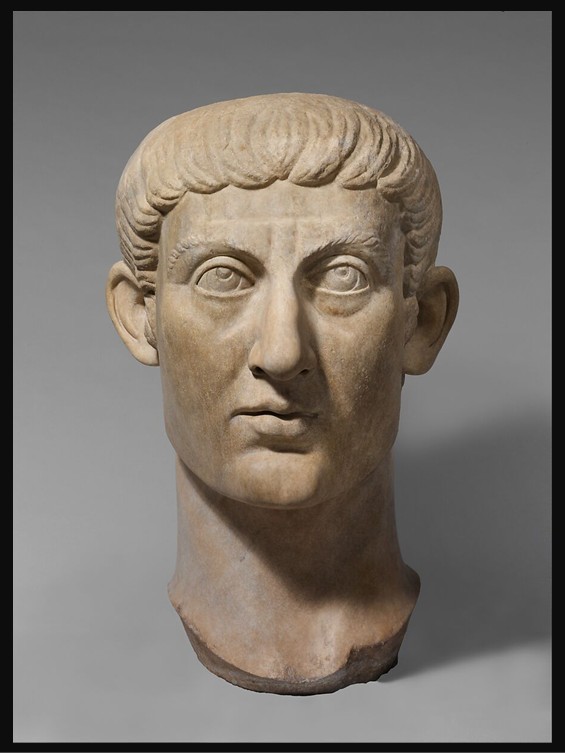
Although initially dated between the 2nd and 4th centuries, recent scholarship proposes a more precise date in the early 5th century, during the reign of Theodosios II (c. 410 AD). This dating is based on strong stylistic parallels with imperial portraits of Valentinian II and Theodosios II, and the bust is thought to have originated in an Asia Minor workshop, likely Aphrodisias. If correct, this attribution provides rare evidence of continued cultural and artistic exchange between Crete and Constantinople following the catastrophic earthquake of 365 AD.

This striking portrait, crafted from fine-grained marble was unearthed in 1982 in Nea Chora, a neighborhood of modern Chania that once formed the western sector of ancient Kydonia. Found in unstratified fill, it lacks a secure archaeological context. Nonetheless, the area was continuously inhabited from the Roman to early Byzantine periods, and the sculpture’s discovery in a historically wealthy district known for luxurious homes supports the notion that it belonged to an elite and culturally vibrant community.

While Crete is most famously celebrated for its Bronze Age Minoan civilization, the island also enjoyed a remarkable cultural resurgence under Roman rule, a period that produced refined works of art like the Bust of a Lady in the Archaeological Museum of Chania. In a region often viewed through the lens of its ancient past, the portrait from Kydonia invites us to appreciate the island’s lesser-known legacy: a vibrant late antique society that continued to engage with the broader currents of imperial art, identity, and belief.

For a Student Activity inspired by the Bust of a Lady in the Archaeological Museum of Chania, please… Check HERE!

Bibliography: Heaven & Earth, Edited by Anastasia Drandaki, Demetra Papanikola-Bakirtzi, Anastasia Tourta, Exhibition Catalogue, Athens 2013 https://www.academia.edu/3655015/Heaven_and_Earth_Art_of_Byzantium_from_Greek_Collections_edited_by_Anastasia_Drandaki_Demetra_Papanikola_Bakirtzi_and_Anastasia_Tourta_Exh_cat_Athens_2013_238_9_275 Pages: 56-57 and https://amch.gr/collection/eikonistiki-protomi-astis-l-3176/

Gian Lorenzo Bernini’s bust of Duke Francesco I d’Este

Gian Lorenzo Bernini, 1598-1680
Bust of Francesco I d’Este, 1650–1652, Marble, 98 x 106 x 50 cm, Galleria Estense, Modena, Italy – Photo Credit: Amalia Spiliakou April 2025

Upon entering the Galleria Estense in Modena, visitors are greeted by a masterpiece of Baroque sculpture that sets an immediate tone of grandeur and theatricality, Gian Lorenzo Bernini’s bust of Duke Francesco I d’Este. Commissioned in the 1650s, this dazzling marble portrait is more than a likeness; it is a triumph of artistic bravura that captures the duke in a moment of almost divine command, his chest proudly thrust forward, his locks swirling with motion, and his gaze lofty and enigmatic. Bernini’s extraordinary ability to fuse idealization with vitality makes the bust an unforgettable encounter at the heart of the gallery’s collection. Decades later and miles away, the bust’s spirit found a new interpretation through the brush of Giovanni Boldini. His painting Bust of Francesco I d’Este after Gian Lorenzo Bernini, now in the National Gallery of Art in Washington, D.C., revives the sculpture’s theatrical essence in painterly form—transforming cool marble into a vibrant, expressive study of light and form. Boldini, known for his flair and fluid technique, pays homage not only to Bernini’s virtuosity but also to the enduring legacy of Baroque splendor.

​In August 1650, Duke Francesco I d’Este of Modena commissioned Gian Lorenzo Bernini to sculpt his portrait in marble. Initially, Bernini was reluctant to undertake the project without meeting the Duke in person, considering it an “almost impossible” task. However, with the persistent intercession of Cardinal Rinaldo d’Este, the Duke’s brother, Bernini agreed, provided he received multiple portraits of the Duke and precise measurements of his height and shoulder width. Consequently, two profile portraits by Justus Sustermans were sent to Rome, while a frontal portrait by Jean Boulanger did not arrive in time. Bernini began sculpting in August 1651 and completed the bust by September. The sculpture arrived in Modena in November, and upon unveiling, the Duke was so impressed that he paid Bernini 3,000 scudi—the same amount Pope Innocent X had paid for the Fountain of the Four Rivers in Rome. This generous payment not only reflected the Duke’s satisfaction but also underscored his ambition to elevate the cultural stature of the Este court through patronage of renowned artists.

Gian Lorenzo Bernini, 1598-1680
Bust of Francesco I d’Este, 1650–1652, Marble, 98 x 106 x 50 cm, Galleria Estense, Modena, Italy https://ducatoestense.com/en/beni-storici-artistici/bust-of-duke-francesco-i-deste/

Bernini’s bust portrait of Francesco I d’Este stands as a quintessential example of Baroque art, embodying the movement’s defining traits of dynamism, theatricality, and grandeur. Far from being a static likeness, the sculpture radiates energy and authority: the Duke’s chest swells with pride, his elaborate curls cascade in dramatic motion, and his expression conveys both noble detachment and inner vitality. Bernini masterfully transforms marble into a living presence, infusing the work with psychological depth and an almost divine aura. This portrait doesn’t merely represent Francesco—it exalts him, turning the Duke into a timeless symbol of princely power and ambition. In doing so, Bernini demonstrates how sculpture in the Baroque era was not just about capturing appearances, but about commanding emotion and crafting an idealized image of rulership through the language of art.

Gian Lorenzo Bernini, 1598-1680
Bust of Francesco I d’Este, 1650–1652, Marble, 98 x 106 x 50 cm, Galleria Estense, Modena, Italy – Photo Credit: Amalia Spiliakou April 2025
Giovanni Boldini, 1842-1931
Bust of Francesco I d’Este after Gian Lorenzo Bernini, c. 1890/1900, brown and blue washes on ivory wove paper, 45.5 x 30.4 cm, National Gallery of Art, Washington DC, USA https://www.nga.gov/press/acquisitions/2022/boldini.html

In the late 19th century, Giovanni Boldini, celebrated for his dynamic and elegant portraits, created a wash drawing titled Bust of Francesco I d’Este, inspired by Gian Lorenzo Bernini’s renowned marble sculpture. Executed around 1890–1900, during Boldini’s flourishing career in Paris, the drawing captures the essence of Bernini’s Baroque masterpiece through expressive brown and blue washes on ivory wove paper. Boldini’s rendition emphasizes the dramatic curls and vigorous movement of the original bust, portraying the head in full profile while simplifying certain elements, such as omitting the lace collar and armor. This approach highlights Boldini’s theatrical style and his ability to convey vitality and motion, aligning with the gestural tendencies of contemporaries like John Singer Sargent. The drawing not only pays homage to Bernini’s work but also reflects Boldini’s exploration of abstract form, bridging 19th-century impressionism and the gestural styles that would influence 20th-century modernism. Acquired by the National Gallery of Art in 2021, this piece enriches the museum’s collection, illustrating the enduring impact of Baroque artistry on later generations

For art lovers, the Galleria Estense in Modena offers more than a collection, it offers a journey into the heart of artistic brilliance, where Bernini’s bust of Francesco I d’Este greets visitors with imperial flair and sculptural poetry. Its enduring legacy, later reimagined through the fluid hand of Giovanni Boldini, reminds us that true masterpieces do not merely survive the passage of time—they continue to speak, to inspire, and to live on in new and unexpected forms.

For a Student Activity on Gian Lorenzo Bernini’s Bust of Francesco I d’Este, and Giovanni Boldini painting of Francesco’s Bust, please… Check HERE!

Bibliography: https://ducatoestense.com/en/beni-storici-artistici/bust-of-duke-francesco-i-deste/ and https://www.nga.gov/press/acquisitions/2022/boldini.html

Sofonisba Anguissola Self-Portrait at the Easel painting

Sofonisba Anguissola of Cremona

Sofonisba Anguissola Self-Portrait at the Easel painting
Sofonisba Anguissola, c. 1532 – 1625
Self-Portrait at the Easel, 1554, Oil on poplar wood, 19.5 x 12.5 cm, Kunsthistorisches Museum, Vienna, Austria https://smarthistory.org/sofonisba-anguissola/

On International Women’s Day, March 8, we honor the visionary achievements of Sofonisba Anguissola of Cremona, a pioneering female artist of the Renaissance whose brilliance defied societal norms of her time. As Giorgio Vasari eloquently wrote… But Sofonisba of Cremona, the daughter of Messer Amilcaro Anguisciuola, has laboured at the difficulties of design with greater study and better grace than any other woman of our time, and she has not only succeeded in drawing, colouring, and copying from nature, and in making excellent copies of works by other hands, but has also executed by herself alone some very choice and beautiful works of painting. Anguissola’s determination and artistic excellence not only earned her a place among the greats but also paved the way for women in the arts, embodying the spirit of this day dedicated to celebrating the achievements of women across history. https://www.gutenberg.org/files/28421/28421-h/28421-h.htm#Page_121  

Sofonisba Anguissola of Cremona (1532–1625) was a remarkable Italian Renaissance painter whose talent and determination broke barriers for women in the arts. Born into a noble but financially modest family, she received an exceptional education, including training in painting, a rarity for women at the time. Encouraged by her father, Amilcare Anguissola, Sofonisba gained recognition for her skill in portraiture, capturing her subjects with a keen sensitivity and psychological depth. Her talent earned her the favor of Philip II of Spain, who appointed her a court painter, a position she held for many years. In her later life, she married twice, traveled extensively, and continued to mentor younger artists. She lived to the age of 93, an extraordinary lifespan for the period, leaving behind a legacy that inspired generations of women to pursue artistic careers.

Self-Portrait of Sofonisba Anguissola holding a book
Sofonisba Anguissola, c. 1532 – 1625
Self-Portrait of Sofonisba Anguissola, 1556, Oil on Canvas, 66×57 cm, Łańcut Castle, Poland https://smarthistory.org/sofonisba-anguissola/

Displaying a harmonious blend of technical mastery, emotional resonance, and subtle elegance, these artistic aesthetics define her work. Sofonisba’s paintings are characterized by an acute attention to detail, particularly in the rendering of facial expressions and gestures, which convey the inner emotions and individuality of her sitters. Rejecting the grandeur and theatricality typical of the Renaissance, she focused on intimate, humanizing portrayals, making her subjects relatable yet dignified. Her self-portraits, for instance, reveal a quiet confidence and intellectual depth, emphasizing her dual identity as both artist and noblewoman. Sofonisba’s use of soft lighting and refined compositions demonstrates her profound understanding of Renaissance techniques, while her innovative approach to storytelling within portraits influenced subsequent generations of artists, including Anthony van Dyck. Her artistry not only elevated the status of portraiture but also redefined the possibilities for women in the visual arts.

Sofonisba Anguissola's painting of The Chess Game
Sofonisba Anguissola, c. 1532 – 1625
The Chess Game (Portrait of the artist’s sisters playing chess), 1555, oil on canvas, 72 x 97 cm, National Museum in Poznań, Poland https://smarthistory.org/sofonisba-anguissola/

Sofonisba Anguissola is a powerful symbol to celebrate on International Women’s Day because she broke through the rigid societal barriers of the Renaissance to excel in a field dominated by men, proving that talent and determination can transcend limitations. As one of the first widely recognized female artists, she demonstrated that women could achieve mastery in the arts, earning respect from contemporaries such as Michelangelo and Vasari. Her work not only showcases technical brilliance but also embodies a unique sensitivity and depth that redefined portraiture, influencing future generations. By excelling in her craft, she opened doors for other women to pursue artistic careers, challenging the gender norms of her time. Anguissola’s legacy reminds us of the importance of advocating for equality and recognizing women’s contributions to culture, making her a bright example of resilience, innovation, and artistic excellence.

The 1556 Self-Portrait at the Easel, housed in Łańcut Castle, Poland, exemplifies her mastery in capturing personal identity and intellectual presence through portraiture. In this work, Anguissola portrays herself as an artist and noblewoman engaged in the act of painting. She is shown with a brush in hand and a palette nearby, gazing outward with a calm yet confident expression, inviting the viewer to recognize her artistic identity and skill. Her attire is modest but elegant, reflecting her noble background while keeping the focus on her profession. The composition draws attention to her hands, tools, and the painting in progress, subtly emphasizing her technical mastery and dedication to her craft. The self-assured presentation, combined with the directness of her gaze, asserts her position not only as a creator but also as an intellectual and innovator in a male-dominated field. This self-portrait is both a declaration of her artistic capability and a rare, introspective glimpse into the life of a Renaissance woman who dared to define herself through her work.

For a PowerPoint Presentation on Portraits of Sofonisba Anguissola, please… Check HERE!

Bibliography: https://smarthistory.org/sofonisba-anguissola/

Painting by Peter Paul Rubens depicting the artist and Isabella Brant in the Honeysuckle Bower

Rubens and Isabella Brant

Painting by Peter Paul Rubens depicting the artist and Isabella Brant in the Honeysuckle Bower
Peter Paul Rubens, 1577-1640
Rubens and Isabella Brant in the Honeysuckle Bower, c. 1609–10, Oil on Canvas, 178 x 136.5 cm, Alte Pinakothek, Munich, Germany https://smarthistory.org/peter-paul-rubens-and-isabella-brant-in-the-honeysuckle-bower/

You can almost smell the sweet fragrance of honeysuckle wafting from the intimate garden alcove in Peter Paul Rubens’s masterpiece, Peter Paul Rubens and Isabella Brant under a Honeysuckle Tree. This luminous double portrait captures the artist and his new bride, Isabella Brant, in a moment of idyllic serenity and mutual devotion. Painted around 1609-1610, shortly after their marriage, the composition brims with symbolism, celebrating the promise of wedded bliss and steadfast marital fidelity. Likely created as a personal tribute and a gift for Isabella’s father, this work reflects Rubens’s mastery in blending naturalism with allegorical depth, offering a glimpse into the couple’s bond through an exquisitely tender lens. https://smarthistory.org/peter-paul-rubens-and-isabella-brant-in-the-honeysuckle-bower/

Peter Paul Rubens stands as one of the towering figures of the Baroque era, renowned for his dynamic compositions, masterful use of colour, and ability to convey emotion and movement. Born in 1577 in Siegen, in present-day Germany, Rubens rose to prominence as a court painter and diplomat, blending his artistic genius with his refined cultural sensibilities. His works, characterized by dramatic contrasts of light and shadow, vibrant palettes, and intricate detailing, encapsulate the grandeur and exuberance of the Baroque style. Beyond religious and mythological themes, Rubens excelled in portraiture, landscapes, and historical allegories, often infusing his pieces with rich symbolism and humanistic depth. His prolific output and influence extended beyond his lifetime, shaping the trajectory of European art and securing his legacy as one of history’s most celebrated painters.

Detail of the Painting by Peter Paul Rubens depicting the artist and Isabella Brant in the Honeysuckle Bower
Peter Paul Rubens, 1577-1640
Rubens and Isabella Brant in the Honeysuckle Bower (detail), c. 1609–10, Oil on Canvas, 178 x 136.5 cm, Alte Pinakothek, Munich, Germany https://smarthistory.org/peter-paul-rubens-and-isabella-brant-in-the-honeysuckle-bower/

Isabella Brant, the first wife of Peter Paul Rubens, was not only the artist’s muse but also a central figure in his life, embodying the harmony and affection that defined their relationship. Born into an affluent family in Antwerp, Isabella married Rubens in 1609, shortly after his return from Italy. Their union coincided with the early blossoming of Rubens’s career, and Isabella played a key role in his personal and professional stability, supporting him during a period of prolific artistic achievement. She was frequently featured in Rubens’s work, immortalized in portraits that reveal her grace, warmth, and intellect. Their life together was marked by mutual respect and joy, enriched by their shared love of art and culture. Tragically, Isabella’s life was cut short in 1626, but her memory endured through Rubens’s poignant depictions and the enduring influence she had on his art and life.

Peter Paul Rubens’s Peter Paul Rubens and Isabella Brant under a Honeysuckle Tree feels like stepping into a deeply personal moment, where art transcends the canvas to tell a story of love and connection. What makes this painting so remarkable is how it invites you to share in the intimacy of Rubens’s life, making you feel like a privileged witness to a quiet moment of wedded bliss. The tender gestures, like their intertwined hands, speak volumes about the bond they shared, while the vibrant honeysuckle tree envelops them in a world of natural beauty and symbolic richness. For me, it’s not just a Baroque masterpiece—it’s a celebration of what it means to love and be loved, painted by a man whose art so effortlessly bridges the personal and the universal. The dynamic interplay of light and shadow draws you closer, whispering that this is not just a painting to view but one to experience and feel.

Detail of the Painting by Peter Paul Rubens depicting the artist and Isabella Brant in the Honeysuckle Bower
Peter Paul Rubens, 1577-1640
Rubens and Isabella Brant in the Honeysuckle Bower (detail), c. 1609–10, Oil on Canvas, 178 x 136.5 cm, Alte Pinakothek, Munich, Germany https://smarthistory.org/peter-paul-rubens-and-isabella-brant-in-the-honeysuckle-bower/

The painting brims with fascinating details that deepen its meaning and showcase the artist’s skill. The honeysuckle tree, a central element, symbolizes love, fidelity, and marital harmony, framing the couple in an idyllic, romantic setting. Rubens’s and Isabella’s hands are tenderly intertwined, a gesture that conveys intimacy and unity, subtly underscoring their bond. Their attire reflects their status and the period’s fashion—Rubens wears a stylish yet relaxed black doublet, signifying elegance without ostentation, while Isabella’s gown, adorned with lace and an elaborate ruff, reflects her grace and social standing. These details not only celebrate their union but also reflect Rubens’s ability to blend realism with symbolic richness, making the portrait a timeless testament to love and devotion.

The death of Isabella Brant in 1625 marked a profound and devastating chapter in Peter Paul Rubens’s life, casting a shadow over the vibrant love that once inspired some of his most intimate works. Her passing was not just the loss of a wife but of a kindred spirit who had been his steadfast companion during his rise to fame. In a deeply poignant letter to Pierre Dupuy on July 15, 1626, Rubens expressed the depth of his sorrow with moving candor: “Truly I have lost an excellent companion, whom one could love—indeed had to love, with good reason—as having none of the faults of her sex. She had no capricious moods, and no feminine weakness, but was all goodness and honesty. And because of her virtues she was loved during her lifetime, and mourned by all at her death. Such a loss seems to me worthy of deep feeling, and since the true remedy for all ills is Forgetfulness, daughter of Time, I must without doubt look to her for help. But I find it very hard to separate grief for this loss from the memory of a person whom I must love and cherish as long as I live.” These heartfelt words reveal not only the artist’s grief but also the enduring impact of Isabella’s love on his life and art. Through his portraits of her, such as In the Honeysuckle Bower, and the legacy of his tender words, their bond remains immortalized, a testament to the transformative power of love and the enduring ache of loss. https://smarthistory.org/peter-paul-rubens-and-isabella-brant-in-the-honeysuckle-bower/

For a PowerPoint Presentation of Rubens and Isabella Brandt, please… Check HERE!

Amarna Period Canopic Jar with a Lid Depicting a Queen

Amarna Canopic Jar

Amarna Period Canopic Jar with a Lid Depicting a Queen
Canopic Jar with a Lid Depicting a Queen, New Kingdom, Amarna Period, Dynasty 18, reign of Akhenaten, ca. 1349–1330 BC, from Upper Egypt, Valley of the Kings, Tomb KV 55, Travertine (Egyptian alabaster), blue glass, obsidian, unidentified stone, Height of Jar and Lid: 53.2 cm, the MET, NY, USA https://www.metmuseum.org/art/collection/search/544689

The Amarna Canopic Jar presented here, created for a funerary purpose, bears a lid adorned with a face so exquisitely detailed that it showcases the skill of a master artist, as if it were a public portrait. The youthful features—marked by a long, slender nose, almond-shaped eyes, and a delicately sculpted mouth—reflect an idealized image intended to endure in the eternal afterlife, regardless of the owner’s true age at death. Stylistically, the jar aligns with the artistic innovations of Akhenaten’s later reign, a period defined by the relocation of the royal court to Amarna. Yet, the mystery lingers: alterations made to the jar and lid in antiquity obscure the identity of the original owner. Who is she? The question haunts this artifact, a silent testament to both artistic mastery and the enigmatic nature of its history.

The enigmatic Canopic Jar, discovered in 1907, offers a fascinating glimpse into the royal intrigues of Akhenaten’s court, its ownership shrouded in layers of mystery and historical debate. Was it created for Queen Tiye, the formidable matriarch of the Amarna dynasty? Or perhaps Queen Nefertiti, renowned for her beauty and influence? Some have speculated it belonged to Queen Kiya, Akhenaten’s favored secondary wife, whose identity is subtly suggested by faint traces of hieroglyphs and the distinctive Nubian wig. Others propose Princess Merytaten, Akhenaten’s eldest daughter and later consort. For a time, even Akhenaten himself was considered a possibility. This confusion underscores the complex dynamics of the royal family, whose intertwined stories continue to captivate and confound modern scholars.

Detail of the Amarna Period Canopic Jar with a Lid Depicting a Queen
Canopic Jar with a Lid Depicting a Queen, New Kingdom, Amarna Period, Dynasty 18, reign of Akhenaten, ca. 1349–1330 BC, from Upper Egypt, Valley of the Kings, Tomb KV 55, Travertine (Egyptian alabaster), blue glass, obsidian, unidentified stone, Height of Jar and Lid: 53.2 cm, the MET, NY, USA https://www.metmuseum.org/art/collection/search/544689

Whoever the original owner portrayed on the lid of the Canopic Jar in the MET was, she is undoubtedly a striking representation of one of the royal women of Amarna, embodying the elegance and refinement characteristic of this unique artistic period. Her features, including a long, slender nose, almond-shaped eyes, and a sensuous mouth, reflect the naturalistic yet idealized aesthetic that defined Amarna art. She wears the Nubian wig, a hairstyle of overlapping curls reserved for adults and favored by Akhenaten’s female relatives, emphasizing her status and maturity. At the center of her forehead, a hole marks the original placement of a separately carved rearing cobra, or uraeus, whose tail elegantly curves across the top of the wig. This royal insignia, exclusively worn by kings and queens, reinforces her elevated position within the court. The fusion of idealized beauty with symbolic details like the uraeus and the wig encapsulates the distinctive style and symbolic language of the Amarna period.

The Metropolitan Museum of Art Canopic Jar was discovered in 1907 within Tomb KV55 in the Valley of the Kings, one of Egypt’s most enigmatic burial sites. This tomb contained a mixture of funerary artifacts, including items inscribed for Queen Tiye, magical bricks bearing Akhenaten’s name, and four canopic jars, among them, the one in question, alongside a wooden coffin likely crafted for Kiya. It is believed that, to protect these items, Tutankhamun ordered their transfer from Akhenaten’s plundered Amarna tomb to Thebes. Subsequently, Kiya’s jars, and coffin may have been repurposed for another royal family member’s burial.

Amarna Period Canopic Jar with a Lid Depicting a Queen
Canopic Jar with a Lid Depicting a Queen, New Kingdom, Amarna Period, Dynasty 18, reign of Akhenaten, ca. 1349–1330 BC, from Upper Egypt, Valley of the Kings, Tomb KV 55, Travertine (Egyptian alabaster), blue glass, obsidian, unidentified stone, Height of Jar and Lid: 53.2 cm, the MET, NY, USA https://www.metmuseum.org/art/collection/search/544689

Tomb KV55’s entrance is cut into the floor of the main valley between the resthouse and the tomb of Rameses IX (KV 6). The tomb comprises an entryway followed by a single corridor leading directly into the burial chamber and its side chamber. Marks on the walls indicate that, after the entrance and stairs were cut, the entrance was enlarged, the ceiling raised, and the number of stairs increased.

The tomb’s discovery and the subsequent analysis of its contents have provided significant insights into the complex burial practices and political dynamics of the late 18th Dynasty, particularly concerning the Amarna period and its aftermath. The relocation and reuse of funerary equipment highlight the period’s turbulent transitions and the efforts to preserve royal legacies amid shifting religious and political landscapes.

For a Student Activity, titled ‘Guardians of the Afterlife – Understanding the Role and Use of Egyptian Canopic Jars’ inspired by the Amarna period Canopic Jar in the MET, please… Check HERE!

Bibliography: https://www.metmuseum.org/art/collection/search/544689 and https://thebanmappingproject.com/tombs/kv-55-tiye-or-akhenaten

Hans Memling's Portrait of a young man praying (obverse) and Flowers in a Jug (verso).

Portrait of a Young Man Praying and Flowers in a Jug

Hans Memling's Portrait of a young man praying (obverse) and Flowers in a Jug (verso).
Hans Memling, 1435-1494
Portrait of a young man praying (obverse) and Flowers in a Jug (verso), ca. 1485, Oil on Panel, 29.2 x 22.5 cm, Museo Nacional Thyssen-Bornemisza, Madrid, Spain https://www.museothyssen.org/coleccion/artistas/memling-hans/retrato-hombre-joven-orante-anverso and https://www.museothyssen.org/coleccion/artistas/memling-hans/florero-reverso

Hans Memling, a prominent Flemish artist of the 15th century, holds a significant place in the Thyssen-Bornemisza National Museum’s collection in Madrid. Known for his refined and emotive style that bridges the Gothic and early Renaissance, Memling’s works exemplify the sophisticated use of colour, meticulous detail, and spiritual depth characteristic of Early Netherlandish painting. The museum houses the double-sided painting of the Portrait of a Young Man Praying and Flowers in a Jug, which demonstrates the artist’s ability to convey sacred narratives with clarity and grace. Memling’s contribution to the collection enriches its representation of Northern Renaissance art, offering visitors a glimpse into the devotional and artistic sensibilities of his era.

Hans Memling, born in Seligenstadt near Frankfurt around 1435, was a German painter who became a leading figure in the Early Netherlandish school. By 1465, he had relocated to Bruges, where he obtained citizenship and established a successful workshop. Memling’s early training is believed to have been under Rogier van der Weyden in Brussels, which significantly influenced his artistic development. Throughout his career, Memling received numerous commissions from both local patrons and international clients, particularly from the Italian community in Bruges. He remained active in Bruges until his death in 1494.

The artist’s work is characterized by its refined elegance and serene compositions, often reflecting the influence of his mentor, Rogier van der Weyden. He was instrumental in popularizing the use of landscape backgrounds in portraiture, enhancing the naturalism and depth of his paintings. His portraits are noted for their meticulous attention to detail and the harmonious depiction of his subjects. Among his notable works are the Triptych of the Last Judgment (1467–1471) housed in the National Museum in Gdańsk, and the Diptych of Maarten van Nieuwenhove (1487) in the Memling Museum in Bruges. Memling’s art had a lasting impact on the development of Northern Renaissance painting, influencing artists such as Gerard David and Juan de Flandes.

Memling’s aesthetic is distinguished by his delicate balance between realism and idealization, a hallmark of Early Netherlandish painting. His works exhibit extraordinary attention to detail, from the intricate patterns of textiles to the soft rendering of skin tones and facial features. His use of colour is particularly notable, with a palette that combines rich, jewel-like tones with subtle gradations to create a sense of luminosity and depth. He masterfully employed oil paints to achieve smooth transitions and fine details, enhancing the lifelike quality of his figures. The tranquil expressions and poised gestures of his subjects contribute to the serene and contemplative mood that defines much of his oeuvre. Furthermore, his incorporation of detailed landscapes as backgrounds—featuring rolling hills, distant towns, and serene skies—imbued his compositions with a sense of expansiveness and connection to the natural world. Memling’s ability to blend spiritual gravitas with human intimacy made his works deeply appealing to both religious and secular patrons, securing his reputation as a preeminent painter of his time.

Detail of Hans Memling's Portrait of a young man praying (obverse) and Flowers in a Jug (verso).
Hans Memling, 1435-1494
Portrait of a young man praying (obverse) and Flowers in a Jug (verso) (details), ca. 1485, Oil on Panel, 29.2 x 22.5 cm, Museo Nacional Thyssen-Bornemisza, Madrid, Spain https://www.museothyssen.org/coleccion/artistas/memling-hans/retrato-hombre-joven-orante-anverso and https://www.museothyssen.org/coleccion/artistas/memling-hans/florero-reverso

The Thyssen-Bornemisza double-sided painting, created around 1485, features the Portrait of a Young Man Praying on the obverse and Flowers in a Jug on the verso. The portrait depicts an unidentified young man in a devout posture, suggesting that the panel was originally part of a triptych. In such an arrangement, the central panel would likely have featured the Virgin and Child, with a female counterpart to the young man on the opposite wing. The subject’s attire and hairstyle indicate he may have been an Italian patron, reflecting Memling’s connections with the Italian community in Bruges. The meticulous attention to detail and serene expression exemplifies Memling’s refined portraiture style.

On the reverse side, Flowers in a Jug, the artist presents one of the earliest known independent still lifes. The composition includes symbolic elements: lilies representing the Virgin Mary’s purity and a jug adorned with Christ’s monogram, alluding to the Holy Family. This panel likely served as one of the exterior wings of the triptych, with the other wing possibly featuring a complementary still life or the couple’s emblem. Memling’s inclusion of such detailed still life elements highlights his innovative approach and contributes to the rich symbolism characteristic of his work.

For a PowerPoint Presentation of Hans Memling’s oeuvre, please… Check HERE!

Bibliography: https://www.museothyssen.org/coleccion/artistas/memling-hans/retrato-hombre-joven-orante-anverso and https://www.museothyssen.org/coleccion/artistas/memling-hans/florero-reverso