La Fornarina

Raffaello Sanzio da Urbino known as Raphael, 1483–1520
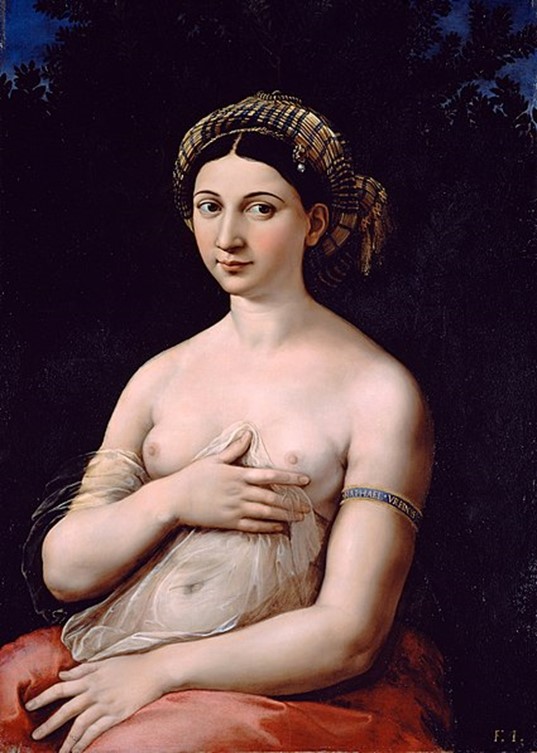
Portrait of a Woman – La Fornarina, about 1519–20, Oil on Panel, 85×60 cm, Galleria Nazionale di Arte Antica (GNAA), Palazzo Barberini, Rome, Italy
https://el.wikipedia.org/wiki/%CE%91%CF%81%CF%87%CE%B5%CE%AF%CE%BF:La_Fornarina,_por_Rafael.jpg

The life of Raffaello Sanzio da Urbino was short, his work prolific, and his legacy immortal. This is how the National Gallery in London experts introduce their audience to the blockbuster Credit Suisse Exhibition on Raphael (9 April – 31 July 2022)… But I want to return to Giogio Vasari… The liberality with which Heaven now and again unites in one person the inexhaustible riches of its treasures and all those graces and rare gifts which are usually shared among many over a long period is seen in Raphael Sanzio of Urbino, who was as excellent as gracious and endowed with a natural modesty and goodness sometimes seen in those who possess to an unusual degree a humane and gentle nature adorned with affability and good-fellowship, and he always showed himself sweet and pleasant with persons of every degree and in all circumstances… and take another look at La Fornarinahttp://www.artist-biography.info/artist/raphael/ and https://www.nationalgallery.org.uk/exhibitions/the-credit-suisse-exhibition-raphael#content

Ever since I saw La Fornarina at Palazzo Barberini in Rome, I was intrigued by its captivating beauty and mysteries. Who is the beautiful woman who modestly tries to cover herself?

Raffaello Sanzio da Urbino known as Raphael, 1483–1520
Portrait of a Woman - La Fornarina (detail of the face), about 1519–20, Oil on Panel, 85x60 cm,  Galleria Nazionale di Arte Antica (GNAA), Palazzo Barberini, Rome, Italy
Raffaello Sanzio da Urbino known as Raphael, 1483–1520
Portrait of a Woman – La Fornarina (detail of the face), about 1519–20, Oil on Panel, 85×60 cm,  Galleria Nazionale di Arte Antica (GNAA), Palazzo Barberini, Rome, Italy
Foto di Mauro Cohen https://www.nationalgallery.org.uk/exhibitions/the-credit-suisse-exhibition-raphael/a-brief-introduction-to-raphaels-life-and-times

Giorgio Vasari describes Raphael as a very amorous man,  fond of women, …always swift to serve them. This description “helps” Raphael enthusiasts identify the woman portrayed in La Fornarina with Margherita Luti, Raphael’s Roman lover, the daughter of a baker in Trastevere. Unfortunately, there is no description or record of such a painting created by the artist at the time. There are, however, “hints” that supporters of this interpretation like to consider. For example, her right-hand rests, gently, over her heart, holding her exposed breast. More so, her left hand, the hand of the heart, is adorned with a luxurious armband bearing the inscription “Raphael Urbinas,” the painter’s signature and her fourth finger is adorned with a ruby wedding ring, hidden under flesh-coloured paint for almost five centuries, and revealed in 2001 when an x-ray analysis was carried out on the painting. According to primary sources, Raphael died a young, unmarried man of 37, engaged at the time to a woman named Maria Bibbiena, the daughter of his patron Bernardo Dovizi. Could La Fornarina truly be the portrait of Margherita? There are “hints” but no evidence… https://www.barberinicorsini.org/en/opera/la-fornarina/ and http://www.artist-biography.info/artist/raphael/ and https://www.walksofitaly.com/blog/art-culture/art-history-mystery-la-fornarina-raphael

Raffaello Sanzio da Urbino known as Raphael, 1483–1520
Portrait of a Woman - La Fornarina (detail), about 1519–20, Oil on Panel, 85x60 cm,  Galleria Nazionale di Arte, Palazzo Barberini, Rome, Italy
Raffaello Sanzio da Urbino known as Raphael, 1483–1520
Portrait of a Woman – La Fornarina (detail), about 1519–20, Oil on Panel, 85×60 cm,  Galleria Nazionale di Arte, Palazzo Barberini, Rome, Italy
https://commons.wikimedia.org/wiki/File:Fornarina_03.jpg

Then come the Palazzo Barberini experts who have a different “reading” on the identity of the elusive young woman… They suggest that Raphael’s female Portrait in their Collection presents no other than Goddess Venus. The position of her hand, for example, one placed on her lap and the other on her breast, follows the classic statuary model of the “Venus Pudica”: a gesture of modesty that yet directs the viewer’s gaze to what she actually seeks to conceal. Other symbols are to be found in the painting’s background… the myrtle bush, laurel, and branches of quince are sacred emblems of Venus, marriage, lust, and fertility. Plausible but not decisive… https://www.barberinicorsini.org/en/opera/la-fornarina/

Raffaello Sanzio da Urbino known as Raphael, 1483–1520
Portrait of a Woman - La Fornarina (detail), about 1519–20, Oil on Panel, 85x60 cm,  Galleria Nazionale di Arte, Palazzo Barberini, Rome, Italy
Raffaello Sanzio da Urbino known as Raphael, 1483–1520
Portrait of a Woman – La Fornarina (detail), about 1519–20, Oil on Panel, 85×60 cm,  Galleria Nazionale di Arte, Palazzo Barberini, Rome, Italy
https://claudiaviggiani.com/fornarina-di-raffaello-in-palazzo-barberini/

Finally, I enjoyed reading Rona Goffen’s article on Raphael’s Designer Labels: From the Virgin Mary to La Fornarina (Artibus et Historiae Vol. 24, No. 48, 2003). pp. 132-135). Raphael, the author believes, tantalized, and still tantalizes his audience with clues to the woman’s identity but withholds her name. Whatever La Fornarina’s real name might have been, the author concludes, whatever (personal amorous) considerations might have motivated Raphael, he painted her portrait as the embodiment of the beauty of his art, that is, not universal, but idiosyncratic, individual, unmistakable for any other. Redefining beauty according to his own criteria, asserting his possession of her, whose image he created, Raphael asserted possession of art itself. And so Raphael signed the Fornarina without a date, because his possession is forever, his achievement immortal. This is an article worth reading! https://www.jstor.org/stable/1483734?read-now=1&refreqid=excelsior%3A2d02ae94d96f8d5167a5b6a3fb35f281&seq=13#page_scan_tab_contents pp. 132-135

For a PowerPoint on Raphael’s Portraits of Women, please… Check HERE!

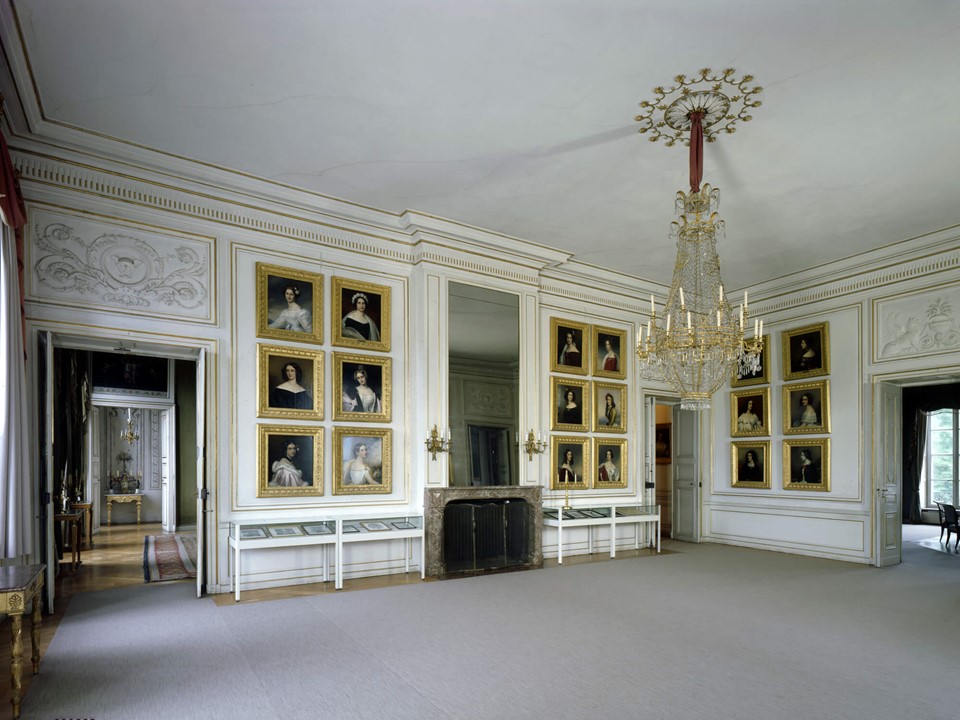
Gallery of Beauties, Schönheiten-Galerie König Ludwig I, Nymphenburg Palace, Munich, Germany

Joseph Karl Stieler’s Portrait of Katerina “Rosa” Botsaris

Joseph Karl Stieler, German Painter,1781–1858   
Katerina “Rosa” Botsaris, 1841, oil on canvas, 72,4 x 59 cm, Gallery of Beauties, Schönheiten-Galerie König Ludwig I, Nymphenburg Palace, Munich, Germany
Joseph Karl Stieler, German Painter,1781–1858   
Katerina “Rosa” Botsaris, 1841, oil on canvas, 72,4 x 59 cm, Gallery of Beauties, Schönheiten-Galerie König Ludwig I, Nymphenburg Palace, Munich, Germany
https://commons.wikimedia.org/wiki/File:Portr%C3%A4t_von_Katharina_Botzaris.jpg

The diarist Christiane Lüth (1817–1900), whose husband was appointed personal chaplain to Queen Amalia of Greece wrote about Katerina “Rosa” Botsaris in her diaries: Of the two young ladies-in-waiting, Miss von Wiesenthau was not very well mannered, Catholic and not very pretty, although she talked constantly. The Greek, very beautiful Rosa Botzaris was not agreeable, but stingy and hated everything German. She was poor, but the glory which surrounded the name of her father, the freedom hero, Marko Botzaris, shone its light over her. When she travelled with the Queen, she was much celebrated for her beauty, which was highlighted by her national costume. She hid the fact that she understood the German language and spread dangerous political comments around her which much damaged Their Majesties, her benefactors. It is obvious Christiane Lüth did not like much, either of Queen Amalia’s Ladies in Waiting, but Rosa’s beauty is undisputed, and Joseph Karl Stieler’s Portrait of Katerina “Rosa” Botsaris is an excellent testimony! https://www.kathryngauci.com/blog-105-25-3-2021-a-literary-world-katerina-rosa-botsaris/

Between 1827 and 1850 Joseph Karl Stieler, court painter of Bavaria, was commissioned by King Ludwig I to create 36 portraits of the most beautiful women from the nobility and middle classes of Munich, Germany. These portraits were to decorate the south pavilion of Ludwig’s Nymphenburg Summer Palace. Among these very popular portraits was that of a Greek lady, Katerina “Rosa” Botsaris, the daughter of Markos Botsaris, the hero of the 1821 Greek Revolution. https://arrayedingold.blogspot.com/2011/11/gallery-of-beauties.html

Katerina’s life was not easy. Born to the prominent Souliot Botsaris family, Katerina was the daughter of Chrysoula Kalogirou and Markos Botsaris, the famed, and revered leader of the Greek War of Independence, who died on the night of August the 8th, 1823, at Kefalobryso in Karpeisi, while with 450 Souliotes, ambushed the enemy camp of Mustafa Pasha of Shkoder (modern northern Albania) inflicting serious casualties. At the time, a child of 5 or 3 years old, Katerina Botsaris lived the life of a “hostage” in the city of Drama, at the harem of Dramali Mahmud Pasha, under the protection of upper-class Ottoman women. Katerina was apparently a particularly charming child, so much so that one of her “protectresses” wanted to officially adopt her. It was not meant to be, and during a prisoner exchange initiative, Katerina was returned to her family and reunited with her mother. Many “adventures” later, the orphaned family of Markos Botsaris settled at the newly created Greek state where members of the Botsaris family were to play an important role. https://archive.org/details/poikilstoaethni02raphgoog/page/n299/mode/2up?view=theater

While in Athens, the importance of the Botsaris name, her delightful personality, and great beauty attracted the attention of Amalia of Oldenburg, Queen of Greece from 1836 to 1862 as the spouse of King Otto (1815–1867), who appointed Katerina as her 1st Greek Lady-in-Waiting. In 1841, Katerina Botsaris accompanied Queen Amalia to Munich, the birthplace of King Otto of Greece. Tradition has it that upon arrival, as she was getting out of her carriage King Ludwig of Bavaria noticed Katerina’s Mediterranean beauty and hurried to assist her. Later on, the royal couple of Greece, Otto, and Amalia, suggested Katerina’s Portrait for the Gallery of Beauties, and King Ludwig wholeheartedly agreed. It is said that she was given the name Rosa, leaving behind her real name, from the ruby ​​color of the rose … that her lips and cheeks had… https://www.bovary.gr/oramatistes/15798/roza-mpotsari-i-ellinida-kalloni-kori-toy-markoy-mpotsari-poy-emeine-sto-pantheon and https://www.patris.gr/2021/01/30/katerina-roza-mpotsari-i-kori-toy-iroa/

Katerina “Rosa” Botsari Costume, mid-19th century, crimson velvet, and embroidery of gold cords, National History Museum - Historical & Ethnological Society of Greece (EIM), Athens, Greece
Photograph Credit: Christina Hilla Famel
Katerina “Rosa” Botsari Costume, mid-19th century, crimson velvet, and embroidery of gold cords, National History Museum – Historical & Ethnological Society of Greece (EIM), Athens, Greece
Photograph Credit: Christina Hilla Famel
https://www.huffingtonpost.gr/entry/endema-pseches-apo-te-foresia-tes-kera-frosenes-mechri-tes-rozas-mpotsare_gr_60f6b247e4b0e92dfebc53bb

Stieler’s Portrait of Katerina “Rosa” Botsaris shows a great Mediterranean beauty. Her complexion is glowing and creamy, her cheeks blushed with youth. High arched eyebrows frame a long straight nose and brown heavy-lidded eyes, which look out at us kindly, a light smile drawn at the corners of her mouth. Glossy chestnut hair flows down her neck, blending into the tassel of her jauntily placed hat and the fur collar of her jacket. She poses in front of the blue, tranquil Aegean Sea, and the pale blue but luminous Greek sky… a landscape that is atmospheric and tranquil,  matching her character and demeanor. She wears an exquisite, fitted Kontogouni (vest)of crimson velvet, embroidered with gold cords, a crisp white Poukamisa (shirt), and a full, silk, pleated skirt, emphasizing her feminine shape. The Kontogouni survived time and it is still a prized treasure of the National History Museum of Greece. The artist Joseph Karl Stieler, trained in the Vienna Academy of Fine Arts and in the Parisian atelier of François Gérard, a student of Jacques-Louis David, created, inspired by the Greek beauty of Katerina “Rosa” Botsaris, the perfect example of a controlled and romanticized Neoclassical portrait. https://www.art-theoria.com/painting-of-the-month/katerina-rosa-botzaris/ and https://www.nationalgallery.gr/images/docs/books/athina-monacho.pdf pages 546-548

In 1845 Katerina “Rosa” Botsaris married Prince George Karatzas. a military man of Fanariot descent and had four children, two of whom died at a young age. The marriage was not particularly happy due to her husband’s strict and authoritarian character and the death of her children. The beautiful Souliotissa died at the age of 57 in January 1875. https://www.patris.gr/2021/01/30/katerina-roza-mpotsari-i-kori-toy-iroa/

Katerina Agrafioti wrote a book (in Greek) about Katerina’s life… the story of a woman who, always respecting her origin, unreservedly served the social “musts” and overlooked her personal pursuits with the power and dignity she derived from her father’s name.https://www.kathimerini.gr/opinion/707109/aikaterini-roza-mpotsari-sti-skia-toy-onomatos-mythistorimatiki-viografia-apo-tin-katerina-agrafioti-ekdoseis-papyros/ and https://www.ianos.gr/ekaterini-roza-mpotsari-sti-skia-tou-onomatos-0195564

Pietro Luchini,  Italian Painter,1800-1883
Ekaterini Botzaris Caradja, 1845, oil on canvas, 207x159 cm, Private Collection
Pietro Luchini,  Italian Painter,1800-1883
Ekaterini Botzaris Caradja, 1845, oil on canvas, 207×159 cm, Private Collection
https://commons.wikimedia.org/wiki/File:Ekaterini_Caradja_Botzaris.jpg
https://i.pinimg.com/originals/84/89/14/848914762a7727cfeb43a89aef41f647.jpg

A Damask Rose species bred in 1856, brightly white and very fragrant, was named Rosa Botsaris after her. https://garden.org/plants/view/415/Rose-Rosa-Botzaris/

For a Student Activity, please … Check HERE!

Rose named after Katerina “Rosa” Botsaris
http://diolkos.blogspot.com/2011/07/blog-post_136.html
Photo and Artworks by and for Marie Euphrosyne Spartali-Stillman

Marie Euphrosyne Spartali-Stillman

Marie Spartali Stillman, 1844-1927
Self-Portrait, 1874, gouache and pastel with gum arabic on paper, 63.5 by 50.8 cm, property of a private collector
Marie Spartali Stillman, 1844-1927
Self-Portrait, 1874, gouache and pastel with gum arabic on paper, 63.5 by 50.8 cm, property of a private collector
https://byronsmuse.wordpress.com/2015/02/14/marie-spartali-stillman-a-grecian-muse/ and https://www.invaluable.com/auction-lot/marie-spartali-stillman-112-c-5vbtvxatmp

Imagine a gender equal world. A world free of bias, stereotypes, and discrimination. A world that’s diverse, equitable, and inclusive. A world where difference is valued and celebrated. Today, the 8th of March, many countries around the world celebrate International Women’s Day, a day when women are recognized for their achievements without regard to divisions, whether national, ethnic, linguistic, cultural, economic, or political. The United Nations page on Women’s Day reminds us how… the growing international women’s movement, which has been strengthened by four global United Nations women’s conferences, has helped make the commemoration a rallying point to build support for women’s rights and participation in the political and economic arenas.  A BLOG POST on Marie Euphrosyne Spartali-Stillman, a Pre-Raphaelite artist par excellence, will be my humble contribution to the importance of the day. https://www.internationalwomensday.com/ and https://www.un.org/en/observances/womens-day/background

Marie Euphrosyne Spartali-Stillman was a Grecian beauty! She was statuesque, nearly 1.90 m in height, with big, dark eyes and long, thick brown hair. Along with her sister Christina, the daughters of Michael Spartali, a wealthy Greek-born businessman and Consul-General of Greece in London, the Spartali girls frequented London’s artistic and literary salons of the 1860s creating a stir. The artist Thomas Armstrong, for example, met the two young women at a Sunday get-together at their parents’ house in 1863 and recalled, “We were all à genoux before them, and of course every one of us burned with a desire to try to paint them.” The poet Algernon Charles Swinburne seeing Marie wearing a white dress with blue ribbon sashes was short of words but quite emotional, writing… “She (Marie) is so beautiful that I want to sit down and cry.” Along with her cousins, Maria Zambaco and Aglaia Coronio were known collectively among friends as “the Three Graces”, after the Charites of Greek mythology (Aglaia, Euphrosyne, and Thalia), as all three were noted beauties of Greek heritage. https://www.artandantiquesmag.com/stillman-paintings/ and https://www.facebook.com/female.artists.in.history/photos/marie-spartali-stillman-british-painter-1844-1927portrait-of-a-young-woman-1868w/1870113673273513/

Photo and Artworks by and for Marie Euphrosyne Spartali-Stillman

Thus… she became the muse and the model to several important artists of the time, particularly artists of the Pre-Raphaelite movement, enchanting them with her elegant stature and classical feature! Her beauty, however, was not easy to capture! Dante Gabriel Rossetti loved her to pose for him but on a letter addressed to Jane Morris, dated  August 14, 1867, he wrote… “I find her head the most difficult I ever drew. It depends not so much on real form as on a subtle charm of life which one cannot recreate.” https://www.facebook.com/female.artists.in.history/photos/marie-spartali-stillman-british-painter-1844-1927portrait-of-a-young-woman-1868w/1870113673273513/

The young woman was artistic and an intellectual. Starting in 1864, and for several years, she became the student of artist Ford Madox Brown. Once more, in a letter addressed to Brown, Rossetti writes “I just hear Miss Spartali is to be your pupil. I hear too that she is one and the same with a marvelous beauty of whom I have heard much talk. So box her up and don’t let fellows see her, as I mean to have first shy at her in the way of sitting.” https://byronsmuse.wordpress.com/2015/02/14/marie-spartali-stillman-a-grecian-muse/

Photo of Marie Euphrosyne Spartali-Stillman

In 1871, against her parents’ wishes, she married American journalist, diplomat, author, historian, photographer, and trained artist William J. Stillman (1828 – 1901). A captivating personality, Stillman served as a war correspondent in Crete and the Balkans, a United States consul in Rome, and afterward in Crete, during the Cretan insurrection. He is known for training the young Arthur Evans as a war correspondent in the Balkans, remaining a lifelong friend and confidant. He is also known for considering taking over the excavation at Knossos from Minos Kalokairinos! The couple, along with their children, lived an exciting life between England, Italy, and the United States, Marie being at the time, the only Pre-Raphaelite artist to work and exhibit in the United States. https://digitalcollections.union.edu/s/home/page/william-james-stillman-collection  

According to Margaretta Frederick, curator of the major monographic exhibition, “Poetry in Beauty: The Pre-Raphaelite Art of Marie Spartali Stillman,” (November 7, 2015–January 31, 2016, at the Delaware Museum of Art) Marie  “…abhorred publicity and never wanted to put herself forward, because she was suspicious of critics and publicity.” She was also a victim of the Victorian mentality, further wrote Margaretta Frederick, that dictated that a woman should not compete with men, or at least not appear to do so… explaining that even Spartali Stillman’s choice of medium—watercolor—was guided by this code of conduct: “In a middle- to upper-middle-class family, women painted in watercolor. So she was fixated on this medium that allowed her to situate herself next to the men and compete on their level without transgressing too many social barriers.” https://www.artandantiquesmag.com/stillman-paintings/

Marie might have abhorred publicity, but she did not labor in obscurity. She exhibited at the Royal Academy starting in 1870 and had dealers selling her work on both sides of the Atlantic. Influenced by the Pre-Raphaelite movement and the Italian Renaissance, she is known for creating over one hundred paintings of dreamy medievalism, plenty of Dante-and-Boccaccio scenes, and Portraits of unusual psychological acuteness. Her style, free, and painterly, is an integral link in the chain of Victorian Aestheticism. https://www.artandantiquesmag.com/stillman-paintings/

For a PowerPoint of artwork by Marie Spartali Stillman at the Delaware Art Gallery in the USA, please… Check HERE!

Katerina Sakellaropoulou the President of the Hellenic Republic at the National Gallery of Greece Exhibition In Search of Immortality - The Art of Portrait in the Louvre Collections (December 1, 2021-28 March 2022).

La Belle Nani by Paolo Veronese

Paolo Veronese, 1528–1588 
Portrait of a Venetian Woman - La Belle Nani, circa 1560, oil on canvas, 119x103 cm, Louvre Museum, Paris, France
Paolo Veronese, 1528–1588 
Portrait of a Venetian Woman – La Belle Nani, circa 1560, oil on canvas, 119×103 cm, Louvre Museum, Paris, France
https://collections.louvre.fr/en/ark:/53355/cl010065927

Men were created before women… But that doesn’t prove their superiority – rather, it proves ours, for they were born out of the lifeless earth in order that we could be born out of living flesh. And what’s so important about this priority in creation, anyway? When we are building, we lay foundations on the ground first, things of no intrinsic merit or beauty, before subsequently raising up sumptuous buildings and ornate palaces. Lowly seeds are nourished in the earth, and then later the ravishing blooms appear; lovely roses blossom forth and scented narcissi… writes Moderata Fonte in her book The Worth of Women: Wherein Is Clearly Revealed Their Nobility and Their Superiority to Men, and I think that La Belle Nani by Paolo Veronese is one such Venetian… ravishing bloom, a lovely roses blossom, a scented narcissi! https://www.goodreads.com/author/quotes/893320.Moderata_Fonte and https://books.google.gr/books?id=AtTGAAAAQBAJ&pg=PA138&lpg=PA138&dq=Men+were+created+before+women.+…+But+that+doesn%27t+prove+their+superiority+%E2%80%93+rather,+it+proves+ours,+for+they+were+born+out+of+the+lifeless+earth+in+order+that+we+could+be+born+out+of+living+flesh.+And+what%27s+so+important+about+this+priority+in+creation,+anyway?+When+we+are+building,+we+lay+foundations+on+the+ground+first,+things+of+no+intrinsic+merit+or+beauty,+before+subsequently+raising+up+sumptuous+buildings+and+ornate+palaces.+Lowly+seeds+are+nourished+in+the+earth,+and+then+later+the+ravishing+blooms+appear;+lovely+roses+blossom+forth+and+scented+narcissi.&source=bl&ots=LzBLZk1PqE&sig=ACfU3U14hiEGCMR-a1Zp9IywMToXnxIAsw&hl=el&sa=X&ved=2ahUKEwi37YHOwKb1AhXLgv0HHYiYA1AQ6AF6BAgCEAM#v=onepage&q&f=false

What an incredible portrait La belle Nani is! Created by Paolo Veronese (1528-1588), one of the most famous painters of the Cinquecento, it fascinates and fires the imagination. Who is she? Is she a respectable Venetian matron, one of Venice’s famous courtesans, or is she the image of the Venetian ideal beauty? Well, we do not really know… except that back in the 19th century, it was thought that the portrait was commissioned by the Nani, a patrician family of Venice, and thus, the nickname La Belle Nani was adopted. http://editions.louvre.fr/en/titles/monographs/painting/veroneseune-dame-venitienne-dite-la-belle-nani.html

Paolo Veronese, 1528–1588 
Portrait of a Venetian Woman - La Belle Nani (detail), circa 1560
Paolo Veronese, 1528–1588 
Portrait of a Venetian Woman – La Belle Nani (detail), circa 1560, oil on canvas, 119×103 cm, Louvre Museum, Paris, France
https://www.iefimerida.gr/politismos/ethniki-pinakothiki-loybro-maska-napoleonta-parisi

The portrait of the “Beautiful Nani” follows, according to the Louvre experts, a very fashionable compositional formula developed by no other than the greatest portrait painter of the Venetian Renaissance, Titian. The model is depicted facing the viewer, in front of a dark neutral background, and is placed next to an element of furniture, in Veronese’s painting, a table covered with a precious carpet of Anatolian manufacture, known as “a la Moretto” style. Portrayed against a sober background the beautiful woman bursts of light and colour reflecting the extraordinary skills of the Venetian Renaissance artist. https://collections.louvre.fr/en/ark:/53355/cl010065927

The Louvre Portrait exalts the beauty of a young woman as much as the richness of her dress. It is believed that this is the Portrait of an aristocratic Venetian mother… beautiful and utterly fashionable! Her delicate complexion, for example, is white and pink, indicating that the lady is protecting herself from the sun. Her sparkling hair is blond, a color that was obtained, according to the beauty recipes of the time, by exposing hair to the midday sun, on the roofs of Venetian palaces. Her ceremonial dress, made of luxurious blue velvet and branched brocade on a white background, is fashionably loose, with a fairly wide opening on the chest, a light white gauze coat draped over her shoulders, and sumptuous pieces of jewelry all over her. https://collections.louvre.fr/en/ark:/53355/cl010065927

La belle Nani is beautiful, fashionable, and virtuous… She chastely turns her gaze away from that of the spectator. Her left hand, whose ring finger is adorned with a wedding ring, elegantly re-dyes the transparent veil of her coat, while her right hand rests on her heart, as a sign of conjugal fidelity. The portrait must thus signify the exemplary nature of this woman: her high social rank, her physical beauty, and her moral virtue. https://collections.louvre.fr/en/ark:/53355/cl010065927

Katerina Sakellaropoulou the President of the Hellenic Republic at the National Gallery of Greece Exhibition In Search of Immortality - The Art of Portrait in the Louvre Collections (December 1, 2021-28 March 2022).
Katerina Sakellaropoulou the President of the Hellenic Republic at the National Gallery of Greece Exhibition In Search of Immortality – The Art of Portrait in the Louvre Collections (December 1, 2021-28 March 2022).
https://www.newsit.gr/politikh/katerina-sakellaropoulou-egkainiase-ekthesi-tis-ethnikis-pinakothikis-foros-timis-sto-mouseiou-tou-louvrou/3418282/

In Search of Immortality – The Art of Portrait in the Louvre Collections (December 1, 2021-28 March 2022) is a wonderful Exhibition at the National Gallery in Athens, Greece. La Belle Nani is just one of one hundred portraits from the Louvre Museum Exhibited in Athens. An impressive selection of valuable works of art dating from the period of Pharaonic Egypt to Gericault and Delacroix, the Athens Exhibition explores the genre of Portraiture with stunning examples like… The Death of Mara by Jacques-Louis or Bonaparte at the Pont d’Arcole by Antoine-Jean Gros. This is an Exhibition worth visiting! https://digitalculture.gov.gr/2021/11/ethniki-pinakothiki-anazitontas-tin-athanasia-i-techni-tou-portretou-stis-silloges-tou-louvrou/

For a PowerPoint on Portraits of Renaissance Women by Paolo Veronese, please… Check HERE!

Image of the Peacock Room featuring the Princess in the Land of Porcelain painting by James McNeill Whistler, Freer Gallery of Art and Arthur M Sackler Gallery, Washington DC, USA

The Princess from the Land of Porcelain by James Abbott McNeill Whistler

James Abbott McNeill Whistler, American Artist, 1834-1903
Rose and Silver: The Princess from the Land of Porcelain (Portrait of Christine Spartali), 1863-1865, Oil on Canvas, 201.5x116.1 cm, Freer Gallery of Art, Smithsonian Institution, Washington DC, USA
James Abbott McNeill Whistler, American Artist, 1834-1903
Rose and Silver: The Princess from the Land of Porcelain (Portrait of Christine Spartali),
1863-1865, Oil on Canvas, 201.5×116.1 cm, Freer Gallery of Art, Smithsonian Institution, Washington DC, USA
https://en.wikipedia.org/wiki/The_Princess_from_the_Land_of_Porcelain#/media/File:James_McNeill_Whistler_-_La_Princesse_du_pays_de_la_porcelaine_-_brighter.jpg

The sitter’s sister Marie (artist Spartali-Stollman) told Pennell: ‘At first the work went quickly, but soon it began to drag. Whistler often scraped down the figure just as they thought it all but finished, and day after day they returned to find that everything was to be done over again … Mrs. Stillman remembers that Whistler partly closed the shutters so as to shut out the direct light; that her sister stood at one end of the room, the canvas beside her; that Whistler would look at the picture from a distance, then suddenly dash at it, give one stroke, then dash away again … The sittings went on until the sitter fell ill … The head in the “Princess” gave him most trouble … During her illness, a model stood for the gown, and when she was getting better, he came one day and made a pencil drawing of her head, though where it went to Mrs. Stillman never knew. There were a few more sittings after this, and at last, the picture was finished.’ The Princess from the Land of Porcelain by James Abbott McNeill Whistler has more stories to tell… https://www.whistler.arts.gla.ac.uk/correspondence/people/biog/?bid=Spar_C&fbclid=IwAR0Z8K3QjV1wsba9ee8HPO7ax0Ri9r3uvxu9QKVkwZdKKaVn-PSZ6Bpaca8 (Pennell, Elizabeth Robins, and Joseph Pennell, The Life of James McNeill Whistler, 2 vols, London and Philadelphia, 1908, vol. 1, pp. 122-25, 130, 157, 203-04; Young, Andrew McLaren, Margaret F. MacDonald, Robin Spencer, and Hamish Miles, The Paintings of James McNeill Whistler, New Haven and London, 1980.)

Image of the Peacock Room featuring the Princess in the Land of Porcelain painting by James McNeill Whistler, Freer Gallery of Art and Arthur M Sackler Gallery, Washington DC, USA
Image of the Peacock Room featuring the Princess in the Land of Porcelain painting by James McNeill Whistler, Freer Gallery of Art and Arthur M Sackler Gallery, Washington DC, USA https://commons.wikimedia.org/wiki/File:The_Peacock_Room.jpg  

During the 1860s until the final years after the First World War, Japanese Art was all the rage amongst the world of Western Αrt ant Ιntelligentsia. At the time, James Abbott McNeill Whistler was a most fervent Japonist. Inspired by ukiyo-e prints, ancient Greek sculpture, music, and dance, Whistler created works of art of entranced female figures…Japanese and ancient Greek art set the tone. Rose and Silver: The Princess from the Land of Porcelain is one such happy consequence. Painted between 1863 and 1865 with Christine Spartali as the model, and described in 1865 as “unready for display and lacking in substance” by the art critic Gustave Vattier, the painting was not an immediate success. Without a direct buyer, the work changed hands for a few years – at one point landing in Dante Rossetti’s studio – before it was purchased by Frederick Leyland for his dreamed porcelainzimmer! In 1903, the painting was bought by Charles Lang Freer, and today Rose and Silver: The Princess from the Land of Porcelain can be seen in Washington DC, the Freer Gallery of Art, a much-appreciated part of the Harmony in Blue and Gold: The Peacock Room. https://www.smithsonianmag.com/arts-culture/the-story-behind-the-peacock-rooms-princess-159271229/ and https://artofdarkness.co/post/137432960224/whistler-princess-from-land-porcelain-gigapixel-details

James Abbott McNeill Whistler, American Artist, 1834-1903
Sketch for Rose and Silver: The Princess from the Land of Porcelain, between 1863 and 1864, oil on hardboard, 61.3 × 35.1 cm, Worcester Art Museum, MA, USA
James Abbott McNeill Whistler, American Artist, 1834-1903
Sketch for Rose and Silver: The Princess from the Land of Porcelain
, between 1863 and 1864, oil on hardboard, 61.3 × 35.1 cm, Worcester Art Museum, MA, USA  https://commons.wikimedia.org/wiki/File:La_Princesse_du_Pays_de_la_Porcelaine_-_James_Abbort_McNeill_Whistler_-_Sketch.JPG

Whistler’s painting Rose and Silver: The Princess from the Land of Porcelain was part of a series of costume pictures undertaken by Whistler in the mid-1860s in which western models appear in Asian dress, surrounded by Chinese and Japanese objects from Whistler’s own collections. He modeled the princess on Christina Spartali, a young woman of Greek descent who is dressed in a kimono and surrounded by luxurious objects that suggest an imaginary “land of porcelain.” Not intended as a portrait, the painting instead demonstrated a new ideal of beauty, one derived from Japanese ukiyo-e prints and the elongated figures painted on Chinese porcelain. https://asia.si.edu/object/F1903.91a-b/#object-content

Kitagawa Utamaro, Japanese Artist, 1753-1806
Washing and stretching cloth, 1796-1797, Color woodblock print on paper, Triptych: each sheet 38.1 x 25.4 cm, NY Public Library, USA
Kitagawa Utamaro, Japanese Artist, 1753-1806
Washing and stretching cloth
, 1796-1797, Color woodblock print on paper, Triptych: each sheet 38.1 x 25.4 cm, NY Public Library, USA
https://artvee.com/dl/drying-and-stretching-cloth/

When I teach American Art, and James Abbott McNeill Whistler, in particular, I like to compare Rose and Silver: The Princess from the Land of Porcelain to Kitagawa Utamaro’s Washing and stretching cloth print of 1796-1797. The elegant postures of Ukiyo-e Ladies, their body language, grace, style, and refinement captivated Whistler’s imagination, creating… wonderful paintings! https://artvee.com/dl/drying-and-stretching-cloth/ and https://risdmuseum.org/exhibitions-events/exhibitions/women-floating-world

For a PowerPoint on paintings by James Abbott McNeill Whistler depicting European Women wearing Asian costumes, please… Check HERE!

Julia Margaret Cameron, 1815-1879
Christina Spartali (later Countess Edouard Cahn d'Anvers), 1868, albumen cabinet card, National Portrait Gallery, London, UK
Julia Margaret Cameron, 1815-1879
Christina Spartali (later Countess Edouard Cahn d’Anvers), 1868, albumen cabinet card, National Portrait Gallery, London, UK
https://artsandculture.google.com/asset/christina-spartali-the-model-for-la-princesse-ca-1865-70-julia-margaret-cameron/qwF4d-HWJ94Gtg

Christina Spartali, the model for Whistler’s Princess from the Land of Porcelain,  was Michael Spartali and Euphrosyne Varsini Spartali’s second daughter. Her father, a prosperous London resident merchant, became Consul-General for Greece in 1866. From 1864, the family lived in London at “The Shrubbery” in Clapham Common, and through their relatives, the Ionides, prominent patrons of the arts, became acquainted with members of the contemporary art world, including James McNeill Whistler. The photographer Julia Margaret Cameron was the Spartalis’ neighbor at Sandford, the family’s estate on the Isle of Wight, where photographs of the Spartali sisters were taken. In 1868, Christina married Count Eduard Joseph Cahen D’Anvers, a Jewish banker from Belgium, moved to Paris, and live the life of an upper-class, apparently not so happy, socialite. https://www.costumecocktail.com/2016/09/26/christina-marie-spartali-ca-1870/ and http://fannycornforth.blogspot.com/2018/12/sunday-16th-december-christine-spartali.html

Maurice Utrillo and his mother Suzanne Valadon, c. 1890 by an unknown photographer

Suzanne Valadon

Suzanne Valadon (Marie-Clémentine Valadon), 1865-1938
Self Portrait with Family (Suzanne Valadon is in the center, flanked by André Utter and her mother, with her son at the foreground), 1912, oil on canvas, 97 x 73 cm, Le Centre Pompidou, Paris, France
Suzanne Valadon (Marie-Clémentine Valadon), 1865-1938
Self Portrait with Family (Suzanne Valadon is in the center, flanked by André Utter and her mother, with her son at the foreground), 1912, oil on canvas, 97 x 73 cm, Le Centre Pompidou, Paris, France
https://www.centrepompidou.fr/fr/ressources/oeuvre/cyjjkkA#&gid=viewer-lightbox&pid=0

The French artist Suzanne Valadon is the protagonist of a unique Exhibition at the Barnes, in the heart of Philadelphia, that introduces to the general public a late 19th – early 20th-century Woman of extraordinary qualities. The Exhibition will be open to the public until the 9th of January, 2021, and so far, the Artist and the Exhibition have been described as… A thrilling tour of [her] portraits, nudes, still lifes, and drawings by The New York Times, or… A brilliant artist making breathtaking paintings that have the flat, colorful solidity of Gauguin, but a piercing intelligence and emotional insight by The Washington Post, or… She is a maverick artist, who often drew from her own life to create a body of work that envisions the 20th-century woman by WHYY, and Breathing new life into rebellious early 20th-century art by the Broad Street Review. https://www.barnesfoundation.org/whats-on/exhibitions/suzanne-valadon?gclid=CjwKCAjwzaSLBhBJEiwAJSRokgRhEY928WI-tXfLFrUON5esRwP3uD8RRKR9pNAu2rdgIPlxP88W8hoCkC4QAvD_BwE

Maurice Utrillo and his mother Suzanne Valadon, c. 1890 by an unknown photographer
https://commons.wikimedia.org/wiki/File:M_Utrillo_et_sa_m%C3%A8re_S_Valadon_vers_1890.jpg

Born Marie-Clémentine, Suzanne Valadon, was born into poverty, as the daughter of an unmarried domestic worker. She grew up in Montmartre, the bohemian quarter of Paris, supporting herself from the age of ten with odd jobs: waitress, nanny, and circus performer. A fall from a trapeze led her in a new direction…that of modeling for some of the most important artists of her time. She was more than a model… she became the muse and the friend of artists like Pierre Puvis de Chavannes and Pierre-Auguste Renoir, Edgar Degas, Amedeo Modigliani, Henri de Toulouse-Lautrec, and Miguel Utrillo, who agreed to give Maurice, Valadon’s son, born out of wedlock, his last name and legally recognize him as his son. Suzanne was artistic. She loved to draw while in the company of her artists/friends, practice her skills by observing them paint, and with the encouragement and tutelage of her mentor Edgar Degas, learn how to master the art of drawing and etching techniques. Valadon soon transitioned from an artist’s model into a successful artist with …a complicated personal life. She was a free spirit and a bohemian in every sense of the word… Suzanne Valadon, her second husband André Utter, and her son Maurice Utrillo were known as the trinité maudite (cursed trinity) because the family environment was characterized by violent outbursts, reconciliations, and alcoholism. https://nmwa.org/art/artists/suzanne-valadon/ and https://www.messynessychic.com/2021/10/15/renoirs-art-model-was-the-greatest-painter-you-never-heard-of/?fbclid=IwAR33WEcmDTxJ4n84O07M7RIJ1rv5WaCZb8Xtc8auSwKRndJhQPfTpaliFZI and https://www.arts-spectacles.com/Valadon-Utrillo-et-Utter-la-trinite-maudite-entre-Paris-et-Saint-Bernard-1909-1939-du-16-octobre-au-12-fevrier-2012_a6460.html

Suzanne Valadon (Marie-Clémentine Valadon), 1865-1938
Self-Portrait, 1898, Oil on Canvas, 40x26.7 cm, Museum of Fine Arts, Houston, USA
Suzanne Valadon (Marie-Clémentine Valadon), 1865-1938
Self-Portrait, 1898, Oil on Canvas, 40×26.7 cm, Museum of Fine Arts, Houston, USA
https://commons.wikimedia.org/wiki/File:Suzanne_Valadon_-_Self-Portrait_-_Google_Art_Project.jpg

The artist is famous for her unapologetic female and male nudes… bold, controversial, and provocative! My favourite Valadon painting is her 1912 Self Portrait with Family…odd, disturbing, and unconventional. https://www.centrepompidou.fr/fr/ressources/oeuvre/cyjjkkA#&gid=viewer-lightbox&pid=0

Suzanne Valadon (Marie-Clémentine Valadon), 1865-1938
Self Portrait with Family (Suzanne Valadon is in the center, flanked by André Utter and her mother, with her son at the foreground), 1912, oil on canvas, 97 x 73 cm, Le Centre Pompidou, Paris, France
Suzanne Valadon (Marie-Clémentine Valadon), 1865-1938
Self Portrait with Family (Suzanne Valadon is in the center, flanked by André Utter and her mother, with her son at the foreground), 1912, oil on canvas, 97 x 73 cm, Le Centre Pompidou, Paris, France
https://upload.wikimedia.org/wikipedia/commons/d/d1/Portrait_de_famille%2C_1912_-_Suzanne_Valadon.jpg

The Centre Pompidou painting shows Suzanne Valadon in the center, flanked by André Utter, her second husband, her mother Magdeleine Valadon, and her son in the foreground, Maurice Utrillo. Suzanne Valadon is the only one directly facing the viewer, but she does so tentatively, with her hand on her chest… Utter and Madame Valadon are gazing to their right, each foreseeing a different future: the young man looks confident and rather content, while the woman – all wrinkled and slightly hunchbacked, with the corners of her mouth turned downwards – appears resigned. Maurice Utrillo’s depiction earns the most sympathy, for he seems to be the most miserable and out of place, gazing melancholically with his head leaning on his hand, as if he simply cannot muster the energy to stand or sit upright… What an unusual family portrait! https://artschaft.com/2018/05/23/suzanne-valadon-family-portrait-1912/

For a Student Activity inspired by the Exhibition at the Barnes, in Philadelphia, please… Check HERE!

Suzanne Valadon (Marie-Clémentine Valadon), 1865-1938
Portrait of the painter Maurice Utrillo, 1921, Collection of the City of Sannois, Val d’Oise, France, on temporary loan to the Musée de Montmartre, Paris
Suzanne Valadon (Marie-Clémentine Valadon), 1865-1938
Portrait of the painter Maurice Utrillo, 1921, Collection of the City of Sannois, Val d’Oise, France, on temporary loan to the Musée de Montmartre, Paris
https://commons.wikimedia.org/wiki/File:Maurice_Utrillo,_par_Suzanne_Valadon.jpg
Cassatt seated in a chair with an umbrella. Verso reads "The only photograph for which she ever posed. Courtesy of Durand-Ruel.", 1913

Five O’Clock Tea with Mary Stevenson Cassatt

Mary Stevenson Cassatt, 1844-1926          
Five O'Clock Tea, 1880, Oil on Canvas, 64.7x92 cm, Museum of Fine Arts, Boston, USA
Mary Stevenson Cassatt, 1844-1926          
Five O’Clock Tea, 1880, Oil on Canvas, 64.7×92 cm, Museum of Fine Arts, Boston, USA https://commons.wikimedia.org/wiki/File:Mary_Cassatt_-_The_Tea_-_MFA_Boston_42.178.jpg

I believe it is customary in good society to take some slight refreshment at five o’clock… Oscar Wilde humorously wrote in Act 1 of his famous play The Importance of Being Earnest… Five O’Clock Tea with Mary Stevenson Cassatt is how an American painter portrayed, in all seriousness, the same customary ritual with paints. https://www.shmoop.com/importance-of-being-earnest/act-i-full-text-2.html

Cassatt seated in a chair with an umbrella. Verso reads "The only photograph for which she ever posed. Courtesy of Durand-Ruel.", 1913
Cassatt seated in a chair with an umbrella. Verso reads “The only photograph for which she ever posed. Courtesy of Durand-Ruel.”, 1913
Source: http://digitalcollections.frick.org/digico/#/archive/Archives/Images%20of%20Artists%20
Images of Artists Collection. The Frick Collection/Frick Art Reference Library Archives.
https://commons.wikimedia.org/wiki/File:Mary_Cassatt_photograph_1913.jpg

Mary Stevenson Cassatt (1844 – 1926) was a fortunate lady! Born into a prosperous family in Pennsylvania who believed it was important for women to receive an education, she grew up attending school in Philadelphia and traveling to Europe where …Art kept changing. Reaching adulthood, she persuaded her parents that her life’s destination was to be in Europe, and painting professionally was to become her life’s pursuit! It was not easy for her father to accept Mary’s artistic ambition, but after serious deliberation, he came around and… in 1866, with her mother and family friends acting as chaperones, she settled in Paris and was accepted to study Art in the private studios of Jean-Léon Gérôme, Charles Joshua Chaplin and Thomas Couture. She expanded her training with daily copying in the Louvre and trips to the French countryside where she drew from life. Two years later, in 1868, her painting A Mandoline Player, was accepted for exhibition in the Paris Salon. She was noticed as a professional painter, but she was not fully content!

Everything changed in 1877 when she submitted paintings to enter the year’s Salon and was rejected by the committee. When she met Edgar Degas, an artist she greatly admired, Cassatt was disillusioned with academic painting and eager to experiment. The French artist invited her to collaborate with the Impressionists and exhibit with them in 1879, during the 4th Impressionist Exhibition… I accepted with joy, she later recalled as I hated conventional art. She was one of just a few women, and the only American, to exhibit with the group. She was finally happy in an artistic environment that suited her needs… Plein Air painting, vibrant, metallic in some cases, color, in short, dancing brushstrokes, flat space, the discovery of Japanism… and scenes of everyday modern life in Paris – her family, friends, and their children. https://www.nga.gov/content/dam/ngaweb/Education/learning-resources/an-eye-for-art/AnEyeforArt-MaryCassatt.pdf and https://collections.mfa.org/objects/32829/the-tea;jsessionid=20E4DE2A8A06D4816FA7D20AFF171D7C?ctx=884b7166-374f-468a-8909-136f2658e914&idx=7

Mary Stevenson Cassatt, 1844-1926          
Five O'Clock Tea (Details – 2 women), 1880
Mary Stevenson Cassatt, 1844-1926          
Five O’Clock Tea (Details – 2 women), 1880, Oil on Canvas, 64.7×92 cm, Museum of Fine Arts, Boston, USA
https://atsunnyside.blog/2018/08/31/tea-by-mary-cassatt-1880/

In 1880 Mary Cassatt painted Five O’Clock Tea documenting the trendy social ritual of well-to-do women like herself. Paintings of women taking afternoon tea became a popular theme for Cassatt in the late 1870s and early 1880s, and in the collection of the Metropolitan Museum of Art in New York, Mary Cassatt aficionados can admire three fine examples of this trend, two paintings in oil and a print. https://www.metmuseum.org/toah/hd/cast/hd_cast.htm

Three paintings by Mary Stevenson Cassatt on the theme of the Afternoon Tea
Mary Stevenson Cassatt, 1844-1926          
The Cup of Tea, ca. 1880–81, Oil on Canvas, 92.4 x 65.4 cm, the MET, NY, USA
Afternoon Tea Party, 1890–91, Drypoint and aquatint, printed in color from three plates, Plate: 34.6 x 26.7 cm, the MET, NY, USA
Lady at the Tea Table, 1883–85, Oil on Canvas, 73.7 x 61 cm, the MET, NY, USA
https://upload.wikimedia.org/wikipedia/commons/8/82/The_Cup_of_Tea_MET_DT88.jpg
https://commons.wikimedia.org/wiki/File:Afternoon_Tea_Party_MET_DP819587.jpg
https://upload.wikimedia.org/wikipedia/commons/b/b5/Lady_at_the_Tea_Table_MET_DT516.jpg  

The MFA Five O’Clock Tea, modern, intimate, and informal, is my favourite. It displays a contemporary drawing room, sometimes described as Cassatt’s own. The fine striped wallpaper and carved marble fireplace, ornamented with an elaborately framed painting and a porcelain jar, are typical of an upper-middle class Parisian interior, and the antique Silver Tea Service on the foreground table implies a distinguished family history. The truth is that the depicted Tea Service was part of a family Tea Set made in Philadelphia about 1813, of which six pieces (but not the tray) are now in the MFA’s collection. https://collections.mfa.org/objects/32829/the-tea;jsessionid=20E4DE2A8A06D4816FA7D20AFF171D7C?ctx=884b7166-374f-468a-8909-136f2658e914&idx=7 and https://i.pinimg.com/originals/7f/ef/3d/7fef3d6daead8cc0cbed4636a232971f.jpg

Mary Stevenson Cassatt, 1844-1926          
Five O'Clock Tea (Detail Tea Set), 1880, Oil on Canvas, 64.7x92 cm, Museum of Fine Arts, Boston, USA
Mary Stevenson Cassatt, 1844-1926          
Five O’Clock Tea (Detail Tea Set), 1880, Oil on Canvas, 64.7×92 cm, Museum of Fine Arts, Boston, USA
https://atsunnyside.blog/2018/08/31/tea-by-mary-cassatt-1880/

Mary Cassatt’s Five O’Clock Tea is a testimony to modernity by rejecting several traditional artistic conventions. For example, the artist denies the human form its usual compositional primacy as the tea service seems larger in scale than the women themselves. Taking further steps towards novelty in art, Mary Cassattt renders the depicted guest in the transitory act of drinking. By selecting the only point in the action when her subject’s face is almost completely hidden by the teacup, Cassatt reiterates her modernist creed that her painting is not only about representing likeness, but also about design and color. Furthermore, she uses the oval shapes of cups and saucers, trays, hats, and faces as repetitive patterns, offsetting the strict graphic geometry of the gray and rose striped wallpaper. I am not surprised that J.-K. Huysmans wrote that the Five O’Clock Tea was an excellent canvas. https://collections.mfa.org/objects/32829/the-tea;jsessionid=20E4DE2A8A06D4816FA7D20AFF171D7C?ctx=884b7166-374f-468a-8909-136f2658e914&idx=7

For a Student Activity, please… Check HERE!

Robert Henri Photo Portrait, circa 1897, Black and white photographic print, 19 x 9 cm, Smithsonian Archives of American Art, Washington DC, USA

The Laughing Boy by Robert Henri

Robert Henri, American Artist, 1865–1929
The Dutch Joe (Jopie van Slouten), 1910, oil on canvas, 60.96 × 50.8 cm, Milwaukee Art Museum, Frans Hals, Laughing Child, circa 1620-1625, oil on wood, Diameter: 27.94 cm, LACMA, CA, USA and The Laughing Boy (Jopie van Slouten), 1910, oil on canvas, 61 × 50.8 × 2.5 cm, Birmingham Museum of Art, AL, USA
Robert Henri, American Artist, 1865–1929
The Dutch Joe (Jopie van Slouten), 1910, oil on canvas, 60.96 × 50.8 cm, Milwaukee Art Museum, WI, USA http://collection.mam.org/details.php?id=13533
Frans Hals, Dutch Artist, 1582/83-1666
Laughing Child, circa 1620-1625, oil on wood, Diameter: 27.94 cm, LACMA, CA, USA https://useum.org/artwork/Laughing-boy-Frans-Hals-1625
The Laughing Boy (Jopie van Slouten), 1910, oil on canvas, 61 × 50.8 × 2.5 cm, Birmingham Museum of Art, AL, USA
https://www.artsbma.org/collection/the-laughing-boy-jopie-van-slouten/

Published on October 14, 2018at the Historians of Netherlandish Art Reviews, I read: Frans Hals was rediscovered as a modern idol two hundred years after his death. He was admired, even adored by late 19th-century artists such as Édouard Manet, Max Liebermann… Vincent van Gogh…  and American artist Robert Henri, I would like to add. They were all impressed by his loose touch and rough painting style, which came across as ‘Impressionist’… Comparing paintings by Frans Hals to work by the artists whom he inspired gives insight into how modern Frans Hals was in their eye and why they used to say that ‘Frans Hals, c’est un moderne’. The Laughing Boy by Robert Henri is a painting that shows how Frans Hals influenced an American artist of the Ashcan School as well… https://hnanews.org/frans-hals-and-the-moderns/

Robert Henri Photo Portrait, circa 1897, Black and white photographic print, 19 x 9 cm, Smithsonian Archives of American Art, Washington DC, USA
https://commons.wikimedia.org/wiki/File:Robert_Henri_1897.jpg

About 1900, a group of Realist artists set themselves apart from and challenged the American Impressionists and academics. They came to be known as the Ashcan School and Robert Henri was a leading figure among them. The Ashcan School artists selectively documented an unsettling, transitional time in American culture that was marked by confidence and doubt, excitement, and trepidation. Ignoring or registering only gently harsh new realities such as the problems of immigration and urban poverty, they shone a positive light on their era. Along with the American Impressionists, the Ashcan artists defined the avant-garde in the United States until the 1913 Armory Show introduced to the American public the works of true modernists Henri Matisse, Pablo Picasso, Marcel Duchamp, and others. https://www.metmuseum.org/toah/hd/ashc/hd_ashc.htm

Robert Henry Cozad (1865-1929 ) was born in Cincinnati, Ohio, to Theresa Gatewood Cozad and John Jackson Cozad, a gambler and real estate developer. The family, in a true “Wild West” story of land dispute and fatal pistol shooting, fled from Cincinnati to Denver, Colorado where young Robert changed his name to Robert Earl Henri, and in 1883, the family moved to New York City, and then, to Atlantic City in New Jersey. In 1886, a twenty-one years old Robert Henri enrolled at the Pennsylvania Academy of the Fine Arts, one of the finest Art Schools in the US at the time, where he studied under Thomas Anshutz. Later, in Paris, Henri studied at the Académie Julian and the École des Beaux-Arts. From 1888 to 1891, when he returned back to Philadelphia, Robert stayed and traveled in Europe where he came to admire greatly the work of Francois Millet, and embrace Impressionism. Back in the United States, Robert Henri gradually became a fine Art teacher and an acclaimed artist, a leading member of the Ashcan School, an organizer, and a contributor artist of a landmark show entitled “The Eight” in N York. Robert Henri was an avid traveler, an influential Art teacher, and a great mentor to women artists in the United States. https://en.wikipedia.org/wiki/Robert_Henri

The Laughing Boy (Jopie van Slouten), 1910, oil on canvas, 61 × 50.8 × 2.5 cm, Birmingham Museum of Art, AL, USA
https://www.artsbma.org/collection/the-laughing-boy-jopie-van-slouten/
Robert Henri, American Artist, 1865–1929
The Dutch Joe, 1910, oil on canvas, 60.96 × 50.8 cm, Milwaukee Art Museum, WI, USA
Robert Henri, American Artist, 1865–1929
The Dutch Joe, 1910, oil on canvas, 60.96 × 50.8 cm, Milwaukee Art Museum, WI, USA http://collection.mam.org/details.php?id=13533

During the summers of 1907 and 1910, Henri worked in the Netherlands, where he became captivated with the work of Frans Hals (1580-1666), the Dutch painter known for using lively brushwork to create animated portraits. Hals, according to the Birmingham Museum of Art in the US, made a number of pictures of laughing children, which Henri sought to emulate in his own paintings of Dutch youths. Henri described the subject of this canvas, Jopie van Slouten, as “a great, real human character to paint.” Robert Henri painted a second portrait of the Dutch boy, known as Dutch Joe, and exhibited it in the Milwaukee Art Museum. For his second portrait of young Jopie van Slouten, Henri said: “Jopie thought it was a great joke to pose, and I thought him a great, real character. I consider it one of my successes in an effort to record a boy as he was.” http://collection.mam.org/details.php?id=13533 and https://www.artsbma.org/collection/the-laughing-boy-jopie-van-slouten/

Frans Hals, Dutch Artist, 1582/83-1666
Laughing Child, circa 1620-1625, oil on wood, Diameter: 27.94 cm, LACMA, CA, USA
Frans Hals, Dutch Artist, 1582/83-1666
Laughing Child, circa 1620-1625, oil on wood, Diameter: 27.94 cm, LACMA, CA, USA https://useum.org/artwork/Laughing-boy-Frans-Hals-1625

For a Student Activity, please… Check HERE!

Between October 13, 2018, to February 24, 2019, in Haarlem, in the Netherlands, a very interesting exhibition took place titled Frans Hals and the Moderns. This exhibition showed the enormous impact of Frans Hals on modern painters. It was for the first time, that portraits of the famous 17th-century Dutch artist were presented alongside modern artistic reactions to his work… like the Laughing Boy by the American Robert Henri. https://www.franshalsmuseum.nl/nl/event/frans-hals-en-de-modernen/

View of the 2018 Exhibition in Harlem titled: Frans Hals and the Moderns
https://www.franshalsmuseum.nl/en/event/frans-hals-and-the-moderns/

Portrait of a Halberdier

Jacopo Carucci, called Pontormo, 1494 – 1557
Portrait of a Halberdier (Francesco Guardi?), 1529–1530, Oil (or oil and tempera) on panel transferred to canvas, 95.3 × 73 cm, The J. Paul Getty Museum, CA, USA
Jacopo Carucci, called Pontormo, 1494 – 1557
Portrait of a Halberdier (Francesco Guardi?), 1529–1530, Oil (or oil and tempera) on panel transferred to canvas, 95.3 × 73 cm, The J. Paul Getty Museum, CA, USA
http://www.getty.edu/art/collection/objects/824/pontormo-jacopo-carucci-portrait-of-a-halberdier-francesco-guardi-italian-florentine-1529-1530/?dz=0.5000,0.5000,0.62 

Reading Vasari’s Life of Jacopo da Pontormo, and preparing for the artist’s Portrait of a Halberdier, I would like to quote three remarks about his extraordinary abilities, by great masters of the time… Jacopo’s first work was, a little Annunciation, Raphael, upon seeing this, he marvelled, and foretold Jacopo’s future success. When Andrea del Sarto saw the figures of Faith and Charity painted by Pontormo for the central arch of the portico of the Basilica della Santissima Annunziata, he is reported saying to Jacopo, …your work is so good that I am sure you could not do better, and as you will have no lack of employment, use these designs (Pontormo wanted the painting changed and had created new designs for the portico) for something else. His work was of such beauty, continues Vasari, that for its new style and the sweetness of the heads of the two women and the charm of the infants it was the finest fresco ever seen till then. Michelangelo, on seeing it, and knowing it to be the work of a youth of nineteen, said… This youth, if he lives and continues to pursue art, will attain to heaven. http://www.artist-biography.info/artist/jacopo_da_fontormo/ and http://www.museumsinflorence.com/musei/Santissima-Annunziata.html

Jacopo Carucci, known as Pontormo, was a Mannerist  Florentine artist, the son of Bartolomeo di Jacopo di Martino Carrucci, an artist as well. He was famous for his ambiguous approach to pictorial space and perspective, wherein his figures, spiritual rather than physical, painted in vivid, crisp colours with fluid contoured lines, float in space, twist, swirl, and entwine, defying the forces of gravity. Pontormo was a versatile painter famous for religious scenes, secular compositions, and insightful portraits. His portraits presenting the ruling Medici dynasty in Florence, the educated elite, and his less aristocratic friends, possess a rare psychological dignity that is enhanced by the artist’s fine eye for symbolism (which, in the case of the Medici’s, alluded to their political and economic power). https://www.theartstory.org/artist/pontormo-jacopo-da/

Jacopo Carucci, called Pontormo, 1494 – 1557
Study of Francesco Guardi as a Halberdier, 1529-30, Red Chalk, 209 x 169 mm, Galleria degli Uffizi, Florence, Italy
Jacopo Carucci, called Pontormo, 1494 – 1557
Study of Francesco Guardi as a Halberdier, 1529-30, Red Chalk, 209 x 169 mm, Galleria degli Uffizi, Florence, Italy
https://upload.wikimedia.org/wikipedia/commons/9/98/Jacopo_Pontormo_-_Halberdier_-_WGA18130.jpg

My favourite Pontrormo Portrait, in the Getty Museum, presents a young, fashionably dressed, Florentine foot soldier, holding a roncone or a halberd, a combination spear and battle-axe weapon, standing before a fortress wall. His direct stare and swaggering pose are strikingly poignant, given the smooth unlined face and slim body that betray him as no more than a teenager. According to Vasari, during the siege of Florence in about 1529, Pontormo painted a “most beautiful work, a portrait of young nobleman Francesco Guardi as a soldier.” It was common practice during the 1529 siege, boys too young to fight took up arms and followed their fathers on patrols in defense of the republic. The historian Benedetto Varchi remarked that these Florentine youths offered “the most beautiful sight… because they were as well armed as they were splendidly dressed.”  Could the Portrait of the Halberdier portray young Francesco Guardi? I can only imagine how proud his father must have been! http://www.getty.edu/art/collection/objects/824/pontormo-jacopo-carucci-portrait-of-a-halberdier-francesco-guardi-italian-florentine-1529-1530/?dz=0.5000,0.5000,0.62 and https://www.metmuseum.org/art/collection/search/821849?&exhibitionId=%7b2c98eb4f-1cd0-43dc-912e-1fd5d5ef9c00%7d&oid=821849&pkgids=689&pg=0&rpp=20&pos=8&ft=*&offset=20

Pontormo’s Portrait of a Halberdier or young Francesco Guardi is currently exhibited in the Metropolitan Museum in New York, part of the magnificent Exhibition The Medici, Portraits & Politics, 1512-1570 (June 12-October 11, 2021). According to the MET experts… Through an outstanding group of portraits, this major loan exhibition will introduce visitors to the various new and complex ways that artists portrayed the elite of Medicean Florence, representing the sitters’ political and cultural ambitions and conveying the changing sense of what it meant to be a Florentine at this defining moment in the city’s history. The exhibition features over 90 works in a wide range of mediums, from paintings, sculptural busts, medals, and carved gemstones to drawings, etchings, manuscripts, and armor. Included are works by the period’s most celebrated artists, from Raphael, Jacopo Pontormo, and Rosso Fiorentino to Benvenuto Cellini, Agnolo Bronzino, and Francesco Salviati. I wish I could visit… to explore and marvel! https://www.metmuseum.org/exhibitions/listings/2021/medici-portraits-and-politics

For a PowerPoint on Portraits by Pontormo, please… Check HERE!

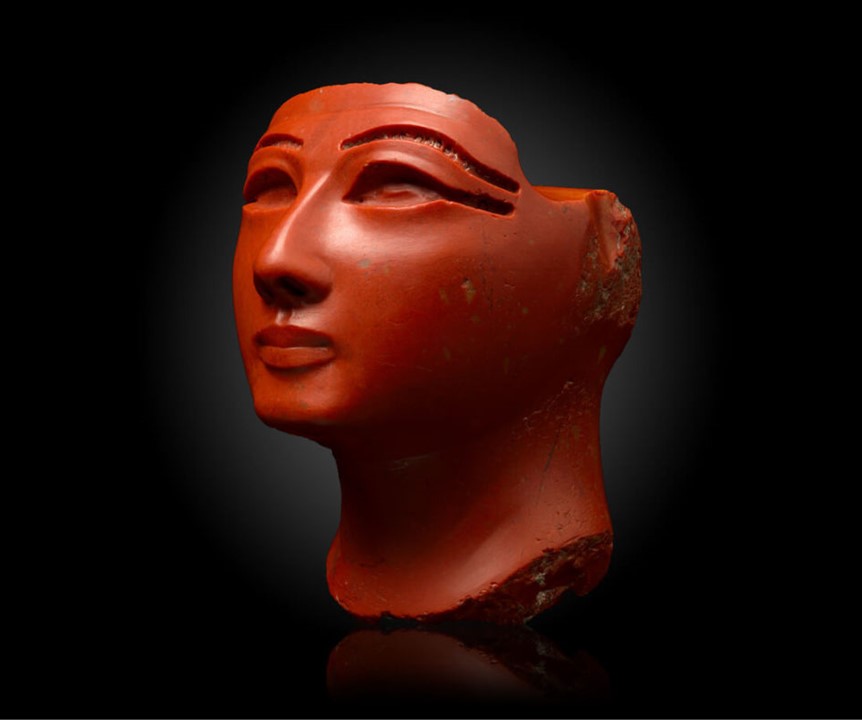
Queen Tiye (probably), ca. 1353–1336 BC, New Kingdom, Amarna Period, Dynasty 18, Quartzite, 13.3x12.5x12.4 cm, the MET, NY, USA

The Formidable Queen Tiye

Queen Tiye (probably), ca. 1353–1336 BC, New Kingdom, Amarna Period, Dynasty 18, Quartzite, 13.3x12.5x12.4 cm, the MET, NY, USA
Queen Tiye (probably), ca. 1353–1336 BC, New Kingdom, Amarna Period, Dynasty 18, Quartzite, 13.3×12.5×12.4 cm, the MET, NY, USA
https://www.metmuseum.org/art/collection/search/544693?searchField=All&sortBy=Relevance&high=on&ao=on&showOnly=openAccess&ft=*&offset=0&rpp=80&pos=61

The long-lost mummy of The Formidable Queen Tiye has been found. Wife of Amenhotep III, mother of Akhenaten, and grandmother of Tutankhamun (?), she has been lurking undetected, virtually under the noses of the Egyptologists, for more than 75 years until Professors Edward P Wente of the Oriental Institute and James R. Harris of the University of Michigan made their spectacular discovery.

The road to the discovery really began in 1898 when the French archaeologist V. Loret came upon three nameless bodies in a side chamber of Amenhotep II’s tomb in the Valley of the Kings. One of these was of a middle-aged woman. Despite the passage of thousands of years her well-preserved face still wore a striking, haughty look, and her head was covered with long, curly, brown hair, that lent a certain sensuality to her face. But there was no clue to the identity of the woman.

Tutankhamun’s tomb was discovered in 1922. In that tomb, in one of a series of miniature coffins, was a lock of Queen Tiye’s hair, deposited as an affectionate memento to accompany the young king on his journey into the beyond. The connection between these two discoveries was overlooked until very recently when Professors Wente and Harris began to prepare a book on the royal mummies of ancient Egypt. While grappling with the problem of the unidentified woman, the idea occurred to them that she might be Queen Tiye. How could they be sure? The lock of hair buried with Tut came to mind, and scientific tests comparing the lock and the mummy’s hair proved beyond doubt that the two belonged to the same person. Queen Tiye was found – and through a discovery of a refreshing degree of certainty. file:///C:/Users/aspil/OneDrive/Blog/Egypt/Queen%20Tiye%20Found.pdf

I love rereading the October 1976 article on the discovery of Tiye’s mummy in the Oriental Institute’s News & Notes (No. 30). Even more so today, as I prepare the presentation of one of my favourite sculptural portraits of Queen Tiye exhibited in New York, at the Metropolitan Museum of Art. https://oi.uchicago.edu/sites/oi.uchicago.edu/files/uploads/shared/docs/nn30.pdf

Colossal statue of Amenhotep III and Tiye with three of their daughters from Medinet Habu in Western Thebes, 1360 BC, limestone, 7 x 4,4 m, Egyptian Museum in Cairo, Egypt
https://joyofmuseums.com/museums/africa-museums/egypt-museums/cairo-museums/egyptian-museum/statue-of-amenhotep-iii-and-tiye/

When I think of Queen Tiye, I think of Egypt’s golden age, a successful Pharaoh of the 18th Dynasty, Amenhotep III (1391–1353 or 1388–1351 BC), a sizeable and prosperous empire, great wealth from Nubia and the Levant, and a new era of monument building and artistic expression. I also think of a formidable lady whose influence on the Pharaoh grew stronger over the years. It is interesting how in official statues of the royal couple, she and Amenhotep are the same height, symbolizing a relationship of equals.https://www.nationalgeographic.com/history/history-magazine/article/king-tut-grandparents-tiye-amenhotep-egypt-royal-couple

Queen Tiye (probably), ca. 1353–1336 BC, New Kingdom, Amarna Period, Dynasty 18, Quartzite, 13.3x12.5x12.4 cm, the MET, NY, USA
Queen Tiye (probably), ca. 1353–1336 BC, New Kingdom, Amarna Period, Dynasty 18, Quartzite, 13.3×12.5×12.4 cm, the MET, NY, USA
https://www.metmuseum.org/art/collection/search/544693?searchField=All&sortBy=Relevance&high=on&ao=on&showOnly=openAccess&ft=*&offset=0&rpp=80&pos=61

The quartzite head of Queen Tiye in the Metropolitan Museum, in New York, dates from the time of Akhenaten’s reign and it seems to be a statue commemorating the Pharaoh’s (Akhenaten’s) royal family in the new “Amarna” style. The sensitive modeling of the face is typical of the workshop of the sculptor Thutmose at Tell el-Amarna and the existence of gypsum plaster casts excavated in Thutmose’s studio suggests that this portrait may have been part of a group statue depicting Akhenaten with his parents, Tiye, and Amenhotep III. The New York portrait shows an imperious, authoritative, and clever woman realistically rendered yet respectful to her maturity. Tiye’s life is an intriguing chapter in Egyptian history, and the MET’s portrait, scared and broken, intrigues me as well… https://www.metmuseum.org/art/collection/search/544693?searchField=All&sortBy=Relevance&high=on&ao=on&showOnly=openAccess&ft=*&offset=0&rpp=80&pos=61

For a Student Activity on The Formidable Queen Tiye Post, please… Click HERE!